Emergency Works & Stabilisation
The first construction response after the storm, flood or blast — shoring what still stands, demolishing what cannot, keeping the weather out and the utilities alive — under emergency powers and blue-light coordination.
Last updated 2026-07-28 by the BuildPedia Editorial Team.
What is Emergency Works & Stabilisation?
Emergency works begin when the disaster stops moving and the buildings are still deciding whether to fall down. The first construction task is not rebuilding — it is stabilisation: making damaged structures safe enough that rescue can finish, the public can be kept out, and assessors can get close enough to decide what happens next. The toolkit is the oldest in temporary works: raking shores leaning against a bulging wall, flying shores spanning between buildings across a void, dead shores carrying a compromised beam from below — alongside the modern kit of rapid-deployment proprietary propping systems, acrow-style adjustable props with hydraulic rams, and needle beams threaded through walls. Every shore is an engineered member with a load path to something sound, because a prop resting on a collapsing floor is theatre, not support.
The legal framework moves as fast as the plant. In the UK, dangerous structures are dealt with under the Building Act 1984 — section 77 lets the local authority require the owner to make safe, and section 78 lets the authority act itself in an emergency and recover the cost — with building control's dangerous structures engineers on call around the clock; demolition under emergency powers follows the same urgency, justified by imminent risk rather than the usual notice periods. The response runs on multi-agency doctrine — JESIP principles, with the fire and rescue service usually holding the inner cordon while life risk exists, and contractors working inside someone else's incident command. CDM 2015 still applies, adapted to the circumstances: the paperwork is proportionate, the competence is not negotiable, and the structure is assumed guilty until a competent person proves it innocent.
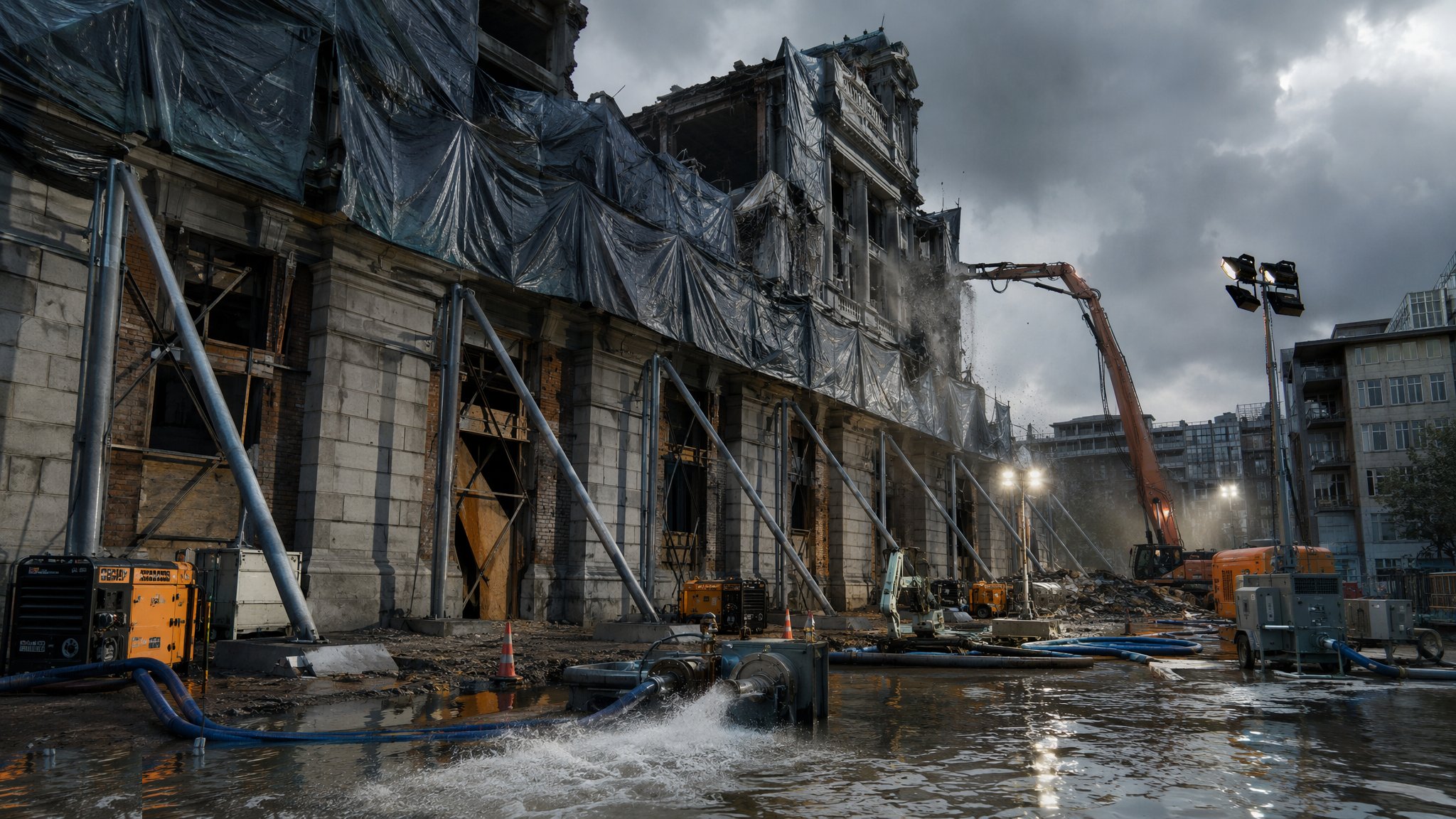
Then comes the unglamorous second act: flood recovery and keeping services alive. Flood works are pumping, mucking out and drying — water out, silt and contaminated debris out, saturated plasterboard and insulation stripped to a cut line, then weeks of managed drying with dehumidifiers and heat while moisture meters, not optimism, decide when reinstatement can start. In parallel, the utility restoration crews rebuild the lifelines: temporary generators and bowsers, over-pumped sewers, re-routed water and power, working to the utility companies' and authorities' priorities. None of it is permanent work — but done badly, it is the difference between a district that recovers in months and one that moulders for years.
When and why is Emergency Works & Stabilisation used?
Emergency works are triggered by events, not programmes: storm and flood damage, fire-damaged structures, vehicle impact, explosion, subsidence and collapse, or a dangerous structure reported by a frightened neighbour at midnight. They matter because they sit at the junction of rescue and recovery: the shoring holds the building long enough for the search teams and the loss adjusters; the emergency demolition removes what would otherwise fall on the public; the temporary weathering stops rain finishing what the fire started; and the utility work keeps the unaffected majority functioning. The contractor's position is unusual — working under emergency powers, inside incident cordons, often without a priced contract, on structures whose behaviour is unknown — and the discipline that makes it survivable is boring consistency: competent structural assessment before entry, engineered temporary works before load, cordons before courage, and records of everything, because the insurance, legal and public inquiries that follow a disaster read every note the site team wrote at 3 a.m.
Types of Emergency Works & Stabilisation
Shoring and propping of damaged structures
Raking, flying and dead shores in timber or steel, proprietary rapid-deployment prop systems, and needle-beam installations carrying compromised elements from sound bearings. Designed or at least verified by a structural engineer on site — the load path to something that can take it is the whole game.
Temporary weathering
Tarpaulin and membrane covers, sheeted temporary roofs on scaffold, boarded openings and temporary rainwater disposal keeping the weather out of a stripped or holed building. Wind loading on a big tarpaulin is a structural problem in itself — the sheet that blows off at night lands three streets away with your scaffold attached.
Emergency demolition
Controlled removal of elements that cannot be made safe — high-reach excavators nibbling a facade back to a stable line, hand demolition where the structure is too fragile for machines, wire-sawing and lifting out of sections under engineer direction. Justified by imminent risk, documented to the hilt, and sequenced so the building never gets more dangerous as it gets smaller.
Flood recovery and drying
Pumping, silt and debris removal, strip-out of saturated finishes to a cut line, sanitisation, and managed drying with dehumidifiers and heat under moisture measurement. The patient end of emergency works: weeks of plant hire and readings, where reinstating too early guarantees mould behind every new wall.
Utility and lifeline restoration
Temporary power from generators, water from bowsers and tanker-fed standpipes, over-pumping of sewers, temporary telecoms, and the re-routing of damaged networks. Run with the utility companies and the authority's priorities — hospitals and pumping stations first, everything else by triage.
Emergency Works & Stabilisation: step by step
Step 1: Integrate with the incident: command, cordons and information
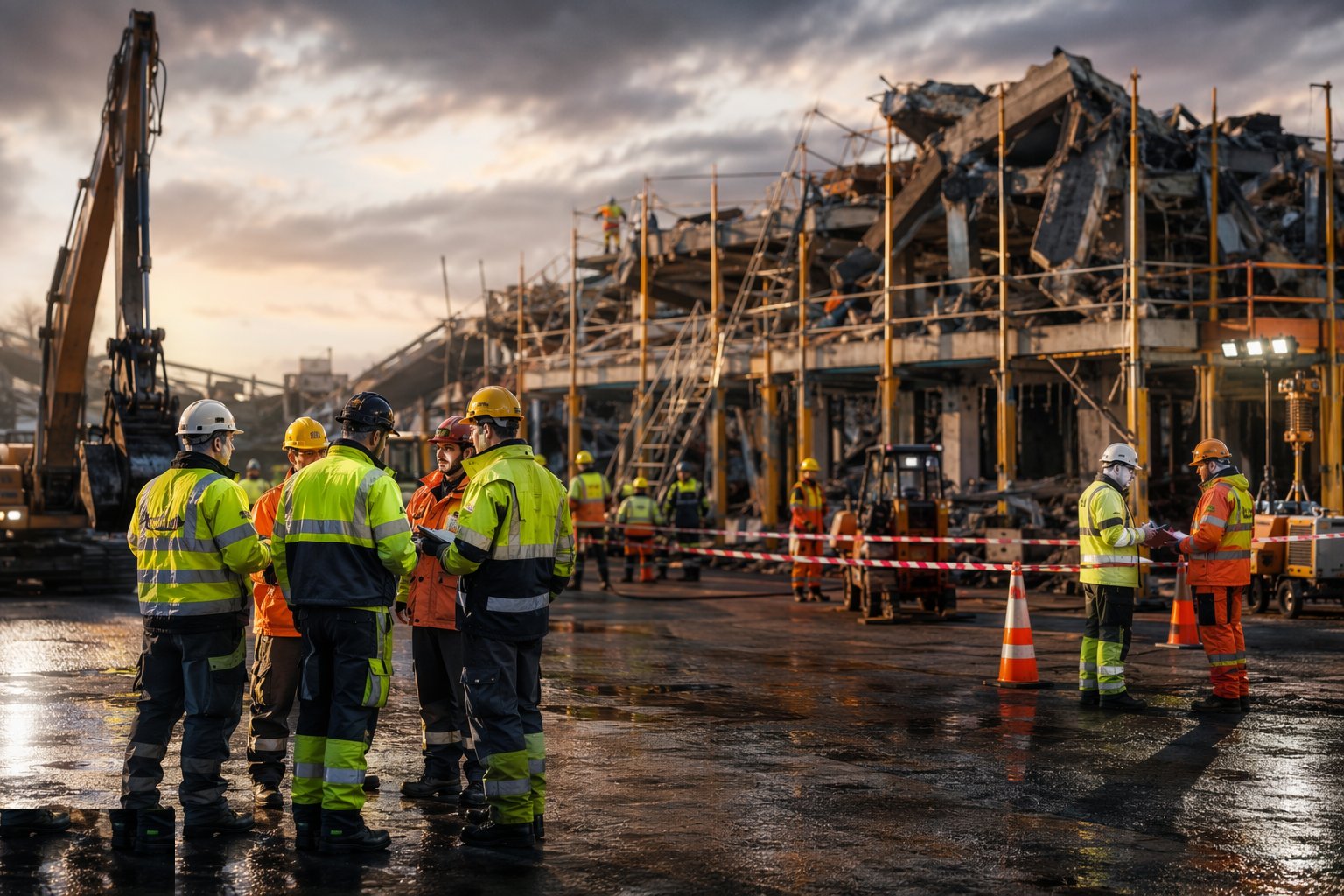
The contractor arrives inside somebody else's incident. The first job is to plug into the command structure — the fire and rescue service's incident commander while life risk exists, the local authority and police beyond it — under JESIP working: a shared picture of what is known, what is assumed, and what nobody knows yet. Cordons are respected and then taken over: the inner cordon is the structure's collapse zone, and nobody crosses it until the assessment says so. The contractor's information flow starts immediately: drawings if they exist, the building's history, the utility layouts, and a decision log that will later explain to insurers, coroners or inquiries why each action was taken with what was known at the time.
Step 2: Make the area safe: services, hazards and access
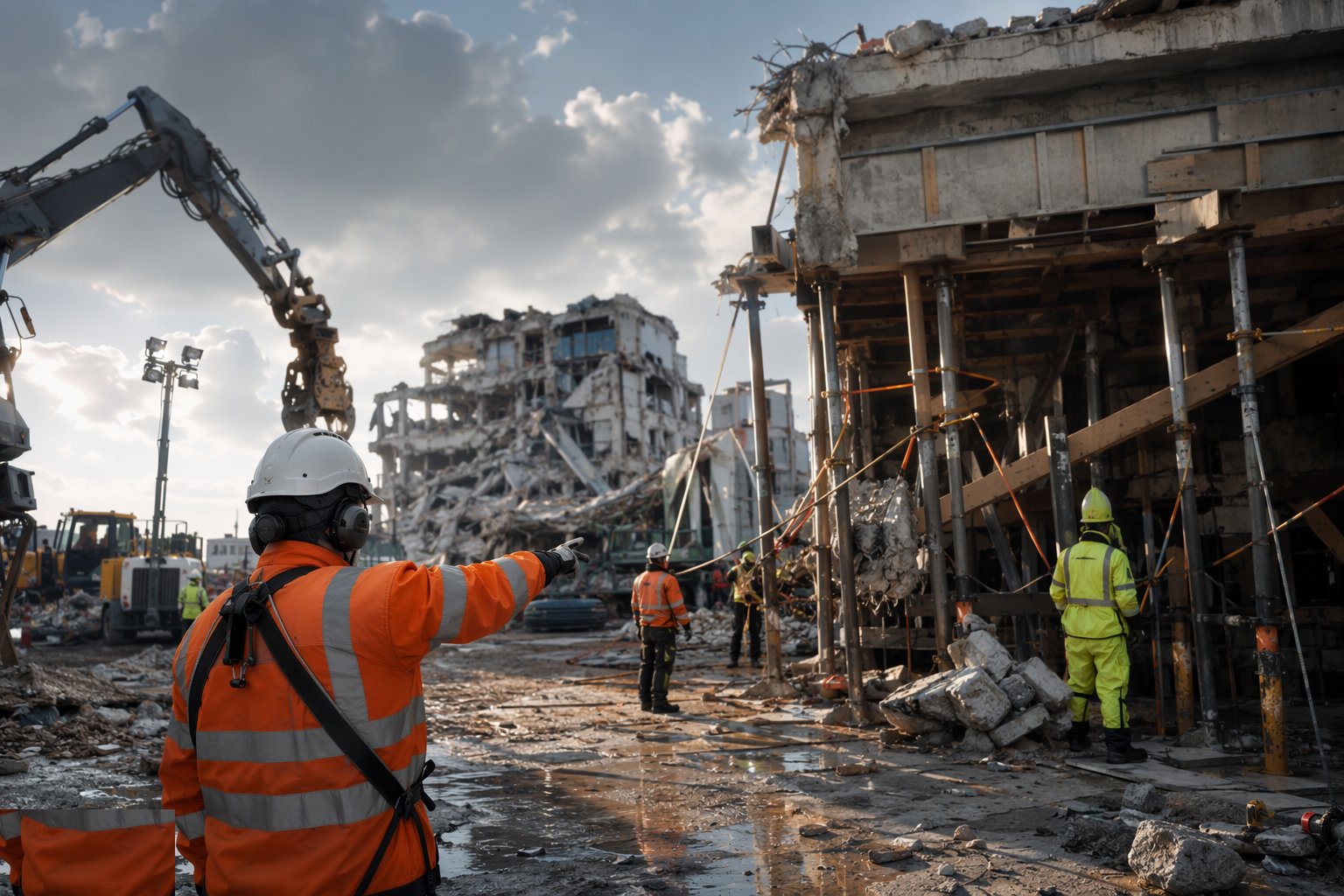
Before a shore is cut, the scene is made survivable: gas, power and water isolated with the utilities and proven dead — a severed gas main inside a collapsed building is a bomb with a postcode — and the hazards of a damaged building surveyed: asbestos in fire-damaged structures, fuel and chemical stores, unstable chimneys, hanging cladding, glass and sharps everywhere. Access routes and working areas are established outside the collapse and fall zones, welfare and lighting go in for what may be weeks of work, and the site is registered as a construction site with emergency-speed proportionate documentation — because the second casualty at a disaster is usually a rescuer or a worker, and the system exists to prevent exactly that.
Step 3: Assess and triage the structures
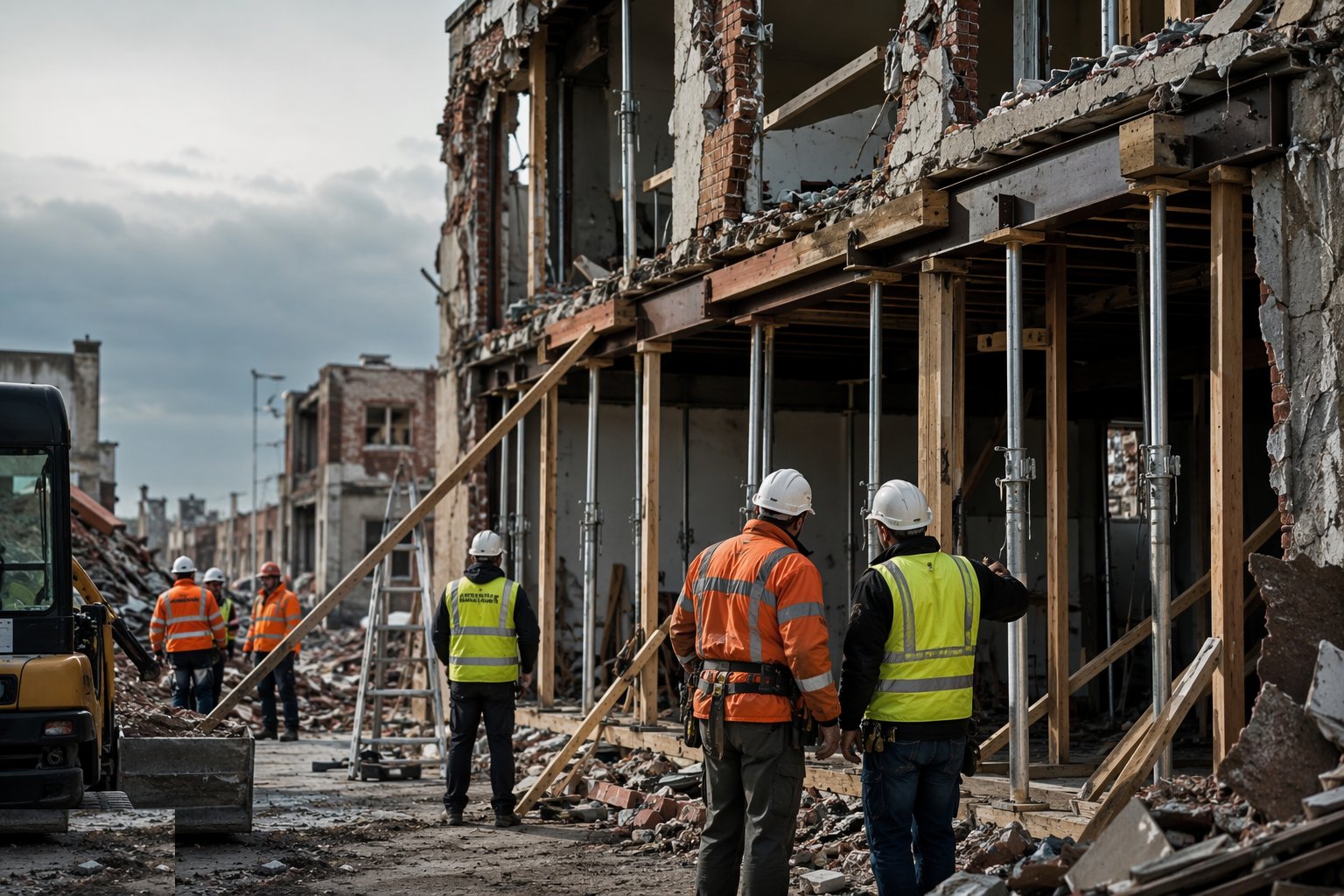
A structural engineer — the local authority's dangerous structures engineer, the rescue team's structural adviser, or the contractor's own — assesses each structure and triages it: safe to enter and work, make safe with shoring before entry, or too dangerous to approach except by machine. The assessment is visual first, from outside the fall zone, then progressively closer as the structure is proven; movement monitoring — tell-tales, laser targets, survey points — watches anything that is left standing under suspicion. The triage is recorded and signed, and it is refreshed as the works change the building, because removing a collapsed bay can unload the wall that was quietly holding the next bay up.
Step 4: Install shoring, propping and temporary support
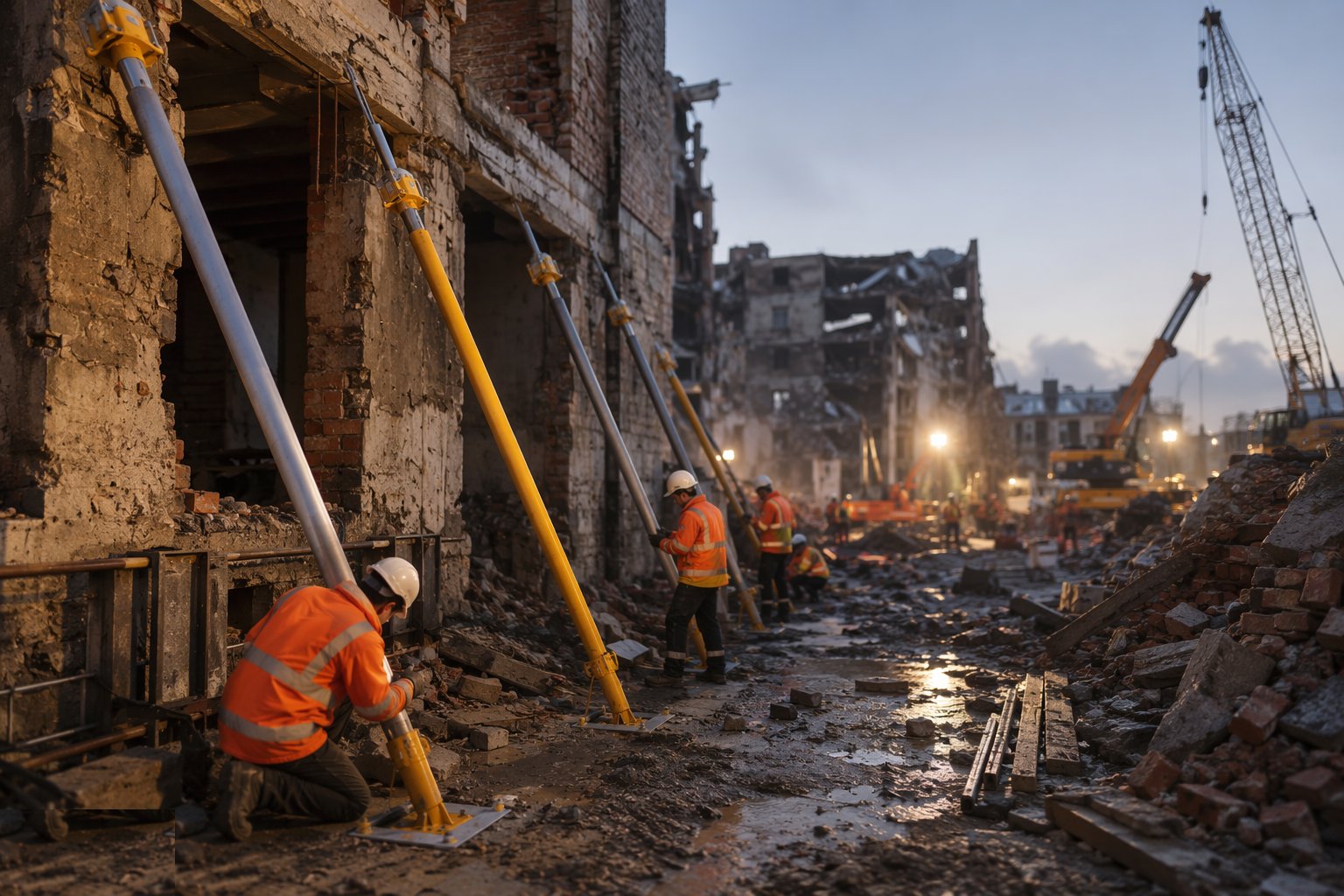
Shoring goes in on the engineer's scheme: raking shores pitched against the wall at the angles and sole-plate bearings the design sets, dead shores under compromised beams down to foundations or proven slabs, flying shores spanning to the neighbouring building where it can take the thrust, and proprietary rapid props where speed matters more than elegance. Every shore is founded on something sound — sole plates on bearing, never on debris or a floor of unknown capacity — tightened and wedged to take load, not just to look upright, and inspected on a regime afterwards, because shores creep, timber compresses and buildings continue to move. The installation is recorded member by member with photographs; in the inquiry that may follow, the shoring file is the evidence that the stabilisation was engineering and not guesswork.
Step 5: Keep the weather out and manage the water
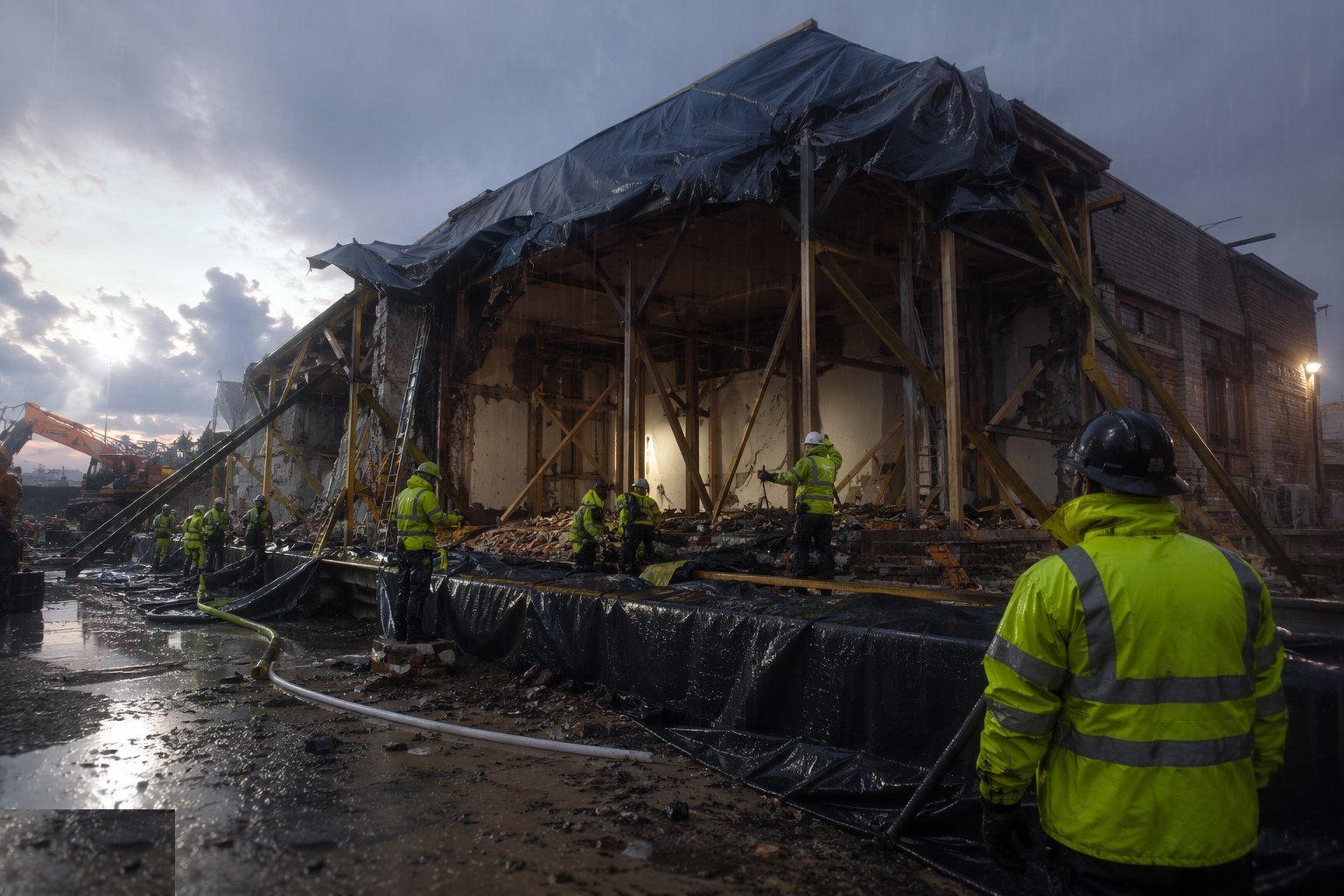
A building opened by disaster dies by rain if you let it. Temporary weathering goes on as soon as the structure allows: tarpaulins and membranes battened and ballasted against wind uplift, sheeted temporary roofs on independent scaffold that does not lean on the wounded structure, openings boarded, and temporary rainwater disposal rigged so water is thrown clear of foundations and neighbouring property. On flooded sites the water management is the works: pumping out with attention to differential pressures on walls and floors — empty a saturated basement too fast and the ground water outside pushes it in — then silt and debris out, and the drying regime started with its moisture baselines recorded.
Step 6: Demolish what cannot stand, under engineer control
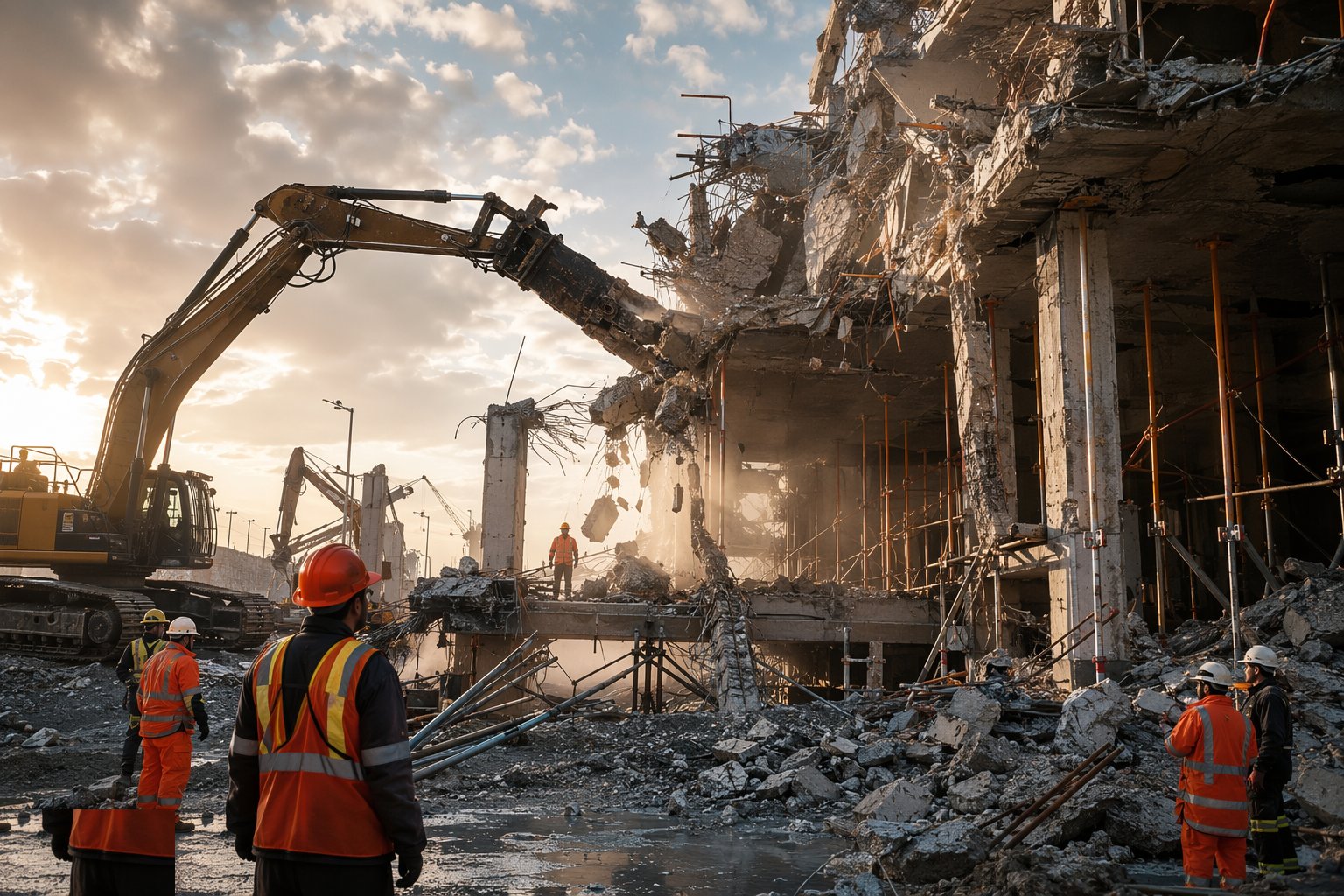
Where elements are beyond making safe, they are removed on the engineer's sequence: high-reach machines working from outside the fall zone, pulling the structure down in an order that keeps every stage stable, or hand demolition by roped or protected crews where the fragility demands it. Debris is managed as evidence and as waste: anything the investigators need is preserved and logged, hazardous materials — asbestos debris, fuel-contaminated arisings — are segregated and consigned lawfully even in the emergency, and the remaining structure is left in a verified stable condition with its cordon. Emergency demolition is demolition with the planning stages compressed into hours; the competence and the sequencing are not compressed at all.
Step 7: Restore the lifelines and hand over to recovery
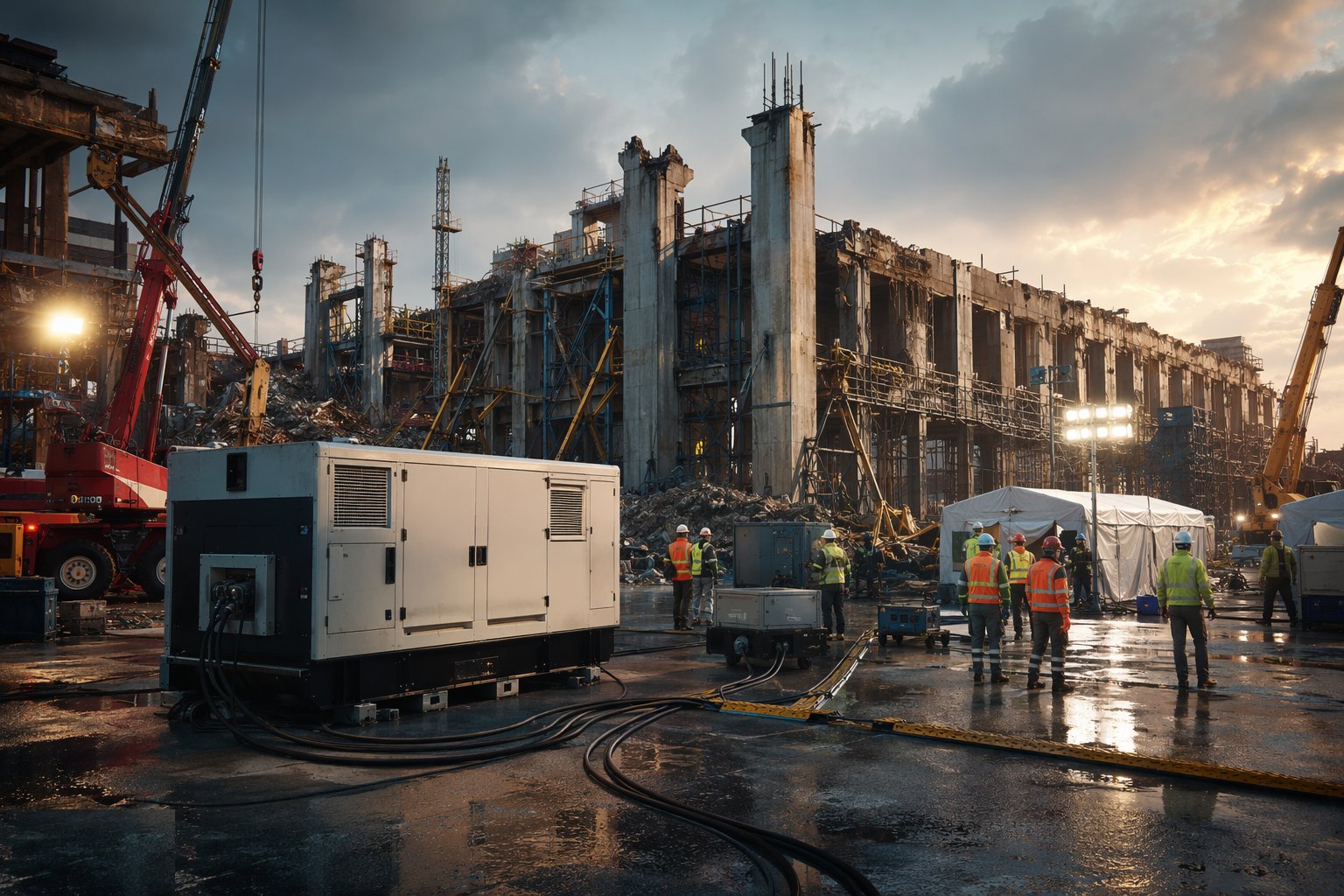
With the structures stable, the lifelines come back: temporary power generation with proper earthing and distribution, water by bowser and standpipe, sewerage over-pumped around the damage, roads cleared and reopened under traffic management, all prioritised with the authority and the utilities. Then the site is handed from emergency to recovery: the dangerous structure notices discharged or transferred to the owner's permanent scheme, monitoring regimes handed over with their records, temporary works documented for the permanent designers, and the site file — decisions, assessments, shoring records, photographs — compiled while the memory is fresh. The contractor who did the 3 a.m. shoring is often best placed to do the rebuild, and the file he hands over is his best tender.
Plant and equipment
- Rapid-deployment proprietary propping systems with hydraulic rams
- Shoring timber, steel soldiers, needle beams, sole plates and wedges
- High-reach demolition excavators and long-reach machines for stand-off demolition
- Mobile cranes for lifting out unstable sections under engineer direction
- Submersible and diesel pumps, over-pumping sets and settlement tanks
- Generators, distribution and lighting towers; bowsers and tankers for water
- Dehumidifiers, heat-drying equipment and moisture measurement kit
- Tarpaulins, sheeting, scaffold and independent temporary roof systems
Quality control checks
- Structural assessment and triage records signed per building, refreshed as works progress
- Shoring installations recorded member by member: scheme, bearings, tightening and inspection regime
- Movement monitoring data — tell-tales, targets and survey points — logged and trended
- Drying records: moisture baselines and progress readings per area before any reinstatement
- Hazardous waste consigned lawfully with transfer documentation even under emergency conditions
- Full decision log and photographic record maintained from arrival to handover
Safety considerations
- Collapse and fall zones defined and cordoned; entry only on the engineer's assessment, never on enthusiasm
- Services proven dead with the utilities before work — gas in a damaged structure is the killer nobody sees
- Asbestos and contamination protocols on fire- and flood-damaged buildings: survey, RPE and decontamination
- Shoring installed under exclusion: nobody in the unsupported zone until the support is in and verified
- Working inside incident command: briefings, roll calls and accountability for every person inside the cordon
- Fatigue management on emergency rotas — exhausted crews and unstable buildings are a combination with a body count
Common defects
- Props founded on debris, debris-strewn slabs or unknown floors — support that shares the collapse it was meant to stop
- Shores installed upright but unloaded — never wedged or tightened, decoration rather than structure
- Basements pumped dry too fast — external water pressure floating or cracking the floor slab
- Tarpaulins and sheeted roofs under-designed for wind — the weathering departing in the next gale, scaffold attached
- Buildings re-entered on stale assessments — the structure moved overnight and nobody re-walked the triage
- Reinstatement over undried structure — mould and rot sealed in behind new finishes, claim by claim
Best suited for
- Post-storm, post-flood and post-fire stabilisation where structures must be made safe before assessment
- Dangerous structures under Building Act 1984 ss.77/78 powers and local authority direction
- Emergency demolition of elements beyond making safe
- Flood recovery, drying and utility restoration ahead of permanent reinstatement
How long does Emergency Works & Stabilisation take?
Typical duration: Stabilisation runs in hours to days per structure; emergency demolition days to weeks; flood drying weeks to months per building — a district-scale event keeps emergency crews deployed for one to six months before recovery works take over..