Utility Diversions & Connections
Moving other people's live services out of the way of the development — trial holes, statutory notices, diversion trenches and live-to-live connections — the unglamorous enabling works that decide when everything else can start.
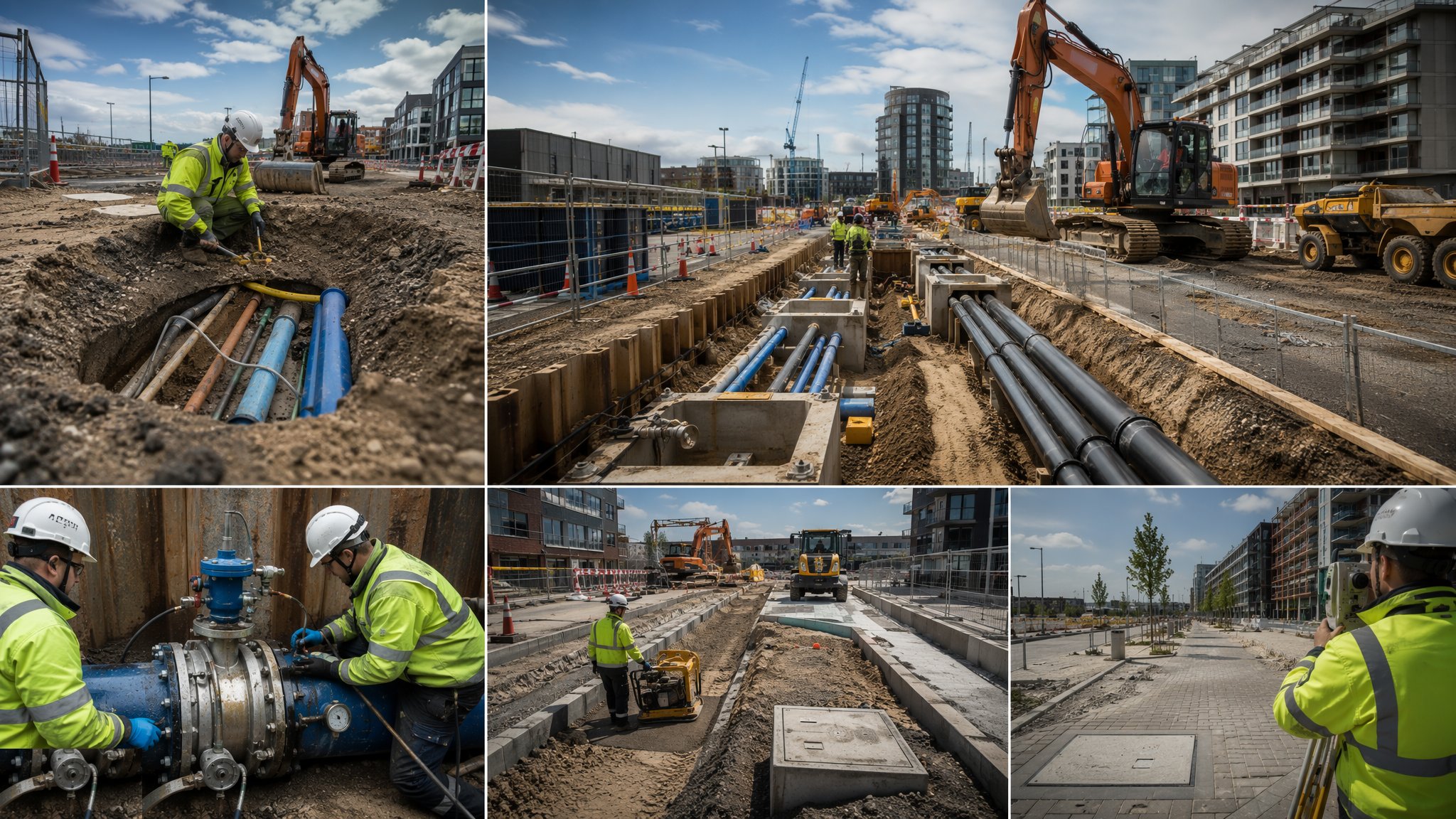
Last updated 2026-07-28 by the BuildPedia Editorial Team.
What is Utility Diversions & Connections?
Almost every development starts by discovering what is already buried in its footprint: HV and LV cables, gas mains and services, water mains, telecom ducts and fibre, sewers, and the occasional undocumented surprise that no record admits to. Utility diversion works move, protect or lower that plant so the scheme can be built, and new connections bring the development its own supplies. It is multi-party by nature: the developer's contractor digs, but the statutory undertakers — the DNOs, gas transporters, water companies and telecom operators — own the plant, set the standards, approve the designs and usually make the live connections themselves. The programme is governed as much by their notice periods and outage windows as by anything that happens with a bucket.
The process is paperwork-sharpened steel. In the UK the NRSWA apparatus enquiry process (the C2/C3 notice stages) exchanges records and diversion requirements before design freezes; trial holes — increasingly by vacuum excavation, which can expose a live cable without touching it — prove positions and depths the records got wrong. Diversion construction then follows each undertaker's specification: bedding and surround materials, depths, marker tape, duct formations, joint bay sizes, and the all-important clearances between services. Gas diversions run under the transporter's procedures with live working restricted to their own gangs; water mains get pressure-tested and chlorinated before adoption; cables are jointed by the DNO's jointers in bays the developer's contractor has dug and kept dry.
The climax of every diversion is the live-to-live connection: the switch or cut-over where customers or supplies transfer from the old main to the new. These are planned like military operations — outage windows agreed months ahead, affected parties notified, standby arrangements made, method statements countersigned by the undertaker — and executed in hours, often at night or weekends. In the UAE the equivalent runs through the authorities' NOC regime: DEWA for power and water, Etisalat (e&) and du for telecoms, the municipality and civil defence for permits and inspections, with diversion approvals secured before the enabling works programme is credible. Either side of the world, the reinstatement is signed off to the highway or landowner standard, because a diversion trench that sinks across someone's road is a debt that comes due.
When and why is Utility Diversions & Connections used?
Diversions happen because the proposed works and the existing plant cannot occupy the same ground — a basement over a water main, a foundation line through a gas service corridor, a road realignment across a duct run. They are programmed first in the enabling works because everything else waits on them, and they are procured early because the undertakers' design approvals, materials and outage windows run on timescales developers consistently underestimate. The alternatives considered are diversion, protection in place (slab or bridging over the plant, with the undertaker's consent) or designing around it — the decision balancing cost, programme and the undertaker's non-negotiable standards for access and cover. Treat diversion liaison as an afterthought and the main works will stand idle while the paperwork catches up; treat live connections casually and the consequences are measured in more than money.
Types of Utility Diversions & Connections
Full diversion to a new route
The plant is abandoned along its existing line and relayed clear of the works, then transferred live-to-live. The cleanest answer where development covers the corridor; longest lead time, and every crossing of other services on the new route is a fresh trial hole.
Lowering or sleeving in place
The main stays on its line but is lowered to clear a reduced formation, or protected under a bridging slab or sleeve where loads pass over. Cheaper and faster than a full diversion, but only ever by agreement with the undertaker — their cover and access standards rule.
Service disconnections and abandonments
Redundant supplies to demolished buildings cut back and capped: gas services purged and capped at the main, cables de-energised and cut back, water services shut at the ferrule. Simple on paper, critical in practice — a "dead" service that was never properly disconnected is an excavation hazard with a pulse.
New connections and contestable works
The development's own supplies: new water connections, gas services, DNO or ICP-installed cables, and telecom ducts. In the UK, contestable works let accredited contractors build adoptable networks the undertaker then adopts — the developer's programme wins, the undertaker's standards still apply.
Utility Diversions & Connections: step by step
Step 1: Enquiries, records and the diversion design freeze
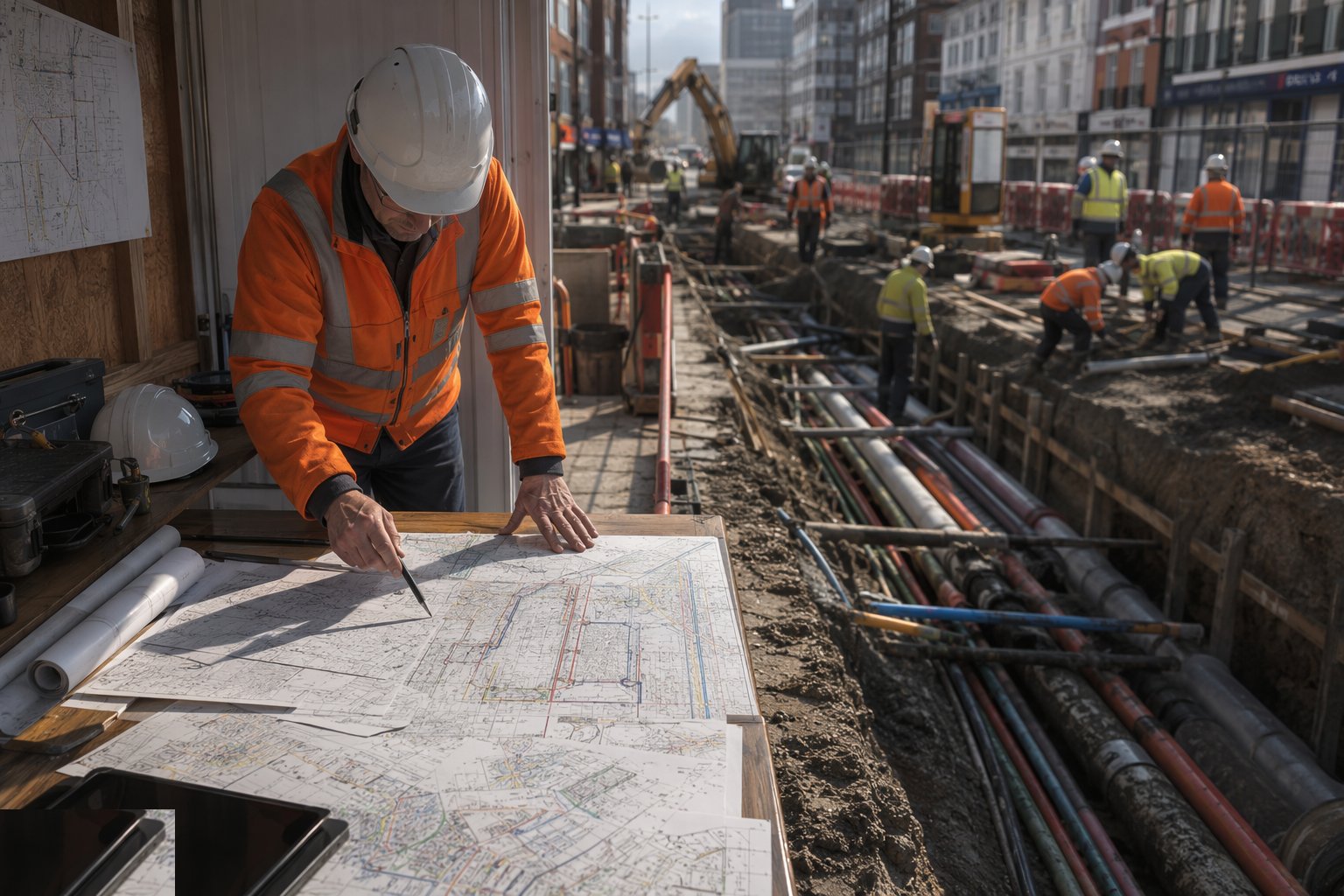
The work opens with desk-bound diligence: apparatus enquiries to every undertaker with an interest, records plotted onto a single composite drawing, and conflicts with the proposed works identified line by line. C2/C3-stage exchanges (or the UAE NOC equivalents with DEWA, the telecom operators and the municipality) establish what must move, what can be protected, and what each undertaker demands — their estimate, their timescale, their connection conditions. The diversion design is then frozen with the undertakers' approvals, because a late design change re-opens every estimate and notice period. This stage feels slow and costs little; skipping it is the most expensive saving a developer can make.
Step 2: Trial holes and on-site verification
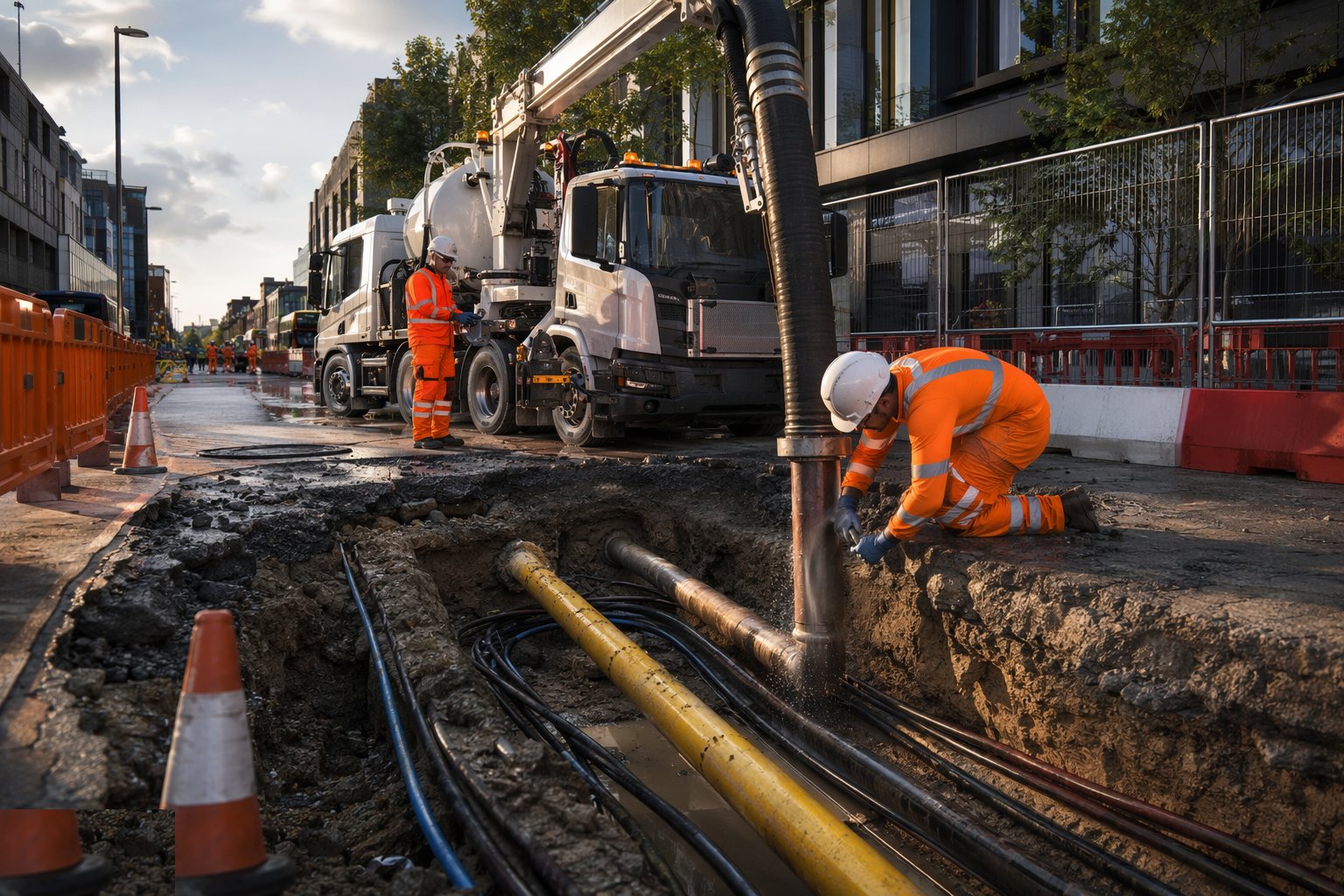
Drawings lie; trial holes tell the truth. Positions and depths of critical plant are proven physically before diversion construction — vacuum excavation where the plant is live and delicate, hand digging elsewhere — and the results surveyed and fed back to the design, because a gas main 300 mm shallower than recorded can move an entire diversion alignment. The proven positions are marked, logged and issued to every gang working nearby, feeding the permit-to-dig regime that governs all later excavation. In ground shared by six utilities, the trial hole log becomes the most-thumbed document on site, and the vacuum excavator the busiest machine.
Step 3: Construct the diversion route
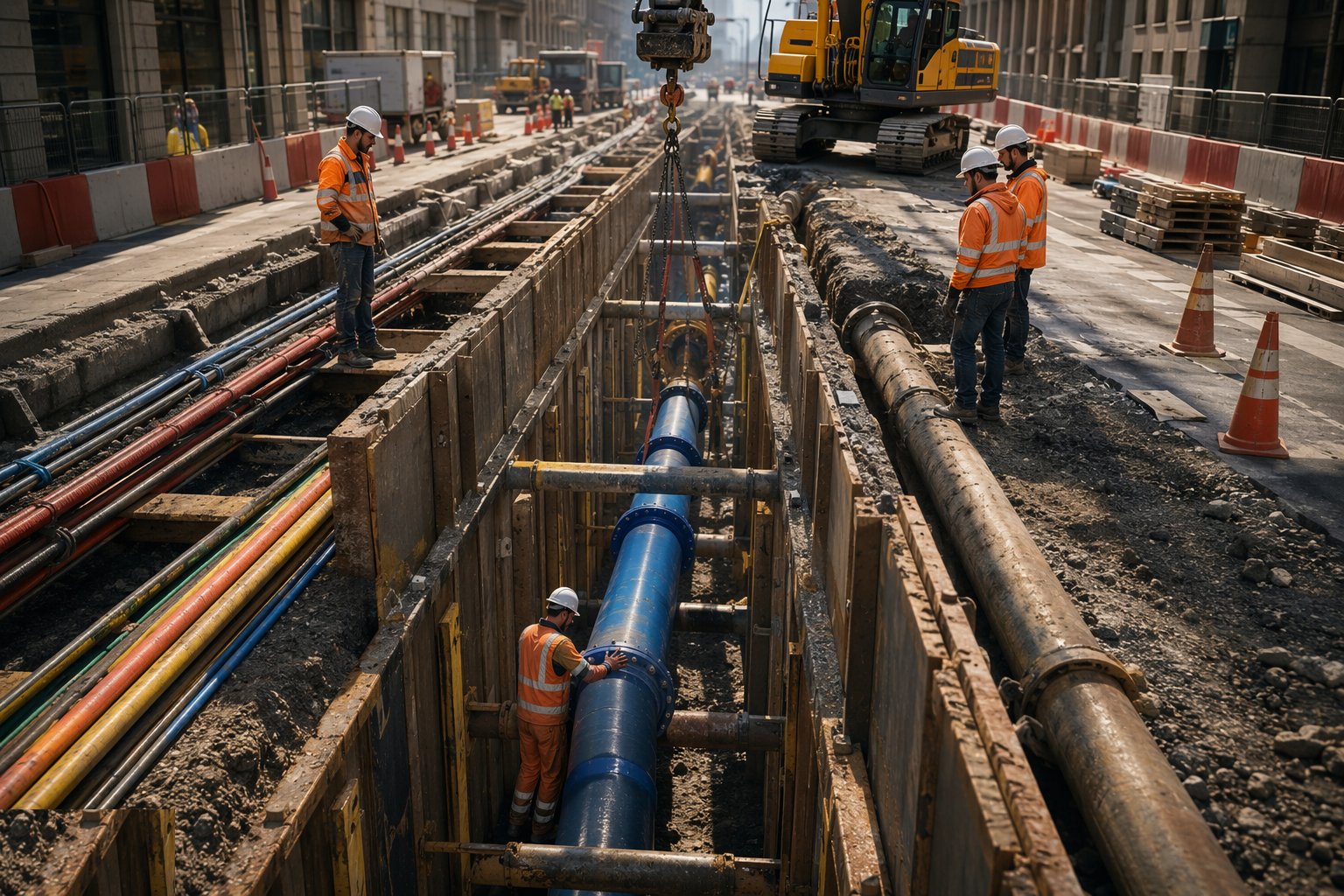
The new route is built to each undertaker's specification: trench excavated to the prescribed depth and width, formation prepared, bedding laid, and the new main, cable or duct run installed with its surround, marker tape and protection — ducts for cable and fibre pulled or rodded and proven, joint bays excavated oversized and kept clean and dry for the jointers, valve chambers and hydrant points built where the water design needs them. Clearances to other services are maintained per the national joint utilities guidance, and every crossing is exposed and protected by hand. Inspection hold points are honoured: the undertaker inspects their trench before backfill, and burying plant without their sign-off risks being told to dig it up again.
Step 4: Test and prepare for transfer
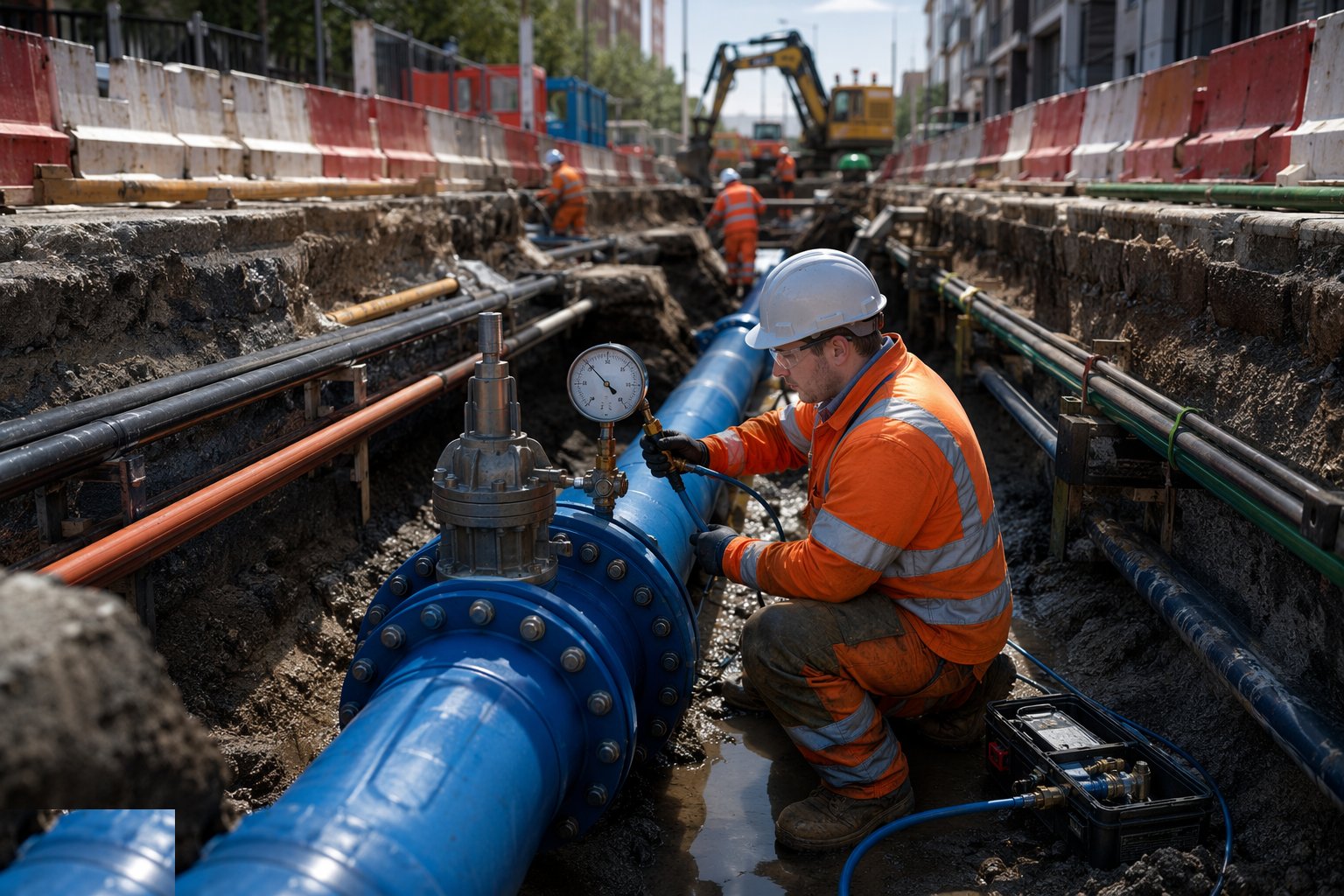
Before anything goes live, the new asset is proven: water mains pressure-tested and chlorinated with samples passed before adoption, gas mains tested to the transporter's procedure, ducts mandrel-proven and cables tested by the DNO. Records are compiled — as-laid survey, test certificates, material traceability — because the undertaker adopts the asset on the strength of this file. The connection method statement is agreed in detail: the sequence, the isolation points, the standby resources, the contingency for the joint that will not pull apart at midnight. Everyone who will stand in the trench during the transfer knows the plan before the window opens.
Step 5: Execute live-to-live connections
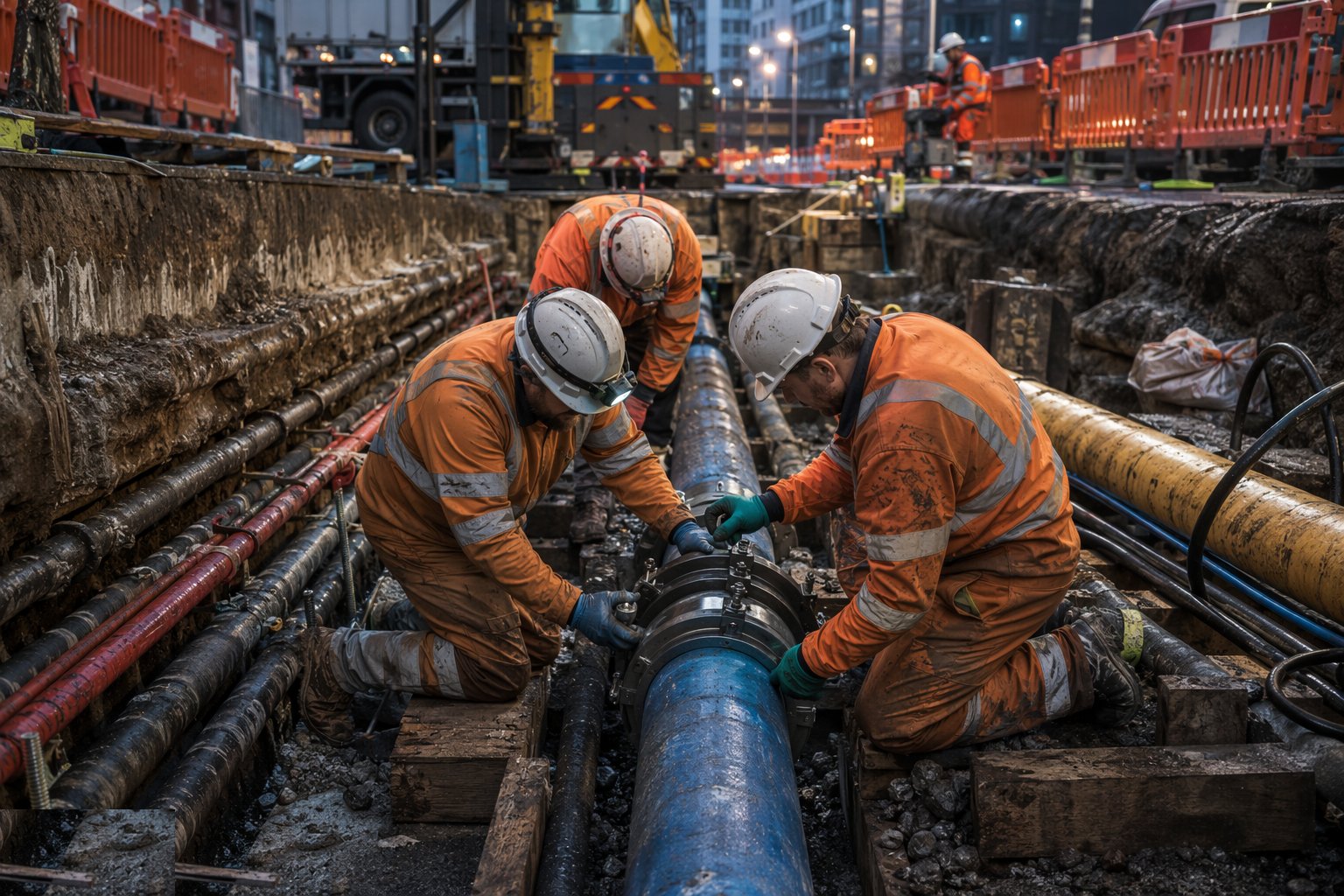
The transfer runs inside its agreed window: the undertaker's gangs make the live connections — gas transferred by their procedures with flow-stopping and purging, cables switched and jointed by their jointers, water cut over at the valves with customers notified — while the developer's contractor supports with excavation, backfill and traffic management. Standby plant and materials wait on site for the contingency that has a habit of arriving. Once the new main carries the load, the old one is formally abandoned: purged, capped, cut back and recorded as dead, with the abandonment proven, not assumed. The window closes with the undertaker's completion sign-off, and only then does the footprint belong to the development.
Step 6: Reinstate, record and close out

The final act is reinstatement and records: trenches backfilled in compacted layers and surfaced to the SROH or landowner standard, joint bays reinstated and chambers' ironwork set true, and the guarantee period logged. The as-built bundle — composite drawings showing new and abandoned routes, test and chlorination certificates, adoption agreements and the undertakers' completion certificates — is issued to the developer and, crucially, to the site's permit-to-dig system, because the main works contractor now excavates beside plant the diversion just created. The scheme's new connections are metered and energised per the connection agreements, and the enabling works can hand the footprint over: clear, proven and on record.
Plant and equipment
- Vacuum excavators for safe exposure of live plant
- Excavators, dumpers and trench support for diversion trenching
- Cable and duct proving equipment: rodders, mandrels, test sets
- Pressure test rigs and chlorination equipment for water mains
- Pumps and wellpoint sets for joint bay and trench dewatering
- Pipe-cutting, fusion-welding and jointing equipment (undertaker gangs on live works)
- Survey equipment for as-laid records; CAT/Genny and GPR for ongoing verification
- Chapter 8 traffic management for highway diversions
Quality control checks
- Trial hole log with surveyed positions and depths reconciled against the composite records drawing
- Undertaker inspection sign-offs at specified hold points before backfill
- Pressure test, chlorination and duct-proving certificates compiled per asset
- As-laid survey of new and abandoned routes, issued to undertakers and the site permit system
- Connection and abandonment certificates from each undertaker for every live-to-live transfer
- Reinstatement records held for the guarantee period
Safety considerations
- Service strikes: permits-to-dig, scans and hand/vacuum excavation near live plant — the fatal four of utility work
- Live gas working strictly by the transporter's authorised gangs; exclusion and monitoring around any gas escape
- Excavation support and access in deep trenches and joint bays, with confined-space procedures where they apply
- Night and weekend connection windows: fatigue management, lighting and supervision when the site runs out of hours
- Traffic management maintained through the works and reinstated safe at every shift end
- Treating every service as live until the undertaker's abandonment certificate says otherwise
Common defects
- Records trusted without trial holes, so the "diverted" main is found exactly where the basement pile line wants to be
- Undertaker hold points buried over without inspection, condemned to re-excavation at the developer's cost
- Chlorination or pressure test failures discovered after reinstatement, doubling the dig
- Abandoned services never properly capped or recorded, left live in the ground for the next contractor's bucket
- Joint bays flooded or contaminated before the jointers arrive, burning the carefully negotiated outage window
- Clearances to parallel services squeezed in the trench, breaching NJUG guidance and the undertaker's adoption conditions
Best suited for
- Enabling works ahead of basements, foundations and road realignments over existing plant
- Major infrastructure corridors where multiple utilities must move in sequence
- Developments using contestable works to control new-connection programmes
- Demolition sites requiring certified disconnections before strip-out
How long does Utility Diversions & Connections take?
Typical duration: Individual diversion trenches build in 2–6 weeks, but undertaker lead times dominate: allow 6–18 months from first enquiry to completed transfer for a multi-utility scheme, with outage windows often bookable only quarterly..