River Engineering & Watercourse Works
Reshaping and armouring watercourses — weirs and fish passes, re-sectioned channels, gabion and riprap banks — much of it built in or over live water behind temporary dams and overpumping, inside a consented season window.
Last updated 2026-07-28 by the BuildPedia Editorial Team.
What is River Engineering & Watercourse Works?
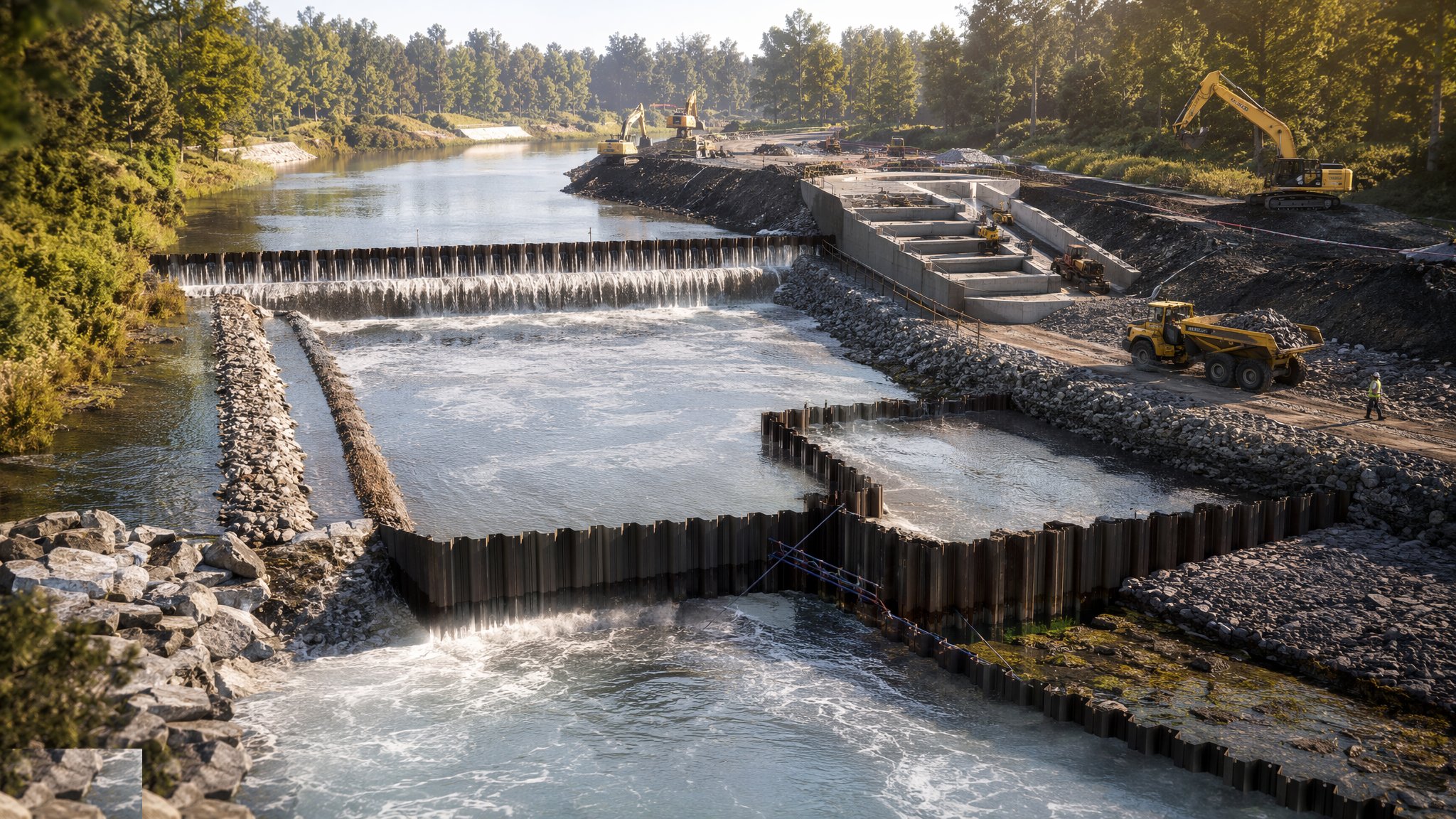
River engineering sits between civil engineering and ecology, and it answers to both. The structures are weirs and grade-control sills that hold bed levels, fish passes — pool-and-traverse, Larinier super-active baffle passes, rock ramps and eel passes — that let migratory fish past barriers the law says they must pass, re-sectioned and realigned channels that move capacity or restore a straightened river to something with pools and riffles, and bank protection that stops the river eating land it was never invited to take. All of it happens under flood risk activity permits or land drainage consents, in working windows fixed by fish spawning and migration, with water-quality conditions that make silt control a contractual obsession.
The defining skill is working dry in a wet place. The work front is isolated with temporary dams — sandbag and clay dams on small watercourses, water-filled barrier systems, framed cofferdams or sheet-pile cells on larger ones — and the flow is carried past the work by overpumping or a flume, sized not just for the average flow but for what the river might do this week. Before any dewatering, licensed fish rescue by electrofishing clears the reach; silt mats and settlement measures protect the water downstream; and the whole temporary works set-up is designed for the risk that the river rises mid-operation, because rivers do. Get the isolation wrong and the best case is a flooded excavation; the worst is a pollution incident with your name in the consent breach.
Bank protection splits into hard and soft. Hard systems — gabion baskets and reno mattresses to BS EN 10223, riprap rock armour sized and placed to resist the design velocity, sheet piles where the bank is also a wall — are placed on geotextile separation with a trenched and protected toe, because scour at the toe is how every bank protection scheme dies. Soft systems — pre-planted coir rolls, willow spiling, brushwood faggots and live staking — use vegetation as the engineering material, and they need the right season and a year of establishment before they earn their keep. The modern scheme mixes both: hard where the energy is, soft where it is not, and always with the bed and toe details done properly, because a river finds the gap in your armour faster than any inspector.
When and why is River Engineering & Watercourse Works used?
Watercourse works are commissioned for flood alleviation, for river restoration under Water Framework Directive objectives, for erosion protection at bridges and developments, and to fix barriers to fish migration that regulators now require to be passable. They matter because a watercourse is a live system that keeps score: armour a bank without protecting the toe and the river undermines it within a few floods; build a weir without a pass and the fishery — and the consent — fails; re-section a channel with the wrong geometry and it silts, scours or floods until it finds its own shape. The consented working window dominates the programme: fisheries restrictions can confine in-channel work to a few months a year, so the whole job is planned backwards from the window, and everything that can be prefabricated or pre-staged is, before the river lets you in.
Types of River Engineering & Watercourse Works
Weirs and grade-control structures
Fixed crest structures — concrete, rock or sheet-pile — that hold bed levels, control gradients and create head for intakes or gauging. Simple in elevation, demanding in construction: the crest level is hydraulically critical and the scour protection below is what keeps it standing.
Fish and eel passes
Pool-and-traverse passes, Larinier super-active baffle passes set into a channel, rock ramps that convert a barrier into a riffle, and bristle or studded-tile eel passes. Precision hydraulics at small scale — baffle positions and crest levels to the millimetre, or the fish vote with their fins.
Channel re-sectioning and realignment
Widening, deepening, re-profiling or moving the channel: two-stage channels with flood berms, re-meandered reaches with pools and riffles, and new cut channels tied smoothly back into the existing course. Earthworks with a hydraulic conscience — the shape you dig is the flow you get.
Rock bank protection — gabions and riprap
Gabion baskets and reno mattresses wired and filled to BS EN 10223, or riprap stone placed — not dumped — to a designed grading and thickness over geotextile. The standard answer to eroding banks, and only ever as good as its toe detail.
Green and bioengineered bank protection
Pre-planted coir rolls, willow spiling, brushwood and live staking that armour a bank with vegetation. Low-carbon, habitat-rich and season-dependent — installed dormant and given a year of watering-in before a flood tests it.
River Engineering & Watercourse Works: step by step
Step 1: Plan the temporary diversion and isolation
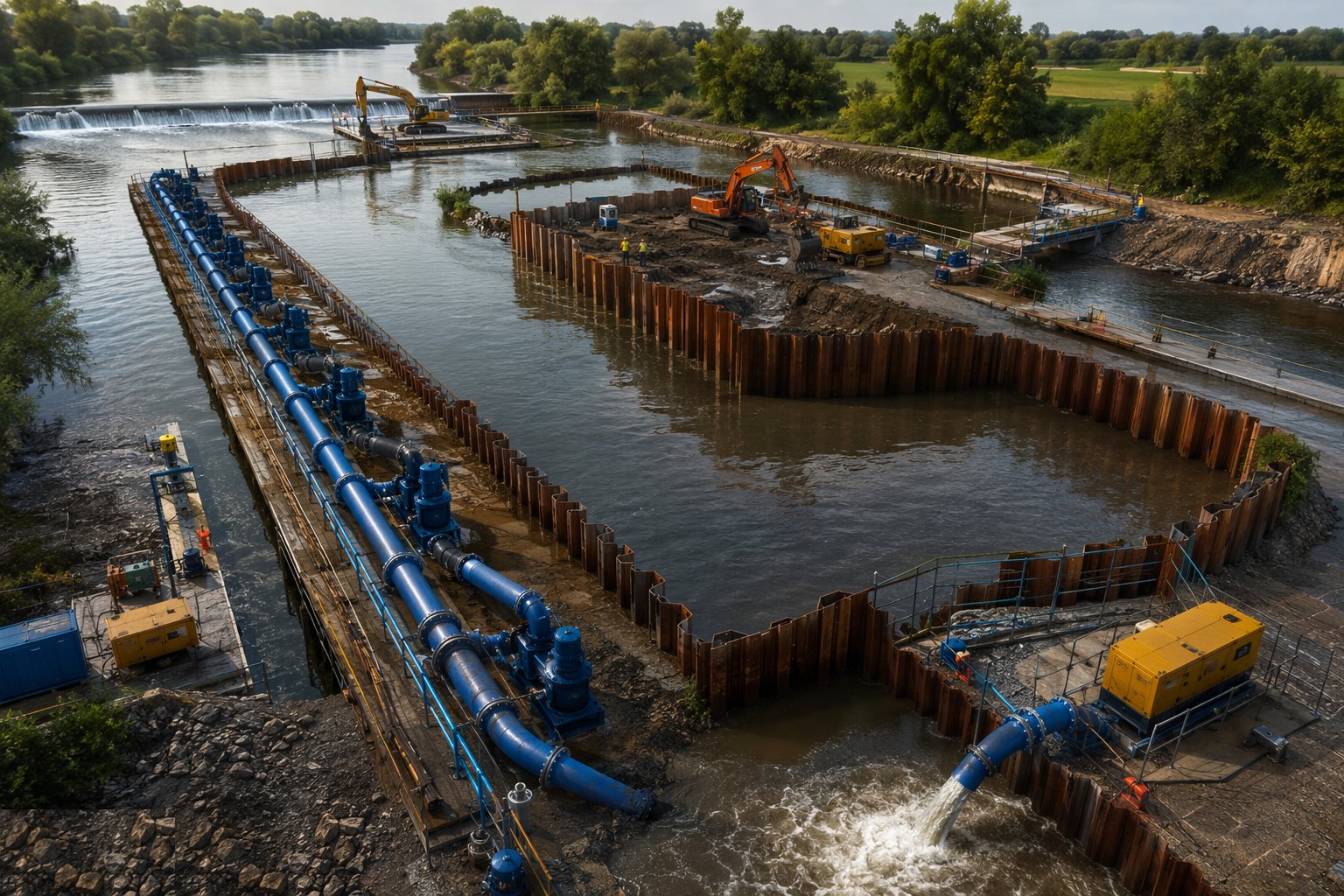
Before anything touches the channel, the temporary works are designed: how the work area is dammed off, how the flow gets past — overpumping through sized pumps and pipework, or a flume through the site — and what happens when the river rises. Pump capacity is checked against realistic flows with standby units, dam stability and seepage are calculated, and the fish rescue is booked: a licensed team with electrofishing gear clears the reach before dewatering, with fish returned downstream under the consent conditions. Silt mats, settlement lagoons and discharge monitoring are set up, because the permit limits what turbidity you may release, and the downstream abstractor or fishery will notice before the regulator does.
Step 2: Isolate and dewater the work area
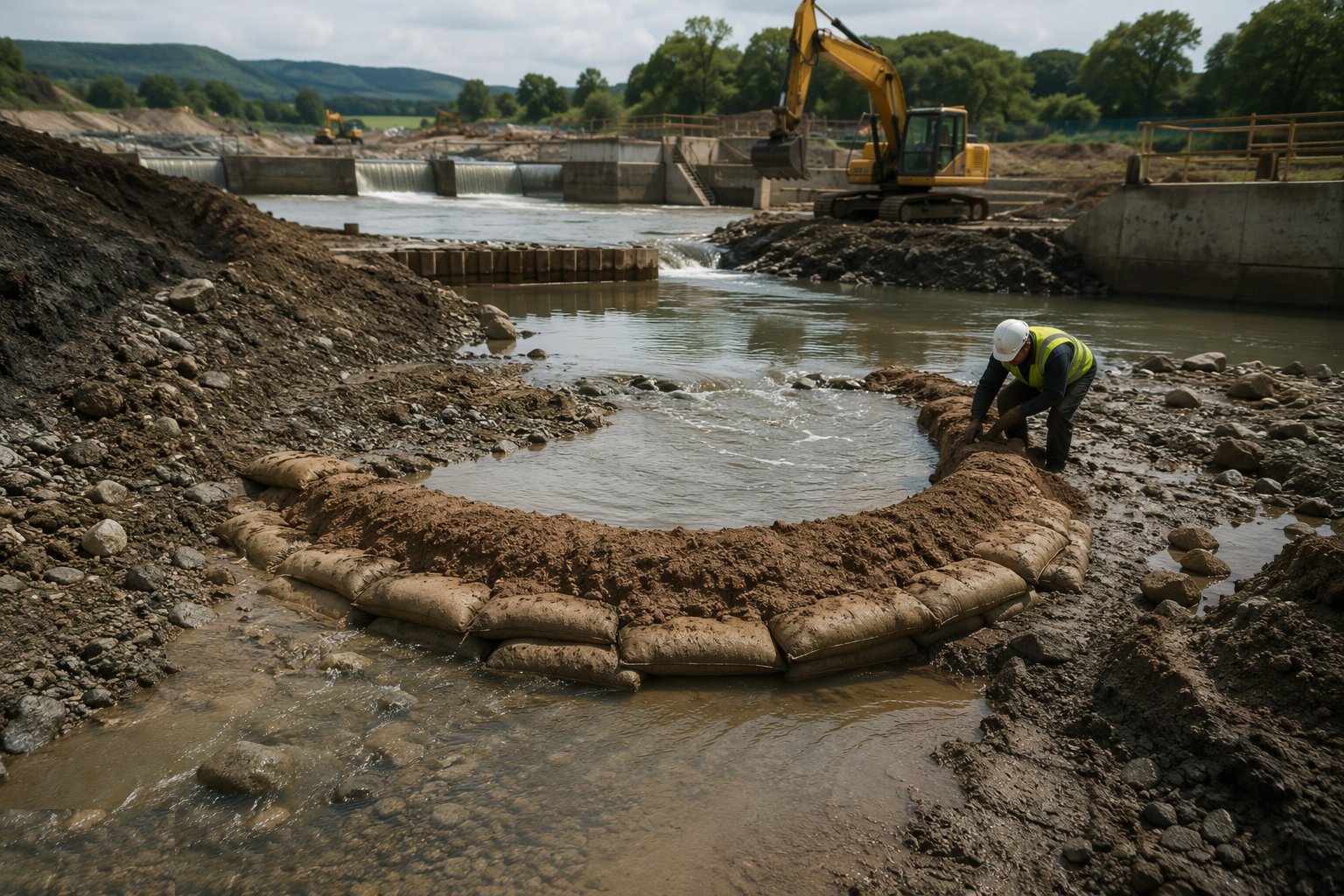
The dams go in from the banks — sandbag and clay on small watercourses, water-filled barriers or framed systems on bigger flows — with the upstream dam first and the overpumping running before the reach is closed off. The isolated section is pumped down steadily so banks do not slump from rapid drawdown, fish rescue completes its sweeps, and the bed is cleaned and surveyed. The temporary system is then babysat around the clock: pump logs, fuel, watchkeepers, weather monitoring and a documented plan for controlled re-wetting if the flow beats the pumps. Every hour of dry working downstream of this set-up is an hour the isolation crew earned.
Step 3: Re-section the channel to design profile
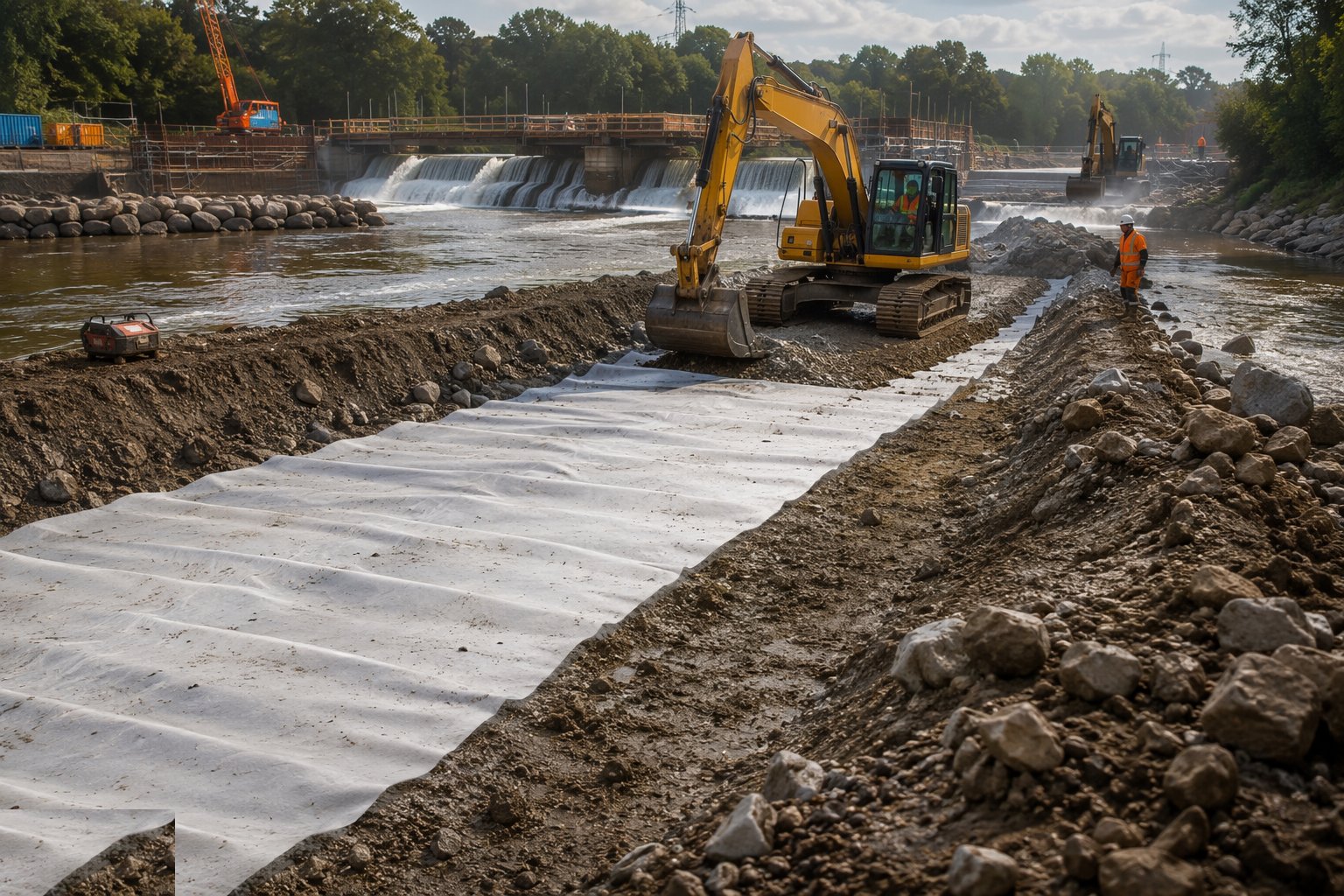
Re-sectioning is earthworks to a hydraulic drawing: the bed cut or filled to design levels, banks re-profiled to stable slopes, two-stage berms excavated where the design spreads flood flows, and the whole profile checked against sections and long-section with the machine guided by GPS or lasers. Soft bed material is excavated and replaced or stabilised where structures will bear; geotextile separation goes down before any armour or fill. The temptation to "improve" on the profile with the excavator bucket is resisted — a channel dug deeper or steeper than designed is a silt trap or a scour generator, and the river will spend the next decade correcting your initiative.
Step 4: Build weirs and fish passes
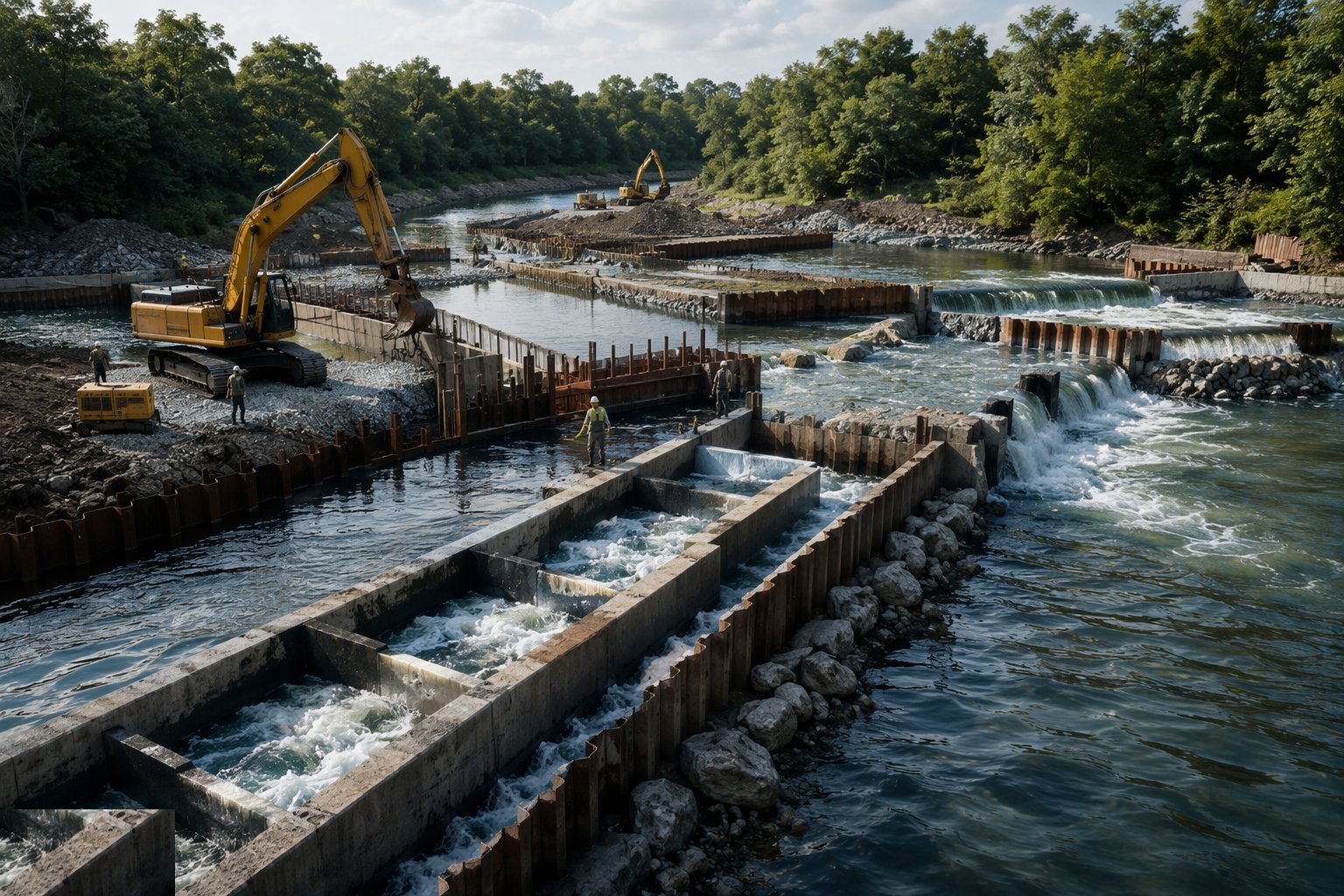
Weir construction in the dry starts with the foundation and the cut-off — the sheet-pile or concrete curtain that stops the structure being undermined — then the body: cast in situ concrete with waterstops and formed stilling basin, or rock built in layers to a formed crest. Crest levels are set and checked to millimetres because hydraulics is unforgiving: a weir crest 30 mm high drowns the reach upstream, 30 mm low and the head is gone. Fish passes are fitted with the same precision — Larinier baffles fixed to template positions, pool walls and notches to the drawing, eel-pass substrates laid at the design gradient — and the downstream apron and scour protection are placed before the water is ever allowed back to test them.
Step 5: Armour the banks and protect the toe
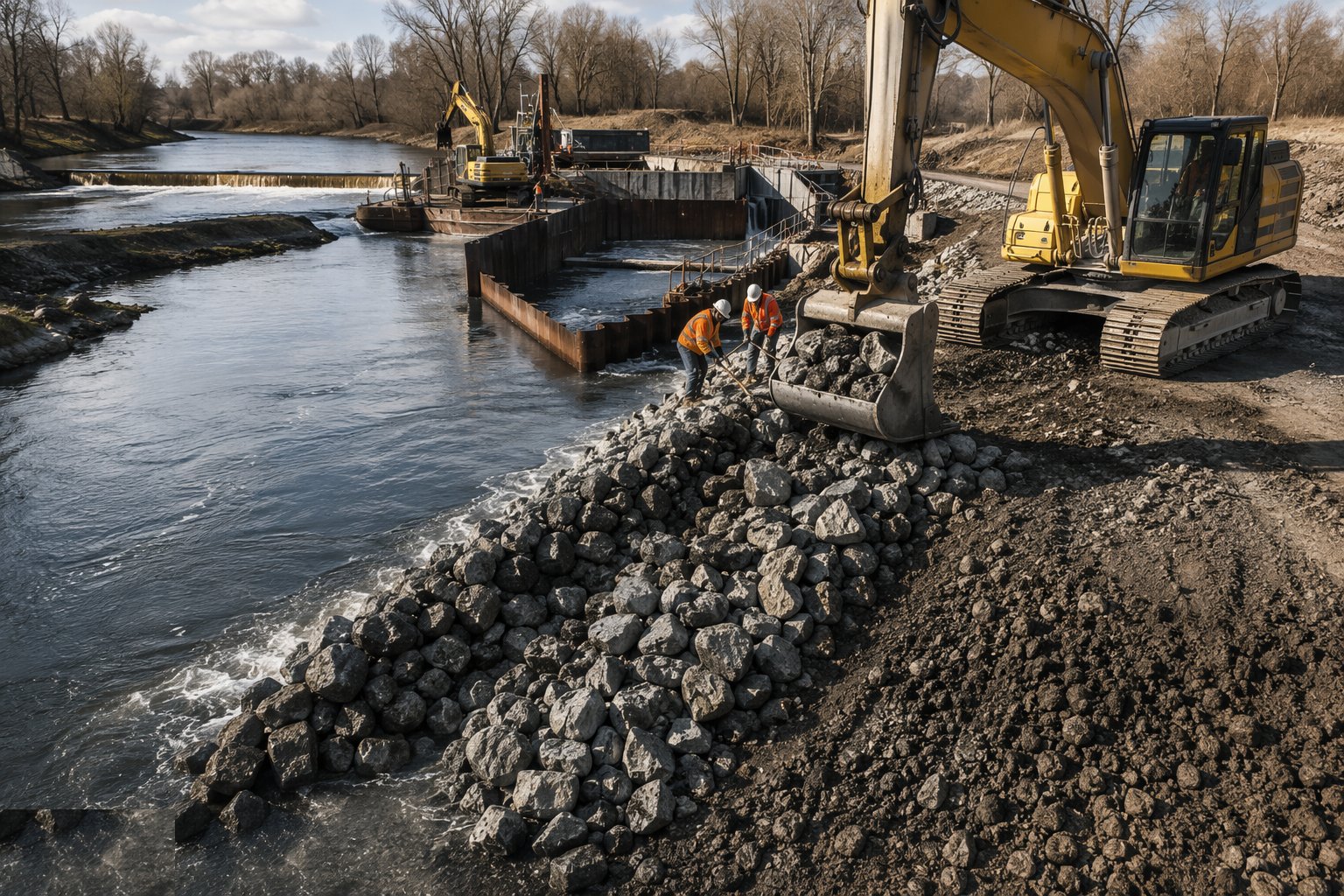
Gabion baskets are assembled, staked, filled with hard durable stone and laced closed so they act as monolithic blocks, not sacks of gravel; mattresses go down on the bed and toe as flexible aprons that settle with scour instead of being undermined by it. Riprap is placed stone by stone or by grab to the specified grading and layer thickness over geotextile — dumped rock is segregation, voids and failure. Whatever the armour, the toe is trenched below the design scour depth or given a falling apron, because the design assumes the bed will move and the armour must move with it or hold against it. Soft engineering — coir rolls, spiling, live stakes — is installed in its dormant season, staked, backfilled and watered in like the planting operation it is.
Step 6: Reintroduce the water and commission
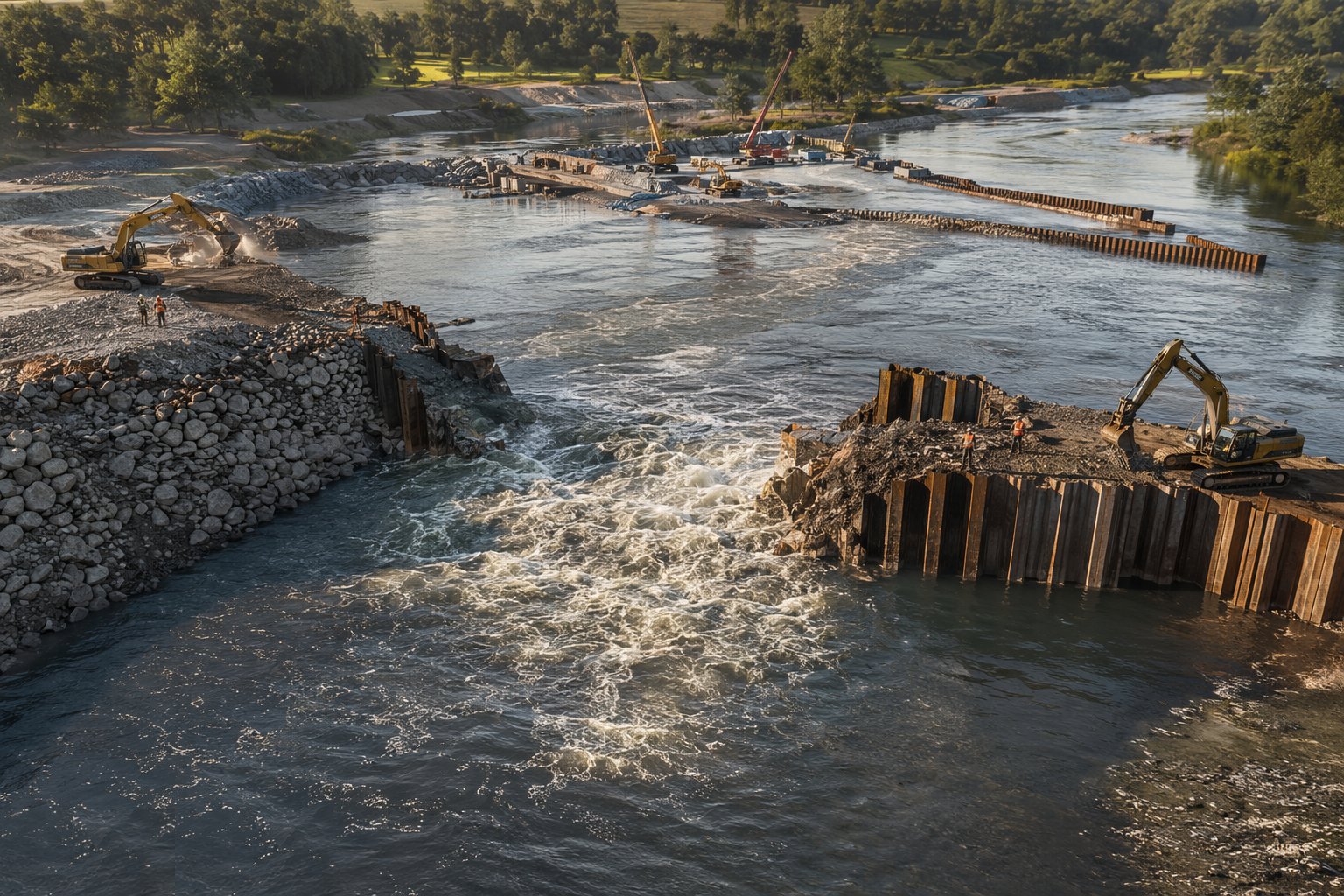
Re-wetting is staged, not sudden: the downstream dam is breached first or the overpumping is throttled back so the reach fills gently, banks saturate without slumping, and every structure takes load gradually. The crew stands by with plant while the river finds the new geometry — watching for scour at transitions, seepage through dams being removed, and unexpected flow paths that mean a detail needs adjusting now, while the machines are still here. Dams come out from downstream up, temporary works are fully removed, and the reach is left clean: no spoil berms, no stranded materials, no pump sump holes — the consent says how you leave it, and the EA remembers.
Step 7: Reinstate, plant and monitor
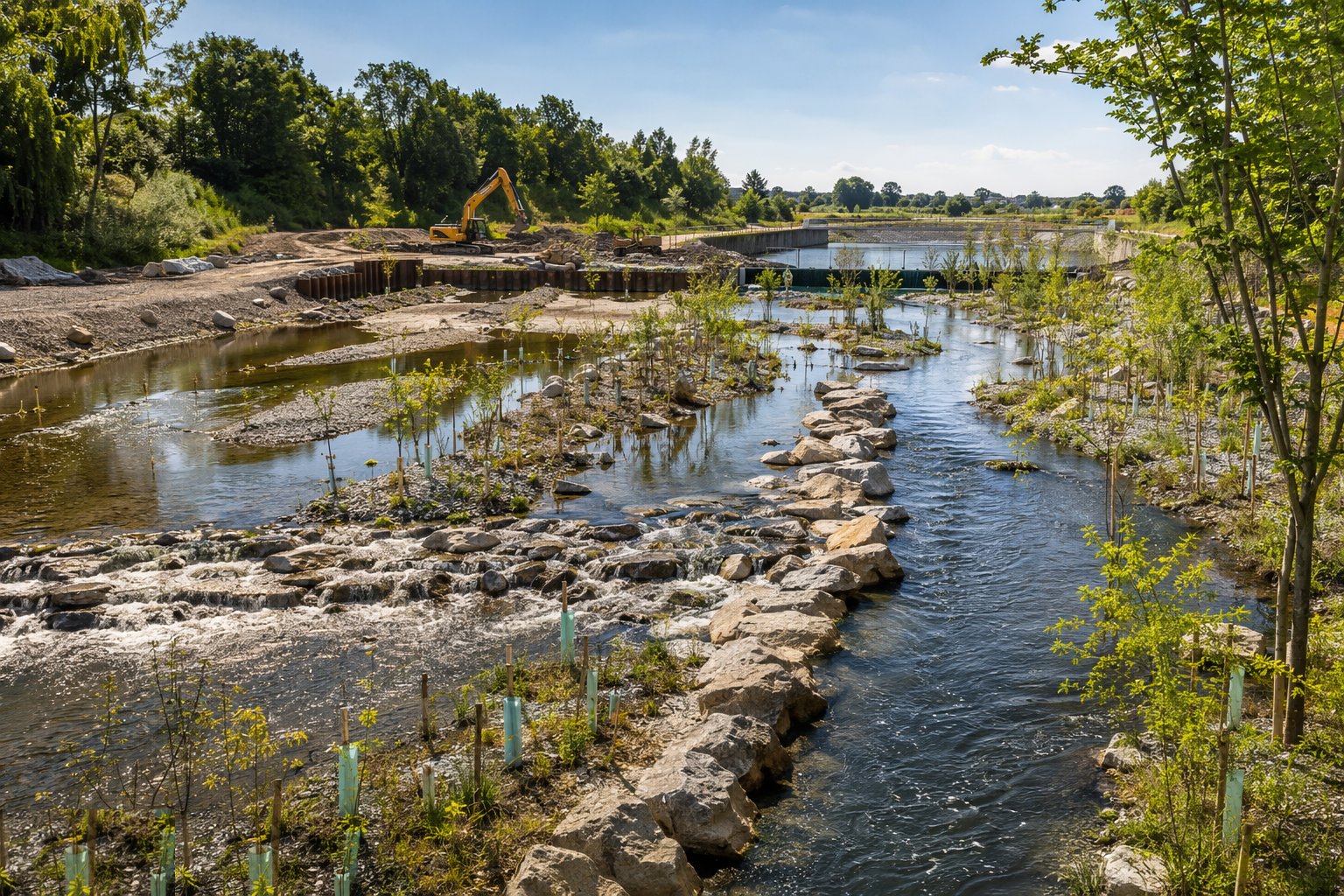
The last phase makes the engineering disappear: margins are re-graded and topsoiled, riparian planting and pre-planted coir go in, riffle gravels are placed where the design creates spawning habitat, and access tracks and compounds are reinstated. Monitoring is written into the consent and the handover — fixed-point photographs, cross-section surveys after significant floods, fish-pass effectiveness checks, and an inspection after the first season's flows to catch scour or settlement early. A well-built scheme needs watching, not fixing; the watching is what proves it was well built.
Plant and equipment
- Long-reach and standard excavators with grabs and tilt-rotators for bank work
- Overpumping sets, layflat and rigid pipework, and standby pumps with fuel management
- Temporary dam systems: sandbag, water-filled barrier, frame cofferdam or sheet-pile kit
- Cranes and excavator-mounted rock grabs for armour placement
- Gabion assembly and filling frames, lacing tools and stone handling gear
- GPS machine control and survey equipment for level-critical profiles
- Safety boats, throw lines and bankside rescue equipment
Quality control checks
- Channel bed and bank profiles surveyed against design sections before and after armouring
- Weir crest and fish-pass baffle levels verified to millimetre tolerance before re-wetting
- Gabion fill quality and lacing checked per run; riprap grading certificates and placed thickness surveyed
- Toe trench depths and apron extents recorded against the scour design before backfilling
- Pump logs, turbidity monitoring and fish-rescue records filed against consent conditions
- Post-flood inspection regime agreed and first-season surveys completed
Safety considerations
- Drowning is the number one risk: buoyancy aids on the bank, rescue equipment staged, safety boat for in-water work, and strict lone-working rules
- Plant stability on soft beds and bank edges: ground assessment, mats, and machines positioned for the collapse you did not plan
- Flood response plan with trigger levels: the river can rise mid-shift and the temporary works have limits
- Suspended rock and gabion loads over water: exclusion zones and controlled placement, never over people or the flow
- Leptospirosis and waterborne infection hygiene; cuts covered, welfare washing enforced
- Manual handling of gabion stone, lacing and coir products on sloping, wet banks
Common defects
- Toe scour and undermining: armour placed without a trenched toe or falling apron, unravelled by the first real flood
- Gabions bulging and flattening from poor filling and lacing — built as sacks, not blocks
- Fish passes flowing wrong: crest levels off, baffles displaced, and a pass that fish sensibly refuse to use
- Banks re-profiled too steep and slumping back into the channel within a season
- Silt releases breaching the consent — inadequate mats, pumped discharges straight to the watercourse, and a regulator at the gate
- Riprap under-sized or placed too thin, plucked out by velocities the design predicted and the placing ignored
Best suited for
- Flood alleviation schemes increasing channel capacity or controlling bed levels
- River restoration and re-meandering under environmental objectives
- Erosion protection at bridges, outfalls and development frontages
- Fish and eel passage retrofit at weirs and barriers
How long does River Engineering & Watercourse Works take?
Typical duration: A standalone weir or fish pass typically takes 8–16 weeks inside an in-river window; linear re-sectioning and bank protection schemes run 6–18 months, often phased across successive consented seasons..