Development Infrastructure & Enabling Works
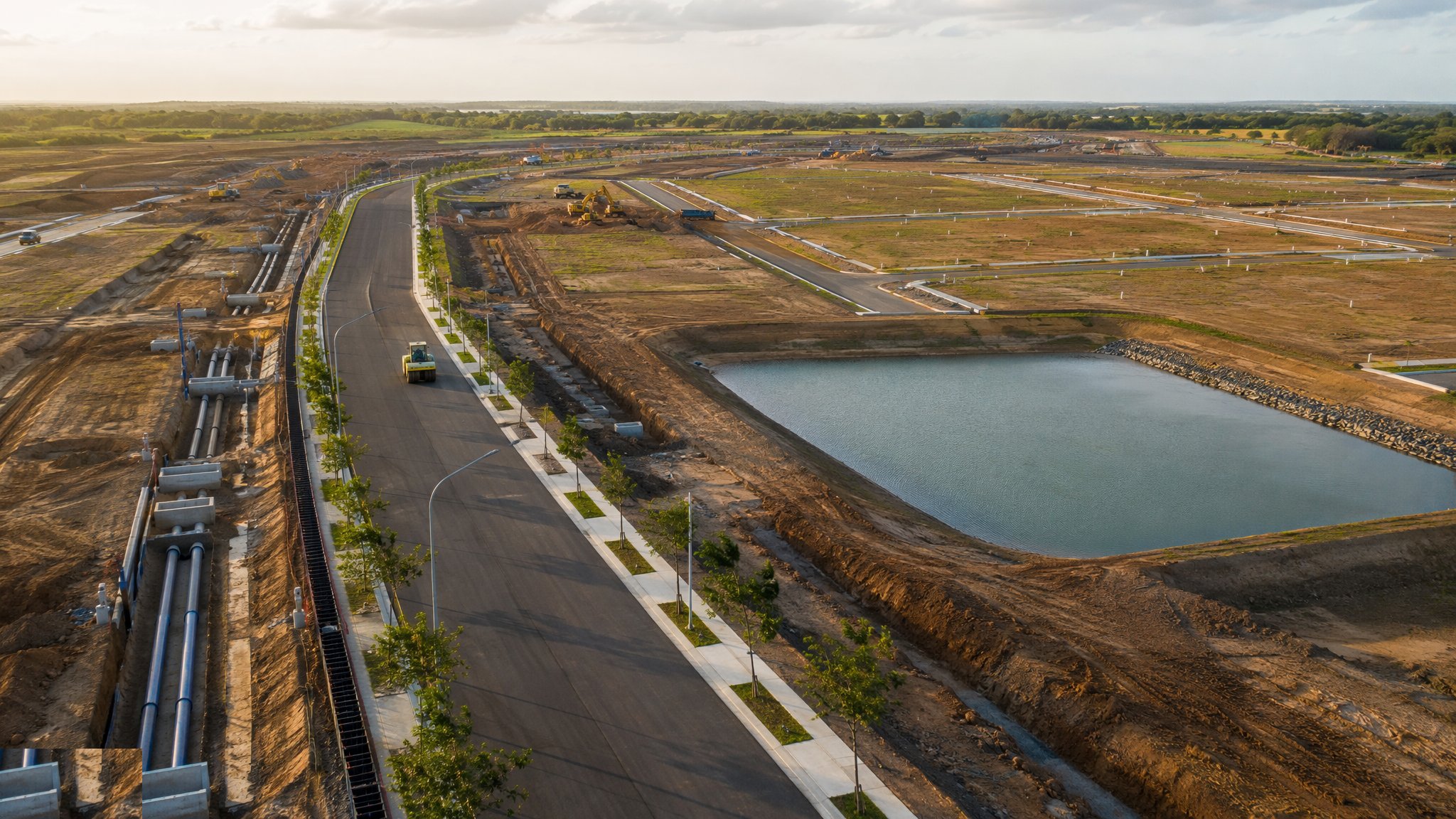
Turning a bare land parcel into serviced plots: spine roads, mains corridors, balancing ponds and the adoption agreements — S278, S38, S104 — that let the developer release land phase by phase.
Last updated 2026-07-28 by the BuildPedia Editorial Team.
What is Development Infrastructure & Enabling Works?
Raw land becomes building plots through infrastructure, and infrastructure is delivered through agreements as much as through excavators. The physical works are heavy civil engineering at estate scale: spine roads and their junctions onto the existing highway, mains services corridors carrying water, power, gas, telecoms and drainage to every plot boundary, surface water management — attenuation ponds, swales and SuDS features sized for the developed catchment — and the earthworks that set every plot at its design level. On a strategic housing site this can mean kilometres of road, a pumping station or two, and ponds that double as landscape; on an industrial land deal it means heavy-duty roads, big power and drainage sized for roof water by the hectare.
The paperwork is the programme. In the UK, works connecting to or altering the existing public highway run under a Section 278 agreement with the highway authority — designed to their standards, built under their inspection, bonded by surety. New estate roads intended for adoption run under Section 38 of the Highways Act 1980; adoptable sewers under Section 104 of the Water Industry Act 1991 — each with its own design vetting, inspection regime and bond, and each ending only when the authority adopts, which is when the developer's liability and maintenance finally end. In the Gulf the equivalents are the authority NOC and permit regimes — RTA access approvals, municipality infrastructure standards, utility connection approvals — with the same logic: the infrastructure is built to an adopting authority's standard, inspected by them, and handed over. None of it is fast, and the adoption tail outlasts the construction by years.
The commercial engine of the whole operation is phasing. Land value is released in stages: phase one infrastructure opens the first plots for sale or development, their receipts fund the next phase, and the infrastructure design must therefore deliver self-sufficient phases — each with working access, drainage that drains, live utilities and fire tender access — while leaving the connections for the next phase ready to tie in without digging up what was just adopted. The balancing act is permanent-versus-temporary: temporary bellmouths, temporary pumping, temporary turning heads all cost twice if the masterplan phasing was drawn on optimism. The sites that make money are the ones where the phasing plan, the adoption programme and the sales programme were drawn by people who talked to each other.
When and why is Development Infrastructure & Enabling Works used?
Infrastructure and enabling works apply to greenfield and brownfield land being brought forward for housing, industrial or mixed development — strategic land promotion, urban extensions, business parks and regeneration platforms. The package runs after planning consent and remediation (where needed) and before or alongside the first vertical construction, because no plot can be sold, let or built without access and services. It matters because it is the value-unlocking spend: the difference between agricultural land value and serviced-plot value is precisely this work, and the difference between a profitable phase and a cash-flow crisis is whether the infrastructure was phased to match sales. It also carries the longest liabilities of any package on site — bonds, maintenance periods and adoption tails measured in years — so the quality of the as-builts, the inspection records and the authority relationships built during construction are still earning or costing money long after the earthworks plant has left.
Types of Development Infrastructure & Enabling Works
Residential strategic-site infrastructure
Spine roads, SuDS and plot servicing for major housing land releases: hundreds to thousands of plots phased over years, with schools, local centres and play areas tied to trigger points in the Section 106 obligations.
Industrial and logistics land servicing
Heavy-duty access roads, high-capacity power and drainage, and large serviced platforms for shed developers: fewer plots, bigger loads, and utility reinforcement — grid connections and off-site mains — that drives the critical path.
Brownfield regeneration enabling
Infrastructure threaded through former industrial land: demolition and remediation interfaces, diverted live services, new corridors cut through old foundations, and phasing that keeps adjoining occupiers running.
Highway improvement packages (S278-led)
Standalone junction, link road and capacity improvements on the existing highway that unlock otherwise consented development — built under the highway authority's inspection on live trafficked roads, with the traffic management as hard as the construction.
Development Infrastructure & Enabling Works: step by step
Step 1: Fix the agreements, phasing and utility strategy
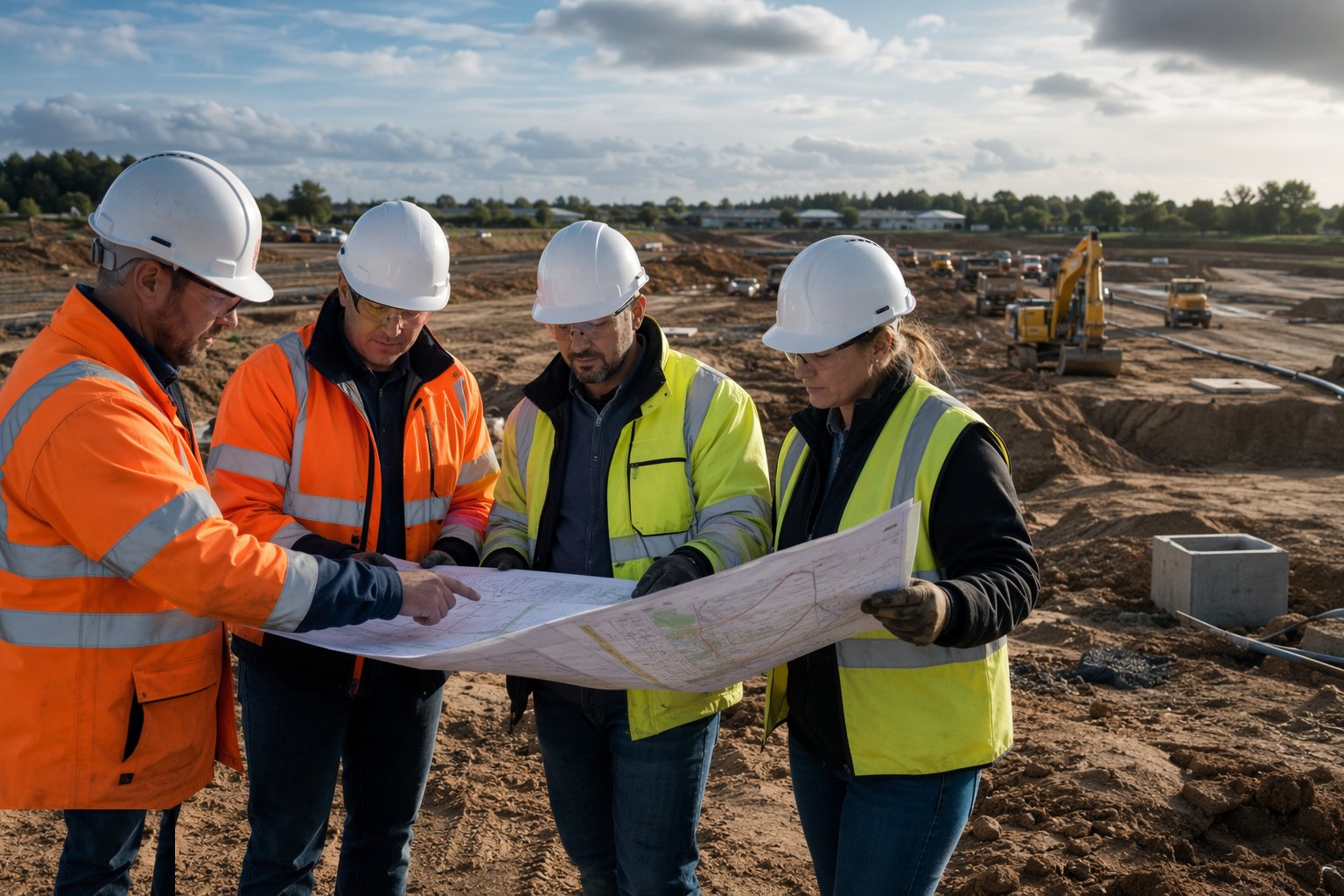
Before excavation, the legal and technical frame is set: S278 and S38 technical approvals from the highway authority, S104 sewer adoption agreement with the water company, utility capacity checks and connection offers — power offers on strategic sites can run years, so they are chased at consent stage, not at construction. The phasing plan is drawn with the sales or letting programme: which plots release when, what infrastructure each phase needs to be self-sufficient, and where the permanent-temporary boundaries fall. Bonds and sureties are arranged — no bond, no agreement, no road opening.
Step 2: Earthworks to development platforms and corridors
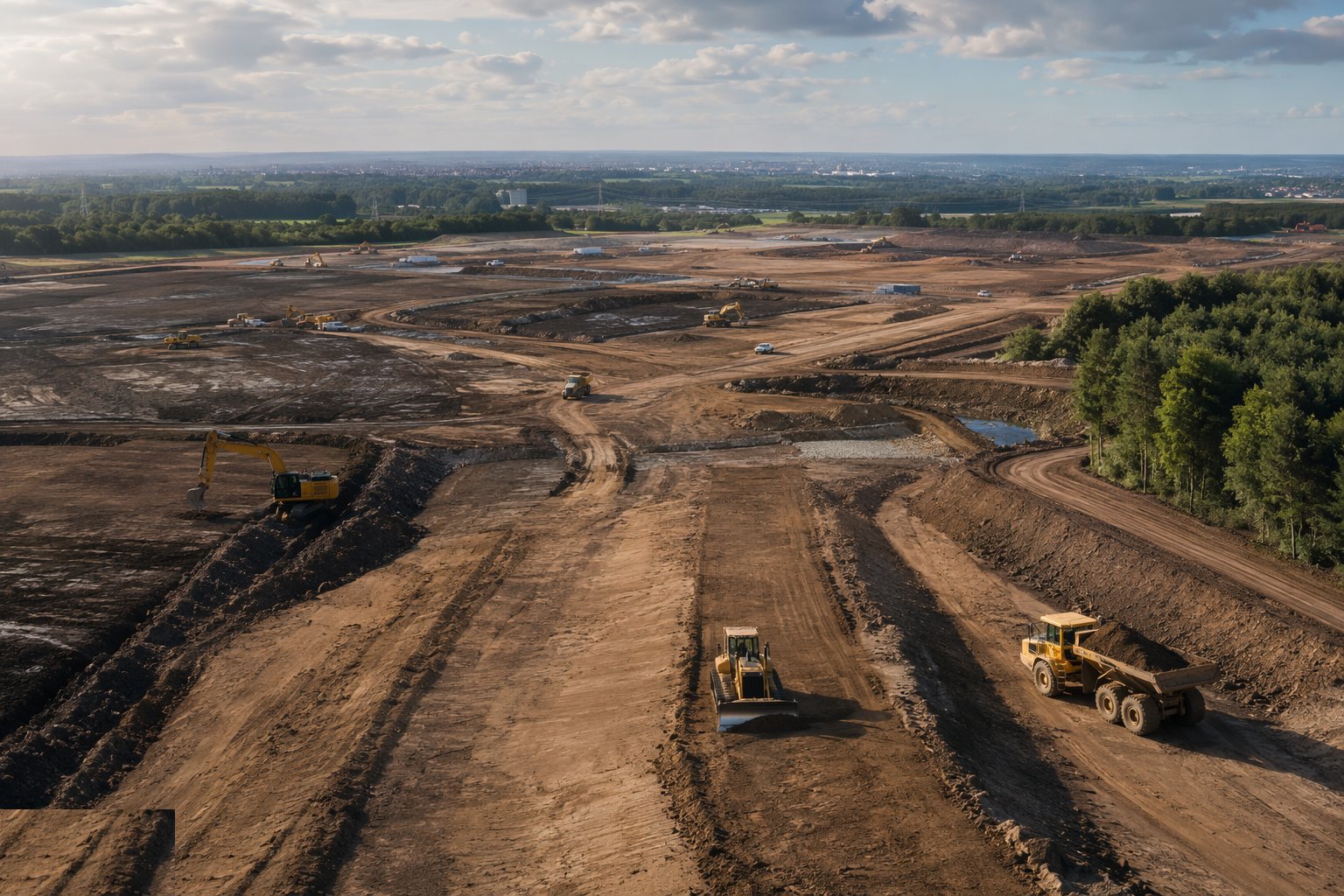
Bulk earthworks set the site: cut and fill to plot platforms and road corridors, engineered fill placed in layers to specification with in-situ density verification, topsoil strip and management for the landscape phases, and the surface water strategy protected from day one — silt control, temporary drainage and the pond excavations themselves, because a construction site without working drainage is a mud farm one storm away from the watercourse regulator. Formation levels are set to give every corridor its falls; a drainage network that cannot drain by gravity is a pumping station the sales brochure never mentioned.
Step 3: Construct drainage and the balancing ponds
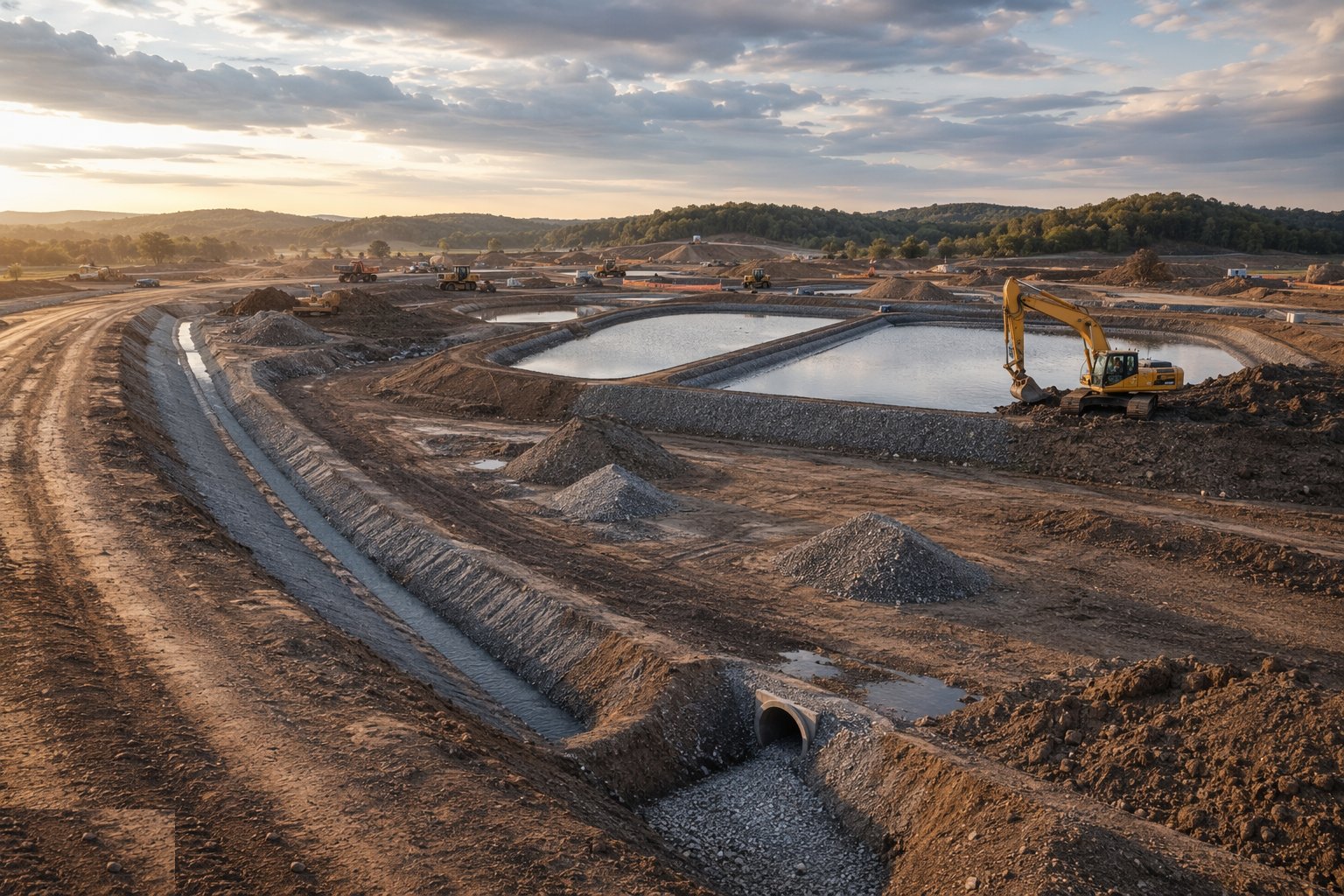
The wet infrastructure goes in first because everything else crosses it: foul sewers to the adoptable standard under the S104 regime — manholes, bedding, air and water tests — surface water sewers to the attenuation features, and the ponds themselves: excavation, liners where ground permeability demands, inlet and outlet control structures, headwalls and the safety benching and margins the adopting authority and the designers require. Ponds are commissioned as functioning drainage early — they earn their keep attenuating construction runoff long before they become landscaping.
Step 4: Install the mains services corridors
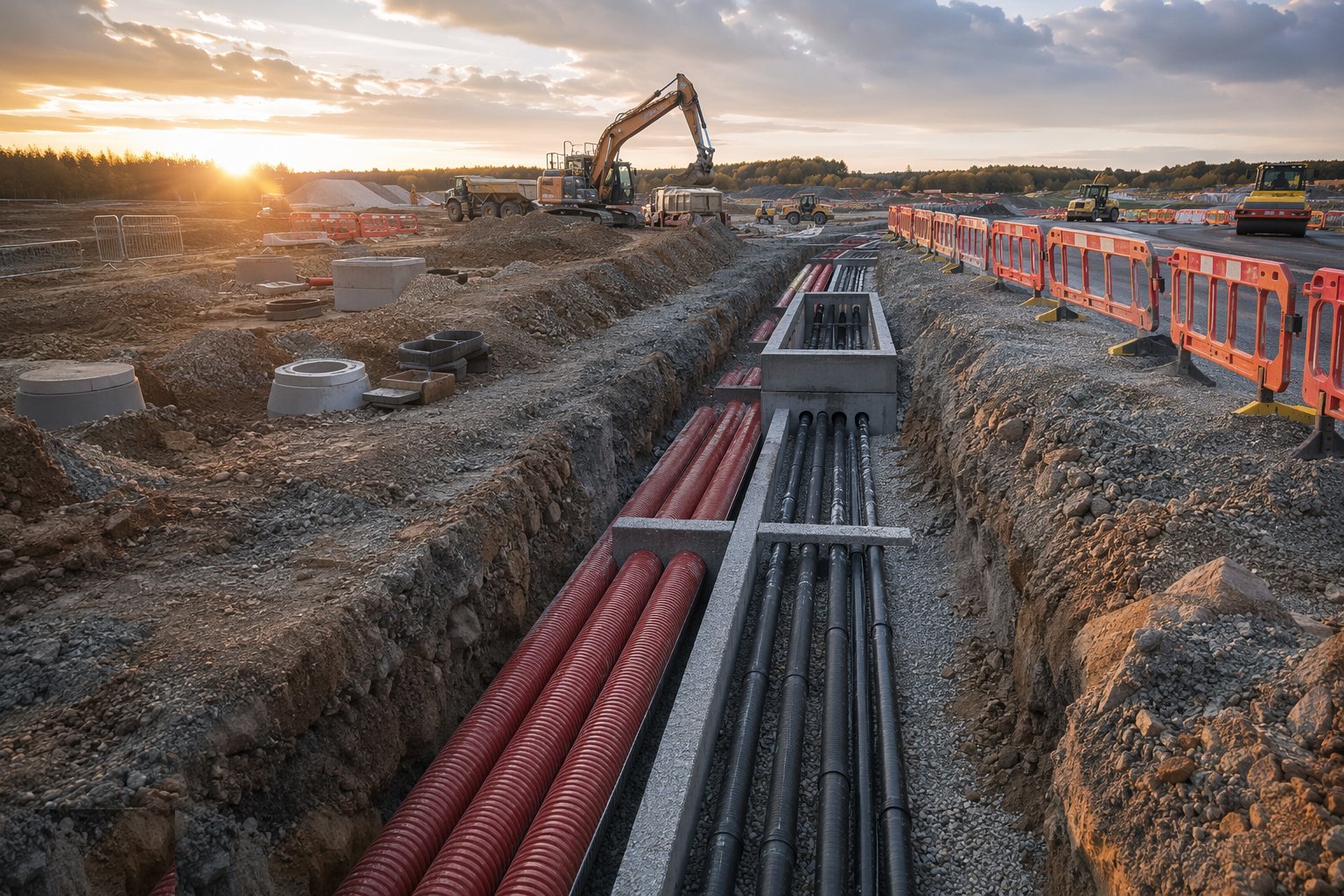
The multi-utility corridors are laid to the agreed service strip layout — water mains, HV and LV ducts, gas, telecoms, each utility laid by its own undertaker or under their accreditation, with depths, separations and marker systems per the standards so the next twenty years of excavations can find them. Coordination is the trade: duct crossings at the right depths relative to the drainage, draw pits and chambers where the plot connections will come, and as-built records captured as the trenches close, because a corridor as-built drawn from memory is a strike waiting for a bucket.
Step 5: Build the roads: formation to surfacing
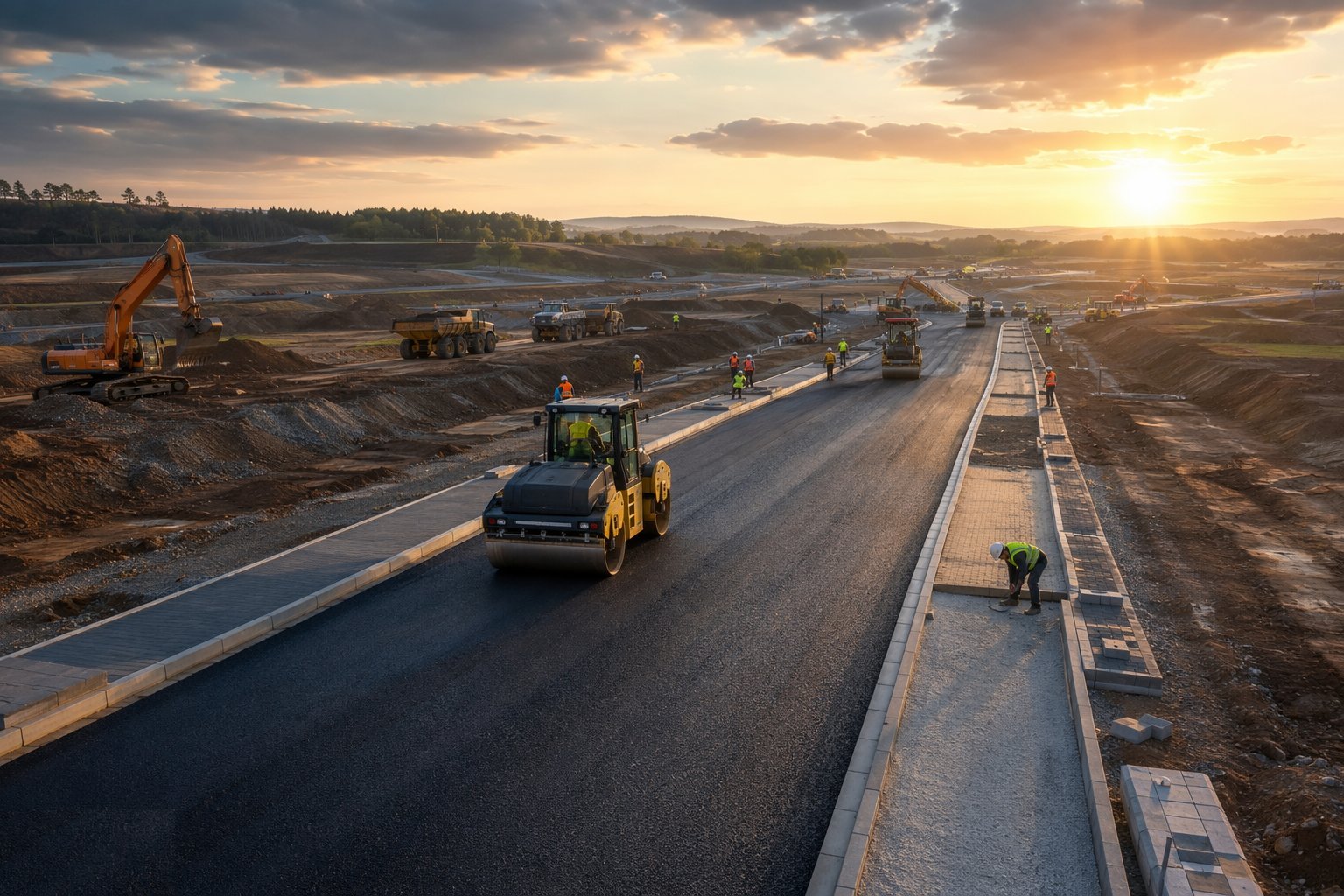
Spine roads and estate roads are built to the adoption standard: capping and sub-base placed and tested — plate and CBR verification at formation — kerbs and footways set out and laid, drainage ironwork set to finished levels, then the bituminous structure: base, binder and surface course laid to the specification with cores and texture checks where the authority requires. S278 works on the live highway run under approved traffic management with the authority inspecting hold points; surfacing is often held at binder course through the construction period so the construction traffic's damage is planed off and re-surfaced at the end — a detail worth its weight in disputes avoided.
Step 6: Release plots and manage the phased ties-ins
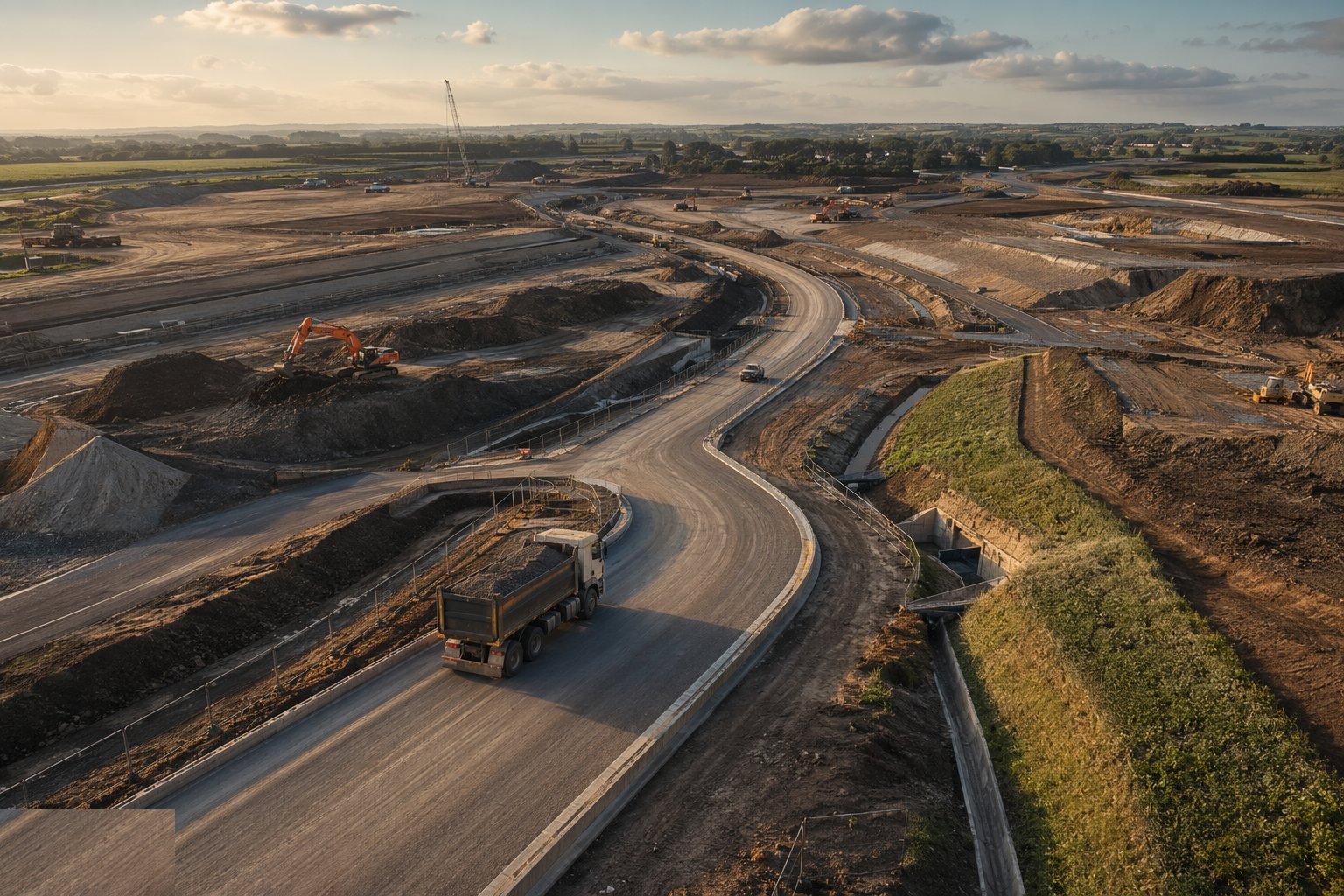
Each phase is closed out as a self-sufficient unit: roads swept and signed, utilities live to the plot boundaries, drainage proven, fire access confirmed, and the plot release documentation — as-builts, test records, utility certificates — handed to the plot developers or the sales team. Tie-ins of the next phase to live, sometimes adopted, infrastructure are planned like possession work: notices to the authorities, road-space bookings, out-of-hours connections. Behind the phases the adoption machine grinds on — remedial lists closed out, maintenance periods running, bonds reducing — until the last road is adopted and the developer's infrastructure liability finally ends.
Plant and equipment
- Bulk earthworks fleet: scrapers, dozers, excavators, articulated dump trucks and rollers
- Pipe lasers, lasers and GPS machine control for drainage falls and formation levels
- Pipe-laying kit: trench boxes and drag boxes, bedding plant, pipe testing equipment
- Kerb laying and block paving gangs; planers and pavers for surfacing
- Concrete pumps and mixers for headwalls, manhole benching and structures
- Geosynthetics, liners and pond outlet control structures
- Traffic management: barriers, signals, temporary surfacing for S278 works
- In-situ density, plate bearing and CBR test equipment for verification
Quality control checks
- Engineered fill: layer-by-layer placement records with in-situ density results against specification
- Drainage air/water test records and CCTV surveys before adoption handover
- Formation and sub-base verification: plate bearing/CBR results at the specified frequency
- Surfacing cores, layer thickness and temperature records to the adoption standard
- Utility as-built records per corridor: depths, separations, duct and chamber positions
- Plot release checklists with authority inspection sign-offs and utility live certificates
Safety considerations
- Live highway working on S278 packages: Chapter 8 traffic management, trained operatives, enforced incursion protection
- Deep drainage trenches: support systems, ladder access and edge protection — trench collapse kills in seconds
- Buried and overhead services: CAT scans, permit to dig and trial holes before any mechanical excavation
- Plant-pedestrian segregation across an open site shared with plot contractors and the public
- Open water hazards at ponds: fencing, rescue equipment and controlled access until adoption
- Public interface on phased sites: secure boundaries between construction and occupied phases
Common defects
- Utility capacity discovered late — the power offer that lands two years after the plots were promised
- Drainage laid flat or back-falling, failing CCTV and air tests at adoption inspection
- As-builts that do not match the ground: ducts struck by the next phase's foundations
- Phasing drawn on optimism: temporary works that become permanent, phases that cannot self-suffice
- Adoption stalled on remedial lists — ironwork levels, verge topsoiling, streetlight certificates
- Ponds built late or undersized: construction runoff flooding plots and breaching watercourse consents
Best suited for
- Strategic housing land releases and urban extensions
- Industrial and logistics land servicing with heavy utility demands
- Brownfield regeneration platforms with complex service diversions
- Consented developments unlocked by off-site highway improvements
How long does Development Infrastructure & Enabling Works take?
Typical duration: First-phase infrastructure on a strategic site typically runs 12–24 months to first plot release; full build-out follows the sales programme over 3–10 years, with the adoption tail running 1–3 years beyond the last surfacing..