Mineral Processing Plant Construction
Crushers, mills, flotation and thickeners — a factory built of heavy concrete and vibrating steel, where the civils are machine foundations and alignment is measured to the millimetre on equipment that weighs hundreds of tonnes.
Last updated 2026-07-28 by the BuildPedia Editorial Team.
What is Mineral Processing Plant Construction?
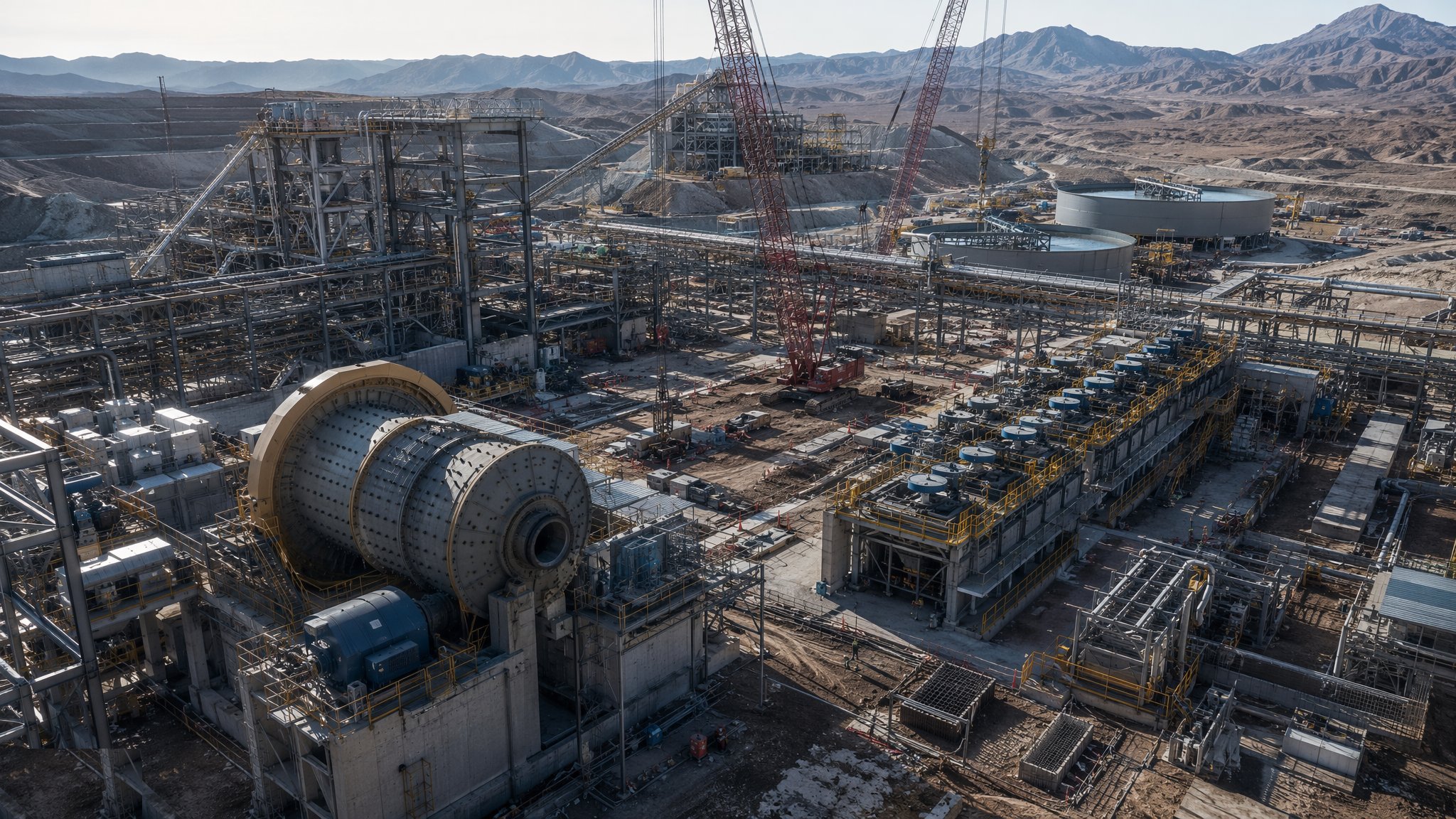
A mineral processing plant is an industrial factory whose raw material arrives by the 200-tonne truckload. The flowsheet sets the building: primary crushing at the ROM pad, then conveying through transfer towers and galleries to secondary and tertiary crushing, screening, grinding mills, flotation or leaching circuits, thickeners and tailings disposal. Every stage is heavy mechanical plant bolted to concrete that is anything but ordinary. Crusher stations are massive reinforced concrete structures — dump pockets, feeder chambers and crusher foundations absorbing impact loads no building code contemplates. Grinding mills sit on inertia blocks and mat foundations designed with the dynamic loads and the mill vendor's stiffness requirements, because a mill foundation that flexes becomes a drive-alignment and bearing-temperature problem that no amount of shimming fixes.
The conveyor system is the plant's skeleton: kilometres of belt running in steel galleries and on trestles, through transfer towers where chutes turn the flow, all aligned and levelled so belts track and chutes do not plug. Galleries are modular steelwork fabricated off-site and bolted up at pace, but their lines and levels are survey work — a conveyor that wanders across its idlers spills tonnage and eats belts. Around the process plant sit the tanks and thickeners: large-diameter concrete or steel tanks on ring beams and engineered bases, with their own settlement criteria, because a thickener that tilts a few millimetres across a 40 m diameter binds its rake mechanism and stops the circuit. Piping, cabling and the MCC rooms thread the whole lot together, and the commissioning sequence — water runs, then ore — is a project in itself.
Construction of a plant like this is a logistics and interfaces battle fought in heavy concrete. Pours for crusher and mill foundations run to hundreds of cubic metres with dense reinforcement, embedded anchor systems set to vendor drawings under template control, and thermal control on the mass concrete. Erection of the mechanical equipment — crushers lowered into pockets, mill shells and heads assembled on their bearings — is precision heavy lift: hundreds of tonnes set to alignment tolerances in millimetres, with laser trackers where the vendor demands them. In remote locations the concrete supply, the craneage and the skilled trades are all brought to the site; in the Gulf, hot-weather concreting rules govern every big pour, and corrosion protection on coastal plants is specified like marine work. The plant that starts up on time is the one where civils and mechanical were managed as one programme, not a handover argument.
When and why is Mineral Processing Plant Construction used?
Process plant construction runs on the critical path to first ore through the mill — the date the mine stops being a construction project and starts being a business — and every heavy foundation, conveyor gallery and tank is a link in that chain. The method exists because comminution and separation economics demand scale: crushers, mills and flotation circuits sized to the orebody, running continuously, where downtime is measured in lost tonnes per hour. It matters because the defects are unforgiving and slow to forgive: a crusher foundation with inadequate mass vibrates until bearings fail; a misaligned conveyor spills ore for its whole life; a thickener base that settles unevenly binds the rake and stops the water balance of the entire plant; and anchor bolts set 15 mm off the vendor drawing turn a two-day equipment set into a two-week re-engineering. Build the foundations like machine beds, align the steel like machinery, and commission with water before ore — the plant will repay it in availability for decades.
Types of Mineral Processing Plant Construction
Crushing and screening plants
Primary, secondary and tertiary crushing with screening circuits: heavy concrete stations, steel-lined pockets and chutes, and vibrating equipment on dynamically designed foundations. The front end of every hard-rock flowsheet, and the highest-impact civil works in the plant.
Grinding and concentrator plants
SAG and ball mills, flotation cells, regrind and classification circuits in the concentrator building: mill foundations as engineered inertia masses, large-span structural steel over the mill aisle with heavy overhead cranes, and dense piping and cabling at every level.
Leaching and hydrometallurgical plants
CIL/CIP tanks, heap-leach pads with their liner systems, solvent extraction and electrowinning halls: containment-first construction with liners, bunds and corrosion protection, because the process fluids are as aggressive as the ground ever gets.
Coal and aggregate preparation plants
Dense-medium circuits, screens, cyclones and dewatering in compact multi-level structures: vibrating equipment stacked vertically, rapid wear on chutes and linings, and construction sequencing that lets modules be replaced without rebuilding the frame.
Modular and relocatable plants
Skid-mounted and modular process units for smaller orebodies or early production: factory-built modules set on simplified foundations, piped and cabled at the interfaces, with the civils deliberately minimal and the whole plant designed to be unbolted and moved.
Mineral Processing Plant Construction: step by step
Step 1: Establish the heavy foundation programme
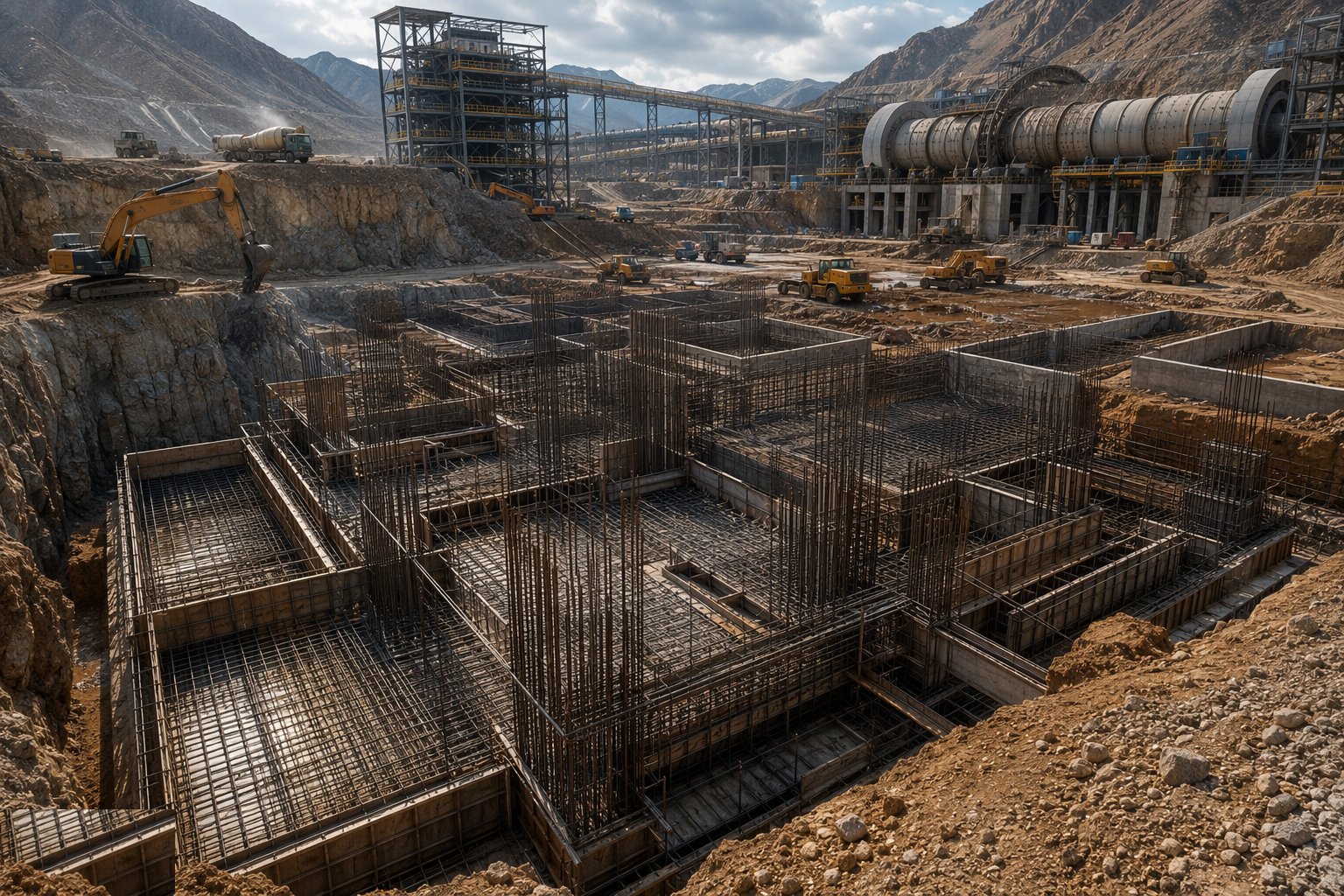
The plant is scheduled foundation-first: crusher station, mill foundations, thickener bases and transfer tower footings identified, sequenced and started before the steelwork programme is allowed to matter. Geotechnical conditions are proven at each structure — the dynamic loads of crushers and mills do not tolerate guesswork — and mass concrete pours are planned with thermal control, delivery logistics and standby capacity, because a cold joint in a crusher foundation is a structural defect at the heart of the plant. Embedded items are the discipline: anchor frames, bolts and plates set on rigid templates to the vendor's drawings, surveyed in position, and protected through the pour, because the equipment arriving in six months forgives nothing.
Step 2: Construct the crusher station and dump pocket
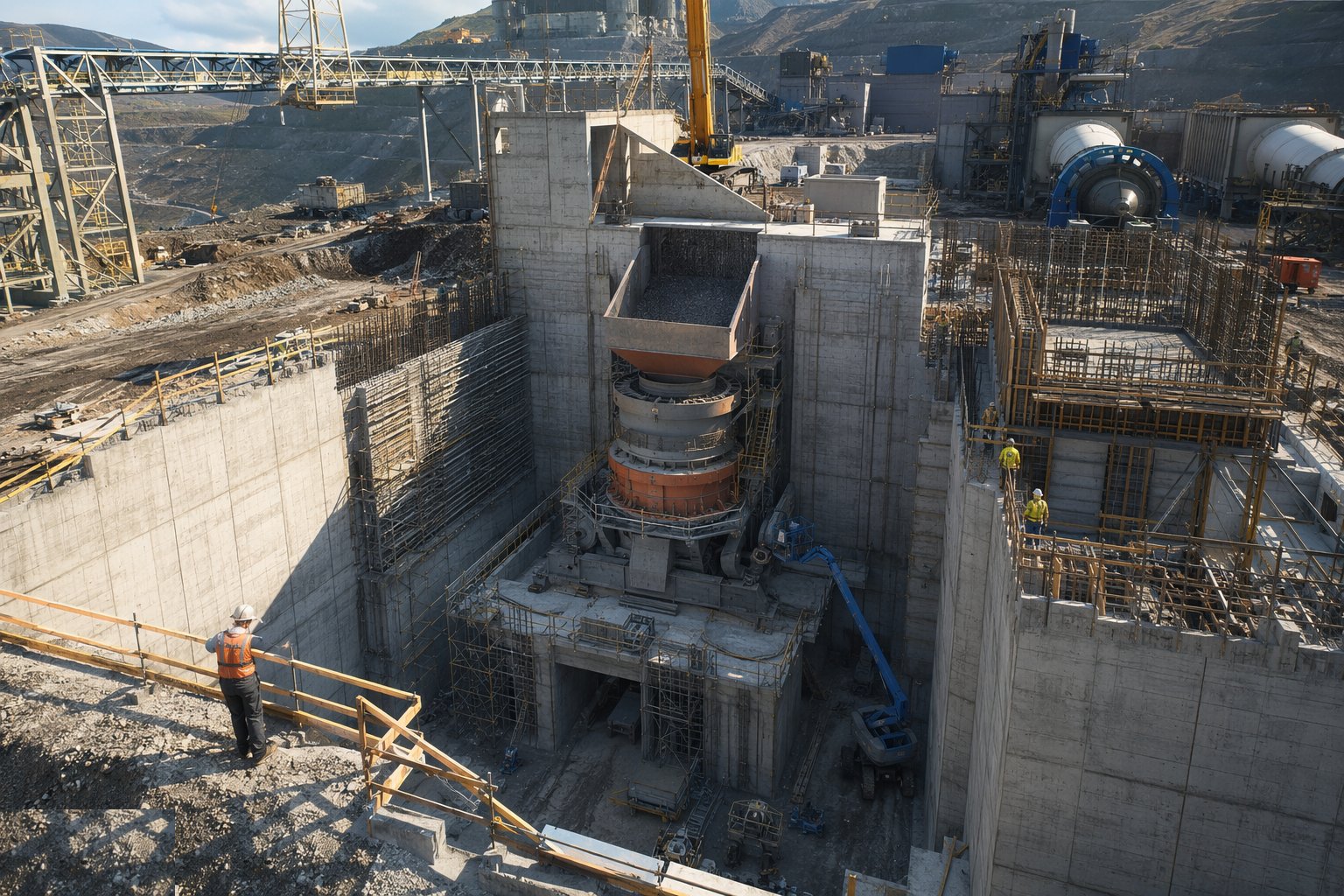
The crusher station is the deepest, heaviest concrete in the plant: base slabs and walls for the dump pocket cast in staged pours with waterstops and dense reinforcement, steel liners and wear plates installed where the rock lands, and the crusher foundation block itself poured with its anchor system template-surveyed to vendor tolerance. Backfill and ground works around the structure are compacted in controlled layers — differential settlement between pocket and adjacent structures is a conveyor-misalignment machine. The ROM wall, crash decks and access steel complete the structure before the crusher is ever lifted, because the lifting study assumes the building around the lift is finished.
Step 3: Erect conveyor galleries, trestles and transfer towers
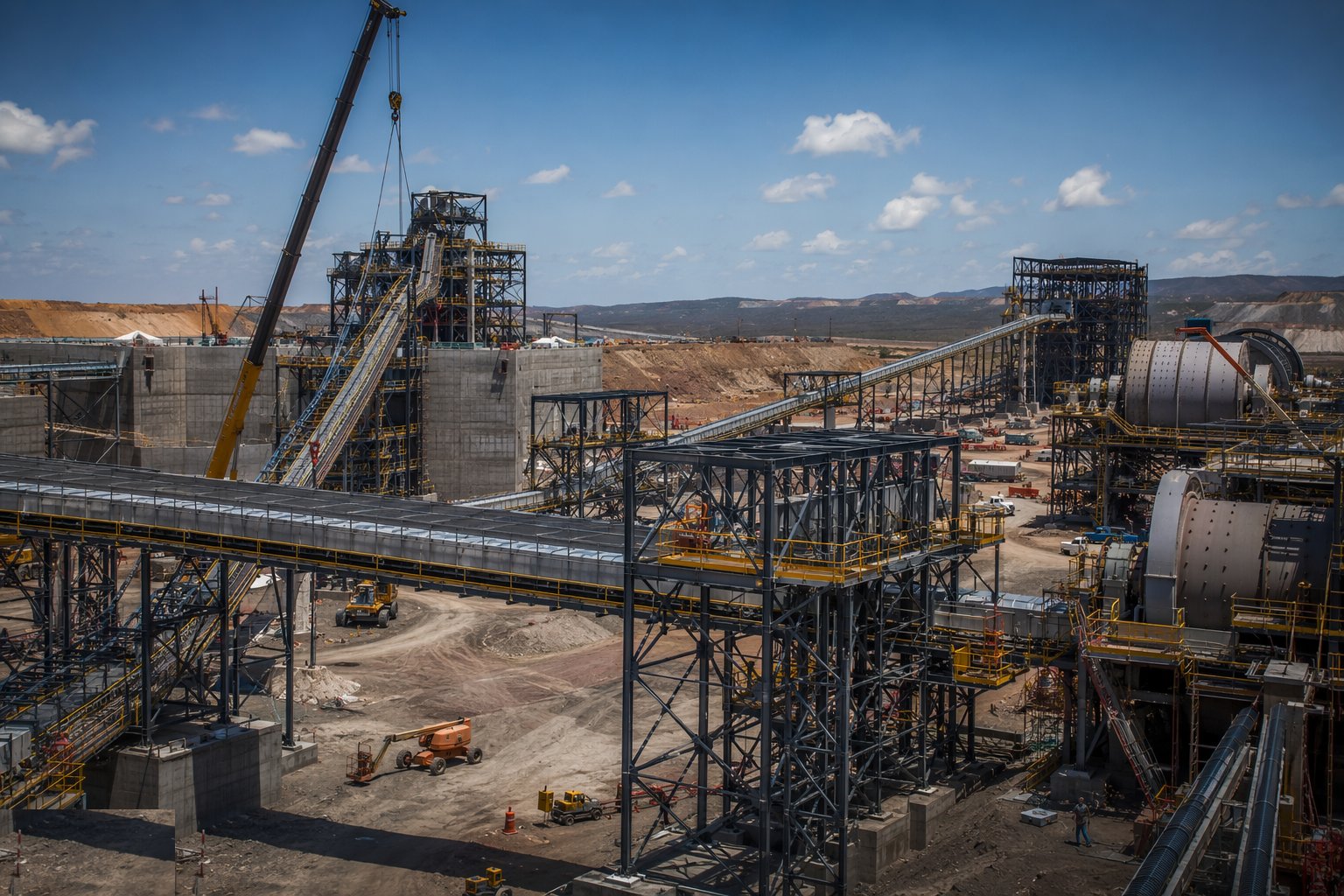
The conveying system goes up as modular steel: trestles set on their footings to line and level, gallery modules lifted and bolted between them, transfer towers erected plumb with their chute work fitted as access allows. Alignment is continuous survey work — belt centre lines, pulley positions and idler levels checked as the run grows — because tracking errors accumulate over kilometres and the belt finds every one. Pull-cord systems, walkways, guards and dust control fitments follow the steel, and the whole run is walked and signed section by section before belts are pulled in.
Step 4: Build the mill foundations and concentrator structure
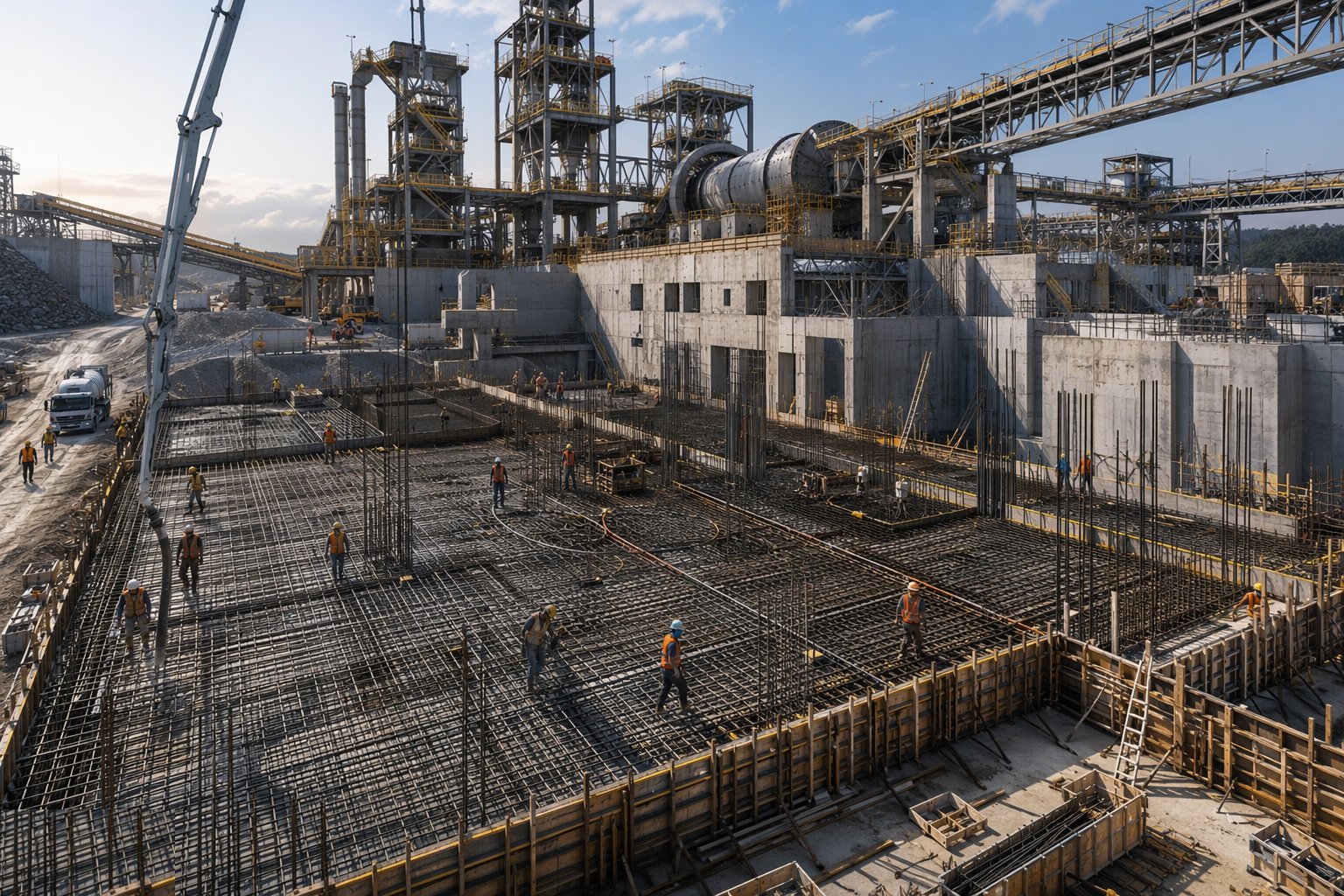
Mill foundations are poured as engineered inertia masses on the schedule the vendor's dynamic design demands: mass concrete with thermal monitoring, anchor and sole-plate systems set under template and survey control, and curing held until strength and stiffness criteria are met — not calendar days. The concentrator building rises around and above them: heavy columns and crane girders for the mill aisle cranes, floors and access steel around the flotation and classification levels, all sequenced so the crane is operational before the mill components arrive. Mill erection then runs as precision heavy lift: shells, heads, trunnions and drives set and aligned to the vendor's laser-tracked tolerances, grouted on their plates, and run in on the inching drive before the gears ever see load.
Step 5: Construct thickeners and tankage
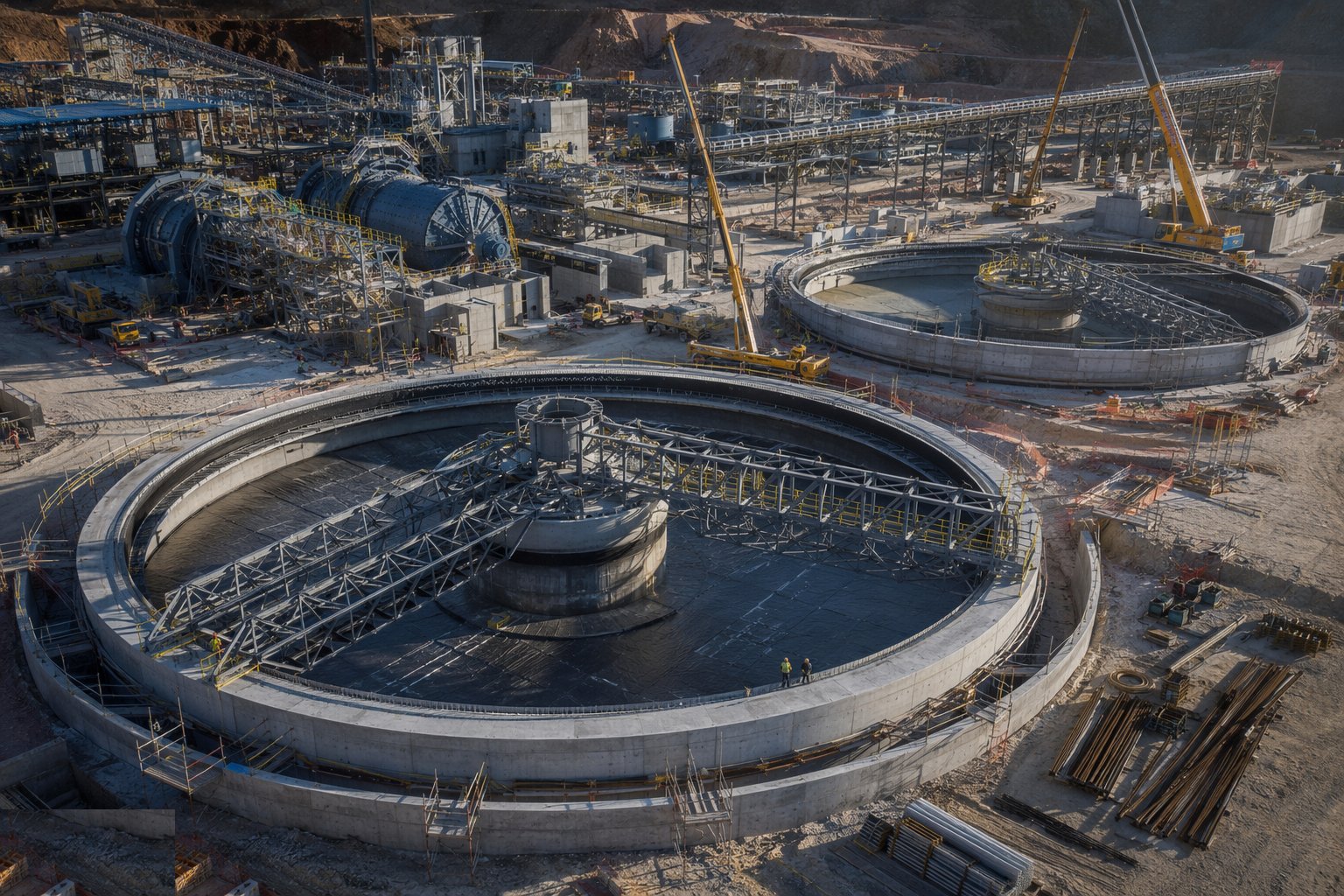
Thickeners and process tanks are ground-works and ring-beam jobs at scale: bases engineered and compacted to the settlement criteria, ring beams cast level to millimetre tolerance around the full diameter, and the tank itself — concrete or site-erected steel — built with its rake mechanism, bridge and feedwell assembled under the vendor's supervision. Levelness of the ring is the whole game: a few millimetres of tilt across the diameter is a rake dragging on one side and lifting on the other. Watertightness testing, liner or coating systems where the chemistry demands them, and the interconnecting launder and pipework complete the circuit.
Step 6: Install piping, electrical and controls
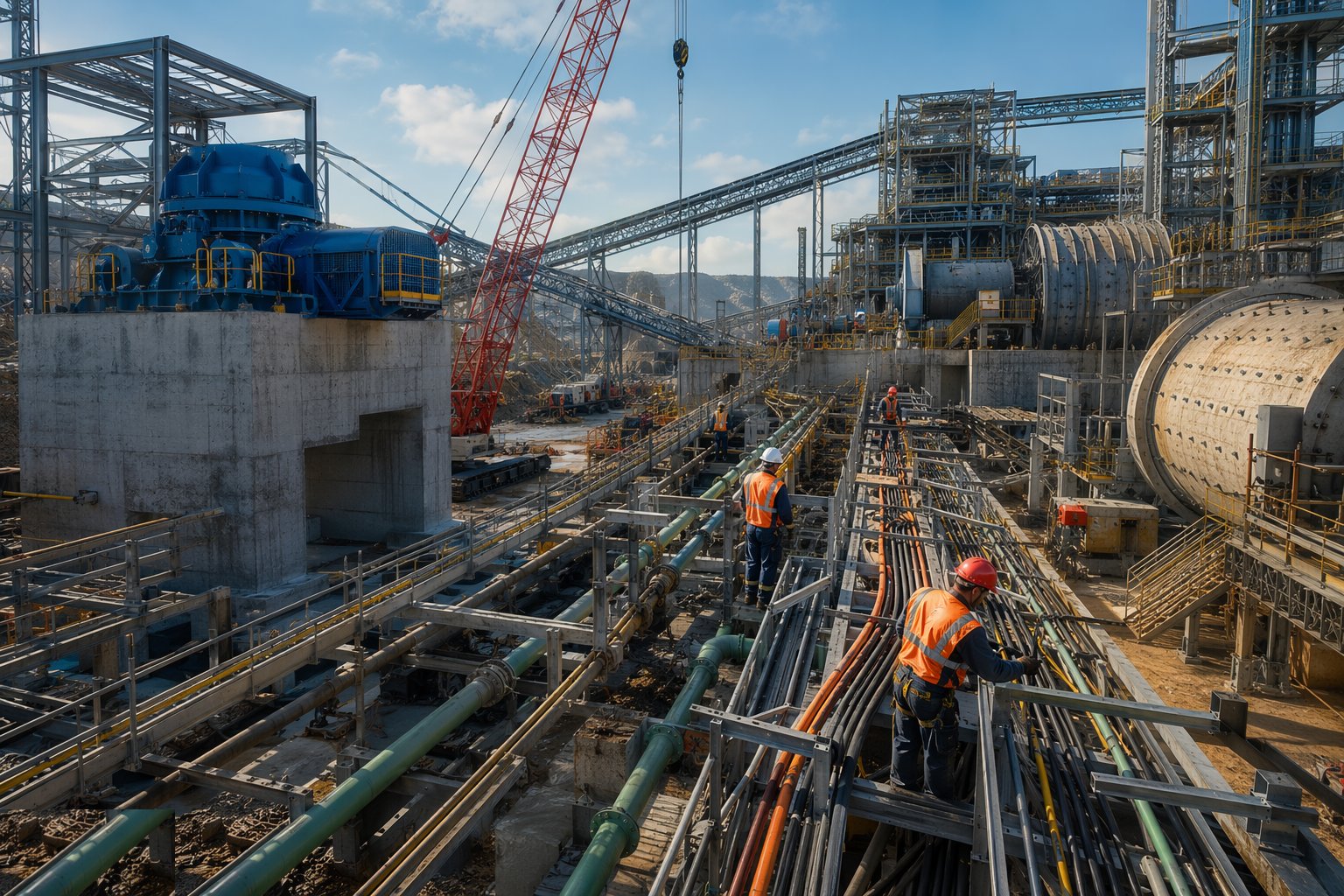
The services phase threads the plant together: slurry and process piping on its racks and sleepers with wear allowances and rodding access, power and control cabling to every drive, MCC and switch rooms fitted out and energised in sequence, and the control system commissioned loop by loop. Slurry piping is a maintenance artefact from day one — routed for access, sloped to drain, with the wear-prone bends in replaceable spools — because the first shutdown to cut out a buried elbow teaches the lesson expensively. Every motor is bumped for rotation, every interlock proven, every instrument calibrated and witnessed before water ever enters the circuit.
Step 7: Commission with water, then ore
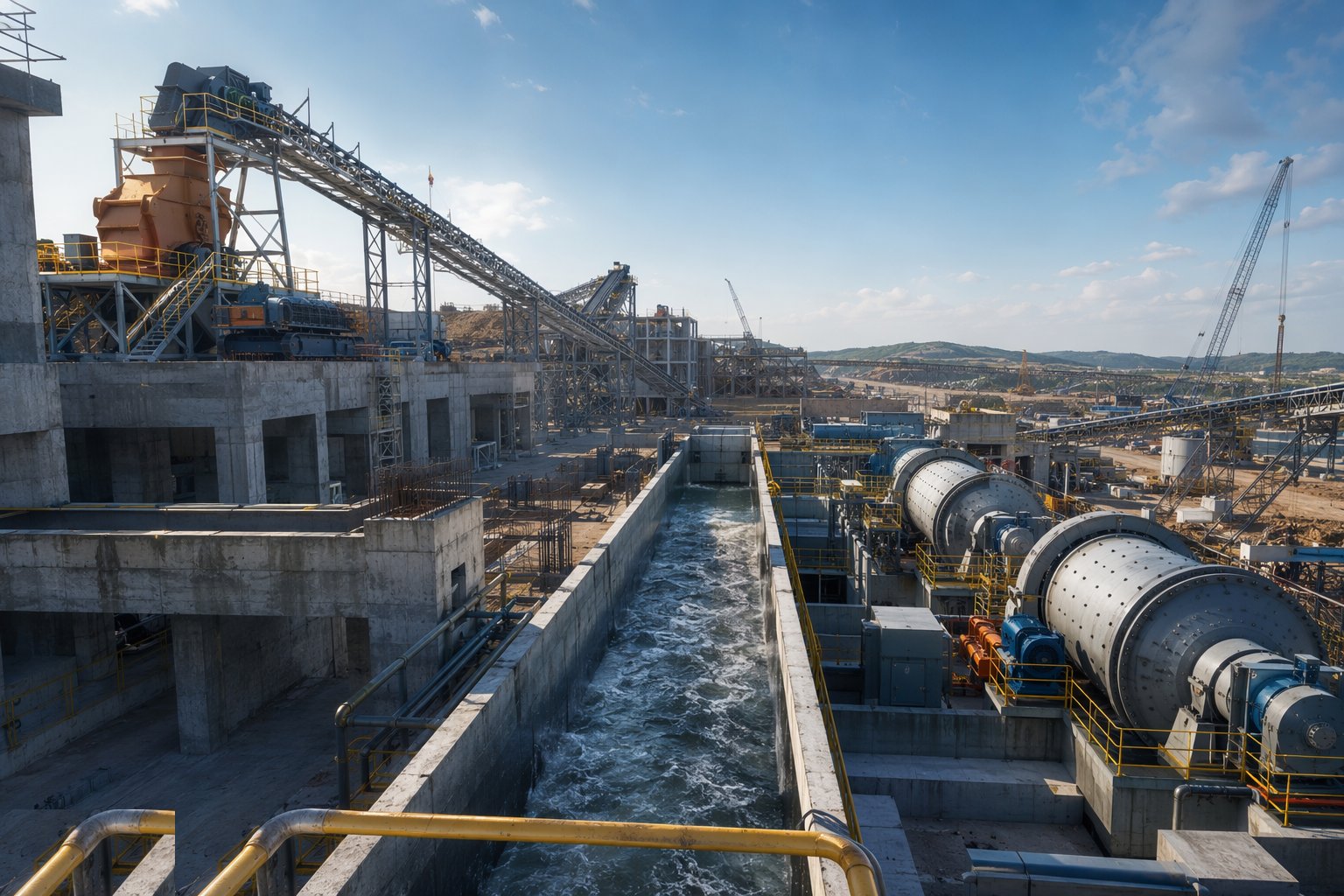
Commissioning runs as a staged proof: water trials through the circuits — pumps, valves, interlocks, conveyors running empty then loaded — shaking out the leaks, the tracking errors and the control logic without a tonne of ore at risk. Ore commissioning follows in steps: crusher to stockpile, then mill to cyclones, then the full circuit at creeping rates toward design tonnage, with the vendors' commissioning engineers embedded and every bottleneck logged and engineered out. Performance trials against the guaranteed throughput and recovery close the file — and the punch list that matters is the one about wear, access and maintainability, because those are the items the operations team will live with for thirty years.
Plant and equipment
- Heavy lift craneage: crawler and large mobile cranes for crusher, mill and gallery erection
- Concrete supply and pumping at industrial scale; ice or chilled water arrangements in hot climates
- Laser trackers, precision levels and total stations for equipment and conveyor alignment
- Structural steel and module erection gear: MEWPs, telehandlers, torque and tensioning equipment
- Specialist mill erection equipment: hydraulic jacks, trunnion handling frames, inching drives
- Welding and NDT resources for structural, tank and piping work
- Dewatering and ground-treatment plant for foundation excavations
- Commissioning water systems, temporary tanks and load-testing equipment
Quality control checks
- Foundation concrete records per pour: cubes, thermal monitoring, and pre-pour sign-off of templates and embedded items
- Anchor and sole-plate as-built surveys against vendor drawings before equipment setting
- Conveyor alignment certificates per run: centre line, level, pulley and idler surveys
- Ring-beam levelness surveys on thickeners and tanks; watertightness test records
- Weld maps and NDT records for structural steel, tanks and pressure piping
- Equipment alignment and grouting records signed by vendor representatives at each hold point
Safety considerations
- Heavy lifts as engineered events: lift studies, exclusion zones, competent supervision and no improvisation under suspended loads
- Confined spaces in pockets, chutes, tanks and galleries: permits, atmosphere testing and rescue arrangements
- Stored energy and rotating equipment during installation and commissioning: lock-out/tag-out rigorously enforced
- Work at height on galleries, towers and concentrator steel: collective protection and disciplined MEWP use
- Dust, noise and vibration exposure around crushing and screening work: suppression, monitoring and PPE
- Chemical and process hazards during hydromet plant commissioning: reagent handling procedures and emergency showers before first fill
Common defects
- Anchor bolts and embedded frames out of position — equipment re-engineered on site at crane-day rates
- Mill and crusher foundations poured with cold joints or thermal cracking from unmanaged mass concrete
- Conveyor misalignment accumulating over the run: tracking problems, spillage and belt wear for the life of the plant
- Thickener ring beams out of level: rakes binding, mechanisms overloaded, circuits stopped
- Differential settlement between structures misaligning the conveyors and pipework that connect them
- Commissioning compressed to hit first ore: water trials skipped, and the leaks, interlocks and tracking faults discovered with ore in the circuit
Best suited for
- Hard-rock concentrators where mill and crusher foundations set the plant's availability for decades
- High-throughput crushing and conveying systems where alignment is a production specification
- Hydrometallurgical plants where containment and corrosion protection are the design brief
- Remote and modular plants where civils must be minimal, fast and exactly right first time
How long does Mineral Processing Plant Construction take?
Typical duration: A mid-scale concentrator — crushing, grinding, flotation and thickeners — typically runs 18–30 months from first concrete to ore commissioning; the heavy foundation programme occupies the first year, and commissioning the final three to six months..