Dredging & Land Reclamation
Winning depth from the sea and winning land from it too — trailer suction hopper and cutter suction dredgers, hydraulic fill placed behind rock or geotextile bunds, then the patient business of ground treatment, surcharge and settlement monitoring before anything is built on the new ground.
Last updated 2026-07-28 by the BuildPedia Editorial Team.
What is Dredging & Land Reclamation?
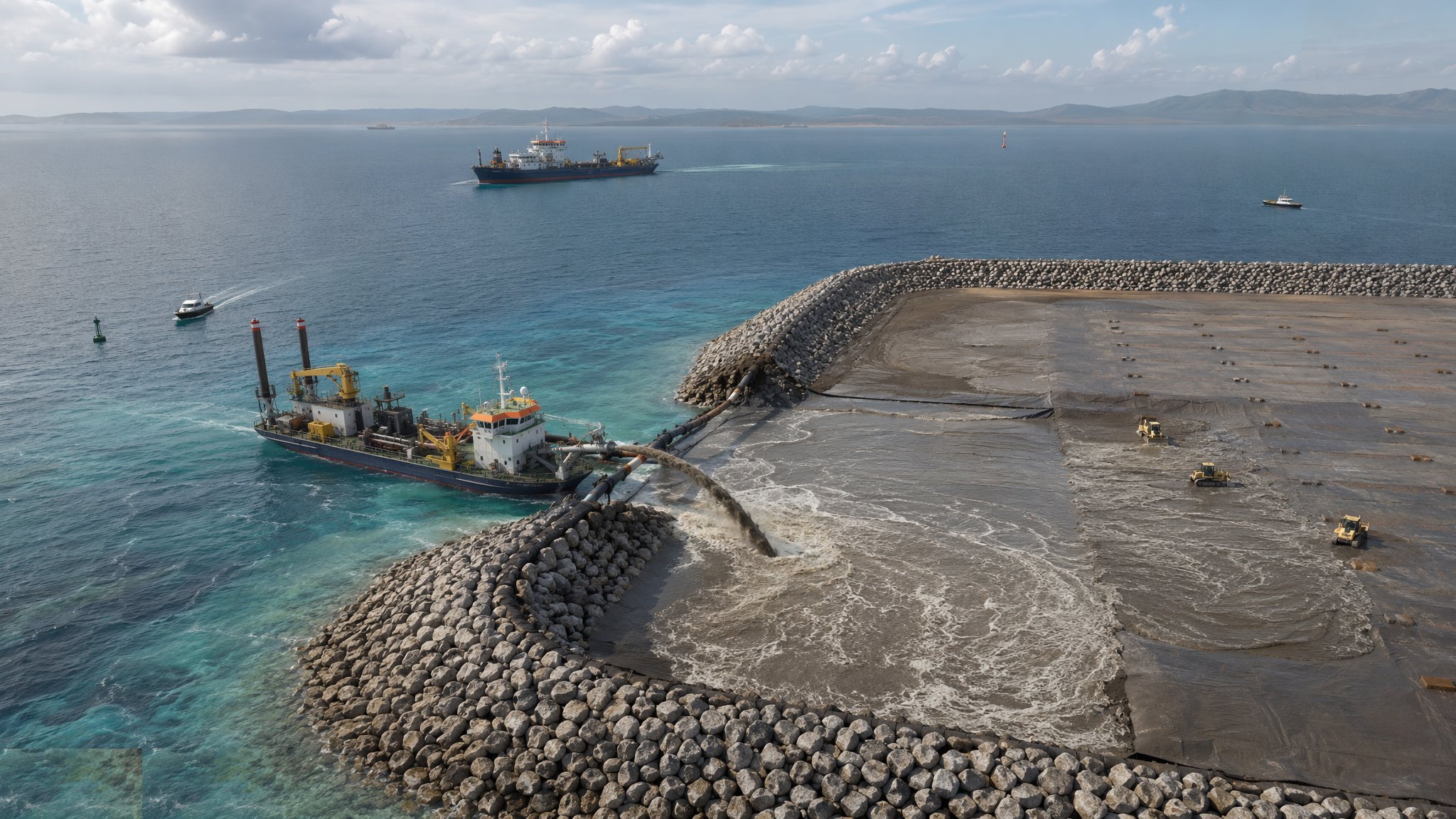
Dredging serves two masters in port work. Capital dredging cuts depth where nature did not put it: berth pockets, approach channels and turning basins taken down to chart datum so the design vessel can float. Maintenance dredging keeps it there against the silt that every estuary returns. Reclamation is the mirror image: material won from the seabed — sand from a borrow area, or the dredged arisings themselves where they are clean enough — is placed behind containment bunds to build new land for terminals, and the fill, the bund and the sea between them are engineered as one system. The plant defines the method: a trailer suction hopper dredger sails as it dredges, dragging its suction heads and hauling the load to the reclamation or disposal site, while a cutter suction dredger sits on spuds, chews the seabed with its rotating cutter head and pumps the slurry through a floating pipeline to the placement point.
A reclamation is built from its edges inward. Containment bunds — rock-armoured dykes, or geotextile tubes stacked in the shallows — close the area and give the fill somewhere to settle. Hydraulic fill arrives as a slurry and is managed like a process: discharge points moved to grade the placed surface, weirs and decant structures controlling the water that runs back to the sea, fines retained where the specification wants them and released where the environmental permit allows. Dry placement by end-tipping suits nearshore work above water; rainbowing from a hopper's bow jet suits placement over distance. Either way, the new ground is born weak — loose, saturated and nowhere near ready for a container yard.
That is where the patience comes in. Reclaimed sand is densified by vibrocompaction or dynamic compaction to the relative density the pavement and crane loads demand. Where the reclamation or the seabed beneath it holds soft clay, the programme is written by consolidation: prefabricated vertical drains stitched into the ground to shorten the drainage path, a surcharge mound heaped on top to squeeze the water out early, and instrumentation — settlement plates, piezometers, extensometers — telling the engineers week by week how much settlement is done and how much is still owed. Nobody builds on reclaimed land because the calendar says so; they build when the monitoring says the ground has finished its argument.
When and why is Dredging & Land Reclamation used?
This process runs whenever a port needs depth or land it does not have: new terminals on reclaimed footprints, deepened approach channels for bigger ships, and the steady maintenance campaigns that keep published depths honest. The dredger choice is made on material and distance — hoppers for sandy material and long hauls, cutters for stiff ground and short pumping distances, backhoes for the tight corners — and the ground treatment is chosen by what the new land must carry and when. It matters because reclamation compresses decades of geology into a construction programme, and the shortcut is always visible later: pavements that dish, crane rails that snake, utilities that snap at the settlement step. Done properly, with the instrumentation believed and the surcharge left on long enough, reclaimed ground carries ports for generations; rushed, it carries claims.
Types of Dredging & Land Reclamation
Trailer suction hopper dredging (TSHD)
Self-propelled hoppers dredging while underway through dragheads, hauling to reclamation or disposal and discharging by bottom doors, pump-ashore or rainbow jet. The bulk mover: unbeatable on sand over long distances, useless in tight corners or stiff clay.
Cutter suction dredging (CSD)
A stationary dredger on spuds with a rotating cutter head loosening the ground and pumping it as slurry through floating and shore pipelines direct to placement. Continuous, accurate and at home in firm materials — the production engine of big reclamations.
Backhoe and grab dredging
Excavator-on-pontoon or grab crane dredging into split-hopper barges for disposal or placement. Slow but precise — the method for berth pockets, quay toes, around structures and anywhere the big plant cannot reach.
Hydraulic fill reclamation behind bunds
Slurry placement inside rock or geotextile-tube bunds with controlled decanting through adjustable weirs. The standard way to build port land from sea sand: graded fills, contained fines and a placed surface the survey can accept.
Ground treatment of reclaimed land
Vibrocompaction and dynamic compaction for sands; prefabricated vertical drains with surcharge preloading for soft clays. Not a dredging method but the half of the job that turns placed fill into building ground.
Dredging & Land Reclamation: step by step
Step 1: Survey the seabed and build the ground model
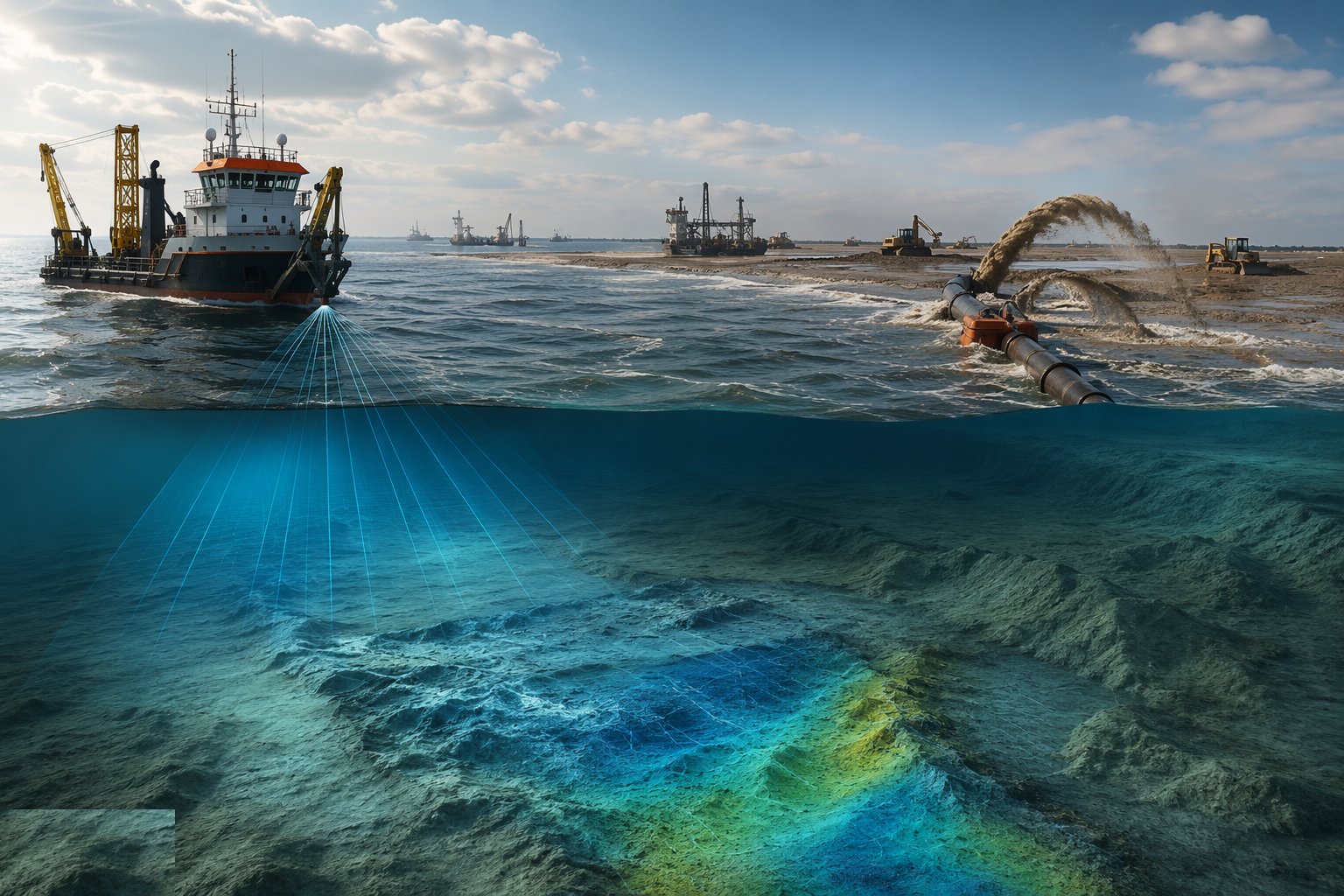
Nothing moves until the seabed is known: multibeam bathymetry of the dredge and borrow areas, sub-bottom profiling for the geology, grab samples and boreholes for the material, and the environmental baseline the licence hangs on. The ground model decides the plant, the production rates and where the fill can go — a campaign planned on a chart and a prayer finds out about the rock ridge or the contaminated pocket at day rates nobody budgeted.
Step 2: Construct the containment bunds
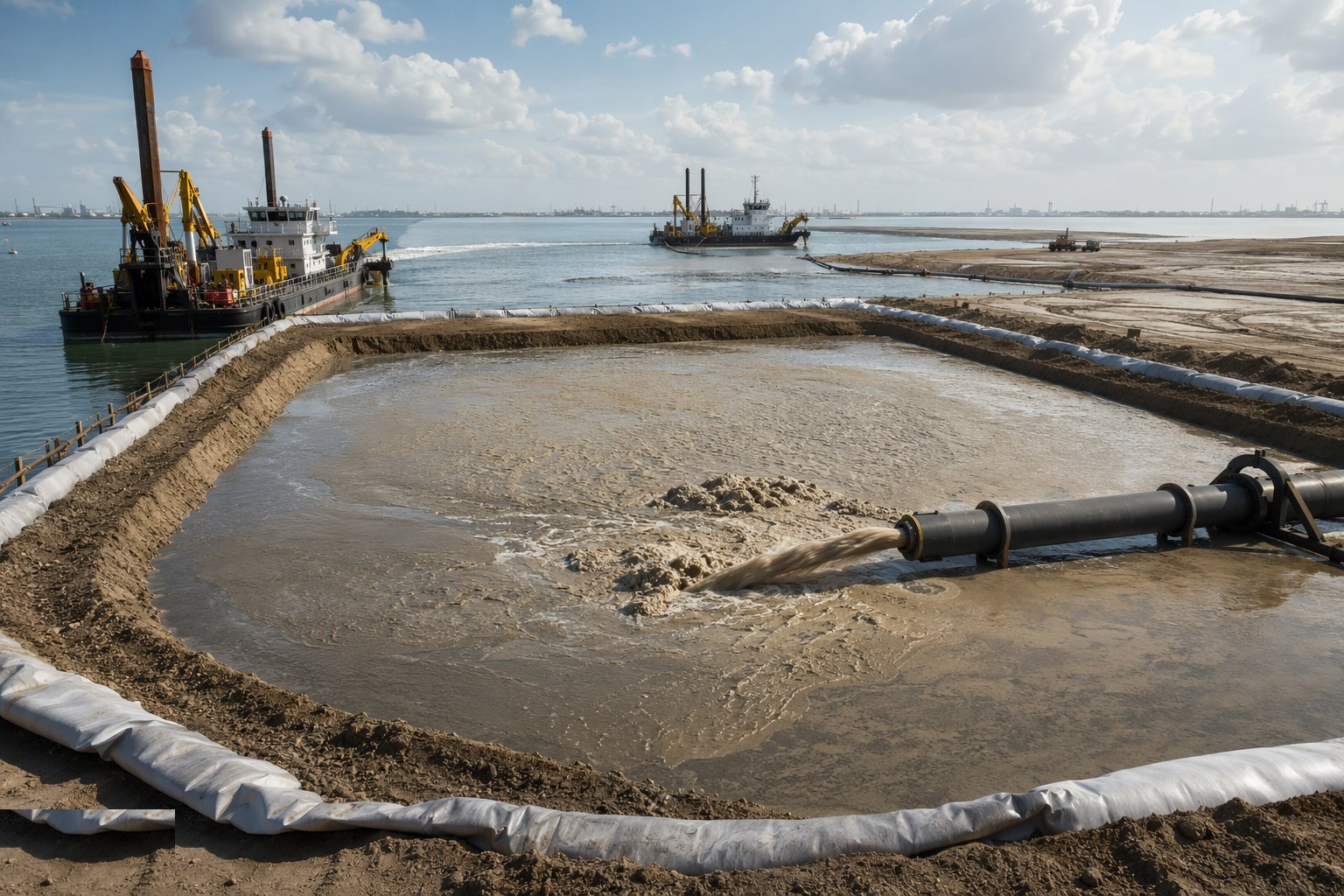
The reclamation is closed before it is filled. Rock bunds are end-tipped or placed by barge, founded on prepared beds with geotextile separators where the seabed is soft, and armoured against the weather the site actually gets. Geotextile tubes are filled hydraulically and stacked in the shallows where rock is scarce. Bund crests are built ahead of the filling with margin for settlement — a bund that overtops or slips mid-fill is an environmental incident with a programme attached.
Step 3: Dredge and place the fill
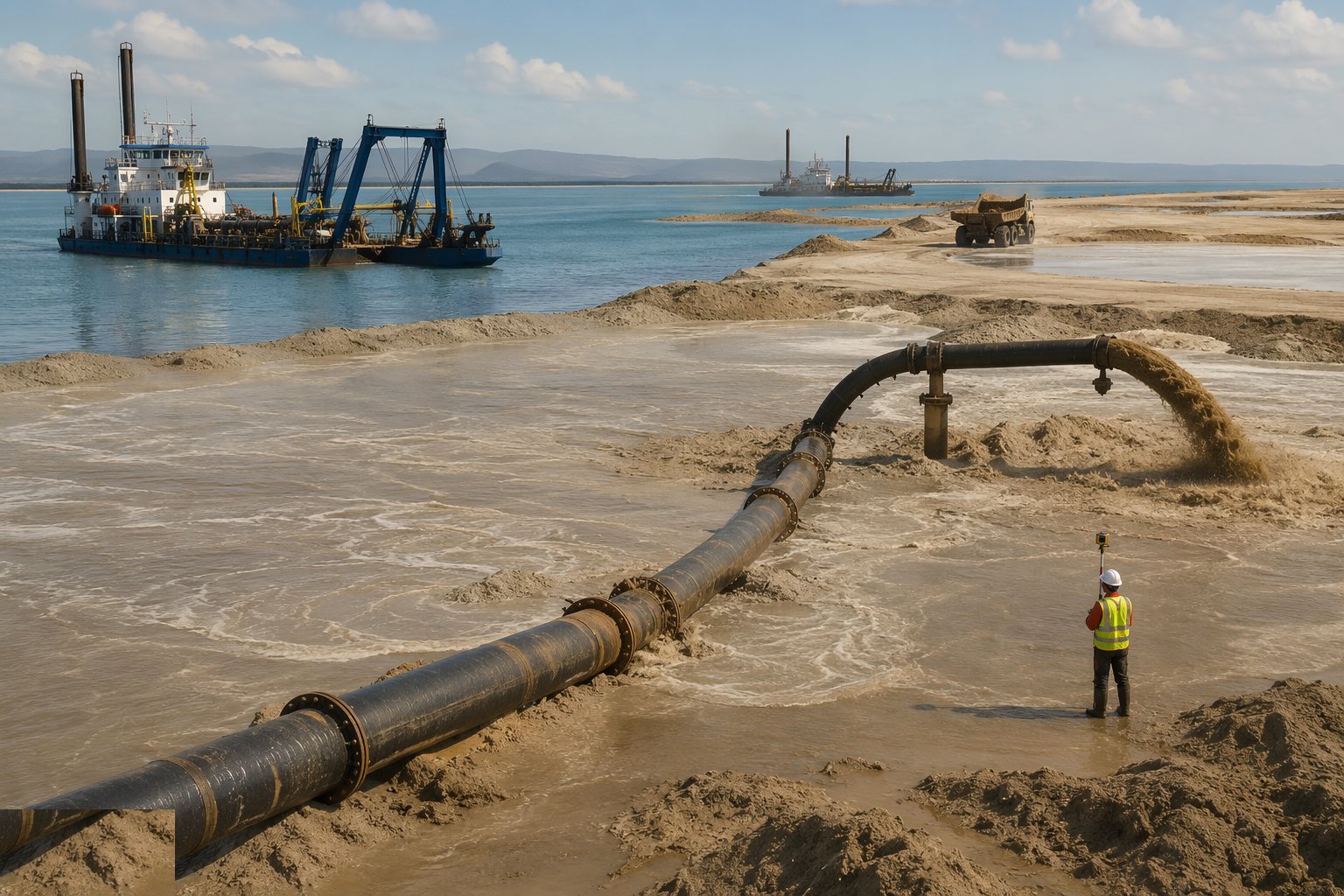
Production dredging runs to the cut lines and levels from the survey system on board — hoppers cycling to the borrow area, cutters pumping through the pipeline — and the fill placement is managed as carefully as the digging: discharge points moved to grade, decant weirs adjusted to hold the fines the spec wants, pipeline sections walked and watched. Environmental controls run continuously: turbidity monitoring at the boundary, silt curtains where sensitive receivers sit, and the licence limits treated as hard stops, not targets.
Step 4: Grade and proof the placed surface
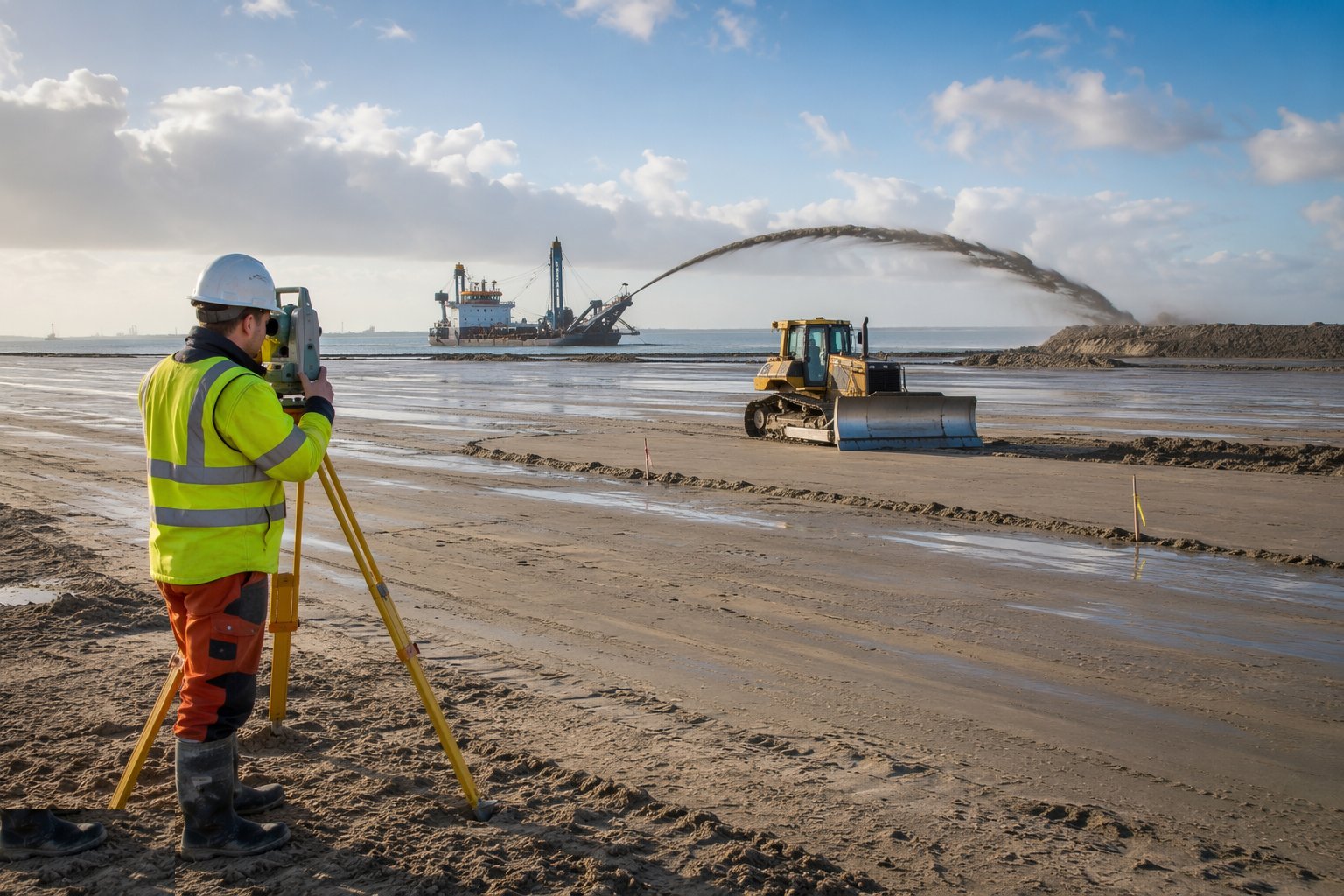
As placement completes, the fill is trimmed to formation by dozers and graders working the new ground, with levels taken by survey against the design surface. The placed fill is tested — density, gradings, the thickness of any fines lenses — because the ground treatment design assumes a material, and the reclamation's job is to have delivered it. Low areas are topped up; soft pockets found now are cheap, found under a pavement they are not.
Step 5: Improve the ground
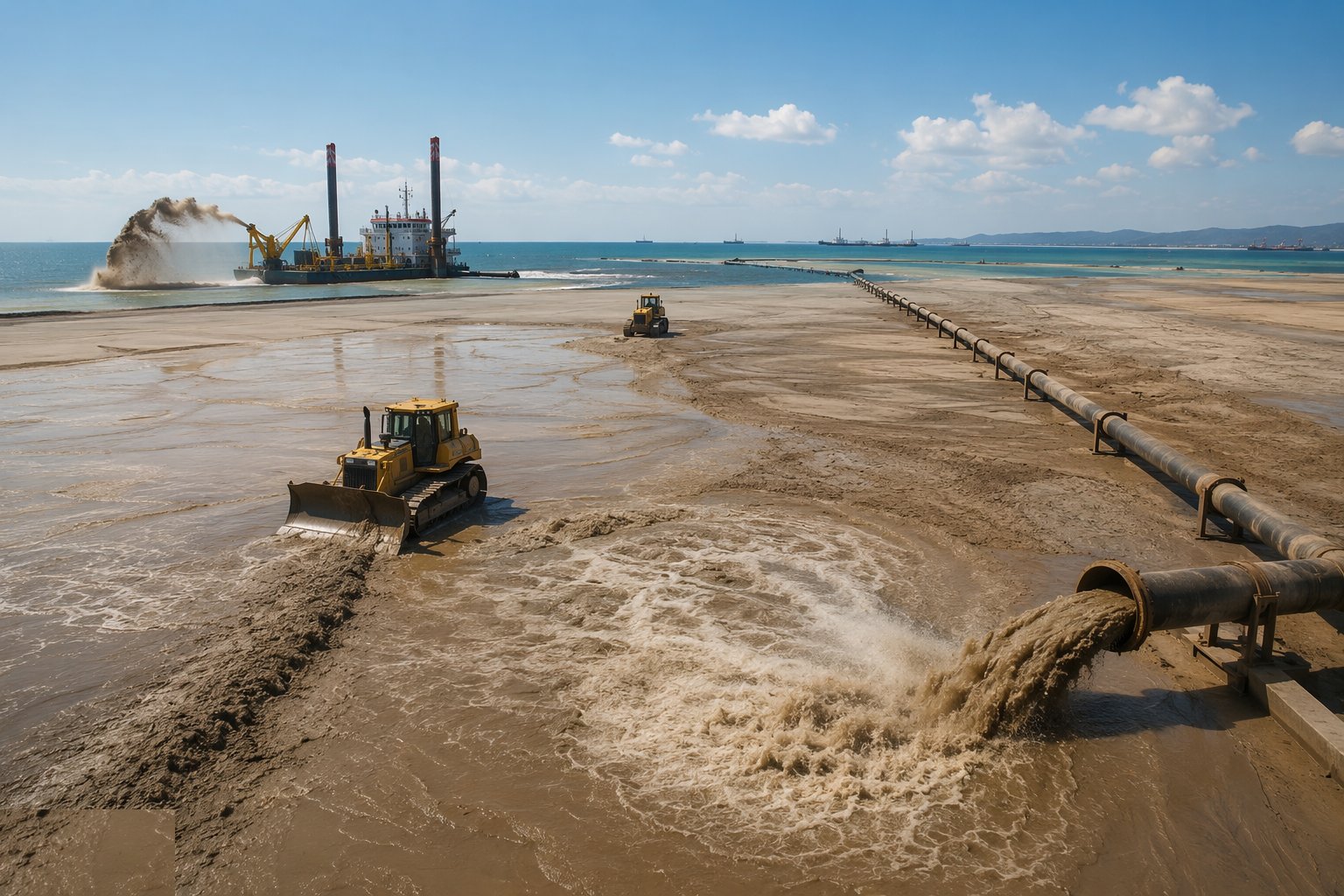
Sands are densified in passes: vibroflots sinking and compacting on a grid, or dynamic compaction dropping the pounder on a pattern until the crater depths and heave tell the designer the ground has tightened. Where soft clay rules, vertical drains are stitched in on their grid, drainage blankets laid, and the surcharge mound heaped over the top to preload the ground — the fill's settlement, spent early, where it costs nothing. Compaction is verified by testing between passes, not assumed from the machine's hours.
Step 6: Monitor settlement until the ground is done
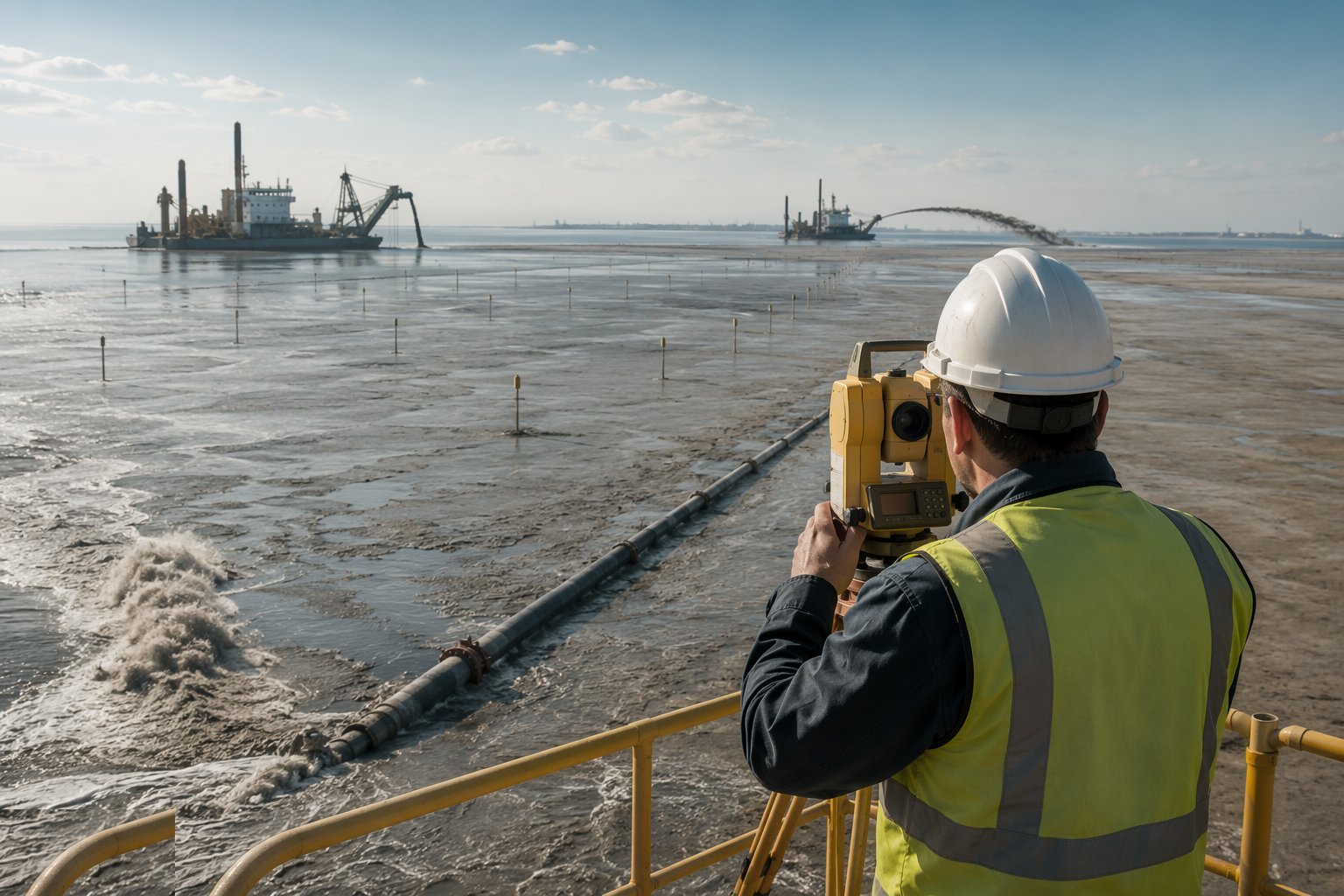
Settlement plates, piezometers and extensometers are read on their schedule and plotted against the consolidation prediction: the curve of settlement against time that decides when building may start. The degree of consolidation is calculated from the readings, the surcharge comes off when the model and the measurements agree, and the residual settlement allowance is set for the works above. Skipping this evidence is how terminals end up relaying pavements in year two.
Step 7: Accept the depth and the land
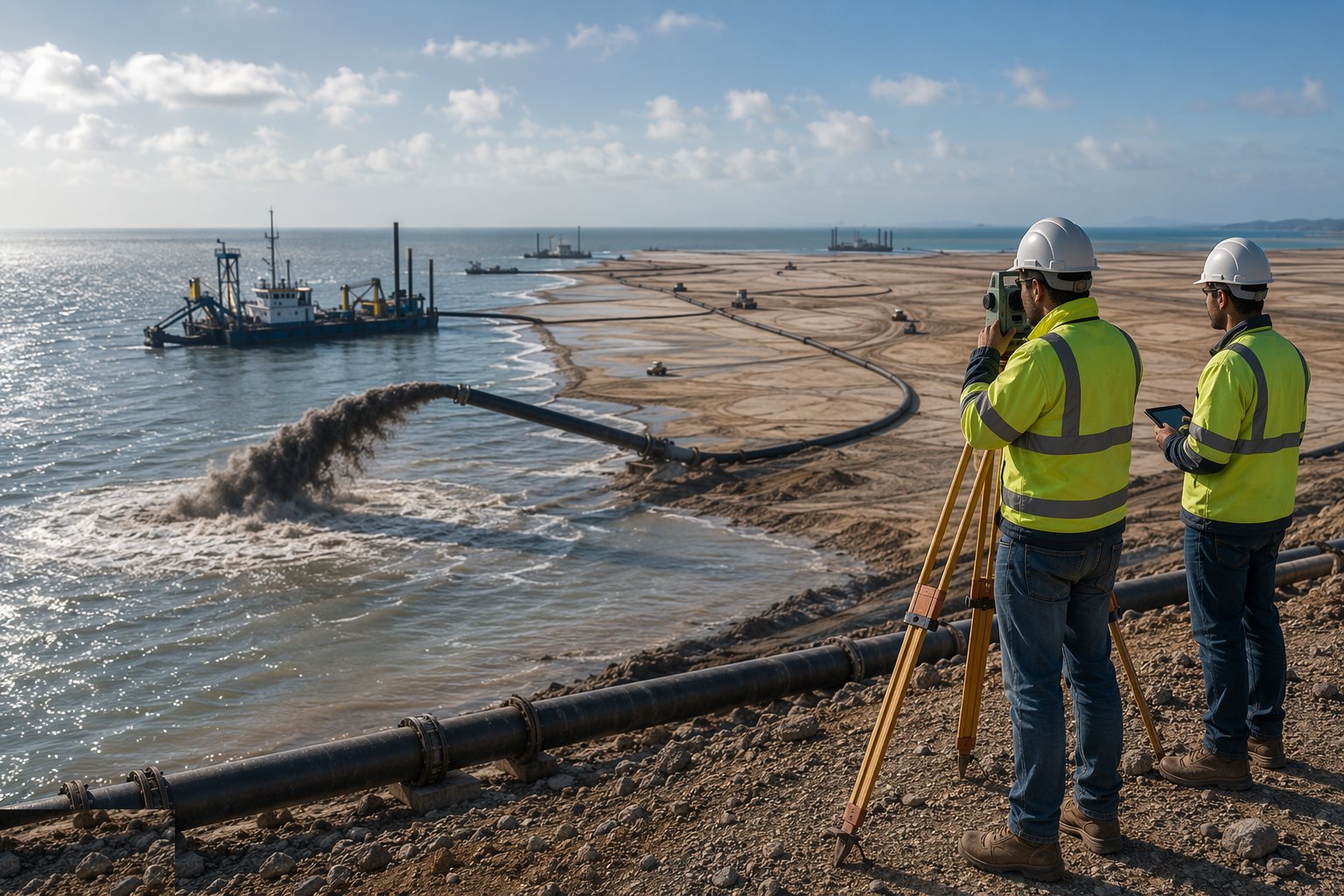
Dredged areas are proven by post-dredge multibeam survey — every square metre at or below the required depth, high spots re-dredged and re-surveyed — and the reclamation is accepted on levels, compaction and settlement records together. The file goes to the port and the designer: surveys, testing, instrumentation histories and the residual settlement statement the pavement and foundation designers will build on. The sea keeps its survey and the port keeps its new ground; everyone else keeps the records.
Plant and equipment
- Trailer suction hopper dredgers and cutter suction dredgers with floating pipelines
- Backhoe and grab dredgers, split-hopper barges and tugs
- Rock placement barges, side-stone dump vessels and geotextile-tube filling spreads
- Multibeam survey vessels and in-dredger survey and production monitoring systems
- Vibroflotation rigs and dynamic compaction cranes with pounders
- Vertical drain stitchers, dozers and graders for surcharge and trim
- Settlement plates, piezometers, extensometers and the reading schedule that serves them
- Silt curtains, turbidity buoys and environmental monitoring kit at the licence boundary
Quality control checks
- Pre- and post-dredge multibeam surveys against required depth and side slopes
- Fill material testing: gradings, fines content and placed density against the treatment design
- Bund construction records: geometry, armour placement and geotextile installation checks
- Ground improvement verification — zone testing, crater records or penetrometer results between passes
- Settlement and pore pressure readings plotted against the consolidation prediction until acceptance
- Environmental monitoring records — turbidity, decant quality — kept inside licence limits throughout
Safety considerations
- Marine traffic management: exclusion zones, notices to mariners and absolute radio discipline around working dredgers
- Floating pipelines and discharge gear as navigation and snagging hazards — lit, marked and patrolled
- Work over water from barges and pontoons: buoyancy aids, safety boats and recovery plans
- Dynamic compaction exclusion zones — flying debris and vibration controlled around every drop
- Soft-ground working: plant on new fill working to assessed bearing, with rescue from bogged machines planned
- Weather and sea-state limits on every operation, with demobilisation triggers agreed before the season turns
Common defects
- Underdredged pockets and high spots left in the berth box, found by the acceptance survey — or the first ship
- Fines losses or turbidity exceedances at the decant, stopping production at the licence limit
- Bund slope failures or overtopping during filling — fill released, programme lost, permit questioned
- Residual settlement beyond allowance where surcharge came off before the instrumentation agreed
- Loose zones missed by the compaction verification — pavement and rail settlements with a pattern
- Mud waves and remoulded clay trapped under fill, moving the new ground sideways as it consolidates
Best suited for
- New port land and terminal platforms reclaimed from shallow water
- Capital deepening of approach channels, turning basins and berth pockets
- Beneficial use schemes placing dredged material as engineered fill
- Soft-ground sites where surcharge and vertical drains buy settlement out of the programme
How long does Dredging & Land Reclamation take?
Typical duration: A 50–200 hectare reclamation is a 12–36-month filling campaign with bund construction ahead of it; soft-ground treatment adds 6–18 months of surcharge and monitoring before the land can be built on — the one item no programme has ever successfully bullied..