Pitches, Tracks & Playing Surfaces
Building the thing the whole venue exists for: natural turf profiles over engineered drainage, synthetic 3G carpets, polyurethane running tracks — all laid to millimetre tolerances and proven by independent certification testing.
Last updated 2026-07-28 by the BuildPedia Editorial Team.
What is Pitches, Tracks & Playing Surfaces?
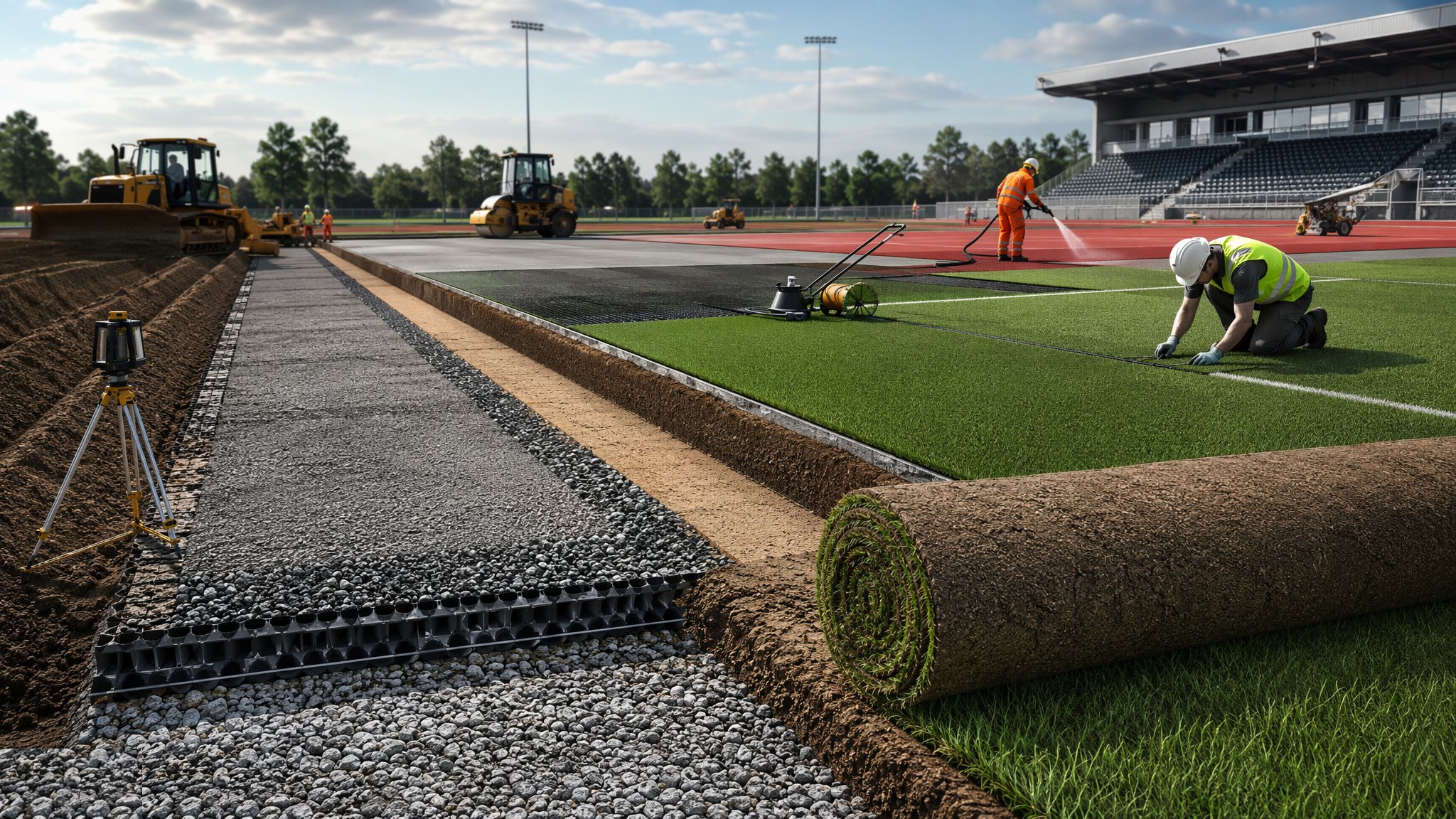
A playing surface is a piece of civil engineering disguised as grass. A natural turf pitch is built as a layered profile: the subgrade shaped to falls, piped drainage laid beneath it, then a gravel drainage blanket or sand slits, then the rootzone — 100–300 mm of specified sand or sand-soil mix that the grass actually grows in, chosen for drainage and stability rather than fertility. On top of that go the systems that keep it alive at professional intensity: pop-up irrigation, and at the top end undersoil heating pipes or electric heating woven through the rootzone. The falls are subtle — typically 1:60 to 1:100 — and the finished surface has to hold them to within millimetres across ninety metres, because a football pitch that ponds is a football pitch on the news.
Synthetic surfaces replace the biology with materials engineering. A 3G football or rugby pitch is a long-pile carpet (40–65 mm) filled with a graded sand layer and a performance infill — traditionally crumb rubber, increasingly organic infills such as cork or olive stone — laid over a shockpad on an engineered asphalt base. The much-marketed "4G" is a no-infill system, but the certification world still tests it against the same standards. Athletics tracks are polyurethane systems — sandwich or full-pour — laid 13–15 mm thick over asphalt, with the same obsession underneath: the base, the falls, the regularity. Courts sit on porous macadam or concrete with acrylic colour coats sprayed and squeegeed on top.
What makes this work specialist is that the surface is not accepted by eye — it is certified by test. Football pitches are tested to the FIFA Quality programme (ball rebound, ball roll, shock absorption, rotational resistance, surface regularity); athletics tracks are certified under World Athletics rules with evenness, thickness and performance tests by accredited laboratories; rugby has its own World Rugby standards. The tests are run on the finished field by independent test institutes, and a failure at certification — a soft spot, a seam, a fall that holds water — is a construction defect found in public. So the whole process is built backwards from the test: the base tolerances, the drainage rates and the laying discipline are all set to pass it.
When and why is Pitches, Tracks & Playing Surfaces used?
Playing surface construction comes late in a venue programme — after the heavy works are clear of the pitch footprint — but it dictates early decisions: the drainage outfalls, the irrigation supply, the kerb lines, the tolerances the earthworks must hand over. It is specialist work because the tolerances are unforgiving and the failure modes are public. A warehouse floor can be out by 10 mm and nobody knows; a pitch out by 10 mm holds a puddle on television. The surface also has a biological or chemical clock: natural turf needs a grow-in period of eight to twelve weeks minimum before it can take play, and polyurethane tracks need curing conditions, so the surface programme is fixed backwards from the first fixture just as rigidly as the stadium structure is. Get the base wrong and every layer above inherits the mistake — which is why the money and the surveying go into what nobody will ever see.
Types of Pitches, Tracks & Playing Surfaces
Natural turf on an engineered profile
Rootzone over drainage layer over piped drainage — from simple soil-based pitches with slit drains to full suspended water-table or USGA-style sand profiles. The professional standard: drains at close centres, gravel blanket, 250–300 mm of specified sand rootzone, big-turf or seeded finish, with irrigation and often undersoil heating at elite level.
Hybrid and stabilised turf
Natural grass reinforced with synthetic fibres stitched or tufted into the rootzone, or laid as hybrid big-roll turf. The elite stadium default now: it looks and plays as grass but survives the wear of a stadium that also hosts concerts — at the price of a demanding construction and maintenance regime.
3G artificial turf (and "4G" no-infill systems)
Long-pile synthetic carpet with sand and performance infill over a shockpad, on engineered asphalt over a free-draining stone base. The community and training-workhorse surface: playable in all weathers, hour after hour — provided the base drainage and the seams are built right, because a 3G pitch is only ever as good as its base and its joints.
Polyurethane athletics tracks
Seamless PU systems — sandwich (granule base mat with PU seal and wear layers) or full-pour (solid polyurethane) — laid over tight-tolerance asphalt. Certified under World Athletics rules for evenness, thickness and performance; the 400 m oval with its D-areas is a geometry exercise as much as a surfacing one.
Acrylic and macadam courts
Tennis, netball and multi-use games areas: porous macadam or concrete bases with acrylic colour-coat systems, cushioned acrylics, or polymeric surfaces. The skills are in the base regularity, the porosity for drainage, and the line marking — a court is a small surface with the same big tolerance expectations.
Pitches, Tracks & Playing Surfaces: step by step
Step 1: Form the subgrade and establish the falls
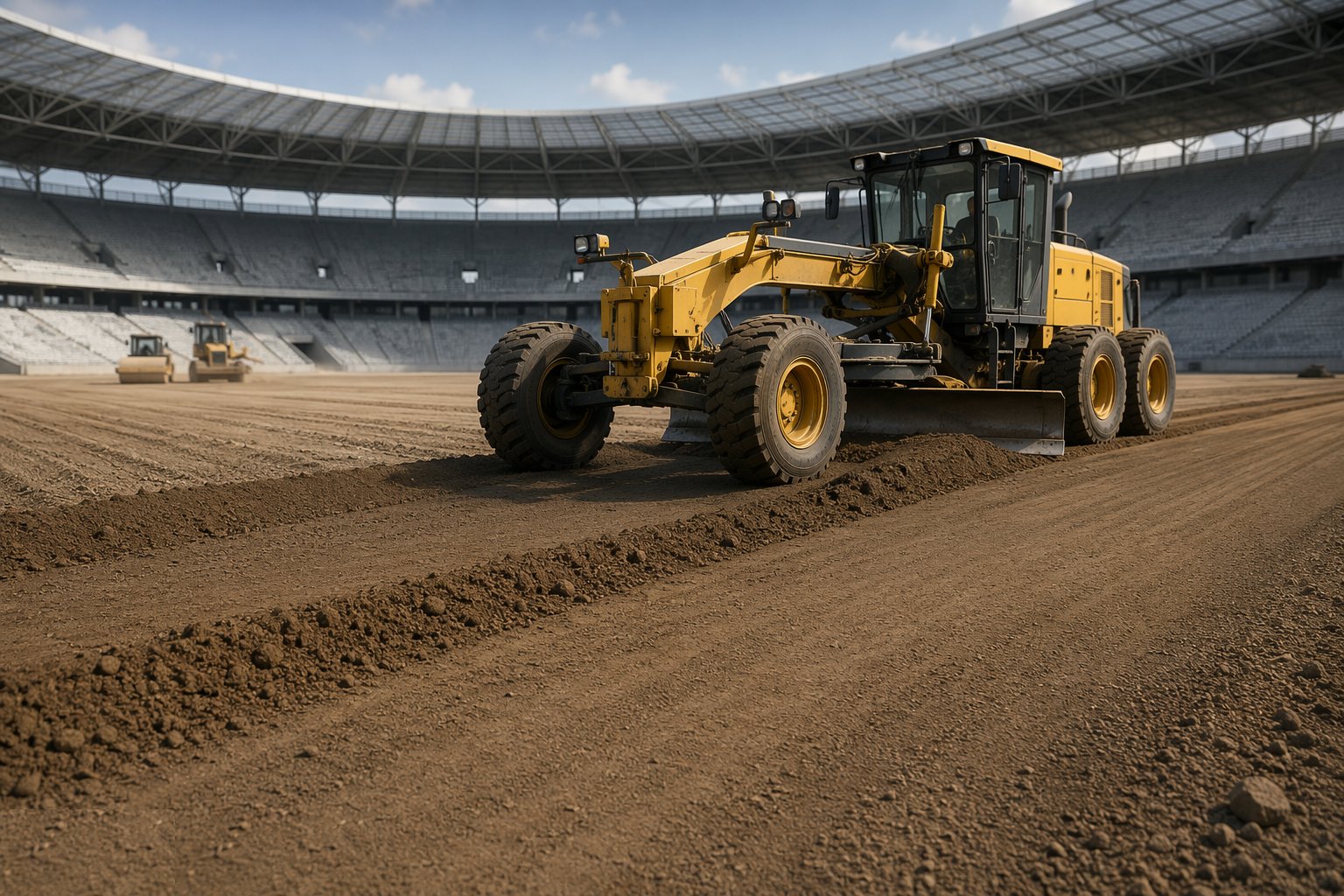
The pitch starts as an earthworks exercise with a surveyor's temperament. The subgrade is cut and filled to formation, compacted and proof-rolled, and shaped to the design falls — shallow, consistent gradients across the whole field, with no local dips, because every hollow in the subgrade reappears in the finished surface a year later. Levels are taken on a tight grid, not by eye across the field; a 10 mm error here is a birdbath in the goalmouth. The formation is then protected: construction traffic is routed off it, because a compacted trackway through the rootzone zone is a drainage dead spot with wheels on it.
Step 2: Install the drainage system
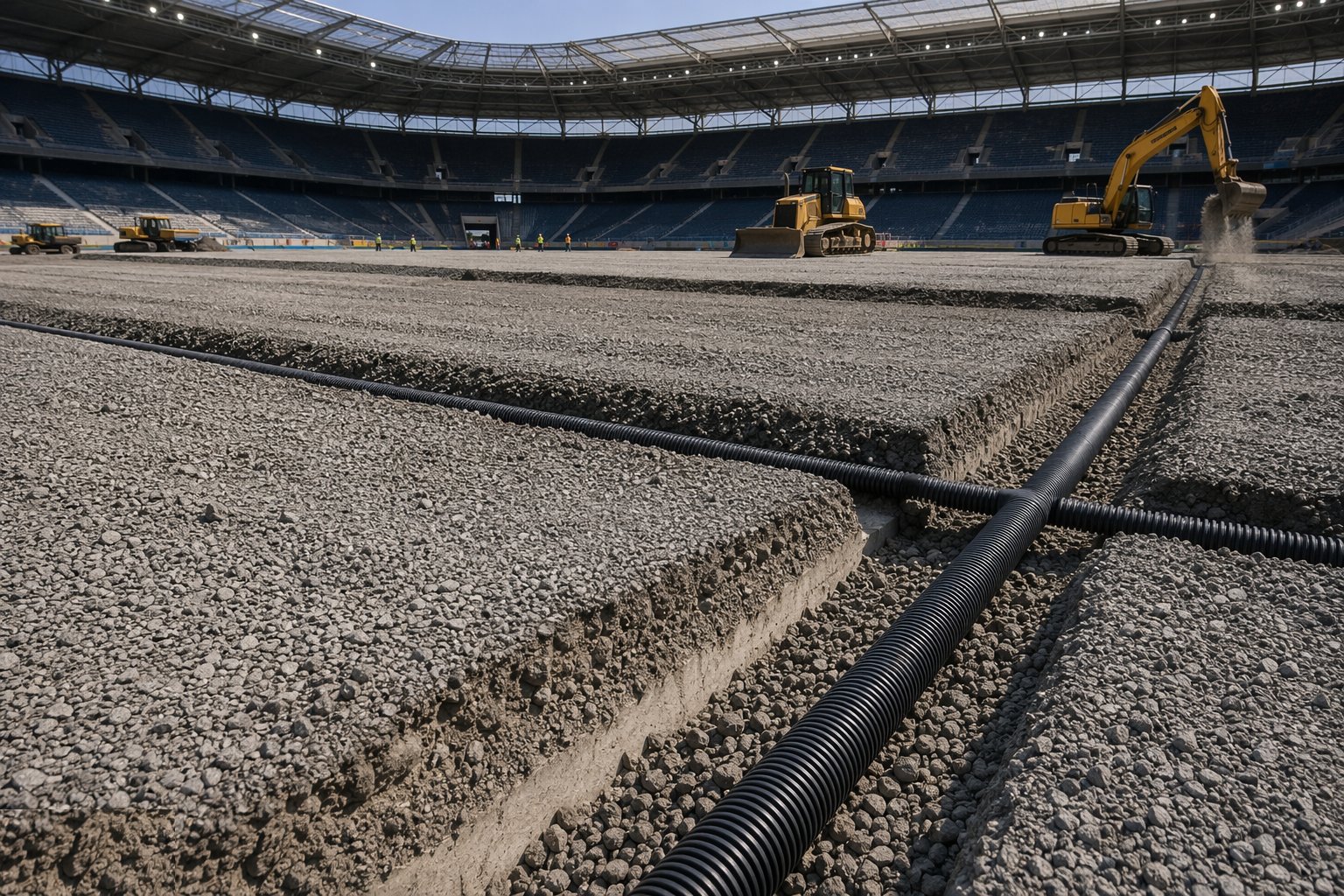
Primary drainage — perforated pipes in gravel trenches, typically at 4–6 m centres on a full spec pitch — is laid to falls into collector drains and outfalls, with chambers and silt traps where the design puts them. Secondary drainage follows where specified: sand slits or gravel bands cut at close centres across the primary system to pull water off the surface fast. Every run is surveyed as laid, because a pipe laid flat or uphill is a length of pitch that will drain never. On synthetic pitches the drainage philosophy changes — the stone base itself is the drainage layer — but the outfall discipline is identical: water must leave the site legally and reliably, or the surface above it drowns.
Step 3: Build the engineered base
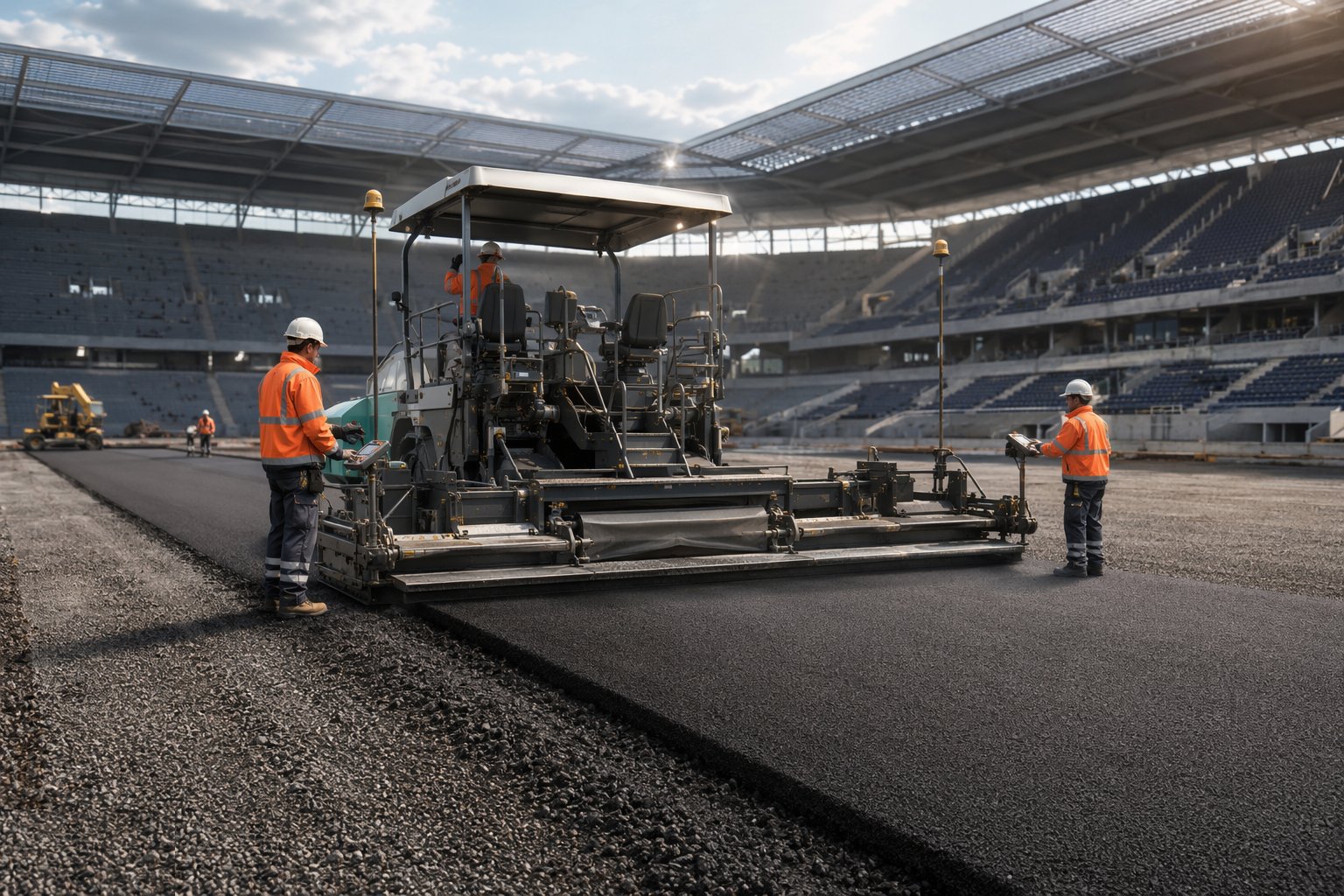
Synthetic surfaces and tracks stand on an engineered base: graded stone layers compacted and shaped, then one or two courses of asphalt laid to very tight regularity — laser-controlled paving is the norm at the top end, because the shockpad and carpet or PU above can only follow, not correct, the shape they are given. Kerb lines, edging beams and drainage channels are set first and become the setting-out datums. The base is surveyed on a grid and tested for evenness and falls before any surfacing is released onto it — this is the last cheap moment to fix a level.
Step 4: Construct the rootzone or the shockpad
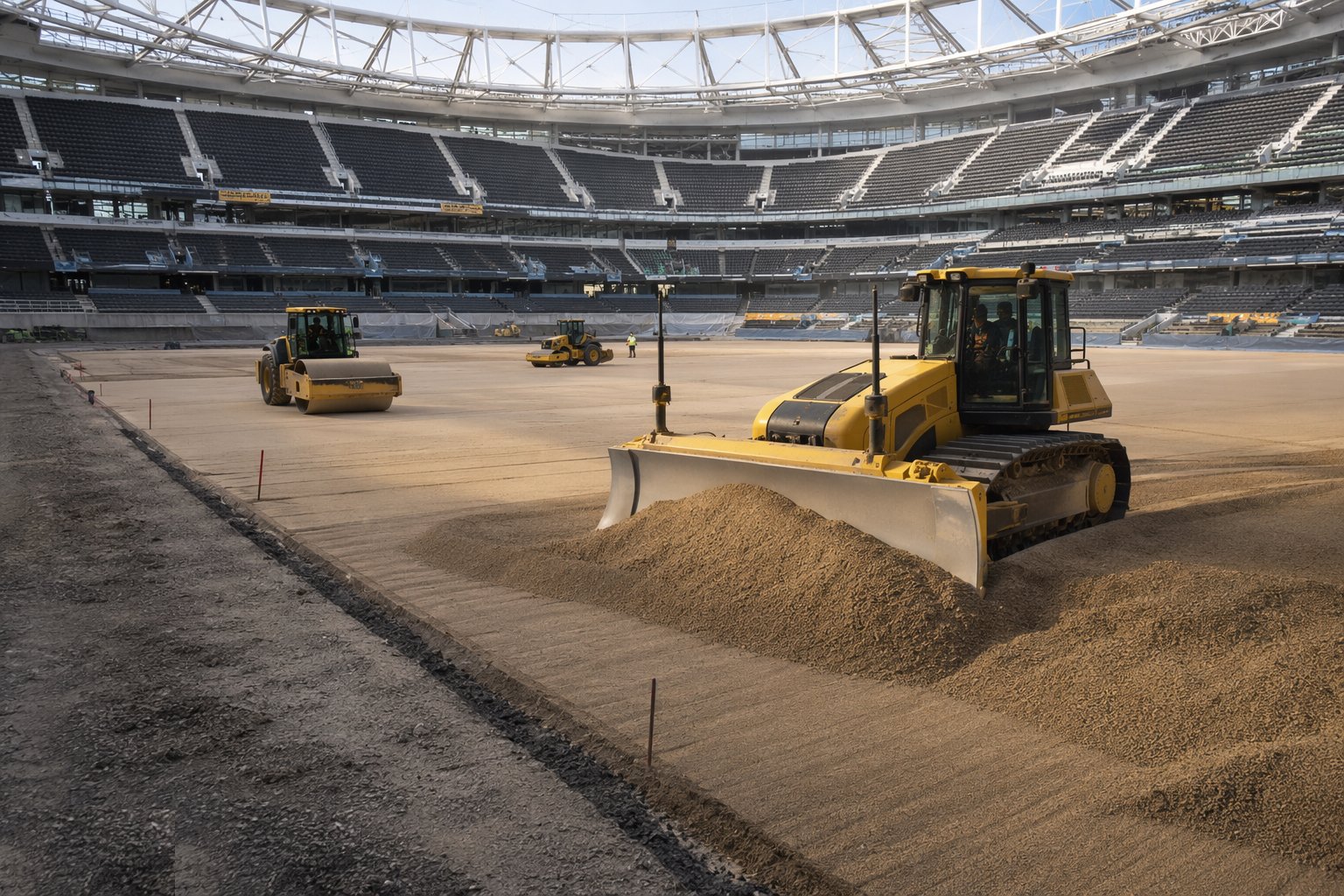
On natural turf the rootzone is placed and levelled in layers — specified sand or sand-soil mix, consolidated, ameliorated with the designed amendments, and graded to final falls with laser-guided equipment, with irrigation heads and undersoil heating pipes set into it as it builds. On synthetic pitches the shockpad goes down — prefabricated pads rolled and locked, or in-situ rubber-bound layers laid by paver — and is itself surveyed, because shockpad thickness and evenness drive the performance test results. In both cases the rule is the same: this layer decides how the surface performs, and it is buried the day it is approved.
Step 5: Lay the surface
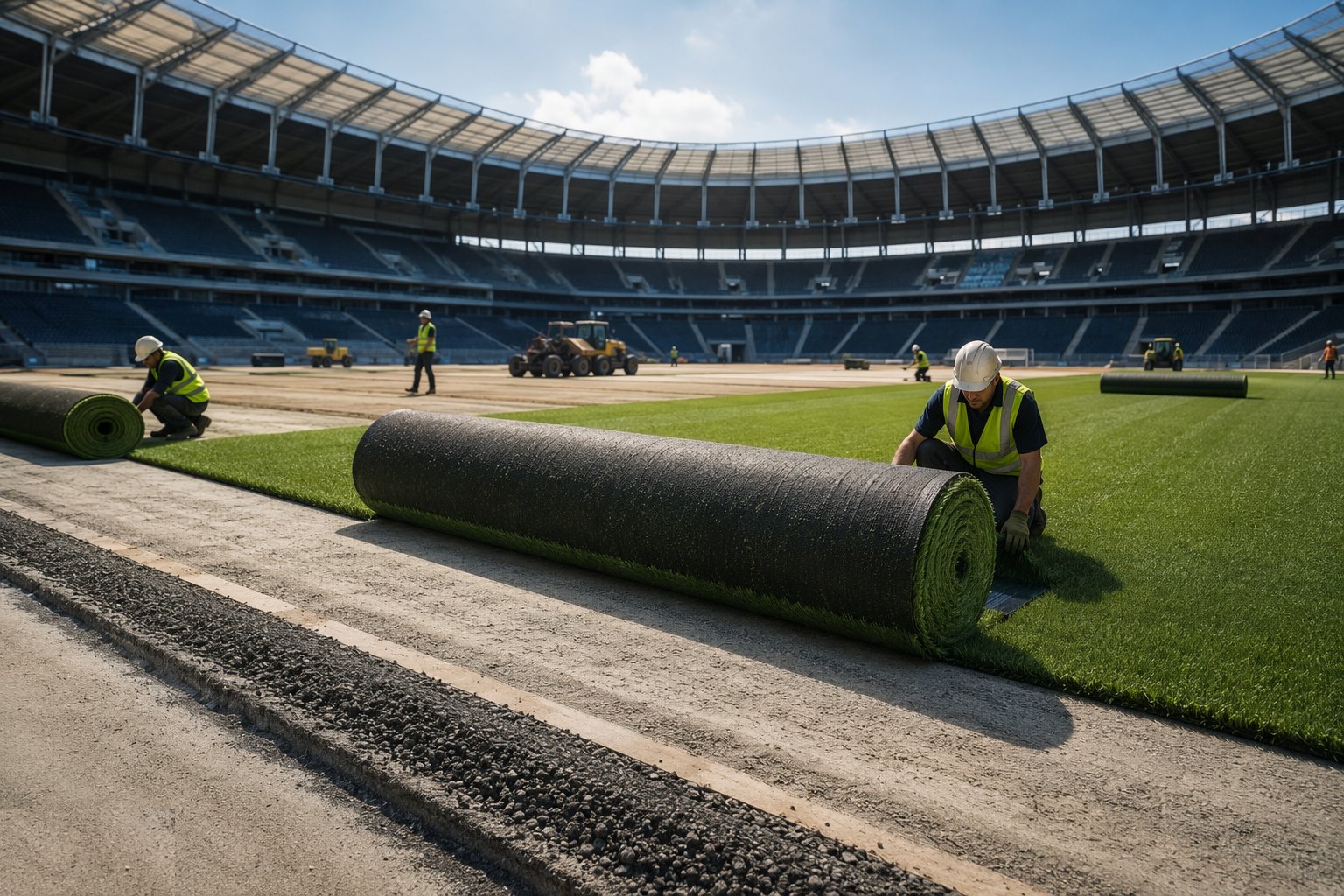
Turf goes down as big-roll turf laid edge-tight and rolled, or as seed into a prepared bed — either way into a growing window dictated by season, with grow-in managed by watering, feeding and patience. Synthetic carpet is rolled out, stretched, seamed with bonded joint tapes and glued lines, then filled: sand first in controlled passes, then performance infill to a measured depth, brushed in and checked. PU track material is mixed and paved or sprayed in continuous passes lane by lane, with weather limits policed — rain on a fresh PU pass is an expensive morning. Courts get their acrylic coats squeegeed and sprayed in thin layers. Each system has its craft, and all of them share one: the surface records every shortcut taken beneath it.
Step 6: Mark out and install the equipment
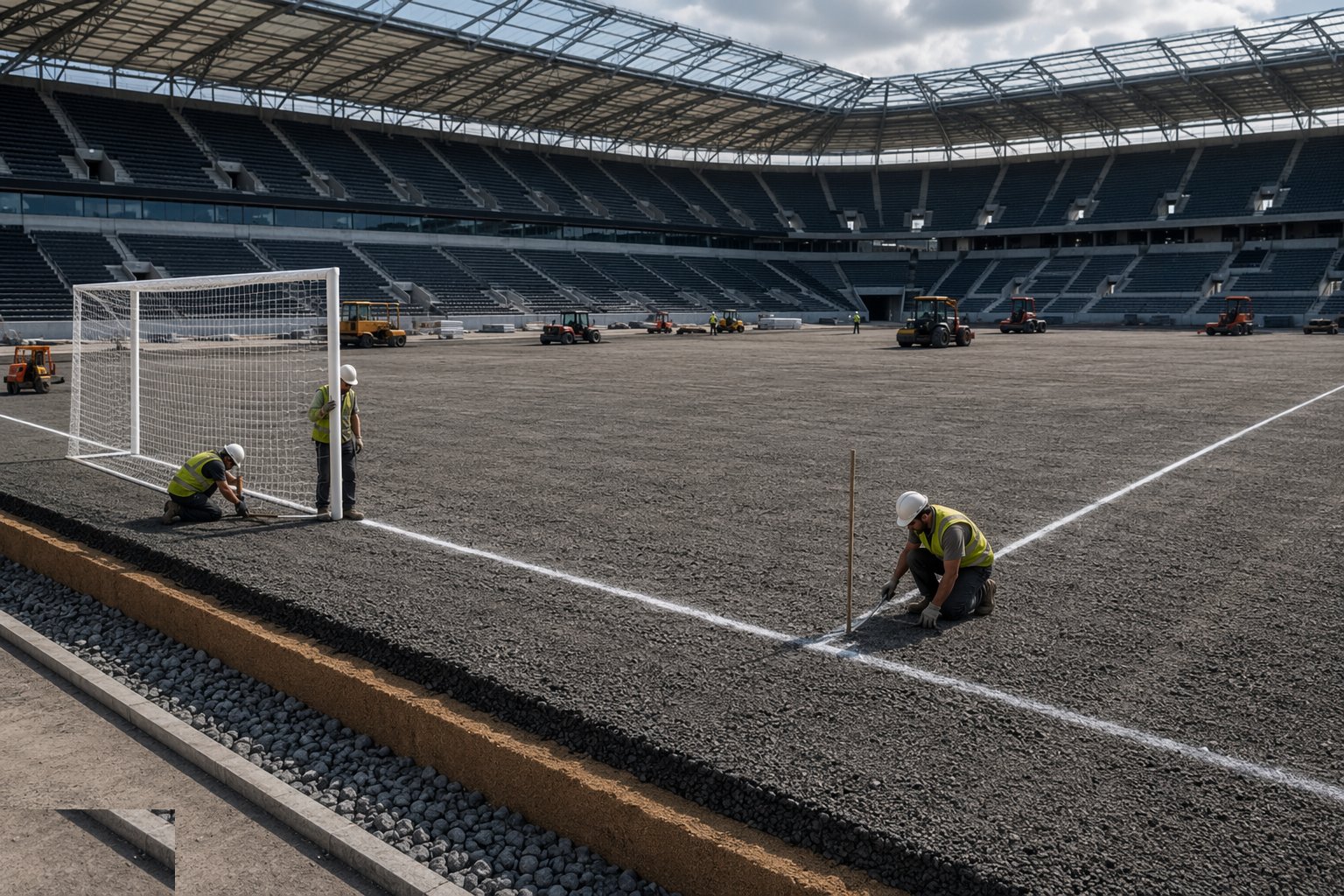
Lines are set out from the primary control — measured, not paced — and cut or sprayed: inlaid lines on synthetic turf, sprayed and measured lane lines on tracks to the governing body's geometry, painted lines on turf re-established as the grass grows. Sockets and anchor points for goals, posts, nets, long jump boxes, steeplechase water jumps and throwing cages are installed to their setting-out, with safe clearances to boundaries checked against the rules of the sport. A pitch is measured geometry; the certification test will measure it again.
Step 7: Test, certify and hand over
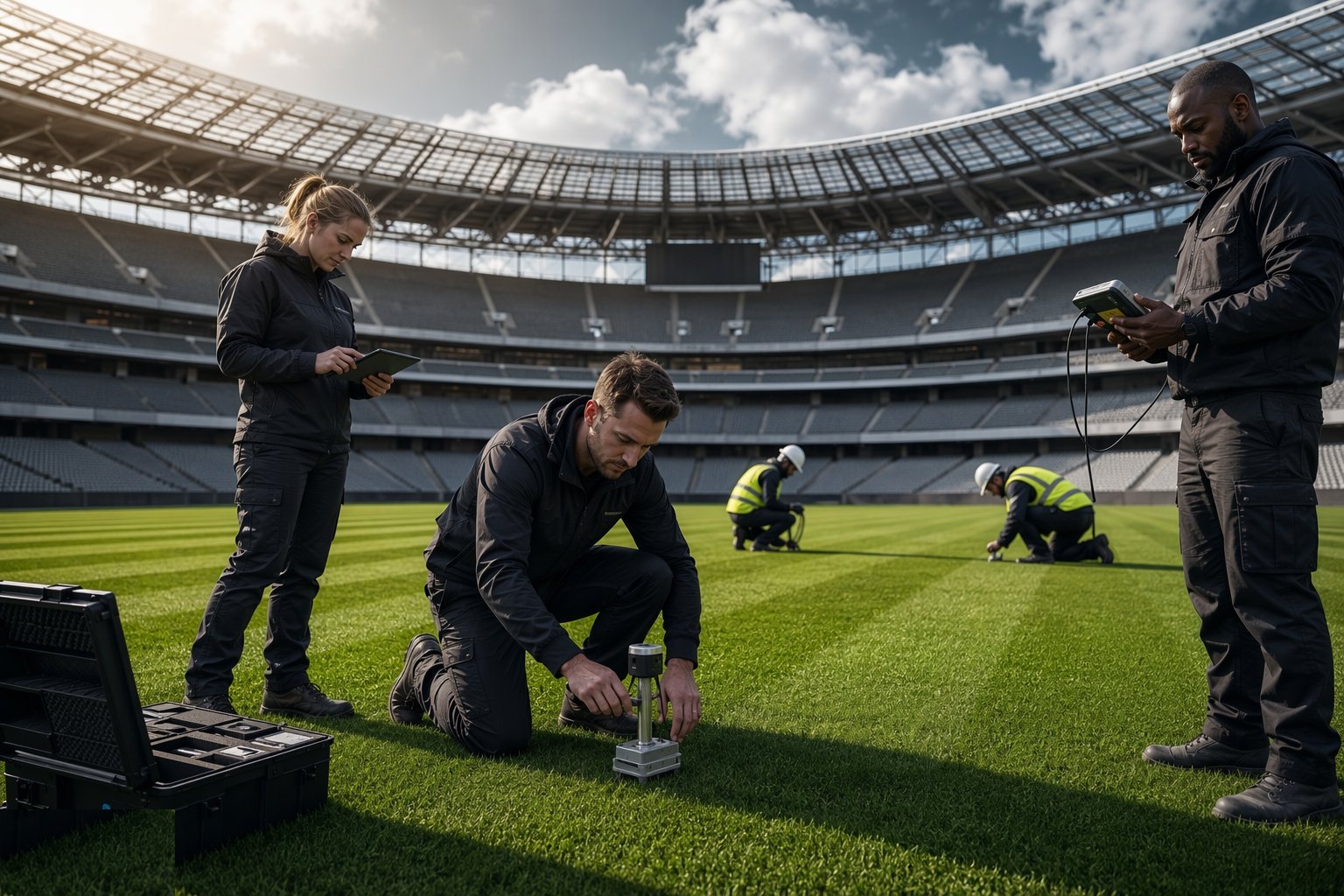
The surface is proven by independent testing before it is accepted: FIFA Quality or Quality Pro field tests on football turf, World Rugby tests, World Athletics certification surveys and performance tests on tracks, with positions tested across the field on a grid. Levels, falls and drainage rates are verified against the design, and the as-built file — layer thicknesses, materials certificates, infill depth records, test reports — goes to the operator with a maintenance regime attached, because a certified surface is a starting condition, not a permanent state. Natural turf is handed over with its establishment maintenance continuing; a pitch is never finished, only passed on.
Plant and equipment
- Laser-guided graders and box levellers for subgrade and rootzone shaping
- Drainage trenchers, sand-slitters and gravel banders
- Asphalt pavers with laser/sonic level control for engineered bases
- Stone spreaders, compaction rollers and proof-rolling kit
- Turf laying and harvesting machinery; big-roll turf handling frames
- Synthetic turf installation kit: seam rollers, gluing equipment, line cutters, infill spreaders and brushes
- PU mixing and paving/spraying equipment for track surfaces
- Survey kit: total stations, laser levels and GPS rovers for grid level control
Quality control checks
- Grid level surveys at every layer — subgrade, drainage, base, shockpad/rootzone, finished surface — filed against design falls
- Drainage verification: as-laid pipe surveys, flow tests and infiltration or percolation rates on record
- Base regularity checks with straightedge and rolling straightedge before surfacing is released
- Infill depth and evenness checks across the pitch on a measured grid
- Independent certification testing: FIFA Quality/Quality Pro, World Rugby or World Athletics field tests and laboratory reports
- Materials traceability: rootzone analysis certificates, carpet and shockpad batch records, PU system approvals
Safety considerations
- Open drainage trenches: support, batter or bench, with access controlled and excavations backfilled promptly across a live pitch footprint
- Hot asphalt work: burns, fume and plant-pedestrian segregation around pavers and rollers
- Manual handling of turf rolls, carpet rolls and infill bags — mechanical handling first, team lifts planned, not improvised
- Plant movement across the site: a pitch is a wide-open area where reversing visibility kills — banksmen and segregation even on the quiet days
- Dust and airborne rubber crumb during infill works: RPE, damping down and controlled tipping
- Weather exposure on long outdoor laying campaigns: heat stress in Gulf conditions with midday-break rules, cold and wet in the UK season
Common defects
- Birdbaths and ponding: local low spots holding water, almost always inherited from a subgrade or base that was never properly surveyed
- Seam and line failures on synthetic turf — joints opening, inlaid lines lifting, edges curling where bonding was rushed or contaminated
- Infill migration and compaction: low spots, hard patches and failed shock absorption tests as the fill moves and packs with play
- Drainage failure — a flat or uphill pipe, a crushed run under plant traffic, a blocked outfall — found only when the first storm floods the pitch
- Rootzone layering or capping on natural turf: a perched, waterlogged profile from incompatible materials or smeared placement
- PU track bubbling, delamination or soft spots from moisture in the base or rain on a curing pass
Best suited for
- Professional and community sports pitches, natural, hybrid and synthetic
- Athletics stadia and training tracks requiring formal certification
- Court surfaces and multi-use games areas
- Any venue where the surface must pass an independent performance test to open
How long does Pitches, Tracks & Playing Surfaces take?
Typical duration: A full natural-turf pitch build runs 3–6 months plus 8–12 weeks minimum grow-in; a 3G pitch 3–5 months; a certified athletics track 4–8 months including base curing and certification..