Beach Management & Nourishment
Fighting erosion with sand instead of stone — dredged fill pumped ashore, profiled to the design beach, then monitored and topped up campaign after campaign.
Last updated 2026-07-28 by the BuildPedia Editorial Team.
What is Beach Management & Nourishment?
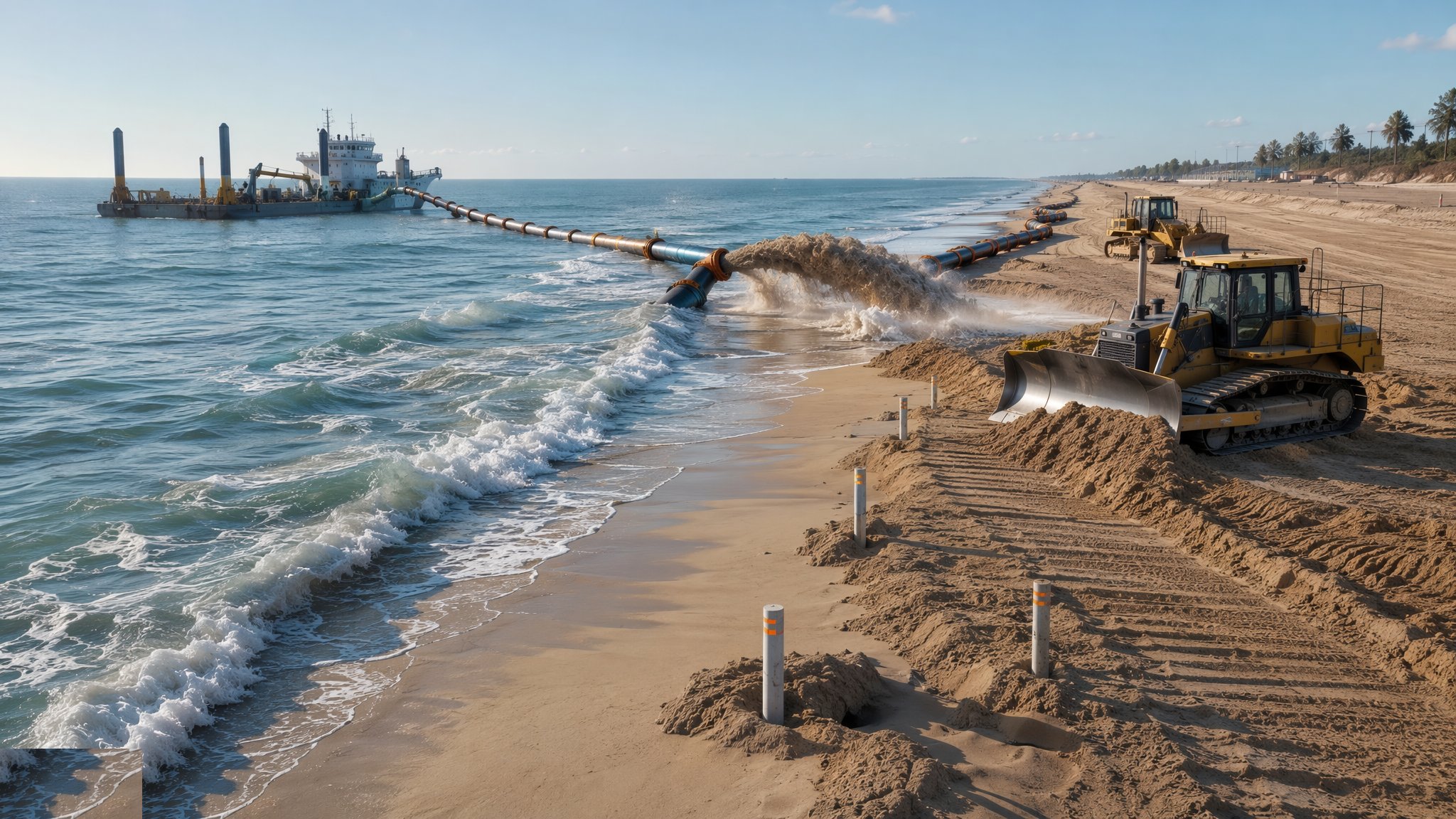
Beach nourishment — recharge, replenishment, call it what the region calls it — is the soft engineering answer to coastal erosion: instead of armouring the coast, you feed it. Sand or shingle is dredged from a licensed borrow area offshore and placed on the eroding beach, restoring the wide, high beach that absorbs wave energy before it reaches the sea wall, the cliff toe or the promenade. The beach is the defence; the works just keep it stocked. Delivery methods vary with the kit and the coast: a trailing suction hopper dredger can rainbow its load ashore in a plume of sand and seawater, discharge through a floating pipeline to a spreader pontoon, or pump into a nearshore berm for the sea to move ashore naturally. On land, bulldozers and loaders then push the placed material up the beach and grade it to the design profile.
The science is in the sediment and the profile. Borrow material must be compatible with the native beach — typically the same grain size or slightly coarser, because finer sand wins no argument with waves and simply leaves — and the scheme design applies an overfill ratio, placing more than the design beach volume to allow for the losses the first winters will take. The design profile is drawn from the wave climate: crest level, crest width and a foreshore slope the waves will reshape toward equilibrium, so the placed beach is always over-steepened slightly in the knowledge that the sea will grade it back. Get the sediment wrong and you have bought the sea a delivery of sand it will remove on your behalf; get the profile wrong and the beach either scarp-fails in the first storm or spreads itself thin along the coast.
Nourishment is never a one-off. The beach is a dynamic stockpile leaking sand alongshore, offshore and over the back of the crest, and the scheme lives or dies on its monitoring: pre-works and post-works surveys, then a programme of beach profile surveys, aerial or satellite imagery and wave data — in England, the regional coastal monitoring programmes run exactly this for the authorities — against trigger levels that say when the beach has lost enough volume to need topping up. Recycling and bypassing schemes close the loop mechanically: shingle is dug from where it accumulates and trucked back up-drift (recycling), or pumped or dredged past an obstruction like a harbour entrance (bypassing), keeping the drift moving so the downdrift coast does not starve. The Dutch took the logic furthest with the Sand Motor — one mega-nourishment left for the sea to redistribute — and the principle is the same everywhere: work with the drift, because you will never beat it.
When and why is Beach Management & Nourishment used?
Nourishment is chosen where a wide beach is itself the best defence and the best amenity — tourist frontages, soft cliffs with property at the crest, and frontages where a hard structure would export erosion downdrift or sterilise the amenity the town depends on. It is the preferred option under many shoreline management plans precisely because it works with coastal processes, and in the Gulf it doubles as amenity engineering: new beaches and maintained corniches placed and held against shamal-driven losses, usually inside groyne fields or behind breakwaters that keep the placed sand home. It matters because the economics only work as a managed campaign: borrow area licensed, dredger mobilisation shared across frontages, monitoring funded for the life of the scheme, and the top-up trigger honoured when the surveys say so. A nourishment scheme without its monitoring budget is a very expensive one-season beach.
Types of Beach Management & Nourishment
Direct placement recharge
Dredged sand delivered straight onto the beach — rainbowed from a trailing suction hopper dredger or pumped ashore through a floating pipeline to discharge points along the frontage, then spread by dozers. The standard method for big volumes: a hopper load every few hours, and the beach growing in front of your eyes.
Nearshore berm and feeder placement
Fill placed as an underwater berm just offshore of the active zone, left for wave action to pump ashore over the following seasons. Cheaper placement, no beach works at all, and a natural feeder — but the delivery is on the sea's schedule, and the monitoring has to prove the sand actually moved the way the model promised.
Recycling and bypassing schemes
Moving the beach's own material back against the drift: shingle excavated from the accreting downdrift end and hauled back up-drift by dump truck, or sand dredged and pumped past a harbour entrance that dams the drift. Continuous management rather than episodic recharge — small plant, permanent programme, and a frontage that never gets the chance to run dry.
Mega-nourishment (Sand Motor principle)
One very large placement — tens of millions of cubic metres — in a single concentrated deposit, designed to feed a long frontage as waves and currents redistribute it over twenty years or more. Fewer mobilisations, less repetitive disturbance, and the coastline itself does the spreading; the price is patience and a monitoring regime measured in decades.
Beach Management & Nourishment: step by step
Step 1: Characterise the sediment and license the borrow area
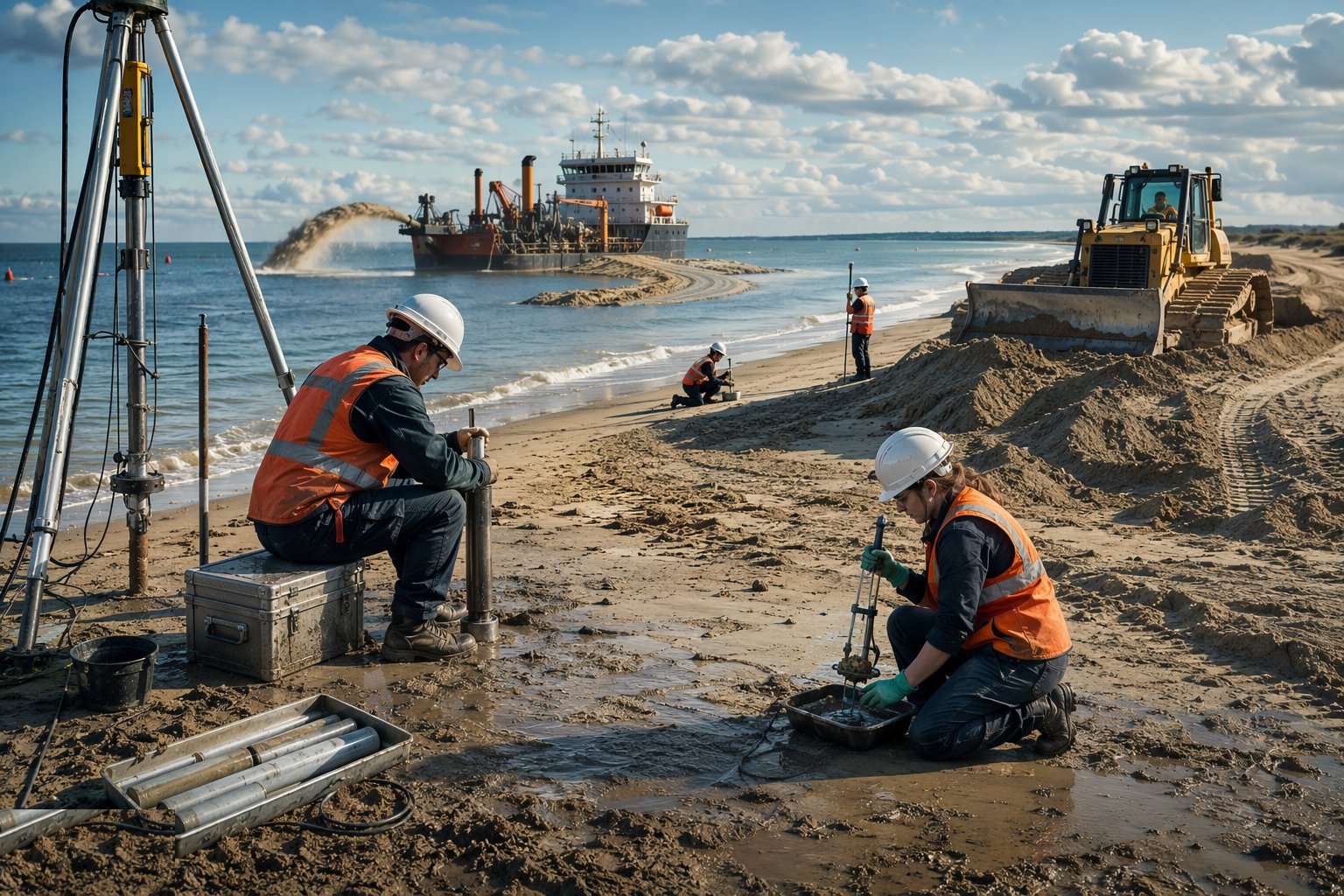
The scheme starts under the sea. The borrow area is investigated — vibrocores and grab samples across the deposit, grain size analysis against the native beach — to prove the fill is compatible: similar or slightly coarser grading, low fines content, no contamination. The overfill ratio and the volumes are calculated from the sediment comparison and the predicted losses. Then the consents: the marine licence and dredging permission (in UK waters, the MMO licence and the Crown Estate or landowner agreement for the borrow area), environmental assessment of the borrow area and the placement zone, and the archaeological and fisheries conditions that come with them. Nobody rainbow-discharges a load of sand on a handshake.
Step 2: Survey the baseline and set the triggers
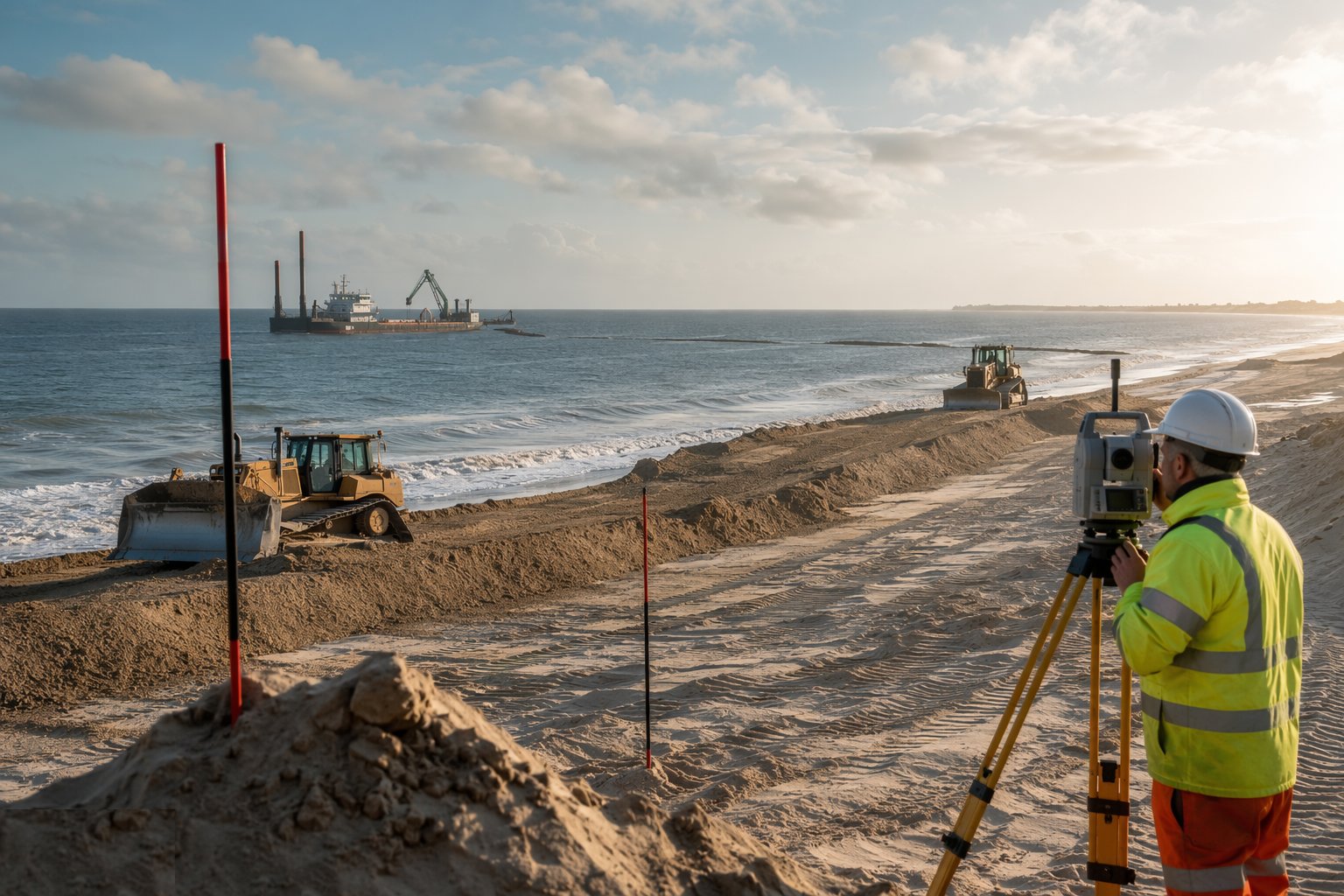
Before placement, the frontage is surveyed end to end: beach profiles at fixed sections, crest levels, and the nearshore bathymetry out to closure depth, all tied to the national datum. This baseline does two jobs — it is the measurement the placed volumes are verified against, and it is the starting point of the monitoring record. The management plan sets the trigger levels at this stage: the beach volume or crest level at each section that, when reached, calls the next campaign. Agreeing the triggers before the sand lands is what separates a managed scheme from an annual argument about whether the beach looks thin this year.
Step 3: Dredge and deliver the fill
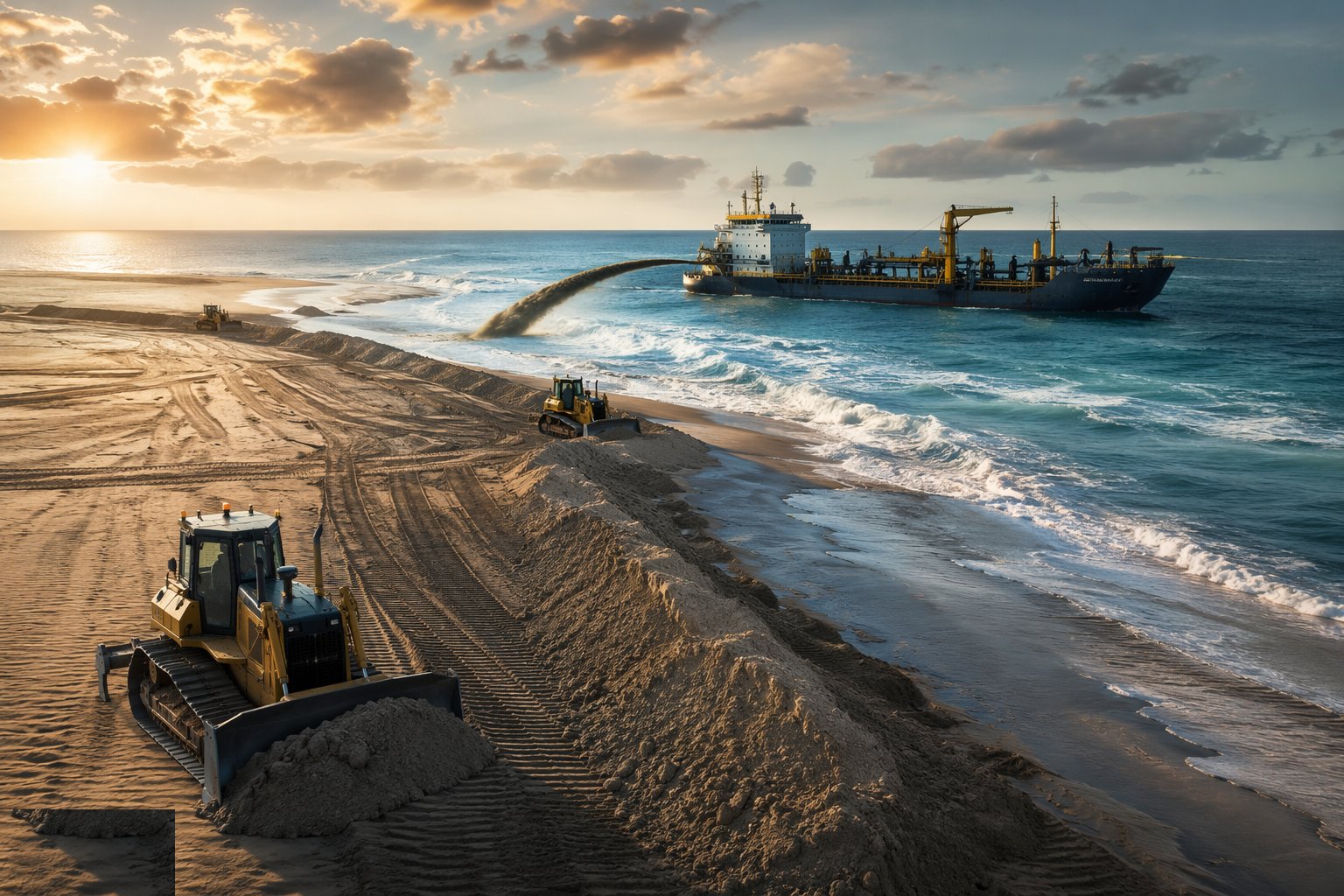
The dredger works the borrow area to its licence — loading by trailing suction, logging every load — and delivers by the agreed method: rainbowing in arcs across the placement zone at the right state of tide, or connecting to the floating pipeline and pumping ashore in a slurry that the discharge spreaders aim up the beach. Delivery is logged load by load — hopper volumes, pipeline meter readings — because payment and verification run on placed quantity. The operation runs around weather and sea state: a hopper dredger has its limits, and the placement front stands down when the sea makes delivery unsafe or placement ineffective.
Step 4: Spread and profile the placed beach
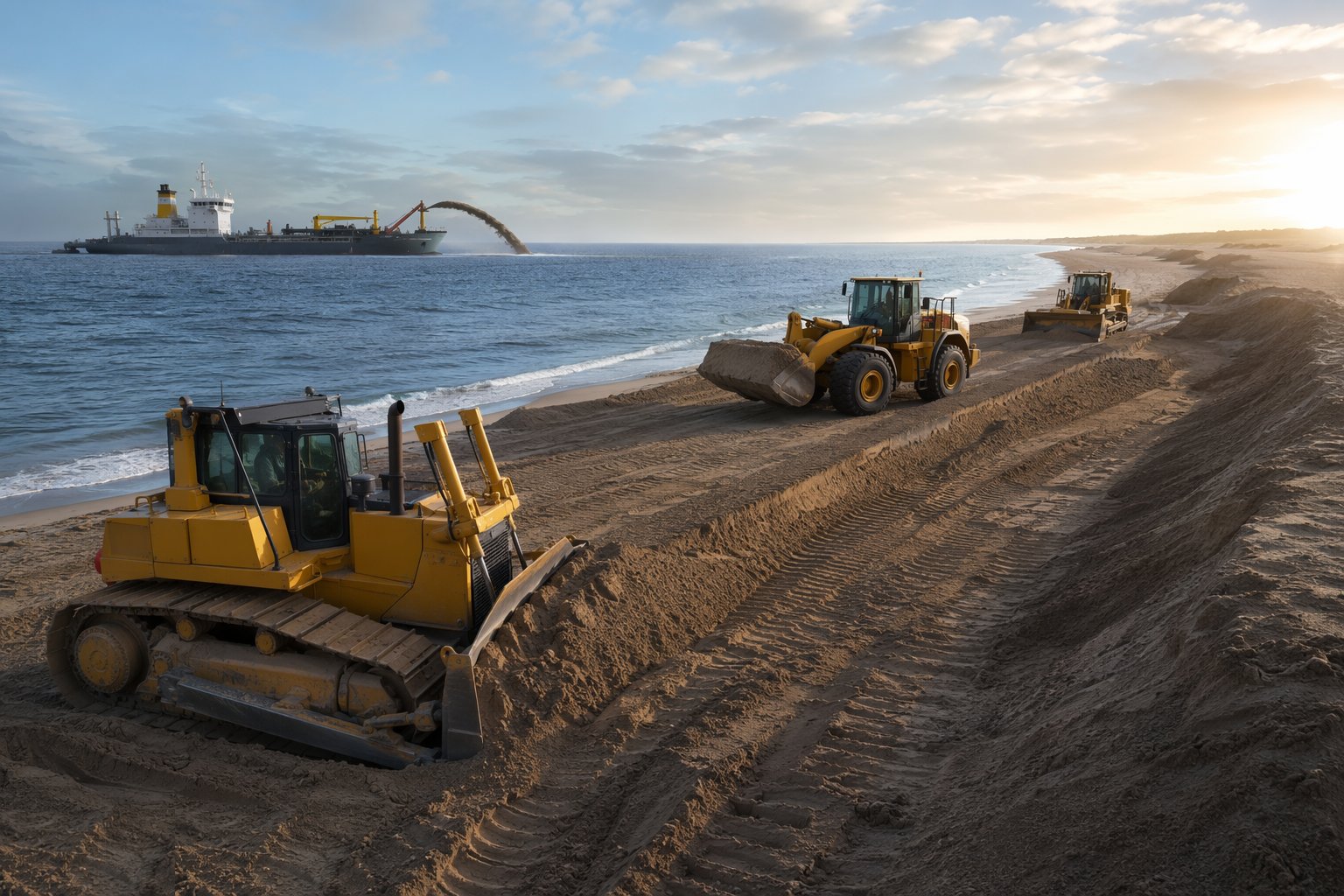
On the beach, the earthworks gang takes over: dozers and loaders push the discharged or rainbowed material up the foreshore, spreading it along the frontage and grading to the design profile — crest level and width at each section, the foreshore slope left slightly over-steep for the sea to finish. Work runs in tide windows, plant retreats as the tide floods, and the profile is checked continuously by GNSS on the machines and rovers on the beach. Drainage of the placed slurry water is managed so it runs back through the beach or over it without scarping the new face, and public access is fenced and stewarded: a freshly charged beach is a construction site that looks like a playground.
Step 5: Verify the volumes and the profile
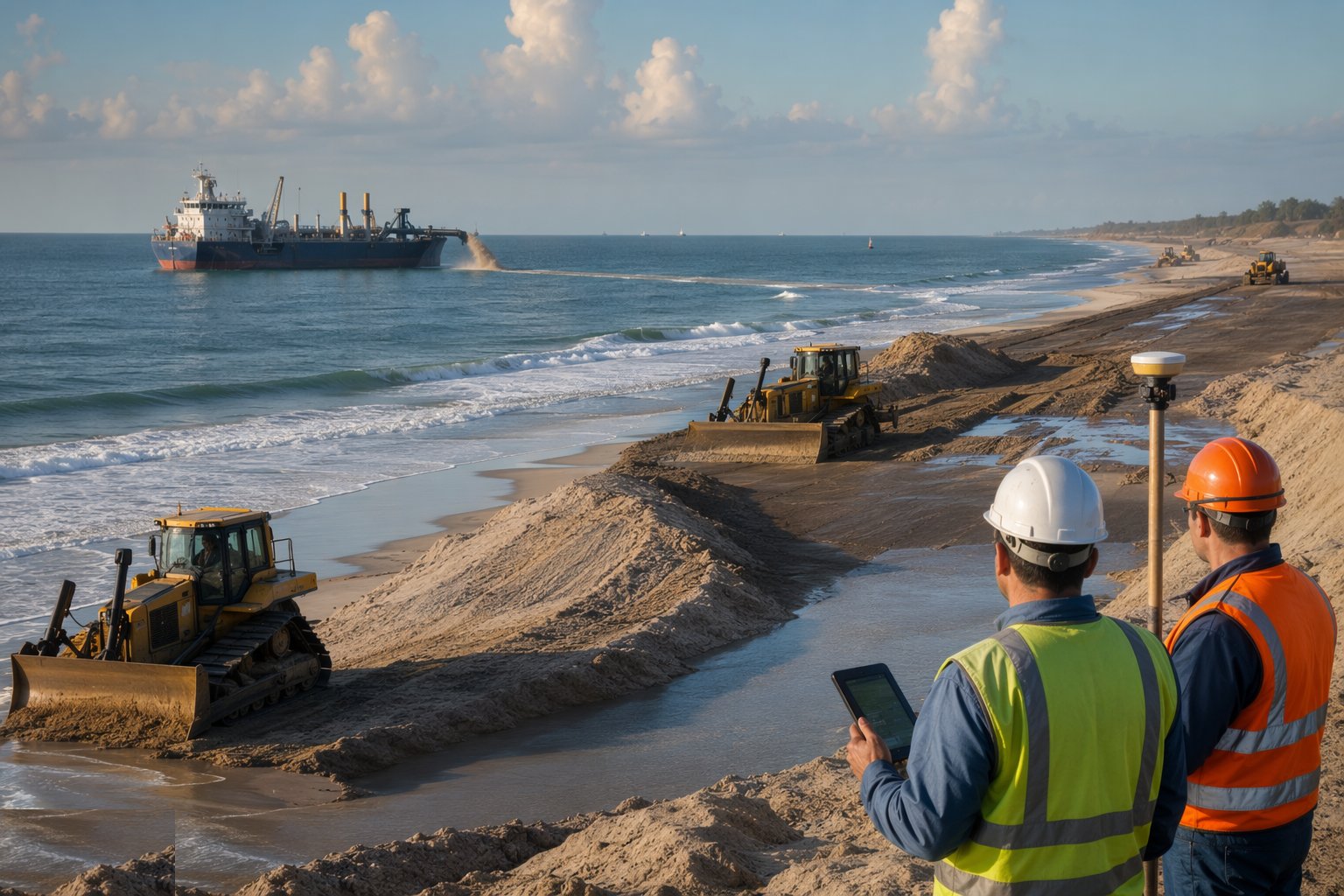
At the end of the campaign the as-built survey repeats the baseline sections: placed volumes computed against the pre-works ground, crest levels and widths checked against the design at every section, and the record reconciled with the dredger's delivery log. Shortfalls are placed before demobilisation — a dredger's mobilisation is the single biggest cost in the scheme, and you do not bring it back for a deficit you could have closed while it was alongside. The verified as-built goes into the scheme record as the new baseline, and the beach is handed back with its monitoring programme already running.
Step 6: Monitor, recycle and campaign again

Then the long game begins. Profiles are resurveyed on the programme — post-storm and at least annually — volumes trended against the triggers, and the results reported to the authority that funds the defence. Where the scheme includes recycling, the plant returns on its seasons: shingle dug from the accreting end, hauled up-drift and tipped to the template, keeping the beach level while the drift keeps working. When a trigger level is reached, the next nourishment campaign is mobilised on the evidence, not the anecdote — and the file that justifies it is the monitoring record you have been keeping since day one.
Plant and equipment
- Trailing suction hopper dredgers with rainbow discharge and pump-ashore capability
- Floating and sinker pipelines with discharge spreaders and Y-pieces
- Bulldozers, long-reach excavators and loading shovels for beach profiling
- GNSS rovers and machine-control systems; fixed beach profile stations
- Dump trucks and low-ground-pressure haulage for recycling campaigns
- Survey launches with multibeam for nearshore verification
- Wave buoys and tide gauges feeding the scheme data record
- Fencing, signage and beach stewarding for public safety during placement
Quality control checks
- Borrow material certification: grain size envelopes checked per investigation and audited during dredging
- Delivery records per load — hopper volumes or pipeline metering reconciled to placed volumes
- As-placed profile surveyed at every design section before the dredger demobilises
- Overfill ratio and total placed volume verified against the scheme design
- Monitoring surveys to the fixed programme, processed and reported against trigger levels
- Recycling quantities and placement templates recorded campaign by campaign
Safety considerations
- Marine dredging operations under certified crews and the flag/port rules; exclusion around rainbowing and discharge zones
- Public interface on an open beach: fenced placement fronts, stewards, and clear signage — the works look like a day out
- Plant working in tide windows on soft placed sand: daily ground checks, marked retreat routes and a watchkeeper
- Soft-edge and quicksand risk on freshly pumped slurry: nobody walks the discharge zone until it is drained and proven
- Dozer and truck movements along a public foreshore: banksmen, segregated haul routes and speed discipline
- Night dredging and delivery: lighting, AIS and communication protocols with the harbour authority
Common defects
- Borrow sand finer than the native beach — the fill disperses offshore within a couple of winters and the volume vanishes
- No overfill allowance — the first storm season's losses take the beach straight back below the trigger
- Profile built too steep and left — scarping, public complaints and rapid reworking of the placed face
- Volumes verified on delivery logs only, never on survey — paying twice for the same sand
- Monitoring budget cut after mobilisation — triggers missed, top-ups late, and the scheme failing quietly
- Downdrift impacts unmanaged — the nourished beach feeding the drift while the neighbouring frontage starves
Best suited for
- Tourist and amenity frontages where the beach is both the defence and the product
- Soft-cliff and dune coasts where hard structures would export the problem
- Groyne-field and pocket beaches that need charging and periodic topping up
- Schemes where working with the drift — recycling and bypassing — beats fighting it
How long does Beach Management & Nourishment take?
Typical duration: A major campaign places a hopper load every few hours and typically runs 4–12 weeks on the frontage per mobilisation; the scheme itself is a rolling programme of surveys and top-ups measured in decades, with recycling campaigns returning every season..