Breakwaters & Groynes
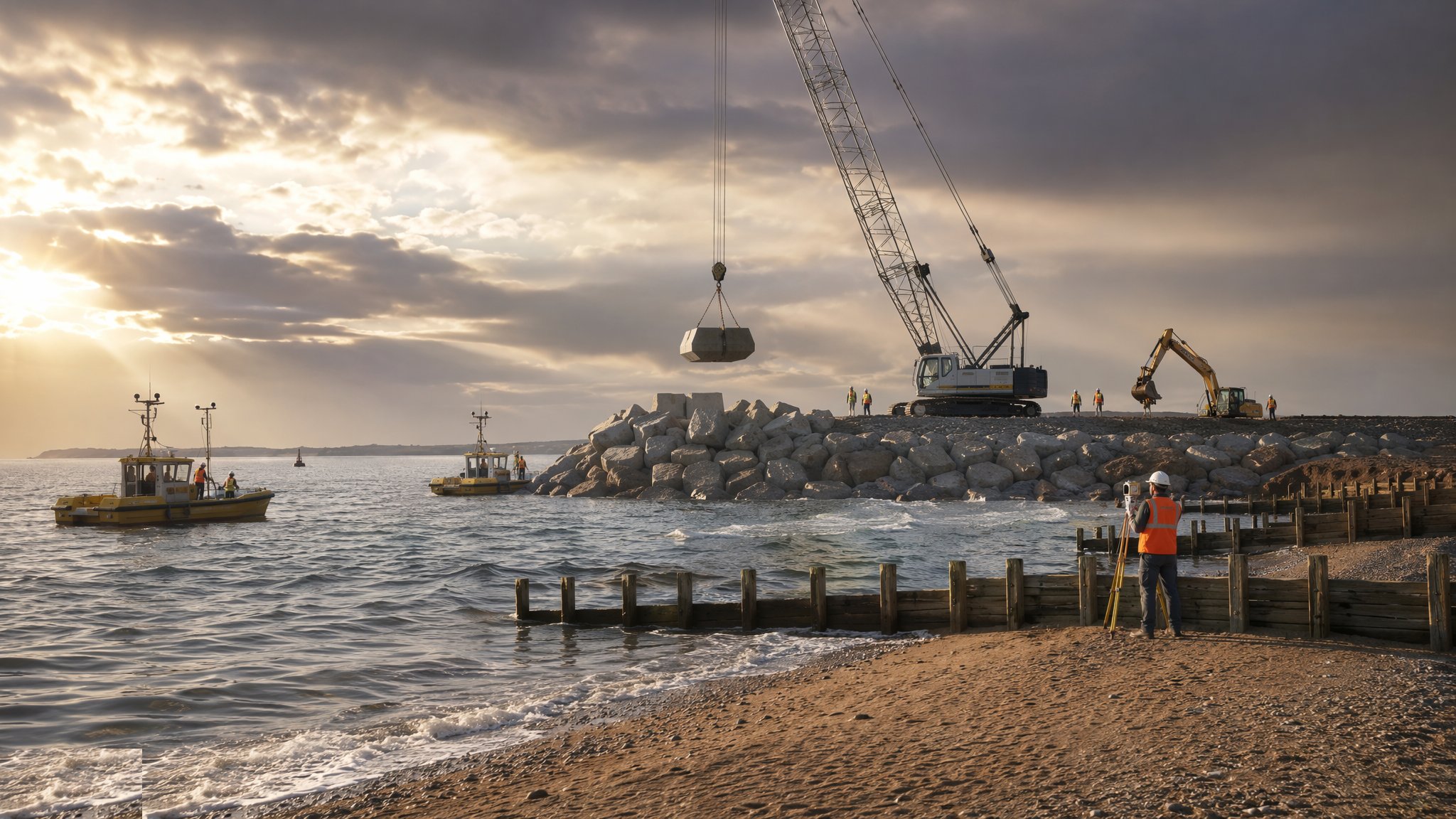
Structures built out into the sea on purpose — rubble-mound breakwaters armoured in rock or concrete units, and groynes holding the beach where it belongs — placed rock by rock under survey control.
Last updated 2026-07-28 by the BuildPedia Editorial Team.
What is Breakwaters & Groynes?
A breakwater is a wall built in the sea to make calm water — sheltering a harbour entrance, a marina, an intake basin or a length of coast from the incoming wave climate. The workhorse is the rubble mound: a trapezoidal heap of quarried stone built up in layers, each layer doing a different job. At the heart is the core — cheap quarry-run rock that gives the mound its bulk. Over that sits the underlayer, a graded rock skin that filters and beds. And on the outside, taking the waves, is the armour layer: either big armourstone placed two rocks thick, or single-layer concrete armour units — Accropode, Xbloc, Core-Loc and their relatives — engineered shapes that interlock and dissipate wave energy in the voids between them. Sizing follows the Hudson and van der Meer stability formulae against the design significant wave height, and the whole mound is designed to flex, settle and even reshuffle slightly in extreme storms without losing its job.
Concrete armour units are a manufacturing business as much as a marine one. Accropode II and Xbloc units — from a few tonnes for a marina to 40-plus tonnes for an exposed trunk — are cast in a precast yard near the site: steel or timber moulds, high-slump self-compacting or conventional mixes vibrated hard into the complex geometry, stripped early, cured and stockpiled by the hundred. Placement is the art: each unit is lowered by crane onto the underlayer to a surveyed grid position, in a random-but-controlled pattern the licence holder specifies, because the interlock between units is what stops the layer unzipping in a storm. A wrongly seated unit is not just a weak spot — it is a domino.
Groynes are the smaller cousins working on a different principle: they do not stop waves, they stop sand. Built out from the beach at intervals along the shore, groynes interrupt longshore drift — the alongshore conveyor of sand and shingle — so the beach accretes in the bays between them. Timber groynes in greenheart are the traditional UK answer; rock groynes do the same job with armourstone; steel sheet-pile groynes go where a thin, durable line is wanted. A groyne field is only ever a management tool — starve the downdrift coast and you export your erosion to your neighbour, which is why groyne schemes come with beach management plans, recycling arrangements and terminal structures at the downdrift end.
When and why is Breakwaters & Groynes used?
Breakwaters are built where the cost of wave energy is unbearable: a harbour that cannot operate in a swell, an intake that cannot tolerate sediment in suspension, a reclamation that needs calm water before it can be filled, or a coast where a detached offshore breakwater can hold a beach by creating a sheltered shadow behind it. Groynes are built where the beach itself is the defence but longshore drift keeps walking it away — classic along developed English south-coast frontages and increasingly along Gulf corniches where placed beach fill must be held in position. The engineering matters because both structure types live entirely in the marine zone: built by land-based plant walking out along the work, or by barges and cranes working afloat, with every placement position fixed by survey and every storm during construction testing the unfinished mound. A half-built breakwater is a design event nobody modelled, and the weather routing of the construction sequence is as engineered as the final profile.
Types of Breakwaters & Groynes
Land-based rubble-mound breakwaters
Built by end-tipping and crane placement from the shore or from the advancing mound itself — the plant walks out along its own work, core first, underlayer and armour closing up behind. The classic method where depths are modest and quarries are close; the crest becomes the haul road, and storm damage to the unfinished head is the standing risk.
Marine-placed rubble mounds
Core and underlayer placed from split-hopper barges or side-stone dumpers, armour placed by floating crane — the method where water depth or exposure defeats land plant. Positioning is by DGPS and barge-mounted survey, placement rates are weather-gated, and the mound is profiled by multibeam survey between lifts.
Single-layer concrete armour (Accropode / Xbloc)
Engineered concrete units placed in a single interlocking layer over the underlayer — Accropode II, Xbloc, XblocPlus, Core-Loc — under the unit designer's placement rules. Roughly half the concrete and rock volume of a two-rock armour layer for the same duty, at the price of a precast yard, a licence, and placement discipline that tolerates no shortcuts.
Timber groynes
Greenheart or equivalent hardwood piles driven in pairs with horizontal waling boards — the traditional UK groyne, still renewed by the hundred on south-coast frontages. Quick to drive from the beach at low water, tolerant of beach level changes, and ultimately consumable: the boards wear, the piles rot at the intertidal zone, and maintenance is a permanent budget line.
Rock and sheet-pile groynes
Armourstone groynes built like miniature revetment heads, or steel sheet-pile lines driven to a levelled crest. Rock groynes flex with the beach and self-heal; sheet piles give a thin, precise line where navigation or promenade width is tight. Both need the same gospel preached: the toe matters, the flanks matter, and the terminal groyne matters most of all.
Breakwaters & Groynes: step by step
Step 1: Survey the seabed and prepare the foundation

The alignment is fixed by survey before a stone moves: bathymetry along the centreline, geophysics and probes to prove the seabed strata, and a dredged or prepared foundation where soft material would let the mound sink or slide. Weak surface material is dredged out and replaced, or the design takes it with a geotextile separator and a staged build-up that lets the ground gain strength under the load. The foundation bed is levelled within tolerance and surveyed again — a mound founded on a soft pocket will find it in the first storm, and a breakwater that settles unevenly opens cracks in its own armour like teeth parting.
Step 2: Win, grade and deliver the rock; cast the armour units
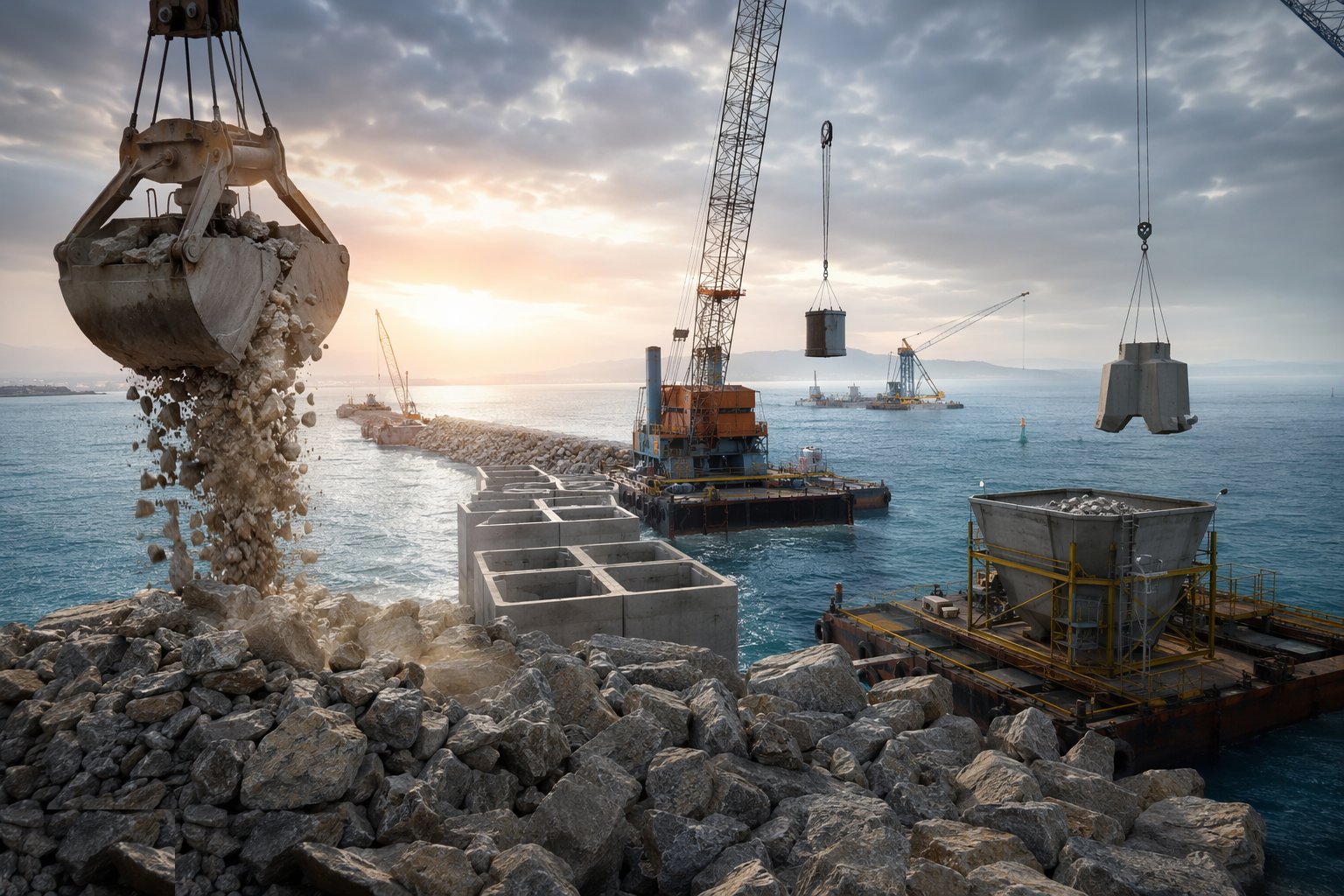
The materials pipeline is half the job. Armourstone and underlayer rock are won, crushed and graded at the quarry to BS EN 13383 classes — each load inspected, because one load of flaky or underweight stone in the armour layer is a storm-repair waiting to happen — then hauled by road or sea to the placement front. In parallel, the precast yard turns out concrete armour units: moulds cleaned and oiled, concrete placed and vibrated into the geometry, units stripped, cured, tested on cubes and stockpiled in placement sequence. The yard's output and the mound's appetite are matched in the programme, because a crane standing idle for want of units costs the same as a crane standing idle for weather.
Step 3: Place the core and form the mound
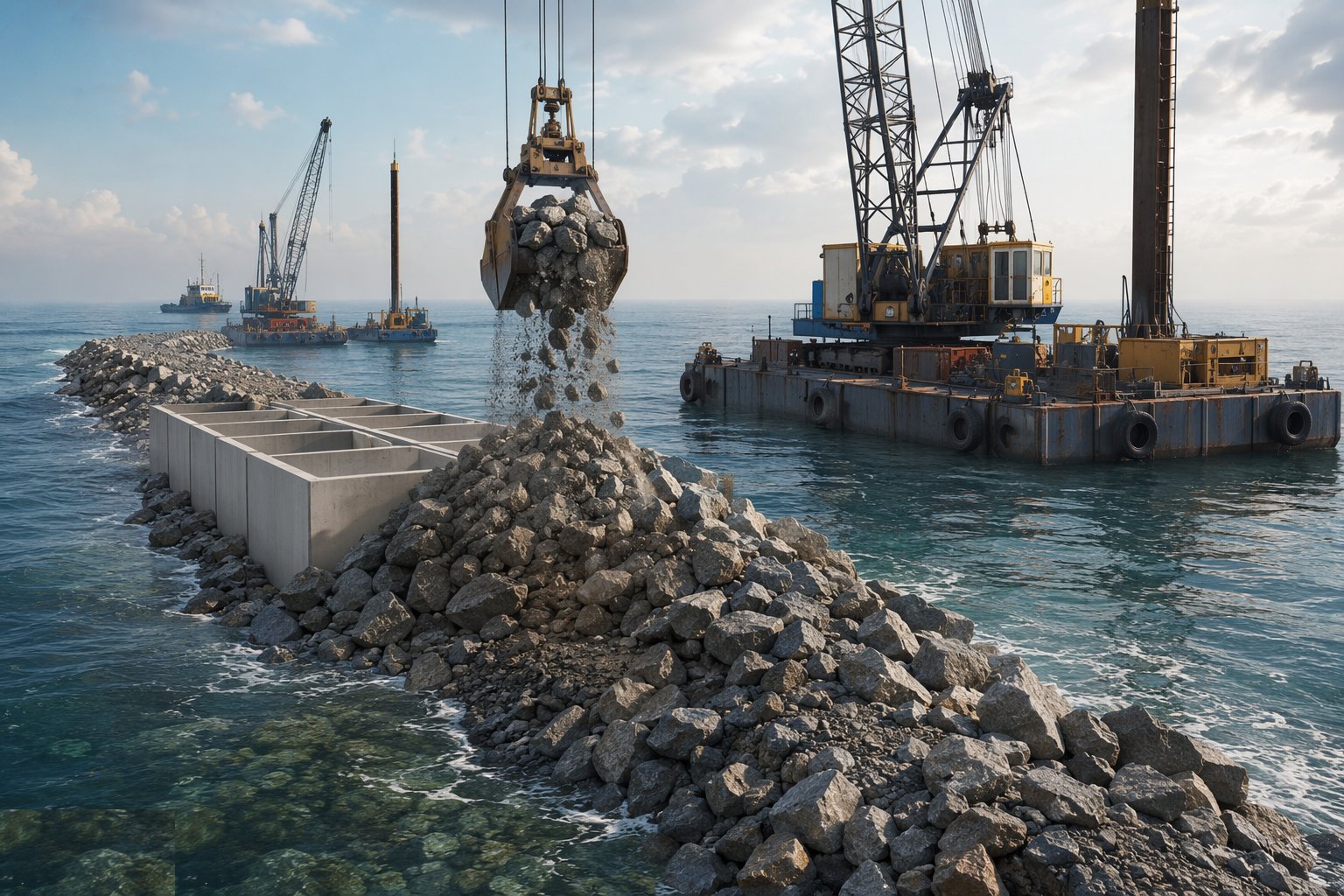
The core goes in first, end-tipped from the advancing crest or side-dumped from barges, placed in layers the design sets so the foundation is never overloaded in one pass. The mound is pushed forward to profile — centreline position, crest level and side slopes checked by GNSS and multibeam as it advances — and the exposed head is never left longer than the construction sequence allows, because the unfinished core is the weakest thing on the site and the sea knows it. In storm seasons the advance rate is matched to the rate at which armour can close up behind: an unarmoured core left over a weekend forecast is a repair bill, not a milestone.
Step 4: Place the underlayer and profile the bed
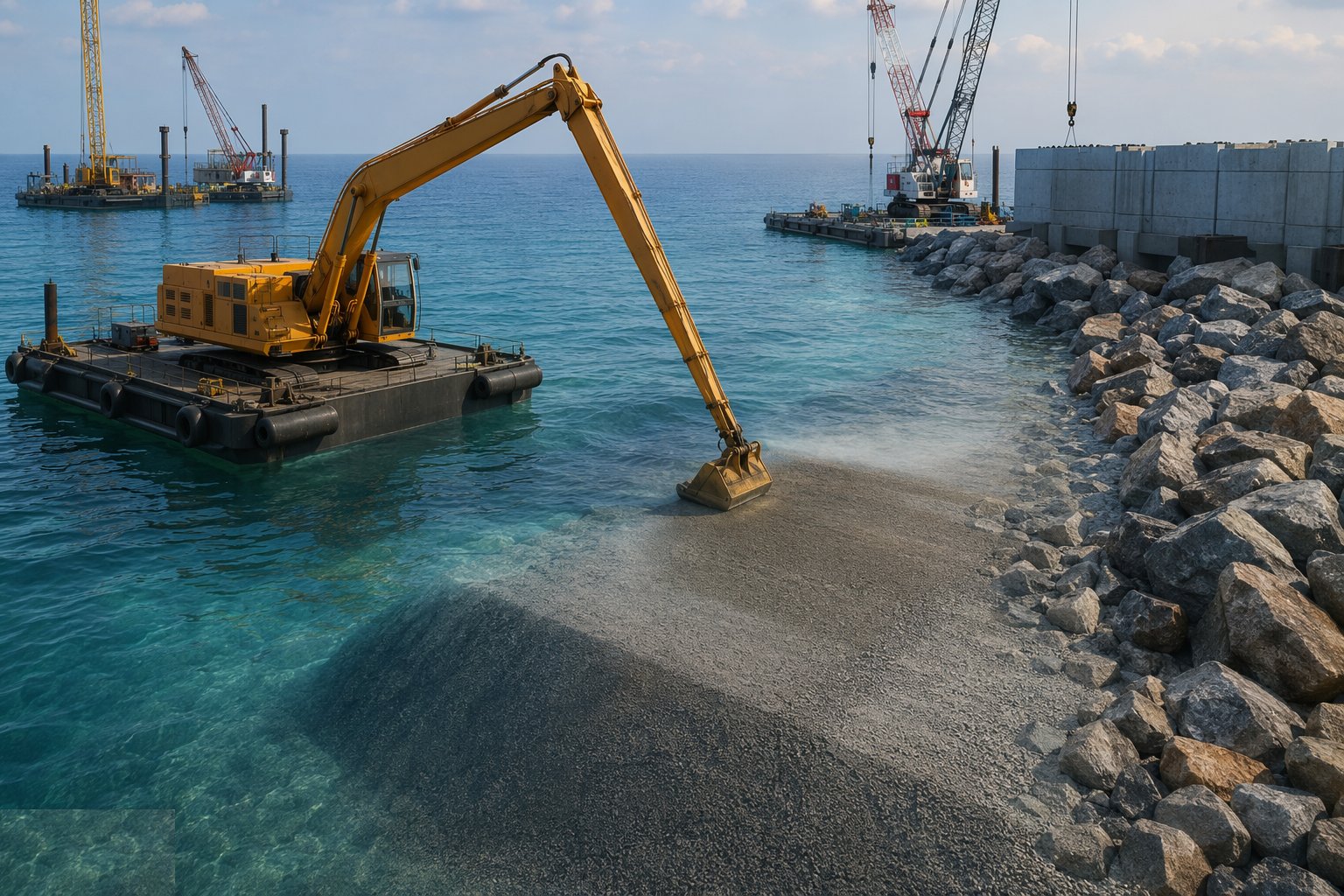
The underlayer is placed over the core in its specified grading and thickness and profiled to the design slopes — by long-reach excavator with machine control from the crest, or by crane and grab with survey frames afloat. The profile tolerance is tight, because the armour layer's performance depends on a regular bed: hollows concentrate units and humps starve them, and both show up as weak patches under wave attack. Each section of underlayer is surveyed and accepted before armour follows, and it is armoured promptly — an underlayer left naked through a gale is a filter the sea has already started to rearrange.
Step 5: Place the armour: rock or concrete units
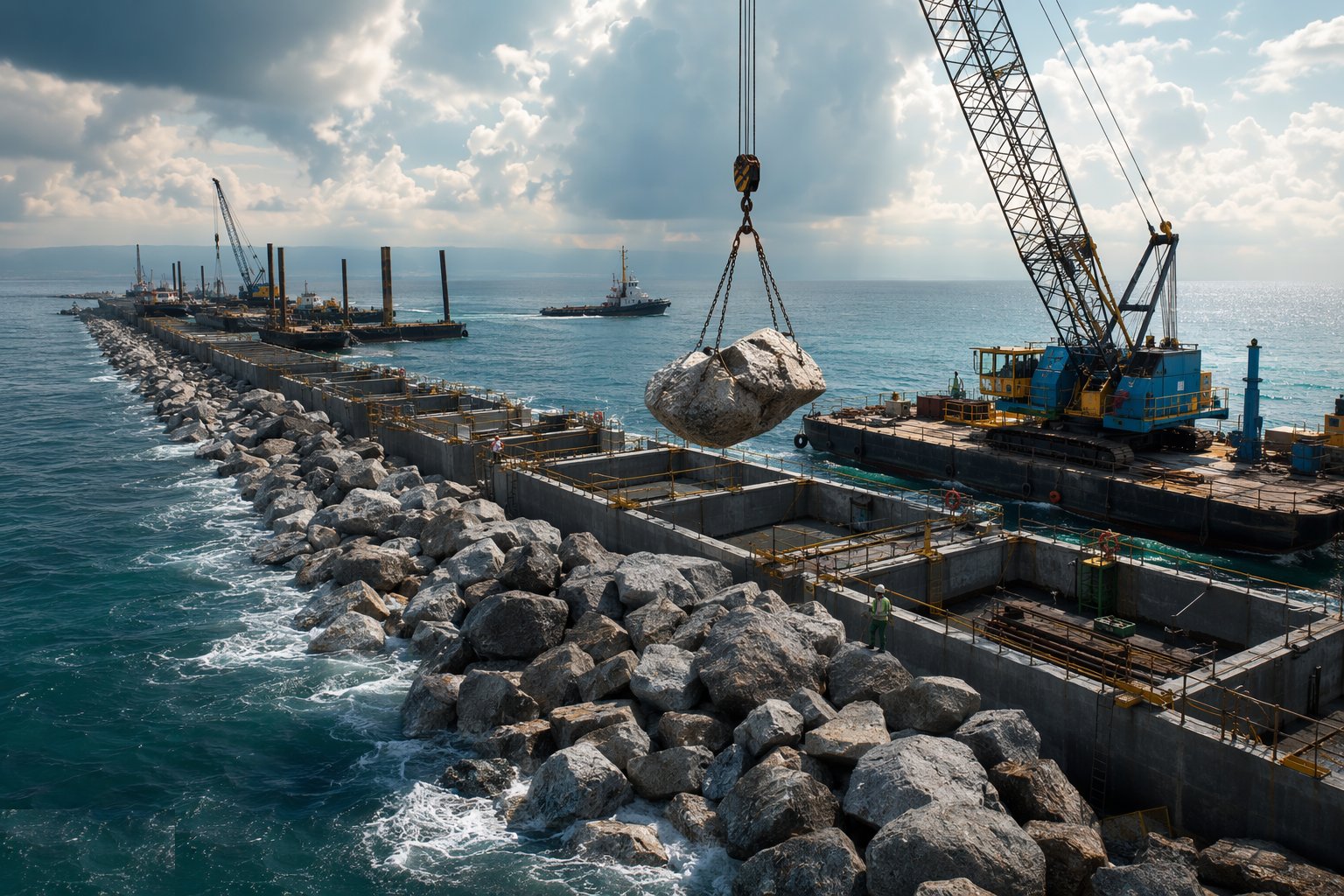
Armour placement is the slow, expensive, survey-driven heart of the job. Armourstone goes on two rocks thick, each stone individually placed, seated into the underlayer and keyed to its neighbours under the Rock Manual's rules — no tipping, no rolling, no gaps. Concrete units are lifted one at a time from the stockpile or barge and lowered to their grid positions in the licence holder's random placement pattern, orientation controlled, each unit checked for seating before the grab releases. Every unit's position is recorded; placement density per area is audited against the design count; damaged or misplaced units are lifted out, not left. The armour layer is the breakwater's reputation, and it is built one careful pick at a time.
Step 6: Build the crest, the head and the terminations
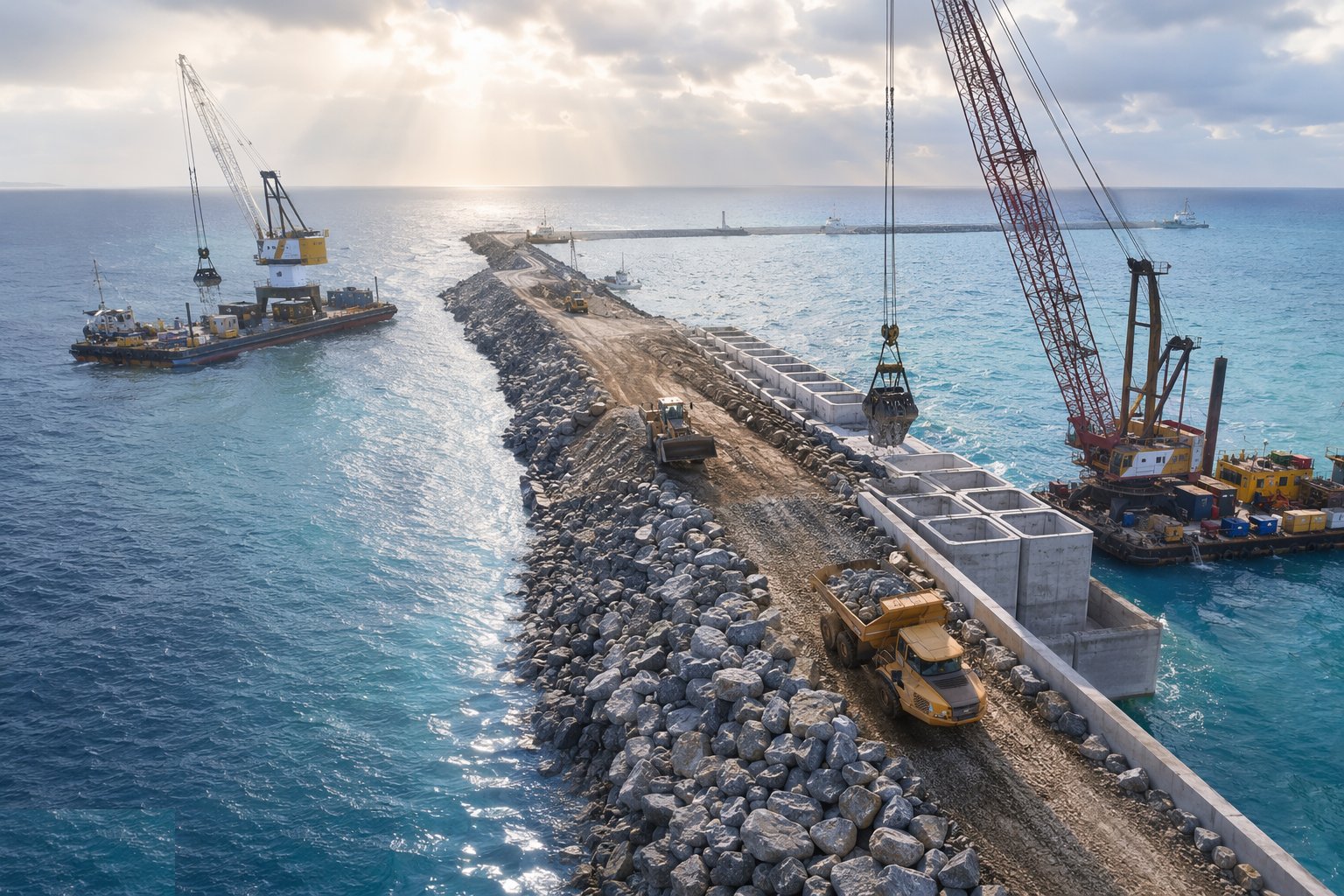
The details that storms hunt are finished with disproportionate care. The roundhead — where the mound turns and waves wrap and focus — gets its upgraded armour and extra placement attention; the crest gets its roadway, wave wall or armour cap as designed; and the root, where the breakwater meets the land, is tied into the shore defence so the sea cannot sneak behind and flank the whole investment. Crown walls are cast in the dry with the same marine-concrete discipline as any sea wall. These transitions, not the straight trunk, are where breakwaters fail — and every one of them gets a surveyed as-built and a photograph for the file.
Step 7: Drive or place the groynes and close out the bays
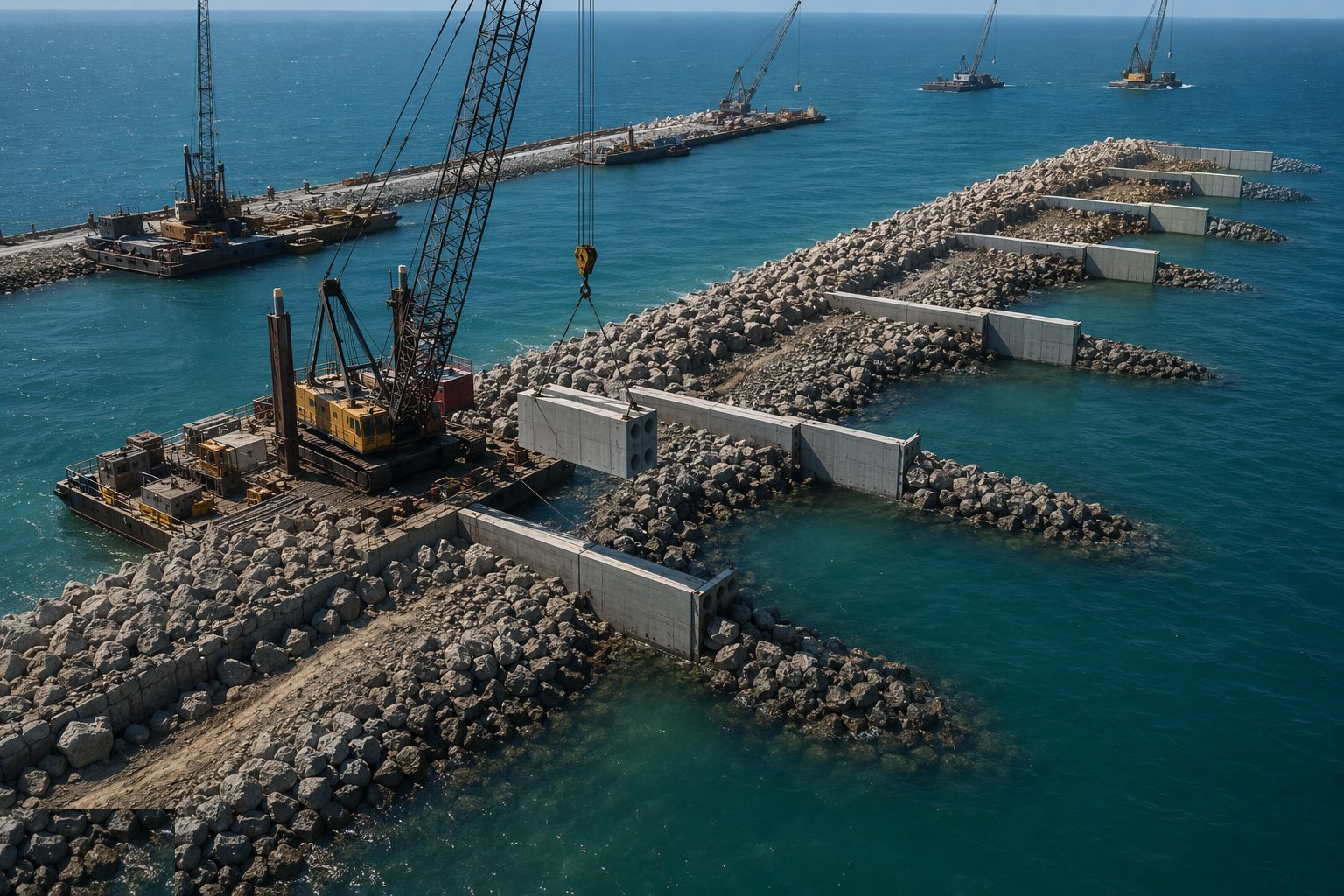
On groyne schemes the rhythm shifts to the beach: timber piles pitched and driven in pairs from low-ground-pressure plant at low water, walings bolted up as the beach allows; or rock placed to template by long-reach from the shoreward end, working seaward in tide windows. Groyne levels are set to the design beach profile, not the beach of the day — a groyne built proud of the design profile weirs the drift and a groyne built low drowns in accretion — and the bays are then managed: charged with nourishment where the scheme includes it, surveyed for their first year, and the downdrift flank watched like a hawk for the starvation the model promised not to cause.
Plant and equipment
- Crawler cranes with orange-peel grabs and purpose lifting tools for armour units
- Split-hopper barges, side-stone dumping vessels and multicat workboats for marine placement
- Precast yard: armour-unit moulds, batching plant, curing facilities and straddle carriers or gantries
- Long-reach excavators with machine control for underlayer profiling
- DGPS/RTK positioning on cranes and barges; multibeam echo sounders for mound surveys
- Low-ground-pressure piling rigs and leaders for timber groyne driving
- Rock haulage fleet and beach haul routes; dumpers rated for foreshore work
- Weather routing and wave forecasting services; site wave rider or telemetry buoy
Quality control checks
- Armourstone to BS EN 13383 grading with quarry and placement inspections; underweight or flaky loads rejected
- Concrete armour units: cube results, casting records and dimensional checks per batch; damaged units culled
- Placement density audits — units per square metre against the design count, every position recorded
- Underlayer profile surveyed and accepted before armour placement on each section
- Mound geometry verified by multibeam and GNSS as the works advance; as-built profile on completion
- Stability design reconciled to the as-built armour layer before the maintenance period starts
Safety considerations
- Plant working out along an unfinished mound: defined haul routes, edge discipline, and retreat plans for rising seas
- Suspended armour units over the mound: exclusion zones, dedicated lifting tools, and tag-line control in wind
- Marine operations: barges and workboats under certified crews, lifejackets on deck, MOB recovery drilled
- Storm-response procedure for the unfinished works: who secures what, and when the site is abandoned to the weather
- Tide-window groyne driving on soft beach: watchkeeper, marked escape routes and plant ground-bearing checks daily
- Night and poor-visibility working with marine plant: lighting, AIS awareness and a permit system that means it
Common defects
- Armour units placed off-pattern or unseated — a storm unzips the layer from the weak point outward
- Underweight or poorly graded rock in the armour layer — rocking, breakage and progressive unravelling
- Underlayer profile out of tolerance — armour concentrated in hollows and starved on humps, both failing early
- Core left unarmoured over a storm — the head washed back and a month of placement to redo
- Roundhead and root details under-armoured — the transitions failing while the straight trunk stands
- Groynes set to the beach of the day rather than the design profile — weiring, scour at the flanks and downdrift starvation
Best suited for
- Harbour, marina and intake shelter where wave energy must be excluded
- Detached or shore-connected breakwaters holding beaches in their wave shadow
- Groyne fields on drift-dominated coasts where the beach is the defence
- Frontages where single-layer concrete armour halves the rock volume the quarry route can supply
How long does Breakwaters & Groynes take?
Typical duration: A land-based rubble-mound breakwater advances 20–60 m per week in fair weather with armour closing up behind; a 1 km scheme with a precast yard typically runs 18–36 months, storm seasons and armour curing dictating the rhythm. A groyne field renews at a groyne or two per tide cycle..