Healthcare Commissioning & Validation
Proving a hospital works before the patients arrive — HTM/HBN compliance testing, theatre and isolation-room ventilation validation, witnessed medical gas tests, derogations and the documentation mountain that hands a building to clinical teams.
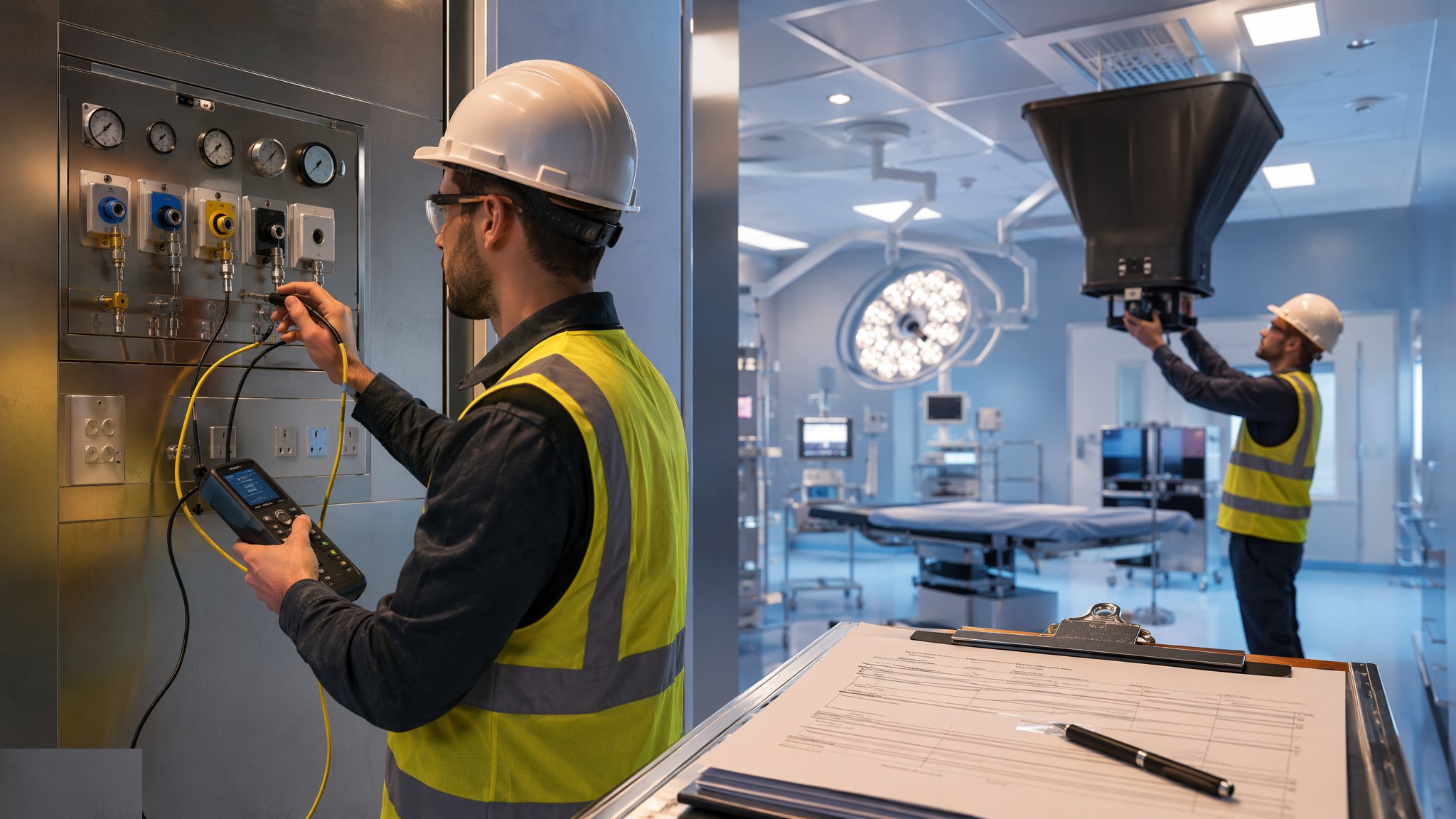
Last updated 2026-07-28 by the BuildPedia Editorial Team.
What is Healthcare Commissioning & Validation?
Commissioning a hospital is commissioning several buildings at once: an ordinary building, a pharmaceutical plant, a laboratory and a piece of life-support infrastructure, each with its own testing law. The ventilation must prove its air-change rates and pressure cascades; the medical gases must prove their purity at every terminal; the water systems must prove they are free of legionella; the electrical supplies must prove their resilience; and all of it must be documented to the standards the healthcare regulators inspect — HTM and HBN in the UK, with CQC and the trust's own governance behind them, and the health authorities' licensing regimes (DHA, DOH) plus international frameworks in the UAE. A commercial building commissions to satisfy a contract; a hospital commissions to satisfy a licence to treat patients.
The framework in the UK is HTM-based: HTM 03-01 for specialised ventilation in healthcare premises, HTM 02-01 for medical gases, HTM 04-01 for water, HTM 06-01 for electrical services, with HBN guidance setting the room-level requirements. Operating theatres and isolation rooms are the sharp end: theatre ventilation is validated for air-change rates, pressure relationships, temperature and humidity control, and ultra-clean ventilation (UCV) canopies for orthopaedic surgery are validated to their performance class. Isolation rooms — source isolation (negative pressure, to keep pathogens in) and protective isolation (positive pressure, to keep pathogens out) — are validated for their pressure cascade and air-change performance, with visualisation and measurement, not assumption.
Where the design cannot meet a standard to the letter, the route is a formal derogation: a documented, risk-assessed departure from the guidance, signed off at trust level, never a quiet workaround. The whole exercise ends not in practical completion but in clinical handover — the point where the trust's clinical and estates teams accept the building as fit to treat patients in, with the evidence base to defend that decision to a regulator or a coroner.
When and why is Healthcare Commissioning & Validation used?
Healthcare commissioning runs across the last quarter of the programme but is planned from the start — the commissioning manager is appointed early, the commissioning plan is written at design stage, and every HTM testing requirement is priced, sequenced and resourced before the trades that must be tested are even on site. It matters because the tests are hold points with no appeal: a theatre that misses its air-change rate does not open, an isolation room that fails its pressure cascade does not admit patients, and a medical gas system that fails purity testing does not get signed into service. It also matters contractually: in the UK the regime feeds the health and safety file and the trust's acceptance; in the UAE, commissioning evidence feeds the healthcare facility licence — the legal permission to operate. Time lost here cannot be bought back at the end, because the tests take what they take.
Types of Healthcare Commissioning & Validation
Ventilation validation (HTM 03-01)
Performance verification of specialised healthcare ventilation: air-change rates, room pressure cascades, temperature and humidity, filter integrity and airflow visualisation in theatres, isolation rooms, sterile services and pharmacies. Theatre UCV canopies are validated to their design class with velocity and entrainment testing.
Medical gases witnessed testing (HTM 02-01)
The Authorised Person-witnessed regime for the pipeline systems: purity, identity, particulate, pressure, flow, alarm and cross-connection tests, each recorded on prescribed certificates and signed into clinical service. No other building service carries this level of personal accountability in its testing.
Water systems safety (HTM 04-01)
Disinfection, sampling and temperature validation of hot and cold water systems against legionella and other water-borne pathogens: pasteurisation or chemical disinfection, microbiological sampling, outlet temperature mapping, and documentation for the trust's Water Safety Group before occupation.
Electrical resilience (HTM 06-01)
Proving the electrical infrastructure behind clinical care: primary and standby supplies, UPS systems for theatres and critical care, generator changeover testing under load, isolated power supplies for Group 2 medical locations, and the documentation that proves the life-support sockets stay live.
Derogation management
The formal process for departures from guidance: documented risk assessment, mitigation measures, clinical and infection-control sign-off, and recording in the handover file. A derogation is a controlled, owned decision — the alternative, quietly not meeting the standard, is a latent compliance failure.
Healthcare Commissioning & Validation: step by step
Step 1: Write the commissioning plan and appoint the team

Appoint the commissioning manager early and write the commissioning plan at design stage: every system to be tested, the standard it tests to, who witnesses, what the acceptance criteria are, and where the evidence lands. Identify the specialist bodies — the Authorised Person for medical gases, the ventilation validation specialists, the water treatment and microbiology labs — and book them, because they are scarce and their lead times are measured in months. The plan becomes part of the programme: HTM testing windows are activities with predecessors and successors like any other, not a vague allowance at the end.
Step 2: Pre-commission and set systems to work
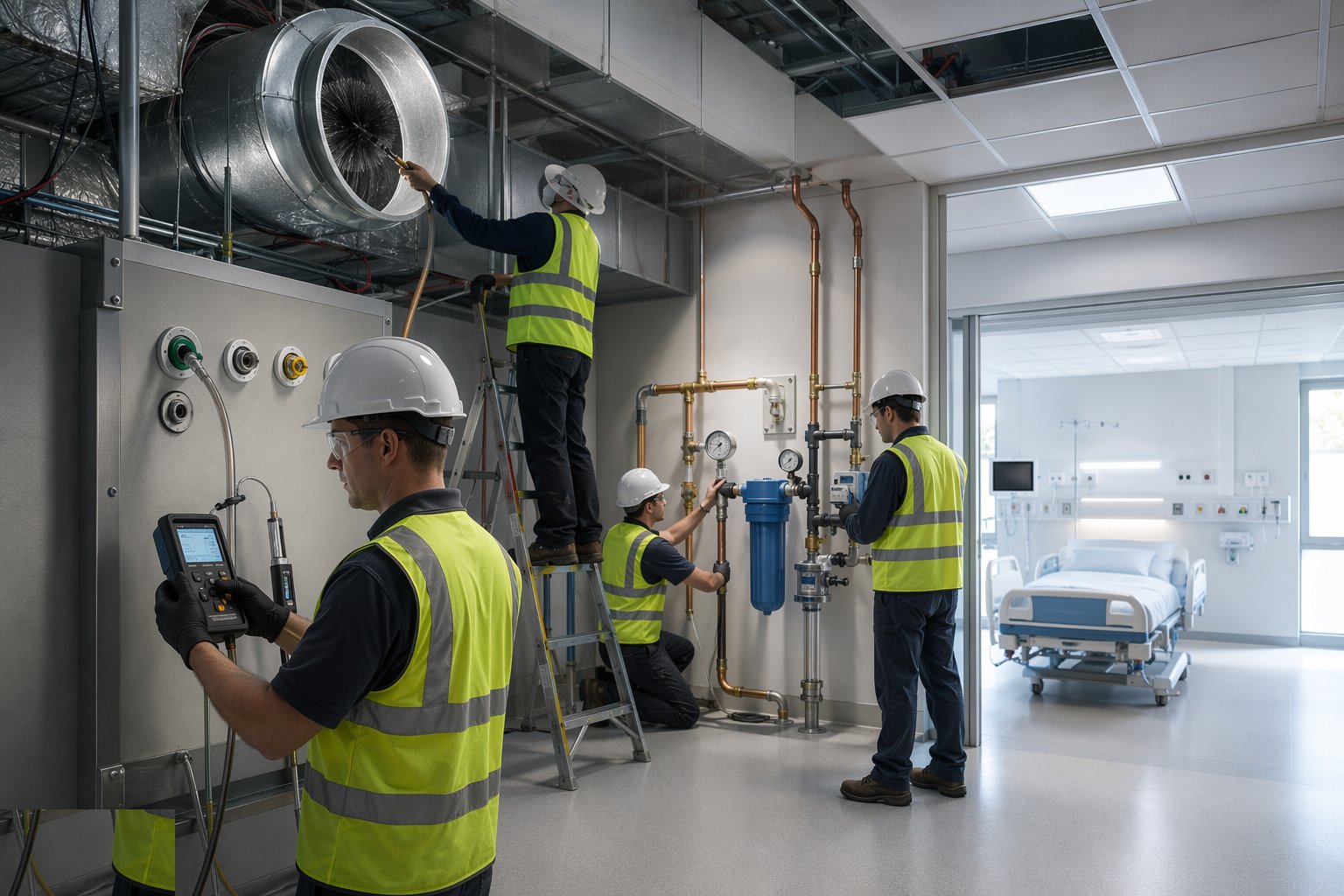
Before validation, prove the systems are ready to be validated: ductwork cleaned and certified, filters fitted and sealed, balancing dampers accessible, plant run in and stable, controls commissioned and trends logged. Set each system to work in sequence — air handling before room validation, plant before terminal testing — and clear the pre-commissioning checklists. A validation visit that finds an unbalanced system or a dirty duct is a wasted visit, and the specialists re-book at the contractor's cost and the programme's delay.
Step 3: Validate theatres, isolation rooms and critical ventilation
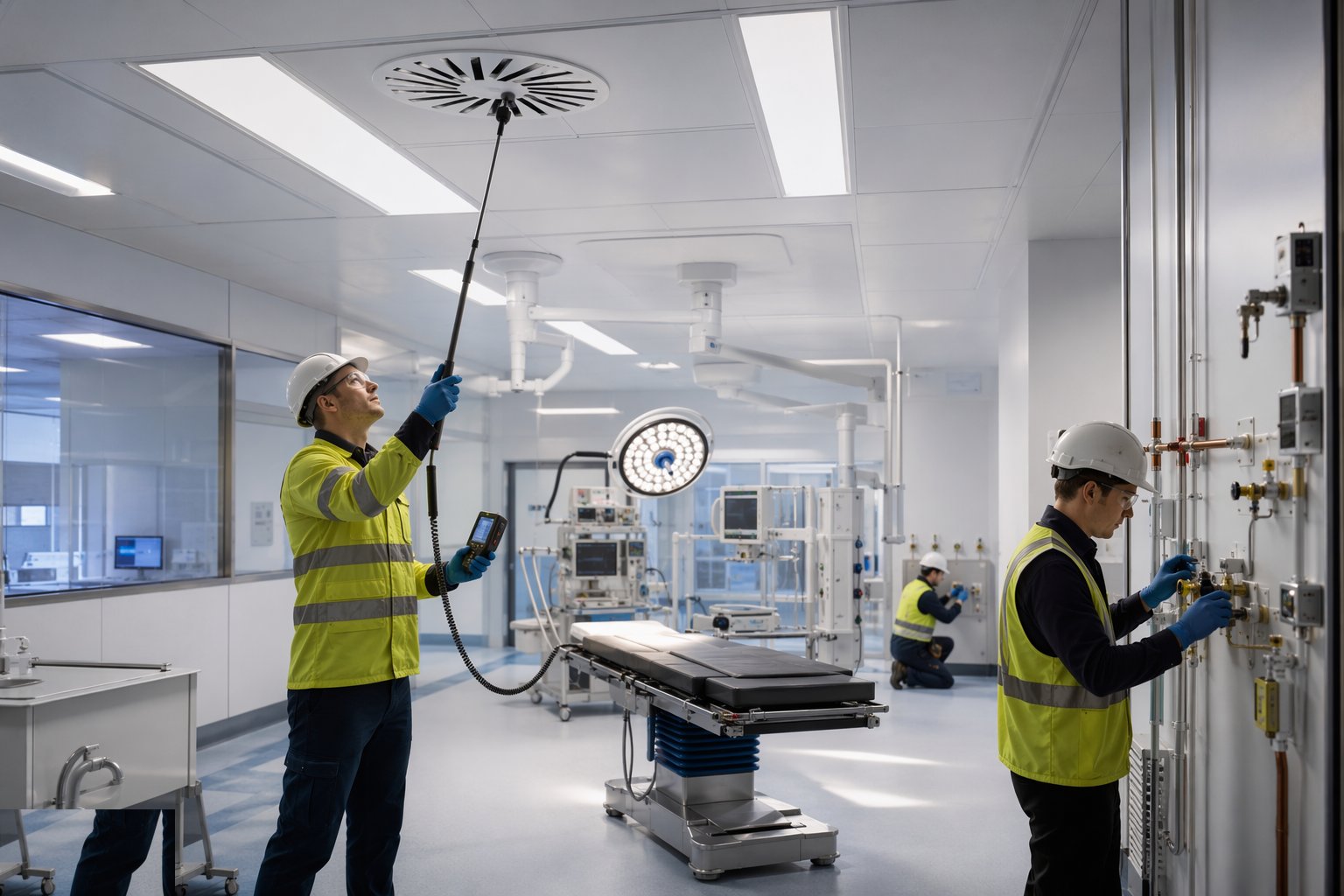
Execute the HTM 03-01 validation with the specialist: measure air-change rates and airflow patterns, verify the pressure cascade room by room with calibrated manometers, prove temperature and humidity control at design load, and visualise airflow with smoke where entrainment or containment matters. Validate UCV canopies to their performance class with velocity grids and entrainment tests. For isolation rooms, prove the pressure relationship holds with doors cycling and under the failure modes the design requires. Every result is recorded room by room; a theatre that misses its figures is diagnosed, corrected and re-validated in full.
Step 4: Complete the witnessed medical gas testing
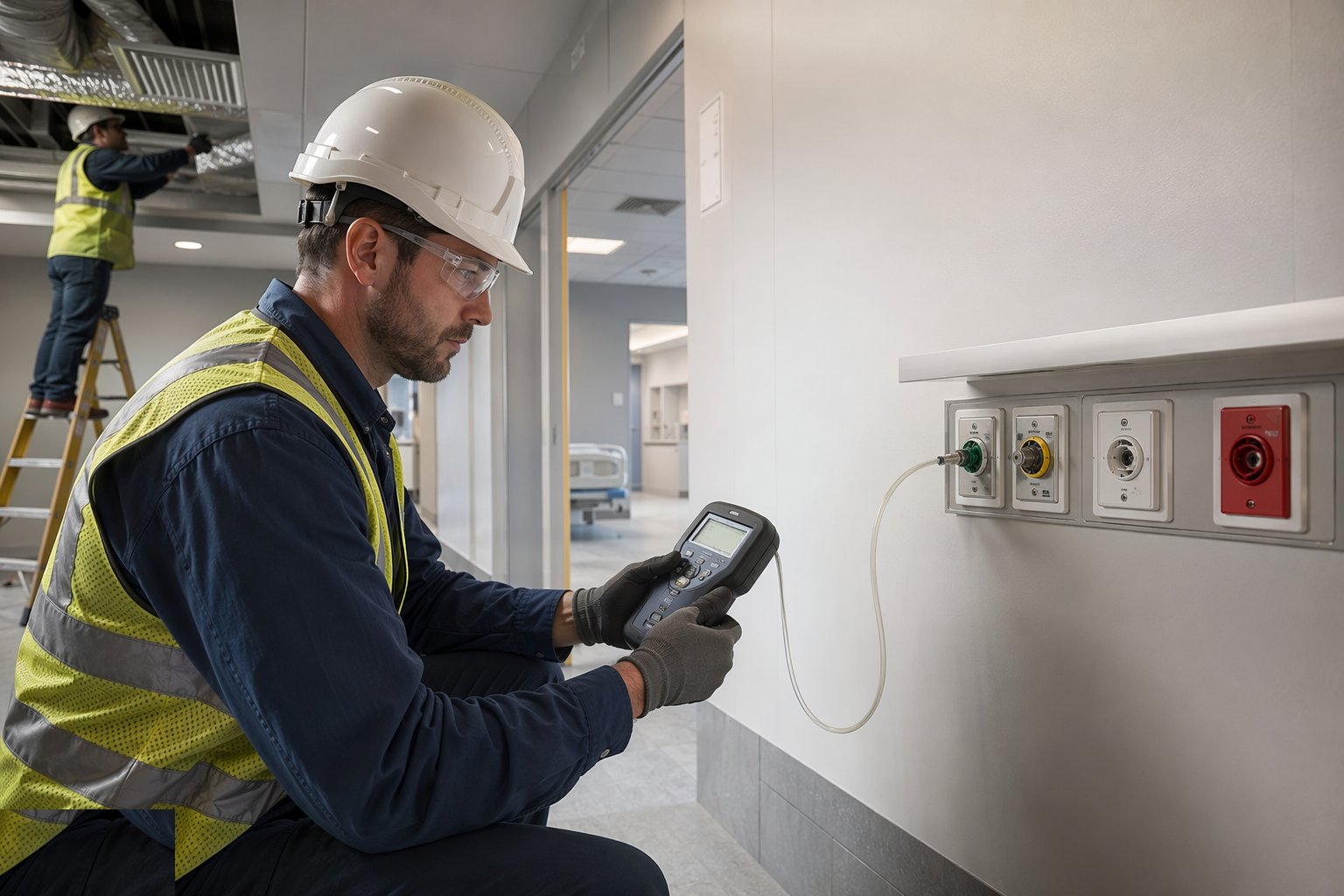
Run the full HTM 02-01 Part B sequence with the Authorised Person witnessing: purity and identity analysis at terminal units, particulate and odour testing, pressure and flow performance, alarm function, and cross-connection testing at every outlet. Record on the prescribed certificates and resolve every failure — a contamination result means tracing the source section by section. The Authorised Person's signature transfers the system to clinical service, and there is no other route to it.
Step 5: Prove water safety and electrical resilience
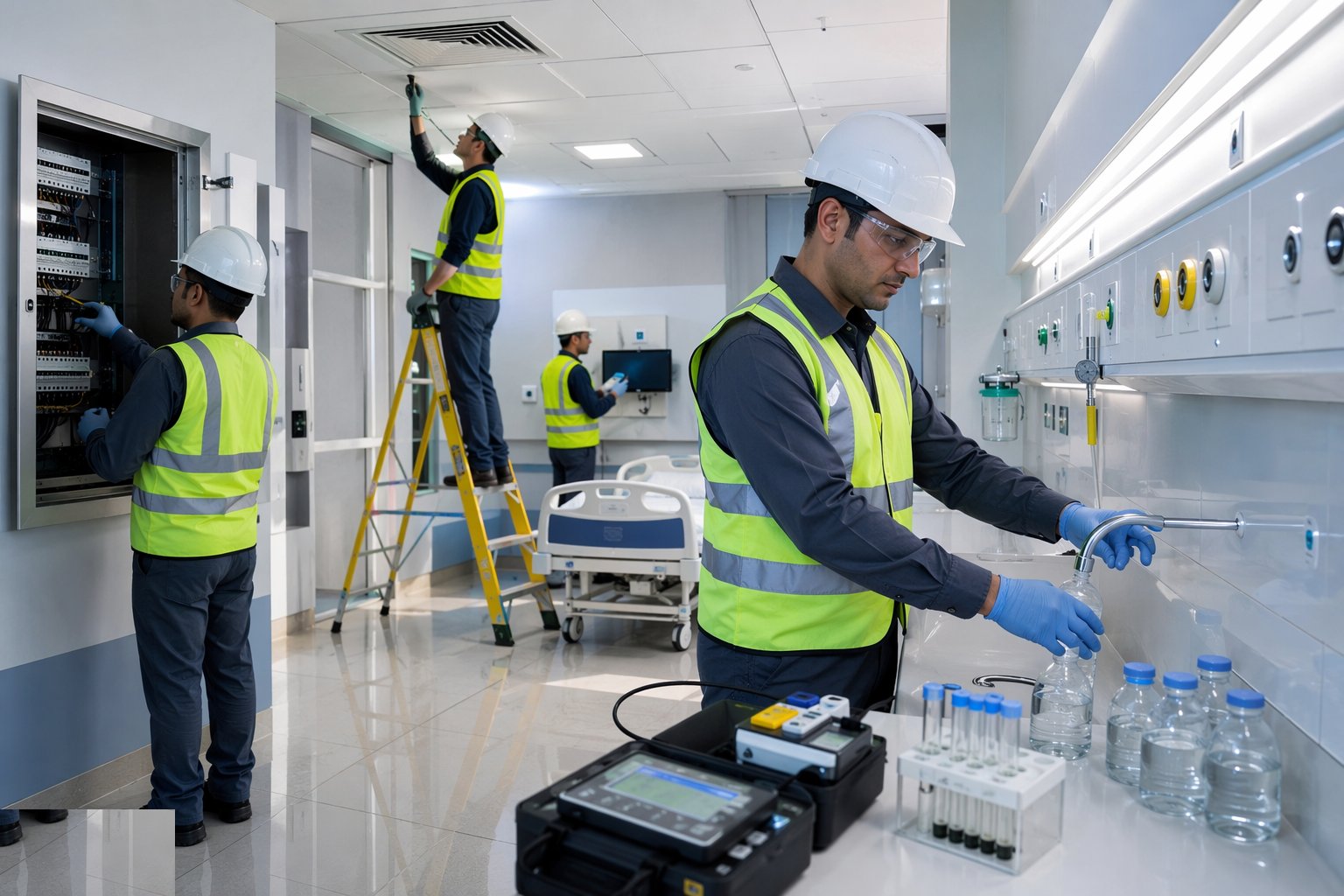
Disinfect the water systems to the HTM 04-01 regime — thermal or chemical — and take microbiological samples through an accredited laboratory; map outlet temperatures across representative outlets and log them for the Water Safety Group. In parallel, prove the electrical resilience: run the generator changeover tests under load, test UPS autonomy for theatres and critical areas, verify isolated power supplies and alarm systems, and witness the lot with the client's electrical Authorised Person. Neither system hands over on paperwork alone — both hand over on measured evidence.
Step 6: Manage derogations to closure
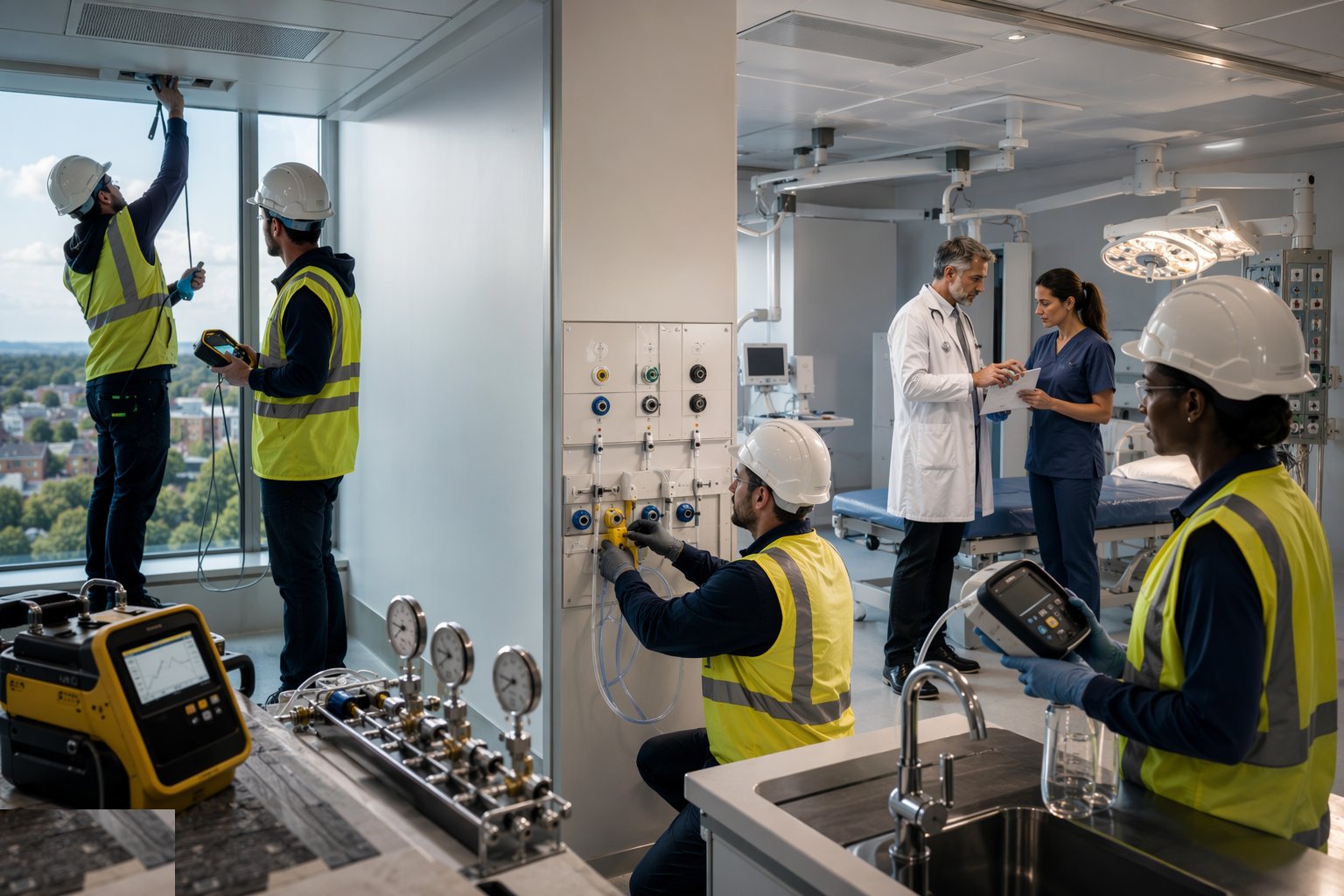
Where any element cannot meet the guidance, process the derogation properly: document the departure, risk-assess it with clinical and infection-control input, define the mitigations, and obtain the trust's sign-off at the right governance level. Record every derogation in the handover documentation with its justification and review obligations. The test of a derogation is whether the trust can defend it to a regulator in five years — if the file cannot tell that story, the derogation is not closed.
Step 7: Compile the evidence and hand over to the clinical teams
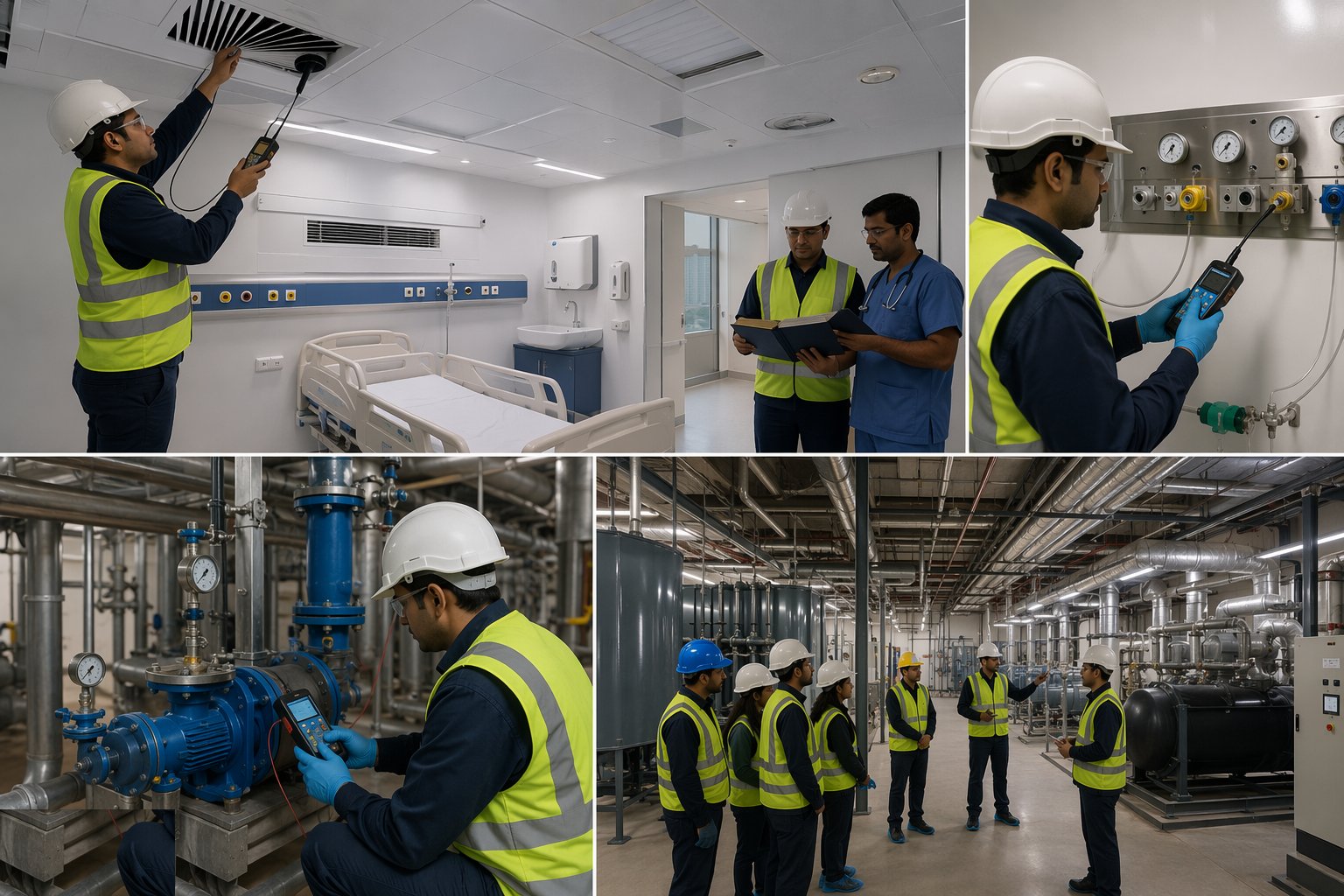
Assemble the commissioning file: validation reports, witnessed certificates, laboratory results, derogation records, as-builts, O&M manuals and the health and safety file. Train the estates and clinical staff on the systems, walk the departments through with the clinical leads, and support the trust's own acceptance processes — in the UK, the governance sign-offs behind CQC registration; in the UAE, the evidence pack behind the healthcare facility licence. Hand over formally, with the clinical teams accepting each department, and stay close through the first weeks of clinical operation — the building is now theirs, and teething problems in a live hospital are managed, not snagged.
Plant and equipment
- Balometers, anemometers and calibrated micromanometers for airflow and pressure measurement
- Particle counters and airflow visualisation (smoke) kits
- Medical gas analysers and laboratory sampling apparatus
- Temperature and humidity data loggers for sustained room monitoring
- Water system disinfection and sampling equipment
- Load banks for generator and UPS proving
- Filter integrity (DOP/PAO) test equipment
- Commissioning management software and certificate documentation systems
Quality control checks
- Commissioning plan written at design stage, with every HTM test requirement scheduled
- Ventilation validation to HTM 03-01 with room-by-room recorded results
- Medical gas testing witnessed and signed by the Authorised Person on prescribed certificates
- Water microbiological results clear before occupation, evidenced to the Water Safety Group
- Every derogation documented, risk-assessed and signed at trust governance level
- Commissioning file complete before clinical handover — no paper chasing after patients arrive
Safety considerations
- Testing in near-complete buildings: permit-controlled energisation, hot works and confined-space entry
- Water disinfection chemicals and pasteurisation temperatures — controlled dosing and PPE
- Load testing of generators and UPS: fuel, exhaust, noise and live electrical working under authorisation
- Working alongside trust staff and early clinical occupation — segregate, communicate and permit everything
- Filter integrity testing agents and smoke visualisation — COSHH assessments and ventilation
- Never decommission or isolate a live adjacent clinical system for testing without the trust's permits
Common defects
- Commissioning planned too late — the validation specialists arrive to find unbalanced systems and leave again
- Theatre air-change rates missed because the ductwork was value-engineered at first fix
- Pressure cascades that work on paper but fail with doors cycling — discovered at validation, redesigned at cost
- Medical gas purity failures traced to early installation sins — the re-test programme eating the handover float
- Derogations left verbal — the trust's governance cannot accept what it cannot read
- Handover documentation incomplete at clinical occupation — the building treating patients while its evidence file is still being written
Best suited for
- New hospitals, theatre suites and critical-care facilities approaching handover
- Ward and department refurbishments requiring re-validation before reoccupation
- Isolation facilities and UCV theatre upgrades
- Any healthcare project where regulatory licensing gates clinical operation
How long does Healthcare Commissioning & Validation take?
Typical duration: The validation and witnessed-testing window typically runs 8–16 weeks for a major department or new wing, excluding pre-commissioning; allow re-test contingency in every programme..