Working In & Around Live Hospitals
Building inside a hospital that never closes — infection control, sealed containment, negative-pressure working and decant logistics that keep patients safe while the work goes on around them.
Last updated 2026-07-28 by the BuildPedia Editorial Team.
What is Working In & Around Live Hospitals?
Hospitals are the only building type where the client carries on delivering a critical service metres from the workface, twenty-four hours a day, and where a cloud of construction dust is not a nuisance — it is a clinical incident. Construction activity releases dust, mould spores and water-borne bacteria; for immunocompromised patients in haematology, oncology, transplant and neonatal units, airborne Aspergillus can be fatal. Everything about working in a live hospital flows from that fact: the works are planned backwards from the infection risk, not forwards from the programme.
In the UK the framework is the Infection Control Risk Assessment (ICRA) — a joint exercise between the contractor, the hospital's infection prevention and control (IPC) team and the estates department that classifies the work by its dust and disruption potential and the patient risk group adjacent to it, and then prescribes the controls. The output is a written permit regime: what containment class is required, what monitoring is required, who has authority to stop the job, and which activities are banned outright during certain hours. NHS guidance (HTM 04-01 for water systems, HTM 03-01 for ventilation, and HBN/HFN construction guidance) sits underneath, and the hospital's own IPC policies usually go further. In the UAE, live-hospital works are governed by the healthcare authority's licensing regime — DHA in Dubai, DOH in Abu Dhabi — whose facility guidelines set equivalent infection-control and life-safety requirements during construction, with the same underlying principle: clinical operations take precedence over construction convenience, every time.
The practical consequence is that the containment is built before the demolition starts, the decant is agreed before the containment goes up, and the programme is written around clinical hours, not the other way round. Negative-pressure hoardings with airlocks, sticky mats and dust monitoring are the baseline, not the upgrade. Hot works, core drilling and water-system shutdowns happen at 2 a.m. by arrangement, or not at all.
When and why is Working In & Around Live Hospitals used?
Live-site containment applies whenever works touch an occupied healthcare facility — ward refurbishments, department extensions, services diversions through occupied corridors, even a plant room upgrade on a roof above theatres. It matters because the contractor controls hazards that the hospital cannot: a breached hoarding, an uncontrolled shutdown, or a vibration spike through an operating theatre floor are patient-safety events that close clinical capacity, and the reputational and contractual consequences are severe. It also matters commercially: decant logistics, double-handling, out-of-hours premiums and permit gatekeeping typically add more to cost and programme than any other factor on healthcare work, and they are priced and planned at tender, not discovered on site.
Types of Working In & Around Live Hospitals
Class II–IV containment hoarding
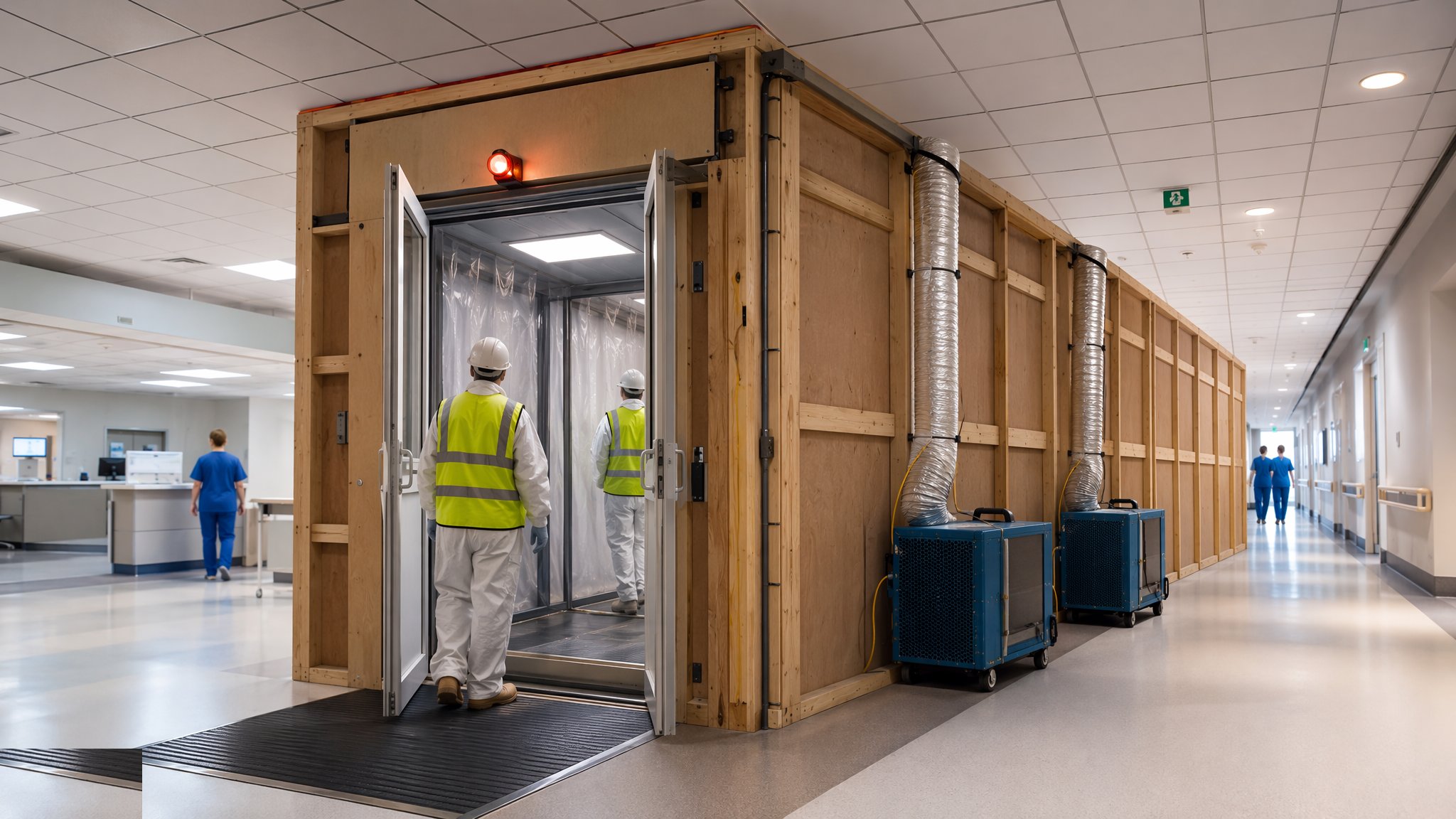
Sealed, purpose-built dust partitions around the workface — from solid timber or proprietary panel hoardings with sealed joints for low-risk areas, up to full double-skin enclosures with anterooms for high-risk units. Class IV adds negative pressure maintained by HEPA-filtered extraction units, so any leak flows into the work zone, never out towards patients.
Negative-pressure anterooms and airlocks
The controlled doorway between clean hospital and dirty site: a two-door lobby, negative to the corridor, with HEPA-filtered extraction running continuously, differential pressure monitored and alarmed. Operatives pass through, dust stays in. Manometer readings are logged daily — an anteroom that has lost negative pressure is treated as a breach, not a maintenance item.
Decant and swing-space working
Moving the clinical service out before the builder moves in: a ward relocated to a decant ward, a department temporarily rehoused in modular buildings, or a night-shift-only regime where the space is handed back clean every morning. Decant is a clinical logistics exercise with a construction dependency — patient moves, equipment, records and IT all move with the service.
Out-of-hours and phased permits
Noisy, dusty, vibration-heavy or shutdown works packaged into agreed windows — nights, weekends, or theatre maintenance days — each under a specific permit signed by estates and IPC. The permit is the licence to work: no permit, no drilling, and the permit wallah is the hospital, not the contractor.
Modular decant villages
For whole-department rebuilds, a temporary modular ward or clinic on the car park — fully serviced, HTM-compliant accommodation that lets the service relocate for a year or more while the permanent building is gutted. Expensive, but it converts an impossible phased job into a straightforward empty-shell one.
Working In & Around Live Hospitals: step by step
Step 1: Run the ICRA and agree the risk classification
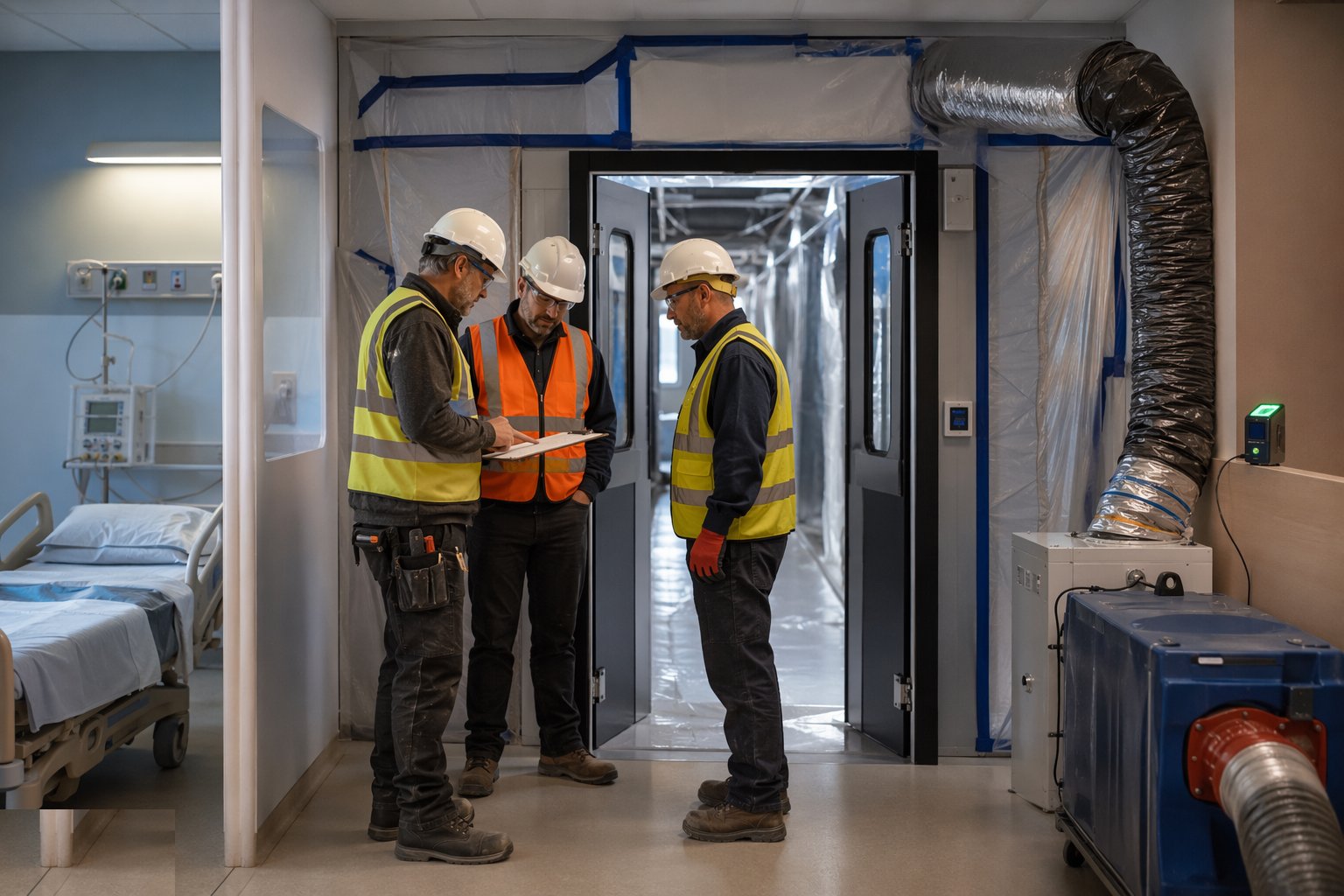
Before a single tool arrives, sit down with the IPC team, estates and the clinical lead and complete the Infection Control Risk Assessment: classify the construction activity by type (inspection-level, minor works, medium dust generation, major demolition) and the patient population by risk group (low, medium, high, highest). The intersection of the two gives the containment class — Class I through Class IV controls. Every trade and every phase of the job gets its own assessment; a job that starts as Class II and becomes Class III when the demolition starts is replanned, not stretched. The signed ICRA becomes part of the construction-phase plan, and nobody works outside it.
Step 2: Agree the decant and logistics plan
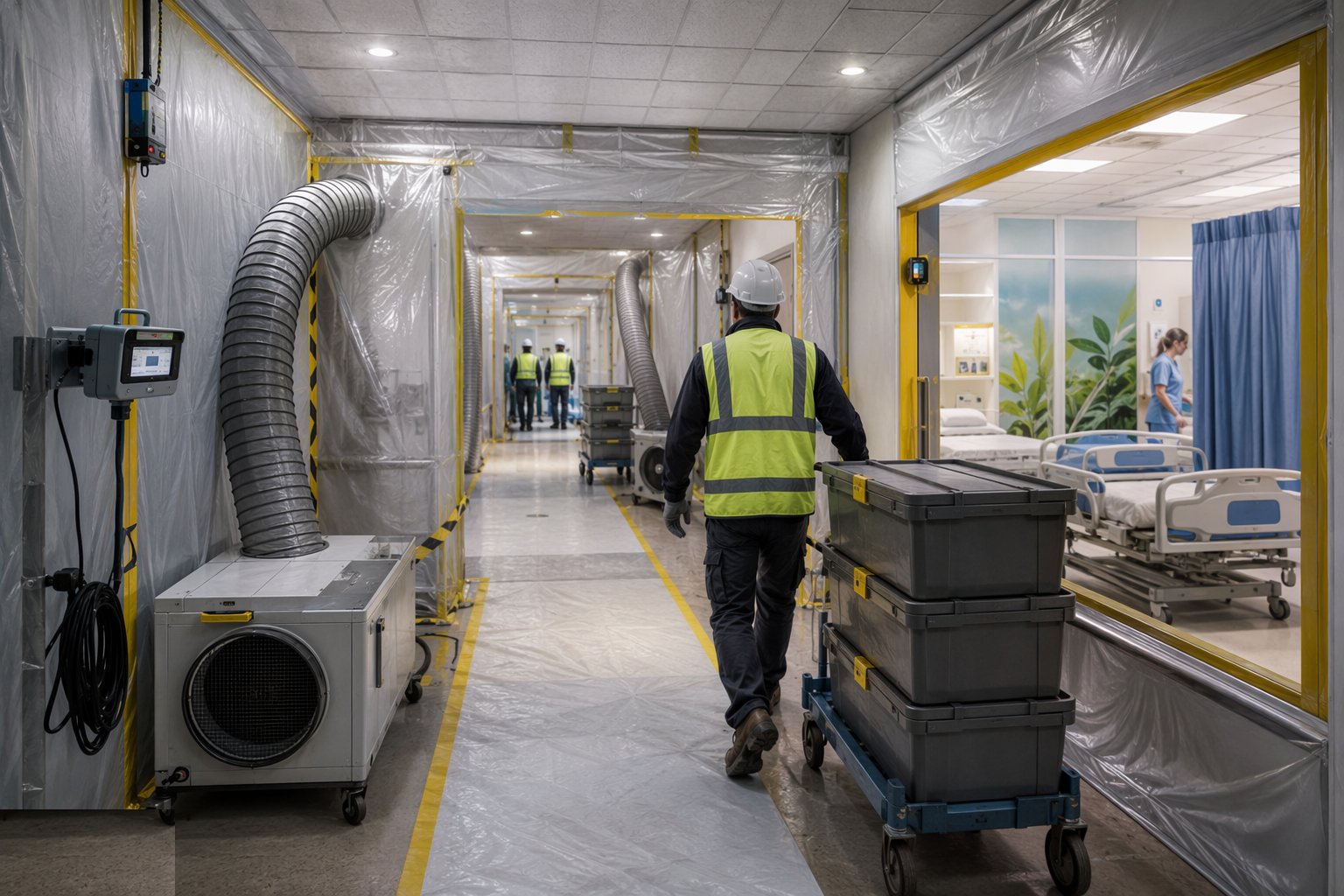
Map every patient, service and piece of clinical equipment that must move, and where it moves to. Agree the swing space, the move sequence and the blackout dates — infection outbreaks, winter pressures and elective peaks are untouchable. Route materials, waste and personnel: site traffic never shares a corridor with patient transport where it can be avoided, waste leaves in sealed containers on agreed routes at agreed times, and a dirty lift is never a patient lift. This plan is signed by the clinical service managers, because when it changes mid-job — and it will — they are the ones who change it.
Step 3: Erect and validate the containment
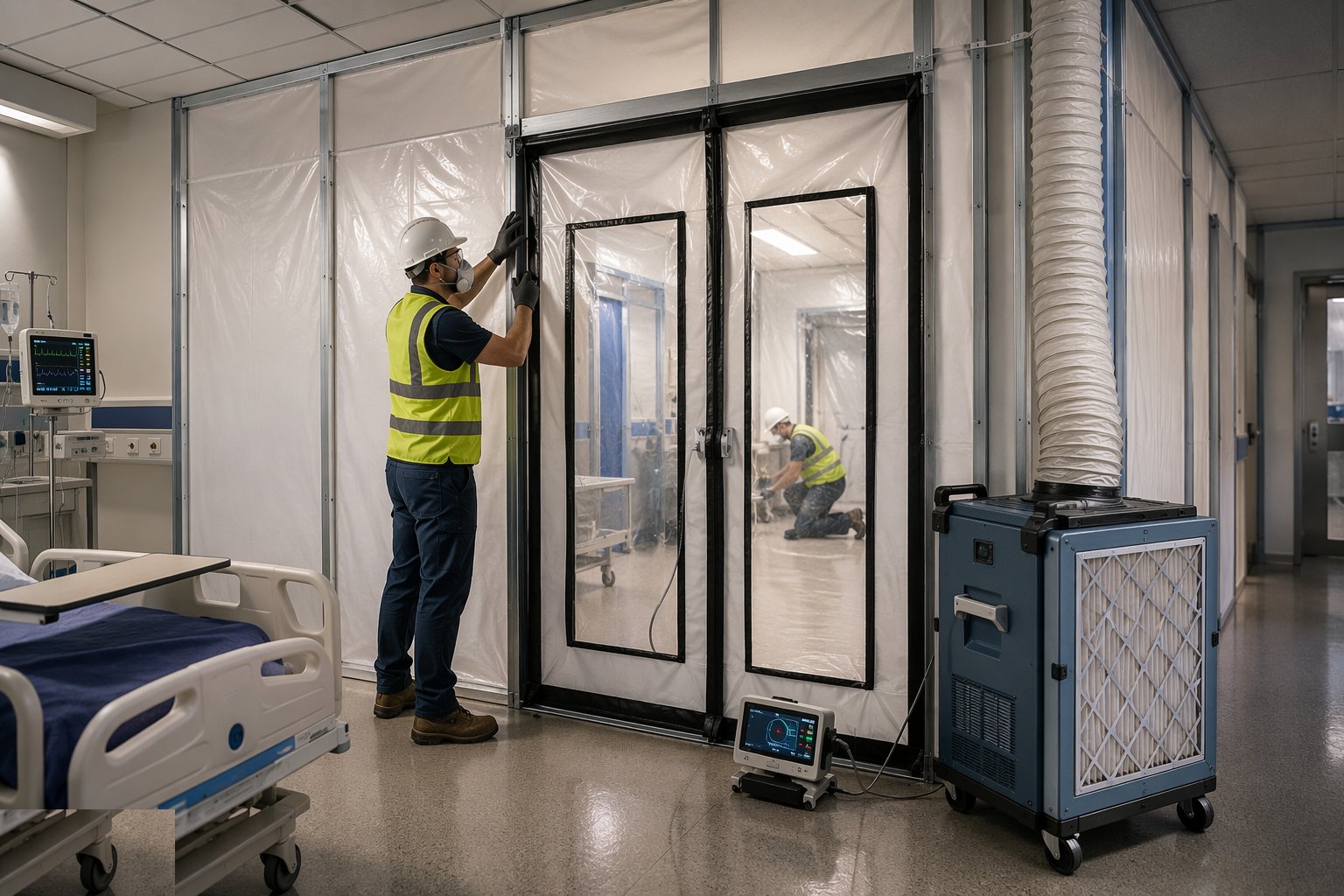
Build the hoarding before the demolition starts: sealed panels floor to soffit, joints taped, penetrations sealed, anteroom doors self-closing. Install the HEPA-filtered negative-pressure units, discharge them away from air intakes and openable windows, and commission the whole enclosure — check negative pressure with a manometer, verify airflow direction with smoke, and log the readings. The IPC team inspects and signs off the containment before it is relied on; from that moment, any hole in it is a reportable breach that stops work until it is made good.
Step 4: Set up dust, noise and vibration control
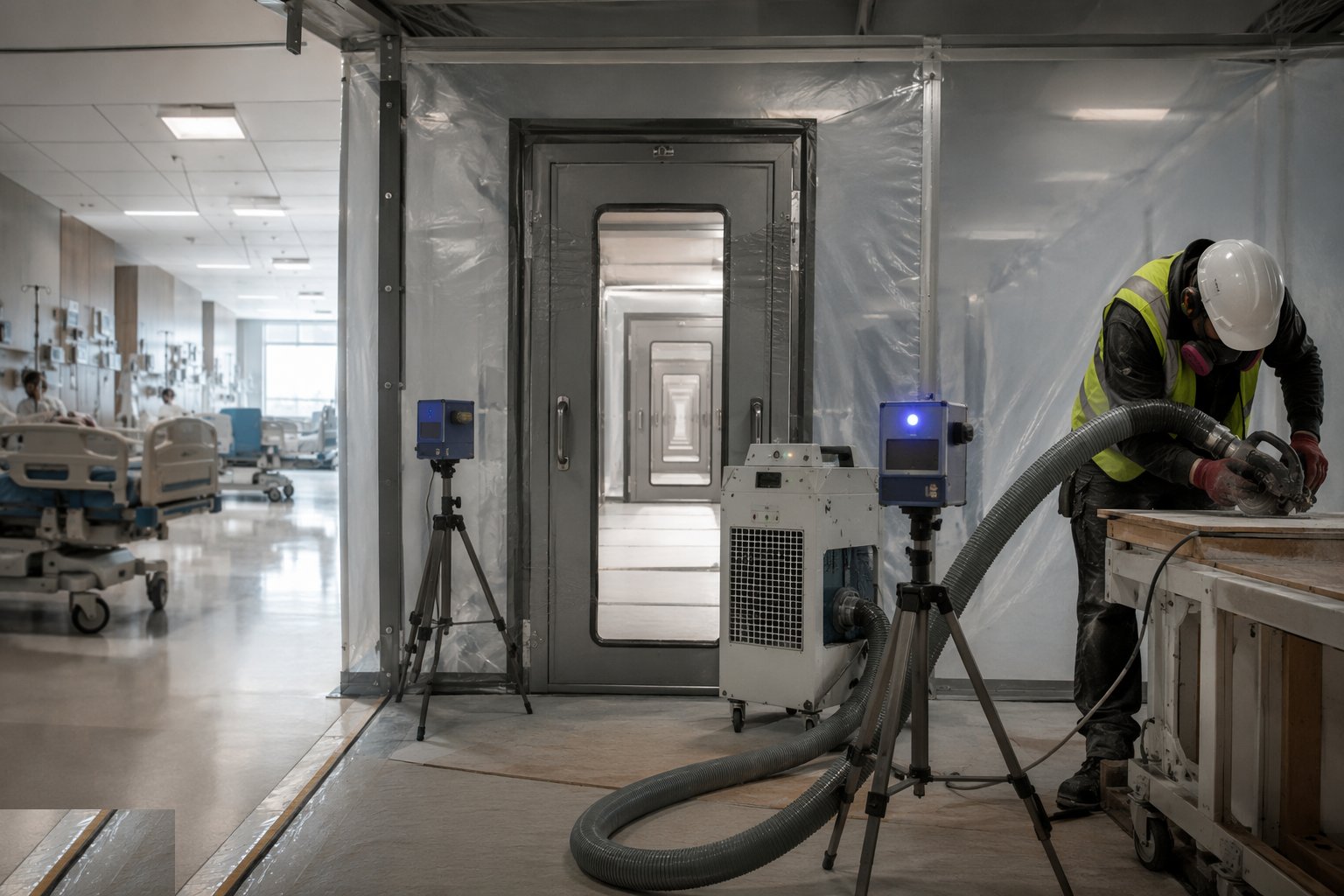
Fit dust monitors at the containment boundary where the ICRA demands them, with alarm levels agreed with estates. Tool-level extraction on saws and drills, water suppression on breaking, and no uncontrolled chasing of blockwork. Noise and vibration are clinical issues, not neighbour issues: drilling above an operating theatre or through a slab over an MRI suite is scheduled with the department, monitored where specified, and stopped instantly on complaint. Baseline vibration surveys are taken where sensitive equipment or structure warrants it, because "it was like that before" is a claim you can only make with a survey in the file.
Step 5: Plan every shutdown and isolation in advance
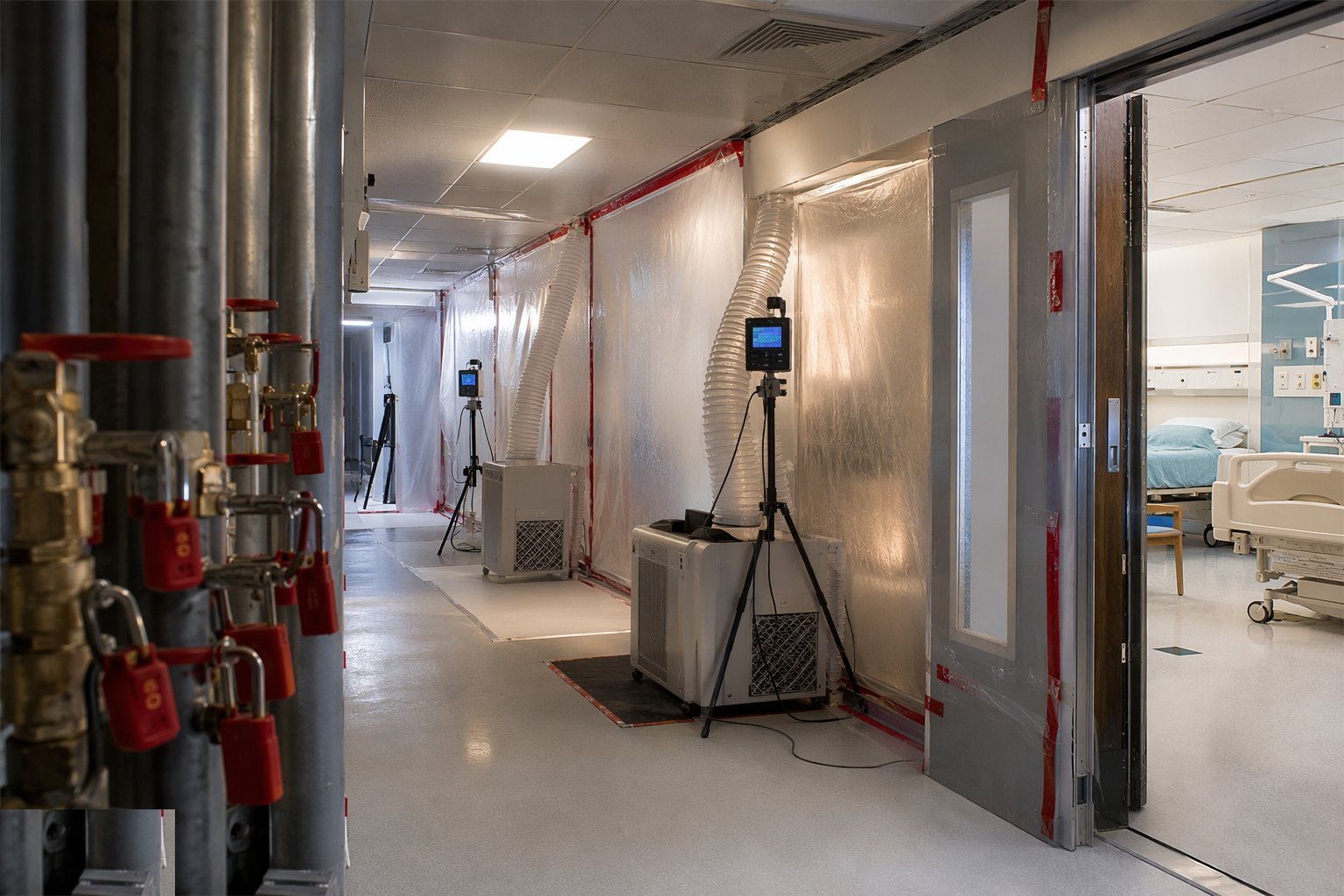
Water, power, medical gases, nurse call, fire alarm zones — every isolation in a live hospital goes through the estates permit system with days or weeks of notice, a written method statement, a backout plan and clinical sign-off. Shutting down a domestic water riser means legionella control on refill to HTM 04-01; isolating a medical gas main means a witnessed medical gases shutdown with the Authorised Person (MGPS). Never improvise: an unplanned isolation that drops a ward's oxygen or a theatre's power is a never-event category incident in every sense that matters to the contractor.
Step 6: Work the permits — hot works, noisy works, out of hours
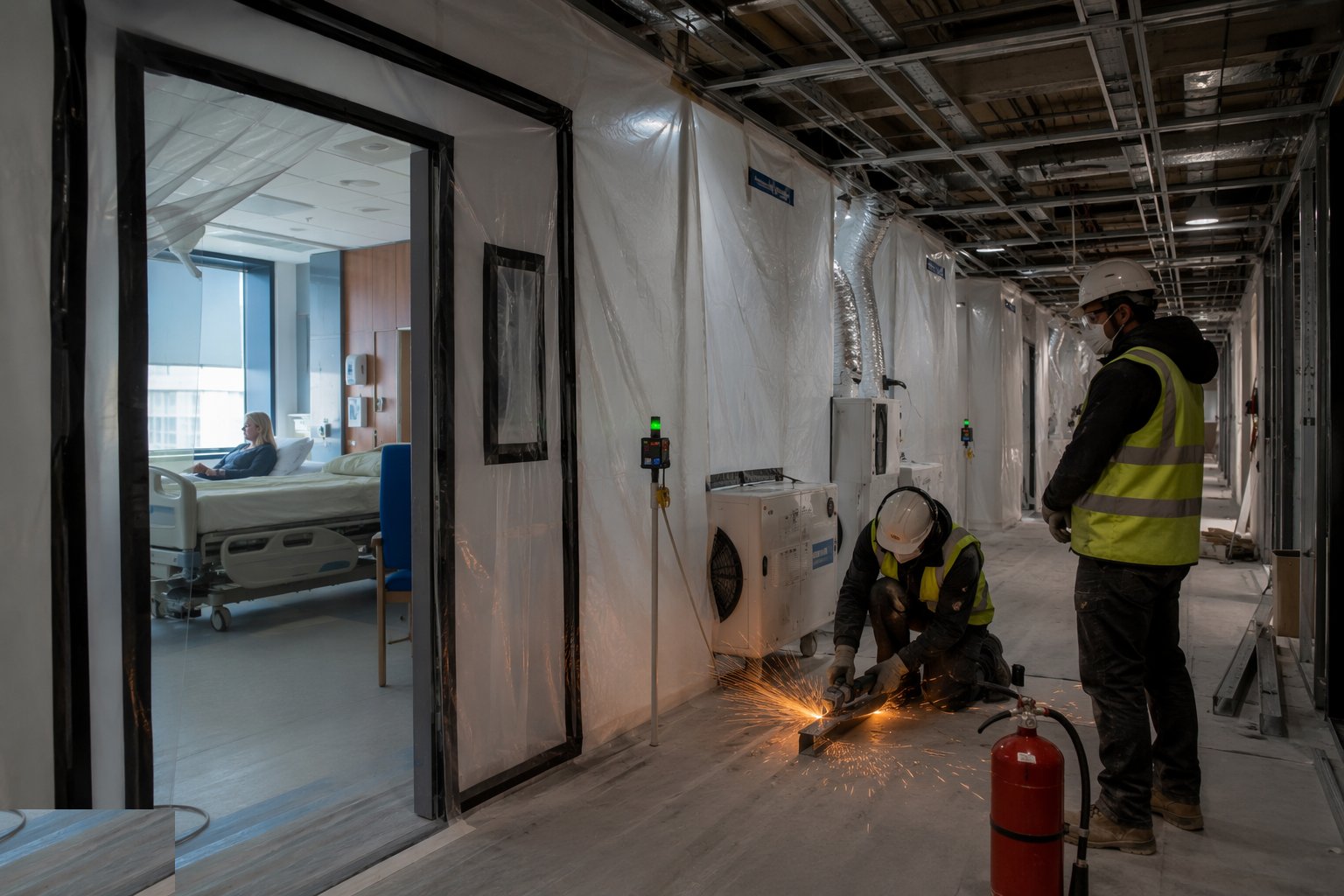
Package high-risk activities into their agreed windows and staff them properly. Hot works in hospitals run on strict permits with fire watch and a fire-alarm isolation protocol agreed with estates — an accidental alarm in a live hospital moves patients, literally. Out-of-hours working means night crews with supervision, hospital security coordination, and clean-down and hand-back standards agreed in advance: the ward corridor that is a works access at 3 a.m. is a clean hospital corridor again by 7 a.m., sticky mats re-laid, floors machine-cleaned, hoarding wiped.
Step 7: Maintain the containment through the job
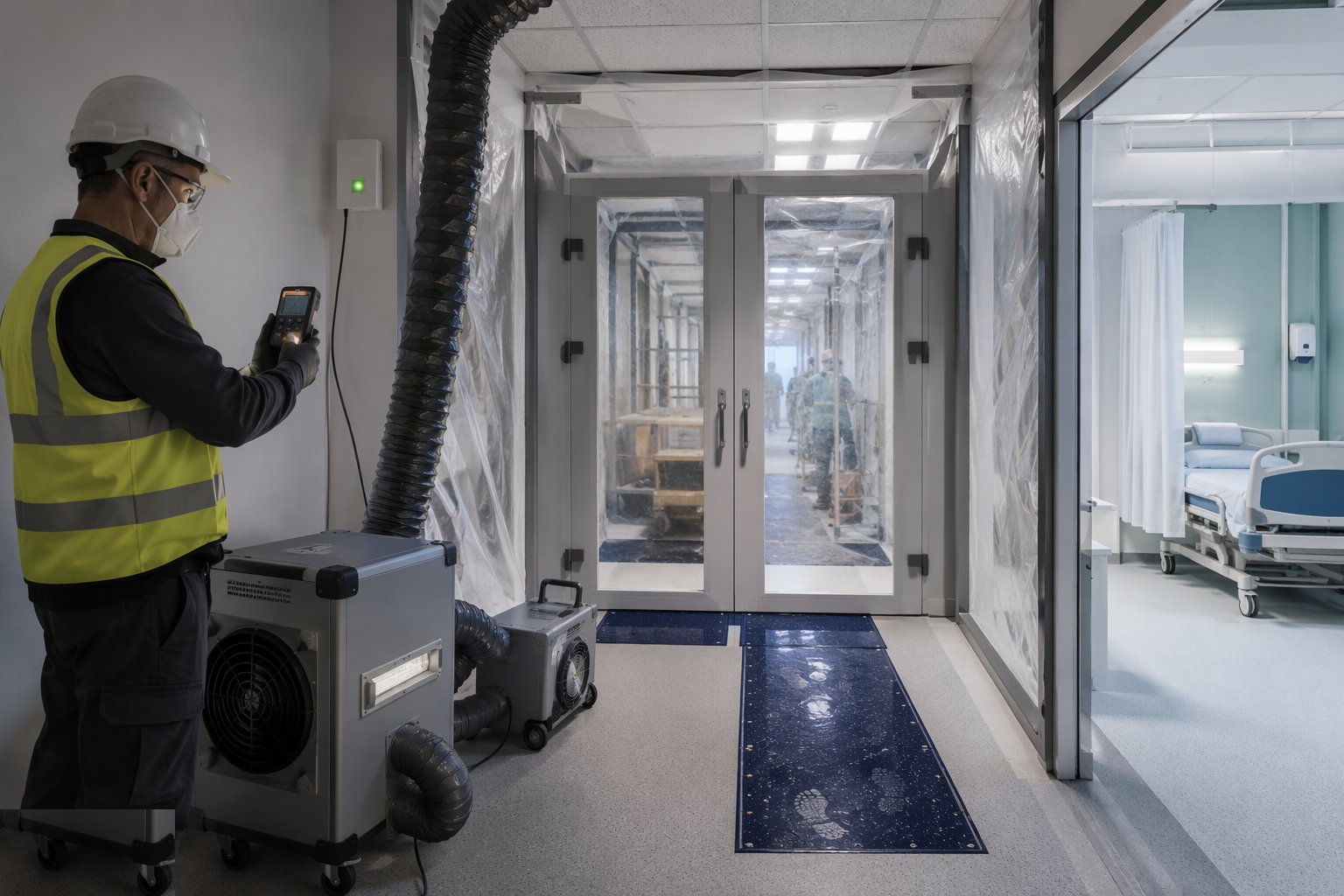
Containment is a living system, not a one-off. Inspect daily: anteroom pressures logged, HEPA unit pre-filters changed on schedule, sticky mats renewed, hoarding damage repaired same-day. Toolbox talks keep trades honest about the rules — no propped-open doors, no personal shortcuts through the anteroom, no eating on the clean side. When the job phase changes, the ICRA is revisited and the controls upgraded to match; the last week of heavy demolition is not the time to discover the containment was only ever Class II.
Step 8: Decommission, clean and hand back
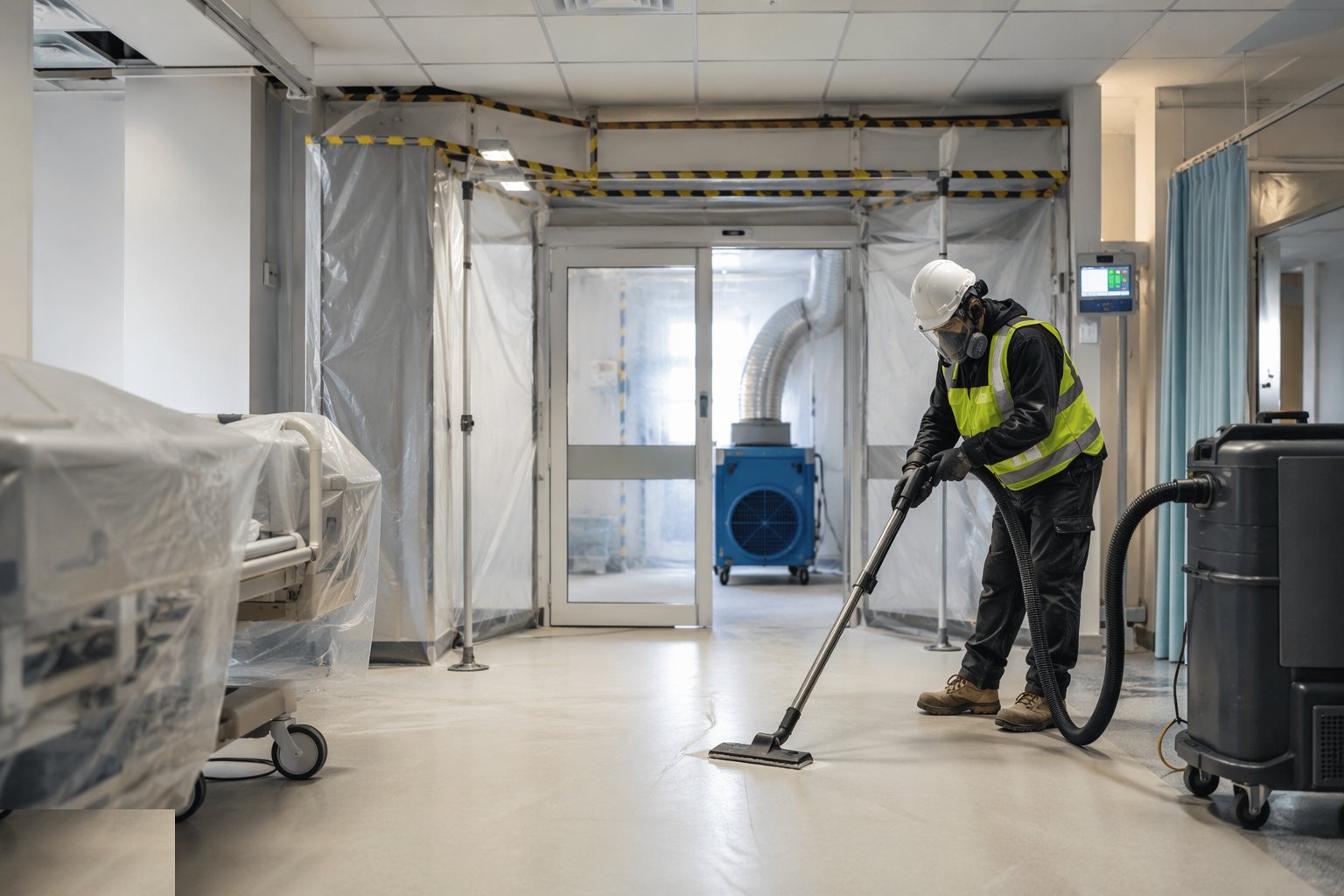
When the works finish, the containment comes down in reverse order and under control: clean the work area to clinical standard, HEPA-vacuum every surface, then clean again before the hoarding is opened — dust released at decontainment is the classic own goal. IPC inspects before reoccupation; ventilation systems are validated, water systems disinfected and sampled, and the space is handed back through estates with the documentation that proves it is safe for patients. Only then do the hoardings, the anteroom and the negative-pressure units leave site.
Plant and equipment
- Proprietary containment hoarding panels and self-closing anteroom doors
- HEPA-filtered negative-pressure (air scrubber) units with manometers
- Dust/particulate monitors with data logging for boundary monitoring
- Tool-mounted dust extraction and water suppression kits
- Sticky (tack) mats, floor protection and clean-down equipment
- Vibration monitoring equipment for works above sensitive departments
- Industrial HEPA vacuums and walk-behind floor scrubber-dryers
- Portable pressure washers and welfare segregated from clinical areas
Quality control checks
- Signed ICRA on file covering every phase and trade before work starts
- Containment commissioned and inspected by IPC before demolition begins
- Daily negative-pressure and dust-monitoring logs maintained and filed
- Every shutdown and isolation under a written permit with clinical sign-off
- Baseline condition and vibration surveys completed before works start
- Final clinical clean and IPC inspection documented before reoccupation
Safety considerations
- Airborne infection risk: containment integrity, HEPA extraction and dust monitoring protect patients first
- Legionella and water-borne pathogens: no uncontrolled disturbance of water systems; disinfection to HTM 04-01 on refill
- Fire: hospital evacuation is horizontal and patient-dependent — fire alarm isolations and hot works only under strict permit
- Working around vulnerable patients, the public and clinical staff — behaviour, security vetting and escorted access as the trust requires
- Services in live hospitals are undocumented and live: treat every pipe and cable as energised until proven isolated
- Manual handling and logistics in live corridors — trolleys, waste and materials moved under agreed escort and timing rules
Common defects
- Containment breached and not reported — a propped door overnight, and the ward next door gets the dust
- Negative pressure lost unnoticed because the manometer was never read — the anteroom becomes decoration
- Works started before the ICRA was signed — the job stops at the first IPC audit and restarts weeks later
- Unplanned shutdown discovered by a ward losing power or water — permit regime suspended for the whole site
- Poor clean-down at hand-back: dust in the corridor at 8 a.m. and the night crew banned from the building
- Decant plan treated as fixed — a clinical emergency reoccupies the swing space and the programme has no float left
Best suited for
- Ward, theatre and department refurbishments in occupied hospitals
- Extensions tied into live clinical buildings
- Services diversions and plant upgrades through operational areas
- Any construction within metres of immunocompromised or highest-risk patients
How long does Working In & Around Live Hospitals take?
Typical duration: Containment and ICRA setup typically 1–3 weeks before works; the regime then runs the full length of the contract, with decant phases adding weeks per department moved..