Medical Gas Pipeline Systems (MGPS)
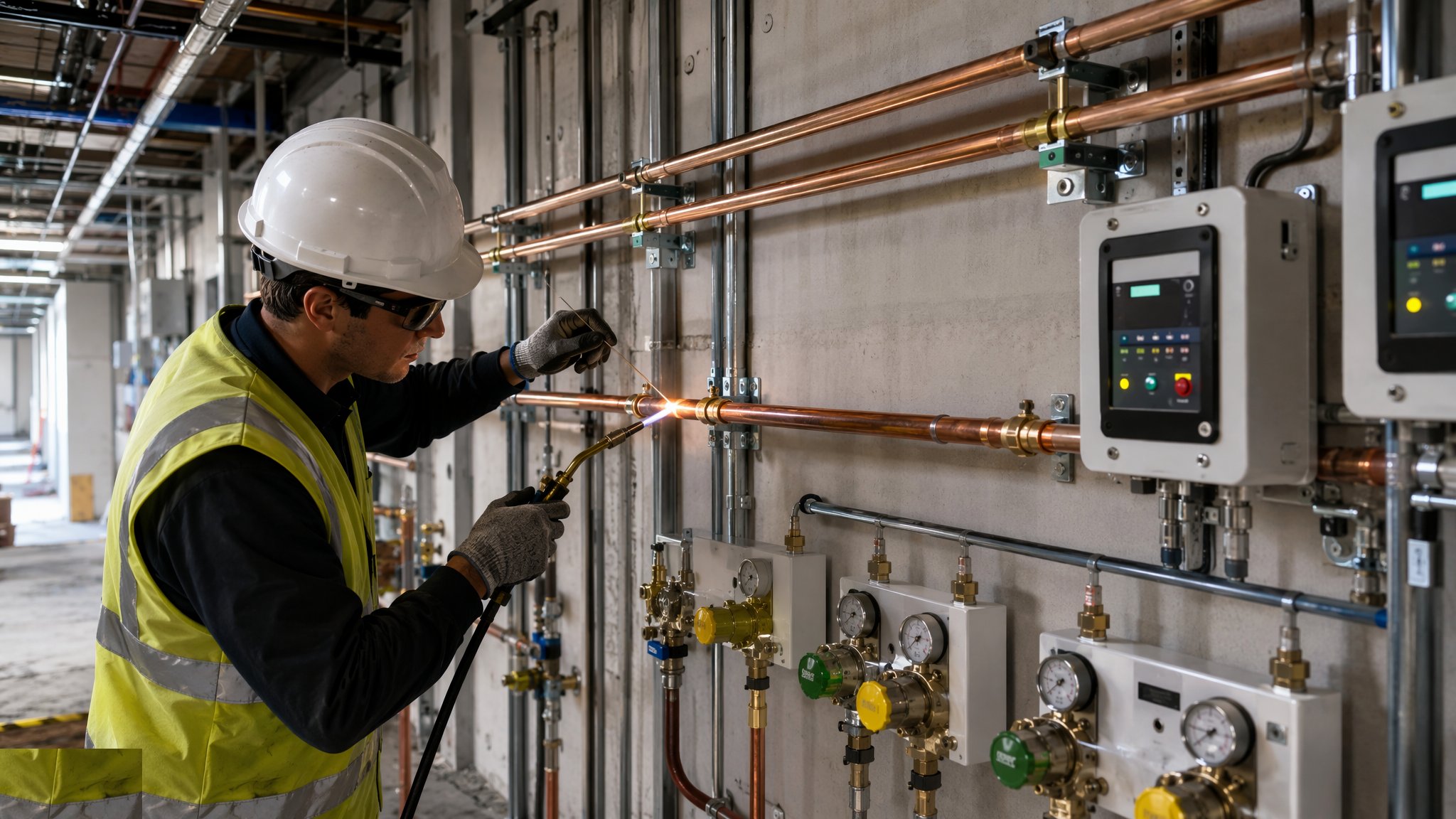
Degreased copper pipelines carrying oxygen, medical air and vacuum to every bedside — brazed under inert-gas purge, tested to destruction-level scrutiny, and governed by HTM 02-01 from first fitting to witnessed blowdown.
Last updated 2026-07-28 by the BuildPedia Editorial Team.
What is Medical Gas Pipeline Systems (MGPS)?
A medical gas pipeline system is the one building service that patients breathe directly from, which is why it is treated more like pharmaceutical manufacture than plumbing. Oxygen, nitrous oxide, medical air, surgical air, medical vacuum and anaesthetic gas scavenging (AGSS) run from central plant — vacuum-insulated evaporator (VIE) tanks, cylinder manifolds, medical air compressors, vacuum pumps — through degreased medical-grade copper pipework to terminal units at every bed, cot and theatre pendant. A contaminant in the pipe, a crossed connection, or a joint full of brazing oxide is not a defect to snag later; it is a clinical hazard, and the entire installation and testing regime exists to prove none of them is present.
In the UK the governing document is HTM 02-01 (Medical gas pipeline systems), sitting on BS EN ISO 7396-1, with a personnel regime that is unique in construction: design is checked by an Authorising Engineer, installation is by trained and certificated specialist fitters, and commissioning tests are witnessed and signed by an Authorised Person (MGPS) appointed by the trust. Pipework is copper to BS EN 13348 — degreased, capped and kept clean from the mill to the braze. Joints are brazed with silver brazing alloy while inert gas (oxygen-free nitrogen or argon) purges the bore, because brazing copper without a purge grows copper oxide scale inside the pipe — and that scale ends up in a patient's airway. Every fitting, every valve, every label follows the same doctrine: nothing inside the pipe that was not meant to be there.
The systems divide into plant and pipeline. Plant — VIE compound, manifold rooms, compressor sets, vacuum stations, AGSS pumps — is sized with duty, standby and reserve, and sited to strict separation and ventilation rules. The pipeline runs through area valve service units (AVSUs) that let a ward be isolated without killing the whole hospital, zone alarms that tell clinical staff of pressure faults, and terminal units gas-specific by design so an oxygen probe cannot fit an air outlet. In the UAE, hospital projects follow the same international framework — HTM-based specifications are common on UK-designed schemes, NFPA 99 on US-influenced ones, with the healthcare authority (DHA/DOH) licensing the final installation before clinical use.
When and why is Medical Gas Pipeline Systems (MGPS) used?
MGPS installation runs as a specialist first-fix and second-fix operation — pipelines in with the structure and risers, terminal units with the finishes, plant and witnessed testing at the end, because the pipeline must be complete, clean and testable before the rooms it serves are finished. It matters because medical gases are a prescribed medicine delivered through a building service: the testing regime (pressure, purity, particulate, cross-connection) is the quality assurance for that medicine, and a trust cannot commission a ward until the Authorised Person has signed the pipeline off. It is also one of the last trades that can afford rework — a failed purity test after ceilings close means opening finished rooms to find the contaminated section, at the contractor's cost and the hospital's delay.
Types of Medical Gas Pipeline Systems (MGPS)
Central supply plant
The source equipment: liquid oxygen VIE tanks with ambient vaporisers, cylinder manifolds for oxygen and nitrous oxide, oil-free medical air compressor sets with dryers and filters, medical vacuum pump stations, and AGSS plant for scavenging waste anaesthetic gases. Each is installed as duty/standby (or duty/assist/standby) with automatic changeover, alarms and reserve capacity per HTM 02-01.
Distribution pipeline
The degreased copper distribution network — mains, risers and branch runs in BS EN 13348 copper, brazed under inert-gas purge, pressure-tested, labelled and valved so any area can be isolated locally. Sizing is calculated for peak simultaneous demand at each terminal, and pipe routes keep medical gases out of lifts, voids and unventilated spaces wherever the standard demands.
Area valve service units (AVSUs)
Lockable, accessible valve stations at ward and department level that isolate the local pipeline for maintenance or emergency without affecting other areas — each with pressure gauges and labelled for the gases it controls. Their location is a design decision with clinical input: staff must reach them in an emergency without entering a plant room.
Terminal units and alarms
The gas-specific outlets at the point of care — wall, bedhead trunking, pendant or column mounted, each fitted with a gas-specific connector to BS EN ISO 9170-1 so probes cannot be interchanged. Area and central alarm panels display line-pressure faults to clinical staff, wired back to the plant and to locations that are staffed 24 hours a day.
AGSS (anaesthetic gas scavenging)
A dedicated disposal system that draws waste anaesthetic gases from theatre breathing circuits and discharges them safely outside — either dedicated AGSS pump plant or venturi-driven systems, with flow rates and capture velocities validated at each terminal. It is a pipeline system in its own right, tested and commissioned like the others.
Medical Gas Pipeline Systems (MGPS): step by step
Step 1: Set up the materials and cleanliness regime
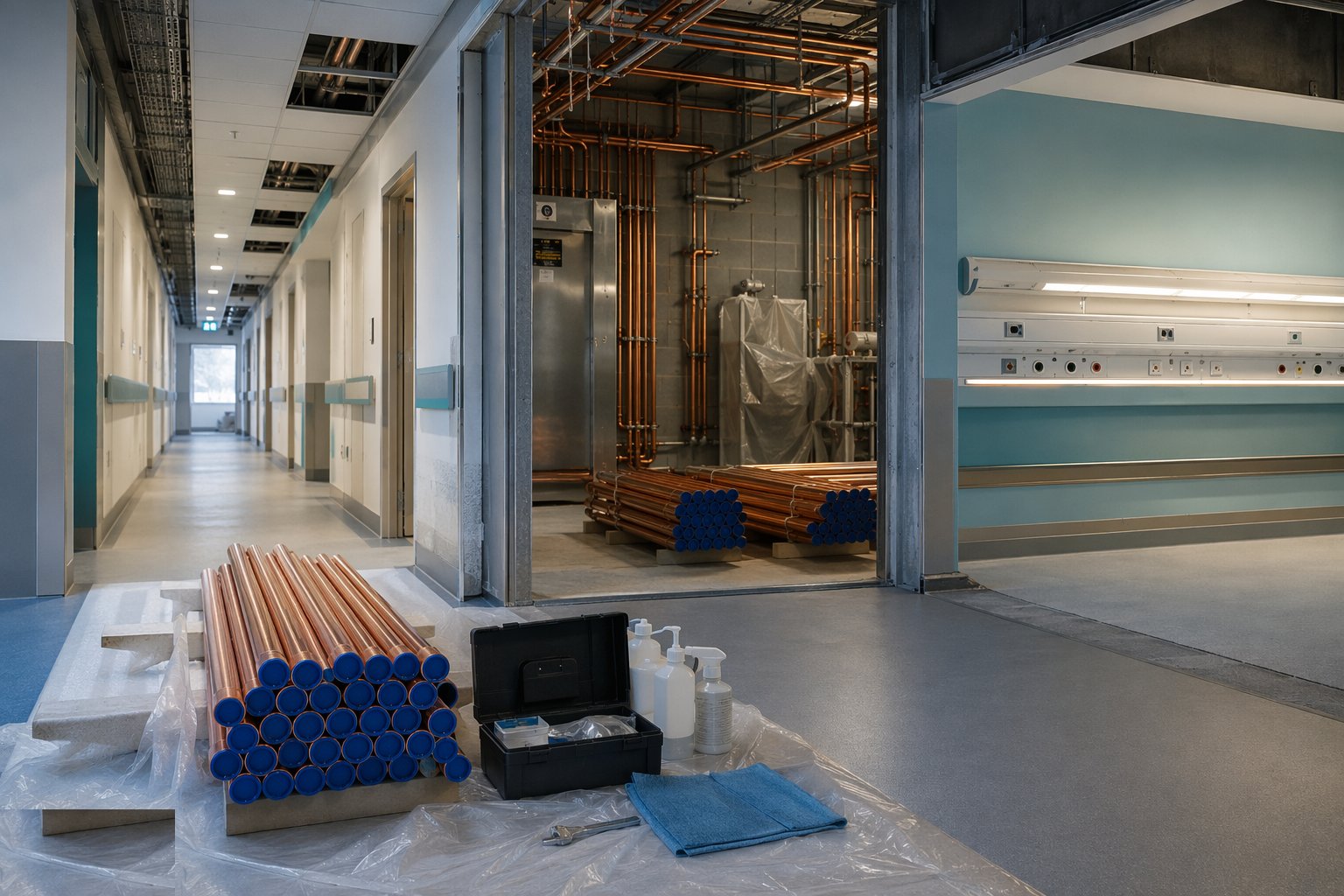
Order pipe and fittings to the correct standards — copper tube to BS EN 13348, delivered degreased, capped and sealed — and quarantine them on site: stored clean, caps on, off the floor, never mixed with plumbing copper. Every joint is cut with wheel cutters or saws with the swarf controlled, deburred, and cleaned; fittings are handled as the clean components they are. The regime is policed by the specialist MGPS contractor's supervisor and audited by the Authorised Person's inspectors — a length of pipe found uncapped on a scaffold is rejected, full stop.
Step 2: Install the pipeline runs with inert-gas purged brazing
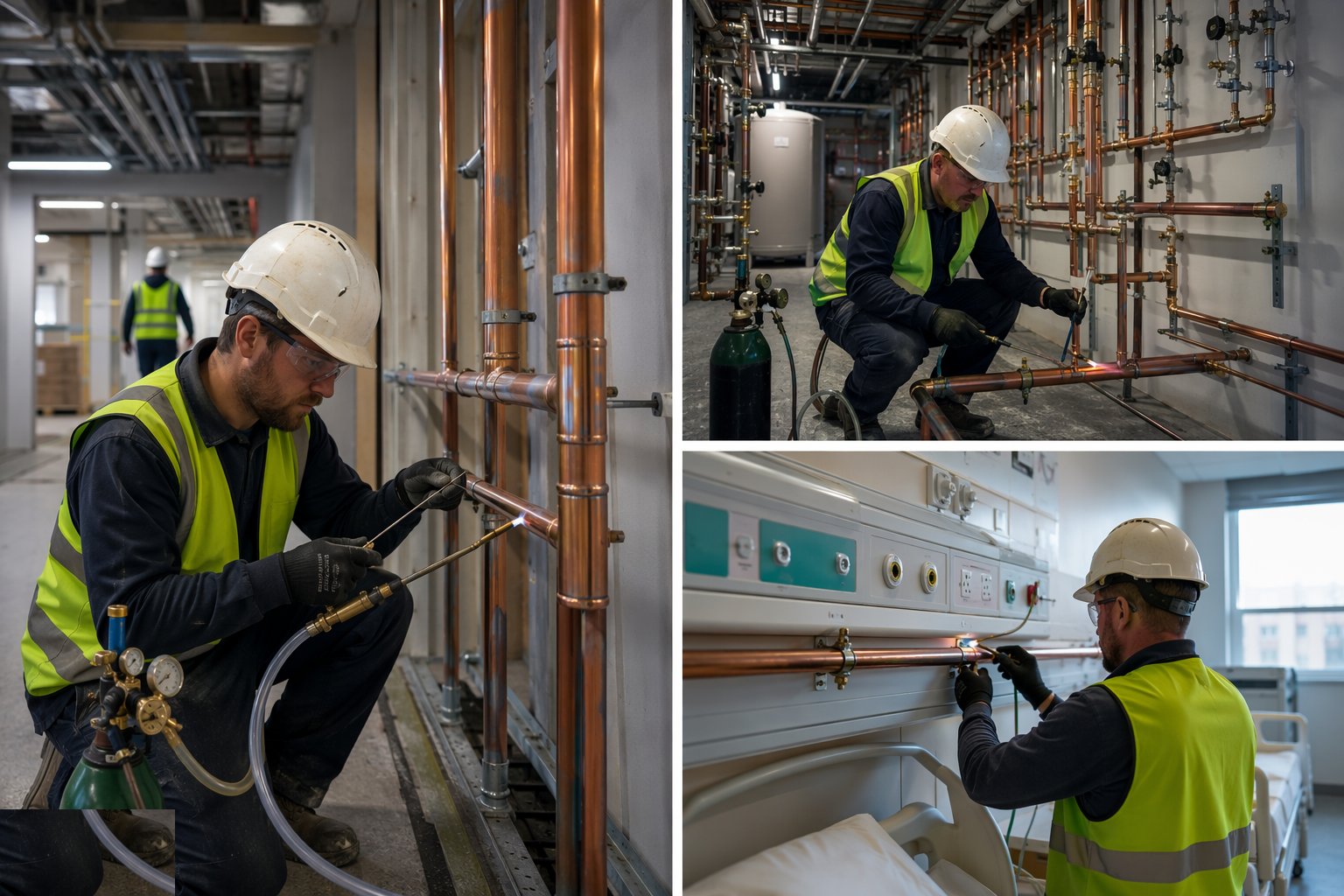
Run the pipelines on their designed routes with proper falls, supports and expansion provision, keeping every open end capped as the work proceeds. Braze every joint with silver brazing alloy while oxygen-free nitrogen or argon flows through the bore at the specified purge rate — the purge prevents oxide scale forming inside, and brazing without it is an automatic reject under HTM 02-01. Joint markings, pipe labels and flow arrows go on as the work proceeds: direction of flow, gas identity and the colour coding are not applied at the end from memory.
Step 3: Install valves, AVSUs and alarm infrastructure
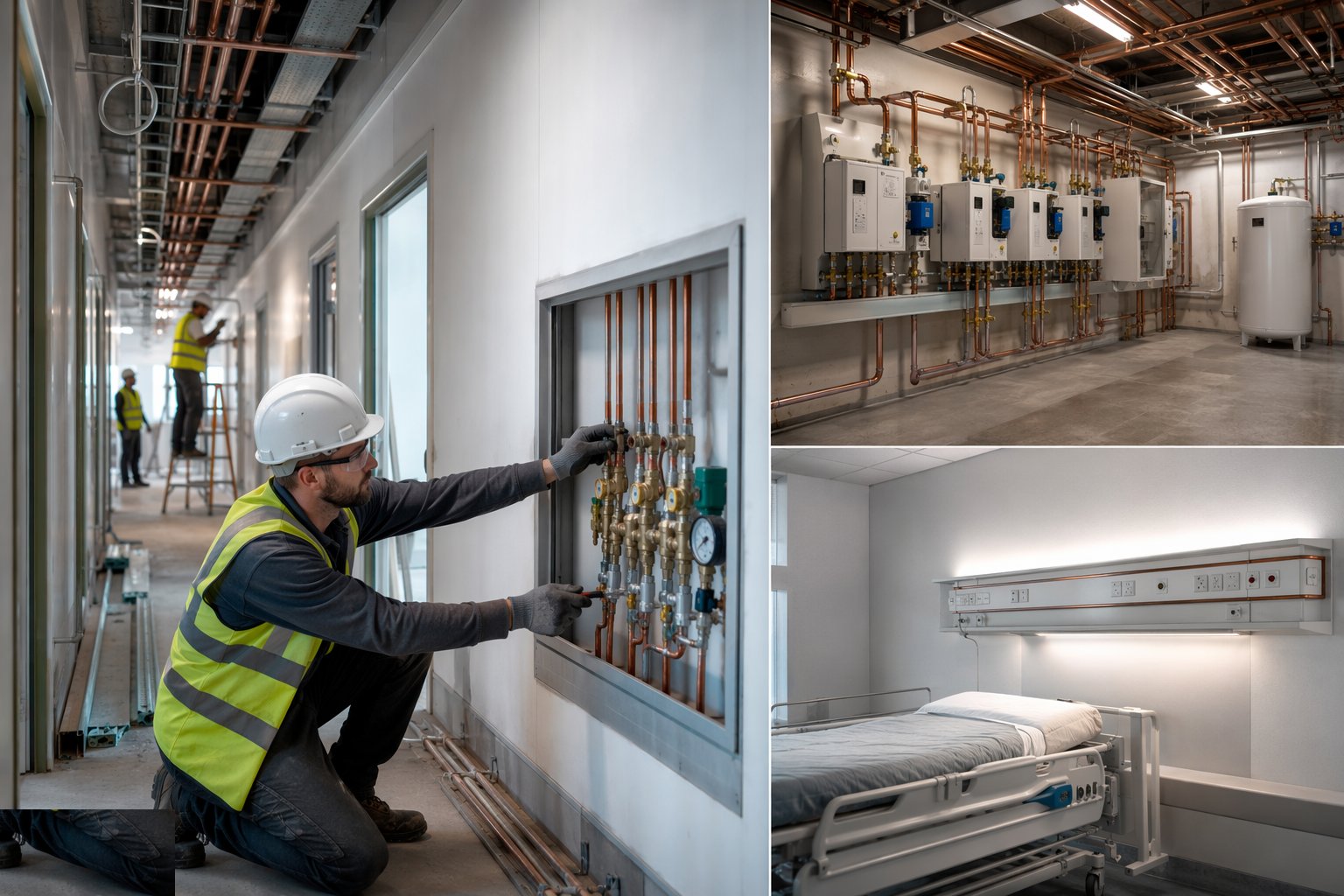
Fit line valves, AVSUs and pressure-sensing points where the design puts them — accessible, labelled, and operable with the pipeline live later on. Alarm cabling and pressure switches run back to the area and central alarm panels. Each AVSU is checked for accessibility and labelled for exactly the gases and areas it controls; the valve chart that the hospital will work to in an emergency is built now, not sketched at handover.
Step 4: Install the central plant
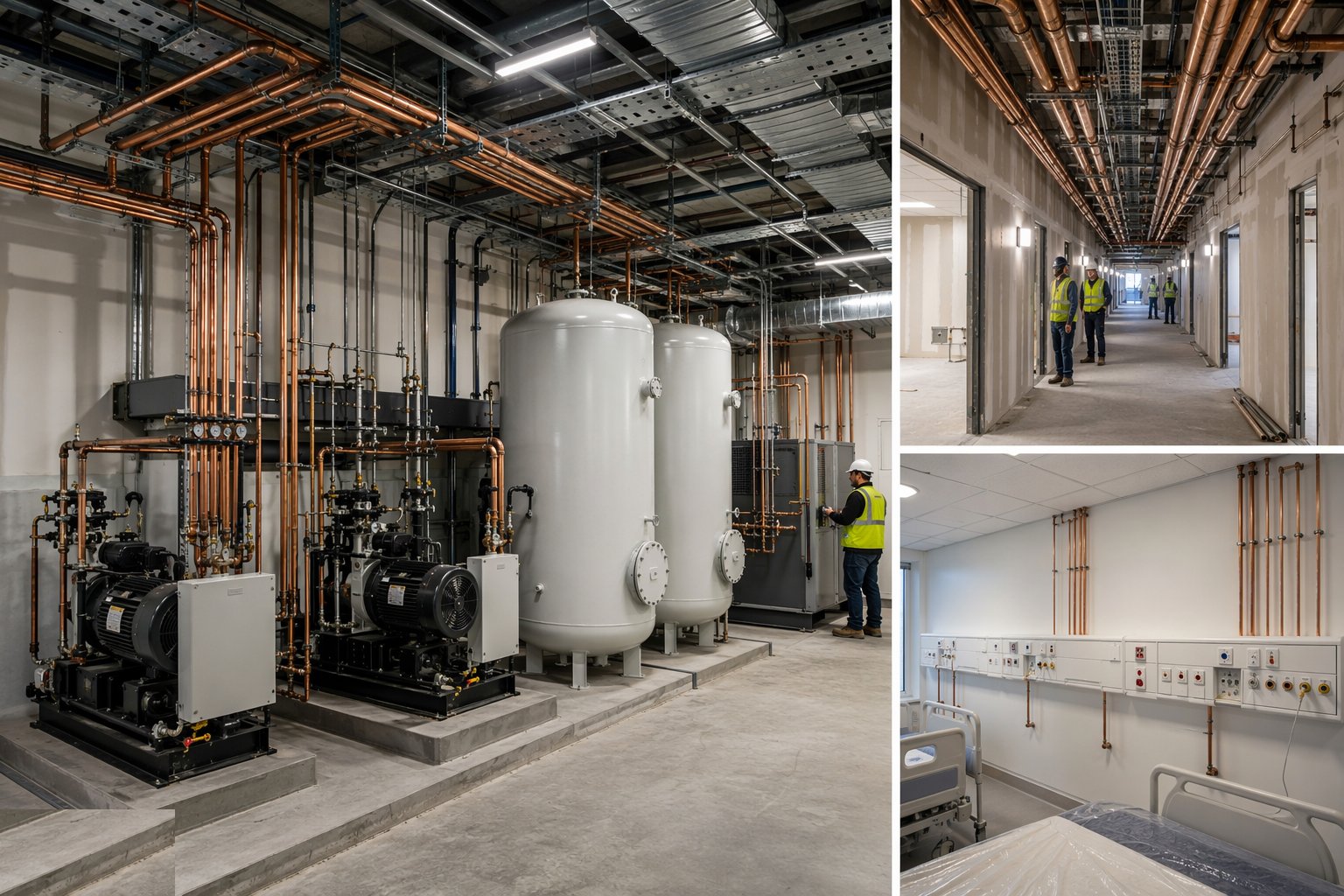
Set the VIE tanks, manifolds, compressor sets, vacuum stations and AGSS plant on their bases with the separation, ventilation, access and drainage the standard demands — compressor intakes positioned away from vehicle exhaust and any contaminated air source, VIE compound ventilated and clear of ignition and traffic risks. Pipe the plant into the distribution network, install the control and alarm panels, and commission each plant unit as duty/standby sets with automatic changeover before pipeline testing begins, because the plant provides the test medium.
Step 5: Blow down, pressure test and prove the pipeline
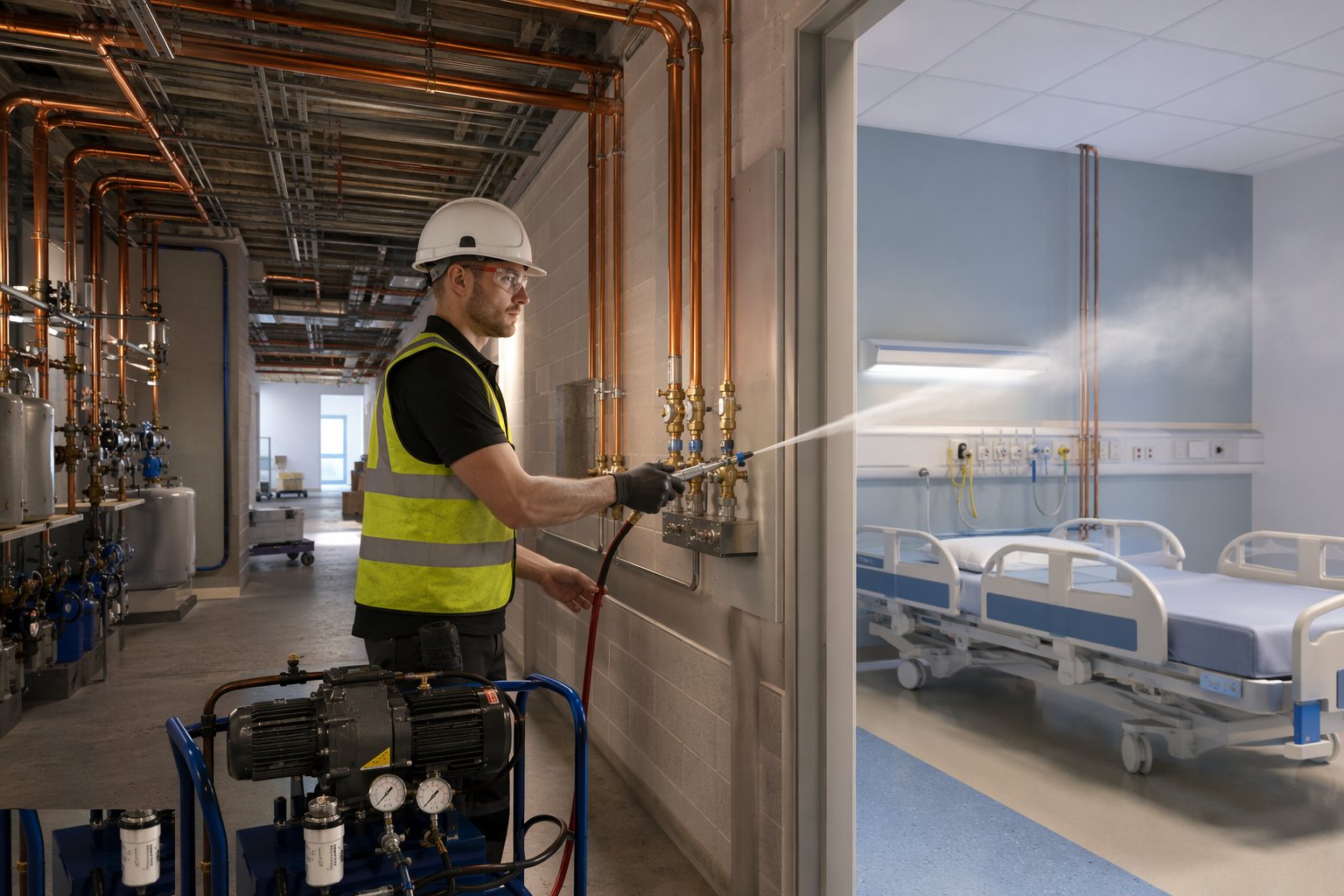
With the pipeline complete and terminal points still open, blow the system through with oil-free air to clear debris — a witnessed blowdown that continues until the discharge at every point runs clean into the test filter. Then pressure-test the pipeline sections and the whole system to the HTM 02-01 regime, holding pressure and logging decay; any leak is found, repaired and the test repeated in full. These tests are witnessed and signed by the Authorised Person (MGPS) — self-certification does not exist in this trade.
Step 6: Install terminal units and second-fix connections
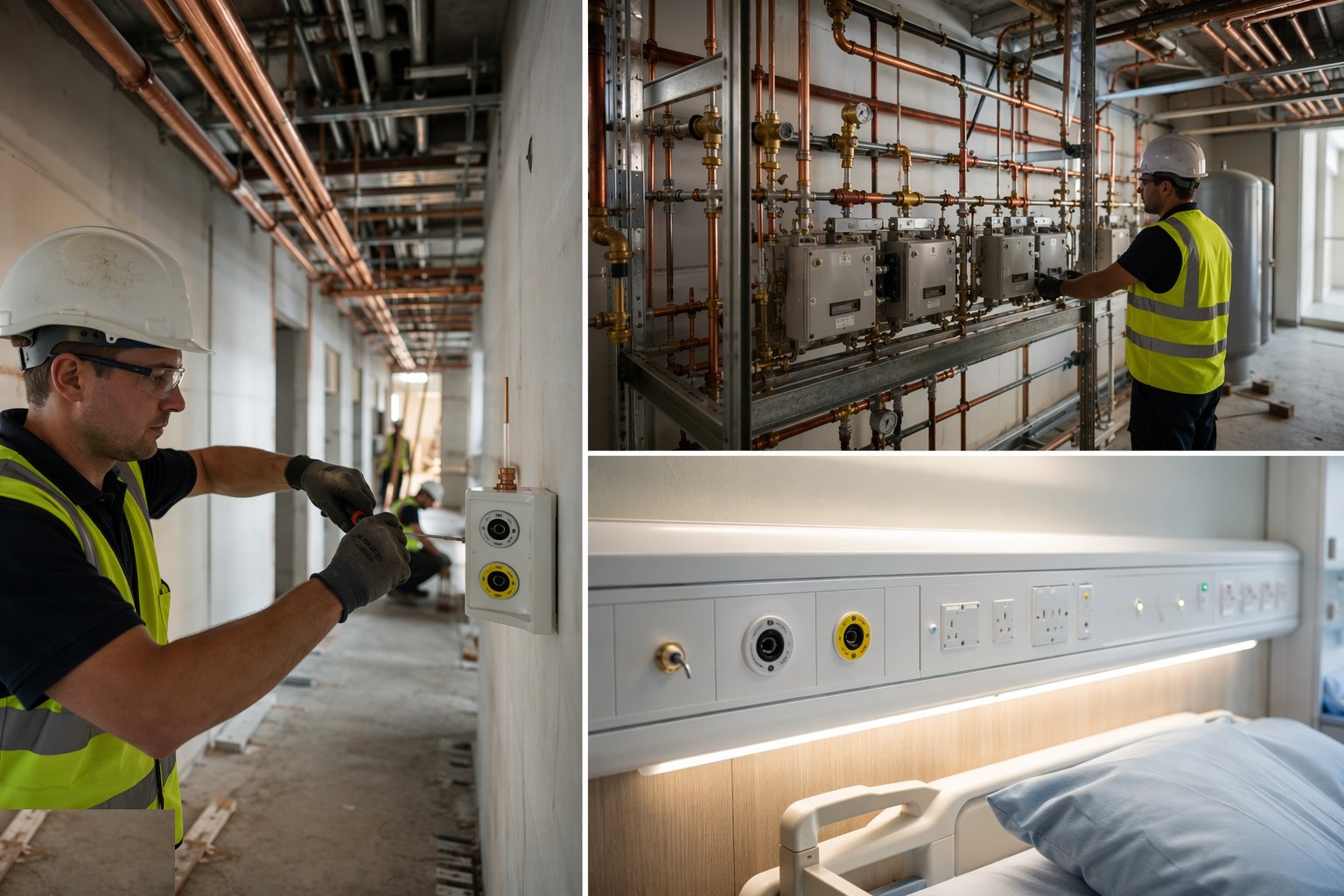
Fit the terminal units as the rooms finish — wall plates, bedhead trunking, pendants — each with its gas-specific connector and indexed so gases cannot be swapped. Labels and colour coding at every terminal, anti-confusion measures at pendants where several gases come together. Pendants and columns are load-tested and their internal hoses checked to the manufacturer's schedule; a theatre pendant is a piece of clinical equipment, not a fancy socket outlet.
Step 7: Run the commissioning test regime with the Authorised Person
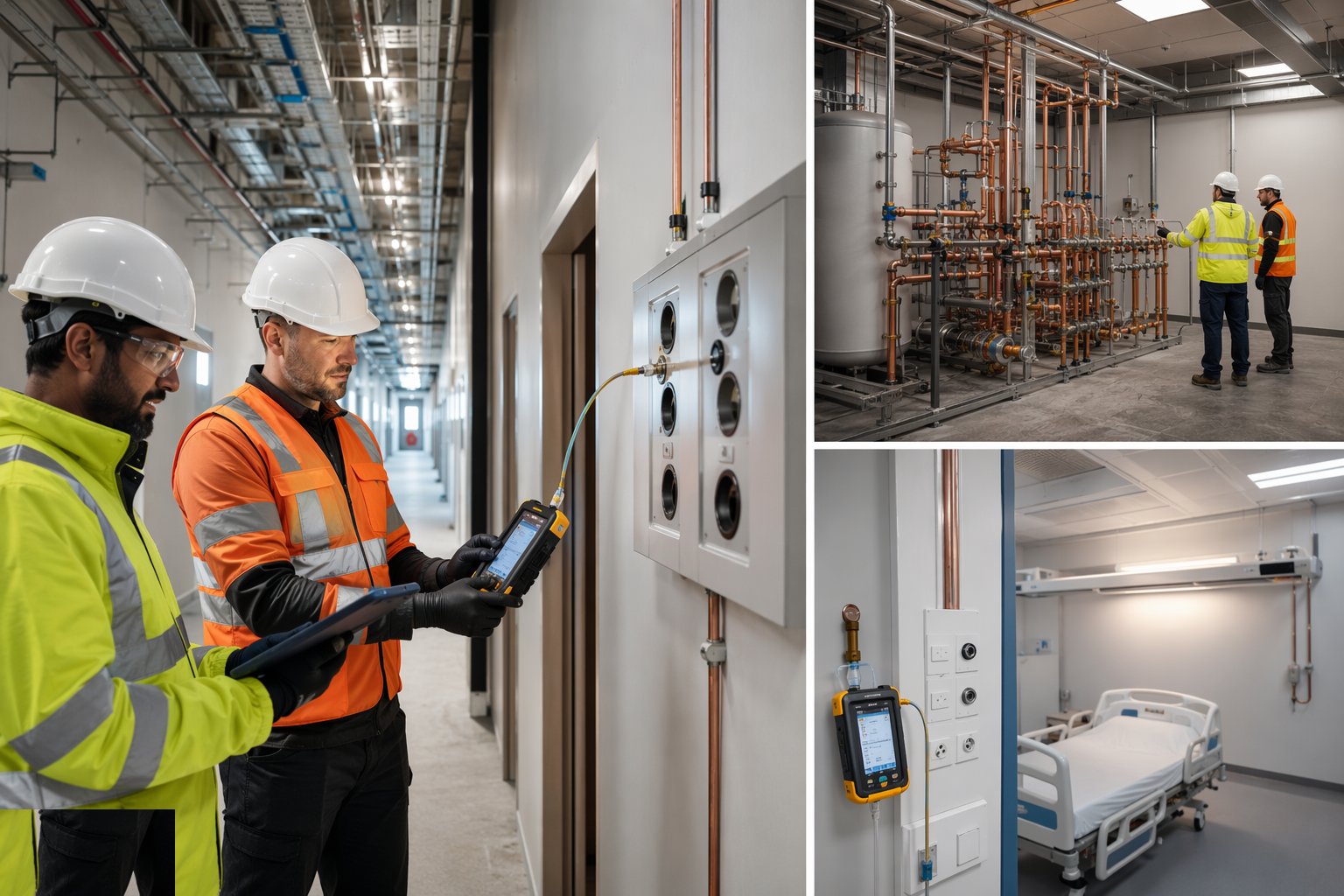
Execute the full HTM 02-01 Part B commissioning sequence with the Authorised Person witnessing: cross-connection tests to prove every terminal delivers only its labelled gas; gas identity and purity analysis at terminal units by a laboratory or certified analyser; particulate and odour tests; pressure and flow performance at design demand; alarm function tests; AGSS flow validation at each theatre terminal. Every result is recorded on the prescribed certificates — a failed purity result means isolating the section, finding the contamination source and re-testing, however many ceilings that argument involves.
Step 8: Label, document and hand over to the trust
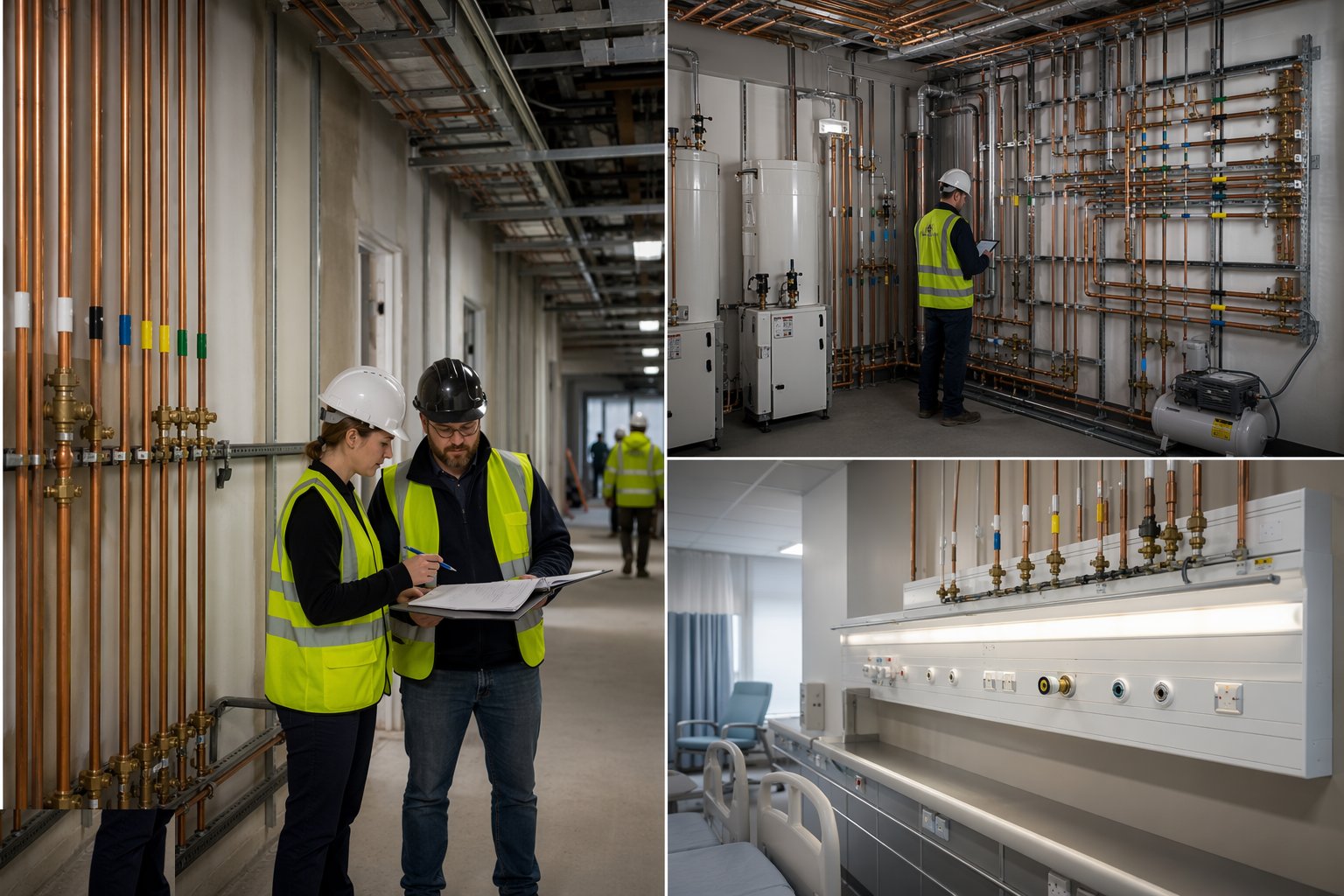
Complete the labelling to the last valve and terminal, finalise the as-built drawings and the valve charts, and compile the handover file: test certificates, purity analyses, brazing records, plant commissioning data and the maintenance schedule. Train the estates team, hand the system to the trust's Authorised Person for acceptance, and formally sign the pipeline into clinical service. Until that signature exists, the gases are a construction system — after it, they are a pharmacy with walls.
Plant and equipment
- Oxygen-free nitrogen/argon purge sets with flow control for brazing
- Silver brazing torches and alloys for copper-to-copper joints
- Wheel cutters, deburring tools and clean-pipe handling kit
- Pressure test rigs, calibrated gauges and data loggers
- Blowdown filters and witness-test kits
- Medical gas analysers (paramagnetic/electrochemical) for purity testing
- Particulate and odour test apparatus
- Manifold, compressor, vacuum and AGSS plant packages with control panels
Quality control checks
- Materials to BS EN 13348, degreased and capped; cleanliness audited through installation
- Every brazed joint made under inert-gas purge by certificated MGPS fitters
- Witnessed blowdown and pressure testing to HTM 02-01 Part B, signed by the Authorised Person
- Cross-connection testing at every terminal — no exceptions, no sampling
- Laboratory/certified gas identity, purity and particulate analysis at terminal units
- Labelling, flow arrows and valve charts verified against as-built drawings before acceptance
Safety considerations
- Oxygen enrichment: leaks raise fire risk dramatically — no smoking, no oil or grease anywhere near the system, ever
- Pressurised systems: test regimes under permit, correct rated equipment, controlled blowdown discharge
- Hot works on pipelines under strict permit; brazing near live clinical areas only with fire precautions agreed with estates
- Cylinders and VIE plant: manual handling, transport and compound security to the gas supplier's and trust's rules
- Never work on a live medical gas system without an Authorised Person's permit and clinical coordination
- Asphyxiation risk from inert purge gases in confined risers and voids — ventilate and monitor
Common defects
- Brazed joints made without purge — copper oxide scale in the bore, found at particulate testing with the ceilings closed
- Pipe left uncapped during installation — swarf, dust and site debris blown out at the terminal units on test day
- Crossed connections at pendants or bedhead units — the test that exists to catch it catches it late and expensively
- Wrong or missing labelling and flow arrows — a maintenance error waiting for its night shift
- AVSUs installed inaccessible or controlling the wrong areas — the emergency valve nobody can reach
- Terminal units installed out of alignment with finished wall and bedhead layouts — chipped finishes and remade outlets at the eleventh hour
Best suited for
- New hospital builds, ward blocks and theatre suites
- Bedhead, pendant and critical-care unit fit-outs
- Hospital plant room upgrades — compressors, vacuum and manifold replacement
- Extensions and conversions of clinical space needing full witnessed testing
How long does Medical Gas Pipeline Systems (MGPS) take?
Typical duration: Pipeline first fix typically runs with the MEP programme over months; the witnessed testing and commissioning sequence alone takes 3–6 weeks for a large department, longer where re-tests are needed..