Phasing & Working Around Live Trading
Refurbishing malls and stores that never close — fire-rated hoarding in live environments, night works, customer segregation, phased handovers and the shopping-centre permit regime that governs every hour of it.
Last updated 2026-07-28 by the BuildPedia Editorial Team.
What is Phasing & Working Around Live Trading?
Most retail construction is not greenfield. Malls are refurbished, extended and re-tenanted while trading; stores are refitted between seasons; supermarkets are remodelled aisle by aisle around customers doing their weekly shop. The defining condition is that the revenue never stops: the asset earns seven days a week, and the works must be organised so that trading, customer safety and the other tenants' businesses are protected at every stage. Construction logic runs second to trading logic — the programme is built backwards from the retail calendar, and nobody pours concrete in a mall concourse in the first week of December.
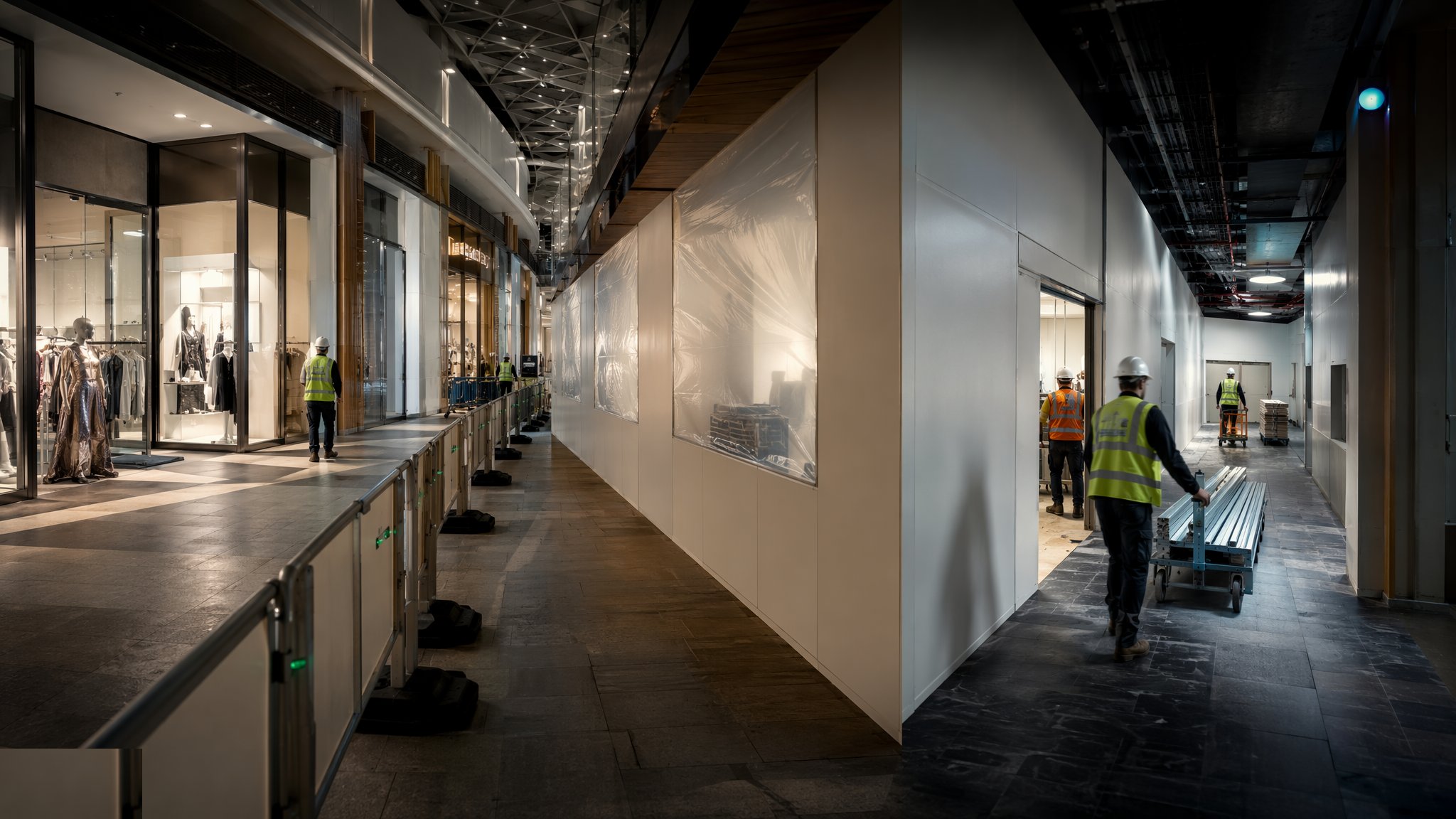
The toolkit is containment, segregation and timing. Works areas are sealed behind rigid, fire-rated, dust-tight hoarding with engineered fixings and its own lighting; customers and materials never share a route — deliveries run at night or through segregated service corridors, waste comes out on the same disciplined paths, and anything too big or too dirty for those rules waits for a closure or a night possession. Noisy and dusty operations are programmed out of trading hours as night works with after-hours checks, and every phase ends with a handover that returns that slice of the building to full public use — fire systems live, escape routes clear, finishes safe — before the next phase's hoarding moves.
The governance is the shopping-centre permit regime, and it is stricter than most main contractors are used to. Centre management controls permits to work, hot-work authorisation with fire watches and after-hours checks, delivery bookings through the service yard, working-hour rules, hoarding standards and the inspection regime — and can stop any operation at any time, because their insurer and their tenants give them both the right and the duty. Fire safety is the non-negotiable: escape routes and alarm coverage are maintained through every phase with documented fire plans, and in the UK the Joint Code of Practice on fire prevention on construction sites applies in full view of the centre's own risk assessments. In the UAE, Civil Defence approvals extend through the works, and a trading mall under refurbishment is inspected as a trading mall, not as a building site.
When and why is Phasing & Working Around Live Trading used?
Phased working is chosen because the alternative — closing the centre or the store — costs more in lost rent and lost trade than the whole refurbishment. It starts at feasibility, not on site: the phase plan decides what can be built at all, because a scheme that cannot be segregated safely cannot be built while trading. The disciplines exist for one reason above all: the public is inside your site hoarding. A customer cannot be briefed, inducted or given boots; the building must be made safe for them by design and by management, phase by phase. It matters commercially too — the tenants who trade through your works pay the rent that funds them, and the centre that handles construction badly loses lettings it took a decade to win. Done well, phased refurbishment is invisible: the centre looks better each quarter and nobody can quite say when the builders were in.
Types of Phasing & Working Around Live Trading
Trading mall refurbishment
Re-flooring, re-ceiling and re-servicing mall common areas and units around full trading: hoarded work zones moving through the centre phase by phase, night works for noisy operations, and the mall reopened to standard every morning. The classic live-environment job — months of works the customers barely see.
Live store refit
A trading store refitted around its own opening hours — aisle-by-aisle in food retail, or section-by-section in department stores — with stock moved nightly, temporary shopfronts, and the store trading from whatever area the phase plan leaves it. The tightest choreography in the sector.
Mall extension alongside trading
New construction bolted onto an operating centre: new mall runs and anchors built alongside live malls, with the breakthrough into the trading centre saved for a possession or a series of nights. Two worlds — greenfield rules outside, live-centre rules inside — meeting at one carefully hoarded line.
Department store floor-by-floor works
Vertical phasing in a trading store: floors closed, refurbished and reopened in sequence with goods lifts and escalators handed between phases, so the store trades on reduced area throughout. Programme-driven by seasonal trading, with the Christmas floor plan sacred.
Phasing & Working Around Live Trading: step by step
Step 1: Build the phase plan around the trading calendar
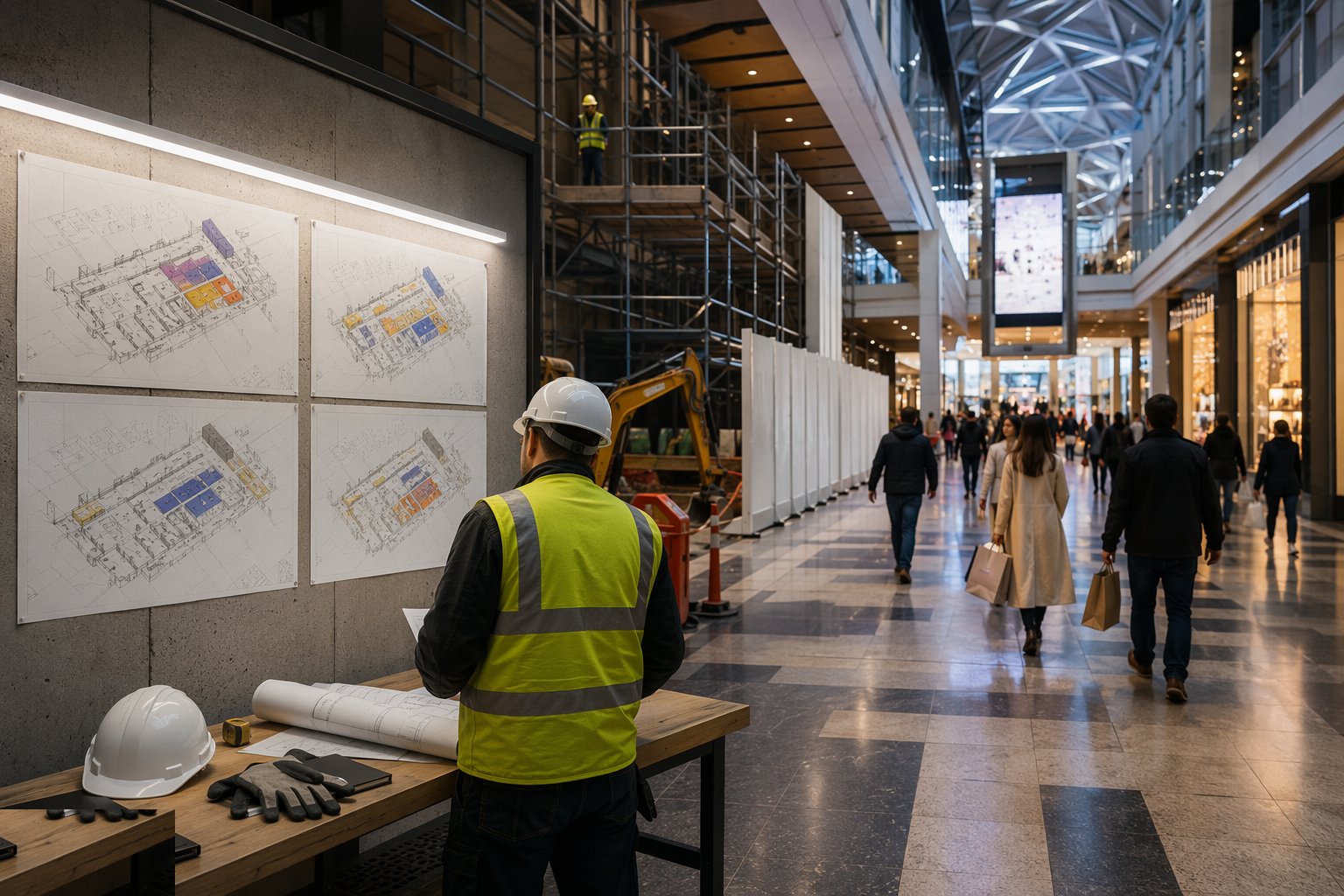
The phase plan is written with the centre's trading team before a single drawing is priced: which areas can be taken and when, trading-hour restrictions, the retail calendar's untouchable periods, delivery and waste capacity through the service yard, and the logic that keeps every phase independently safe — fire systems live, escape routes complete, compartments intact at every stage. Each phase is designed to hand back cleanly: no phase ends leaving a fire system impaired, a route blocked or a tenant's frontage compromised without an agreed temporary arrangement. The plan is then priced honestly, because night rates, double handling and protection are the cost of live trading, and pretending otherwise just moves the argument to site.
Step 2: Agree the permit regime, insurances and rules
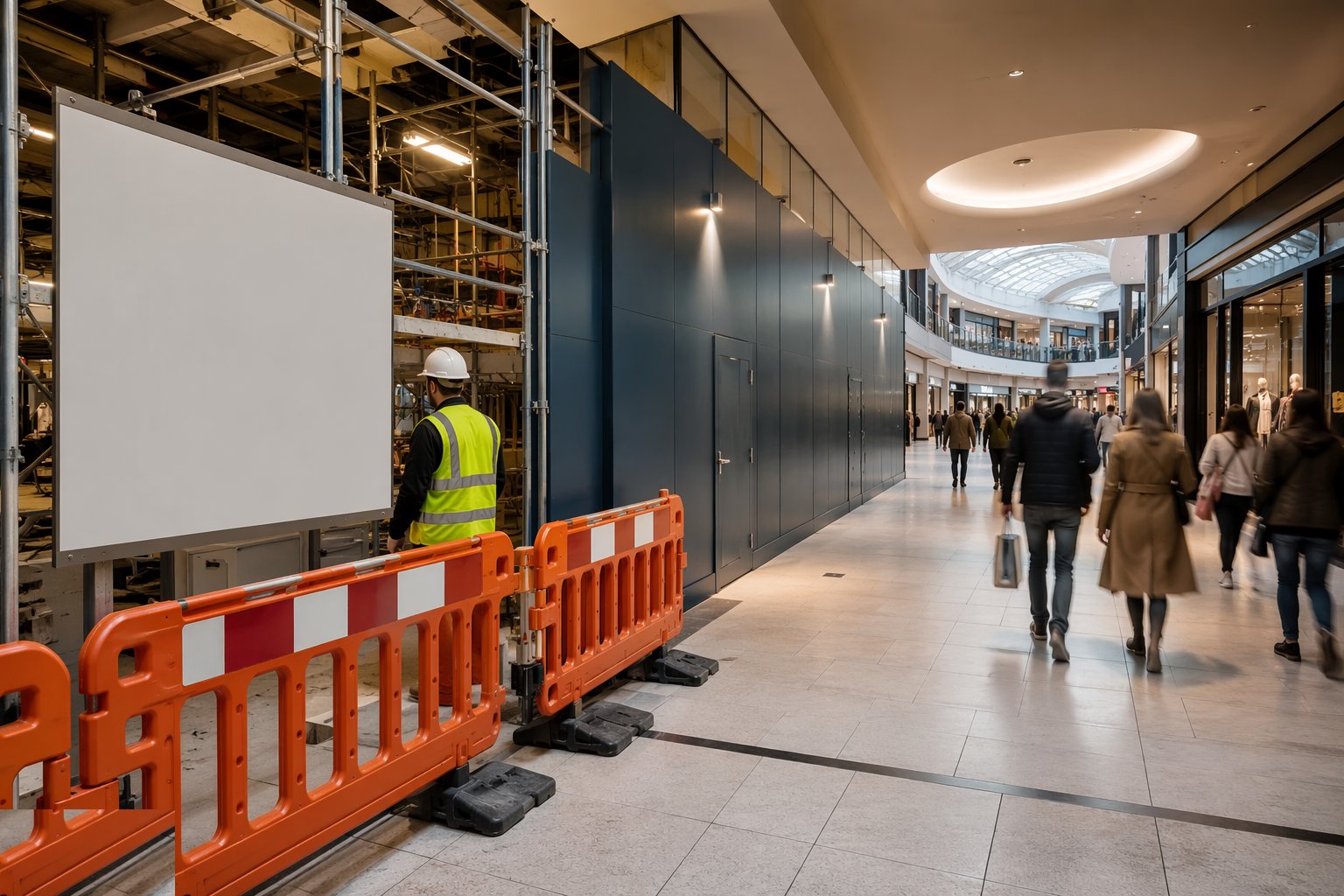
The contractor signs up to the centre's regime before mobilisation: permits to work for every operation the centre classes as controlled, hot-work permits with fire watches and after-hours checks, delivery booking through the yard management system, working-hour rules, induction requirements and the stop-work authority centre management holds over everything. Insurance is verified on both sides — the works insured for construction risks in an occupied building, the centre's cover confirmed for trading through construction, with the Joint Code of Practice fire-prevention requirements adopted where the insurer calls for them. In the UAE, the authority approvals and Civil Defence permissions for works in an occupied centre sit alongside the centre's own rules, and both must be satisfied before the first hoarding panel stands.
Step 3: Erect live-environment hoarding and segregation
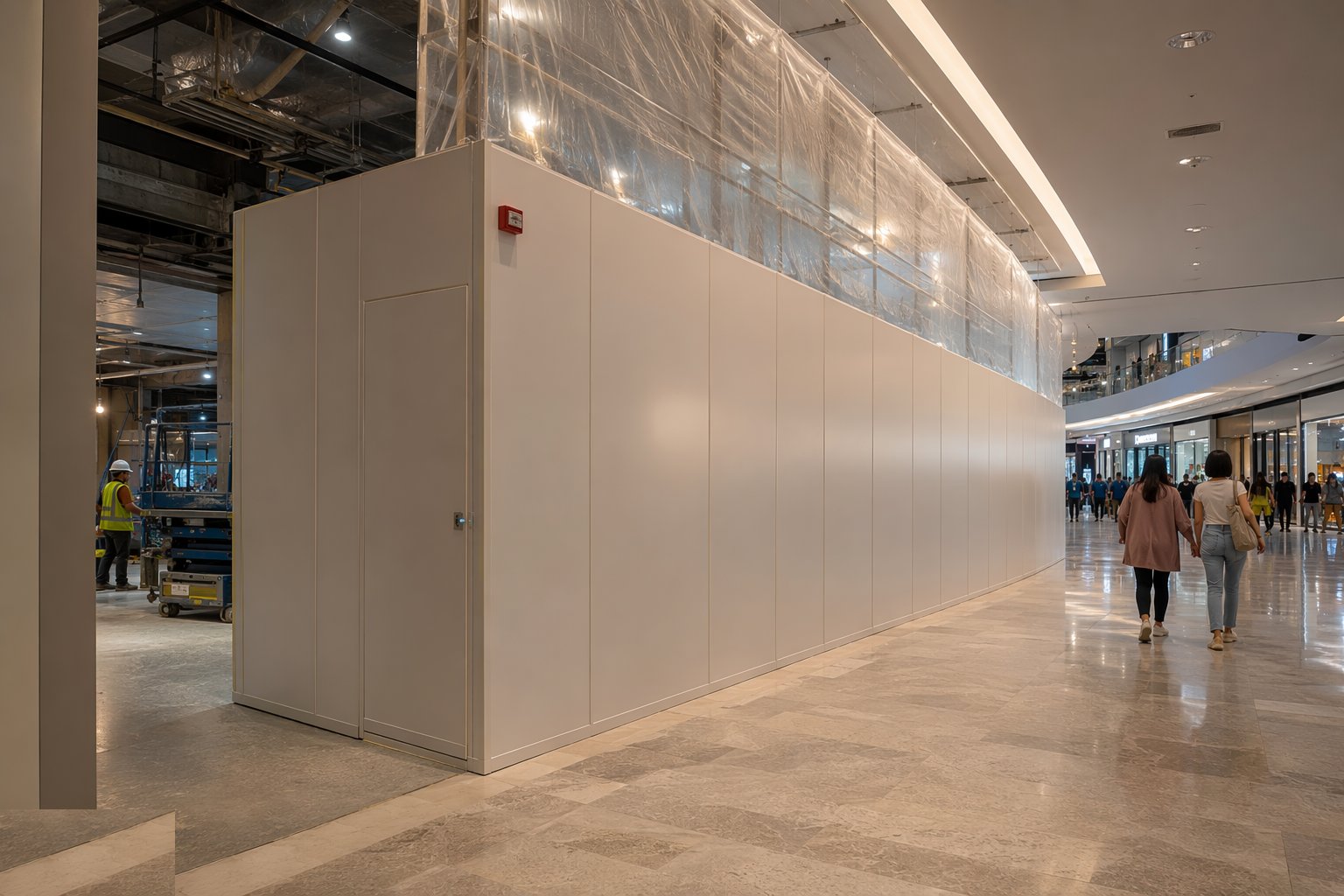
The hoarding is engineered for a public environment: rigid panels with calculated fixings to slab and soffit, fire-rated where the compartmentation demands, dust-tight at every joint, stable against crowd pressure and air movement, and finished to the centre's standard with lighting, graphics and vision panels. Segregation is three-dimensional — the works are sealed not just at the hoarding line but above ceilings and below floors where services run, because dust and smoke travel through voids and so do customers' complaints. Every hoarding line is checked against the fire plan: it must not block an escape route, bury a call point or blind a detector without a documented, approved temporary measure.
Step 4: Establish segregated logistics: people, materials, waste
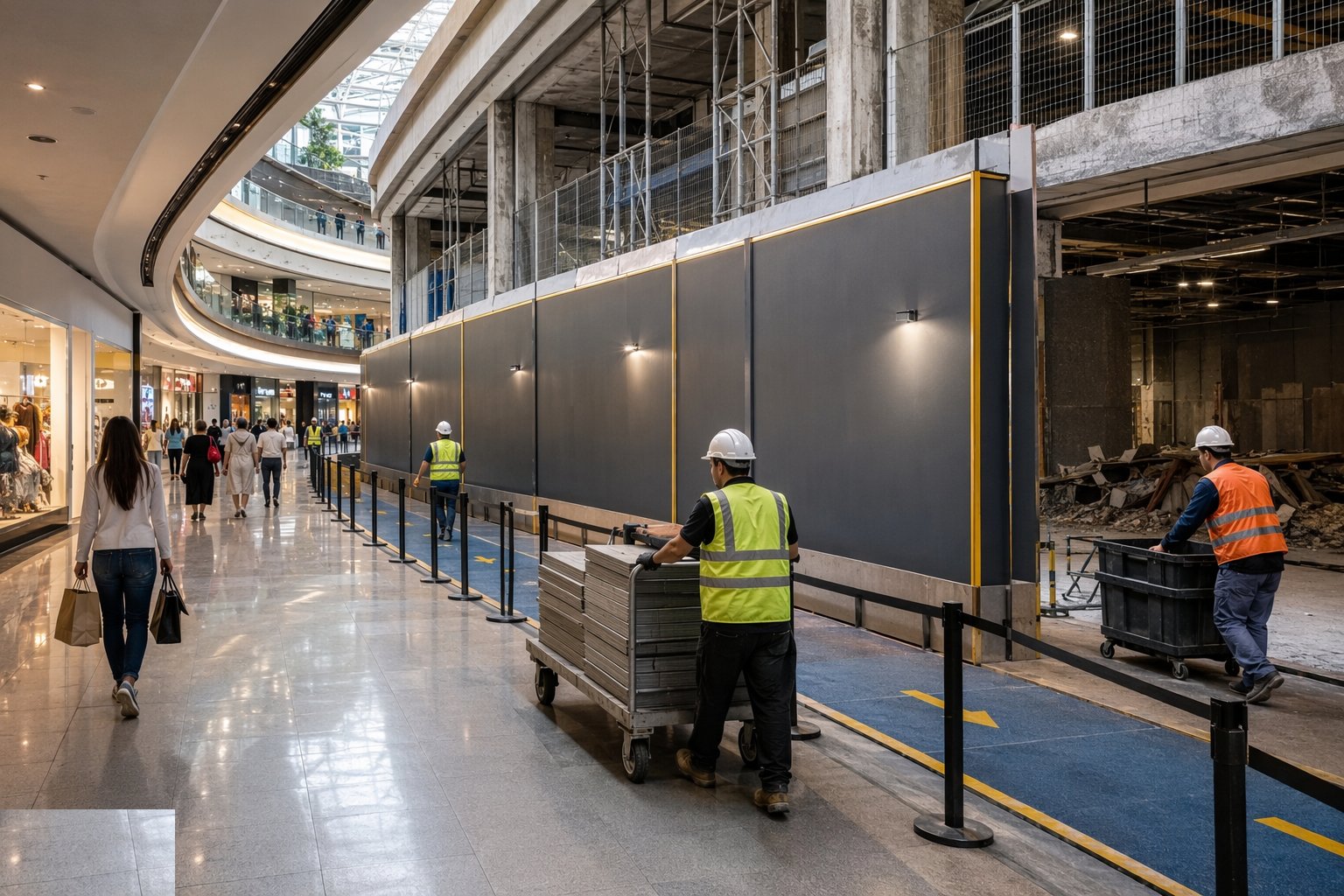
Materials come in and waste goes out on routes that never meet the public: service yard bookings, goods lifts scheduled between phases, escorted movements where a route must cross a trading area, and everything timed to the delivery windows the centre enforces. Waste is managed to the centre's standard — segregated skips in the yard, no accumulation in the works that the fire plan does not allow, dusty waste bagged and sealed before it moves through the building. The logistics plan is rehearsed with the yard and security teams, because a missed delivery window is a day's materials on the street and a centre manager with a long memory.
Step 5: Run night works and changeovers
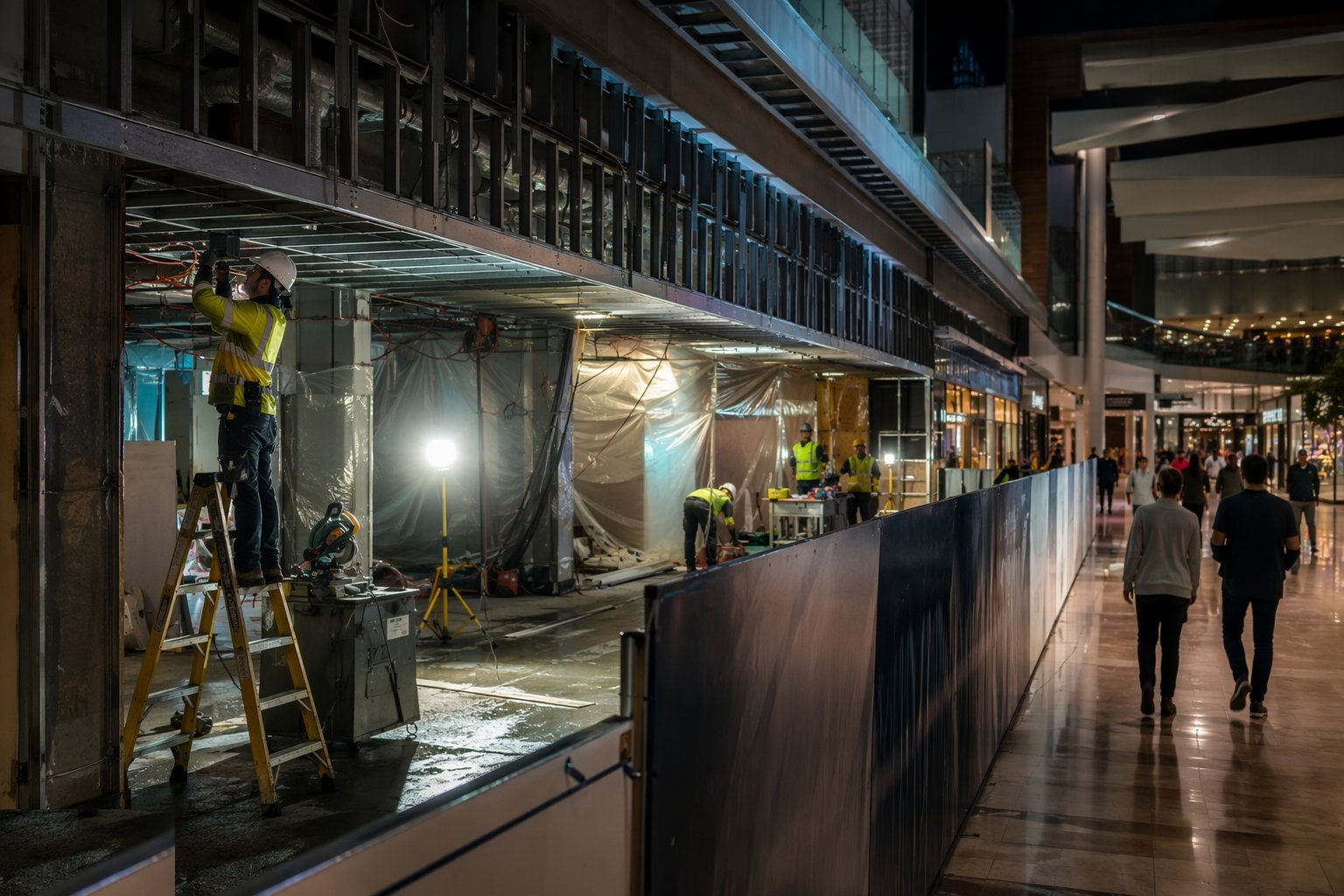
Noisy, dusty and disruptive operations — breaking out, saw cutting, heavy fixings, floor grinding — run at night under the centre's out-of-hours rules: crews inducted for night working, lighting and welfare provided, supervision at the same standard as days, and a defined hand-back each morning — area clean, protection removed from trading routes, fire systems reinstated and tested, and the centre walked down with security before doors open. Hoarding moves and phase changeovers are planned like mini-projects, usually on the quietest nights of the year, with every trade's sequence at the changeover line rehearsed beforehand. Fatigue is managed as the risk it is: rotated crews, rest rules and a hard line on double shifts.
Step 6: Maintain fire safety and escape through the works
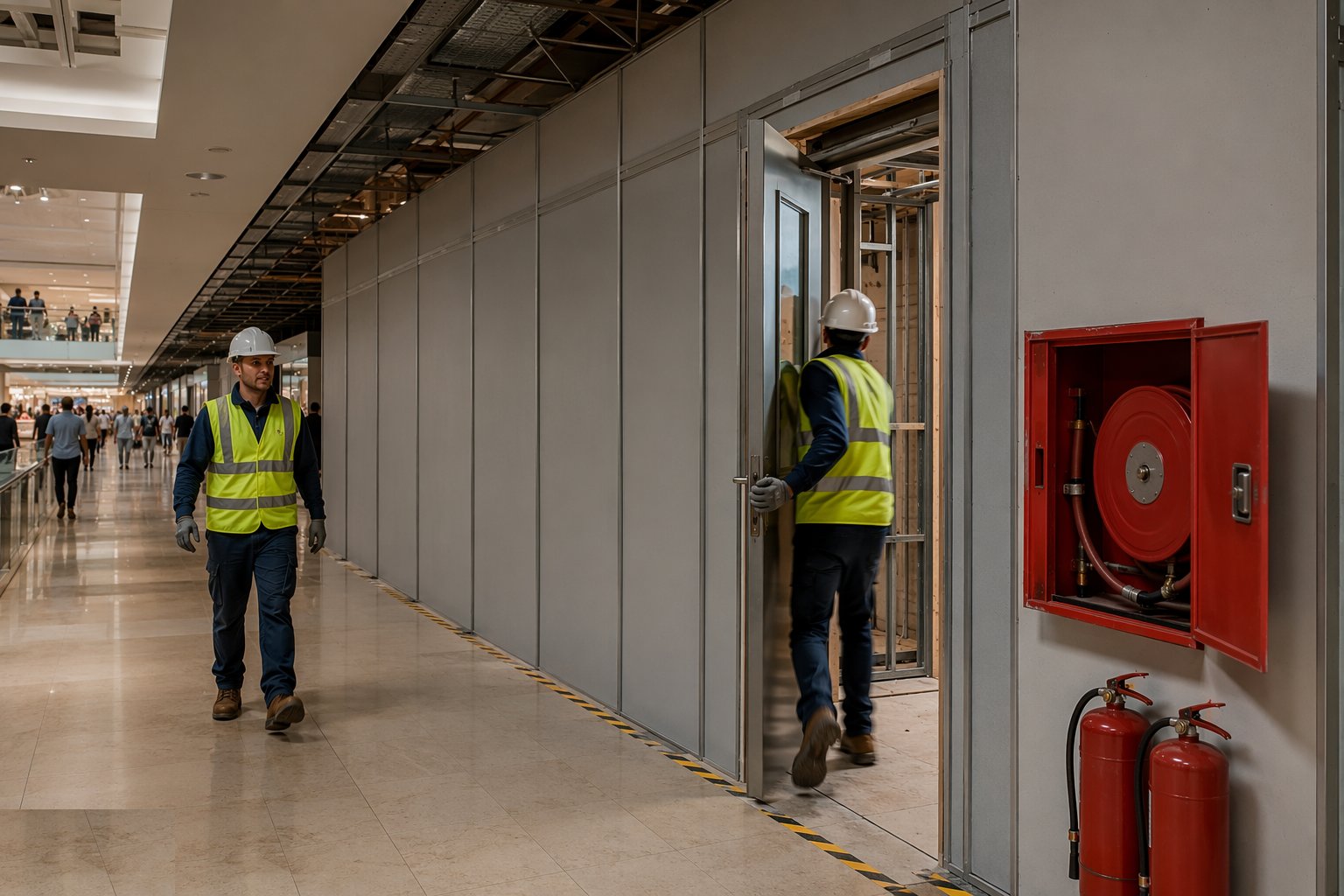
The fire plan is a living document through every phase: escape routes maintained or replaced with approved temporary routes, alarm and detection coverage preserved or substituted with documented impairments and waking watches where required, sprinkler and smoke control zones kept live or formally isolated with the insurer's and the authority's agreement — never quietly valved off. Hot work is permitted, watched and checked after hours per the regime; flammables are stored to the rules; and every phase boundary is inspected against compartmentation before trading resumes around it. In the UAE the Civil Defence regime treats a trading centre under works as a higher-risk occupied building, and their inspectors will ask to see exactly these records.
Step 7: Hand over phase by phase and make good
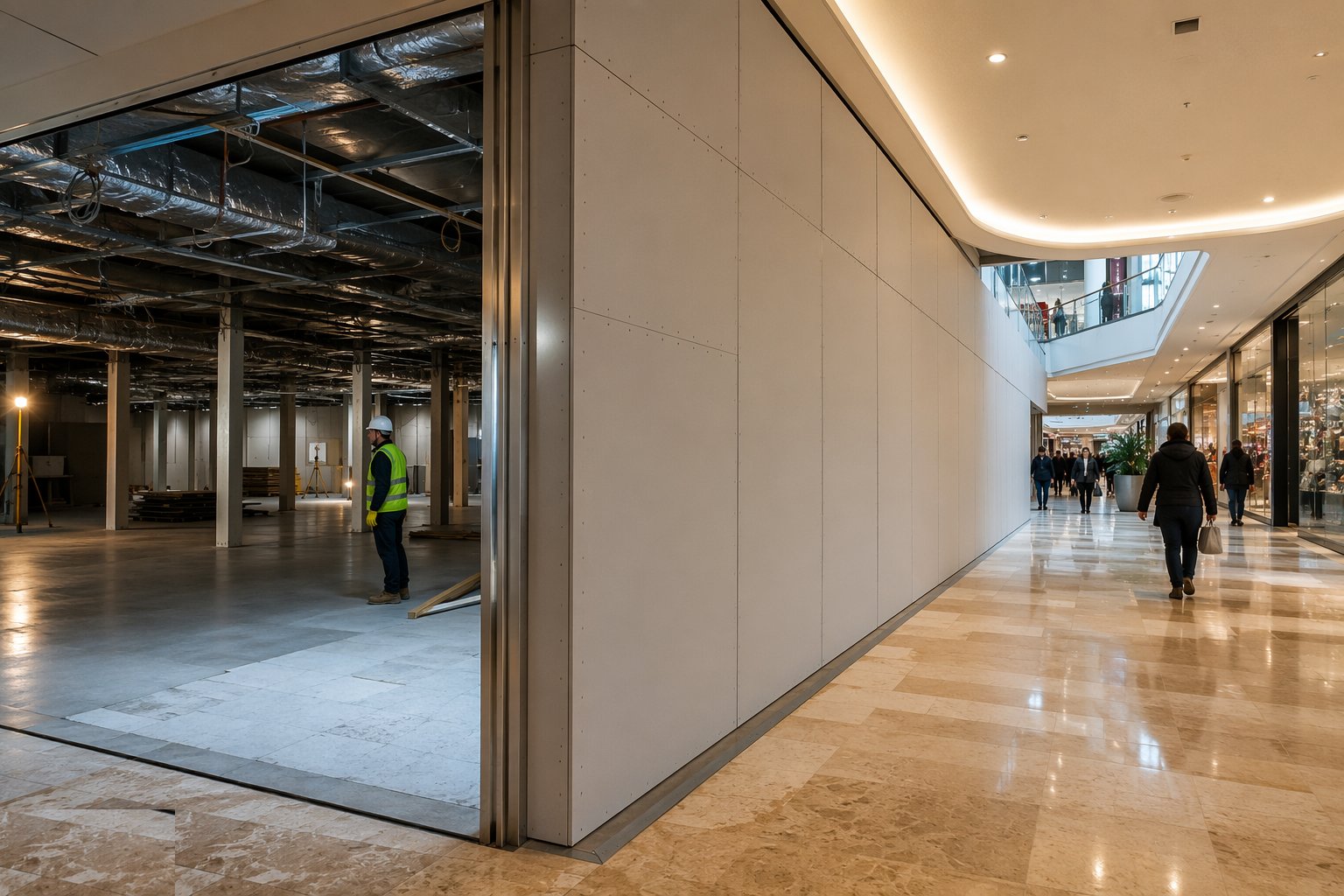
Each phase closes with a mini-handover: the area snagged to trading standard, fire systems fully reinstated and witnessed, meters and services transferred, the hoarding struck and the mall or store returned to the centre in a condition they can trade from that morning — with the as-builts, test records and O&M updates for that phase delivered, not promised. Making good at phase boundaries is detailed work: floors meeting at hoarding lines, ceilings and lighting running true across the phase joint, and the previous phase's protection removed without damage to its finishes. The final phase hands back the last hoarding line, the dilapidation survey closes the argument about what the works damaged, and the centre should be able to point at the finished job and not quite remember where the site was.
Plant and equipment
- Engineered rigid hoarding systems with fire-rated panels, lighting and graphics
- Negative-air units, dust screens and vacuum tooling for dust-tight working
- Floor and frontage protection materials rated for public areas
- Night-work lighting towers, temporary power and welfare for out-of-hours crews
- Escorted delivery vehicles, tail lifts, pallet trucks and yard handling equipment
- Fire-safety equipment for impairments: temporary detection, extinguishers, waking-watch kit
- MEWPs and access equipment sized to work inside hoarded zones with public alongside
Quality control checks
- Phase hand-back inspections with centre management every morning after night works
- Fire-system impairment and reinstatement records, witnessed and countersigned per phase
- Hoarding line inspections against the fire plan before each phase opens to the public
- Snagging to trading standard at every phase handover — no rolling snag lists into live areas
- Dilapidation surveys before works and at completion, agreed and signed by both sides
- As-builts, test certificates and O&M updates delivered phase by phase, not at the end
Safety considerations
- The public is inside the site: segregation engineered, inspected daily and never trusted to tape and cones
- Escape routes and fire systems maintained through every phase with documented impairments and watches
- Hot work under permit with fire watch and after-hours checks — the regime is absolute in a trading building
- Night-work fatigue managed: rotated crews, rest rules and supervision equal to day shifts
- Deliveries and waste on segregated, escorted routes — materials and customers never share a path
- Out-of-hours security, lone-working controls and emergency arrangements agreed with the centre
Common defects
- Hoarding failures — panels down, dust through joints, or a line that blinds detectors and blocks signage the fire plan needs
- Fire systems quietly impaired — a zone valved off for a week that becomes a season, found by the insurer or the authority
- Phase joints visible in the finished work — floor levels, ceiling lines and lighting grids that show where the hoarding stood
- Logistics breaches — materials on trading routes, waste through public areas, missed delivery windows and a centre manager out of patience
- Snagging rolling into trading areas — contractors behind barriers inside a live store at night rates, for months
- Dilapidation disputes at completion because the pre-works survey was thin — every scuff in the mall suddenly the contractor's
Best suited for
- Mall refurbishments and re-tenanting where closure costs more than the works
- Live store refits programmed around opening hours and seasons
- Extensions bolted onto operating centres with late breakthrough
- Any retail asset where the revenue must survive the construction
How long does Phasing & Working Around Live Trading take?
Typical duration: Phased mall refurbishments run 6–24 months depending on area and phase count; a live store refit typically takes 12–40 weeks of night-weighted working — roughly twice the calendar time the same works would take in an empty building..