Anaerobic Digestion & Composting Facilities
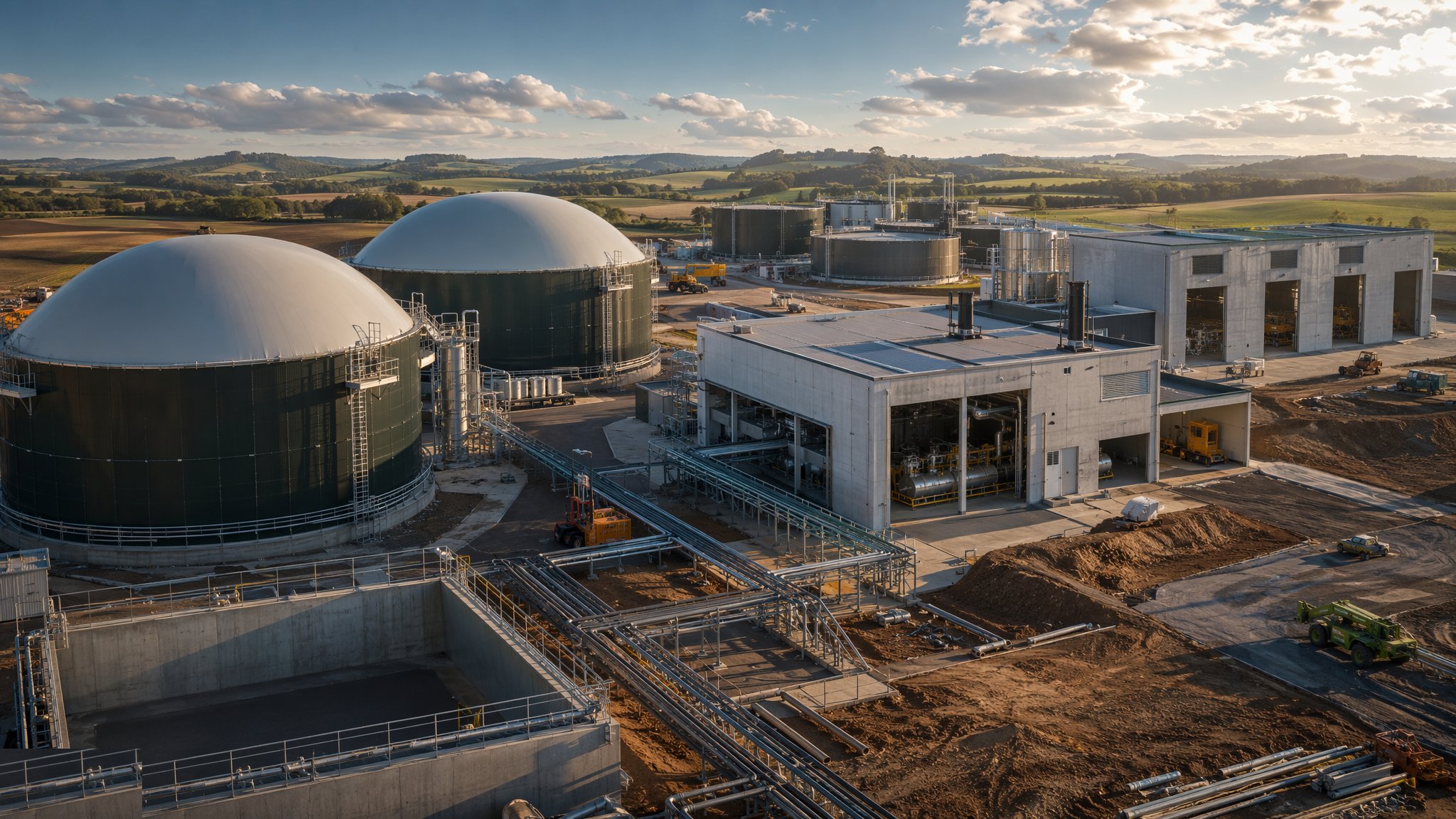
Sealed tanks that turn food waste and slurry into biogas — gas-tight digesters, double-membrane gas holders, CHP engines, odour-locked reception halls and composting tunnels — process plants where the biology, not the builder, sets the final pace.
Last updated 2026-07-28 by the BuildPedia Editorial Team.
What is Anaerobic Digestion & Composting Facilities?
An anaerobic digestion plant feeds organic waste — food waste, slurries, energy crops — into sealed, heated tanks where microbes convert it to biogas and digestate. The process train runs: reception and preparation, where waste is tipped, de-packaged and pulped; the digesters, circular tanks held at mesophilic temperatures around 40 °C, mixed continuously and sealed gas-tight; gas handling — double-membrane roofs or separate gas holders, then combined heat and power engines or upgrading to biomethane for the grid; and digestate storage and treatment. Where animal by-products are in the feedstock, pasteurisation is a legal duty, not an option: 70 °C for one hour under the Animal By-Products Regulations, validated and recorded.
The digesters are the construction centrepiece, and they come in two families. Post-tensioned concrete tanks are cast in situ, stressed circumferentially and sealed to be gas-tight — durable, thermally massive and unforgiving of poor concrete. Glass-fused-to-steel tanks are factory-enamelled steel plates bolted together on site, erected by jacking from the top ring down — fast to build and common on farm and mid-scale plants, with the gasket and bolt-torque regime deciding whether the tank holds gas or leaks it. Either way, the tank is a pressure vessel's cousin: roof penetrations for mixers and gas offtake are detailed and tested, and the completed tank passes a gas-tightness test before a litre of feedstock is accepted.
The rest of the plant exists to manage two reputational risks: smell and explosion. The reception hall is a sealed building under negative pressure with fast-acting doors, its extracted air scrubbed through a biofilter — because one open door on a food-waste plant can generate complaints that end up at the Environment Agency by lunchtime. Biogas is methane: the whole gas train is zoned under ATEX and the Dangerous Substances and Explosive Atmospheres Regulations, with Ex-rated equipment, gas detection and controlled ignition sources. Composting facilities share the family resemblance: in-vessel tunnels with aerated floors and sealed doors for the sanitisation phase, then maturation in windrows or pads, with the same odour and leachate discipline. Commissioning is biological — the digesters are seeded, warmed and loaded gradually over weeks while the microbial population establishes — and no amount of construction programme pressure makes bacteria grow faster.
When and why is Anaerobic Digestion & Composting Facilities used?
AD and composting plants are built where policy pushes organics out of landfill — council food-waste collections, farm slurry management, and biomethane-to-grid economics — typically on rural or industrial sites close to feedstock and the gas or electricity grid. They matter because they are simultaneously waste infrastructure and energy plant, and because their two big risks are created at construction: a plant that leaks gas or odour was built wrong, whatever the process vendor says. For the contractor, the defining disciplines are gas-tightness, ATEX compliance and validated pasteurisation — all provable at commissioning, all expensive to retrofit, and all inspected by regulators who have seen every excuse.
Types of Anaerobic Digestion & Composting Facilities
Wet AD plants (food waste)
Fully enclosed plants taking packaged and loose food waste through reception, de-packaging and pulping into pumped wet digestion. The municipal workhorse: odour-critical reception, pasteurisation where required, and gas to CHP or grid.
Agricultural and slurry AD
Farm and estate-scale plants digesting slurries, manures and energy crops, usually glass-fused-to-steel tanks with simple reception. Smaller, simpler civils — but the same gas-tightness and ATEX rules apply at every scale.
In-vessel composting tunnels
Enclosed concrete tunnels with aerated floors, forced ventilation and sealed doors, sanitising green and food waste at controlled temperatures before maturation. Civil engineering as a process vessel: floors, doors, air systems and leachate drainage doing the biology's housework.
Open windrow composting and maturation pads
Long turned windrows on engineered, drained pads — the low-technology end of the sector, but still built to containment standards: sealed surfaces, leachate collection and odour management by siting and turning regime.
Biomethane upgrading plants
AD plants whose gas is cleaned and upgraded — membrane, PSA or water-wash systems — to grid-quality biomethane rather than burned in engines. Adds a gas-processing island with pressure systems, analysers and grid-entry equipment to the civils scope.
Anaerobic Digestion & Composting Facilities: step by step
Step 1: Civils, foundations and sealed drainage
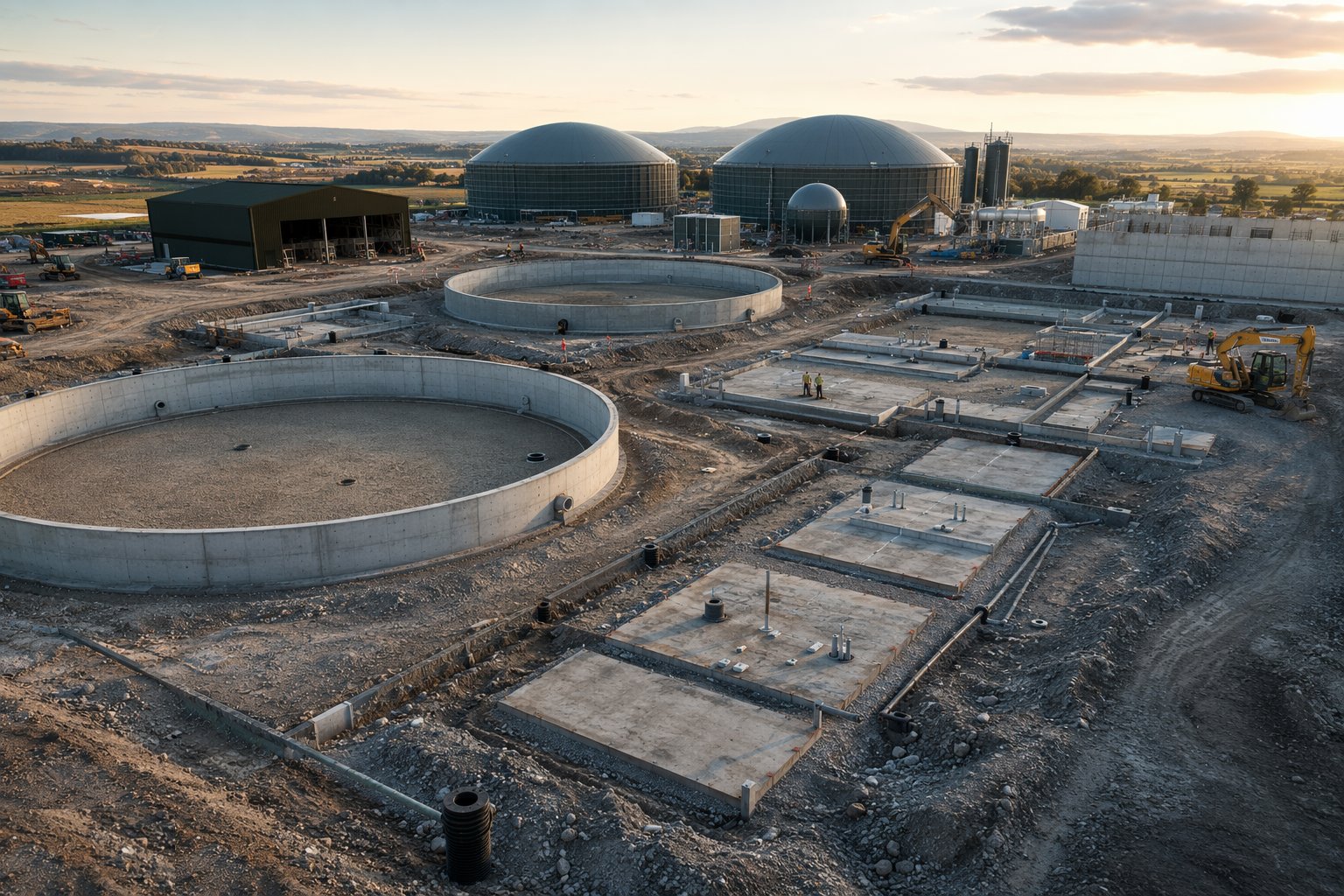
The site is laid out around the process and the zoning: tank ring foundations cast level to tight tolerance because a bolted tank built on an out-of-level ring never seals, reception-hall slabs with falls to contained drainage, and every surface that can see feedstock or digestate draining to the sealed system — process water and leachate are recycled to the digesters or tankered, never discharged to ground. Buried services are routed with the ATEX zones in mind, and the compound for the gas train is set out with the separation distances the hazard assessment demands. This is a process plant: the civils exist to serve pipes, tanks and zoning, and the drawing they most often refer to is the P&ID, not the site plan.
Step 2: Build the digester tanks
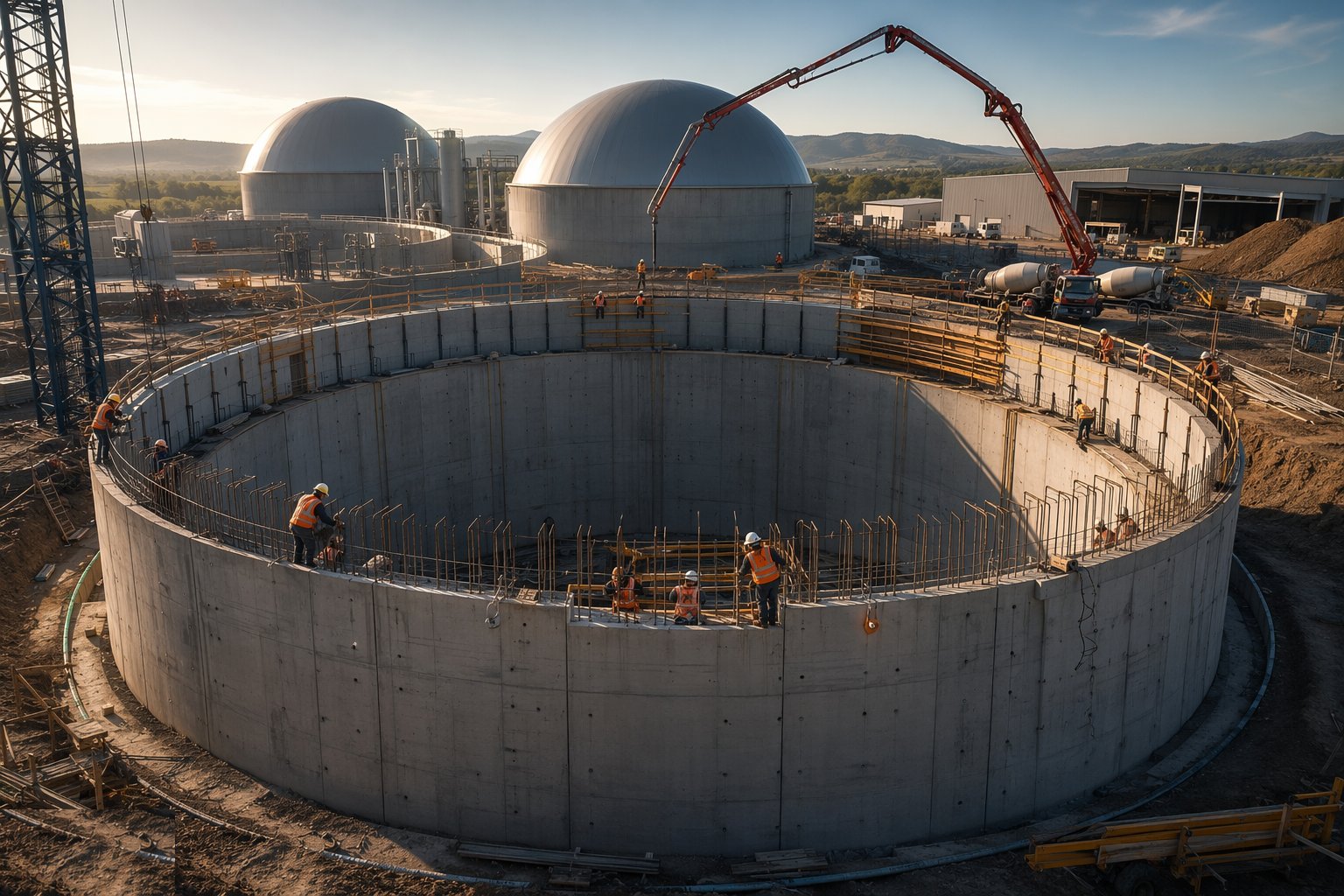
Post-tensioned concrete tanks are cast in pours with waterstops and penetrations set before concrete, stressed circumferentially on strength, pressure-tested and sealed; the stressing records and test certificates are the tank's birth certificate. Glass-fused-to-steel tanks are built ring by ring from the top: jacks on the ring beam lift each completed ring while the next course of enamelled plates is bolted beneath it, gaskets seated and every bolt torqued to specification — twice, on the schedule the manufacturer demands. Enamel damage is touched up only by the approved method, roof structures and mixer bridges are landed, and the completed tank is gas-tightness tested at its design pressure and the result logged, because a digester that leaks is a methane source with a planning condition attached.
Step 3: Fit mixers, heating and the gas train
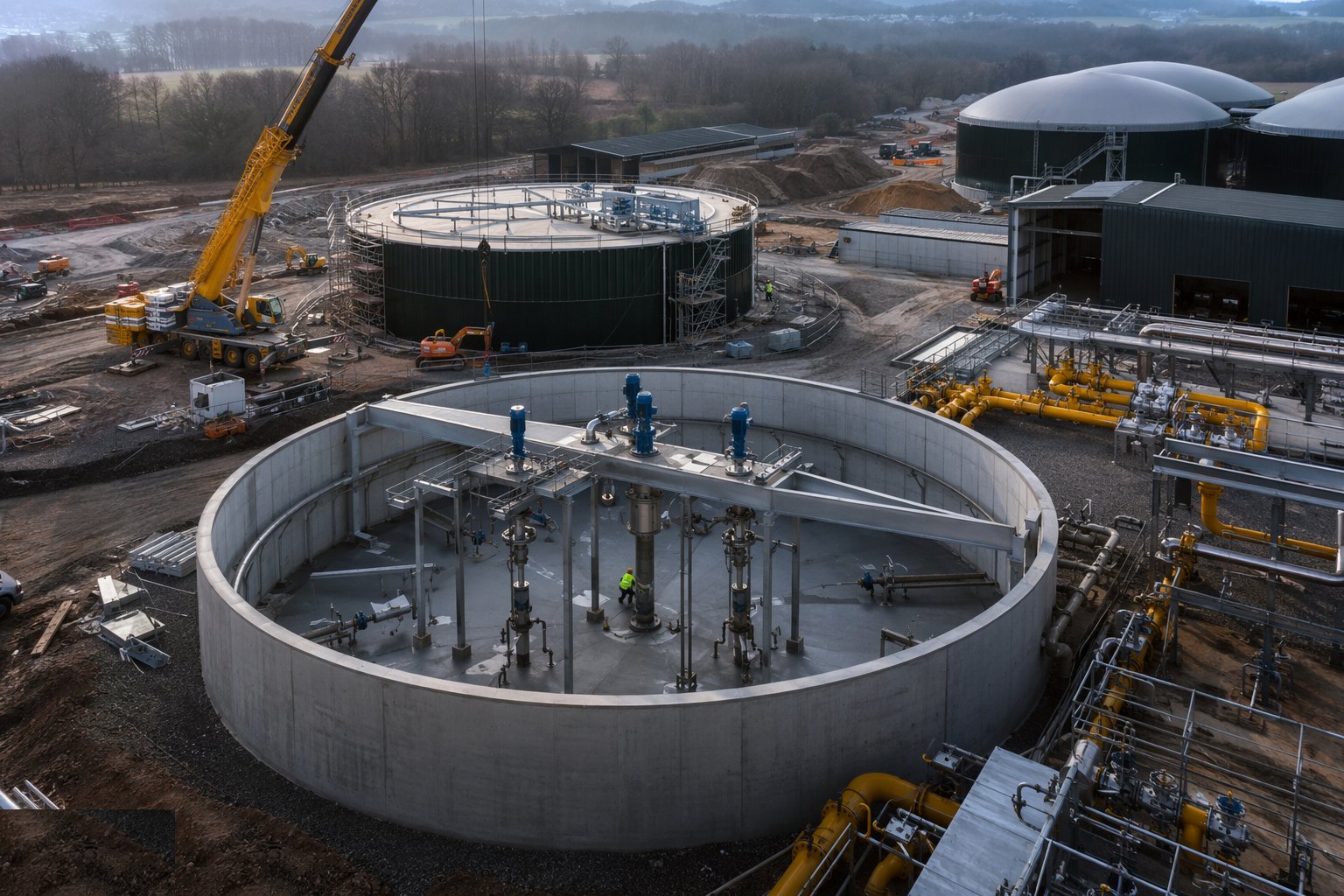
The tank internals and roof equipment go in as precision mechanical work: submersible or top-entry mixers through their gas-tight seals, heating coils or external heat exchangers piped to the hot-water circuit, level and temperature instruments, and the gas offtake pipework rising to the double-membrane roof or the separate membrane gas holder. Every penetration is a potential leak path and is sealed and tested as one. The gas train — pipework in rated materials, condensate pots, blowers, the emergency flare that must always be ready before the first cubic metre of gas exists — is installed by Ex-certified trades to the ATEX design, with earthing, bonding and gas detection completing the zone.
Step 4: Construct the reception hall and odour control
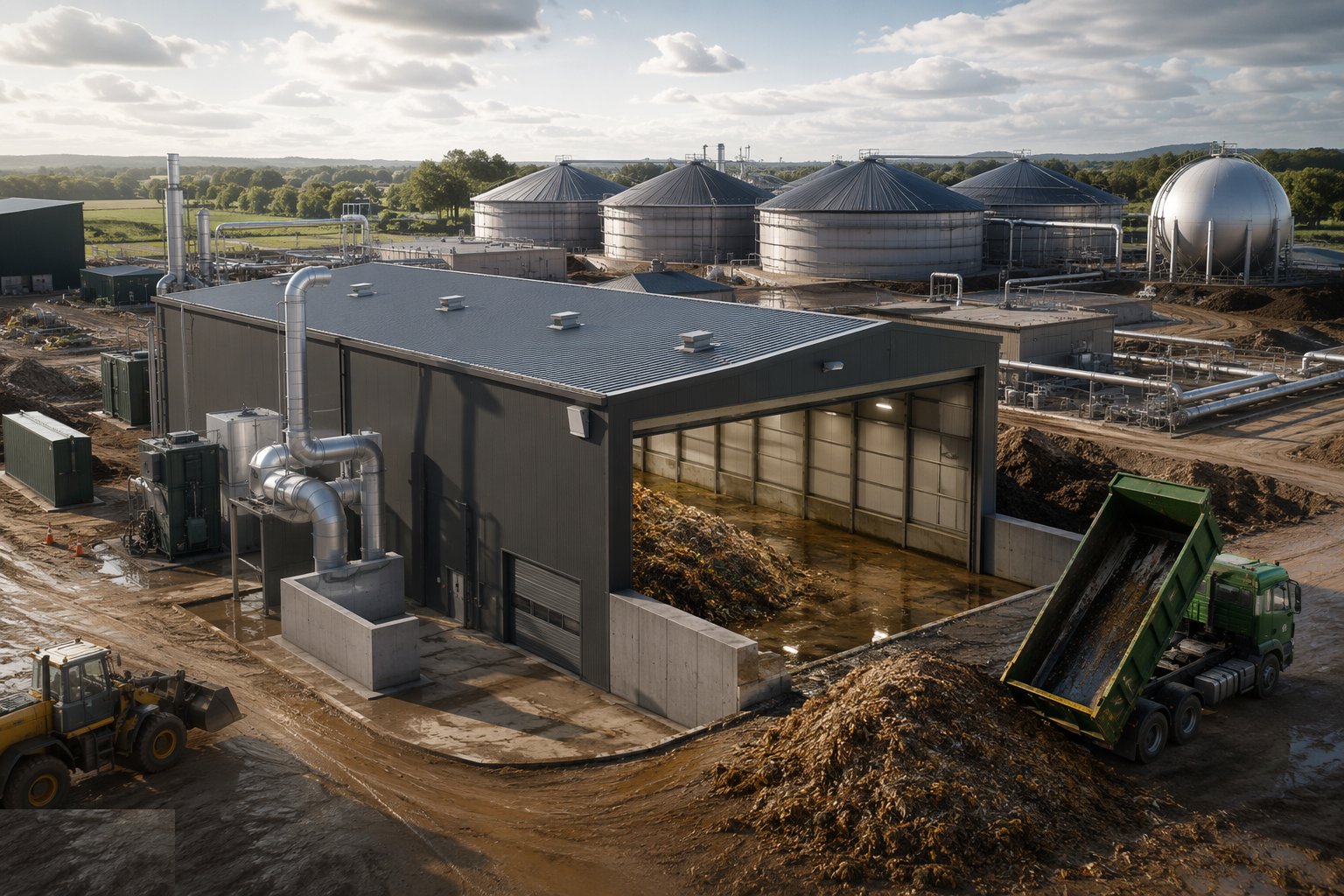
The reception hall is built as a sealed box that happens to have doors: heavy-duty slab and push walls inside, fast-acting roller doors on the vehicle routes with airlocks or vestibules where the odour risk demands, and an extraction system sized to pull the hall negative whenever a door cycles, discharging through a biofilter bed sized for the real air flow, not the optimistic one. De-packaging and pulping equipment is set on its plinths with its wash-water and reject systems piped to the sealed drainage. The acceptance test is simple and brutal: tip a load of food waste on a still day, open the door as operations will, and stand at the boundary — the plant's social licence is decided right there.
Step 5: Install CHP, upgrading and pasteurisation
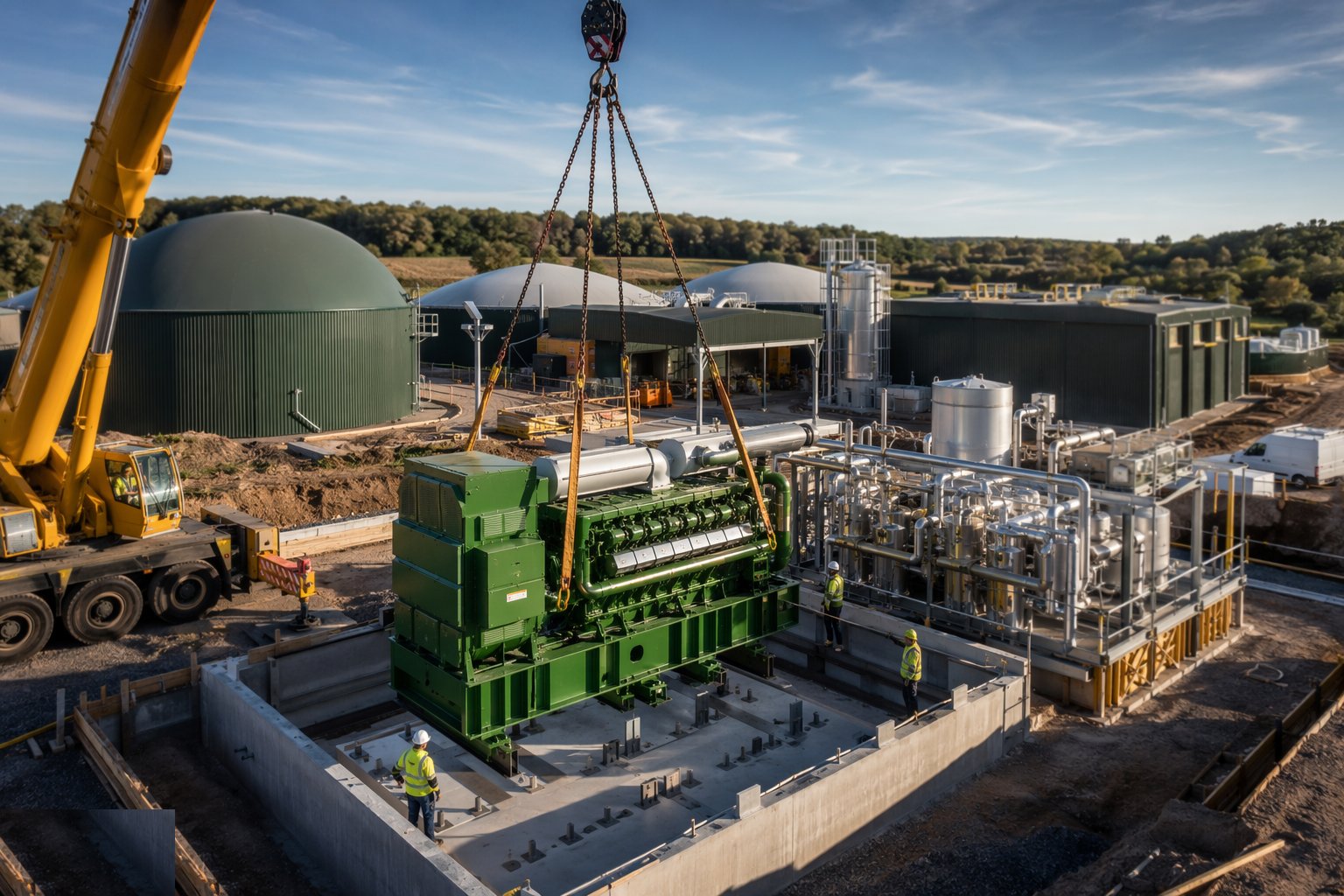
The energy island is set and connected: CHP engines on inertia bases with their exhausts, cooling and heat-recovery circuits — the hot water that heats the digesters comes from here, closing the energy loop — or the upgrading package with its compressors, membranes, analysers and grid-entry unit. Pasteurisation vessels or flows are installed where the Animal By-Products Regulations bite, with temperature recording and validation that proves 70 °C for one hour across the full flow — cold spots in a pasteuriser are regulatory failures, not process niggles. Electrical and control systems tie the plant together under one SCADA, and the grid connection is commissioned with the network operator witnessing.
Step 6: Build composting tunnels and maturation pads
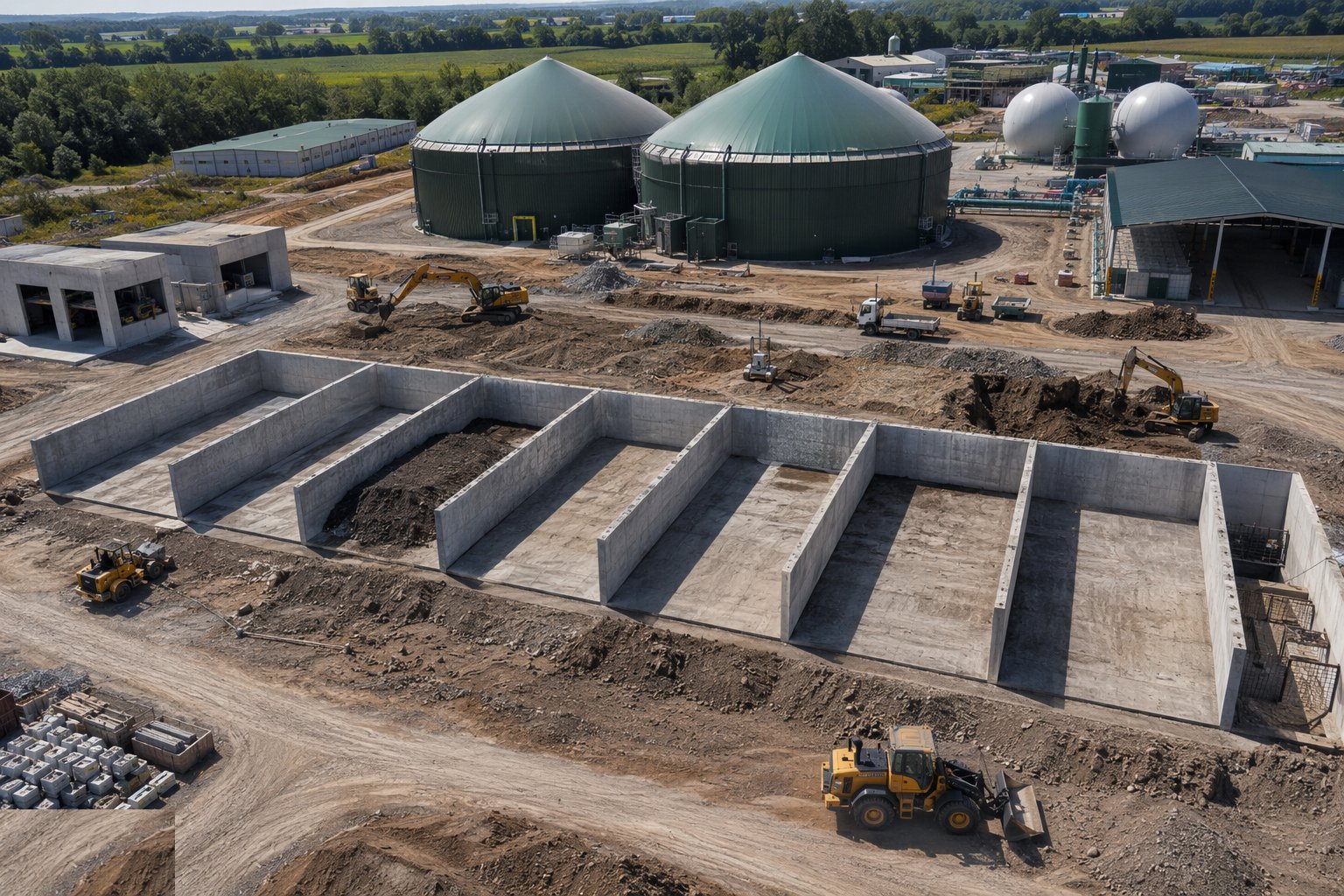
Composting tunnels are concrete boxes with working floors: aeration channels or spigot floors cast true so air distributes evenly, drainage falls to the leachate system, sealed doors rated for the tunnel pressure, and the aeration plant — fans, ducting, biofilter — installed and balanced. Maturation pads are engineered surfaces: sealed and drained hardstanding with leachate collection, laid to falls that never pond, with wheel-wash and access keeping the operation clean. The civils look simple and are not: an aeration floor cast 10 mm out of true is a composting tunnel with a dead zone, and a pad that ponds leachate is an odour source the neighbours will name.
Step 7: Commission the biology
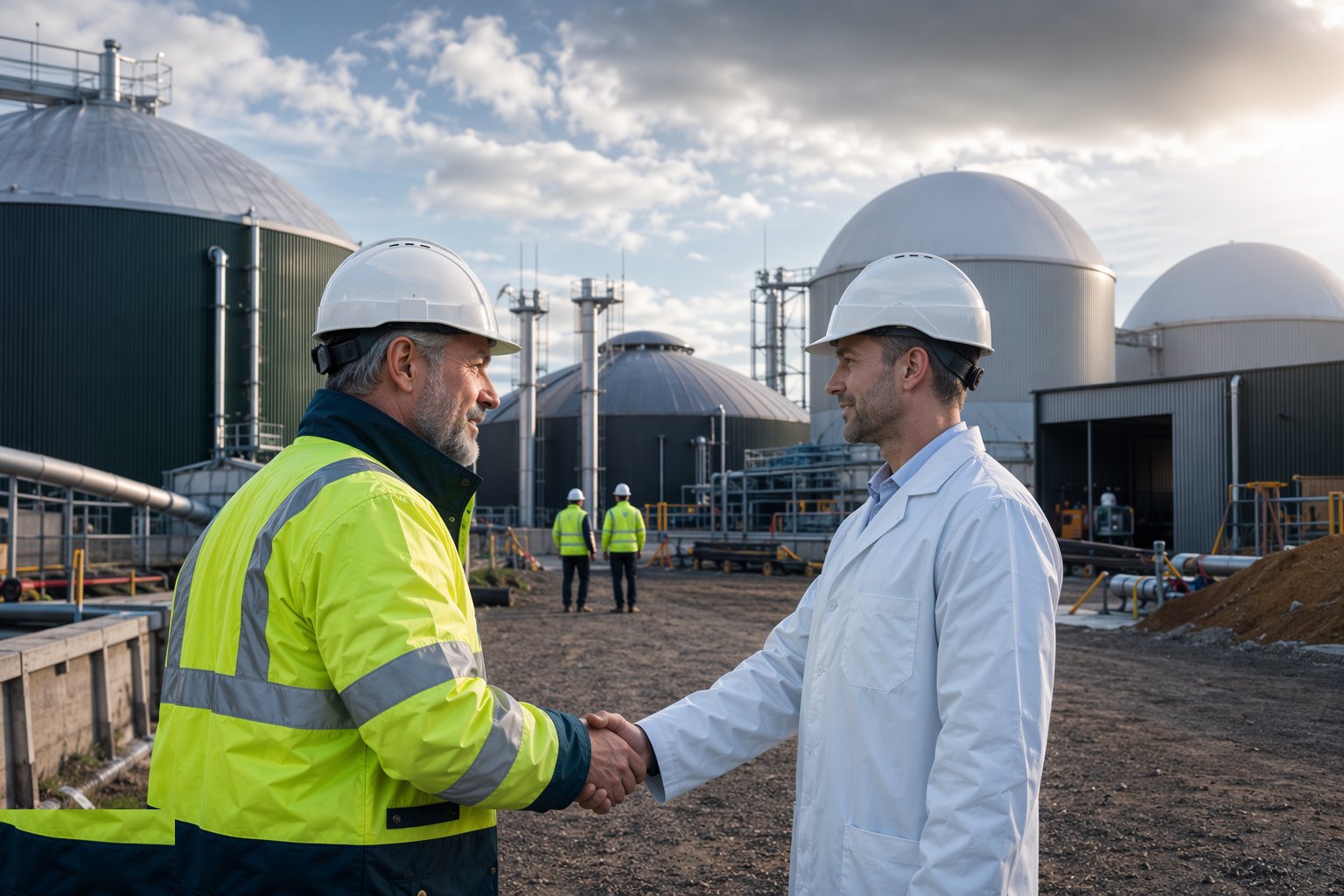
Mechanical completion hands over to a different clock. Tanks are water-tested and cleaned, then filled and seeded with digestate from an operating plant, warmed to temperature over days, and loaded gradually — feed rates stepped up over weeks while gas production, volatile fatty acids and pH tell the biologists how fast to go. Gas quality is proven into the engines or the grid; odour systems are commissioned against real loads with boundary monitoring; pasteurisation validation runs are witnessed and recorded. Handover includes the O&M manuals, the ATEX verification file, the gas-tightness certificates and the commissioning records — and the standing advice every operator already knows: you can rush concrete, but you cannot rush bacteria.
Plant and equipment
- Cranes and tank-jacking systems for glass-fused-to-steel tank erection
- Post-tensioning stressing jacks, pumps and grouting equipment for concrete digesters
- Torque equipment calibrated for bolted tank construction
- Concrete pumps and formwork systems for tanks, tunnels and plinths
- Mechanical installation kit for mixers, pumps and gas equipment, with Ex-rated tools in zoned areas
- Gas detection and ATEX verification instrumentation
- Welding, fusion and NDT equipment for pipework in gas and process service
Quality control checks
- Tank gas-tightness and water-tightness test certificates before any feedstock is accepted
- Post-tensioning records — jack pressures, elongations, grouting logs — for concrete digesters
- Bolted-tank torque records, gasket inspections and enamel repair logs per ring
- ATEX installation verification file: Ex certificates, earthing and bonding records, zone drawings
- Pasteurisation validation data proving 70 °C for one hour across the full flow
- Odour-system commissioning results with boundary monitoring against the permit
Safety considerations
- Explosive atmospheres: ATEX zoning enforced, Ex-rated equipment in zones, hot work under permit, ignition sources controlled absolutely
- Hydrogen sulphide and asphyxiation in tanks and confined spaces: entry permits, gas testing, ventilation, rescue plans — H2S kills without warning at high concentration
- Biological hazards: bioaerosols at reception and composting, leptospirosis hygiene, dust and odour exposure managed by design and PPE
- Heavy plant and reversing vehicles at reception: segregation and one-way flows designed into the layout
- Hot systems — pasteurisers, engines, heating circuits: guarding, insulation and isolation procedures
- Working at height on tank roofs and membrane holders in zoned areas: combined fall and ignition discipline
Common defects
- Gas leaks at roof edges, mixer seals and penetrations — found by the tightness test, or by the gas detector at 2 a.m.
- Bolted-tank leaks from under-torqued bolts or damaged enamel, weeping digestate down the rings
- Mixer seal failures and dead zones in tanks where mixing design met a floor cast out of tolerance
- Odour escapes at reception doors: slow doors, failed interlocks, negative pressure lost at shift change
- Pasteurisation cold spots failing validation — flow and temperature never mapped across the vessel
- Aeration floors cast out of true: compost tunnels with dead zones and the odour that comes with them
Best suited for
- Municipal food-waste treatment tied to kerbside collection contracts
- Farm and estate slurry management with renewable energy offtake
- Biomethane-to-grid schemes where gas upgrading economics hold
- Green and food waste composting with in-vessel sanitisation requirements
How long does Anaerobic Digestion & Composting Facilities take?
Typical duration: A food-waste AD plant typically builds and commissions in 12–24 months including biological ramp-up; farm-scale plants run 6–12 months; in-vessel composting facilities 9–15 months depending on tunnel count and odour-system scope..