Runway & Taxiway Pavement Construction
Building the strip itself — rigid pavement-quality concrete or thick-lift asphalt over a proven subgrade, textured and grooved for wet grip, with FOD discipline throughout and acceptance that ends at a friction survey.
Last updated 2026-07-28 by the BuildPedia Editorial Team.
What is Runway & Taxiway Pavement Construction?
A runway is a pavement like no other: typically 3–4 km long and 45–60 m wide, carrying 300-plus-tonne aircraft at touchdown speeds over 200 km/h, on a surface that must drain standing water, shed rubber and keep its grip in a downpour. Design starts at the subgrade — its strength, expressed as CBR, drives the whole build-up — and the finished pavement's capability is published as a PCN (pavement classification number) that airlines match against their aircraft's ACN before they schedule in. Two structural families dominate: rigid pavements in pavement-quality concrete, and flexible pavements in heavy-duty asphalt — with composites, asphalt over old concrete or concrete over old asphalt, filling the reconstruction space in between.
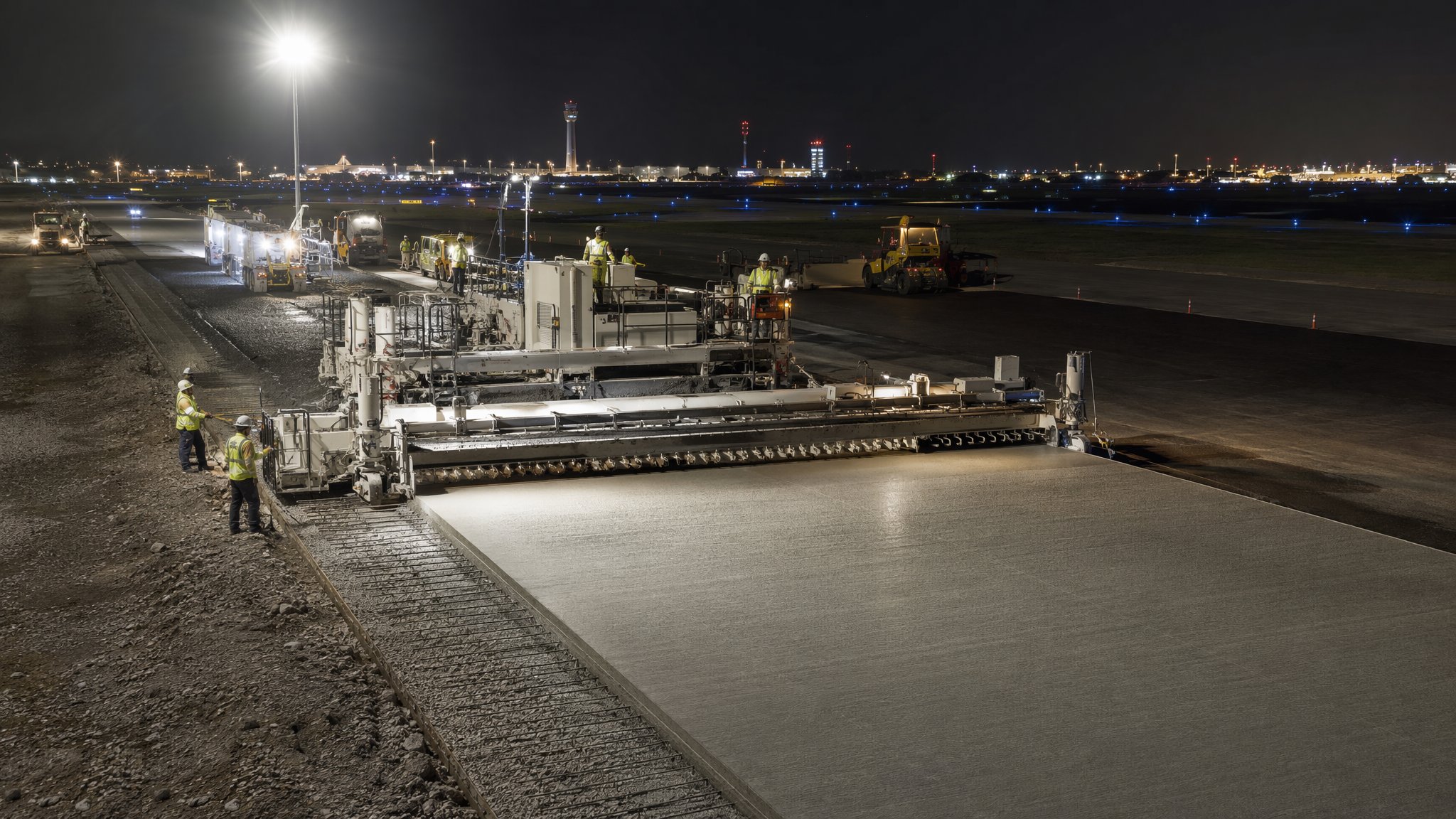
Rigid construction is a concrete paving operation at industrial scale. Pavement-quality concrete — a stiff, low-slump mix designed for flexural strength — is placed by slipform pavers in full-width passes, typically 300–450 mm thick on runways, over a lean concrete or granular subbase, with dowelled transverse joints formed or sawn to control cracking and transfer load between slabs. Flexible construction is thick-lift asphalt: base, binder and surface courses of dense or Marshall asphalt laid by echelon pavers to tight level tolerances, compacted to density targets the airport's QA regime cores to prove. Either way, the surface then gets its texture: freshly laid concrete is dragged or broomed for macrotexture and, on runways, transverse grooves are cut — commonly around 6 mm wide by 6 mm deep at close centres — so water escapes from under a tyre at speed and aquaplaning stays a theory rather than an incident.
The disciplines around the paving are as defining as the pavement itself. The work is airside, so FOD — foreign object debris — control rules everything: one bolt on a runway can destroy an engine, so haul routes are kept clean, tyres are checked at the gate, work faces are swept continuously and a final FOD walk precedes every handback. Quality assurance runs at aviation level: subgrade CBR proven, layer densities cored, concrete flexural beams tested, levels and ride surveyed, texture depth measured by sand patch, and the finished runway friction-tested with continuous friction measuring equipment before acceptance. The documentation closes against the aerodrome's certification basis — ICAO Annex 14 and, in the UK, the CAA's CAP 168 — because a runway is not accepted by a clerk of works; it is accepted by an aerodrome licence holder.
When and why is Runway & Taxiway Pavement Construction used?
Runway construction comes early on a new airfield — it is the longest single asset and often the programme's spine — but the harder and more common job is reconstruction on a live airport, where the work compresses into night possessions between the last arrival and the first departure. The rigid-versus-flexible choice is made on traffic, ground, materials and maintainability: concrete for the longest life and heaviest traffic where the subgrade and supply chain support it, asphalt where speed of construction, staged night works and easy future overlay matter more. It matters because there is no cheap error on a runway: a bay with low flexural strength, a texture that fails the sand-patch test or friction that fades early cannot be patched quietly — the world's airlines hold your PCN in their performance manuals, and the pavement you sign for is the one they trust at 200 km/h in the rain.
Types of Runway & Taxiway Pavement Construction
Rigid PQC pavement, dowelled
Slipformed pavement-quality concrete 300–450 mm thick with dowelled transverse joints and tied longitudinal joints, textured and grooved. The benchmark for major runways: decades of life under the heaviest traffic, at the price of a big, continuous, quality-hungry paving operation.
Flexible thick-lift asphalt
Dense bituminous or Marshall asphalt base, binder and surface courses over a granular or stabilised foundation, laid in lifts by echelon pavers. Faster to build and reconstruct, tolerant of staged night works, and the default at many regional airports — with a maintenance overlay cycle the owner must fund.
Composite reconstruction
Asphalt overlays on existing concrete, or concrete on asphalt, with reflection-crack controls and bond preparation between old and new. The live-airport reality: most runway work is rebuilding what is there, not starting green.
Rapid-setting repair systems
High-early-strength concretes and proprietary repair mortars for slab replacements and local repairs inside night possessions. Concrete that takes aircraft by morning — expensive per cubic metre, cheap per hour of runway kept open.
Grooved and textured surfaces
Not a pavement type but the finish that defines acceptance: dragged or broomed macrotexture on fresh concrete, transverse sawn grooves on runways, and friction courses on asphalt. Where the structural pavement meets the certification requirement for wet grip.
Runway & Taxiway Pavement Construction: step by step
Step 1: Prove and prepare the subgrade and subbase
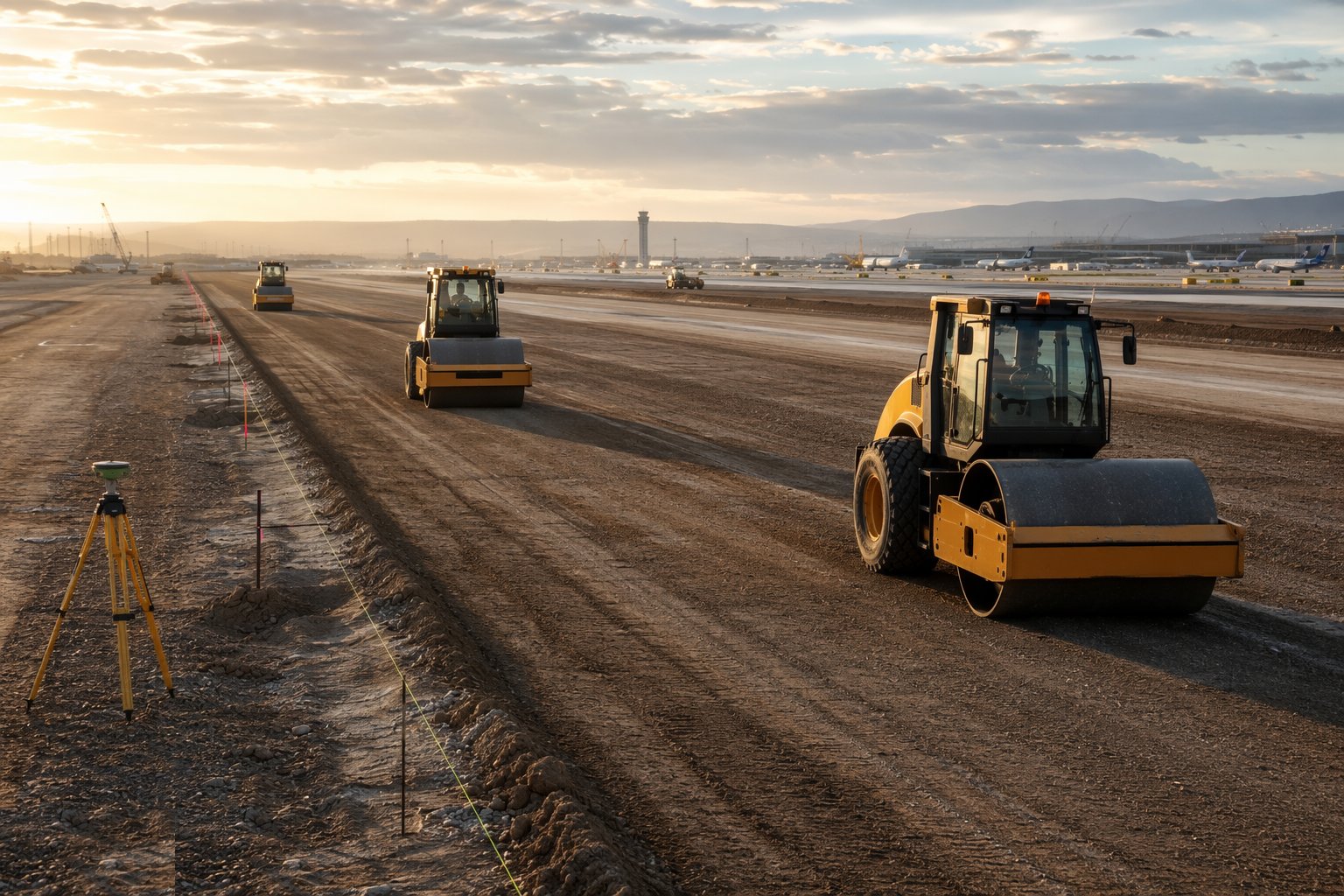
The formation is trimmed, proof-rolled and tested — CBR or plate tests against the design assumption — because every layer above inherits the ground's honesty. Subbase goes down in controlled layers: granular or lean concrete, compacted to density and level tolerances checked by survey, with fines kept off haul routes and the surface kept clean. A soft spot passed over at formation is a cracked slab or a rutted wheel track two winters later, and on a runway there is no hiding it under the landscaping.
Step 2: Set out the paving train and the datum
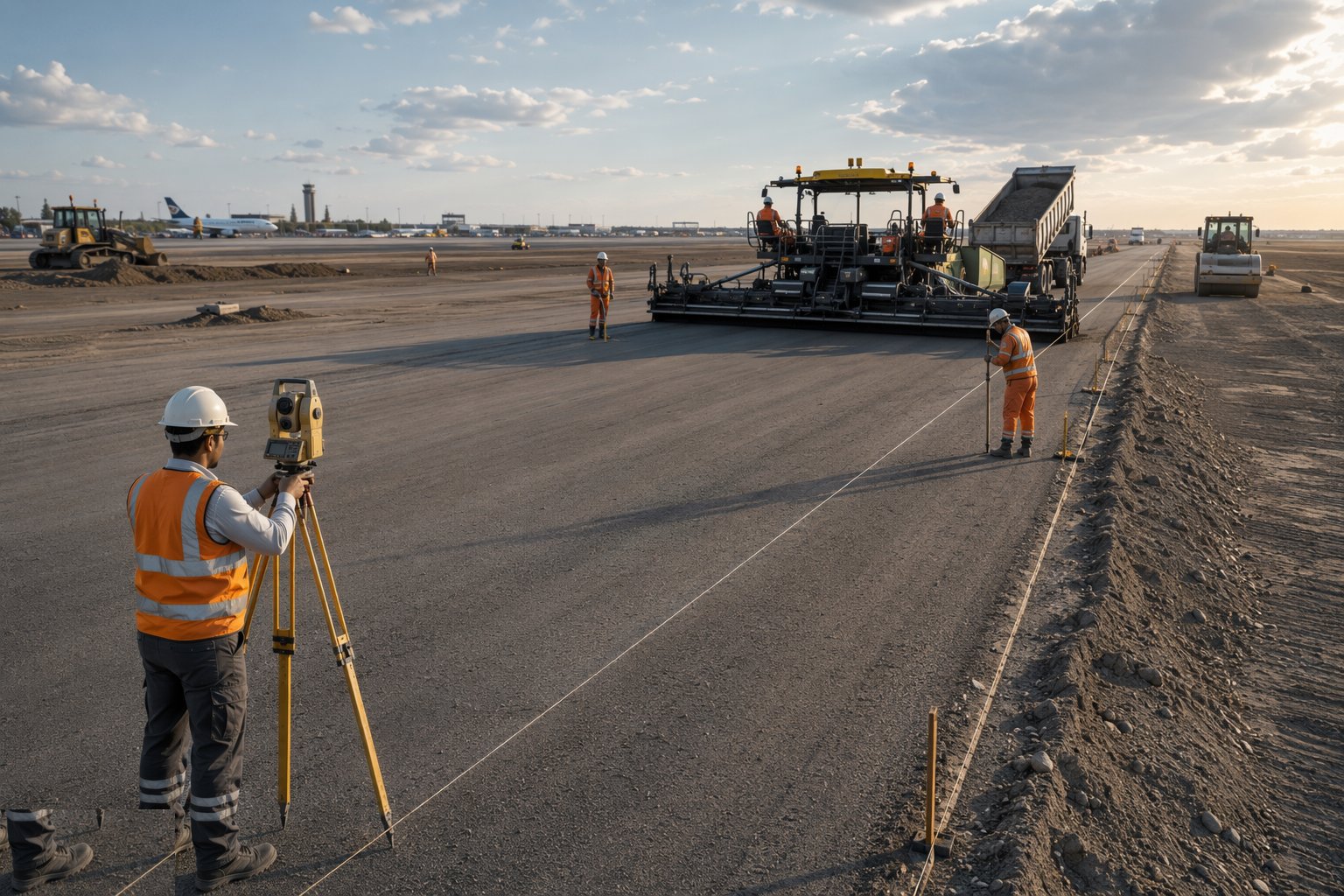
Slipform pavers work off stringlines or 3D machine control from the airport grid; asphalt echelon paving sets its level control by ski, sonic or total station. Edge lines, centreline and crown or transverse fall are established and checked before a load of material is called — the runway's geometry is a certification item, so the pavement's levels are surveyed like a structure, not eyeballed like a car park. Trial bays are paved and tested first: texture, strength, level and density proven on the trial before the main works commit.
Step 3: Place the pavement: slipform concrete or echelon asphalt
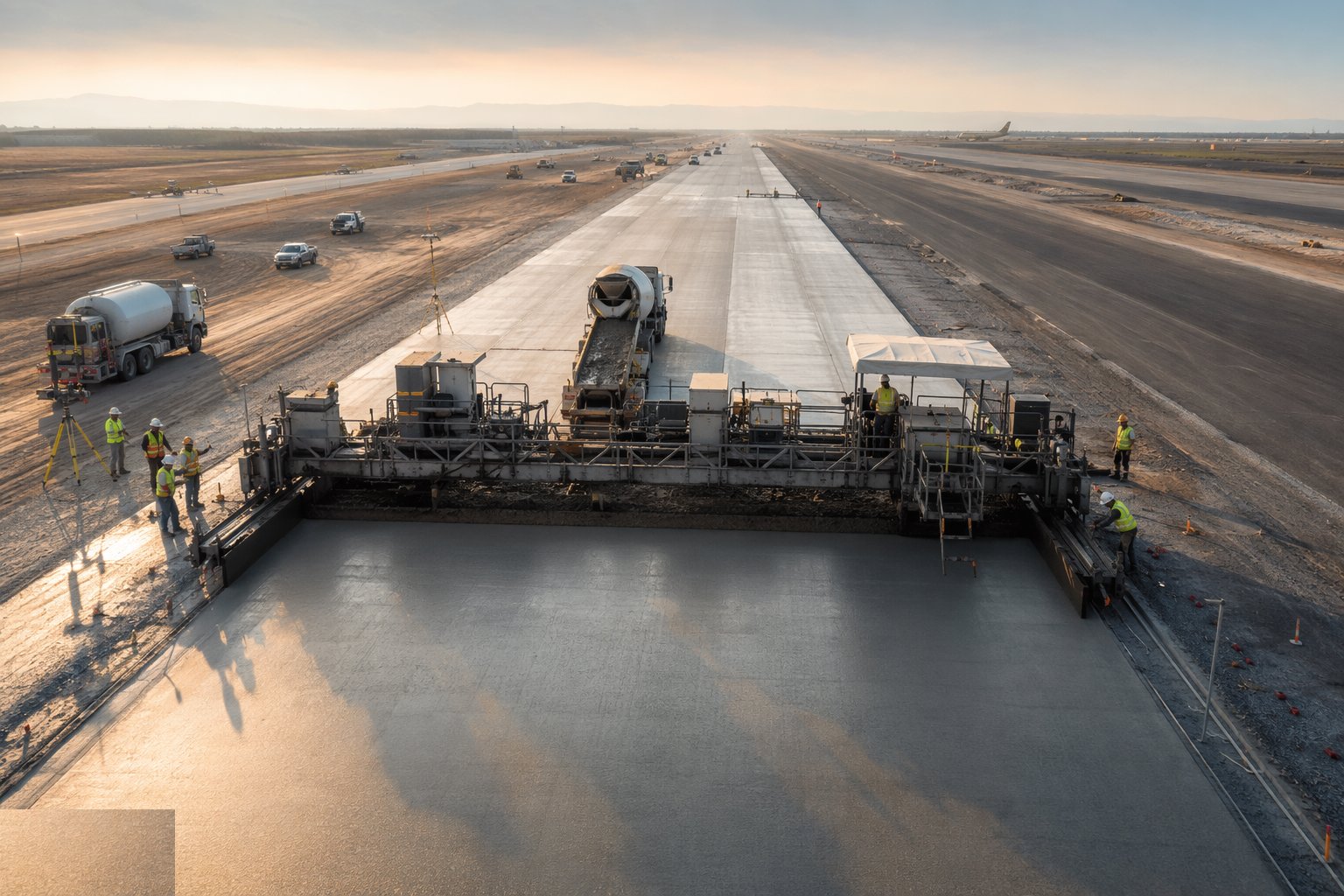
Rigid work runs as a continuous train — batching, delivery, slipform paving, dowel and tie-bar insertion, floating, texturing, curing membrane — with FOD discipline at every step and nobody walking the fresh surface without need. Asphalt runs in echelon: pavers side by side to kill cold joints, deliveries kept hot and continuous, rollers working to the density specification with gauges verifying as they go. Both operations live or die on continuity — a stopped train is a cold joint or a torn slab — so logistics, standby plant and weather calls are managed like the pour that cannot pause, because it cannot.
Step 4: Form joints and crack control in rigid pavements
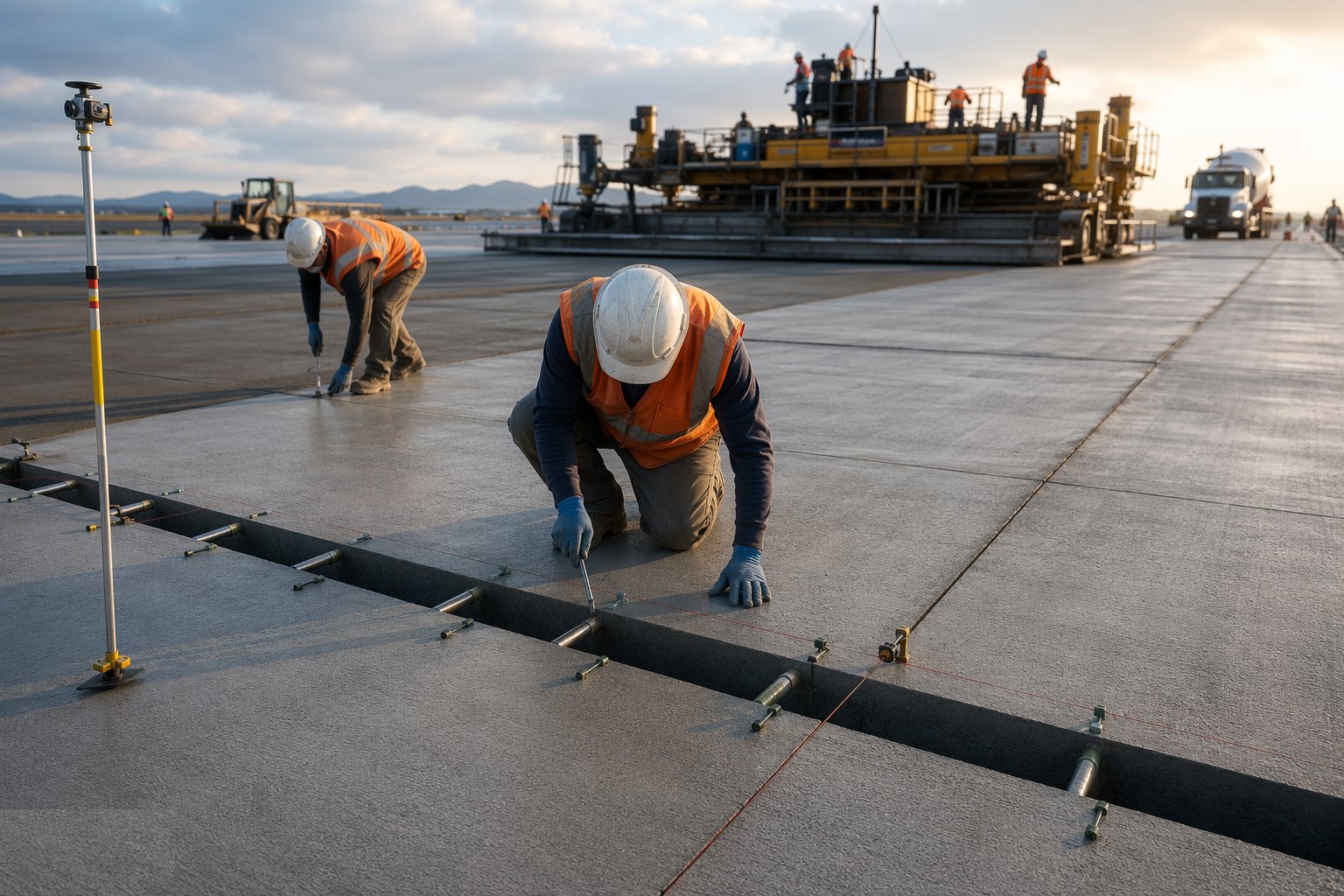
Transverse joints are sawn to schedule — early enough to beat the uncontrolled crack, late enough to avoid ravelling — with dowels aligned so slabs transfer load without locking up; longitudinal joints carry tie bars; joint seals go in after cleaning to keep water and incompressibles out. Dowel alignment is checked, not assumed: a misaligned dowel is a restrained slab, and a restrained slab cracks where it chooses rather than where you drew the joint.
Step 5: Texture, groove and cure the surface
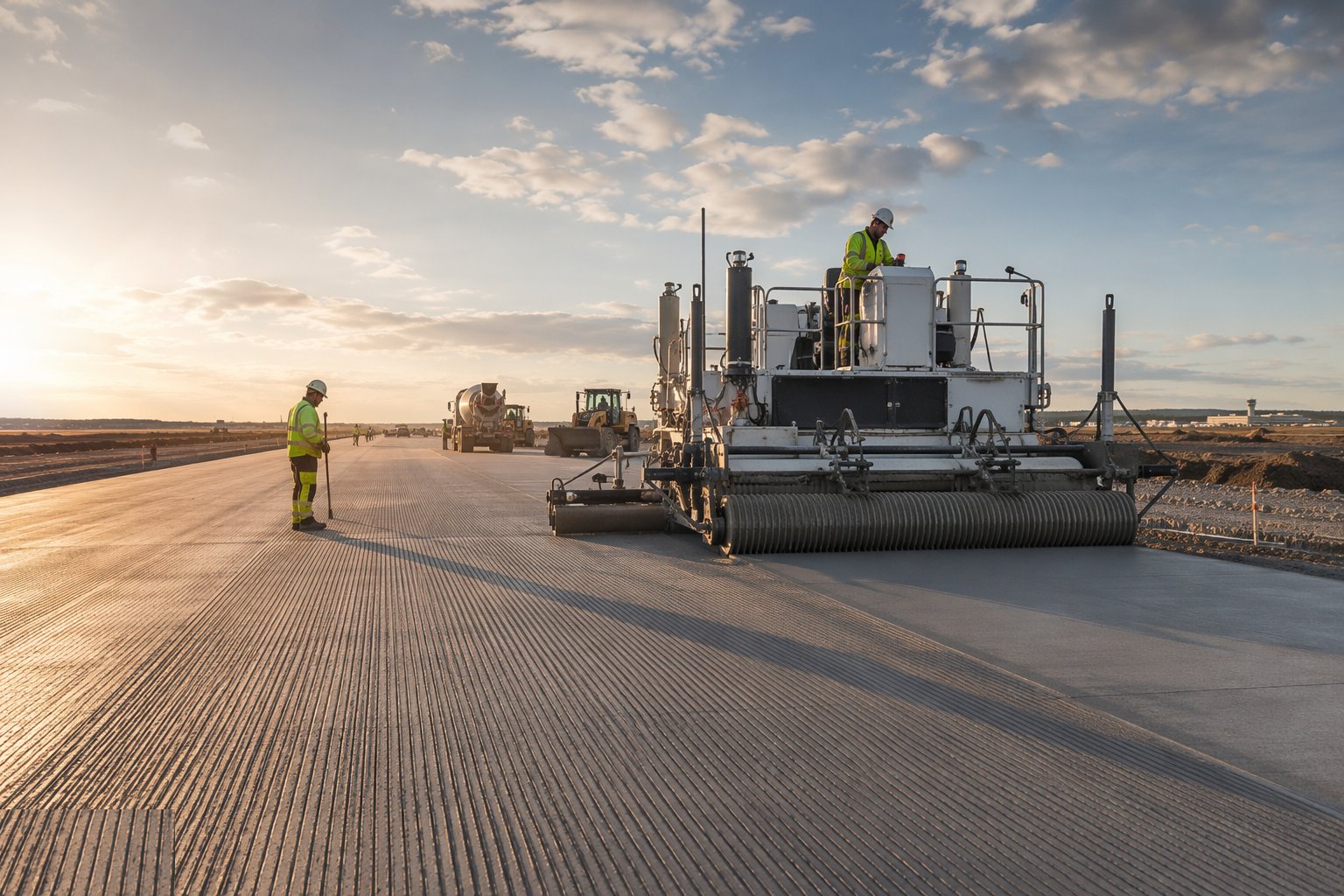
Fresh concrete gets its macrotexture by drag or broom behind the paver, then curing membrane within minutes — a dry, windy afternoon will skin the surface and take the texture with it if the cure lags. After hardening, transverse grooves are cut by gang-saw machines to the specified width, depth and spacing, with slurry and arisings captured, washed and removed — grooving residue left on a runway is FOD with a pedigree. Asphalt surfaces take their friction from the mix design and are checked the same way: texture depth and, in due course, friction testing.
Step 6: Run the aviation QA regime
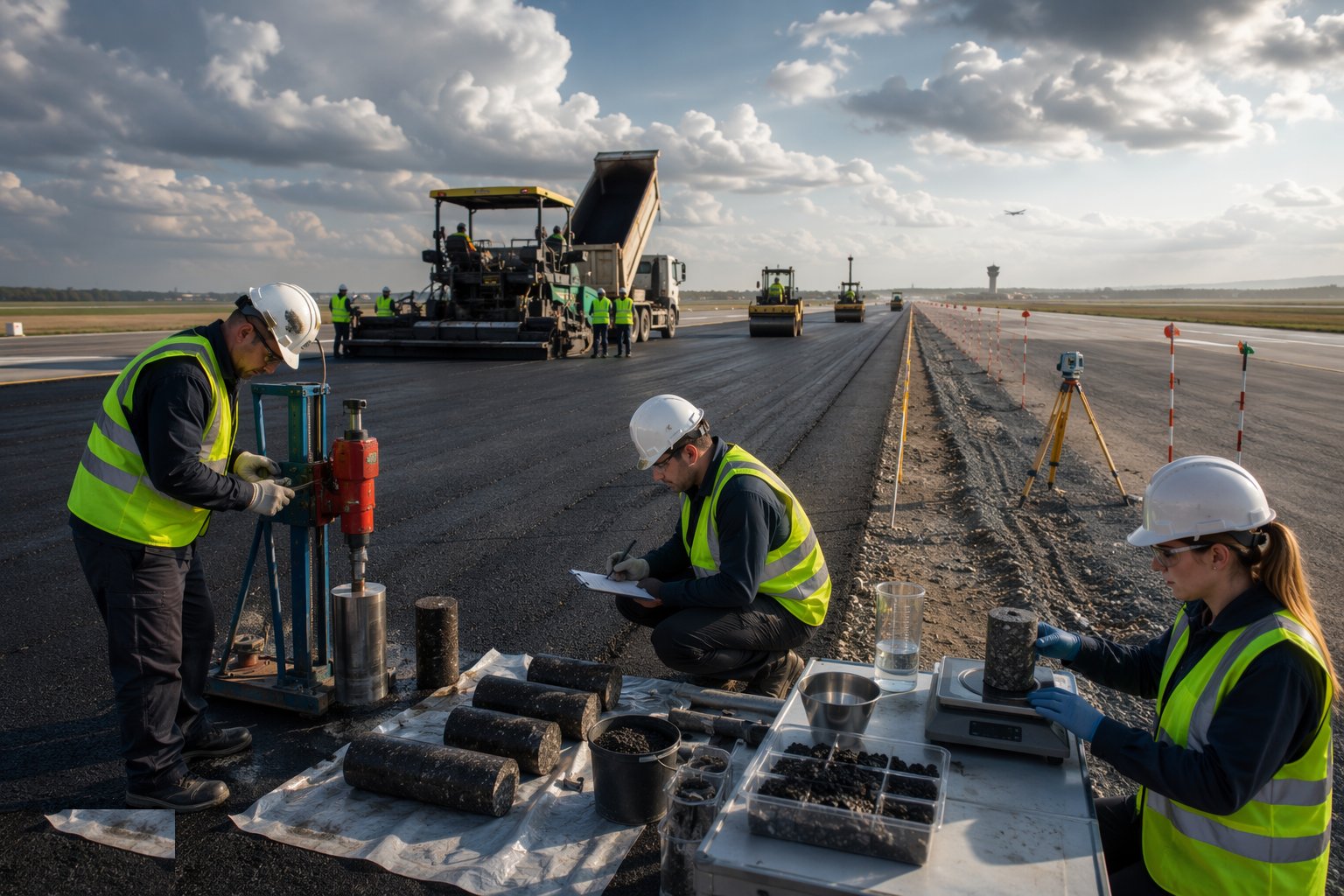
Sampling and testing runs continuously: concrete cubes and flexural beams per volume, asphalt cores for density and thickness, level and ride surveys against tolerance, texture depth by sand patch on a grid, joint seal inspection, and subgrade and layer records compiled bay by bay. Nonconformity is handled in the open — a low-strength bay or a thin core is investigated, cored further and either accepted by assessment or replaced — because the alternative is an undocumented doubt sitting under 300 tonnes of landing aircraft.
Step 7: Friction test, mark and hand back
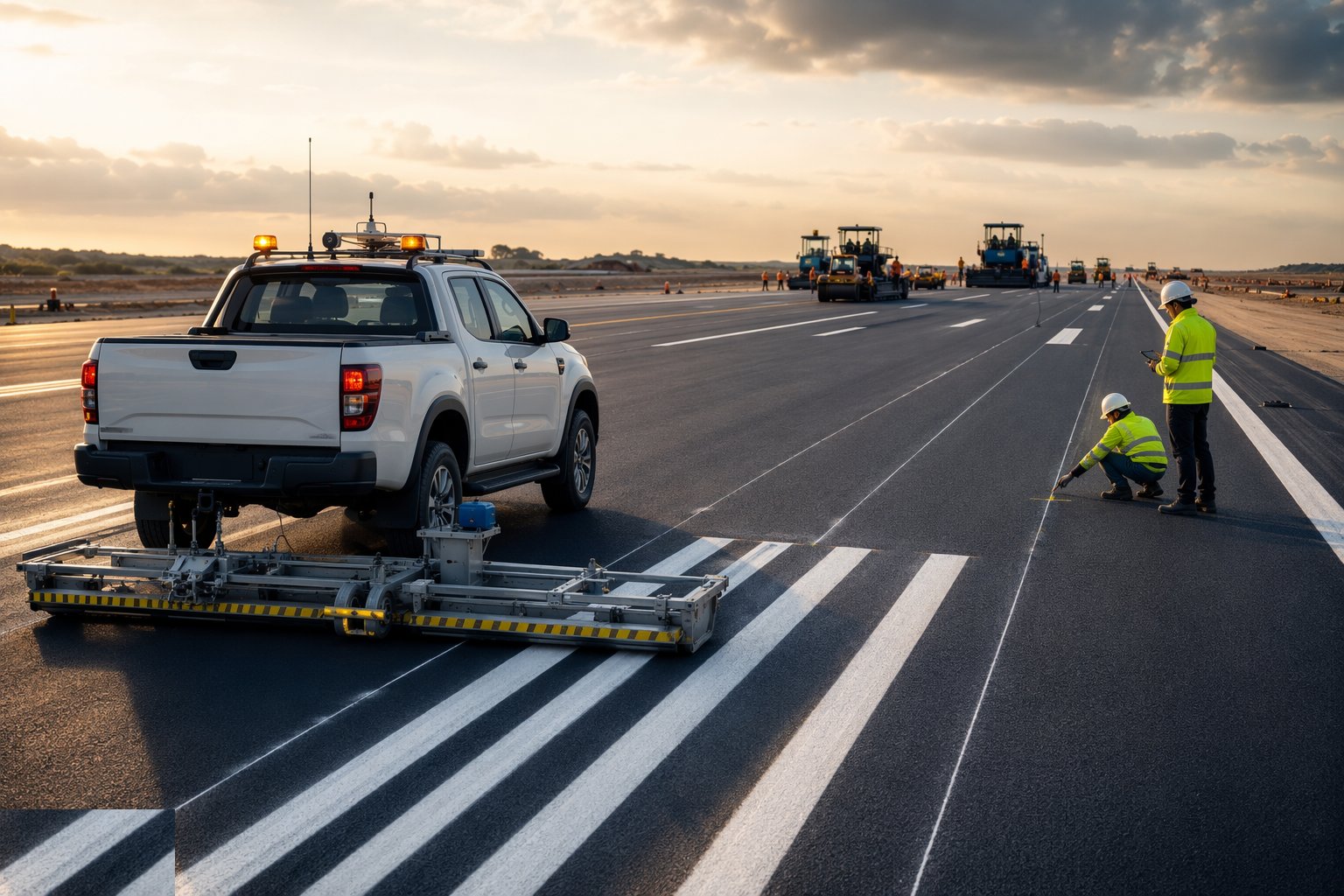
Before acceptance, the runway is swept and washed, FOD-walked end to end, and friction-tested with continuous friction measuring equipment to demonstrate the wet-grip requirement; permanent markings go down to specification and the lighting interfaces are confirmed with the AGL team. The handback file — test records, as-builts, PCN declaration inputs — goes to the aerodrome, the NOTAM is cancelled or amended, and the strip returns to service. From first pass of the paver to the friction survey, the whole operation runs knowing the first customer is an aircraft that cannot swerve.
Plant and equipment
- Slipform concrete pavers with dowel bar inserters and texturing/curing attachments
- Asphalt pavers in echelon with material transfer vehicles to keep the mat continuous
- Concrete batching plants — often on site — with chilled mixes where heat demands
- Tandem and pneumatic-tyred rollers; density testing gauges
- Gang-saw grooving machines with slurry recovery
- Sweepers, magnetic bars and FOD-collection kit at every work face and gate
- Continuous friction measuring equipment — trailer or vehicle-mounted — for acceptance
- Total stations and 3D machine control for level and line on the airport grid
Quality control checks
- Subgrade CBR or plate-test records against design; proof-rolling witnessed and logged
- Concrete cubes and flexural beams per pour volume; asphalt cores for density and thickness on a grid
- Level, ride and texture-depth surveys bay by bay against the certification tolerances
- Dowel alignment and joint saw-cut timing records on rigid pavements
- Friction testing of the finished surface before acceptance, with results in the handback file
- Trial bay results signed off before main works — texture, strength, level and density proven once, then repeated
Safety considerations
- Airside working: passes, escorts, radio discipline and absolute compliance with the aerodrome's rules — the aircraft always has right of way
- FOD as a safety discipline, not housekeeping: gate checks, covered loads, tyre inspections and end-of-shift FOD walks
- Night possession working: fatigue management, lighting, and the hard stop of a handback deadline with an aircraft schedule attached
- Paving train hazards: reversing delivery vehicles, hot asphalt and men on foot beside heavy plant — segregation and positive communication
- Slurry, dust and curing compound exposure; hearing and respiratory protection at the grooving machines
- Live-works interfaces: open excavations and level changes beside an operating taxiway barriered, lit and NOTAM'd
Common defects
- Flexural strength below specification in isolated bays — the coring-and-assessment exercise nobody budgeted for
- Uncontrolled cracking from late saw-cutting or misaligned dowels
- Texture depth failing the sand-patch test — a surface that meets strength but not wet grip
- Asphalt density shortfalls at joints and edges — the mat's weakest three hundred millimetres, found by the cores
- Grooving slurry or paving debris left on the surface — self-inflicted FOD at handback
- Level or ride out of tolerance at tie-ins to the existing pavement — a bump every landing aircraft will report
Best suited for
- New runways, taxiways and aprons on greenfield airfields
- Runway reconstruction and overlays under night possessions on live airports
- Heavy-duty rigid pavements for the busiest hubs and the largest aircraft
- Rapid-strength repairs keeping single-runway airports open
How long does Runway & Taxiway Pavement Construction take?
Typical duration: A new 3–4 km runway pavement is a 12–24-month operation from formation to friction test; night-possession overlay programmes on a live runway are measured in seasons — typically one full closure season per 1–2 km of major work..