Commissioning & Integrated Systems Testing
The five-level commissioning framework that ends with pulling the plug on a live load — factory witness tests, load banks, integrated systems testing and failure drills that prove the facility behaves exactly as the redundancy philosophy promised.

Last updated 2026-07-28 by the BuildPedia Editorial Team.
What is Commissioning & Integrated Systems Testing?
Data centre commissioning is the most demanding in the building industry because the product being commissioned is not a building — it is a promise of continuous operation. The industry framework is the five-level model, now embedded in owner project requirements and standards such as ASHRAE commissioning guidance and the Uptime Institute's methodology: Level 1 factory witness testing of major equipment at the manufacturers' works; Level 2 site receipt and installation verification; Level 3 individual system start-up and functional testing; Level 4 system-by-system performance proving, usually under load banks; and Level 5, integrated systems testing — IST — where the whole facility is operated as one machine and failure scenarios are deliberately induced while the IT load (simulated by load banks) is watched for a single flicker. Nothing is assumed; everything is witnessed, scripted and recorded.
The IST is the defining event. Scripts written months in advance walk the facility through its failure modes: utility power lost without warning, generators starting and taking load, UPS systems riding the gap on batteries, cooling plants transferring and recovering, a chiller tripping at full load, an A-train switchboard killed while the B-train carries the hall. Every sequence is timed and trended — transfer times, battery autonomy consumed, temperature excursions in the halls, alarm annunciation at the DCIM — and measured against the design's predictions and the client's service level commitments. A script step that fails is a defect with a root-cause investigation, a fix and a re-test; the IST does not conclude by running out of days, it concludes when the script passes.
The surrounding machinery matters as much as the test days. Commissioning is managed from design stage by a commissioning authority or agent acting for the owner, reviewing the design for testability before it is built and writing the owner's project requirements that every test is judged against. Load banks — trailer-mounted megawatt resistive loads — stand in for servers through Levels 4 and 5, generating the heat and electrical load that make the tests real. And the output is not just a passed script: it is the commissioning dossier, the as-tested settings and sequences of operation, the training of the operations team who ran the drills, and the evidence base behind Tier certification, insurance and the SLA the facility will be sold on.
When and why is Commissioning & Integrated Systems Testing used?
Commissioning runs across the final quarter of construction but is governed from the start — the commissioning authority is appointed at design stage, the OPR and basis of design are written then, equipment is purchased with factory witness test requirements in the orders, and the programme carries explicit Level 1–5 windows that construction feeds into. It matters because a data centre that has not passed IST is a hypothesis, not a facility: the first real utility outage is not an acceptable time to discover the generators cannot take the step load. It also matters commercially at the highest level — enterprise and hyperscale customers audit the commissioning evidence before committing, Tier certification is awarded on demonstrated performance, and insurers price on it. The IST dossier is, in a real sense, part of the product being sold.
Types of Commissioning & Integrated Systems Testing
Level 1 — Factory witness testing
Major equipment proven at the manufacturer's works before it ships: switchgear, UPS frames, generators, chillers and CRAH units run through witnessed performance tests against the purchase specification. Defects are fixed where fixing is cheap — a failed UPS module at the factory is a delay; at site it is a crisis.
Level 2 — Receipt and installation verification
Equipment checked on arrival and through installation: damage, correct storage, correct installation per the manufacturers' requirements, correct terminations, and the pre-energisation checklists signed. The level where construction quality and commissioning discipline first meet.
Level 3 — Start-up and functional testing
Individual systems started, set to work and functionally tested: every breaker operation, every valve stroke, every control point proven end to end from sensor to action to trend log. Component-level failures are found and fixed here, before they can hide inside integrated behaviour.
Level 4 — System performance under load
Systems proven at rated conditions with load banks: full-load runs of electrical trains and cooling plants, transfer sequences exercised, thermal performance of halls demonstrated, and battery autonomy discharged and measured. Each system individually earns its rating before the integrated test asks them to perform together.
Level 5 — Integrated systems testing (IST)
The facility operated as one machine under scripted failure scenarios with load-bank IT load: utility loss, generator response, UPS ride-through, cooling recovery and the measured behaviour of every interlock and alarm. The script is the contract made physical — pass, and the facility is proven; fail, and the failure is fixed and the scenario re-run.
Post-occupancy and seasonal testing
The levels that follow handover: seasonal testing at summer and winter design conditions, re-commissioning checks through the first year, and ongoing failure drills the operations team runs for the life of the facility — because a facility that could ride a power cut at handover must still be able to in year ten, and only drills prove it.
Commissioning & Integrated Systems Testing: step by step
Step 1: Appoint the commissioning authority and write the OPR
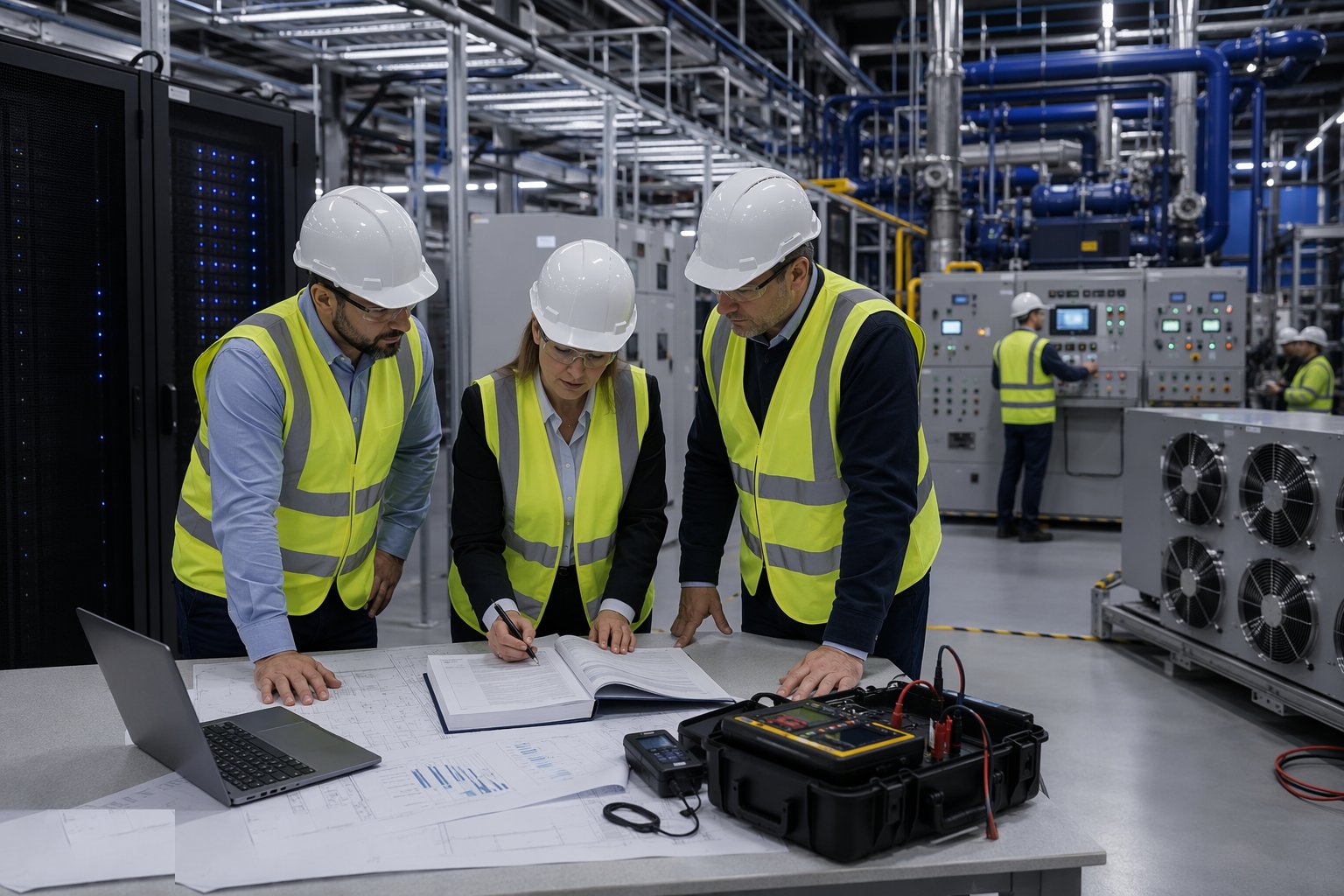
Engage the commissioning authority at design stage — owner-side, independent of the construction team — and write the owner's project requirements and the commissioning plan: what will be tested at each level, to what acceptance criteria, witnessed by whom, and documented how. Review the design for testability: isolation points, load-bank connection provisions, monitoring points and access for test equipment are design features, and retrofitting them during Level 4 costs multiples of designing them in. The commissioning schedule is built into the master programme with hard windows and explicit dependencies — construction complete per system, then L2, L3, L4, and finally the IST that everything feeds.
Step 2: Witness the factory tests (Level 1)
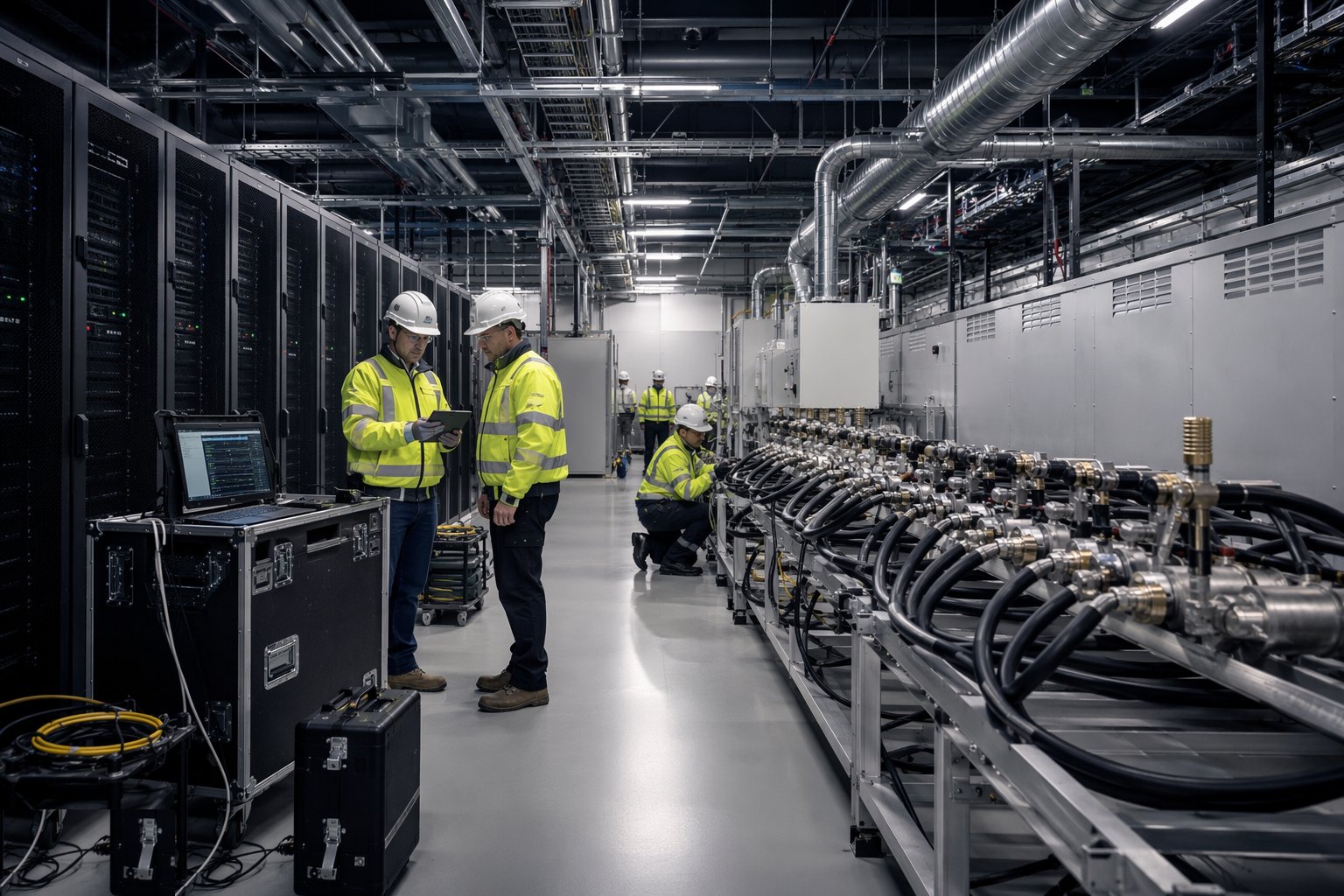
Attend the manufacturers' works for the witness tests specified in the purchase orders: generators on the test bed at full and step load, UPS frames through efficiency and transfer testing, switchgear through injection and functional sequences, chillers at rating. Record against the acceptance criteria in the purchase specification — witnessed, signed and filed — and hold shipment until nonconformities are closed or formally dispositioned. The FAT file travels with the equipment and becomes the opening section of its commissioning dossier.
Step 3: Verify installation and energise in sequence (Levels 2–3)
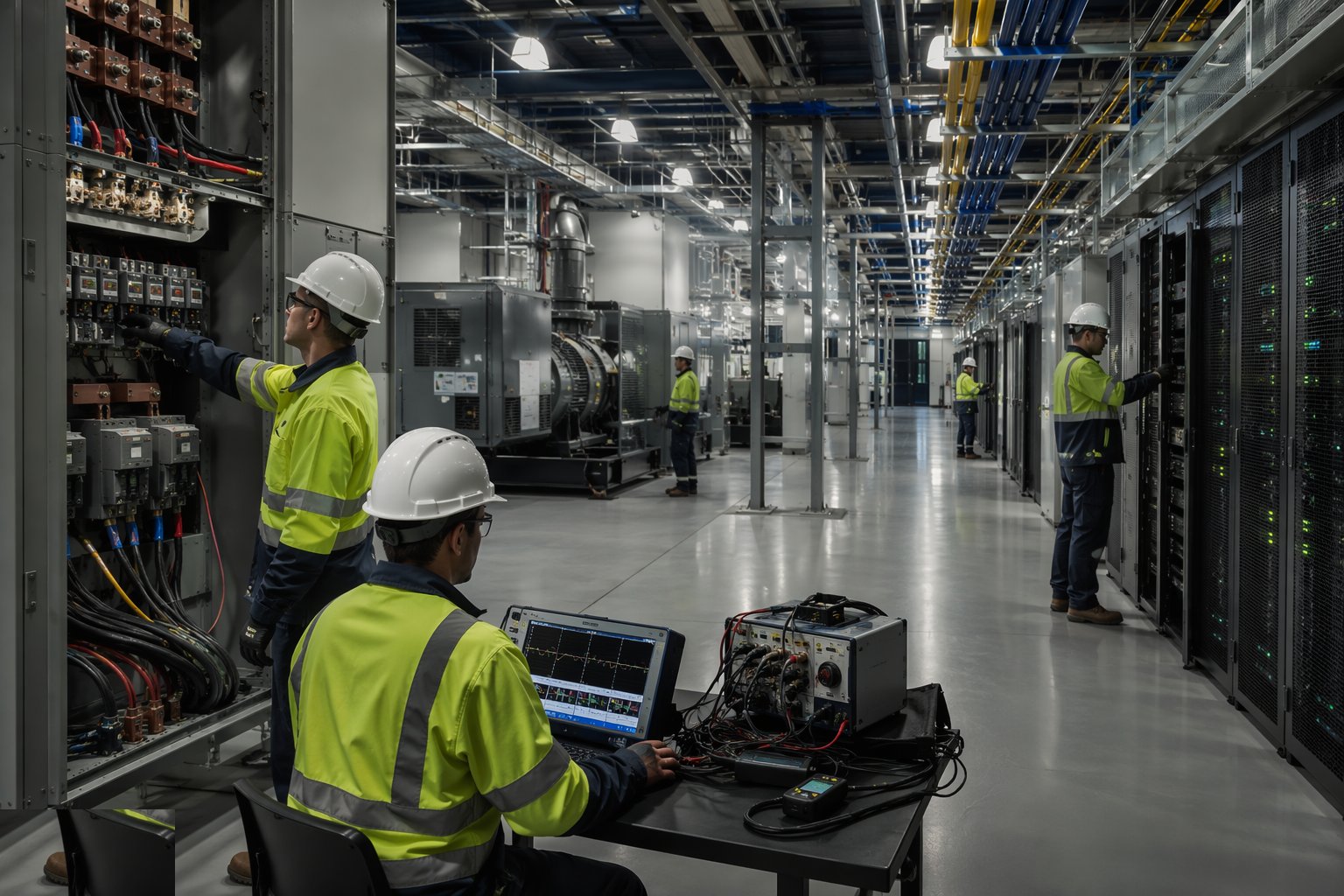
As installation completes system by system, verify and energise in the engineered sequence: pre-energisation checklists, protection settings injected, first energisation under permit with the utility's milestones honoured, then start-up and functional testing point to point. Prove every control loop from field device to BMS trend; prove every interlock physically, not from the drawing. The Level 3 file is the largest in the dossier — thousands of signed test sheets — and its discipline is what makes Level 4 a performance test rather than a debugging session.
Step 4: Prove systems under load banks (Level 4)
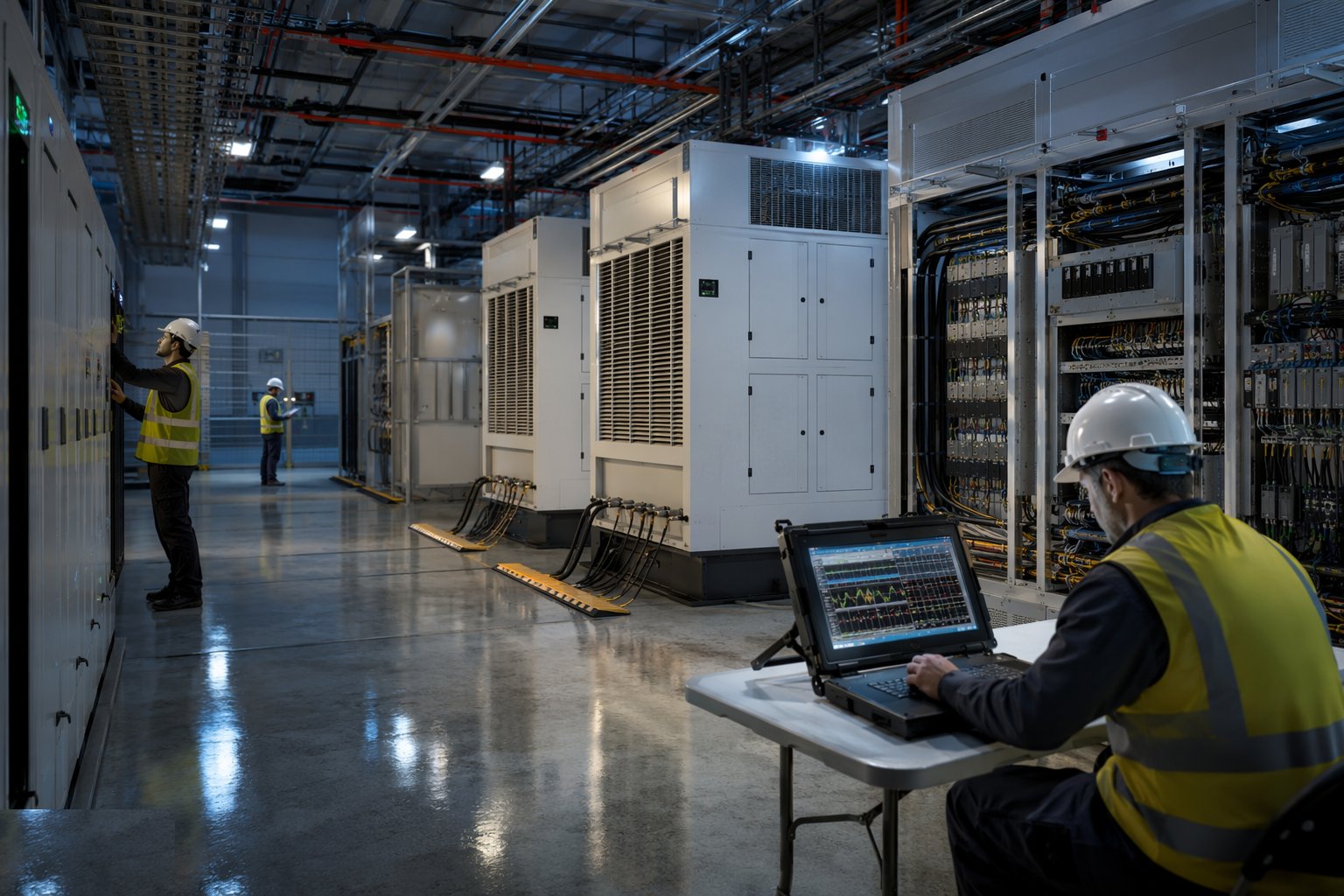
Mobilise the load banks — megawatts of resistive load on trailers, connected to the load-bank provisions the design included — and run each system to its rating: full electrical trains loaded and thermal-surveyed, generators run at sustained load with fuel and cooling verified, UPS autonomy discharged and timed, cooling plants proven at full hall heat load with temperature mapping across the white space. Exercise every transfer and changeover at system level and record the trends. Correct and re-test until each system meets its design figures; the IST script assumes these numbers are true, and the IST is not the place to find out they are not.
Step 5: Rehearse and execute the IST (Level 5)
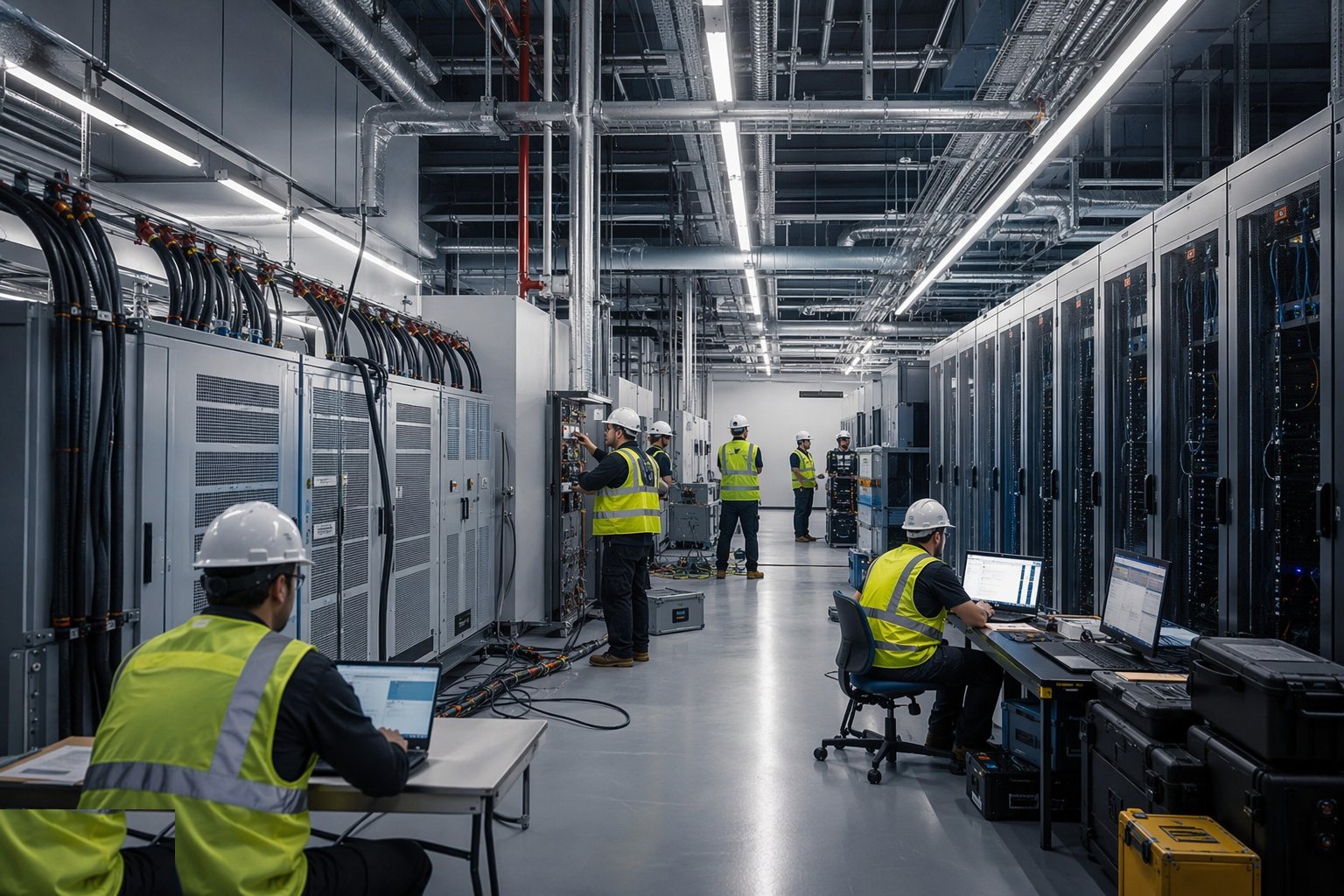
Write the IST script months ahead — every scenario, step, hold point, expected response, measurement and abort criterion — and rehearse the team through it on paper and in walk-throughs before the live event. Then execute with the full facility under load-bank IT load: pull the utility feed and watch the UPS ride, the generators start, synchronise and take load, the cooling transfer and recover, the halls hold temperature, and every alarm annunciate as designed. Then the component failure scenarios — a chiller trip, a train failure, a stuck damper — each induced, measured and recovered. Every second is trended; every deviation is logged, root-caused, fixed and the scenario re-run until the script passes end to end. The client, the operations team and the certification body where relevant witness the lot.
Step 6: Train the operators and run the failure drills
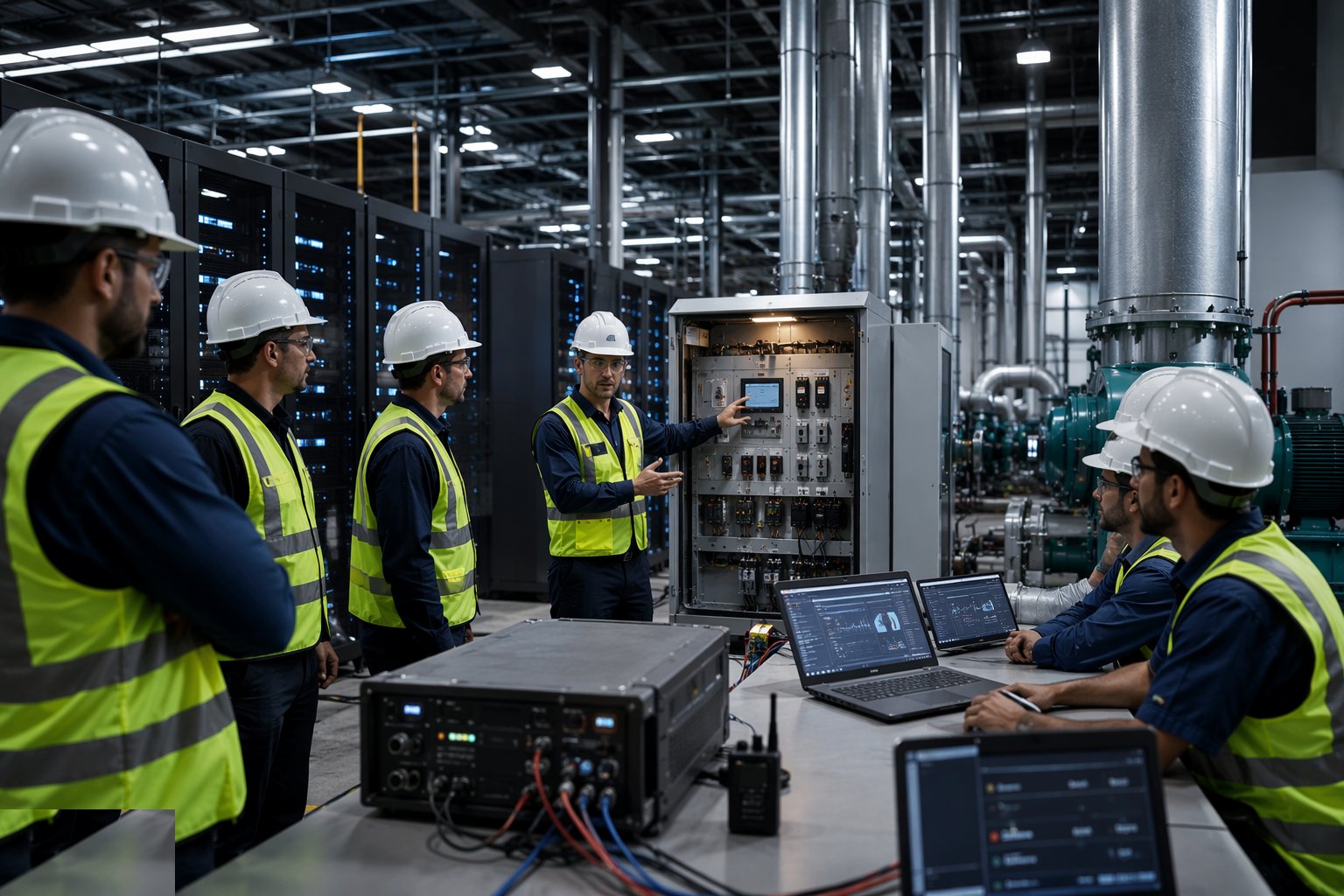
The operations team is commissioned like the plant: trained on every system, walked through every sequence of operation, and drilled on the failure scenarios until they can run them without the script. Standard operating procedures, emergency operating procedures and the as-tested settings are handed over as controlled documents — the versions the tests proved, not the versions the design intended. The drills do not end at handover: the ongoing regime of periodic failure testing is agreed and scheduled, because availability is a practice, not a certificate.
Step 7: Compile the dossier and hand over the facility

Assemble the commissioning dossier: OPR and basis of design, Level 1–5 test records with every signature, as-tested settings and sequences, the IST trends and the defect log closed to zero or formally dispositioned, training records and the operations documentation. Support the client through their acceptance, the certification processes where pursued, and the insurance and customer audits that will read this file for years. Hand over formally, and stay engaged through seasonal testing — the first Gulf summer at real load is the final examiner, and the commissioning authority's name is on the file when it sits the paper.
Plant and equipment
- Trailer-mounted resistive load banks (megawatt scale) with cabling and connection gear
- Power quality analysers and high-speed data loggers for transfer measurements
- Thermal imaging cameras and temperature/humidity mapping arrays
- Protection injection test sets and commissioning multimeters
- BMS/DCIM trend and historian systems configured for test capture
- Fuel polishing and sampling equipment for generator proving
- Commissioning management platforms for test scripts, signatures and dossier compilation
- Communication and control infrastructure for coordinated multi-team test events
Quality control checks
- OPR and commissioning plan written at design stage; design reviewed for testability
- Factory witness tests attended and nonconformities closed before shipment
- Level 3 functional records complete before any Level 4 testing begins
- Load-bank testing to full rating with trends recorded against design figures
- IST script executed to completion — every scenario passed or fixed and re-run, no time-expiry endings
- As-tested settings and sequences handed over as controlled operations documents
Safety considerations
- Megawatt test events are industrial operations: permit-controlled, scripted, with abort authority clearly held
- Load banks generate serious heat — cable routes, clearances and fire watch managed throughout
- Deliberate power failures near construction activity — the site knows when the plugs get pulled, or nobody pulls them
- Generator and fuel systems under sustained test — exhaust, noise, heat and fuel handling monitored
- Fatigue management for multi-day IST events with night sequences
- Live-adjacent testing on phased campuses: absolute separation between the test event and operating halls
Common defects
- Design not testable — no load-bank provisions, no isolation points, monitoring gaps discovered at Level 4
- Level 3 records papered over — the IST debugging component faults that functional testing should have caught
- Battery autonomy consumed faster than predicted — transfer chains that work, just not within the autonomy
- Cooling recovery slower than the thermal model — hall temperatures drifting during failure scenarios
- Alarms that annunciate somewhere nobody is looking — the DCIM integration tested electrically but not operationally
- Operations team meeting the systems for the first time at the IST — the drills that cannot be drilled
Best suited for
- New hyperscale and colocation facilities approaching first customer load
- Facilities pursuing Uptime Tier certification or equivalent demonstrated-availability credentials
- Major plant replacements and expansions on operating campuses
- Any facility whose SLA, insurance or customer audit demands demonstrated failure performance
How long does Commissioning & Integrated Systems Testing take?
Typical duration: Level 2–4 commissioning typically 3–6 months per building phase; the IST event itself 2–4 weeks of scripted testing, preceded by weeks of rehearsal and followed by seasonal testing through the first year..