Rail Formation & Trackbed
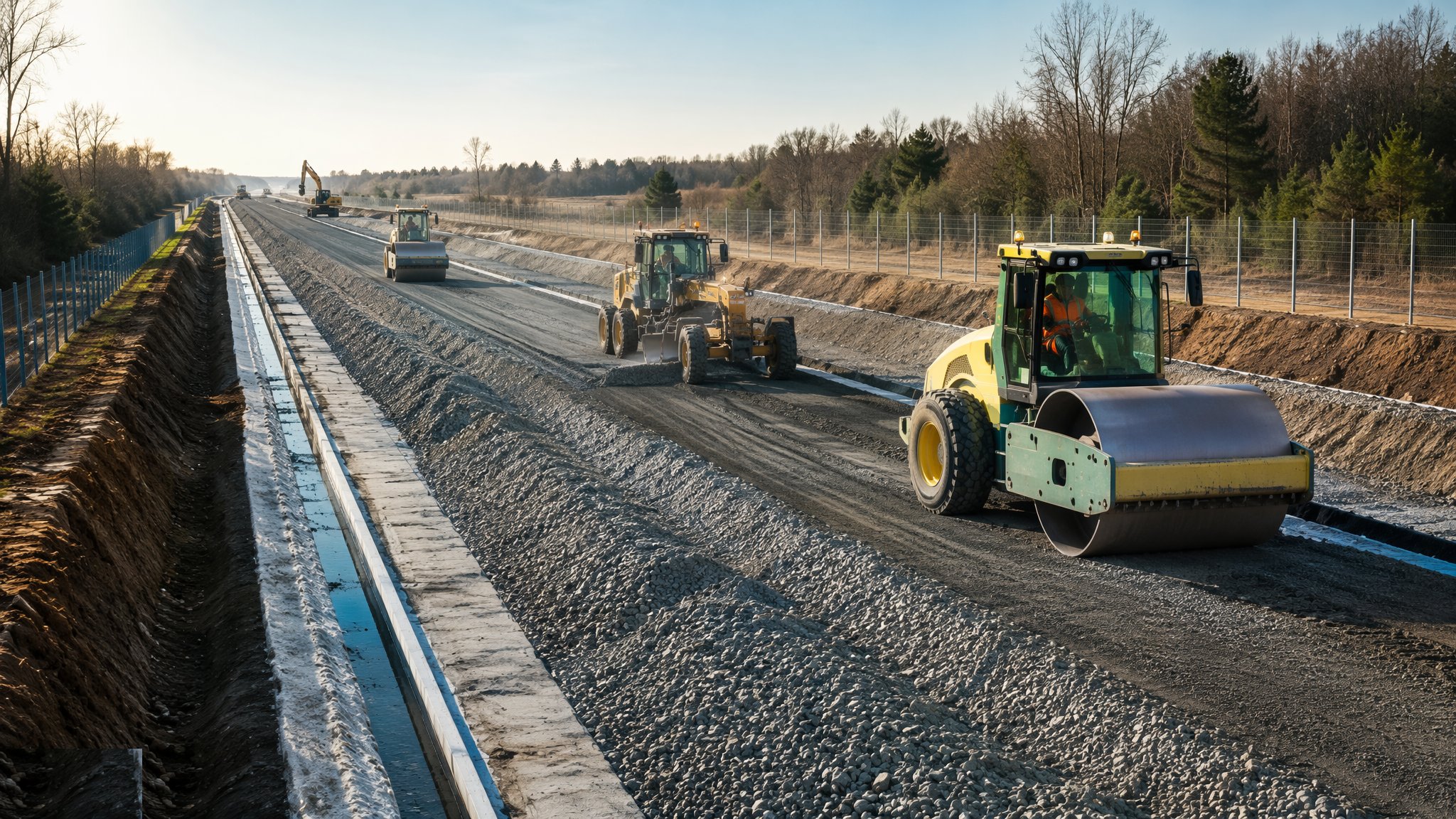
Preparing the formation, placing the capping and sub-ballast, and cutting in the track drainage — the engineered ground the whole railway stands on.
Last updated 2026-07-28 by the BuildPedia Editorial Team.
What is Rail Formation & Trackbed?
A railway asks far more of the ground beneath it than a road ever does. Axle loads of 22.5 tonnes and more land on the same few metres of formation millions of times over the design life, and the track above can only be held to its tight alignment and level tolerances if the platform below refuses to move. So the trackbed is engineered as a layered system: the formation — the prepared top of the earthworks — is improved where it is weak with a capping layer of granular material or stabilised soil, separated from the ballast by a sub-ballast layer (often called a sand blanket) that filters and spreads the load, and drained by cess drains and catchpits so that water never gets a vote in the matter. A formation that pumps, settles differentially or holds water will show up as track faults within a few years, and on a running railway every fault costs a possession to fix.
In the UK, trackbed design and treatment sit within Network Rail's track engineering framework — the requirements flow from the track system standards into the company specifications for formation treatment, with ballast itself specified to BS EN 13450 and the acceptance of finished track works governed by BS EN 13231. Formation strength is judged by its stiffness and its CBR, and the improvement menu will be familiar to anyone who has built road foundations: excavate and replace, reinforce with geogrid and geotextile, or stabilise with lime or cement. What is different is the consequence of differential settlement — a road can ride a bump, but a rail dipped 20 mm over a few metres is a speed restriction and a report.
In the Gulf the formation conversation is dominated by sand, sabkha and heat. Wind-blown sands compact to a decent platform if they are watered and rolled properly, but they are uniform, erosion-prone and unforgiving of poor compaction; sabkha along the coastal corridors must be excavated out or treated before any fill goes on it, because the salt chemistry will destroy both fill and concrete. The Etihad Rail corridors across the Emirates run hundreds of kilometres through exactly this ground, and the urban metros in Dubai, Doha and Riyadh put their at-grade sections and depots on reclaimed and marginal land where settlement monitoring runs for years, not months.
When and why is Rail Formation & Trackbed used?
Formation and trackbed work follows the bulk earthworks and drainage of the corridor, and it must be complete and accepted before any ballast or slab is laid — the tracklaying gangs, the welding trains and the systems contractors behind them all queue on this one deliverable. It matters because the trackbed is the cheapest place on the whole project to buy reliability: every tonne of capping and every metre of cess drain placed now is a maintenance intervention avoided later, on a railway where an hour of possession time costs more than a week of earthworks. It is also where the long-run settlement risk is bought out — embankments pre-loaded and monitored, soft spots treated rather than bridged optimistically — because the testing and commissioning programme at the end assumes a track that stays where it was put.
Types of Rail Formation & Trackbed
Granular capping over weak formation
The default treatment: soft or variable formation covered with a layer of well-graded crushed material, compacted in controlled lifts to create a stiff, frost-proof working platform. Cheap, fast and proven, it is the first answer wherever the formation CBR falls short of the design assumption.
Geosynthetic-reinforced trackbed
A separation geotextile on the formation with geogrid at the base of the capping or sub-ballast, letting a thinner granular layer carry the cyclic axle loads without punching or pumping. Standard practice over soft alluvium in the UK and over the edges of treated sabkha and reclamation in the Gulf.
Stabilised formation
Marginal soils improved in place with lime or cement, mixed to depth and cured before covering. It saves muck away and import, but the chemistry must suit the ground — saline or sulphate-bearing sands need the binder compatibility proven before a single load is spread.
Sub-ballast and sand blanket
The filter layer between capping and ballast: a graded granular blanket that stops ballast migrating into the formation, spreads the sleeper load and, where specified, forms the formation waterproofing layer under slab track. Under ballasted track it is also the layer that keeps the drainage paths open.
Rail Formation & Trackbed: step by step
Step 1: Prove the formation against the design
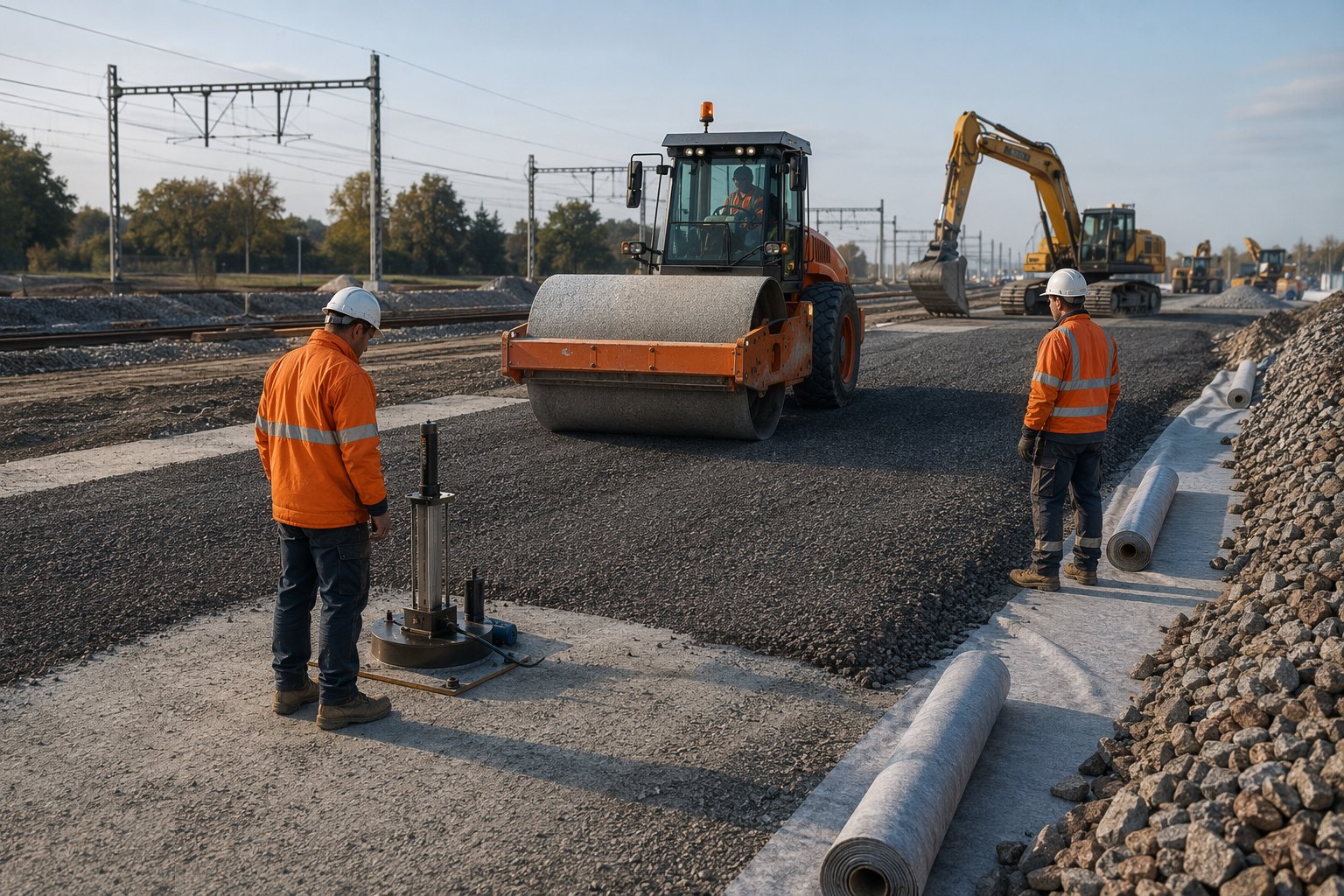
Survey the formation on a grid, proof roll it and test its strength with in-situ CBR, plate-bearing or dynamic cone testing. Mark out every soft, wet or deflecting area for treatment. The trackbed designer assumed a strength and a stiffness; this is where you find out whether the earthworks gang kept that promise, and where the argument about extra capping is won or lost with test results rather than opinions.
Step 2: Treat the weak and contaminated ground
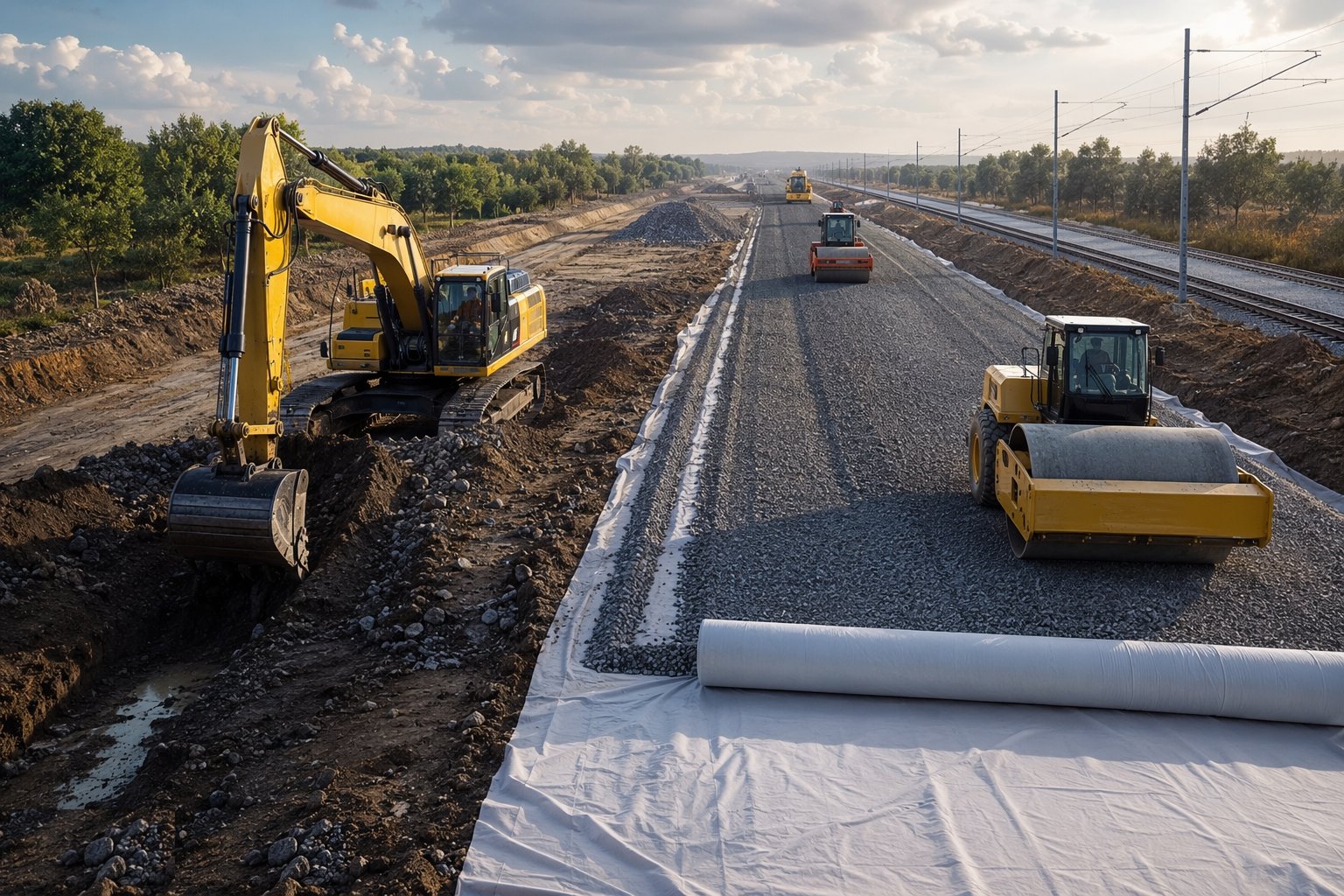
Excavate soft spots, peat lenses and contaminated material to firm ground and replace in compacted layers, or bridge with geotextile and additional capping where the designer signs up to it. In the Emirates this is where the sabkha comes out — the salt crust and the loose saturated sand beneath are removed to sound material, because burying sabkha is a settlement and heave claim waiting for a train. Keep the working area drained throughout; a formation drowned by the next rainstorm has to be re-proven before it is covered.
Step 3: Lay geosynthetics and place the capping
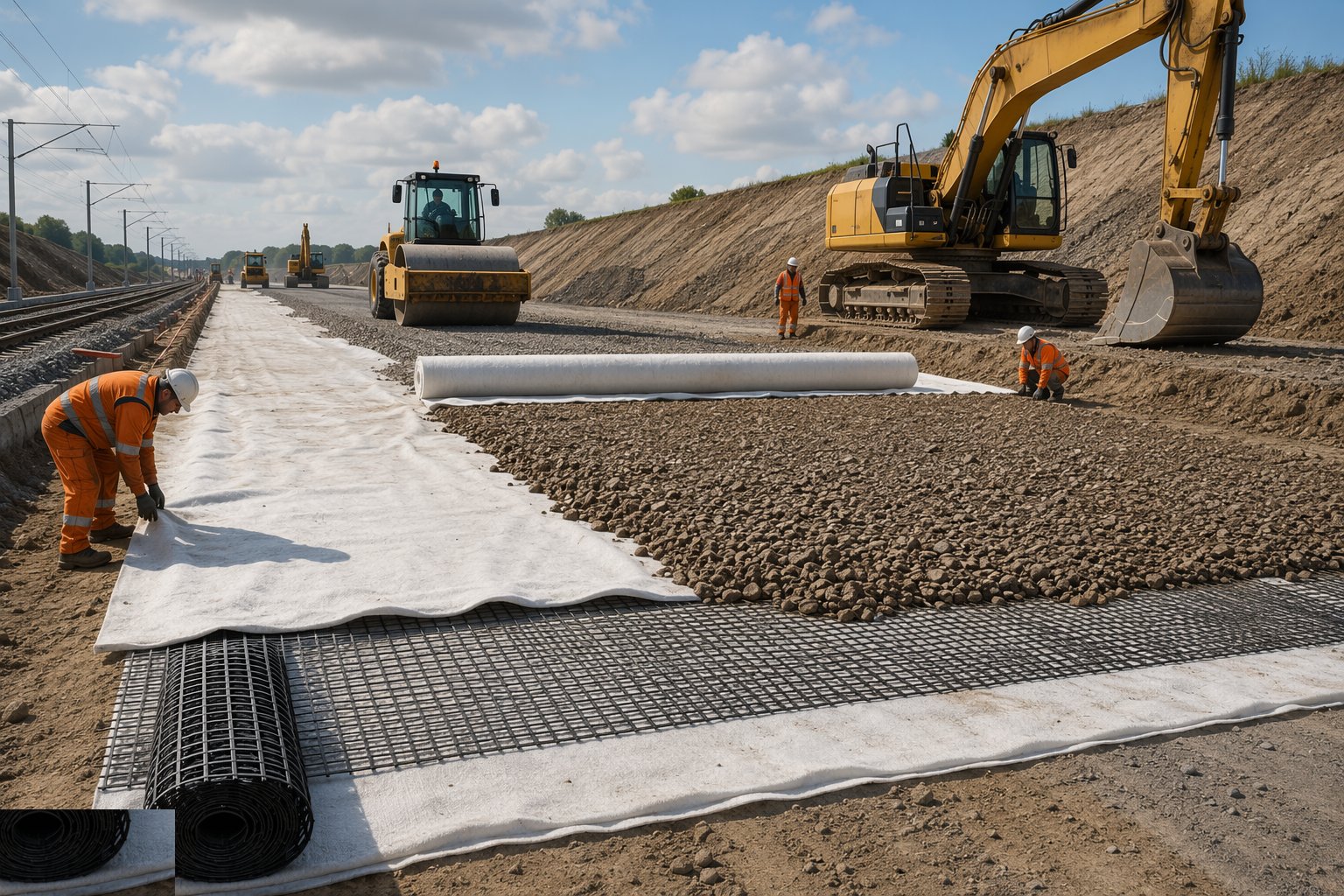
Roll out the separation geotextile with the specified overlaps, lay geogrid taut and jointed as detailed, and end-tip the first lift of capping over it — never track plant across bare grid. Place and compact the capping in layers thin enough to compact fully, keeping the surface shaped so water always runs off to the cess. Test density and stiffness per layer, because the number the trackbed design consumes is the achieved modulus, not the nominal thickness.
Step 4: Construct the track drainage
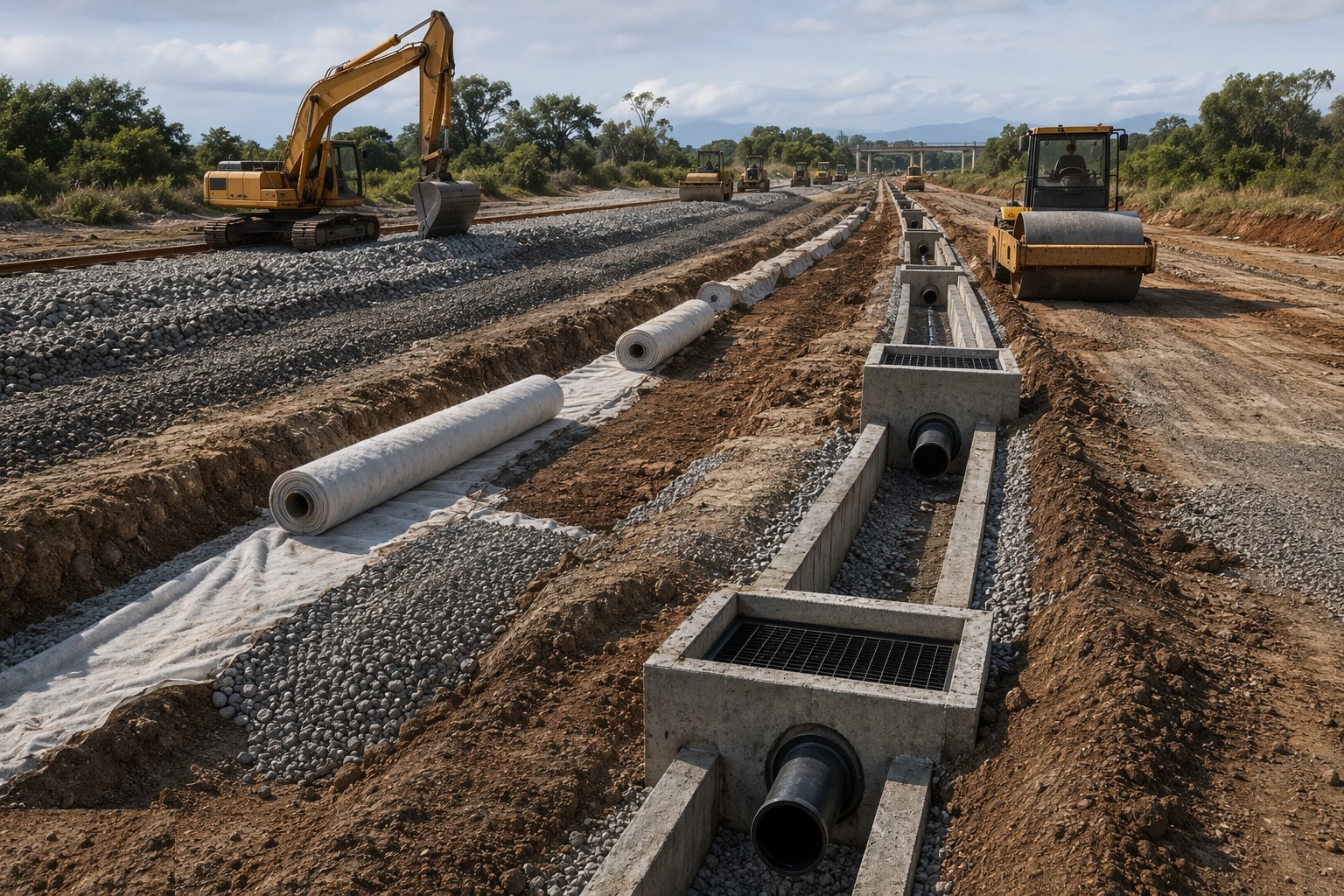
Cut and pipe the cess drains along the low sides of the formation, form catchpits at the design spacing with their silt traps and outfalls, and connect to the corridor drainage system installed ahead of you. The drains are laid to falls and tested before backfill — a trackbed that drains poorly will pump fines into the ballast and foul it within a few years of service. Every outfall discharges to a consented point; in the Gulf that consent is in hand before the pipe goes in the ground.
Step 5: Place the sub-ballast layer
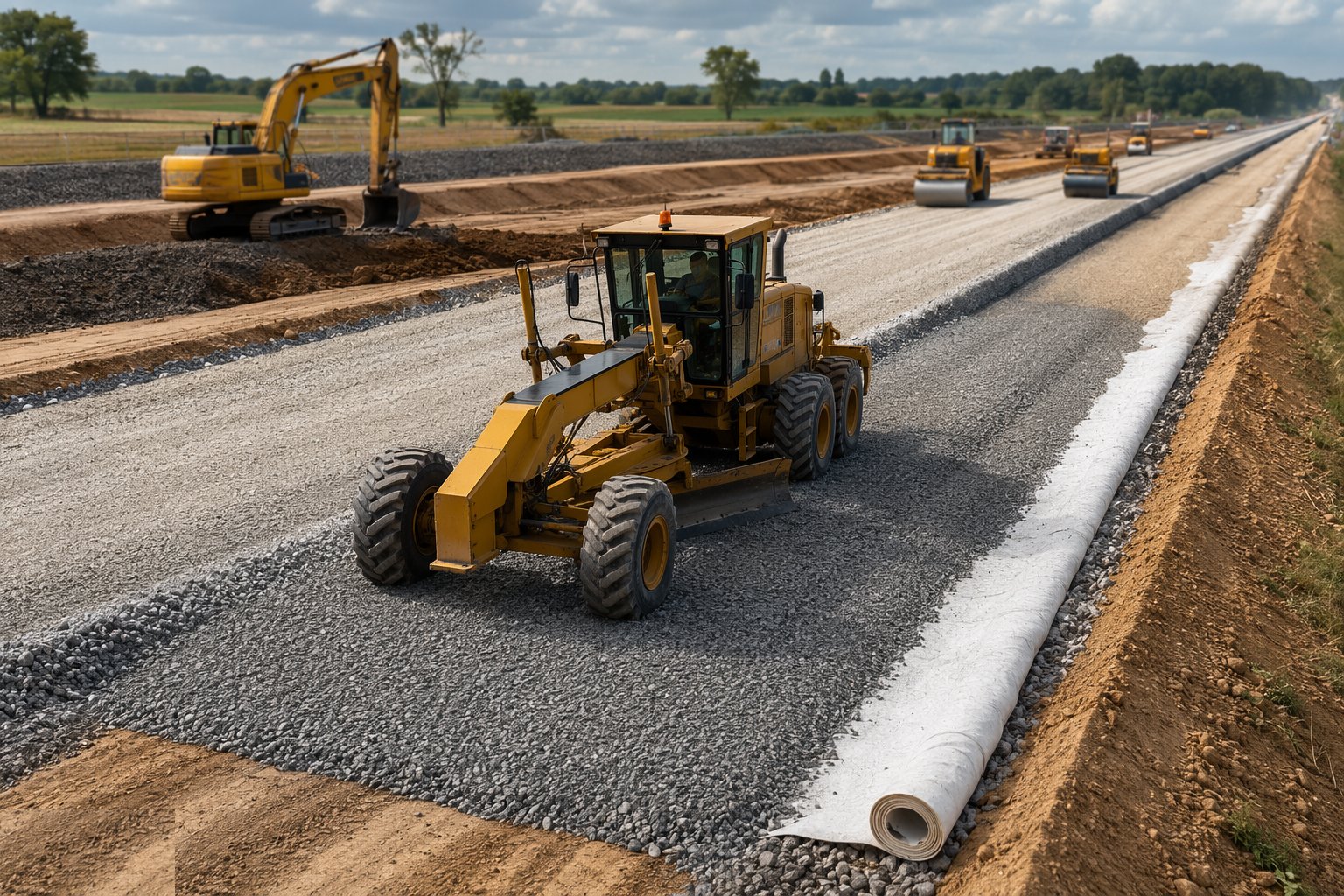
Spread the sub-ballast or sand blanket in an even layer to the design thickness, compact it and trim it to the final trackbed profile — the correct width for the track form, with the shoulders that retain the ballast and the falls that feed the cess drains. Survey the finished surface on a tight grid, because the tampers and slab layers above will copy whatever profile you leave. This surface is the acceptance point: levels, thickness, density and drainage all proven before the track process starts.
Step 6: Protect the trackbed and hand over
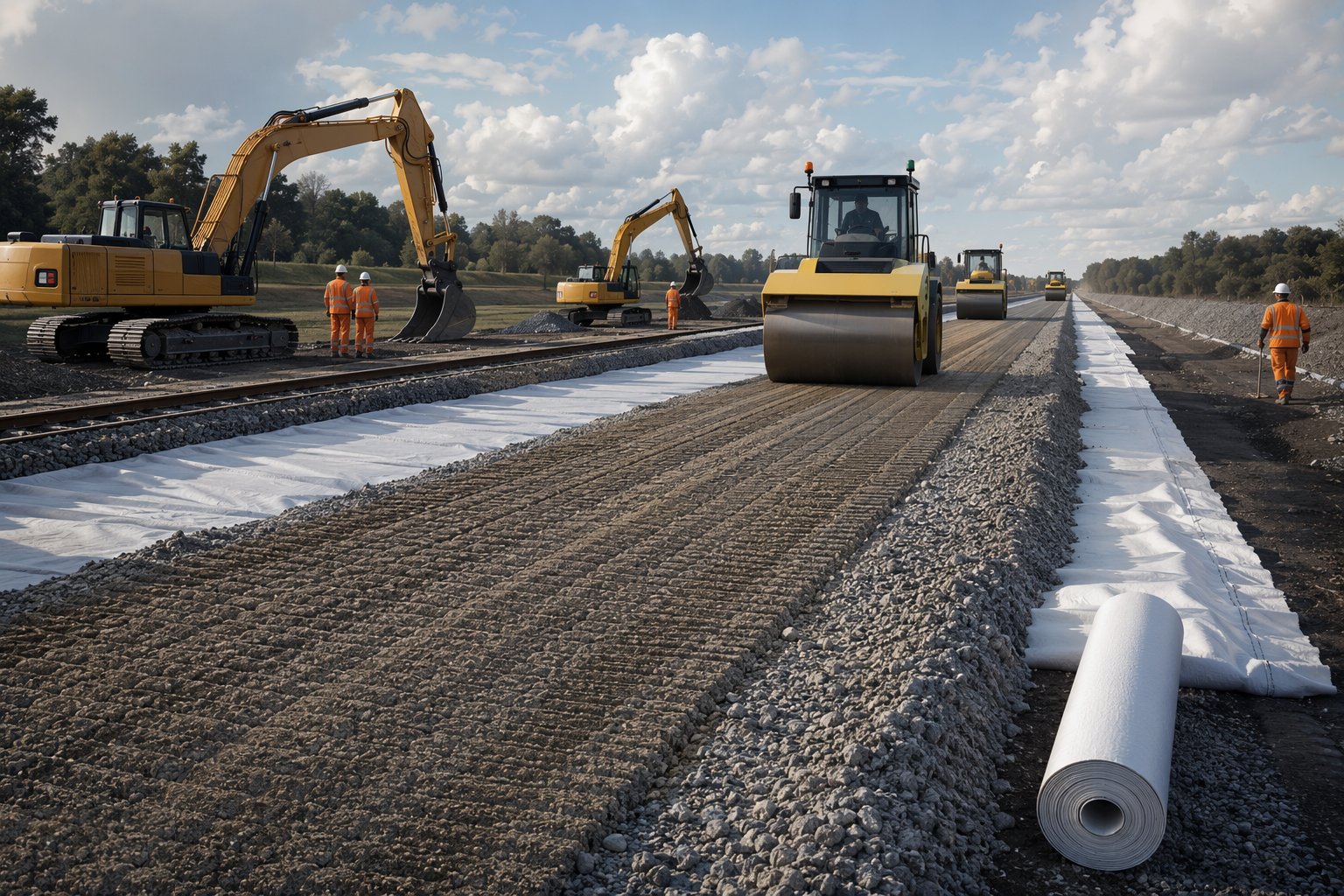
The finished trackbed is an asset under management: route plant over it in controlled lanes, keep the cess drains running, and repair any rutting or contamination immediately. Monitor settlement points on embankments and treated ground through the remainder of the works — the readings are part of the handover evidence. Formation acceptance is a formal hold point: tracklaying starts on a tested, surveyed and drained platform, or it does not start.
Plant and equipment
- GPS-controlled dozers and motor graders for spreading and trimming
- Smooth-drum and padfoot rollers for capping and sub-ballast compaction
- Stabilisation train: binder spreaders, mixer and water tanker
- Excavators and articulated dump trucks for treatment dig-outs and fill
- Trenchers and pipelayers for cess drains, with laser level control
- Proof roller or loaded lorry for formation proof rolling
- Plate-bearing, dynamic cone and density test equipment
- Settlement plates, survey monuments and monitoring total stations
Quality control checks
- Formation strength proven by test before any covering layer is placed
- In-situ density and stiffness testing per layer against the specification
- Finished trackbed levels and profile surveyed on a grid before tracklaying
- Cess drains laid to falls, tested and proved connected before backfill
- Geosynthetic type, overlaps and condition photographed before covering
- Settlement monitoring records maintained and filed as handover evidence
Safety considerations
- Plant and pedestrian segregation on open corridors that run for kilometres
- Banksmen at tips and excavations; exclusion zones around reversing plant
- Dust suppression on sand and granular works — a permit condition in the Gulf
- Trench support and safe access for cess drain and catchpit excavations
- Heat management, hydration and midday-break compliance in Gulf summer working
- Dewatering and drainage discharge only to consented outlets
Common defects
- Trackbed covered before the formation was proven — the soft spot arrives as a track dip in year two
- Sabkha bridged instead of excavated — settlement and sulphate attack within a few years
- Capping placed too wet and compacted anyway — density achieved at the top, nothing at the bottom
- Cess drains laid flat or disconnected — fouled ballast and a pumping trackbed in service
- Geotextile torn by tracked plant turning on it — separation lost exactly where the ground was weakest
- Sub-ballast trimmed by eye — the tampers spend their whole budget correcting the trackbed, not the track
Best suited for
- Turning the earthworks formation into a proven, drained platform for tracklaying
- Weak or variable ground needing capping, stabilisation or geosynthetic reinforcement
- The settlement risk bought out before the track and systems contractors mobilise
- Long greenfield corridors where trackbed quality decides decades of maintenance cost
How long does Rail Formation & Trackbed take?
Typical duration: Typically 2–4 weeks per kilometre of single track equivalent, longer where stabilisation curing, sabkha excavation or embankment pre-loading is involved..