Rail & Metro
Railways and metros — formation to trial running.
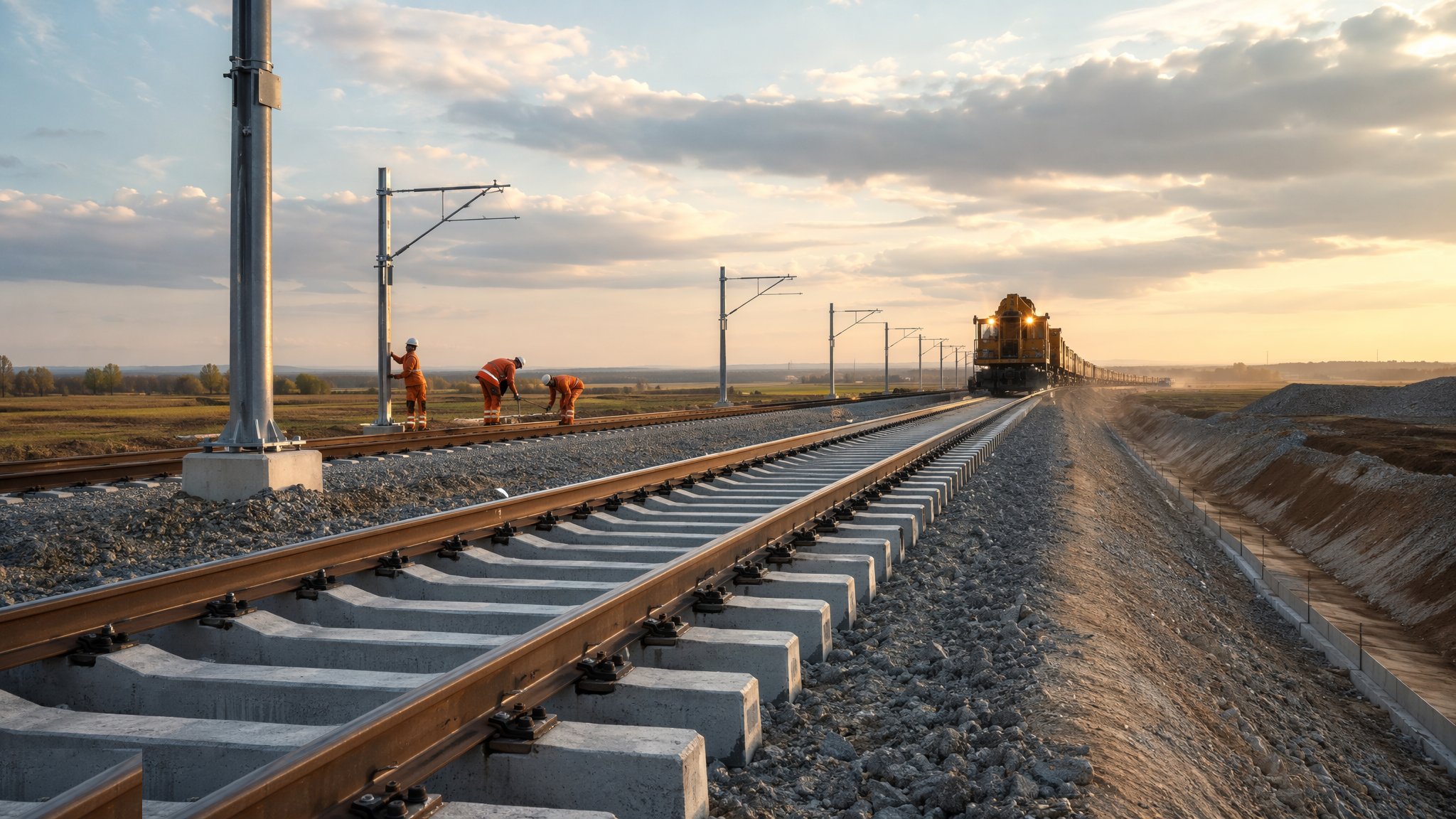
A railway gets to its starting line the same way every transport corridor does: access, survey control and ground investigation, bulk earthworks, drainage, and — where the alignment demands it — tunnels and bridges. Those corridor civils are shared with the roads, bridges and tunnels sectors and are linked below; their canonical guides live there.
The railway itself is a different trade chain. Formation and trackbed engineered to hold alignment to millimetres under 22.5-tonne axle loads; track construction — ballast, sleepers, rail and welding, or slab track where the maintenance budget allows; then the systems that make it a railway rather than a guideway: electrification, signalling and telecoms. Stations are buildings with a railway through them, and the whole thing closes with testing, commissioning and trial running before the first passenger boards.
The six guides in this sector follow that chain in build order — formation, track, systems, stations, commissioning — from the prepared earthworks the corridor sectors hand over, to a railway ready to enter service.
What does Rail & Metro cover?
Process guides in Rail & Metro
- Rail Formation & Trackbed — Preparing the formation, placing the capping and sub-ballast, and cutting in the track drainage — the engineered ground the whole railway stands on.
- Track Construction — From sleeper or slab to stressed, welded continuous rail — the process that turns a prepared trackbed into a railway you can run a train on.
- Rail Electrification — OLE & Conductor Rail — Foundations, masts and portals, contact and catenary wires run out and tensioned — or conductor rail laid and bonded — the power delivery system of an electric railway.
- Signalling & Telecoms — Signals, point machines, train detection, interlockings and the telecoms backbone — the systems that keep trains apart and tell them where to go.
- Station Construction — Station boxes and platform structures, canopies and footbridges, lifts and escalators, and the fit-out that turns civil engineering into a place passengers use.
- Systems Integration, Testing & Trial Running — Static tests, then dynamic tests, then trial running — the disciplined proof that the railway works as one system before a single passenger boards.
Shared methods used in Rail & Metro
- Corridor Access & Enabling Works
- Survey Control & Ground Investigation
- Bulk Earthworks — Cuttings & Embankments
- Drainage & Utility Corridors
- TBM Tunnelling & Segmental Lining
- SCL & Drill-and-Blast Tunnelling
- Bridge Deck Construction
- Bridge Erection Methods
- Testing, Commissioning & Asset Handover
Part of the Transport Infrastructure group.