Testing, Commissioning & Asset Handover
Proving the asset works, then handing it to the authority that will maintain it for the next hundred years.
Last updated 2026-07-28 by the BuildPedia Editorial Team.
What is Testing, Commissioning & Asset Handover?
Infrastructure handover is not like handing over a building. There is no single owner with a set of keys: the road goes to a highway authority, the sewers to a water company, the lighting to whoever maintains it, and each one has its own acceptance process, its own inspection regime and its own paperwork. Your job at the end is to prove — with test results, surveys and records — that what you built matches what was specified, and then to stand behind it through the defects period.
In the UK, new or altered highways are adopted under Section 38 or Section 278 agreements of the Highways Act 1980, with the highway authority inspecting at every stage and the works built to its adoptable standards throughout — adoption is earned during construction, not applied for at the end. Sewers pass to the water company under the Section 104 adoption process with CCTV surveys and as-builts. Under CDM 2015 the health and safety file is compiled for the client, and every electrical installation — road lighting, signals, pumps — is tested and certified before energisation. Commissioning is the word for making it all work: lanterns lit and levels measured, signals running their phases, pumping stations run wet and witnessed.
In the UAE, handover runs on FIDIC mechanics: the Engineer issues the Taking-Over Certificate under Clause 10.1 when the works are complete except for minor outstanding items, the Defects Notification Period — universally called the DLP, typically a year — follows, and the Performance Certificate under Clause 11.9 closes the contract and releases the remaining retention. The RTA and Dubai Municipality run their own final inspections and as-built certification in parallel. And underneath it all sits decennial liability: under Article 880 of the Civil Code, contractor and supervising engineer carry joint liability for structural and stability defects for ten years, whatever the DLP paperwork says.
When and why is Testing, Commissioning & Asset Handover used?
Testing, commissioning and handover close the sequence because they can only happen when everything else is demonstrably complete — and because the maintaining authority will not take on an asset with open test failures or missing records. It matters because infrastructure is handed to the public realm: the moment the traffic management comes down, the asset belongs to everyone, and the records you hand over are the only account of what is actually under and inside it. Even the smallest job in this stream — a single crossover or a short private sewer connection — ends the same way: inspected against the adopting authority's standards or, where nothing is adopted, handed over on the builder's own test records and as-builts, which are then the only account of what lies under the drive.
Types of Testing, Commissioning & Asset Handover
Highway adoption (Section 38 / 278)
New estate roads adopt under Section 38; works on the existing highway under Section 278. The highway authority inspects throughout, and at completion checks surfacing tolerances, drainage, lighting and signs against its adoptable standards before issuing the adoption certificate. A maintenance period — commonly twelve months — precedes final adoption, during which defects are put right at the developer's cost.
Sewer adoption (Section 104)
Foul and surface water sewers offered to the water company under the Water Industry Act 1991, built to the Sewerage Sector Guidance from day one. CCTV surveys, air tests, manhole inspections and as-builts are submitted; the company inspects, snags and finally vests the sewers — after which they are its problem, which is exactly why it is so fussy.
Handover to a transport authority (UAE)
RTA roads, Dubai Municipality drainage and DEWA networks each run their own completion inspections and as-built certification. The sequence is Engineer's inspection, snag list, Taking-Over Certificate, DLP, then the Performance Certificate — with as-built drawings and test certificates bundled into the O&M documentation the authority's maintenance teams will actually use.
Systems commissioning
The electrical and mechanical assets: road lighting circuits tested and lantern output verified, traffic signals run through their phases on and off peak, tunnel ventilation and pumping stations trialled under load and witnessed by the client. Commissioning certificates, not promises, close these systems out.
Testing, Commissioning & Asset Handover: step by step
Step 1: Assemble the completion evidence

Long before the end date, gather the proof that the asset is what the records say: materials test certificates, density and CBR results, concrete cube results, drainage CCTV and air tests, electrical test certificates, and the as-built surveys. Chasing a missing test certificate from month three in the final week is the classic handover farce — the ITPs and WIRs should have caught every one as the work was covered up.
Step 2: Pre-handover inspections and snagging

Walk the asset with the maintaining authority's inspector or the Engineer: surfacing ride quality and levels, ironwork set flush and quiet, white lining and signs complete, drainage running clear, verges and landscaping established. Everything found goes on the snag list with owners and dates. In the UK adoption world the highway authority's snag list is law; in the UAE the Engineer's inspection precedes the Taking-Over Certificate.
Step 3: Commission the systems

Energise and prove every system under witness: lighting circuits tested to BS 7671 and lanterns checked for output and spacing, signals run through full phase sequences with detection proven, pumps run at duty with float and alarm levels verified. Record every test on commissioning certificates signed by the tester and witnessed by the client or authority. Nothing is commissioned in a hurry at 3 a.m. on opening day — that is how faults become features.
Step 4: Compile the handover documentation

Assemble the health and safety file required under CDM 2015 — as-built drawings, residual risks, maintenance requirements — together with the O&M manuals, test certificates, warranties and keys. For adoptable assets, submit the adoption pack the authority specifies: as-builts, CCTV reports, test results. In Dubai, as-built certification goes through the authority NOC processes, and the handover documents go to the Engineer for the Taking-Over Certificate application.
Step 5: Completion, taking over and opening

With the snag list substantially clear, formal completion follows: adoption certificates or the Section 278 sign-off in the UK, the Taking-Over Certificate under FIDIC Clause 10.1 in the UAE — issued when the works are complete except minor outstanding items that do not affect safe use. The temporary traffic management comes down, the asset opens, and the first half of the retention is released. From this moment the public owns the asset's behaviour; your name is still on its defects.
Step 6: Defects period management

Through the maintenance or defects period — twelve months is typical in both markets — defects are notified, inspected and put right: reflective cracking at a trench line, a gully that silts, a lantern that fails. Settlement and surfacing defects on adopted highway works carry guarantee periods (two years, three for deep reinstatements), so early trench settlement still finds you. Keep the records: every defect closed out with evidence.
Step 7: Final certificate and close-out
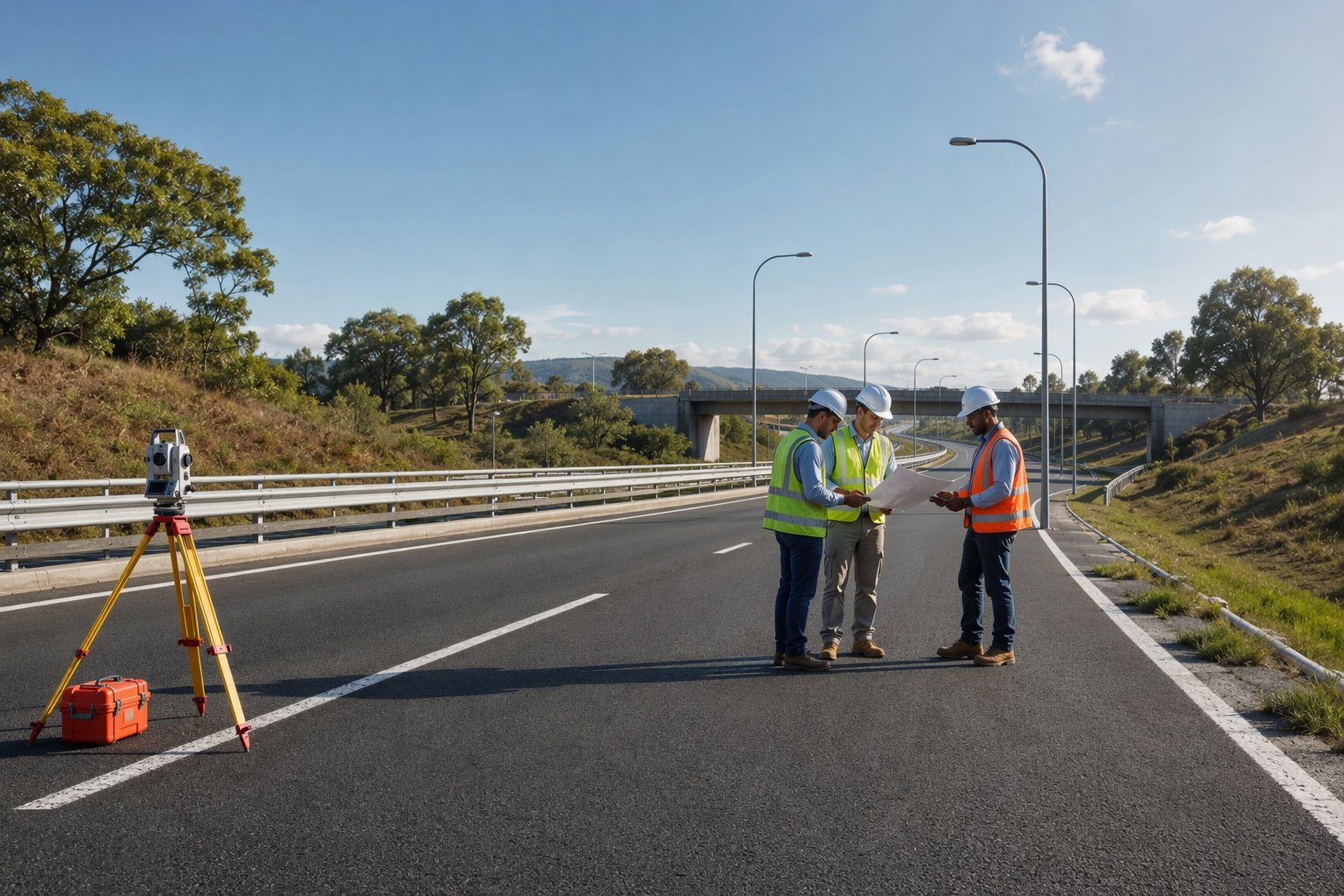
At the end of the defects period, the final inspections are walked, the last defects closed, and the paperwork completes: final adoption and vesting in the UK, the Performance Certificate under FIDIC Clause 11.9 in the UAE, releasing the remaining retention and the performance security. In the UAE the file is never quite closed — decennial liability under Civil Code Article 880 runs for ten years on structural and stability defects, which is why the records are archived, not binned.
Plant and equipment
- CCTV crawler units for final drainage surveys
- Electrical test instruments for BS 7671 certification
- Lux meters and lighting survey equipment
- Survey kit for final as-built and level verification
- Road survey vehicles: SCRIM / grip testing and profiler surveys where specified
- Jetting and suction units for pre-handover drainage cleaning
Quality control checks
- ITPs closed out with no open hold or witness points before completion is offered
- Every NCR closed with agreed remedials and re-test evidence
- Drainage CCTV and air test reports current and filed
- Electrical installation certificates for every circuit, witnessed commissioning records
- As-built drawings verified against the finished asset before submission
- Health and safety file complete to CDM 2015; O&M documentation to the authority's format
Safety considerations
- Commissioning on live or partly live assets under permit and approved traffic management
- Electrical work on energised systems only by authorised persons under safe isolation
- Confined space procedures for final chamber and tunnel inspections
- Public protection during demobilisation as fencing and traffic management come down
- Defect visits in the live highway treated as street works with full traffic management
Common defects
- Missing test certificate from month three discovered in handover week — the work is long covered up
- Ironwork left proud or low after final surfacing — rocking covers and a snag list entry
- Drainage handed over dirty: silt and site debris in the pipes at the adoption CCTV
- As-builts that do not match the ground — the first maintenance dig proves it
- Snag list left to grow until the defects period becomes a second construction phase
- DLP closed without decennial records archived — the ten-year liability has no defence file
Best suited for
- Proving the asset to the maintaining authority's standards
- Phased handovers and sectional completions along a linear scheme
- As-builts, test records and the health and safety file for the operator
- Closing out defects through to adoption or final acceptance
How long does Testing, Commissioning & Asset Handover take?
Typical duration: 2–6 weeks of testing, commissioning and inspections to taking over; the defects period then runs typically twelve months to the final or Performance Certificate..
Related processes
- Sub-base & Base Construction
- Asphalt Surfacing — Binder & Surface Course
- Kerbs, Footways & Road Furniture
- Road Markings, Signage & Lighting
- Corridor Access & Enabling Works
- Survey Control & Ground Investigation
- Bulk Earthworks — Cuttings & Embankments
- Drainage & Utility Corridors
- Subgrade Preparation & Capping
- Testing, Commissioning & Asset Handover in Bridges & Elevated Structures
- Testing, Commissioning & Asset Handover in Tunnels & Underground
- Testing, Commissioning & Asset Handover in Rail & Metro
- Roads & Highways sector guide
- Transport Infrastructure group