Corridor Access & Enabling Works
Turning a length of route — often a live highway — into a controlled, approved, workable construction corridor.
Last updated 2026-07-28 by the BuildPedia Editorial Team.
What is Corridor Access & Enabling Works?
Infrastructure enabling works are a different animal from a building site set-up. Instead of one plot with a fence around it, you are taking possession of a corridor that can run for kilometres — through open country, along a live dual carriageway, or down a city street full of shops and buried services. The enabling works are everything that makes that corridor safe, legal and workable: the temporary traffic management that keeps the travelling public moving, the compounds and haul routes strung along the route, the welfare cabins, and the mass of approvals that let you put the first cone out.
In the UK, any work in or alongside the public highway operates inside the New Roads and Street Works Act 1991 (NRSWA) and its codes of practice, with the Highway Authorities and Utilities Committee (HAUC) guidance setting how highway authorities and statutory undertakers coordinate. Notices are served on the highway authority, working methods and durations are agreed, and temporary traffic management follows Chapter 8 of the Traffic Signs Manual. In the UAE, nothing touches the road reserve without the RTA's right-of-way approvals: NOCs are lodged through the RTA's eNOC / right-of-way permit systems, covering construction works, traffic diversions and even the trial trenches used to prove utility positions, with Dubai Municipality, DEWA and the telecoms operators (e& and du) clearing their own assets in parallel.
This stage also decides how the job is judged by everyone who never meets you. Motorists stuck in a badly signed taper, mud dragged across a junction, a compound floodlit into someone's bedroom window — that is the project's reputation, set in week one. A clean, well-signed corridor with working wheel washes and tidy compounds is the first quality benchmark, and both highway inspectors and RTA engineers notice it the moment they arrive.
When and why is Corridor Access & Enabling Works used?
Corridor access and enabling works come first because nothing else can legally or practically start without them: the traffic management must be in place before anyone works adjacent to live traffic, the approvals must be in hand before the road reserve is touched, and the welfare, compounds and haul routes must exist before plant and people arrive in numbers. In the UAE the approvals are the critical path — RTA right-of-way NOCs, utility clearance NOCs and the traffic diversion approvals run in parallel and nothing intrusive starts until they are all current, because working in the right of way without a valid permit is a stop-work offence, not a paperwork issue. The process also has a genuine small end: a dropped-kerb vehicle crossover or a utility connection dug into the highway for a single house runs through the same notices, the same Chapter 8 signing and the same service-proving trial holes — the corridor is ten metres long, the obligations are as long as ever.
Types of Corridor Access & Enabling Works
Greenfield corridor
A new route across open land — a bypass, a link road, a rail alignment. Access is formed from compacted stone haul roads along the line of the works, with compounds positioned at structure locations and drainage outfalls. The main challenges are ground bearing, crossing points at existing roads, and keeping the public and livestock out of a corridor that has no natural fence line.
Works within the live highway
Widening, junction improvement or reconstruction alongside or within live traffic. The enabling works are dominated by temporary traffic management — lane closures, contraflows, narrow lanes and temporary barriers — phased so the road keeps running. Night and weekend possessions are common, and every phase needs its own approved layout before it goes in.
Urban corridor / street works
Works down a city street with frontagers, buses, pedestrians and a wall of buried apparatus. Footways are diverted, loading bays suspended, and work proceeds in short sections under NRSWA noticing. In Dubai the same environment is governed by RTA right-of-way permits with approved traffic diversions, and utility trial trenches need their own NOC before any excavation.
Corridor Access & Enabling Works: step by step
Step 1: Route walkover and condition surveys

Walk the corridor end to end with the design drawings and utility records: flag every structure, watercourse, access, overhead line and buried service. Photograph and record the existing condition of the highway, adjacent properties and boundary features — this baseline protects you against later damage claims. Plot the constraints on a single corridor plan that every subcontractor is then briefed from.
Step 2: Secure the approvals and serve the notices

In the UK, serve the NRSWA notices and agree works durations with the highway authority; major schemes run under their own orders, but the coordination discipline is the same. In the UAE, lodge the RTA right-of-way NOCs for construction works and traffic diversions, the trial trench NOCs, and the utility NOCs from DEWA, e& and du — tracking every submission on a register with validity dates, because expired NOCs stop work. Confirm jurisdiction stretch by stretch; on Dubai roads the RTA rules the road reserve, but Dubai Municipality or Trakhees may rule what happens beside it.
Step 3: Install the temporary traffic management

Erect the approved traffic management for phase one: advance signing, tapers, buffers and barriers to Chapter 8 of the Traffic Signs Manual, or the RTA-approved diversion layout. Check every sign against the approved drawing, day and night — an unlit sign or a collapsed cone in a live lane is a reportable incident. The traffic management is inspected and logged on every shift, and it moves with the work, phase by phase.
Step 4: Establish compounds and haul routes
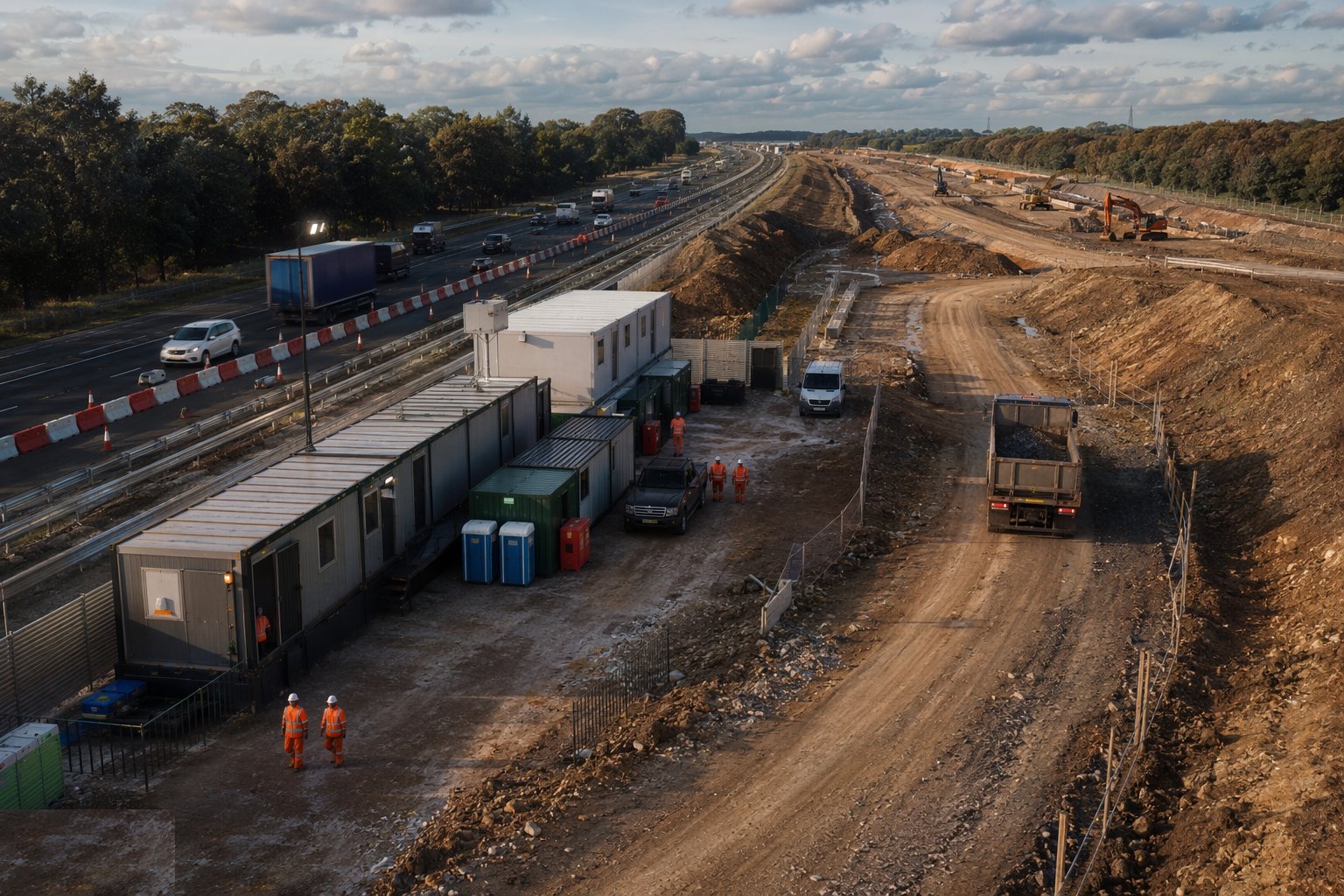
Set up the main compound — offices, welfare, stores, batching or laying support if needed — on land agreed for the purpose, plus satellite compounds at remote structures. Form haul routes from compacted stone over geotextile, sized for the heaviest delivery, with wheel washes or rumble grids at every exit onto the public highway. Welfare to CDM 2015 standards is a legal duty from day one in the UK; in the Emirates the same facilities are expected, with the midday summer working rules observed for outdoor crews.
Step 5: Locate and prove buried services

Before any ground is broken, trace the corridor for buried apparatus with cable avoidance tools and scan to HSE HSG47 practice, then prove positions with hand-dug or vacuum trial holes at every crossing and conflict point. Record each find — owner, depth, condition — on the services drawing. In the UAE this proving work is itself permitted: trial trenches go ahead under their own RTA NOC, and the results feed back into the design before the main works.
Step 6: Set up environmental controls
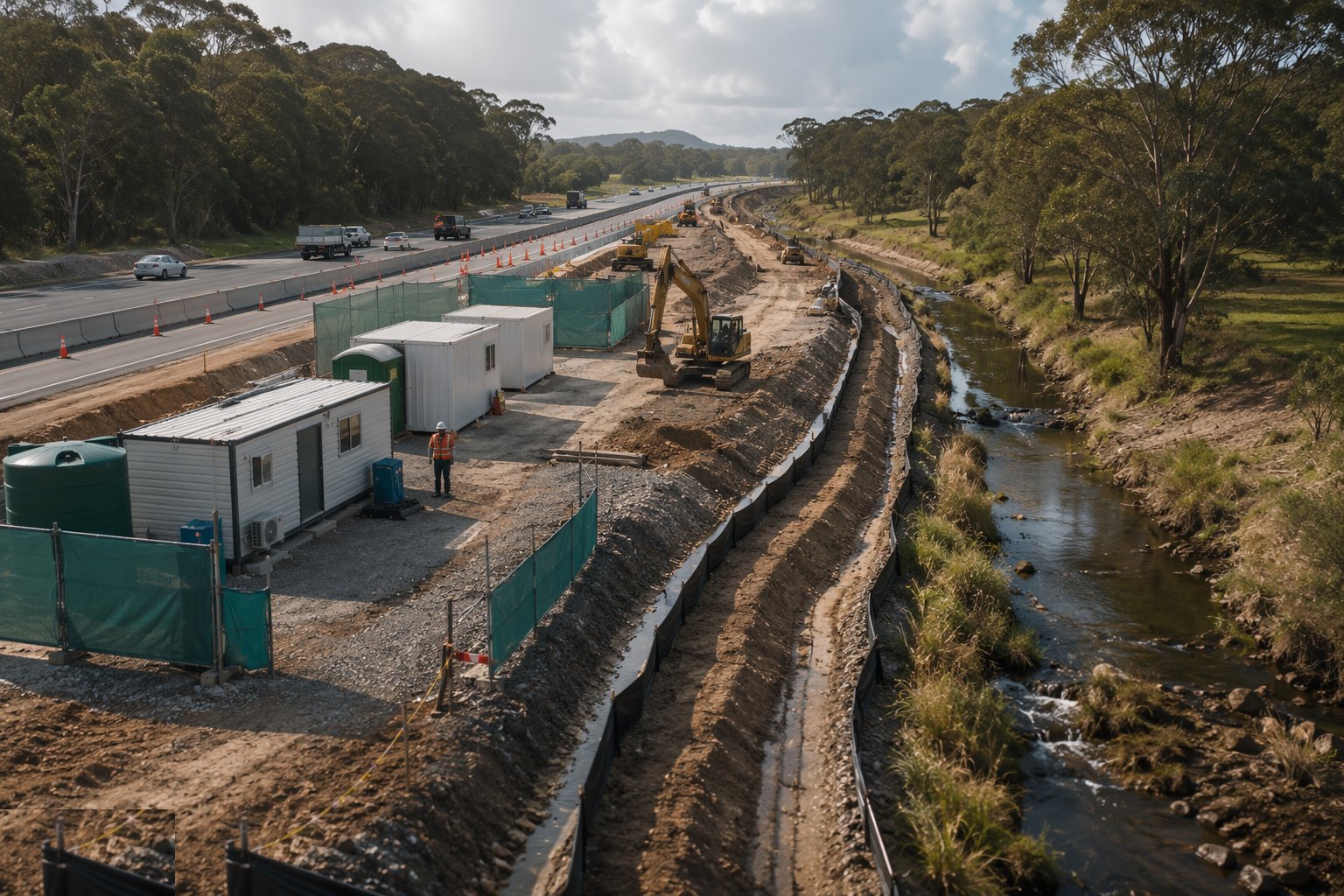
Install silt fencing, cut-off ditches and settlement arrangements so no dirty water leaves the corridor into watercourses or the storm network — discharges need consent in both markets. Sheet stockpiles, set up dust suppression, and agree working hours and noise limits with the environmental health officer or municipality. Fuel storage is bunded and spill kits staged at every refuelling point along the route.
Step 7: Protect existing assets and boundaries
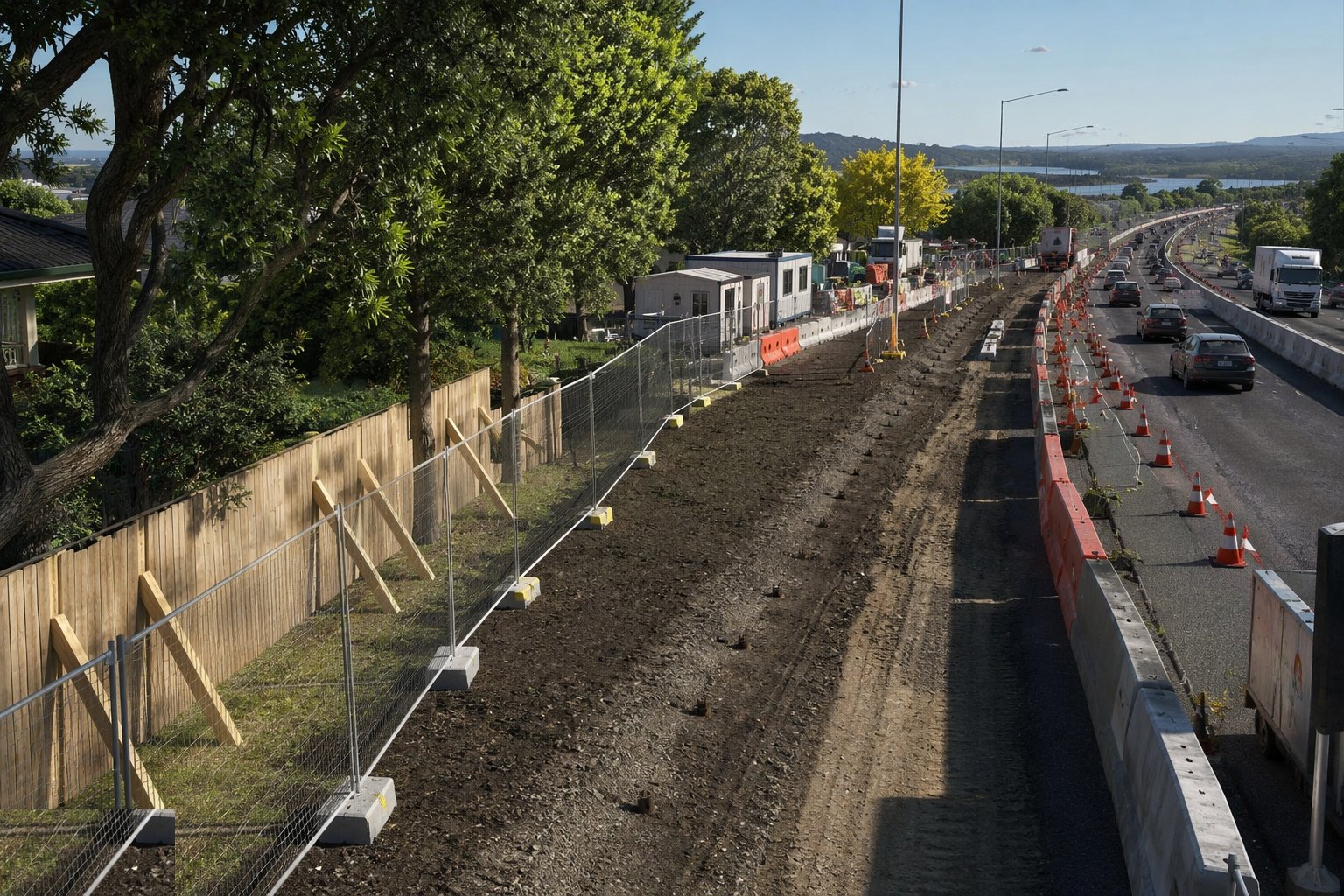
Fence off retained trees with root protection, support or relocate boundary features, and protect existing ironwork, cabinets and chambers that stay. Where the works tie into the live road, install the tie-in traffic management and protect the running surface from tracked plant with mats or a sacrificial layer. Anything damaged here is reinstated at your cost to the highway authority's standard — photograph it before you start.
Plant and equipment
- Temporary traffic management: signs, cones, barriers, temporary traffic signals
- Heras-type fencing and corridor security barriers
- Site cabins and welfare units strung along the route
- Wheel washes, rumble grids and road sweepers
- 360° excavator and dozer for haul road formation
- Cable avoidance tools, GPR scanners and vacuum excavation unit for trial holes
- Lighting towers, generators and temporary distribution
- Water bowser, dust suppression bowsers and mist cannons
Quality control checks
- Approvals register live and current: NRSWA notices or RTA/utility NOCs with validity dates
- Photographic condition survey of highway, structures and adjacent property filed
- Traffic management inspected and logged each shift against the approved layout
- Trial hole records logged against the services drawing and shared with the designer
- Haul route compaction and CBR checked where heavy plant is expected
- Discharge consents in place before any pumping or washout
Safety considerations
- Live traffic interface: approved traffic management, signed pedestrian routes, no unprotected work adjacent to running lanes
- Permit to dig and CAT scan before any excavation; trial holes at every service crossing
- Reversing controls and banksmen on haul routes; one-way systems where possible
- Night work: task lighting, hi-vis to the correct class, fatigue management on possessions
- Welfare from day one — a statutory duty under CDM 2015 in the UK
- Heat management and midday-break compliance for outdoor crews in the Emirates
Common defects
- Work started in the road reserve with an expired or missing NOC — stop-work and resubmission
- Live service struck at a crossing where the trial hole was skipped
- Mud tracked onto the live highway from an unmaintained wheel wash
- Traffic management erected differently from the approved drawing — non-conformance and a night shift to correct it
- Compound sited where the embankment or the drainage pond later needs to be
- Damage claim from a neighbour or the highway authority with no pre-start photographic record
Best suited for
- Linear projects on live highways and railways
- Traffic management, possessions and stakeholder interfaces along the route
- Compounds, haul routes and welfare serving a moving work front
- Utility diversions and enabling works ahead of the main construction
How long does Corridor Access & Enabling Works take?
Typical duration: 2–6 weeks on a greenfield corridor; 8–16 weeks where works run within a live highway with phased traffic management and utility proving..
Related processes
- Survey Control & Ground Investigation
- Bulk Earthworks — Cuttings & Embankments
- Drainage & Utility Corridors
- Subgrade Preparation & Capping
- Sub-base & Base Construction
- Asphalt Surfacing — Binder & Surface Course
- Kerbs, Footways & Road Furniture
- Road Markings, Signage & Lighting
- Testing, Commissioning & Asset Handover
- Corridor Access & Enabling Works in Bridges & Elevated Structures
- Corridor Access & Enabling Works in Tunnels & Underground
- Corridor Access & Enabling Works in Rail & Metro
- Roads & Highways sector guide
- Transport Infrastructure group