Roads & Highways
Corridors, earthworks and pavements — the artery from first peg to final white line.
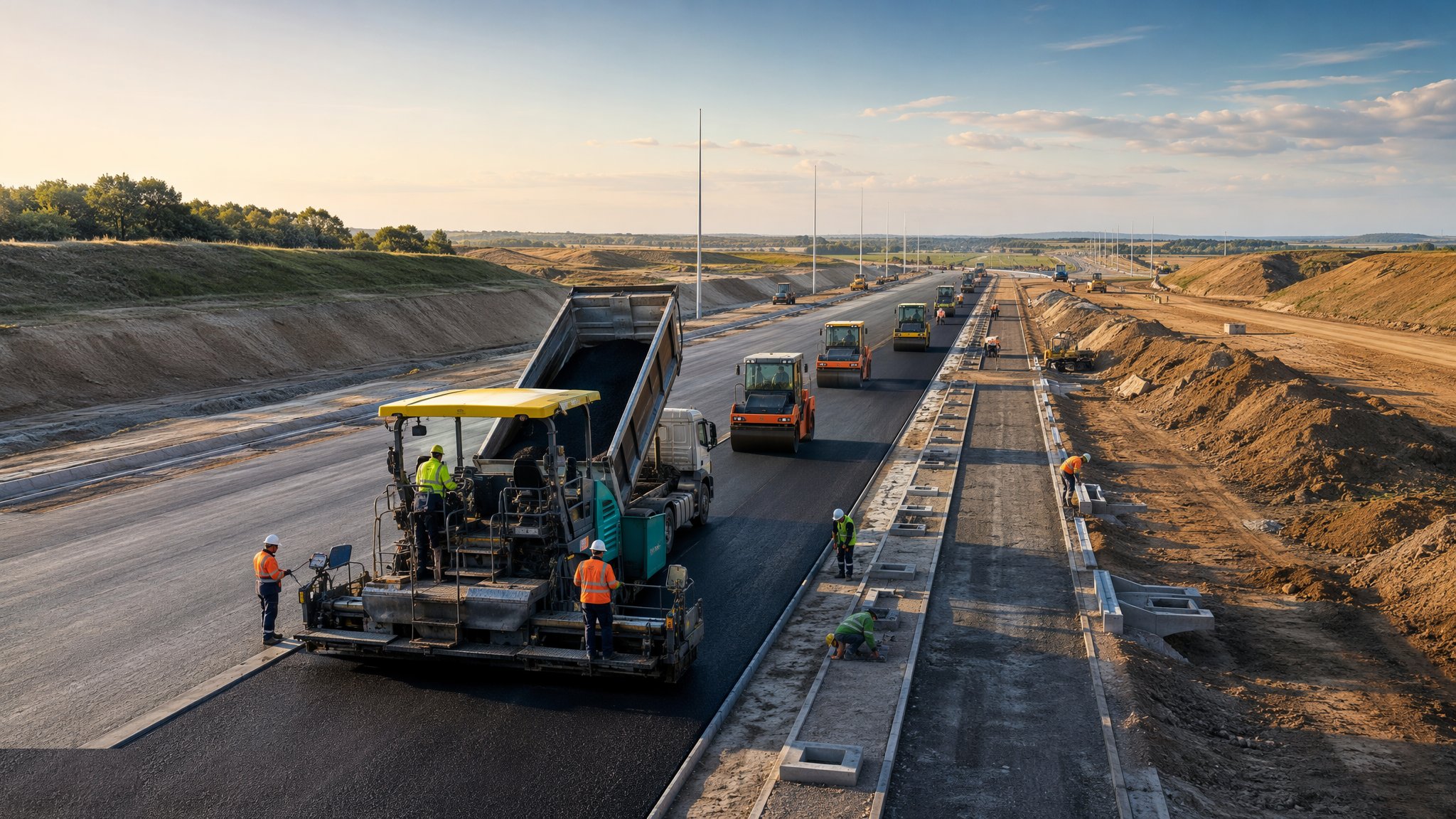
A road scheme is a conveyor belt of earthworks that never stops moving. The shared enabling works come first — corridor access, survey control and ground investigation, bulk earthworks, and drainage and utility corridors — then the pavement train: subgrade preparation and capping, subbase and base, asphalt surfacing, and finally kerbs, footways, markings, signage and lighting before the asset is handed to the maintaining authority.
The ten guides in this sector follow one scheme end to end in build order. The first five and the last one are shared with bridges and tunnels — the same corridor works serve every transport alignment — so their canonical pages live here and the other transport sectors link back to them.
What does Roads & Highways cover?
Process guides in Roads & Highways
- Corridor Access & Enabling Works — Turning a length of route — often a live highway — into a controlled, approved, workable construction corridor.
- Survey Control & Ground Investigation — Corridor control networks and the ground investigation that tells you what the road, bridge or tunnel is actually standing on.
- Bulk Earthworks — Cuttings & Embankments — Moving hundreds of thousands of cubic metres to build the corridor's shape — cuttings, embankments and the formation everything sits on.
- Drainage & Utility Corridors — Pipes, ducts, chambers and culverts — the buried networks installed before the pavement goes over them.
- Subgrade Preparation & Capping — Proving the formation and building the capping layer — the low-cost working platform that decides whether the pavement above it lasts.
- Sub-base & Base Construction — The structural platform: granular sub-base and bound base layers that spread every wheel load into the ground.
- Asphalt Surfacing — Binder & Surface Course — The blacktop the public judges: binder course and surface course laid hot, compacted within the window, and tested to the millimetre.
- Kerbs, Footways & Road Furniture — The finishing trades that contain the carriageway, carry the pedestrian and give the road its edge — kerbs, footways and the furniture in between.
- Road Markings, Signage & Lighting — The information and visibility layer — markings, signs and lighting that turn a strip of asphalt into a legal, usable road.
- Testing, Commissioning & Asset Handover — Proving the asset works, then handing it to the authority that will maintain it for the next hundred years.
Part of the Transport Infrastructure group.