Bulk Earthworks — Cuttings & Embankments
Moving hundreds of thousands of cubic metres to build the corridor's shape — cuttings, embankments and the formation everything sits on.
Last updated 2026-07-28 by the BuildPedia Editorial Team.
What is Bulk Earthworks — Cuttings & Embankments?
Bulk earthworks is the large-scale cutting, filling and hauling of material that forms the platform for roads, railways and other linear infrastructure — the heaviest work in the sector. A highway scheme moves material by the hundreds of thousands of cubic metres, and the whole game is the mass haul: balancing cut against fill so material travels once, short distances, and as little as possible leaves or enters the site. Every cubic metre handled twice or carted off as muck away is money burnt, so the earthworks strategy — haul routes, stockpiles, borrow pits and tips — is planned like a military operation before the first machine starts.
In the UK the work is specified to the Specification for Highway Works Series 600 (MCHW Volume 1), which classes materials as acceptable or unacceptable for use in the works and sets how fill is placed and compacted — either to a method specification (stated plant, stated passes, stated layer thickness) or an end-product specification (a density you must achieve and prove by testing). Cuttings are excavated in benches to designed slope angles from the GI; embankments are built up in layers, compacted and tested until the formation — the prepared surface the pavement or track formation sits on — is reached.
In the UAE the earthworks are often less about depth and more about the ground itself: dune sands compact readily but are uniform and collapsible, sabkha needs removal or treatment, and the water table in coastal zones can be within a metre or two of the surface, turning a shallow dig into a dewatering exercise. Dust control is a permit condition, not a courtesy, and any discharge of pumped groundwater needs authority approval.
When and why is Bulk Earthworks — Cuttings & Embankments used?
Bulk earthworks follows the ground investigation and precedes every pavement, structure and drainage run, because the corridor's vertical profile — the cuttings, the embankments, the formation levels — must exist before anything is built on it. Errors here are the most expensive in the sector: a settling embankment delays the pavement by months, and an unstable cutting slope is a danger for the life of the asset, not just the job. Scaled down, this is the mini digger regrading a building plot or terracing a sloping garden: strip the topsoil, cut and fill in thin layers, compact and prove — the mass-haul plan becomes a barrow run, but fill placed too thick or too wet settles just the same under a patio as under a pavement.
Types of Bulk Earthworks — Cuttings & Embankments
Cuttings
Excavation of the natural ground to take the alignment below existing level, opened in benches to slope angles derived from the GI — steep in rock, flat in soft clays. Slope drainage, berms and inspection access are built in as the cut descends, and the exposed faces are inspected by the geotechnical engineer as they open, because the ground always has the final say.
Embankments from site-won fill
The mirror image: fill won from the cuttings placed in controlled layers — typically 150–250 mm depending on the compactor — at moisture content near optimum, compacted and density-tested layer by layer. Side slopes are trimmed as the fill rises, and where settlement matters a surcharge or a consolidation period is programmed before the pavement follows.
Stabilised and strengthened earthworks
Marginal material improved rather than wasted: lime or cement stabilisation turns wet, weak clays into engineered fill and forms stabilised capping over weak subgrades. In the Gulf, dune sand is routinely stabilised or used in controlled layers with geotextile separation over sabkha. The binder content, mixing and curing are all tested — stabilisation is a chemical process with a working window, not a sprinkle of dust.
Reinforced earth and slope solutions
Where land is tight, embankments stand steeply: geogrid-reinforced slopes or reinforced earth walls with precast facing panels let fills run at near-vertical faces. Drainage behind the face is critical — a reinforced earth structure with blocked drainage is a slow-motion failure.
Bulk Earthworks — Cuttings & Embankments: step by step
Step 1: Set the earthworks strategy and mass haul
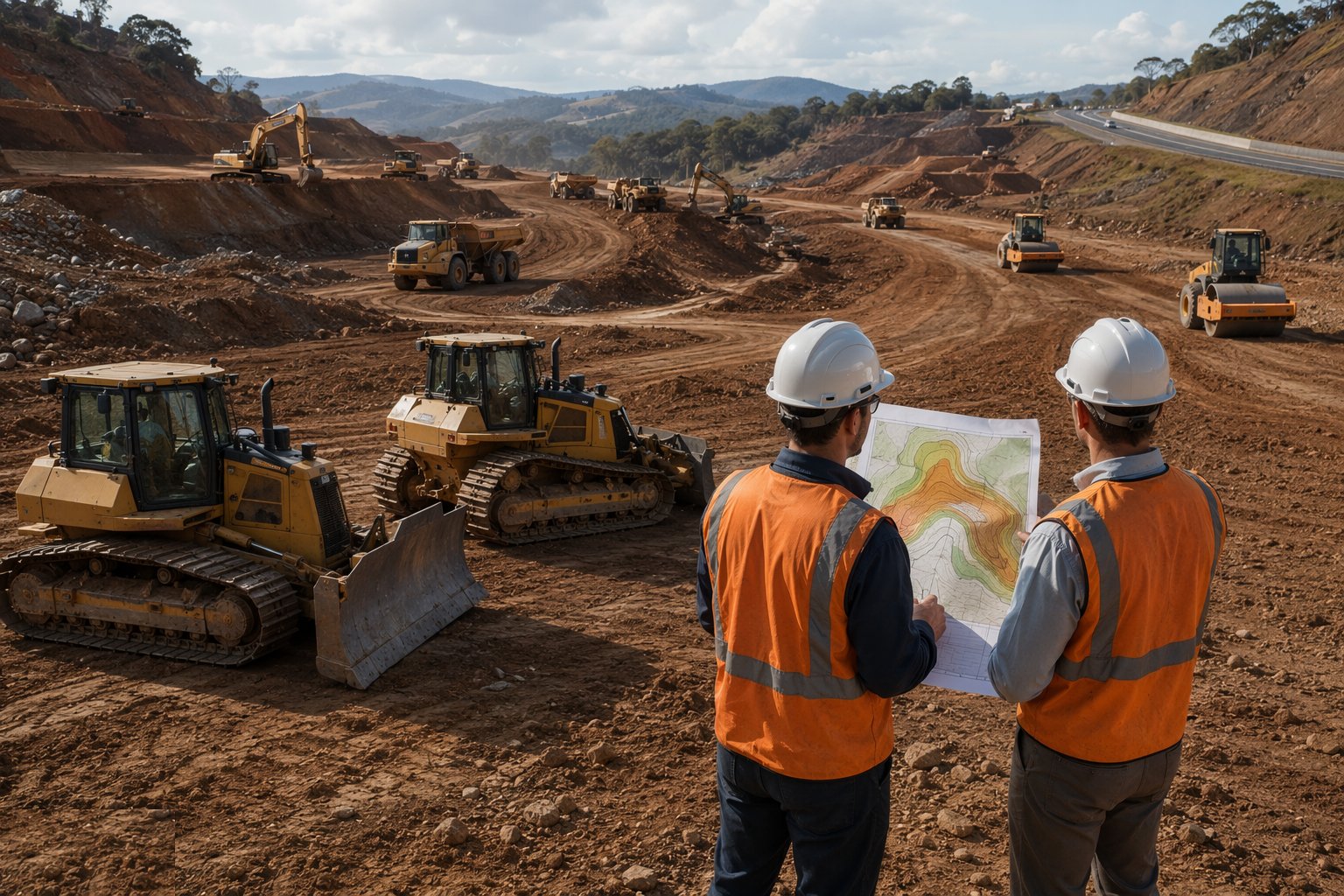
From the GI and the design levels, build the mass haul diagram: where material is cut, where it is needed, and the haul distance between. Decide which materials are acceptable under Series 600, what needs treatment, what is genuinely waste, and where stockpiles and haul routes go. This plan drives the whole programme — a bad mass haul means double-handling for a year.
Step 2: Strip topsoil along the corridor
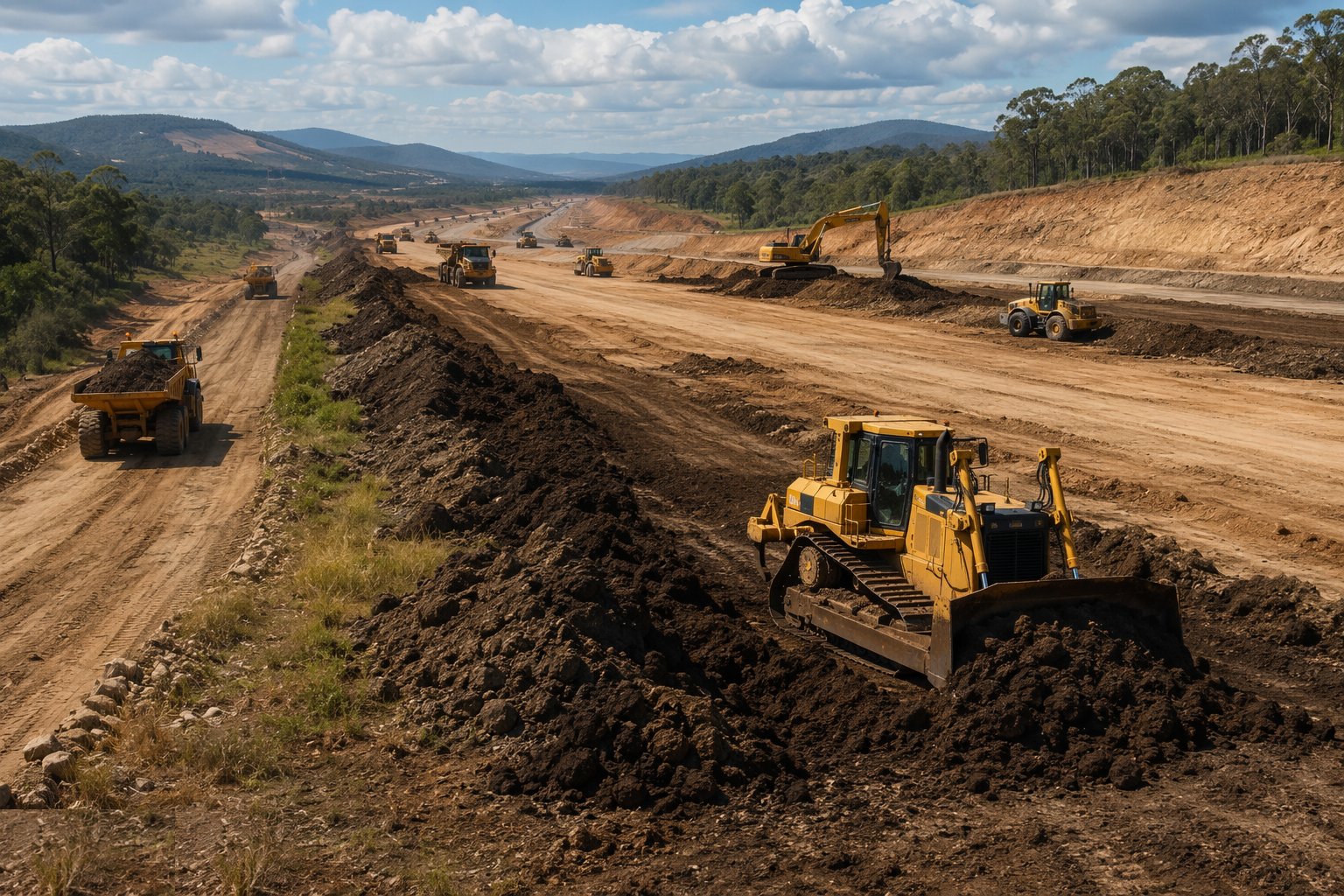
Strip and stockpile topsoil separately along the whole corridor — it is a resource for the landscape works at the end, not fill. Stockpiles are bunded, low and long to preserve soil structure, sheeted or seeded against erosion. Subsoil and unsuitable material never contaminate the topsoil stockpiles.
Step 3: Drainage first: cut-off and slope drains
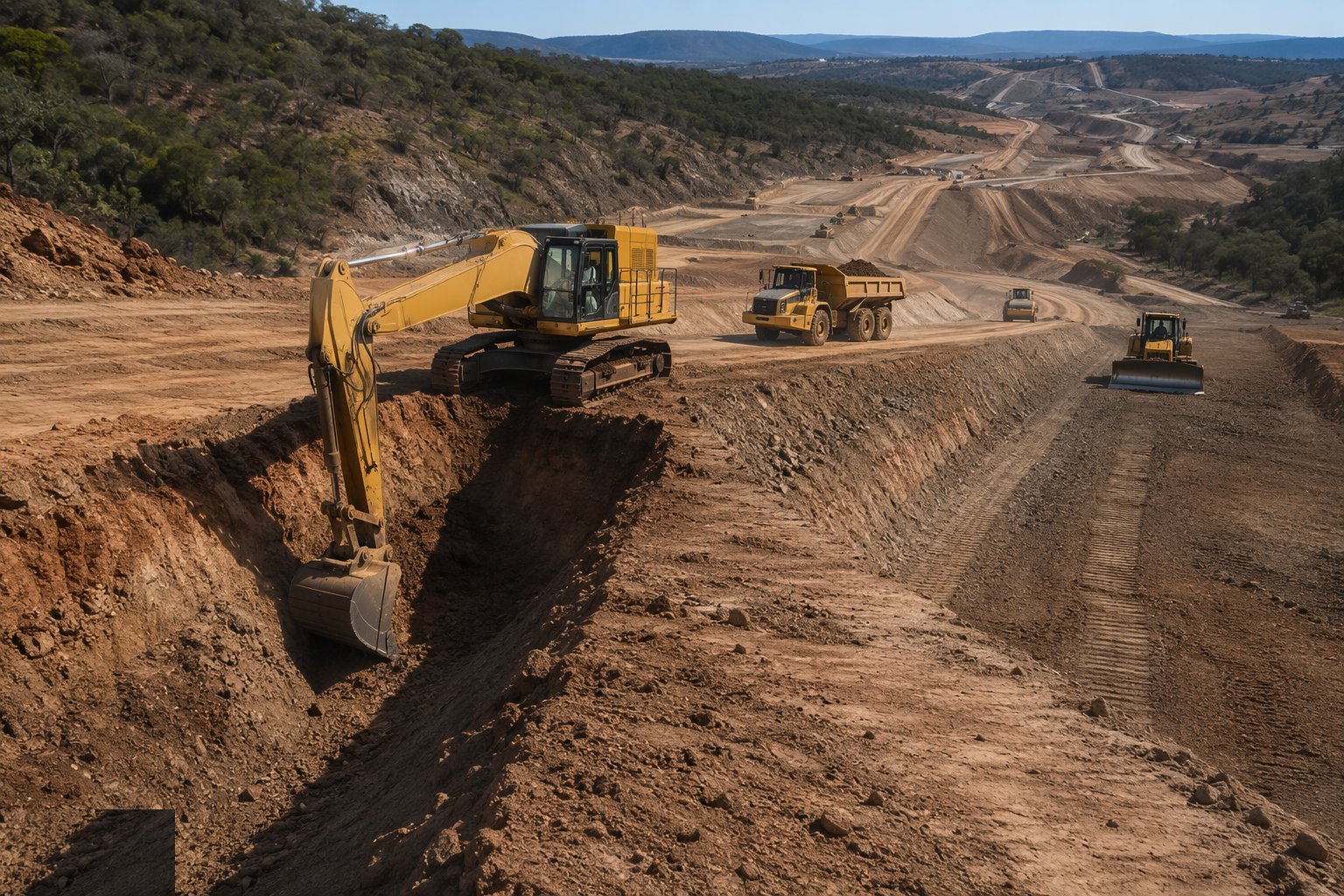
Before opening a cutting or raising an embankment, cut the drainage that protects it: cut-off drains at the crest of cuttings to intercept run-off, ditches at the toe of fills, and temporary channels to settlement lagoons. Earthworks done in standing water fail; the drainage is the first earthworks operation, not an afterthought.
Step 4: Excavate the cuttings in benches
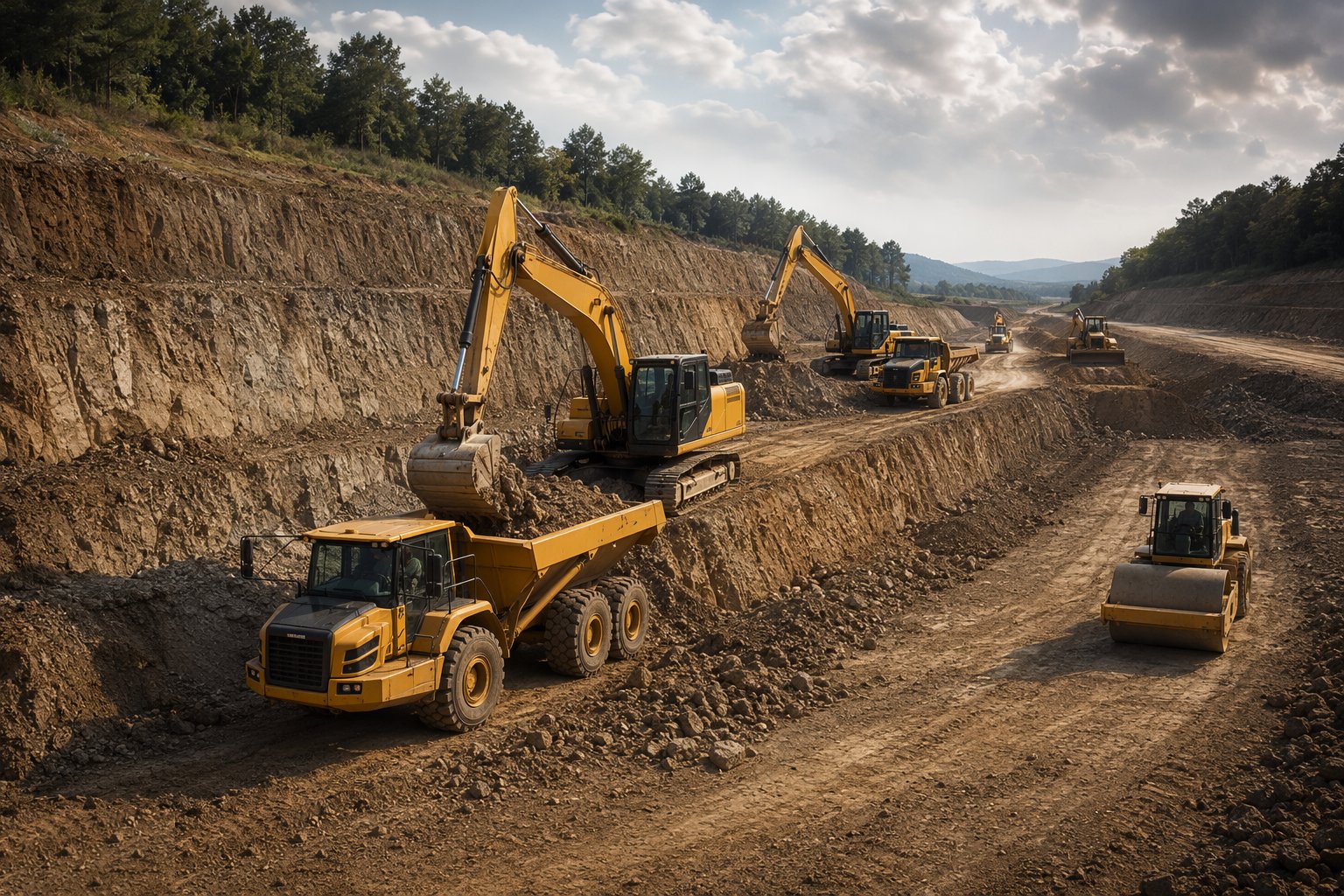
Open cuttings from the top down in planned benches, with dozers and excavators loading articulated dump trucks on the haul routes. Leave the last few hundred millimetres above formation for a final trim just before the pavement works, so weather never sits on the finished surface. Faces are inspected and logged by the geotechnical engineer as they open; any change from the GI expectation goes back to the designer.
Step 5: Place and compact the embankment fill
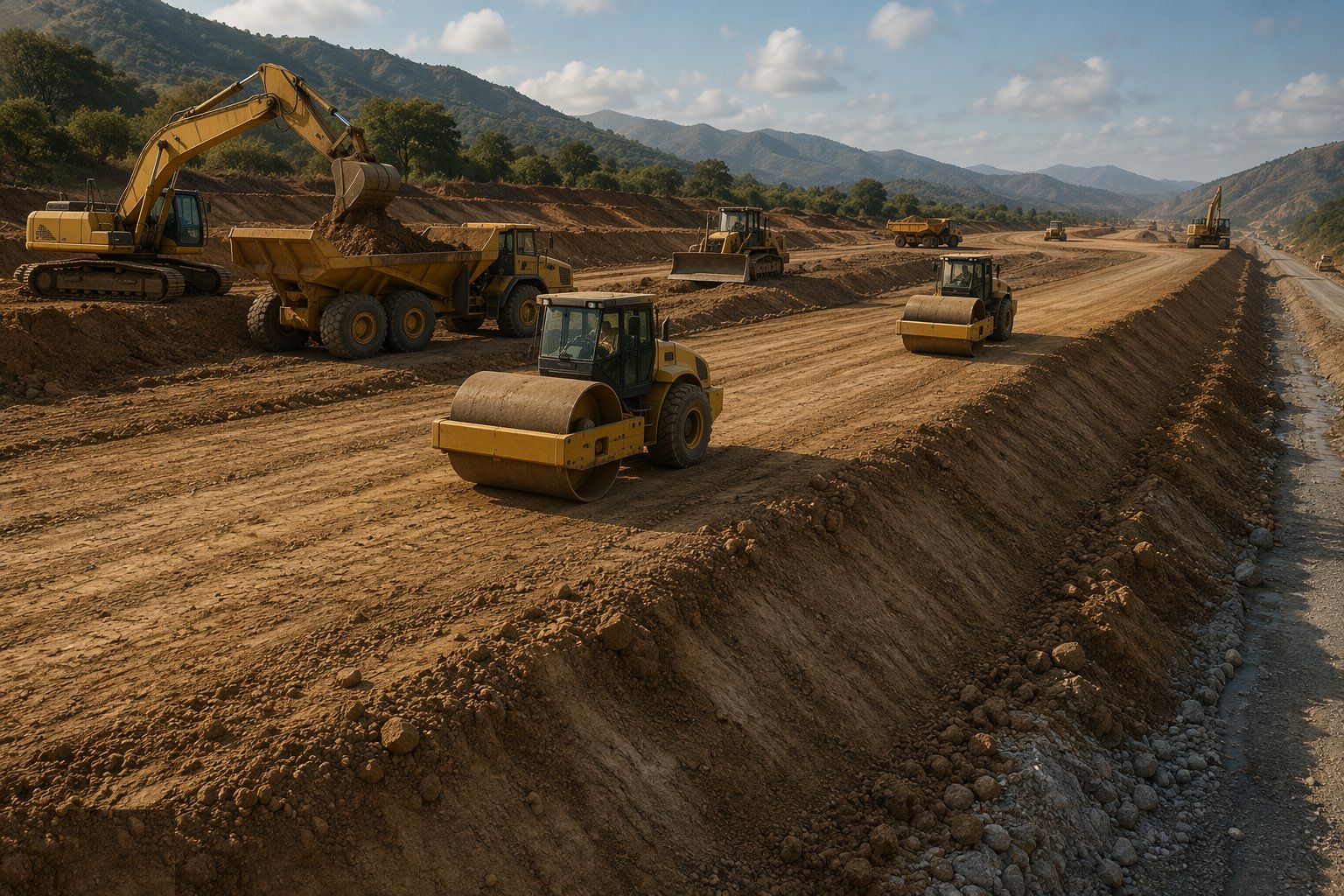
Spread acceptable fill in even layers and compact with the plant and pass count from the method specification, or to the density the end-product specification demands — smooth drum rollers on granular, padfoot on cohesive. Test in-situ density on a grid per layer; a layer that fails is ripped up and re-compacted, not averaged away. Keep the fill surface crowned so rain sheds off, and never let haul plant run across finished, tested formation.
Step 6: Deal with soft spots, sabkha and groundwater
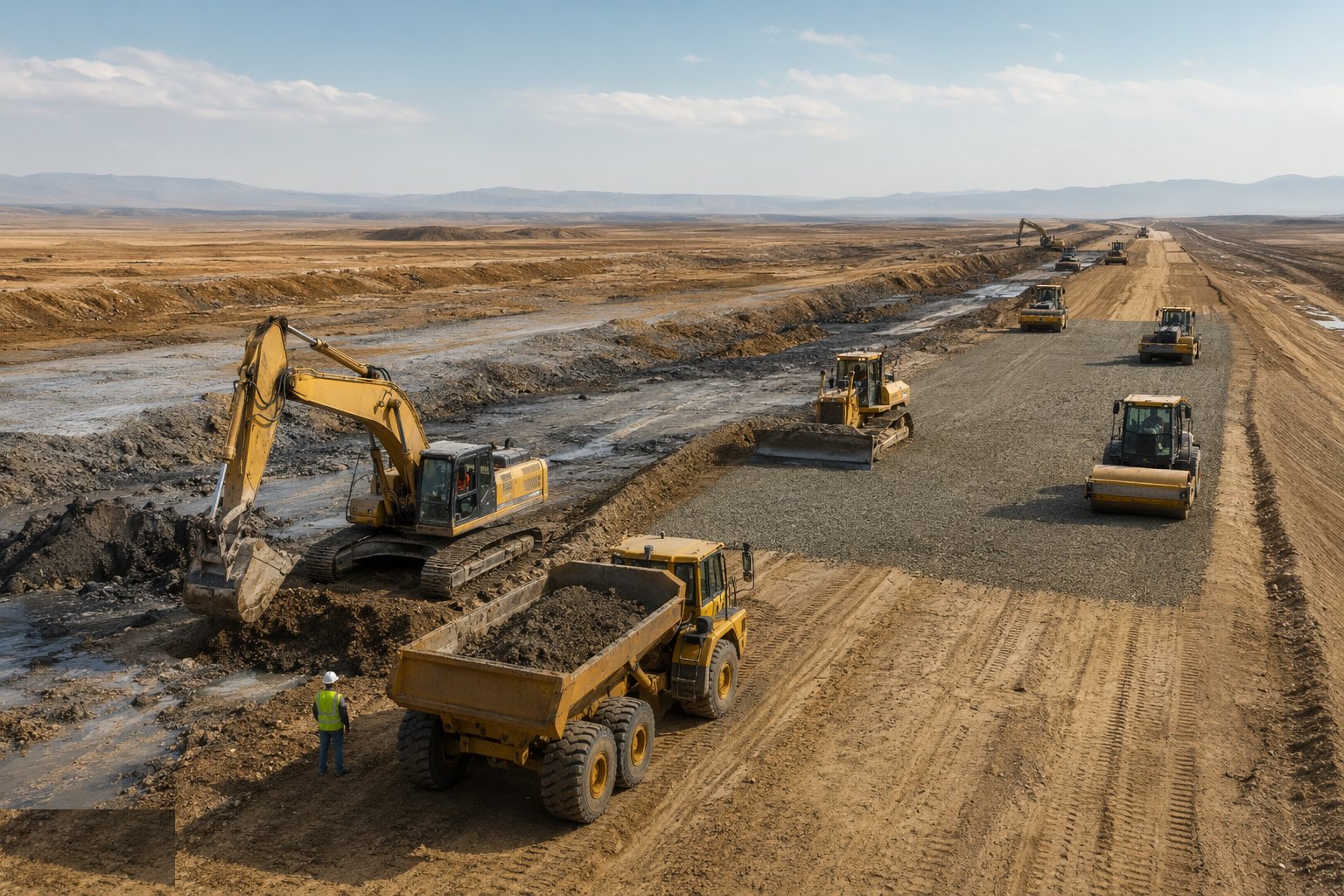
Where the formation proves weak — soft alluvium in a UK flood plain, sabkha or a high water table in the Emirates — excavate and replace with granular fill, bridge it with geotextile and geogrid, or stabilise in place. Dewater to keep the works dry, with discharge to approved outlets only; in Dubai the discharge permit from the municipality or RTA drainage network is in hand before pumping starts.
Step 7: Trim the formation and protect it
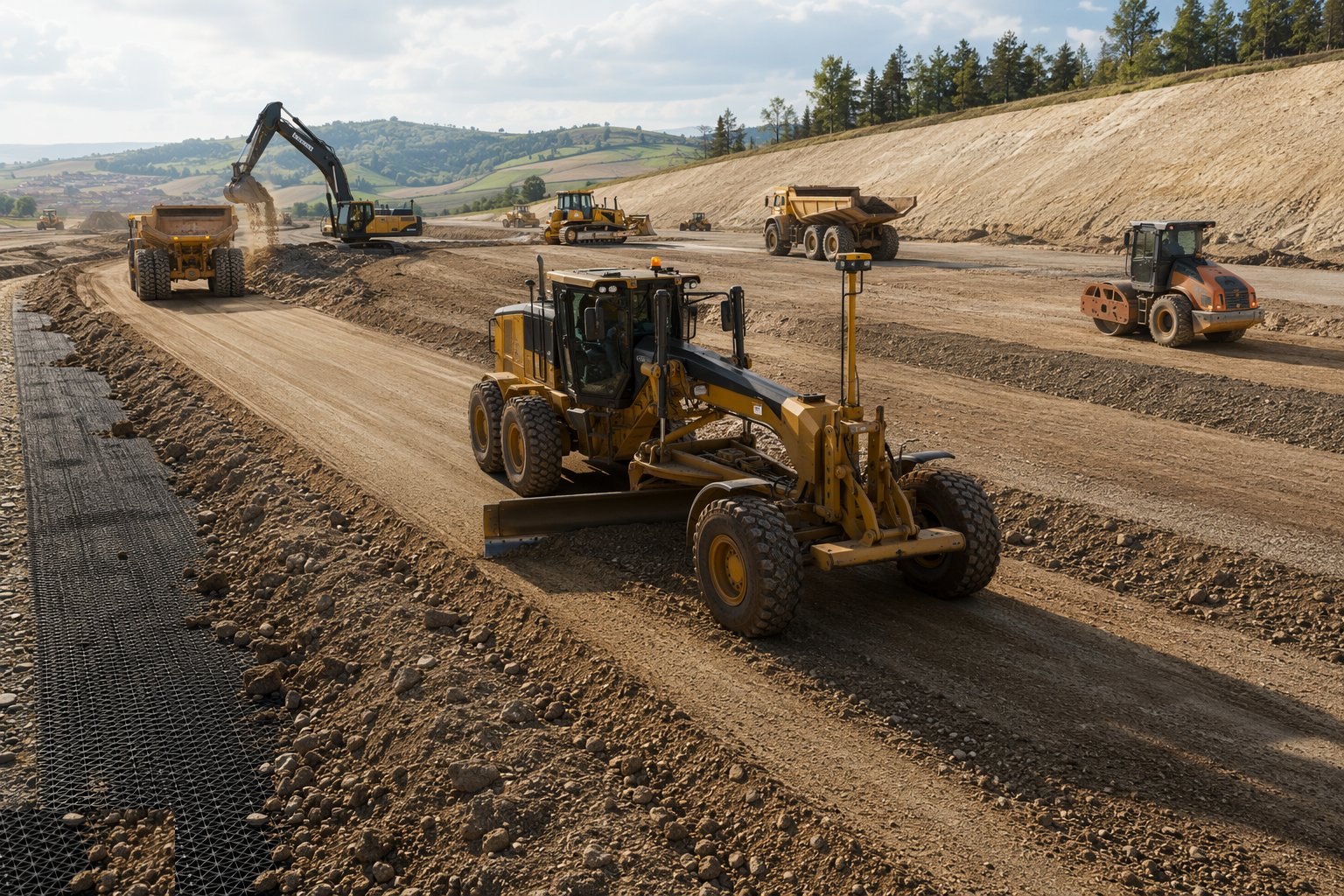
Trim formation to level and tolerance with GPS machine control, proof roll or plate-test it, and record the CBR or modulus the pavement designer assumed. Then protect it: formation exposed to weather or traffic degrades fast, so the capping or sub-base follows promptly, and standing water is pumped off immediately. Formation approval is a hold point — pavement works start on accepted ground or not at all.
Step 8: Manage surplus and unsuitable material

Unsuitable and surplus material is classified — reusable elsewhere on the scheme, inert to tip, contaminated to licensed disposal — and moved under duty-of-care waste transfer notes in the UK. Landscape mounds and noise bunds absorb surplus fill where the design allows. Every load is recorded; the mass haul closes out when cut, fill, stockpile and tip quantities all reconcile.
Plant and equipment
- Dozers and GPS machine control for bulk grading and trimming
- 360° excavators (20–40 t) loading articulated dump trucks (25–40 t)
- Motor graders for fine trimming of formation
- Rollers: smooth drum vibratory, padfoot, and pneumatic-tyred
- Stabilisation spreaders, mixers and binder tankers for lime/cement treatment
- Water bowsers for moisture conditioning and dust suppression
- Wellpoint or deep-well dewatering plant where the water table intrudes
- Tipper lorries for muck away and off-site movements
Quality control checks
- Acceptability classification of every fill source against Series 600 before use
- In-situ density testing per layer on a grid (nuclear gauge or sand replacement)
- Formation levels checked by survey on a grid; CBR or plate-bearing verification
- Moisture content of fill within the specified range at compaction
- Geotechnical inspection logs of exposed cutting faces
- Stabilisation: binder content, mixing uniformity and cured strength tested
- Mass haul reconciliation — cut, fill, stockpile and tip quantities audited
Safety considerations
- Haul route segregation: plant and pedestrians apart, one-way systems, banksmen at crossings
- Face stability: no undercutting, work from the top down, daily face inspections and after rain
- No entry to unsupported excavations over 1.2 m — batter, bench or box
- Edge protection at bench crests and settlement lagoon fencing
- Dust suppression as a permit condition; heat management for crews in Gulf summer
- Rig and truck stability on soft formation — no plant near uncompacted edges
Common defects
- Fill placed too wet — it pumps under the roller and never reaches density
- Unsuitable material buried in the embankment to save a tip run — settlement follows
- Formation left open through wet weather, then built on without re-testing
- Cut-off drains omitted: the cutting face erodes before it is even finished
- Stabilised layer trafficked or wetted before curing — the chemical set is broken
- Mass haul ignored: the same material hauled past itself twice for eighteen months
Best suited for
- Forming the corridor profile — cuttings, embankments and formation at scale
- Cut-and-fill balance across the route to minimise haul and import
- Stabilising weak formations before pavement or track construction
- High-output muck shifting under dust, noise and haul-route controls
How long does Bulk Earthworks — Cuttings & Embankments take?
Typical duration: Months to years on a major scheme — a single kilometre of moderate earthworks is typically 8–16 weeks; bulk earthworks usually sits on the critical path of the whole project..
Related processes
- Corridor Access & Enabling Works
- Survey Control & Ground Investigation
- Drainage & Utility Corridors
- Subgrade Preparation & Capping
- Sub-base & Base Construction
- Asphalt Surfacing — Binder & Surface Course
- Kerbs, Footways & Road Furniture
- Road Markings, Signage & Lighting
- Testing, Commissioning & Asset Handover
- Bulk Earthworks — Cuttings & Embankments in Bridges & Elevated Structures
- Bulk Earthworks — Cuttings & Embankments in Tunnels & Underground
- Bulk Earthworks — Cuttings & Embankments in Rail & Metro
- Roads & Highways sector guide
- Transport Infrastructure group