Site-Based MMC — Tunnel Form, Jump Form, Slipform, ICF
Modern methods that never leave the site: tunnel form on repetitive residential, self-climbing cores, insulating formwork and thin-joint blockwork — industrialised concrete without the factory.
Last updated 2026-07-28 by the BuildPedia Editorial Team.
What is Site-Based MMC — Tunnel Form, Jump Form, Slipform, ICF?
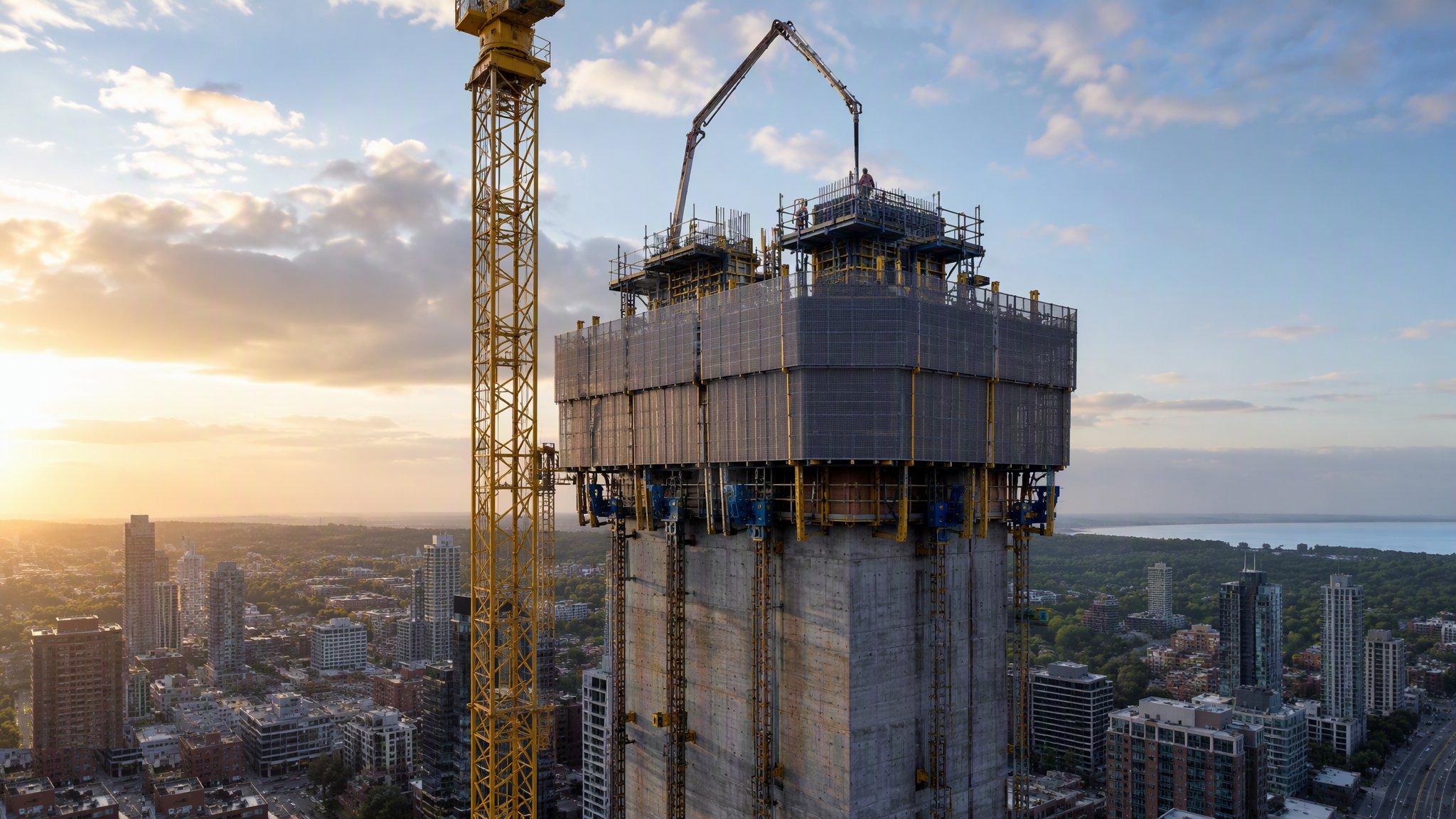
Not every modern method involves a lorry from a factory. A family of site-based systems industrialises the concrete frame itself: tunnel form, where storey-height room-sized formwork casts walls and slab in one daily pour on repetitive residential plans; jump form and slipform, where the core formwork climbs itself, either in storey-height jumps or continuously; insulating concrete formwork (ICF), where the formwork is the insulation and stays in place; and thin-joint blockwork, which replaces 10 mm mortar beds with 3 mm glue joints and cuts walling time roughly in half. What they share is the factory logic applied on site — repetition, engineered kit, cycle discipline — without the transport problem, the vesting certificates or the design freeze at week minus thirty.
Tunnel form is the purest example. On a hotel or apartment block with a repeating room module, L-shaped steel half-tunnels form one wall and half the slab; two halves make the room. Concrete for walls and slab goes in one pour, the formwork is struck the next morning on early-strength concrete, and the whole kit flies out of the building face and one bay along on the crane. A well-run tunnel-form job casts a complete room — structure, both — every day per tunnel set, and the concrete finish is good enough to take paint directly. The catch is written into the name: the plan must repeat. Every non-standard room, transfer level or set-back breaks the rhythm, and rhythm is the entire business case.
Jump form and slipform are the core equivalents: jump form climbs the core in storey-height lifts on a 2–4 day cycle per level, while slipform never stops — hydraulic jacks crawl the formwork up at 150–300 mm per hour, day and night, with concrete fed continuously and reinforcement fixed from the working deck. Slipform is unbeatable on tall regular cores and silos but unforgiving: a stopped pour is a cold joint in a moving form, so standby plant, standby concrete and round-the-clock supervision are not optional. In the UAE all of these run hot-weather variants — chilled concrete, night pours on tunnel-form slabs, and slipform summer rates adjusted because concrete that sets too fast drags and tears on the forms.
When and why is Site-Based MMC — Tunnel Form, Jump Form, Slipform, ICF used?
Choose tunnel form when the plan repeats hard: hotels, student blocks, prisons, build-to-rent — a minimum of about a hundred rooms or units before the formwork set pays back, and a crane available continuously because the system is crane-hungry. Choose jump form on any tall core where floor plates trail behind; choose slipform on very tall, very regular cores, silos and shafts where continuous pouring beats the stop-start of lifts. ICF suits low-rise housing and basements where thermal performance and speed matter more than a thin wall. Thin-joint blockwork upgrades any masonry package where the blocks are autoclaved aerated concrete and the gang can be trusted with glue instead of mortar. The common thread: these methods trade flexibility for cycle time, and the trade only works if the design is settled.
Types of Site-Based MMC — Tunnel Form, Jump Form, Slipform, ICF
Tunnel form
Room-sized L-shaped steel forms casting party walls and slabs in a single daily pour. The whole structural shell of a repetitive residential block at one room per tunnel set per day, with fair-faced concrete taking direct decoration.
Jump form (climbform)
Self-climbing core formwork rising in storey-height lifts on hydraulic or crane-jumped brackets, running ahead of the floor plates on a 2–4 day cycle. The standard on UK and UAE tower cores.
Slipform
Continuous hydraulic climbing — jacks on embedded rods lift the forms 150–300 mm per hour while concrete is placed around the clock. Silos, chimneys, shafts and very regular tall cores. Nothing about it forgives a stoppage.
Insulating concrete formwork (ICF)
Hollow polystyrene or wood-crete blocks stacked dry, reinforced and filled with pumped concrete; the formwork stays as the insulation layer. Low-rise housing, basements and pool walls — fast, warm, and dependent on disciplined bracing during the pour.
Thin-joint blockwork
Autoclaved aerated concrete blocks laid on 2–3 mm adhesive beds instead of 10 mm mortar: roughly double the laying speed, better thermal performance (no mortar cold bridges), walls ready for plaster within hours — but intolerant of out-of-level slabs and damp blocks.
Site-Based MMC — Tunnel Form, Jump Form, Slipform, ICF: step by step
Step 1: Prove the repetition and plan the cycle
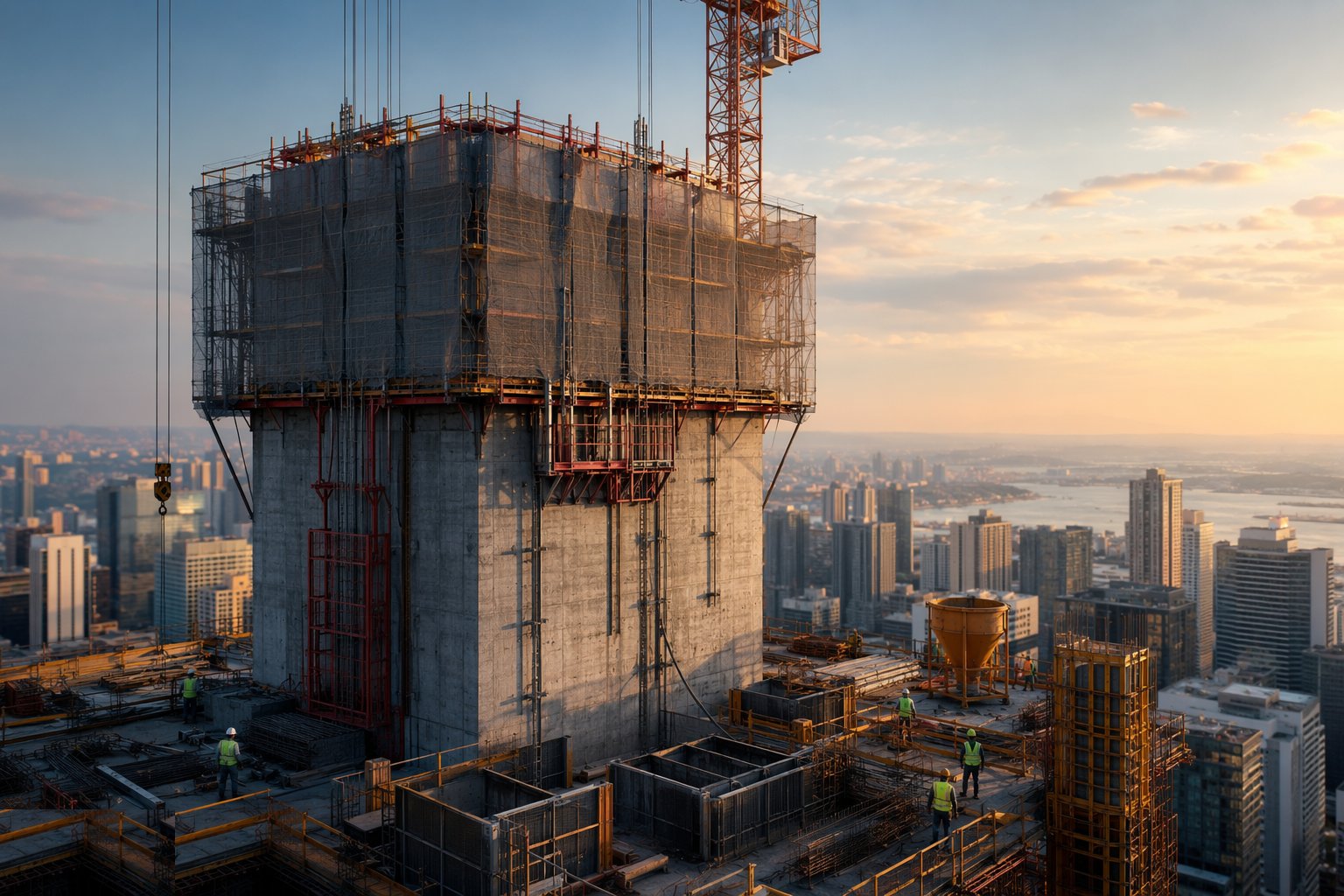
Count the repeats before buying the kit: tunnel form needs its rooms per floor and floors per block; jump and slipform need their core geometry stable for the full height. Then write the cycle — a tunnel-form day is strike, fly, set, fix reinforcement, close, pour, and every trade knows which hour of that day is theirs. The programme is a metronome: if the cycle says a room a day and week three is doing a room every three days, the job is already in trouble and the reason is findable in the cycle log.
Step 2: Set up the formwork and datum control
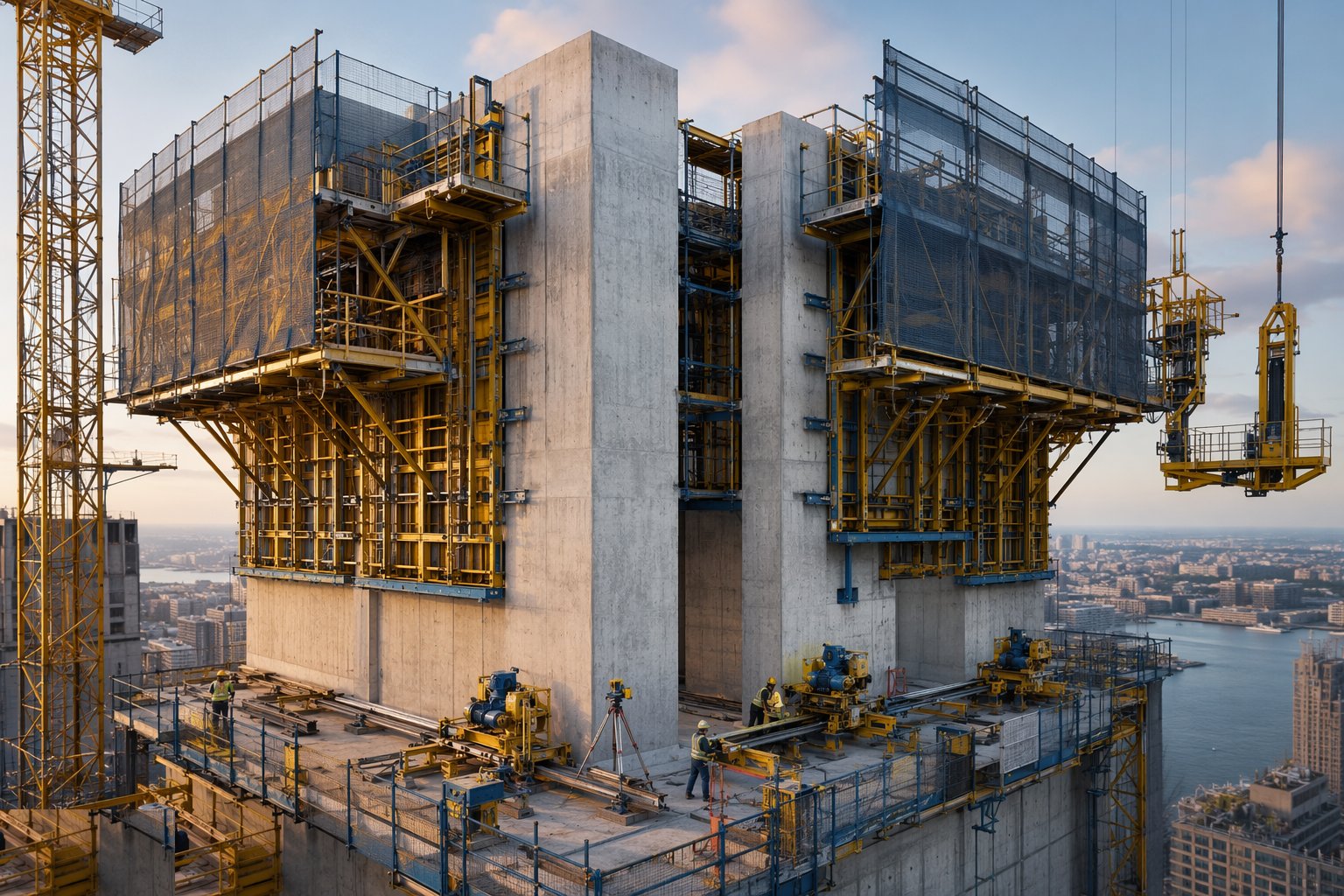
First-time set-up decides the whole job: tunnel forms levelled on their rails and jacked to slab datum, jump form brackets anchored to concrete that has hit its specified strength, slipform yoke frames levelled and the jack rods plumb. Survey control for a climbing core is continuous — laser or optical plummets from ground datum, checked against GPS or total station at height, because a core that wanders at floor 10 cannot be argued straight at floor 30.
Step 3: Fix reinforcement and cast-in items inside the system
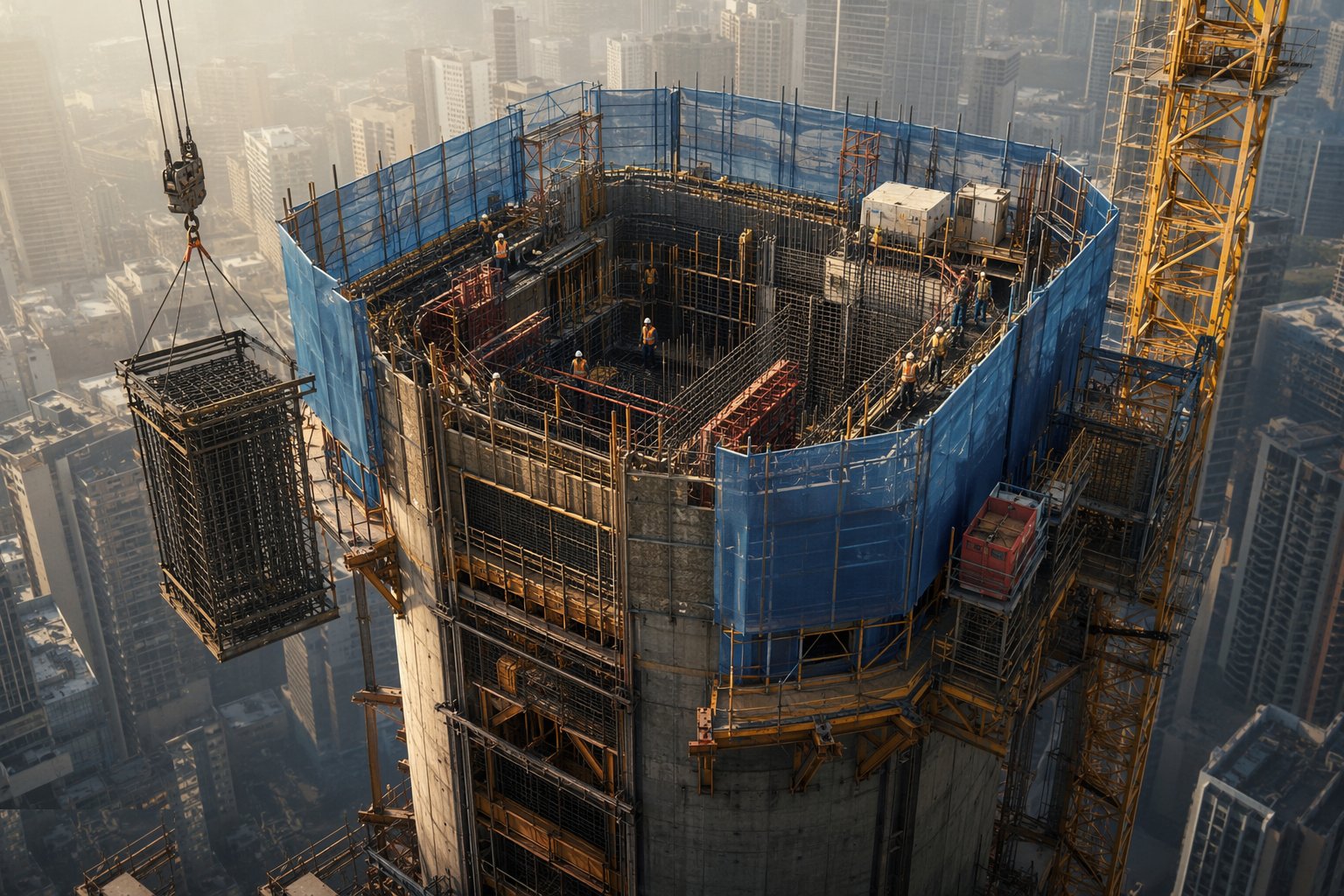
Reinforcement goes in against the clock — prefabricated cages and mats earn their keep here because loose bar fixing inside a tunnel form is slow and filthy work. Every opening box-out, sleeve, coupler and anchor channel is fixed before closing, checked on a pre-pour card, because a missed box-out in tunnel form means diamond-drilling a structural wall in a finished room. On slipform, bars are fixed from the working deck as the forms rise, with lap lengths planned against the climb rate.
Step 4: Pour to the system, not the other way round
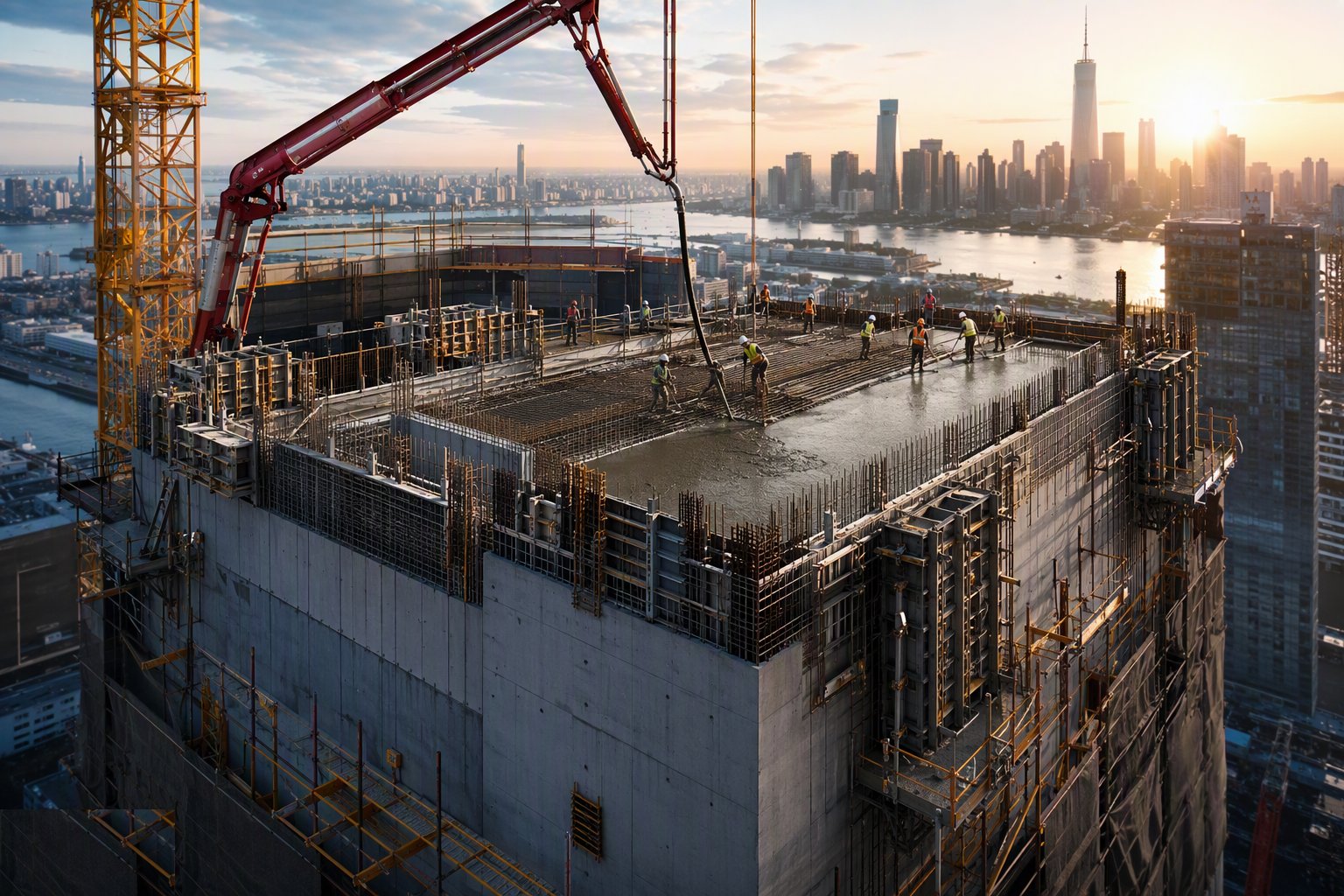
Tunnel form takes walls and slab in one pour — mix and sequence designed so wall concrete is placed and vibrated before the slab follows, with early-strength mixes for next-morning striking. Slipform pours continuously in layers matched to the climb rate; the concrete leaving the forms must be at the right early strength — too green and it slumps, too stiff and it drags and tears. In UAE summer, that means chilled mixes, night windows for big tunnel-form pours, and temperature records on every load.
Step 5: Strike, climb or slip — the engineered move
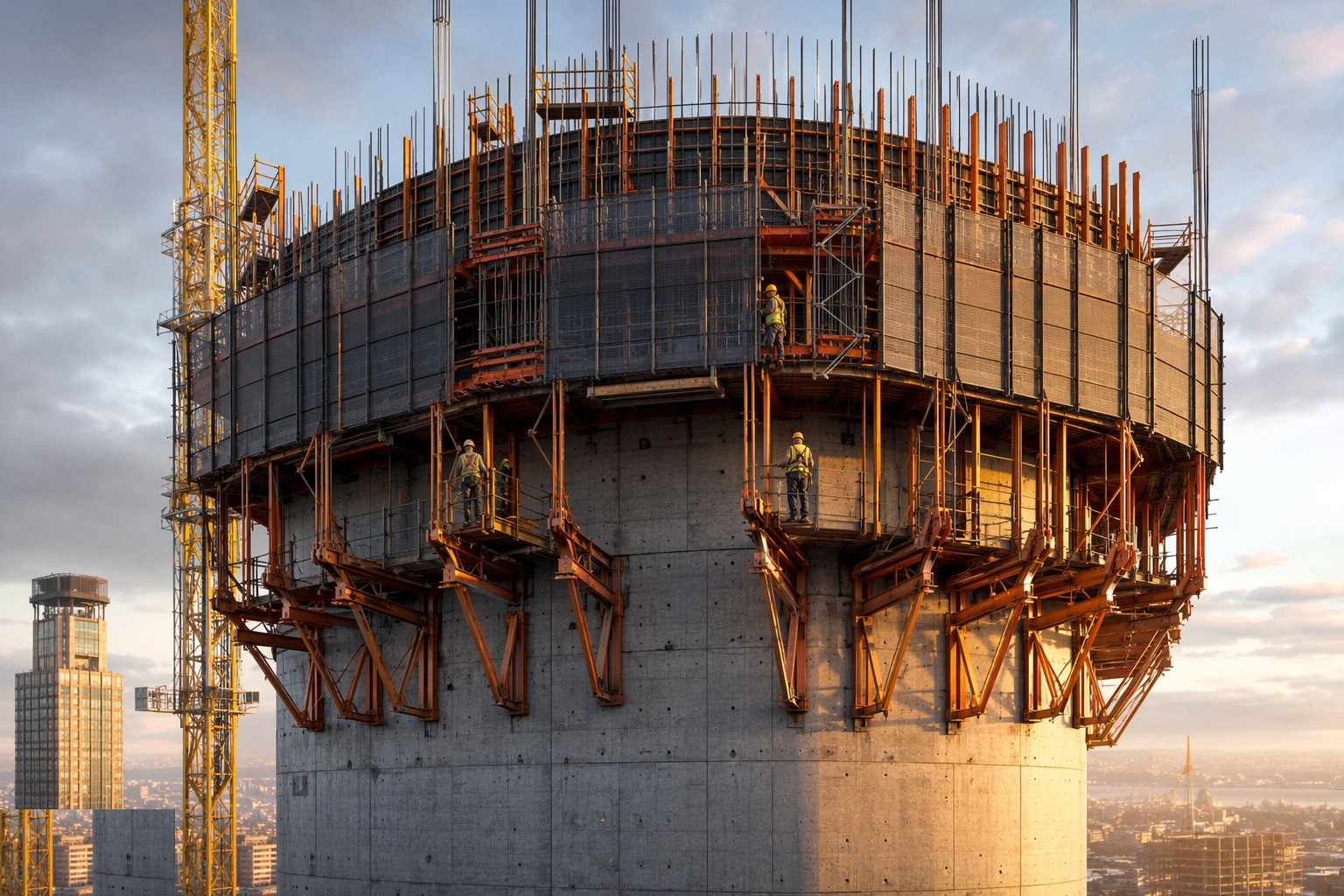
Striking and climbing are designed operations, not muscle work. Tunnel forms strike on verified early strength (cube or maturity meter), roll out on their wheels and fly to the next bay in one crane pick per half. Jump form climbs on hydraulics with the wind speed checked against the limit — a climbing rig in a gust is a pendulum full of concrete. Slipform climbs are monitored hourly: rate, level across the deck, concrete strength at the trailing edge. Every move is logged; the log is how you prove the cycle and find where it leaks.
Step 6: Manage the crane dependency honestly
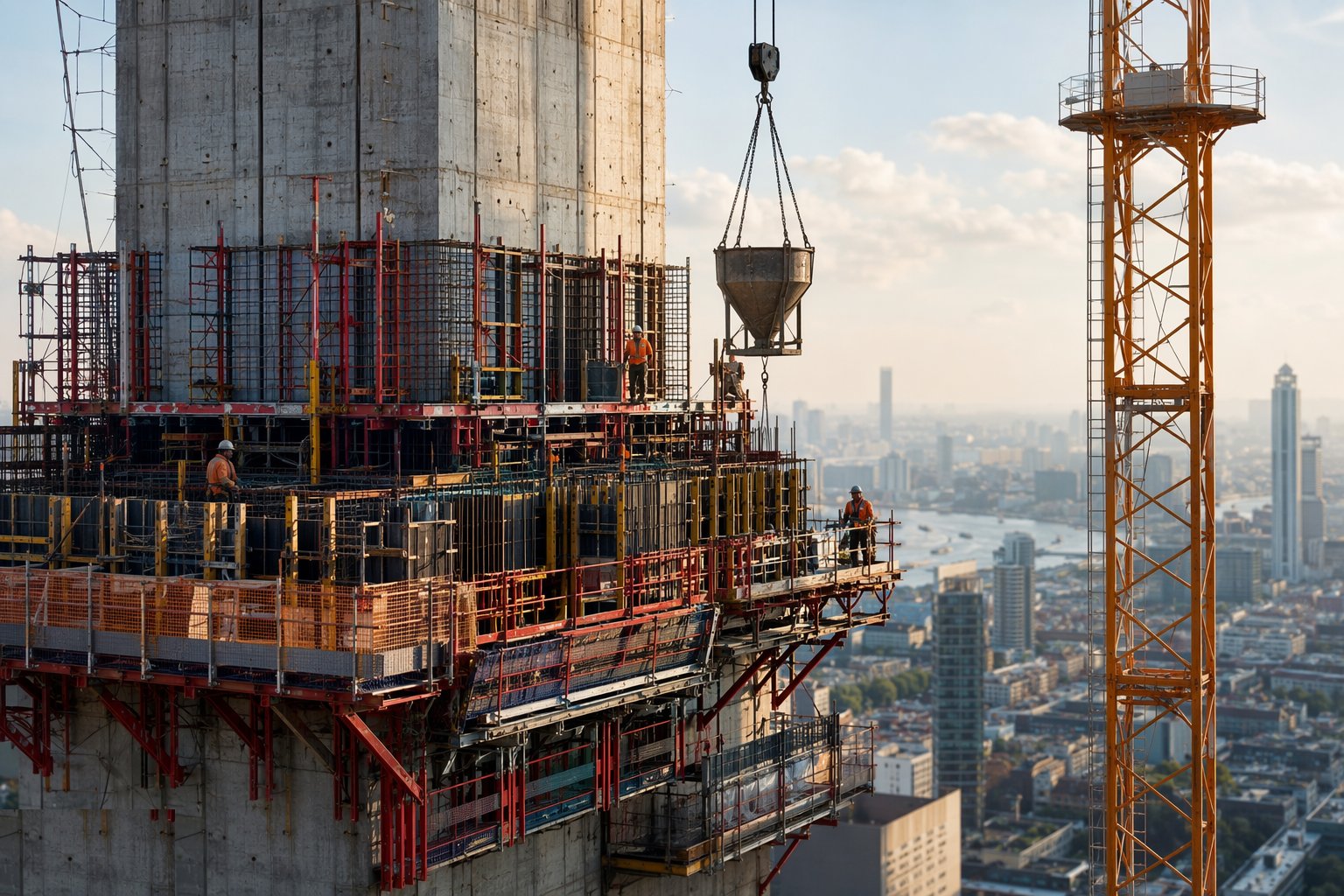
Tunnel form is the crane-dependency trap made concrete: the formwork, the reinforcement, the concrete skip and the follow-on trades all queue for the same hook, and a crane down for a day is a room not poured, which is a day gone forever — the cycle has no slack. The answers are boring and essential: crane maintenance scheduled inside the cycle's low hour, a concrete pump as backup to the skip, prefabricated reinforcement to cut picks, and a tower crane sized and positioned for the formwork weights, not just the general build.
Step 7: Finish from the forms and follow with the trades
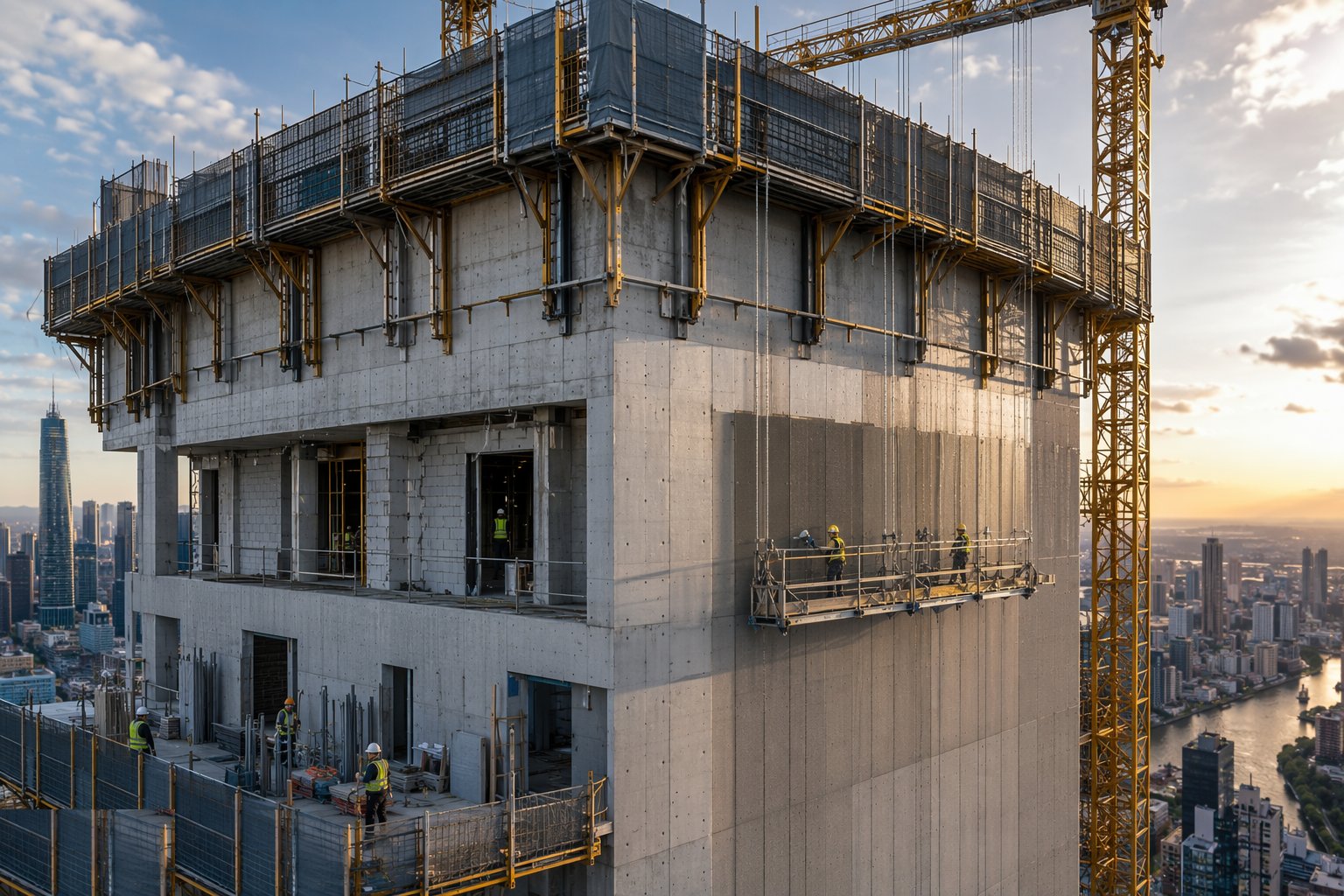
The payoff arrives here: tunnel-form concrete faces take direct decoration, so skim or paint follows close behind the structure, and the blockwork/ICF equivalents hand over insulated walls ready for services. Follow-on trades work the same metronome — first fix enters on floor N while the formwork flies on floor N+2 — and the interfaces are protected: nobody cuts into a shear wall for a socket without the structural conversation. Thin-joint walls are chased shallow and to the guide, because the blocks carry less meat than dense blockwork.
Step 8: Survey, record and hand the cycle over

As-built survey of walls, openings and core position goes to the quality file floor by floor, with concrete records — batch, temperature, cubes, strike approvals — tied to each pour. On slipform the record is continuous: climb log, level readings, concrete strength curve. Defects are made good to the finish standard the system promised — if the sell was paint direct on concrete, the making-good standard is a decorator's, not a plasterer's cover-up.
Plant and equipment
- Tunnel form sets sized to the room module, with rails, wheels and stripping jacks
- Jump form or slipform rigs with hydraulic climbing equipment
- Tower crane sized for formwork flying weights at full radius
- Concrete pumps and placing booms; skips as backup, not primary
- Prefabricated reinforcement cages and mats
- Maturity meters and early-strength cube regime for strike control
- Survey control: plummets, total stations, deck level monitoring on slipform
- ICF bracing and alignment systems; thin-joint adhesive sleds and saws
Quality control checks
- Cycle log kept daily — strike to strike — as the primary programme control
- Early-strength verification before every strike or climb: cubes or maturity
- Pre-pour inspection cards inside the forms: reinforcement, box-outs, sleeves
- Core verticality surveyed every lift; slipform deck level logged hourly
- Concrete temperature and delivery time records in hot weather
- Form face condition inspected per cycle — a damaged face is a damaged finish for the rest of the job
- ICF bracing and alignment checked immediately before and during each pour
Safety considerations
- Flying formwork over live areas: exclusion zones, dedicated lift plans, no pick shortcuts
- Climbing operations in wind limits with anemometer readings logged
- Slipform runs 24/7 — fatigue management, night lighting, standby plant always available
- Edge protection at the building face where tunnel forms fly out
- Concrete burns and manual handling in confined formwork spaces
- Hot-weather concreting in the UAE: night pours, hydration, midday rules for the pour gangs
- ICF pour pressure: braced walls, controlled pour rates, watch for bulging
Common defects
- Cycle slippage blamed on weather when the log shows the crane queue was the real cause
- Honeycombed wall bases from slab concrete poured before walls were properly vibrated
- Dragged and torn slipform faces where the mix stiffened faster than the climb
- Cores out of plumb from skipped survey checks in the rush to hold the cycle
- Missed box-outs drilled afterwards through structural walls
- ICF walls bulged or burst from over-fast pours on under-braced forms
- Thin-joint walls out of plumb because the first course was not levelled on a proper bed
- Early striking on optimistic cube results — cracked slabs and deflected soffits
Best suited for
- Hotels, student blocks, prisons and build-to-rent with a repeating room module (tunnel form)
- Tall residential and office cores — jump form on nearly all of them, slipform when very tall and regular
- Silos, chimneys and shafts where slipform's continuous pour is unbeatable
- Low-rise housing and basements where ICF delivers structure and insulation in one pour
- Any masonry package on AAC blocks where thin-joint halves the walling time
- Sites without factory access or where transport economics kill volumetric — the factory logic stays on site
How long does Site-Based MMC — Tunnel Form, Jump Form, Slipform, ICF take?
Typical duration: Tunnel form: one room (walls plus slab) per tunnel set per day — a 10-storey, 20-room-per-floor block in about 10–12 weeks of shell, against 20-plus for conventional frame and infill. Jump form: 2–4 days per storey on a core. Slipform: 3–6 m of core per day, continuously. ICF: a house shell in 2–3 weeks. Thin-joint: roughly double standard blockwork rates. All of it collapses to conventional speed or worse the moment the plan stops repeating or the crane stops turning..
Related processes
- SIPs, Floor and Roof Cassettes
- Precast Concrete Structures
- Bathroom Pods, Riser and Plant Modules
- Design for Manufacture and Assembly
- Hybrid MMC — Modules on Podiums, Precast on Cores
- Off-Site Logistics, Craneage and Tolerance
- 3D Printing and Additive Construction
- Modern Methods of Construction — What They Actually Are
- Volumetric Modular Construction
- Panelised Systems — Open and Closed Panel
- Off-Site & Modern Methods sector guide
- Buildings group