Testing, Commissioning & Handover — Commercial
Proving the building works as designed — balancing, BMS cause-and-effect, witness testing and seasonal commissioning — then handing a documented, supported asset to the facilities team.
Last updated 2026-07-28 by the BuildPedia Editorial Team.
What is Testing, Commissioning & Handover — Commercial?
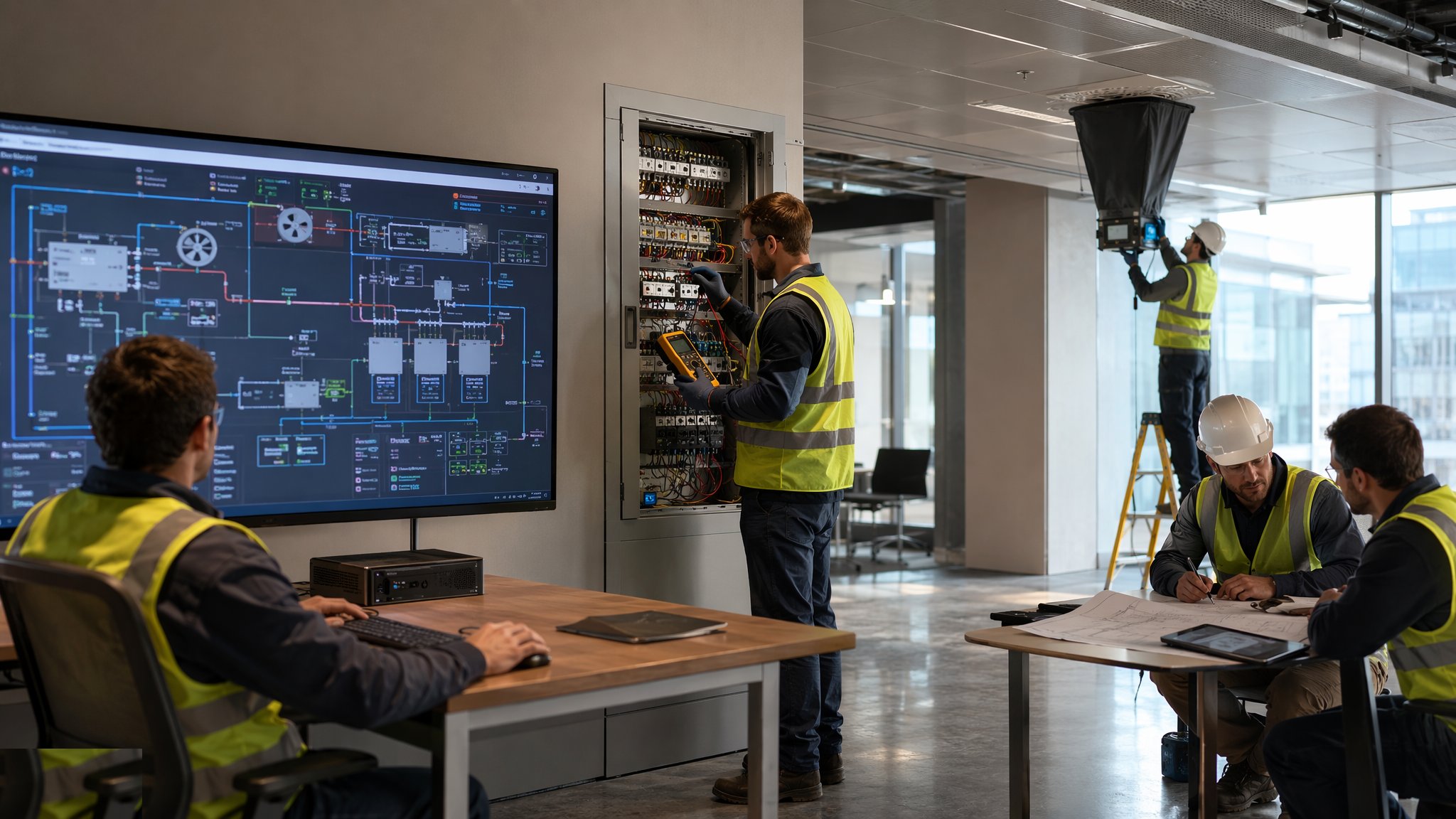
Commissioning is not switching the building on. It is the systematic process of proving that every system performs to the design intent: pre-commissioning checks, setting to work, regulation and balancing of air and water systems, performance testing, witnessing, and documentation — the CIBSE and BSRIA framework that turns an installed building into a proven one. On a commercial tower this is a campaign of months: every AHU and fan coil, every pump and valve, the BMS with its thousands of points, the life-safety systems whose cause-and-effect must work perfectly under witness, and the electrical distribution energised under the authority's sequence. Done properly, commissioning starts in design, is managed through construction to BSRIA BG 5 practice, and ends not at handover but after the building has run through its first seasons.
The life-safety spine runs through everything. The fire alarm cause-and-effect matrix — detectors and alarms triggering the right sounders, door releases, smoke control, lift recalls, plant shutdowns and firefighter's systems — is tested scenario by scenario, witnessed by the fire engineer, the client and, in the UAE, approved under the Dubai Civil Defence regime, whose clearance gates energisation and occupation. In Dubai the completion path runs to the Building Completion Certificate from DM, DDA or Trakhees after final inspection, with DEWA connection following Civil Defence clearance; contractually the FIDIC sequence applies — the Engineer's Taking-Over Certificate with its list of minor outstanding works, then the Defects Notification Period (universally called the DLP in the Gulf), then the Performance Certificate. In the UK the equivalents are practical completion under JCT, the health and safety file under CDM 2015, and the building log book under Part L.
Modern handover does not stop at the certificate. Seasonal commissioning returns to the systems under real summer and winter loads — a chilled water system balanced in a mild spring may be hopeless in August — and soft landings aftercare keeps the commissioning and design team engaged through the first one to three years of occupation, fine-tuning controls, reviewing energy performance and training the facilities team properly. The handover file itself is an asset: as-built drawings, O&M manuals, test and commissioning certificates, warranties, and the BMS point database and graphics — the difference between an FM team that runs the building and one that reverse-engineers it at call-out rates.
When and why is Testing, Commissioning & Handover — Commercial used?
Commissioning begins in earnest once systems are complete and clean — flushed pipework, tested ductwork, terminated BMS — but its planning starts months earlier, because the commissioning manager's programme dictates the order floors and systems are finished, not the other way round. It matters for three reasons. Contractually, witnessed testing is the evidence gate to practical completion or the Taking-Over Certificate: no witnessed cause-and-effect, no completion. Commercially, a commercial building that cannot hold its temperatures or pass its balancing tests is unlettable — tenants' surveyors check, and the rent reflects the answer. And operationally, handover is the moment the asset changes ownership: the FM team that receives poor documentation, no training and a building balanced by luck will spend the DLP finding out what the project team never proved. Seasonal commissioning and soft landings exist precisely because some of the truth only arrives with the weather and the occupants.
Types of Testing, Commissioning & Handover — Commercial
Contractor-led commissioning with client witness
The MEP contractor manages and executes commissioning to the specification, with the client's consultant witnessing the critical tests. The traditional model — workable when the specification is tight and the witness regime has teeth, but the independence of the evidence depends on the witnesses turning up and saying no.
Independent commissioning management (CxA)
An independent commissioning manager or authority appointed early — often in design — who owns the commissioning plan, reviews the design for commissionability, and directs and verifies the testing the contractors perform. The model that serious Grade A and Gulf premium projects now default to: it costs a fee and saves a lawsuit.
Seasonal commissioning and fine-tuning
Deferred testing under peak summer and winter loads after occupation: setpoints, control loops and balancing verified against real weather and real occupancy. Written into the commissioning plan as a duty, with access and budget reserved — not a goodwill visit.
Soft landings aftercare
The BSRIA Soft Landings framework: the project team stays engaged through extended aftercare — typically one to three years — with resident support, energy and comfort reviews, and structured FM training. The bridge between a building that passed its tests and a building that actually performs.
Testing, Commissioning & Handover — Commercial: step by step
Step 1: Plan commissioning from design stage
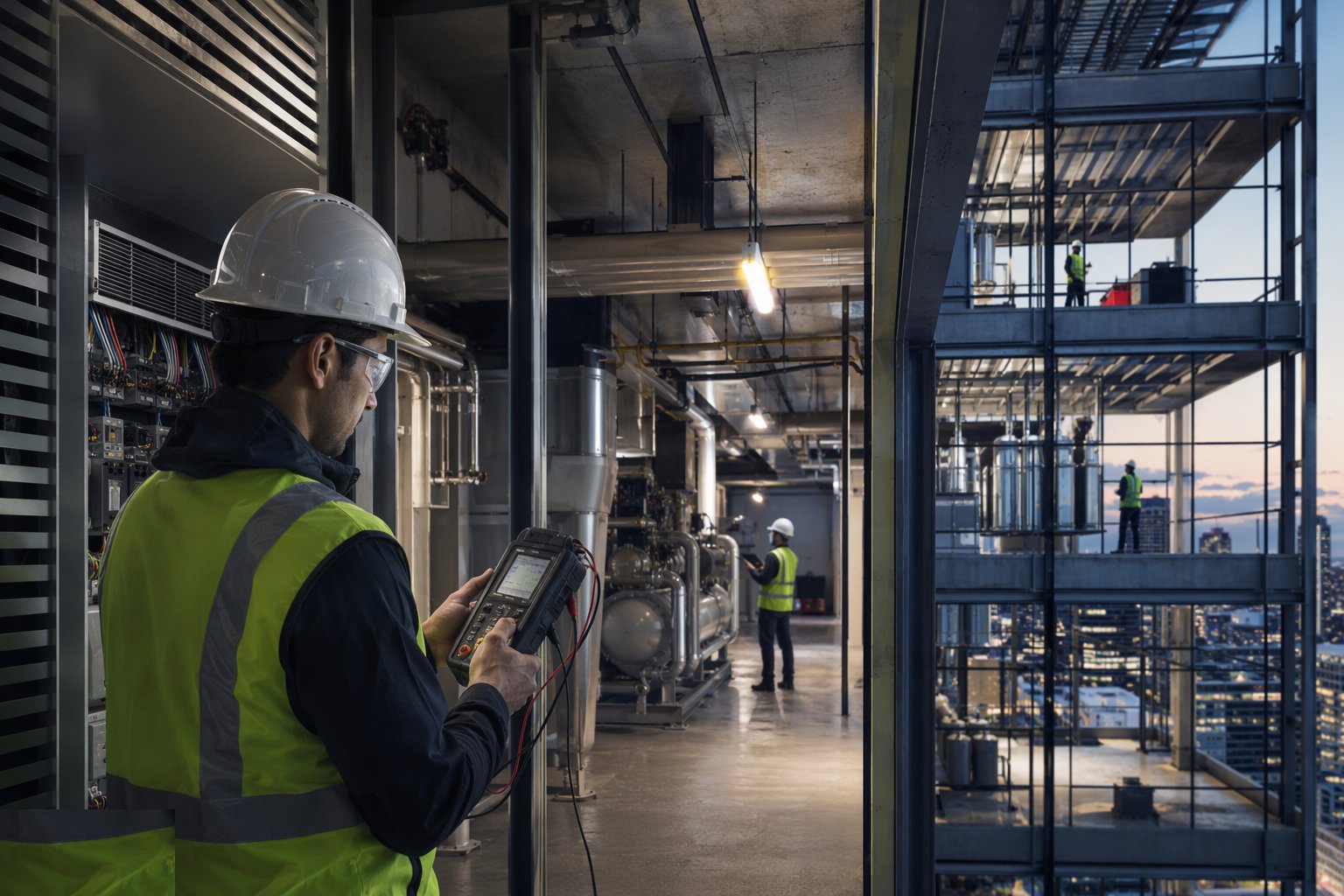
The commissioning manager or authority is appointed early and writes the commissioning plan: which systems, which tests, which witnesses, in what sequence, against which design criteria. The design is reviewed for commissionability — are there test points, drain points, access to dampers and valves, measuring points where balancing will need them — because a system that cannot be measured cannot be commissioned. The construction programme is then aligned so systems complete in commissioning order: risers and plant first, floors in sequences that let testing start months before the last ceiling closes.
Step 2: Pre-commission and set the systems to work
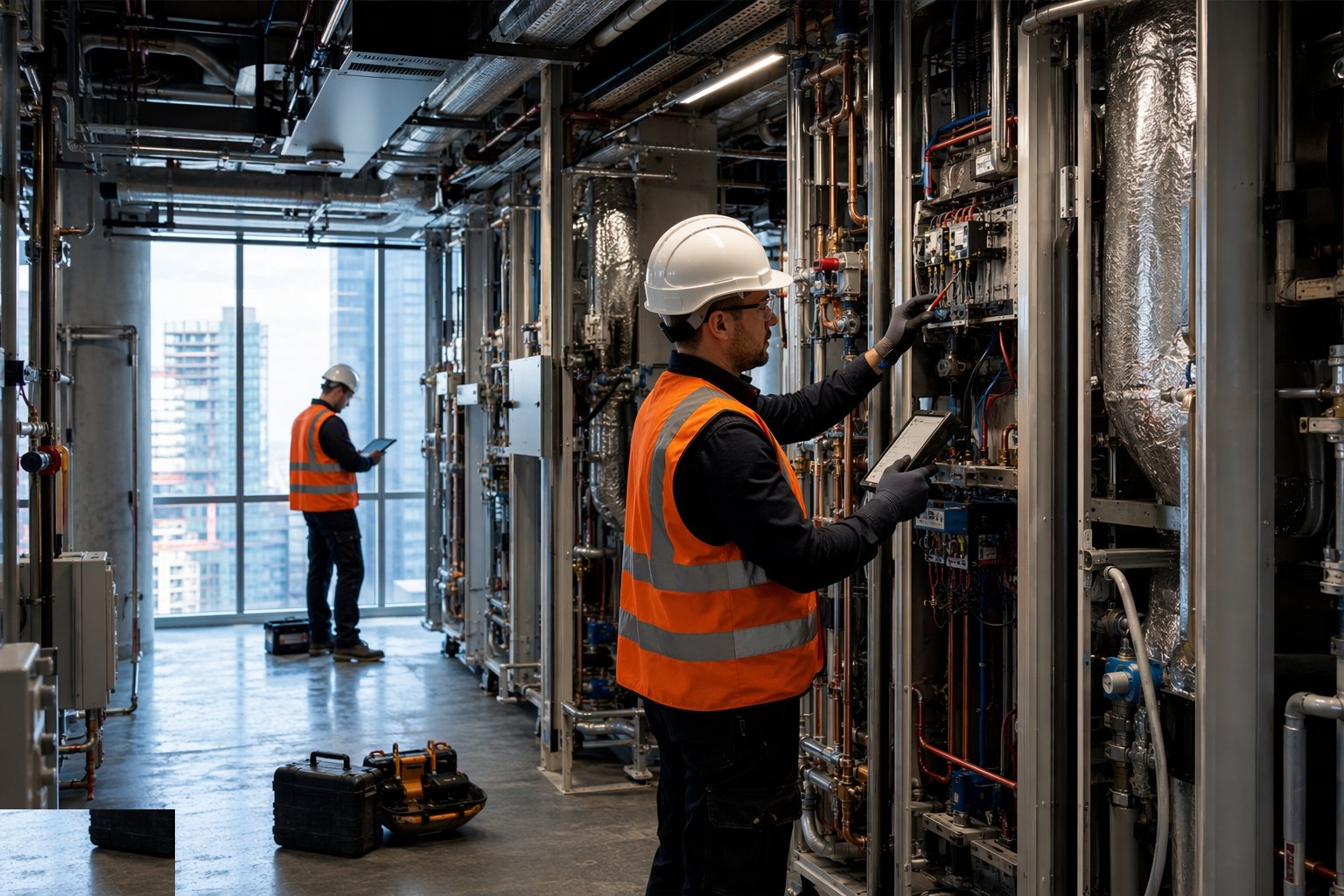
Before any balancing, the systems are proven ready: pipework flushed, cleaned and dosed with water analysis on file; ductwork leakage-tested; electrical systems tested and certified; BMS points verified end-to-end; strainers clean, dampers stroking, sensors reading reality. Setting to work follows — plant started under supervision, rotation and alignment checked, safety devices proven, control loops given their first stable setpoints. Nothing is balanced on a dirty or unproven system; the pre-commissioning file is the entry ticket, and commissioning that starts without it is theatre.
Step 3: Balance air and water to the design
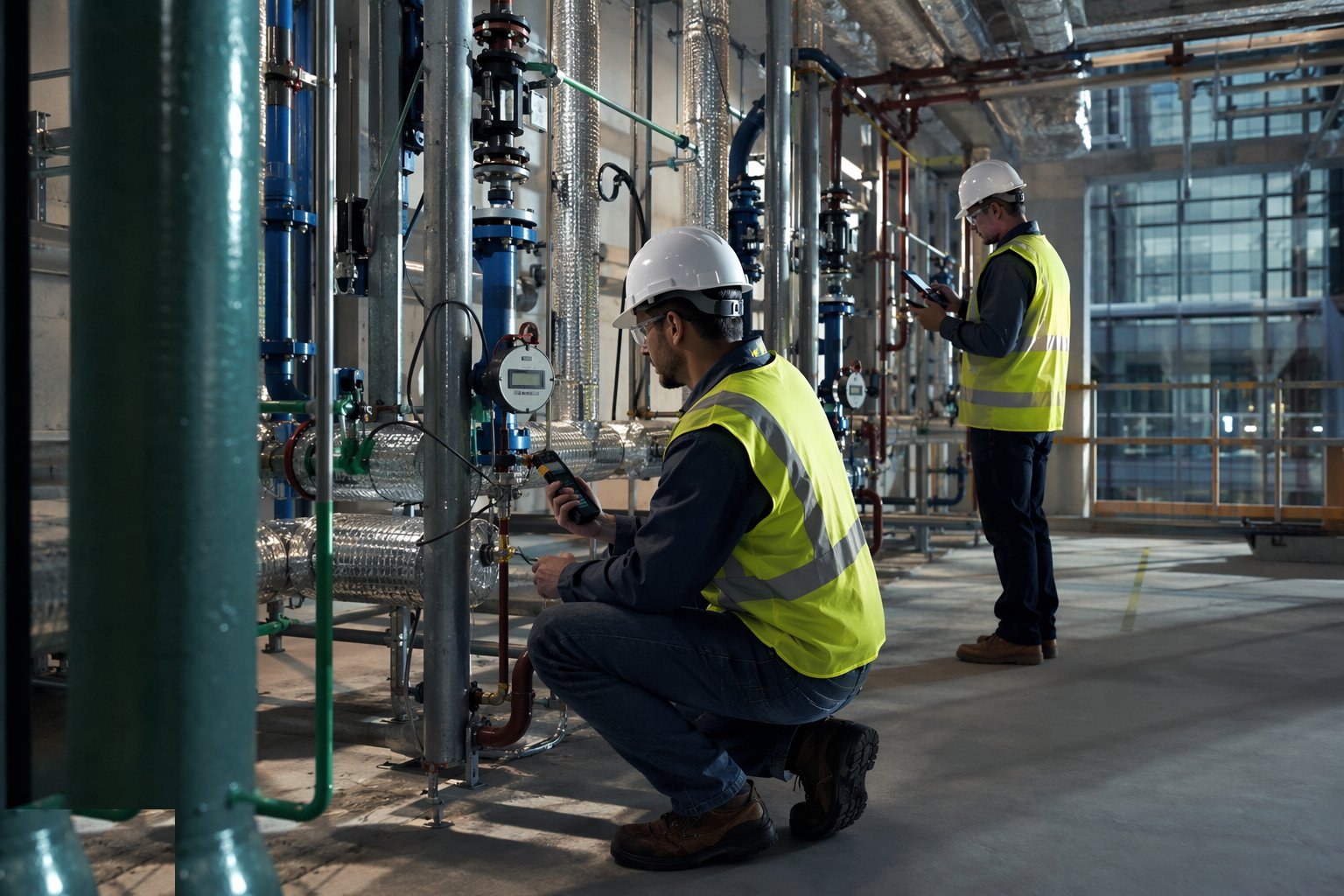
Regulation is the craft core of commissioning: water systems balanced circuit by circuit against the design flows — commissioning sets, double-regulating valves and ultrasonic measurement, with the index circuit proven at full flow — and air systems regulated from the AHU to the terminals, duct static pressures and terminal volumes set to design within the specified tolerances. Every result is recorded on the commissioning sheets with instrument serials and dates. The numbers are the building's vital signs: a floor that cannot reach design air volume is a leasing problem in waiting, and a riser that never balances is a design query, not a valve problem.
Step 4: Prove the BMS and run the cause-and-effect

The BMS is commissioned as a system: point-to-point verification completed, control loops tuned, trends and alarms configured, graphics reconciled to reality. Then the integrated testing — the cause-and-effect matrix executed scenario by scenario: a detector in alarm must raise the right sounders, release the right doors, recall the lifts, drive the smoke control and shut down the right plant, and the BMS must show it all happening. Fire alarm, sprinklers, smoke ventilation, lift recalls and generator changeover are tested together under the fire strategy, witnessed by the fire engineer and the authority where required. Anything that fails fails the building — there is no partial credit on life safety.
Step 5: Witness test and close the completion gates
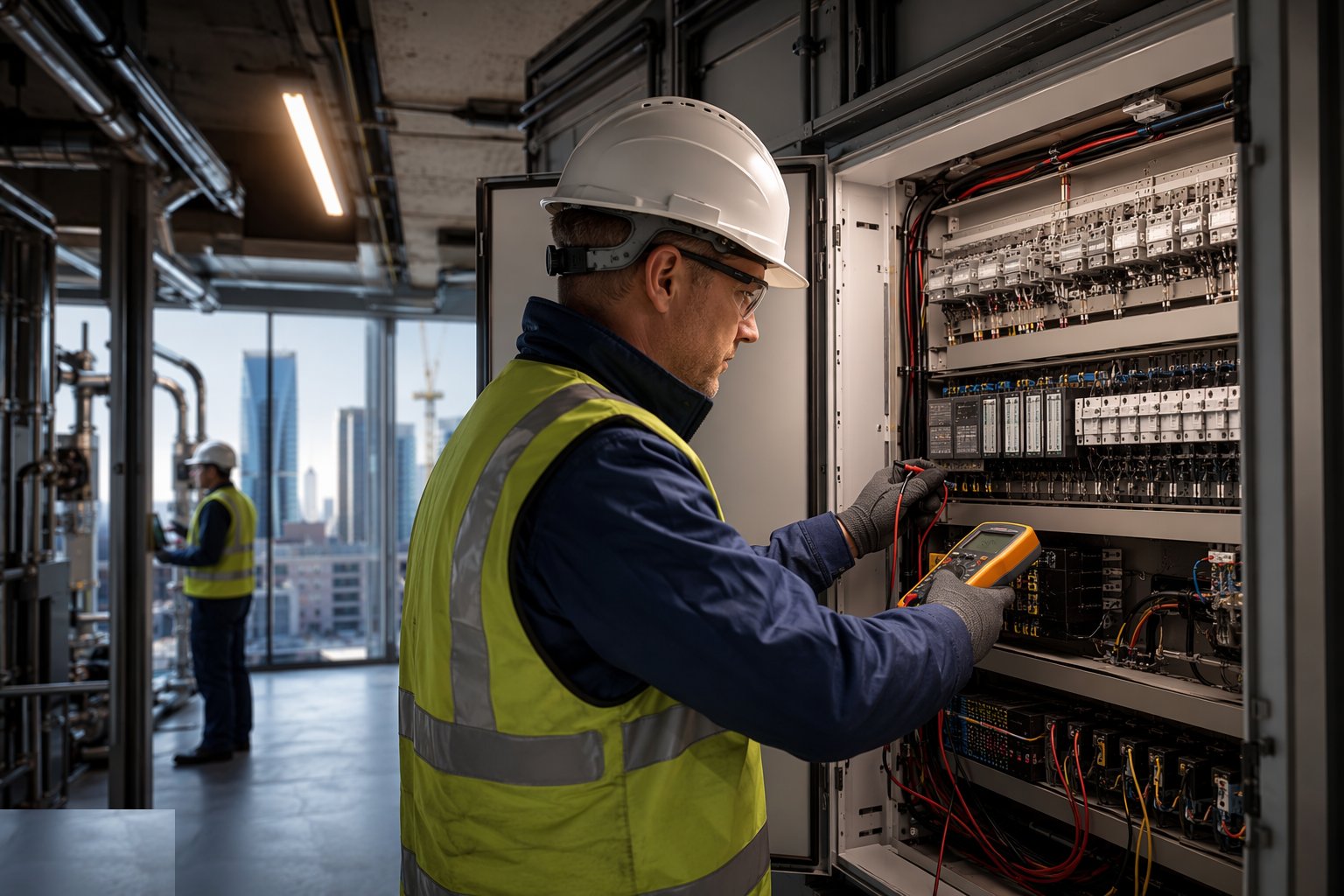
The client, consultant and authorities witness the specified tests: balancing results demonstrated on sampled terminals, plant performance against duty points, electrical systems and changeover proven, and the life-safety scenarios re-run for the record. In the UK, the certificate trail feeds practical completion, the health and safety file and the building log book. In Dubai, Civil Defence clearance precedes DEWA energisation and occupation, the authority final inspections feed the Building Completion Certificate, and the Engineer issues the Taking-Over Certificate with its schedule of minor outstanding works. The witness records are the completion mechanism — snagging supports the certificate; it does not substitute for it.
Step 6: Compile the handover file and train the FM team
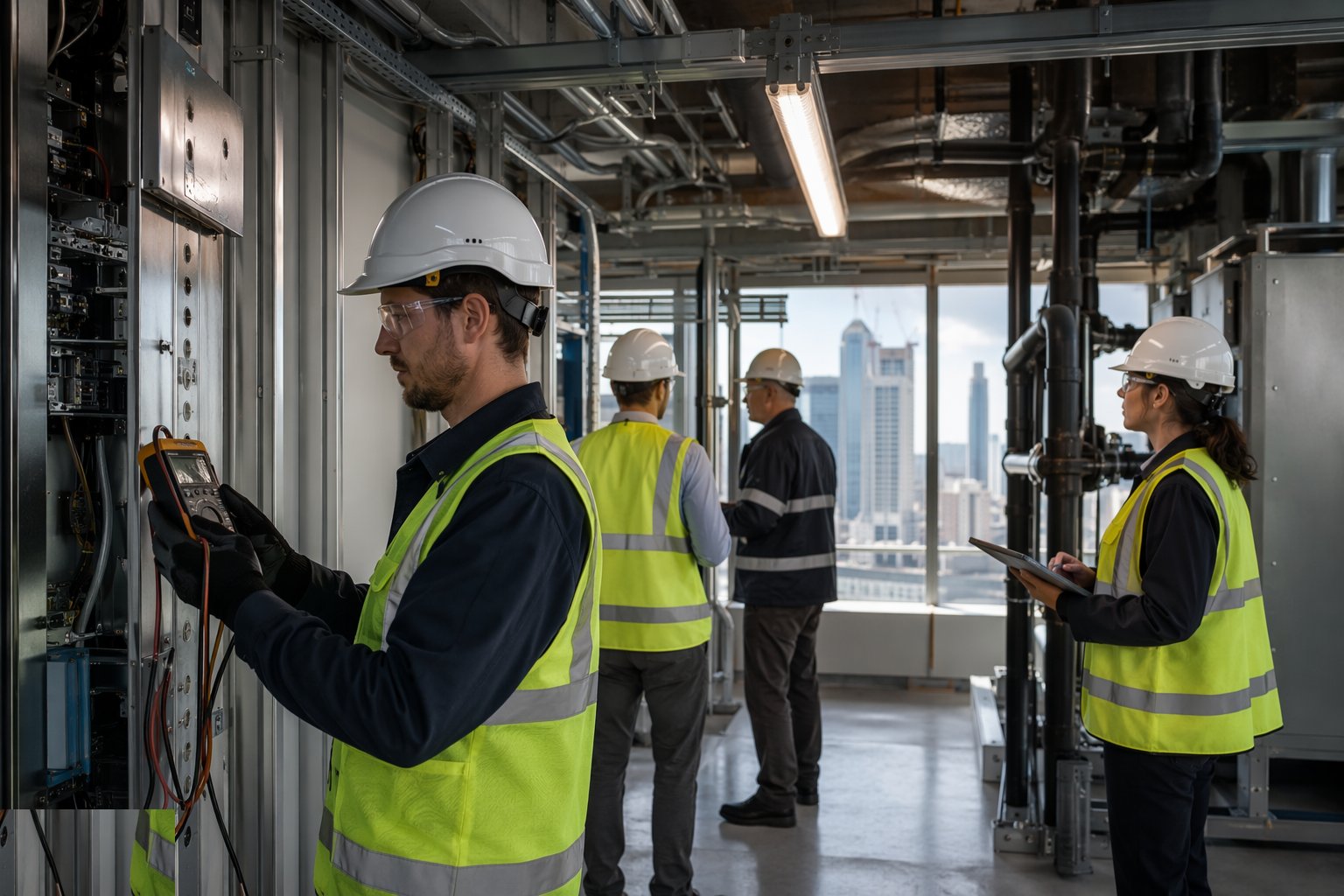
The documentation is assembled as the asset's operating manual: as-built drawings from the red-line records, O&M manuals for every system, test and commissioning certificates, warranties and spare schedules, the BMS database and graphics, keys, access and the planned maintenance regime. Training is delivered properly — not a walk-round but structured sessions per system, videoed where possible, with the FM team operating the plant themselves before the project team leaves site. In the UK the health and safety file under CDM 2015 joins the package; in the UAE the file supports the TOC, and the DLP clock starts with the contractor still obliged to respond.
Step 7: Seasonal commissioning and soft landings aftercare
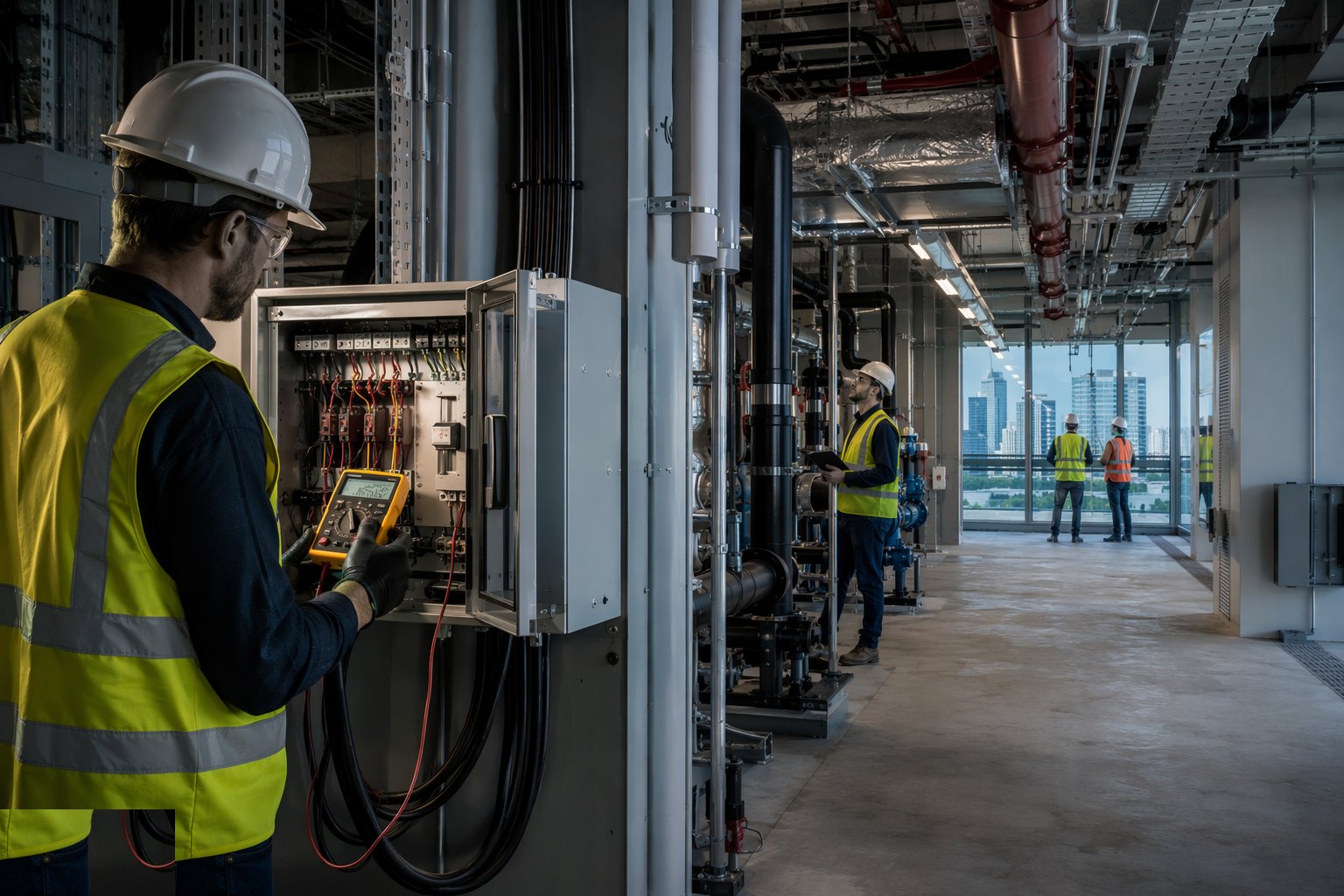
The building is revisited under real load: summer commissioning proves the cooling under peak Gulf or UK summer conditions and winter commissioning the heating, with setpoints and control loops fine-tuned against actual occupancy. Under soft landings, the team provides extended aftercare — monthly reviews, energy performance monitoring against the design, and a structured feedback loop into the FM regime. The DLP or rectification period runs its course with defects made good and recorded, until the Performance Certificate or final certificate closes the contract — remembering that in the UAE, decennial liability under Civil Code Article 880 runs ten years on structural matters, long after the DLP ends.
Plant and equipment
- Airflow measurement: balometers, anemometers, Pitot traverses and micromanometers
- Ultrasonic flow meters and commissioning instrument sets for water balancing
- Electrical test instruments to BS 7671 and thermal imaging for distribution surveys
- BMS head-end workstations, trend logging and point verification tools
- Sound level meters and environmental loggers for performance verification
- Smoke-generating and detector test equipment for cause-and-effect scenarios
- Commissioning documentation systems and digital handover platforms
Quality control checks
- Commissioning plan in place from design stage; systems reviewed for commissionability
- Pre-commissioning certificates — flushing, leakage, electrical, point-to-point — before balancing starts
- Balancing records per circuit and terminal within specified tolerances, instruments calibrated and traceable
- Cause-and-effect matrix fully executed and witnessed, failures rectified and re-tested
- Authority witness and inspection records closed — Civil Defence, DEWA sequence, BCC in Dubai
- Handover file complete: as-builts, O&M, certificates, warranties, BMS database and training records
- Seasonal commissioning visits and soft landings reviews programmed, resourced and reported
Safety considerations
- Energisation and live testing under permit with authorised persons only — the building wakes up in stages, each one controlled
- Life-safety testing coordinated building-wide: nobody works in a zone during smoke control or cause-and-effect scenarios without clearance
- Stored energy on pressure systems and rotating plant during setting to work: guarded, excluded and supervised
- Working in live risers and plant rooms: isolation procedures, confined space rules where applicable, lone-work controls
- Occupied-building commissioning after handover: permits, inductions and respect for tenants who now own the risk
Common defects
- Commissioning compressed into the last month — balancing by guesswork and witness tests failed in front of the client
- Systems balanced on dirty water or unproven points — results that decay within weeks of handover
- Cause-and-effect tested in fragments rather than integrated scenarios — the life-safety chain with a missing link nobody tested
- BMS graphics and points bearing no relation to the plant — the FM team commissioning the building again at call-out rates
- Handover file delivered late or thin — as-builts that are red-lined fiction, O&M manuals without commissioning evidence
- Seasonal commissioning written in but never resourced — the August overheating discovered by tenants, not by the team
- FM training reduced to a walk-round — the building's systems understood by the people who just left site
Best suited for
- Proving MEP performance to design intent before completion
- Integrated life-safety testing under witness for completion gates
- Documented handover to facilities management with training and support
- Seasonal commissioning and soft landings aftercare through the first years of occupation
How long does Testing, Commissioning & Handover — Commercial take?
Typical duration: Active commissioning typically runs 3–6 months on a commercial tower, overlapping the last floors' fit-out; seasonal commissioning and soft landings extend structured support 12–36 months beyond completion..