Construction Plant and Equipment
The plant families every site runs on — earthmoving, lifting, access, concrete, compaction and piling — and how to choose, hire and man them properly.
Last updated 2026-07-28 by the BuildPedia Editorial Team.
What is Construction Plant and Equipment?
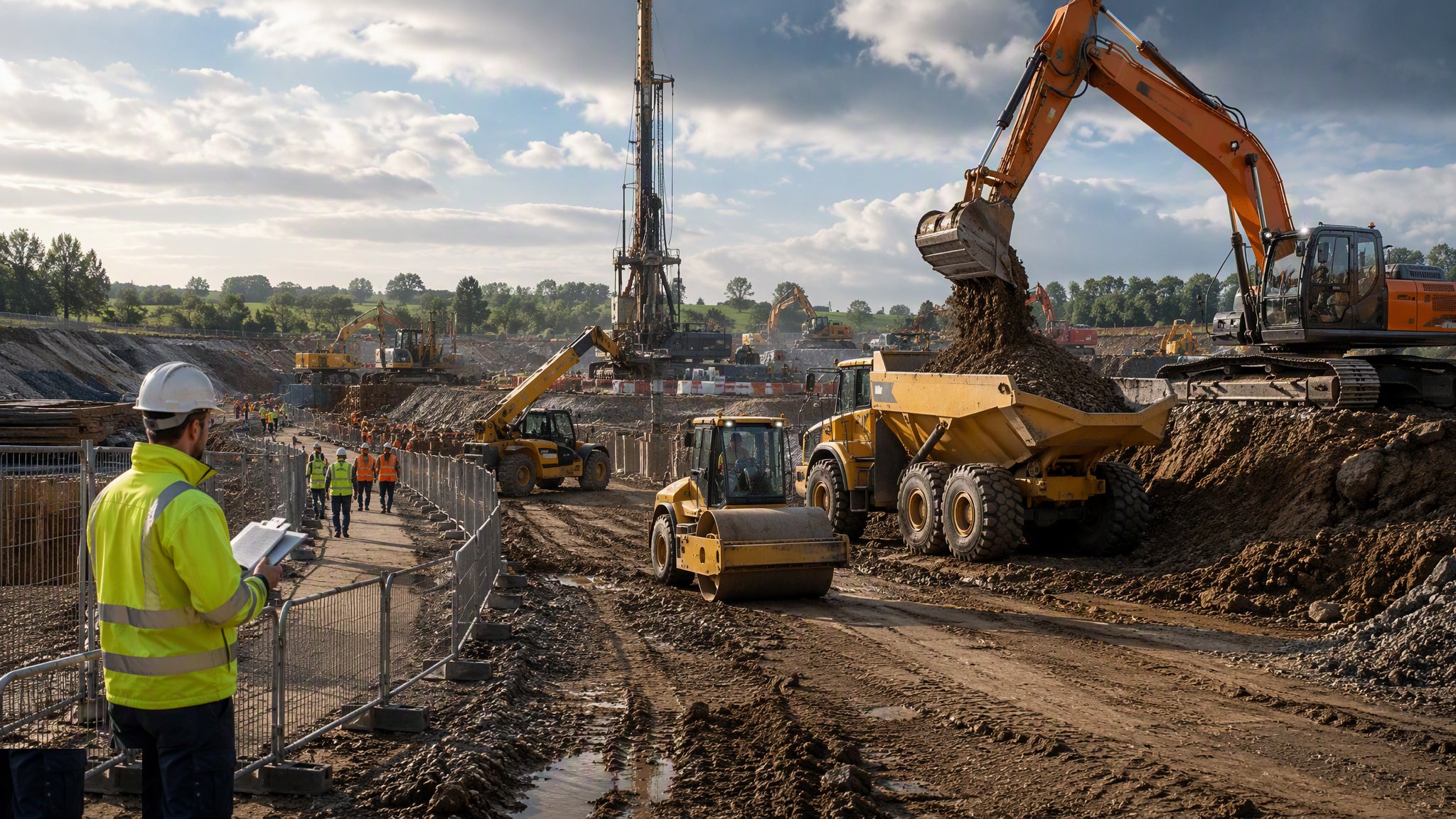
This is the hub page for the machines. Every construction site is a plant operation with a building as a by-product: excavators move the ground, cranes move the materials, access kit puts men at the workface, concrete plant places the structure, compaction kit makes the ground carry load, and piling rigs found it all. The detailed pages in this section cover the operations that lean hardest on each family — craneage and lifting, hoists and material handling, excavation support, temporary works design — and the earthworks, piling and concrete pages in the wider library cover the permanent-works side. This page is about the plant itself: what the families are, how to choose between them, and what competence looks like on the levers.
Selection logic is always the same triangle: the work to be done, the ground and space to do it in, and the rate the programme needs. A 13-tonne excavator is the wrong answer to both a garden wall foundation (too big to stand) and a 200,000 m³ cut (too slow to matter). Utilisation drives the money: a machine that works four days a week belongs on hire; one that works fifty weeks a year might belong in the fleet. UK hire economics run on weekly rates plus standing charges; the honest comparison includes mobilisation, operator, fuel, maintenance and the downtime risk of an owned machine with a dead hydraulic pump.
Competence is not optional and is not generic. In the UK, CPCS and NPORS cards evidence operator training by category — a 360° excavator ticket is not a telehandler ticket — and lift roles (Appointed Person, slinger/signaller, lift supervisor) carry their own categories. In the UAE, operator licensing runs through the emirates' authorities with third-party certification for cranes and lifting equipment, and principal contractors commonly require UK-equivalent cards or local equivalents plus site-specific assessment. A card gets a man in the seat; familiarisation on the specific machine and a site induction keep him there. Every machine on site should be able to answer three questions: who is authorised to operate it, when was it last examined, and what is it rated to lift or carry.
When and why is Construction Plant and Equipment used?
Plant decisions are made at three levels: the tender logistics plan (which families, what sizes, tower crane or mobiles), the mobilisation plan (what arrives when, standing where), and the weekly supply decisions (hire on, hire off, swap sizes as the works change phase). Hire versus owned turns on utilisation and balance sheet: specialist kit — piling rigs, big crawlers, MCWPs — is hired with the specialist contractor attached; general fleet — excavators, dumpers, telehandlers, rollers — is hired by the week in both markets, with the big UK and UAE hire fleets carrying the maintenance risk. The wrong plant decision shows up as money (standing machines), as programme (undersized kit) or as an accident (unrated, unexamined or wrongly operated machines), so it gets the same engineering attention as the structure.
Types of Construction Plant and Equipment
Earthmoving
Excavators 1.5–80 t, dozers, dumpers and ADTs, loaders, graders and scrapers. Sized to the cut, the haul and the ground — see the earthworks and excavation support pages for the operations they serve.
Lifting
Tower, mobile and crawler cranes, telehandlers on lifting duties, and the accessories that make them legal. Selection is a load-radius-ground calculation — see the craneage page for the full method.
Access
Scaffold, MEWPs (scissor and boom), mast climbers and hoists. Chosen by duration, height, loading and the trade being served — see the hoists and material handling page for the vertical logistics side.
Concrete and compaction
Pumps, placing booms, vibrators, saws and power floats on the concrete side; plates, rammers and rollers from 80 kg to 12 t on the compaction side. The concrete and earthworks pages carry the method detail.
Piling and ground engineering
CFA and rotary bored rigs, driven rigs and hammers, mini and restricted-access rigs, grout plant. Specialist plant that arrives with its contractor — see the piling pages for selection by ground and load.
Construction Plant and Equipment: step by step
Step 1: Define the work before the machine
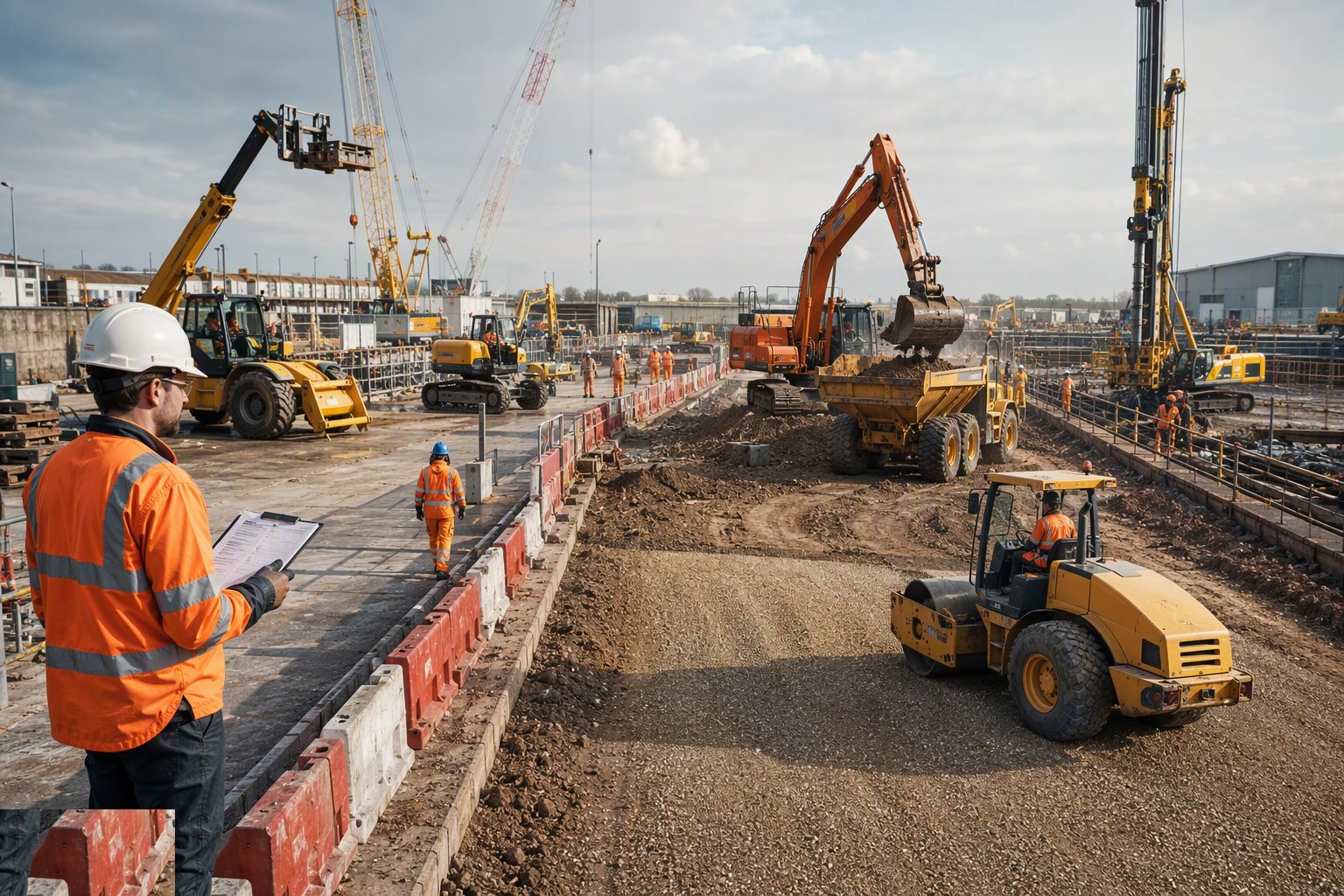
Start with quantities and rates: cubic metres per week, lifts per day, square metres per pass. The production requirement sizes the machine, and the haul distance, ground conditions and access constrain it. Write it down — "a digger" is not a specification; "13 t 360° with 0.6 m³ bucket, zero-tail because of the boundary, 40 hr/week utilisation" is.
Step 2: Check the ground and the space
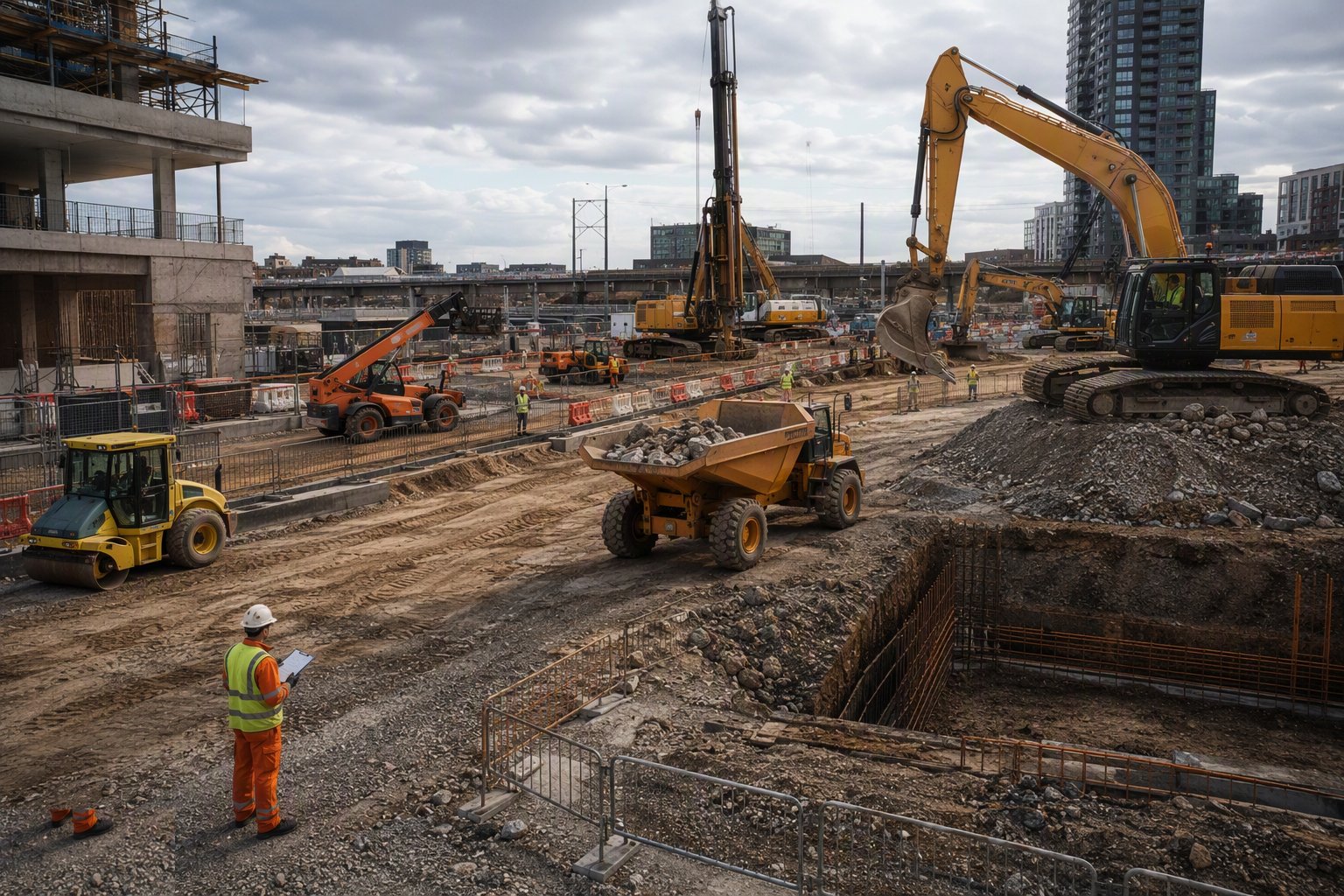
Every machine imposes load and needs room: bearing capacity under tracks and outriggers, slew and working radius against boundaries and overhead lines, haul routes and gradients, headroom in basements and under bridges. The access audit is part of selection — the right machine that cannot get to the workface is the wrong machine.
Step 3: Run the hire-or-own arithmetic
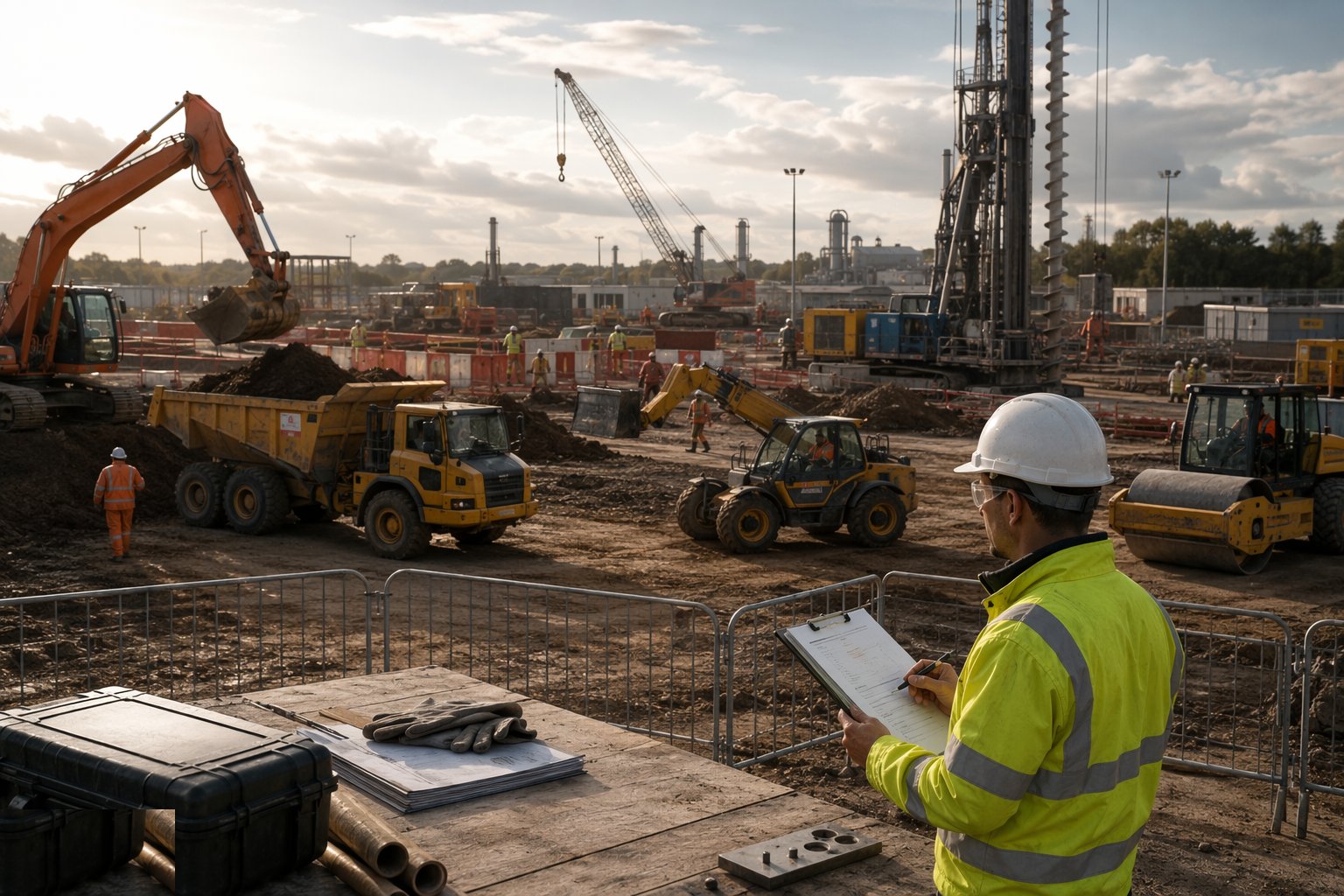
Compare the true weekly cost: hire rate plus fuel, operator, mobilisation and insurance against ownership depreciation, maintenance, transport and the cost of standing idle. Break-even on general plant typically sits well above 60–70% utilisation once maintenance and downtime are honestly counted. Specialist kit defaults to hired-with-operator; commodity kit is a genuine choice.
Step 4: Specify the safety and compliance package
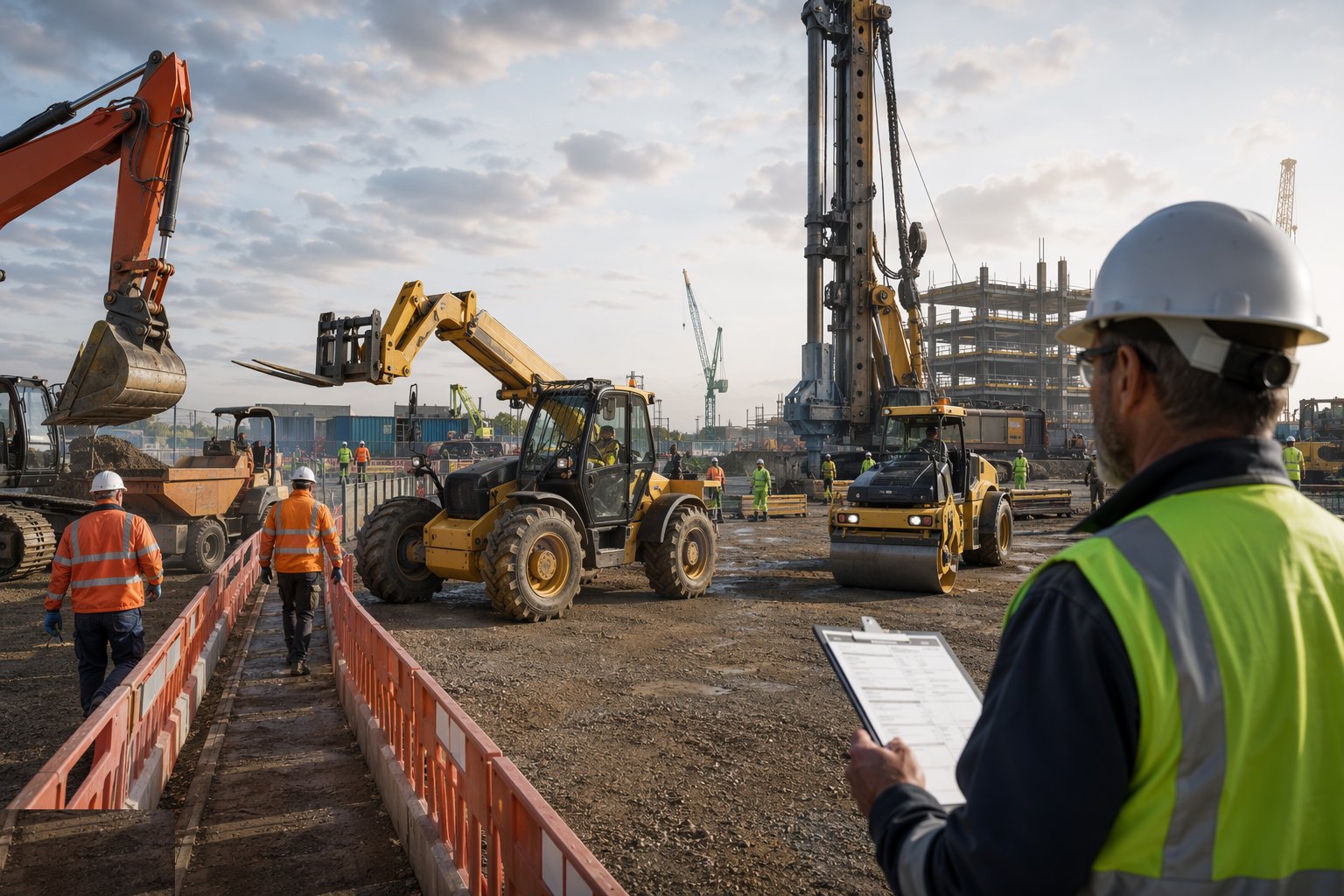
The order states what the machine arrives with: thorough examination certificates where applicable (LOLER for lifting), CE/UKCA conformity, ROPS/FOPS cabs, seat belts, reverse alarms and cameras or radar, quick-hitch standards with the safety pin actually fitted, and emissions compliance for low-emission zones. In the UAE, third-party certification for lifting gear and the authority registrations travel with the machine.
Step 5: Verify the operators
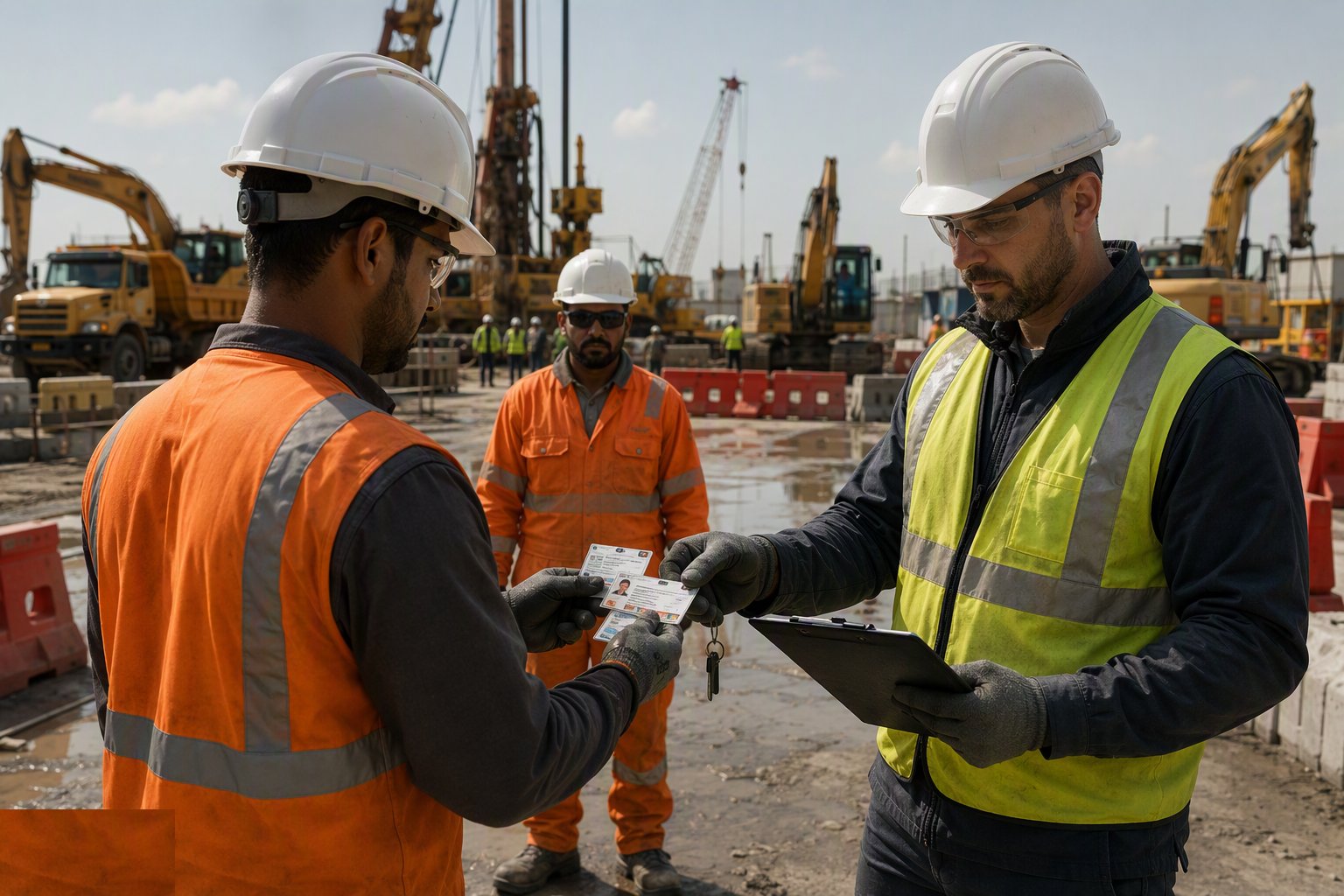
Cards checked against category before the key is handed over: CPCS/NPORS categories in the UK, UAE operator licences plus third-party crane certification in the Gulf, and lift-role categories (Appointed Person, slinger/signaller, lift supervisor) for the lifting team. Then machine-specific familiarisation and site rules: exclusion zones, pedestrian segregation, signalling code, refuelling and shutdown procedures.
Step 6: Induct, inspect and maintain on site
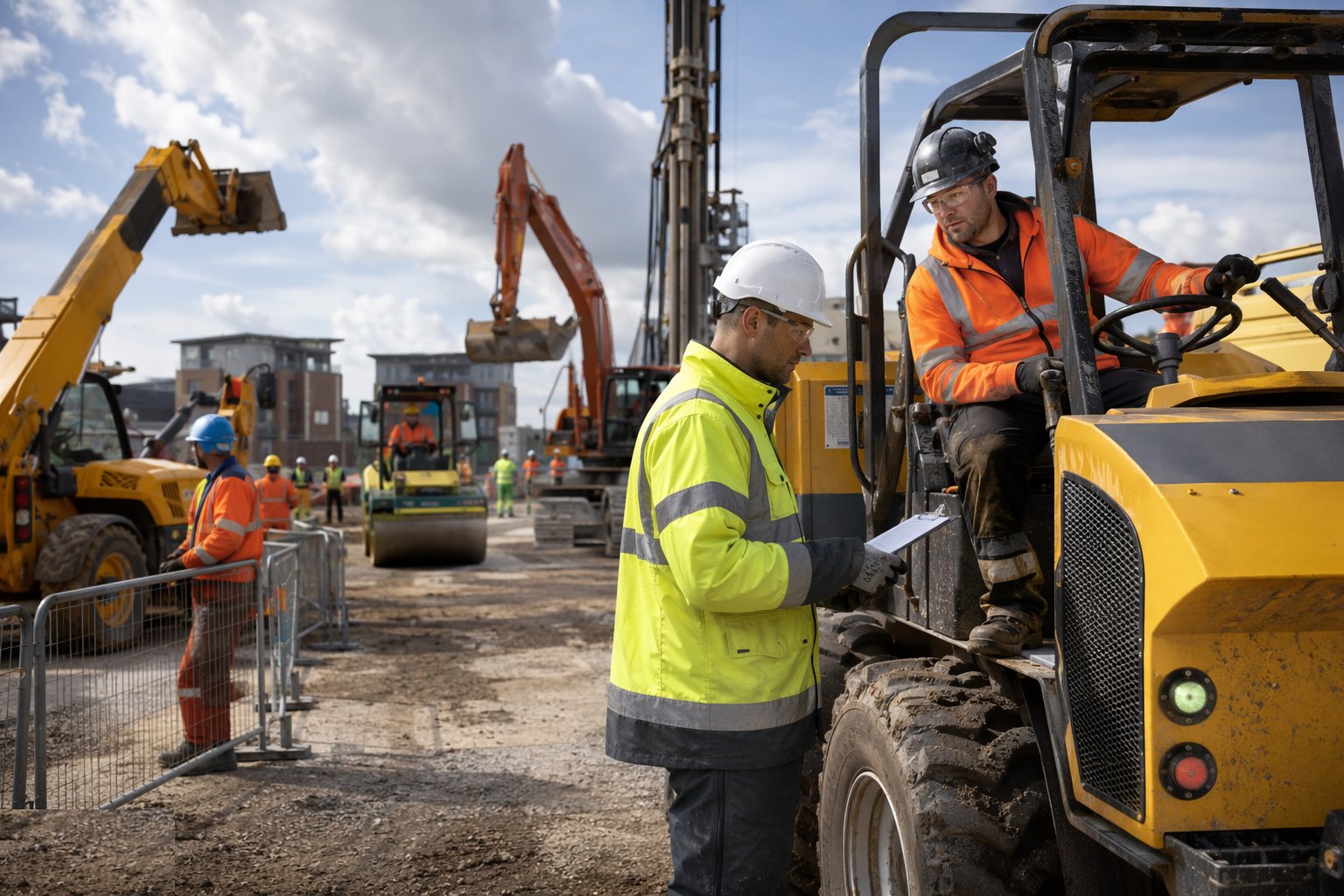
Every machine is inducted: documents checked, defects logged, daily pre-use checks assigned to the operator and actually done. Weekly plant inspections by the plant team catch what daily checks miss — hose chafe, track tension, quick-hitch wear. Hired machines with defects get tagged out and the hire company called; the pressure to "use it for today" is exactly how hydraulic hoses become headlines.
Step 7: Manage the interface — people, plant and public
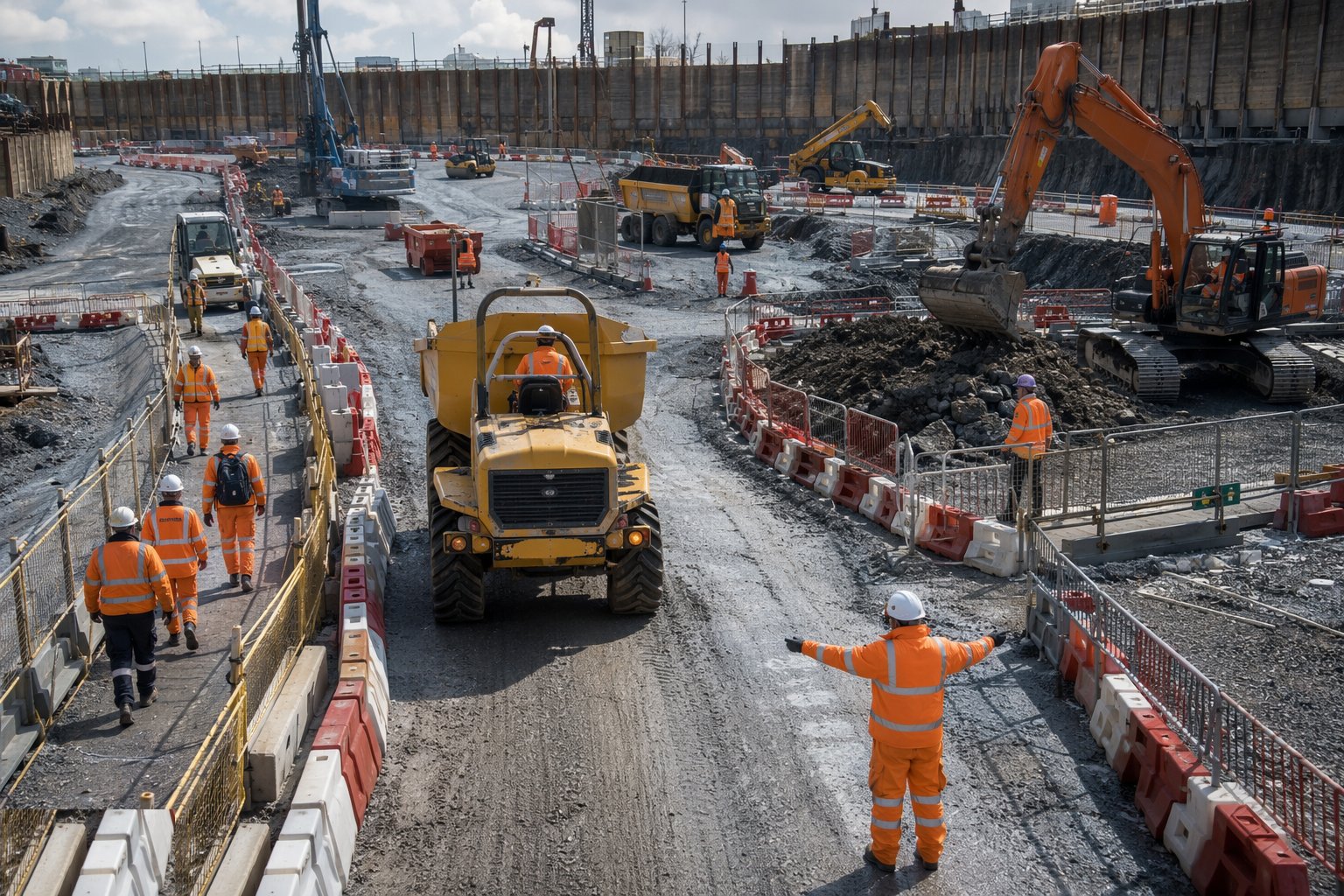
Plant and pedestrians are segregated by design: walkways, barriers, crossing points, one-way haul routes, and a vehicle marshaller wherever reversing is routine or sightlines are poor. Overhead lines and buried services are on every operator's briefing with their approach distances. Off-site, road-going plant is cleaned, lit, plated and escorted as the movement order says.
Step 8: Review utilisation and hire off

Weekly, the plant list is walked: what is working, what is standing, what the next phase actually needs. Standing machines are hired off — the two weeks a 13-t sat unused paid for a lot of something else. Phase changes (earthworks to frame, frame to fit-out) are planned plant transitions: the big kit leaves as the access and logistics kit arrives, and the site audit confirms nothing on hire has quietly become furniture.
Plant and equipment
- Excavators 1.5–80 t with buckets, breakers and grabs on safe quick-hitches
- Dumpers and ADTs, dozers, loaders and graders for bulk earthmoving
- Tower, mobile and crawler cranes; telehandlers with lifting duties
- MEWPs, hoists, MCWPs and scaffold for access and vertical logistics
- Concrete pumps, placing booms, pokers, saws and power floats
- Compaction: plates, rammers, tandem and single-drum rollers
- Piling rigs: CFA, rotary bored, driven, and restricted-access variants
- Site support: bowsers, generators, lighting towers, compressors and welfare power
Quality control checks
- Plant register live on site: every machine, certificates, inspections, authorisations
- Thorough examinations current for all lifting equipment and accessories
- Daily pre-use checks recorded by operators; defects tagged out, not worked round
- Weekly plant inspections with close-out tracking on defects
- Utilisation reviewed weekly against the programme — standing plant hired off
- Quick-hitch, ROPS, alarms and camera systems verified functional at induction
- Fuel, hour-meter and telematics data used to spot abuse and plan maintenance
Safety considerations
- Pedestrian-plant segregation by design — walkways, barriers, controlled crossings
- Reversing controlled: marshals, cameras, one-way systems; the rear blind spot kills
- Operator competence verified per machine category before the seat is taken
- Overhead lines and buried services on every briefing with approach distances
- Quick-hitches pinned and checked — the detached bucket is a recurring UK fatality mode
- Seat belts in anything with a cab; ROPS only works with the belt on
- Refuelling, battery isolation and shutdown discipline at shift end
- Road movements compliant: clean, lit, plated, escorted where required
Common defects
- Oversized machines standing half the week — the hire cost nobody revisited
- Undersized kit stretching the programme because the rate was never calculated
- Quick-hitch buckets detached mid-task — the pin was never fitted or checked
- Unexamined lifting accessories sharing a container with certificated ones
- Cards not matching the machine — a telehandler ticket on a 17-t excavator
- Daily check books signed in advance in the cab at 6:55 am
- Machines hired on for a phase and quietly standing into the next one
Best suited for
- Every site: the plant plan is the logistics plan made of steel
- Tender stage — where the tower crane and earthworks fleet decisions are cheapest to change
- Phase transitions, where hiring on and off to the programme saves the standing costs
- Specialist operations where the plant arrives with its contractor and its method
- Teams building a plant register, competence matrix and inspection regime from scratch
How long does Construction Plant and Equipment take?
Typical duration: Mobilisation of a general plant fleet: 1–2 weeks with the site setup. Specialist plant (piling rigs, crawlers): per mobilisation order, often 2–4 weeks of lead time. The fleet runs the duration of the works, re-shaped at every phase change..
Related processes
- Propping, Façade Retention and Temporary Support
- Excavation Support and Trench Shoring
- Craneage and Lifting Operations
- Hoists, Mast Climbers and Material Handling
- Temporary Works — Design, Control and the TWC
- Scaffolding and Access Systems
- Vertical Formwork — Wall, Column, Climbing and Jump Form
- Horizontal Formwork and Falsework
- Temporary Works & Plant sector guide
- Buildings group