Temporary Works & Plant
The kit that holds the job up while the real work happens — design, access, formwork and lifting.
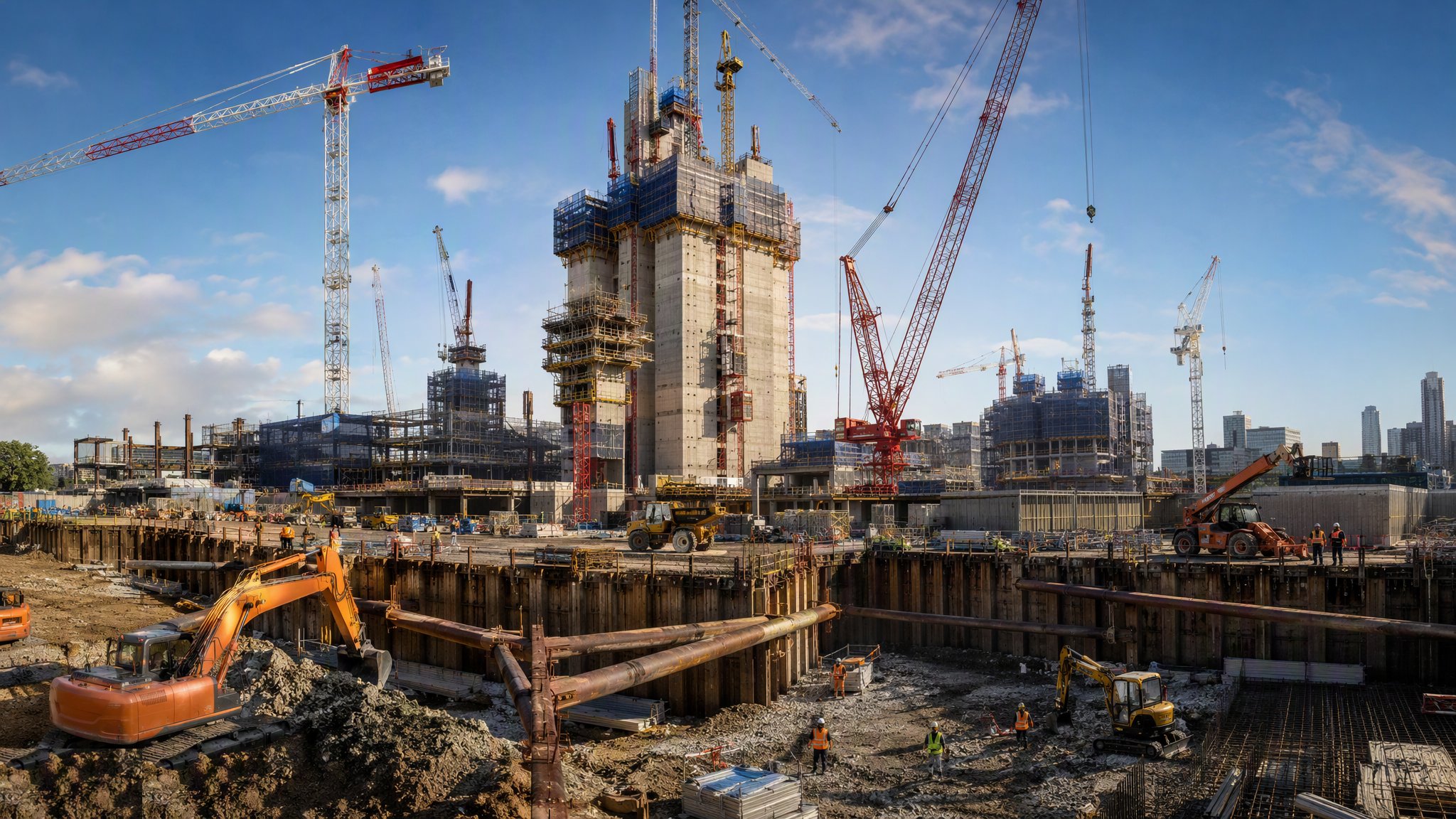
Temporary works is everything that gets built to build the building and then disappears: the scaffold you stand on, the formwork the wet concrete pushes against, the props holding the slab above, the shoring keeping the trench open, the crane base the whole lift plan depends on. It routinely carries more load than the permanent structure around it, and temporary works failures kill more people on site than failures of the permanent design ever have. That is why the discipline exists: every item on a register, every item with a design brief, every design checked in proportion to its risk, and a Temporary Works Coordinator with the authority to say no. The register and the permit-to-load are not paperwork for its own sake — they are what stands between a wet slab and a collapse.
Then there is the plant itself, and the decisions here set the programme more than any drawing does. The crane you choose decides how many storeys a week you can climb; the hoist decides when the trades can follow the frame; the scaffold system decides how the envelope sequence runs. Get the craneage and access strategy right at tender and the job flows — get it wrong and you spend the whole contract working around it. These nine guides cover the control regime, the access systems, the formwork and falsework, the propping and shoring, and the lifting and logistics kit that every sector on this site quietly depends on.
What does Temporary Works & Plant cover?
Process guides in Temporary Works & Plant
- Temporary Works — Design, Control and the TWC — The register, the briefs, the checks and the permits that stop formwork, scaffolds and props collapsing — the paperwork that actually prevents failures.
- Scaffolding and Access Systems — Tube-and-fitting and system scaffolds, towers and MEWPs — how the workforce actually gets to the work face, tied, tagged and inspected.
- Vertical Formwork — Wall, Column, Climbing and Jump Form — Timber, panel, climbing and jump form systems for walls and columns — pour pressure, plumb, kickers and striking on strength.
- Horizontal Formwork and Falsework — Table forms, prop-and-panel decks and birdcage falsework for slabs and beams — back-propping, load paths, striking sequence and precamber.
- Propping, Façade Retention and Temporary Support — Holding a building up while you take parts of it away — needle beams, raking shores, façade retention frames and the monitoring that tells you it is all still standing.
- Excavation Support and Trench Shoring — Keeping the sides of a hole standing — battered slopes, trench boxes, hydraulic walings and sheet piles — because a cubic metre of soil weighs about two tonnes and it does not warn you.
- Craneage and Lifting Operations — Choosing, standing and running the cranes that feed the whole site — lift planning under BS 7121, ground bearing, wind limits and the people who make a lift legal.
- Hoists, Mast Climbers and Material Handling — The vertical logistics that decide whether a tower finishes on time — passenger hoists, goods hoists, mast climbers, telehandlers and the loading-bay strategy behind the finishing programme.
- Construction Plant and Equipment — The plant families every site runs on — earthmoving, lifting, access, concrete, compaction and piling — and how to choose, hire and man them properly.
Shared methods used in Temporary Works & Plant
- Site Access & Enabling Works
- Concrete Frame Construction
- Basement & Substructure
- Earthworks & Excavation
- Bridge Deck Construction
- Steel Frame Construction
Part of the Buildings group.