Soft Landscaping & Gardens (Homes & Villas)
Plot-level soft landscaping for homes and villas — topsoil, drainage and irrigation, turfing and planting, from a UK family garden to an irrigated UAE villa plot.
Last updated 2026-07-28 by the BuildPedia Editorial Team.
What is Soft Landscaping & Gardens (Homes & Villas)?
This is the garden at plot level: the ground around a house or villa turned from builder's rubble and compacted subsoil into lawn, beds, trees and living space. It sits deliberately apart from the public-realm landscaping guides elsewhere on the site — those cover streetscapes, parks and podiums at infrastructure scale with specification planting and adoption standards. Here the client is the homeowner, the quantities are measured in lorry loads rather than hectares, and the trade is judged at eye level from the kitchen window. The work is still engineering of a kind: levels that drain away from the DPC, topsoil of the right depth and quality, drainage that stops the lawn becoming a pond, and in the UAE an irrigation system without which nothing planted survives its first summer.
The sequence matters more than the planting list. Get the levels and the drainage right before the topsoil; get the topsoil down before the turf; plant trees and shrubs when the season, not the programme, says so; and do not let the paving gang and the irrigation first fix fight over the same trench a week before handover. Most garden defects — waterlogged lawns, dead hedges, heaving paths — were decided underground at groundworks stage, months before anyone unrolled a turf.
When and why is Soft Landscaping & Gardens (Homes & Villas) used?
Soft landscaping is the closing trade of the external works — after the building is weathertight, the hard landscaping (paving, walls, fences) is substantially built, and the heavy plant has left the plot for good. It happens last because topsoil, turf and planting cannot survive site traffic, and because the finished levels of every path, patio and manhole cover must be fixed before the soil meets them. In the UK the timing is seasonal: turf and planting want spring or autumn, and an NHBC handover in midwinter often means seed or a return visit. In the UAE the irrigation first fix is on the critical path — planting without a commissioned, DEWA-approved water supply and controller is a write-off — and the planting window is October to March. On show homes the whole garden is compressed into the final fortnight before the marketing suite opens, which is exactly when the corners get cut.
Types of Soft Landscaping & Gardens (Homes & Villas)
UK family garden
Topsoil over improved subsoil, turf or seed lawns, mixed shrub and hedge planting, a specimen tree or two, and drainage that copes with a wet winter. Works to NHBC and Building Regs levels: ground falling away from the DPC, 150 mm below damp level, rainwater managed on the plot where possible.
UAE villa garden with irrigation
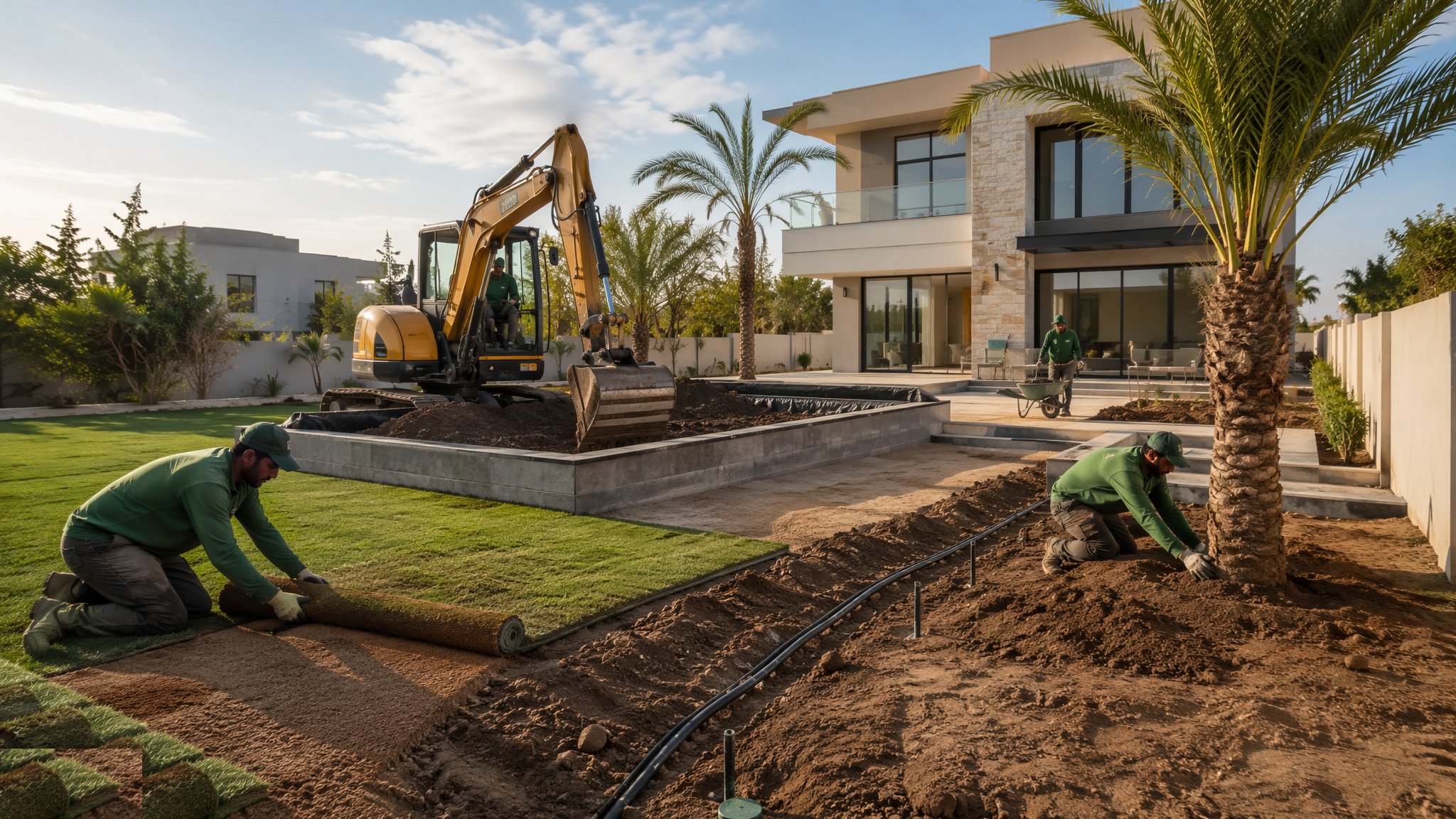
Irrigated lawns, palm and native or salt-tolerant planting, imported sweet soil in beds, and an automatic drip and pop-up irrigation system zoned off a DEWA-compliant supply. Water efficiency, shade and establishment watering decide what lives; hard-landscape interfaces (boundary walls, paving, pools) dominate the detailing.
Show-home & fast-track garden
Instant-impact landscaping for the sales window: mature or semi-mature specimens, rolled turf on prepared soil the same week, containerised planting, and irrigation stubbed for the purchaser to commission. Everything is done in days, so the preparation — levels, soil, drainage — has to be right first time.
Roof, terrace & podium gardens
Soft landscaping over structure: lightweight growing medium over drainage boards and protection layers on the waterproofing, restrained planters, wind-tolerant species and irrigation run from the building services. Load limits, root barriers and access for maintenance replace the open-ground rules entirely.
Soft Landscaping & Gardens (Homes & Villas): step by step
Step 1: Set levels and place the topsoil
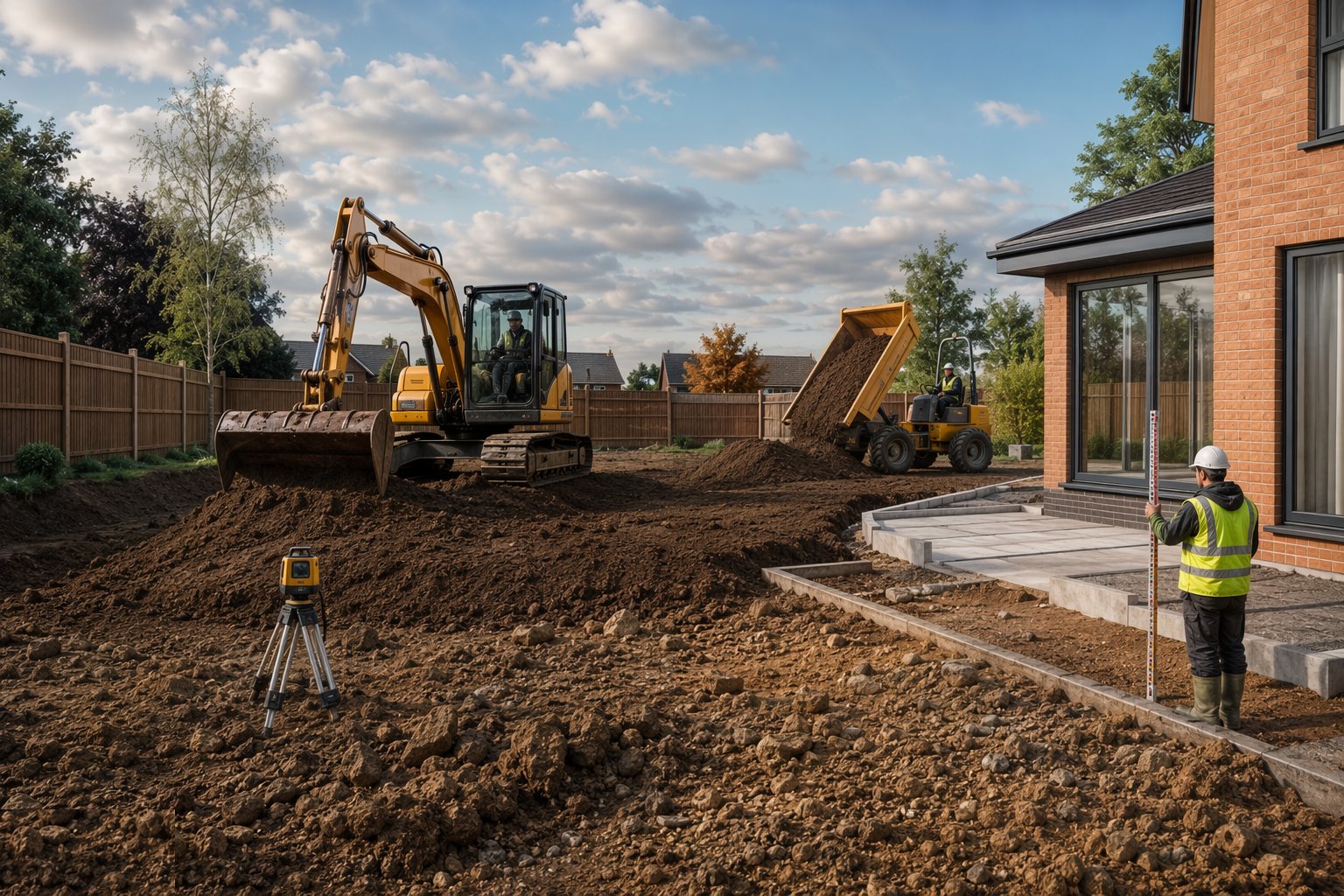
Finished garden levels are worked out from the fixed points — DPC, paving, manhole covers, thresholds — before a load of soil arrives: ground falling away from the building, 150 mm minimum below damp level, no soil bridges against the wall. Subsoil is ripped and decompacted, rubble and builder's debris carted away, and topsoil placed to the specified depth — typically 150 mm for lawns, 300–450 mm for beds, more over tree pits — not spread thin over compacted fill and called done.
Step 2: Drainage and irrigation rough-in
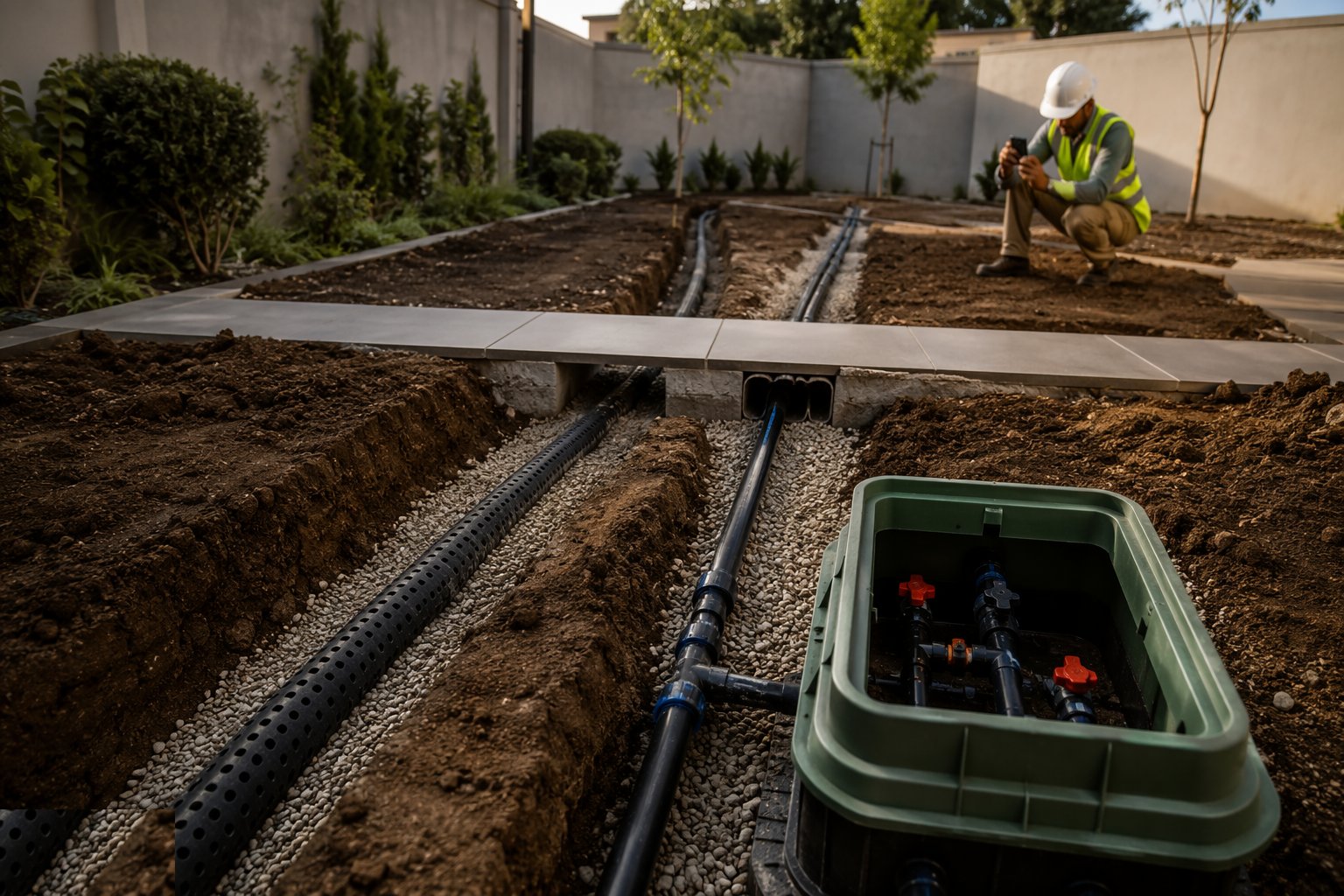
The wet trades go in while the ground is still open. Land drains or a soakaway relieve the wet corners; gullies connect to the surface-water system; and in the UAE the irrigation rough-in runs now — MDPE mains, zone valves in chambers, controller position and power, and sleeves under every path and wall the pipe must cross later. Every route is photographed and dimensioned before covering, because the first thing a spade finds in year two is the pipe nobody recorded.
Step 3: Prepare the soil — cultivation and amelioration
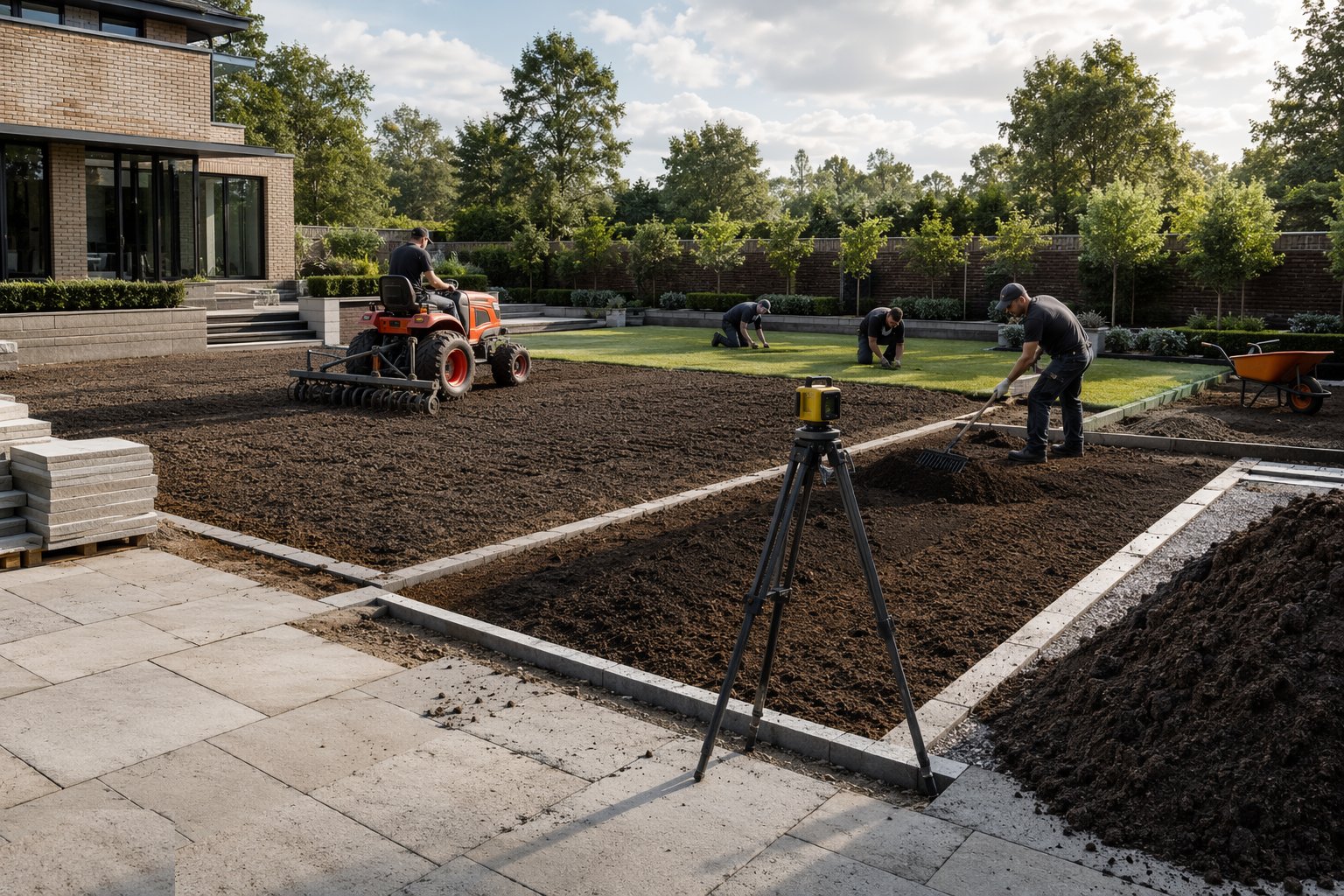
Topsoil is cultivated to a fine tilth for turfing areas, stones and debris picked off, and ameliorants worked in where the ground needs them — organic matter into sandy UAE soils, grit or compost into heavy UK clays, fertiliser to the soil analysis rather than habit. Levels are re-checked after cultivation: soil settles, and a lawn laid on unconsolidated ground ripples within a season.
Step 4: Hard-landscape interfaces and edging
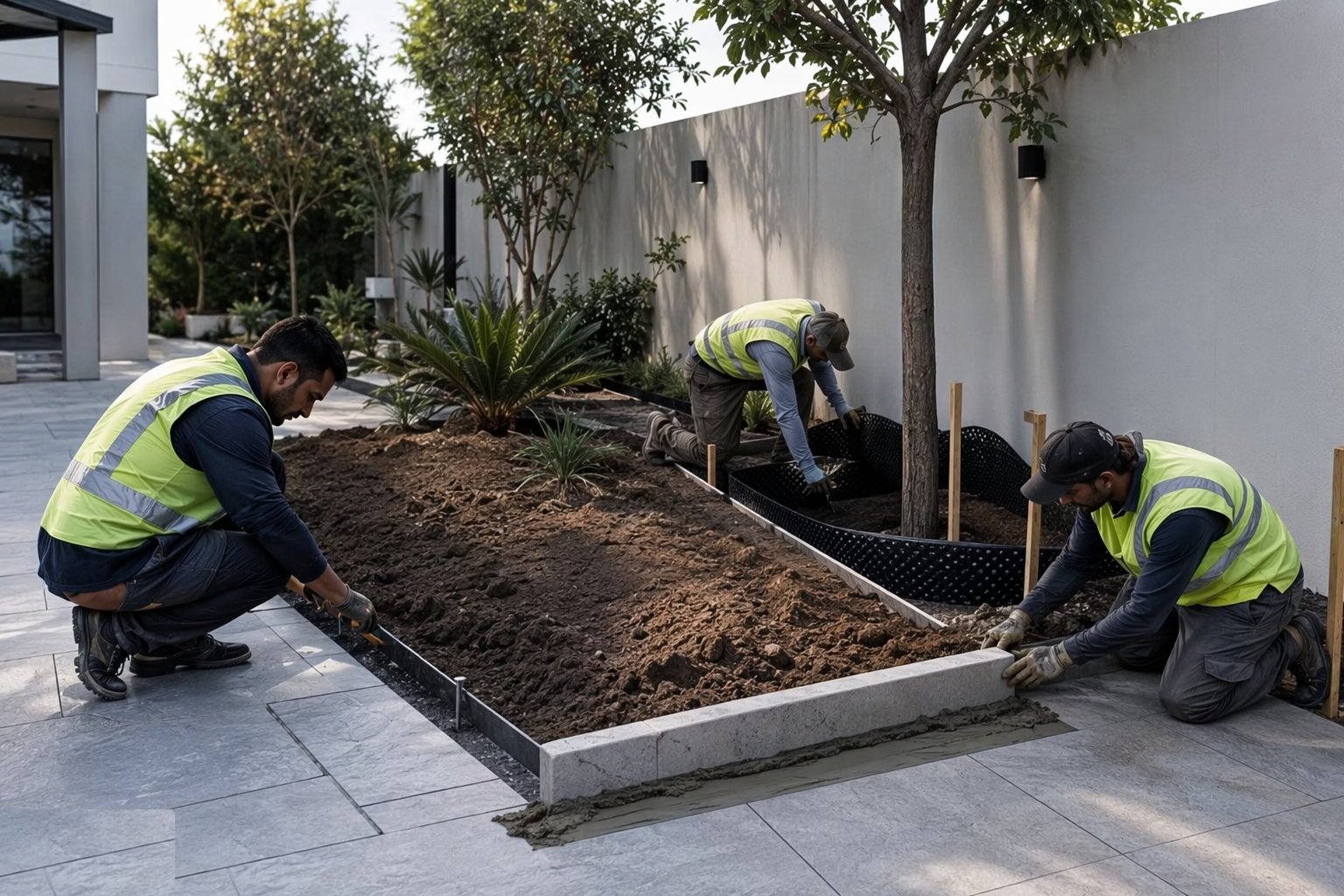
Where soft meets hard, the detail is set before planting: mowing edges and metal or precast edgings along beds, soil held back off paving at the right upstand, root barriers where trees sit near walls or drains, and tree pits formed with their stakes, ties and watering pipes. On UAE villas the interfaces are boundary-wall footings, pool surrounds and shaded pergola bases; on podiums they are planter upstands, drainage-board outlets and the waterproofing that must never be punctured.
Step 5: Turfing and seeding
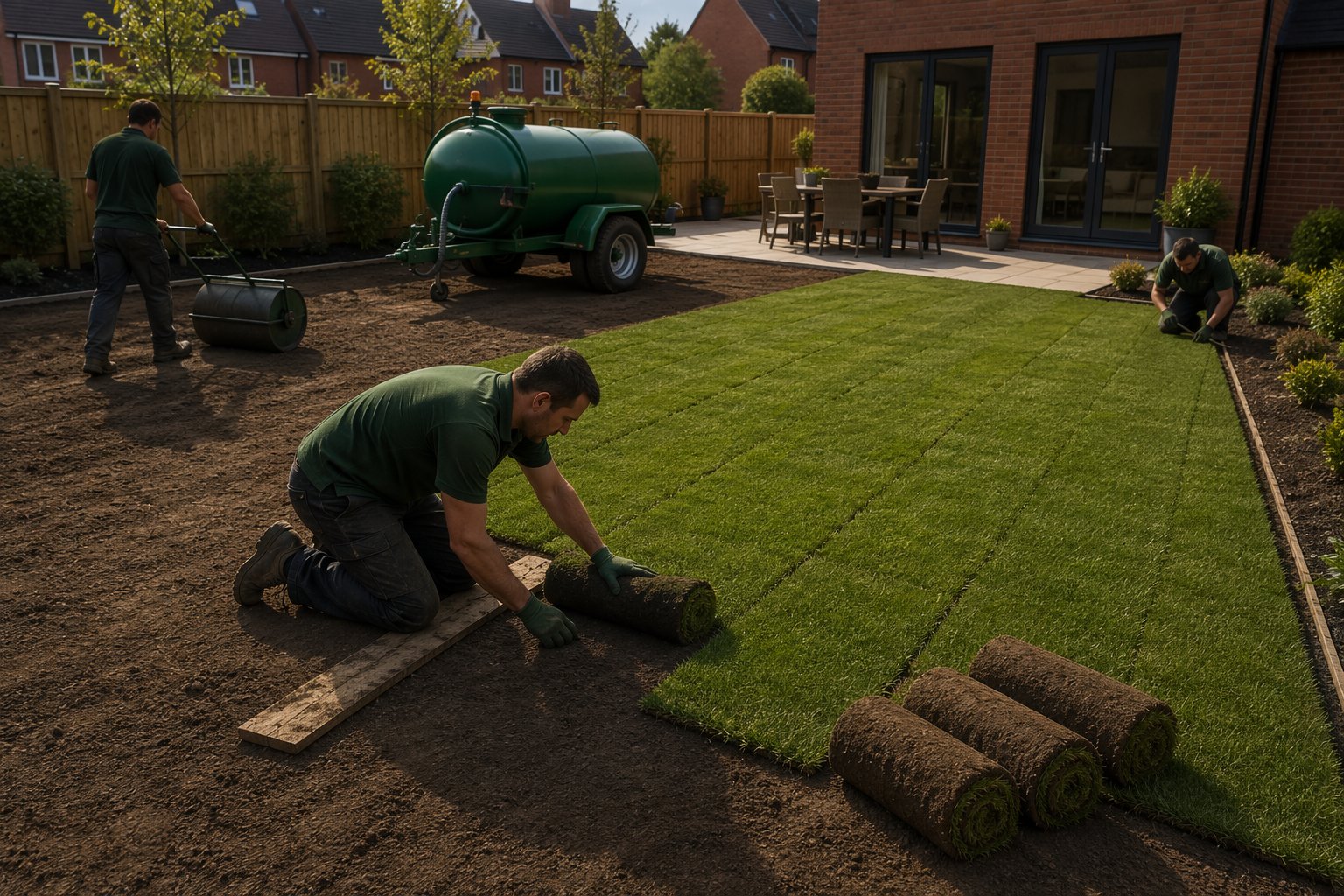
Turf goes down on prepared, firmed, level soil the day it arrives — laid staggered bond, butted tight, worked off boards, rolled and watered in within the hour in hot weather. Seed is the patient alternative on larger UK lawns, needing the right season, a fine seedbed and protection from birds and feet. Edges are cut to the line last, and the first mow waits until the turf has knitted — lifting a corner to check for roots is the test, not the calendar.
Step 6: Planting — trees, shrubs and hedges
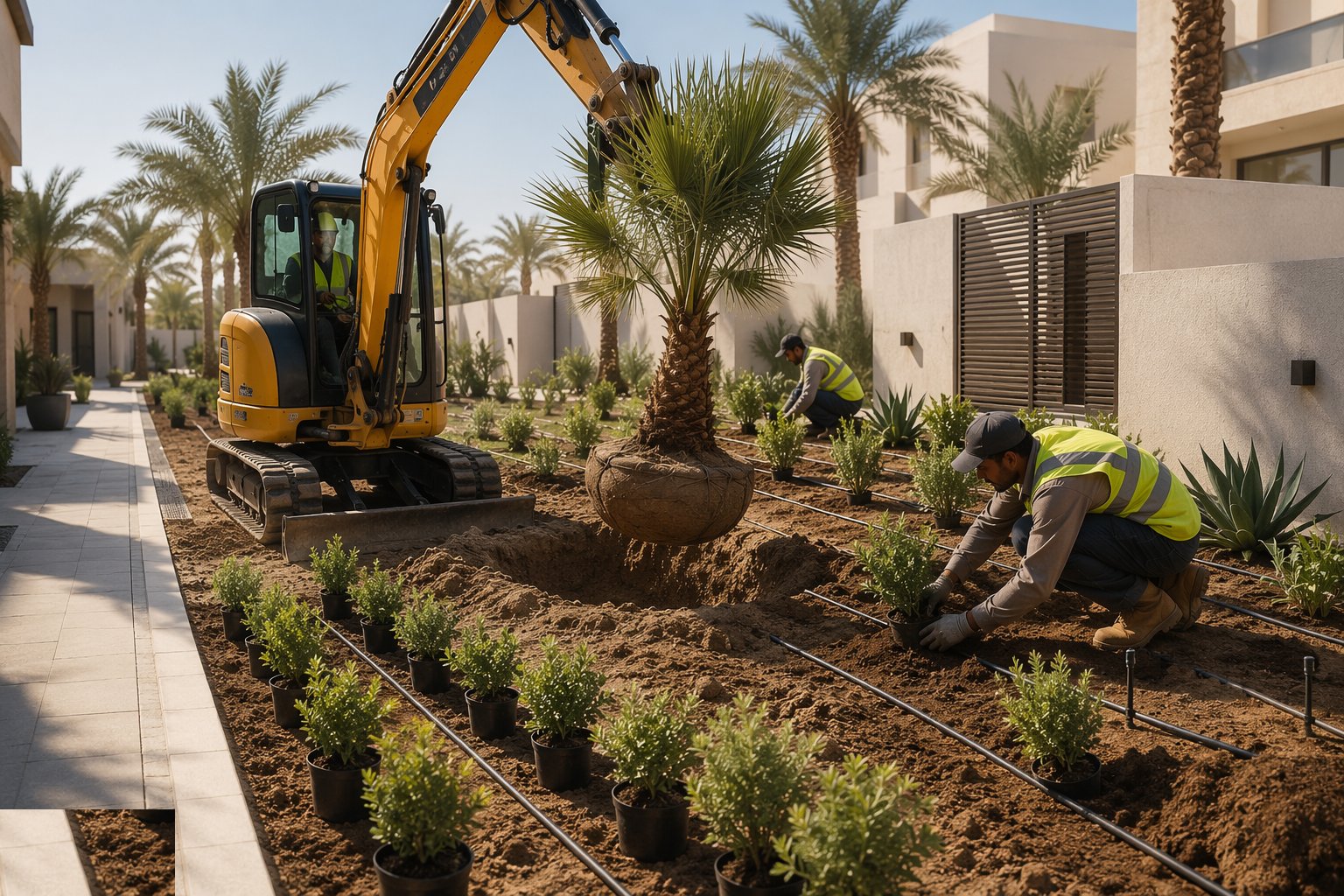
Trees plant first, pit twice the rootball, on undisturbed or compacted ground at the base so they do not sink, staked low and tied with room to move. Shrubs and hedges follow to the planting plan at the specified centres, containerised stock soaked before planting, root-balled stock planted in its season. In the UAE the palette is native and salt-tolerant species — ghaf, sidr, bougainvillea, jasmine, date and ornamental palms — with establishment watering programmed from day one; in the UK it is hedging whips, specimen shrubs and the seasons doing most of the watering.
Step 7: Water features and garden lighting — first-fix coordination
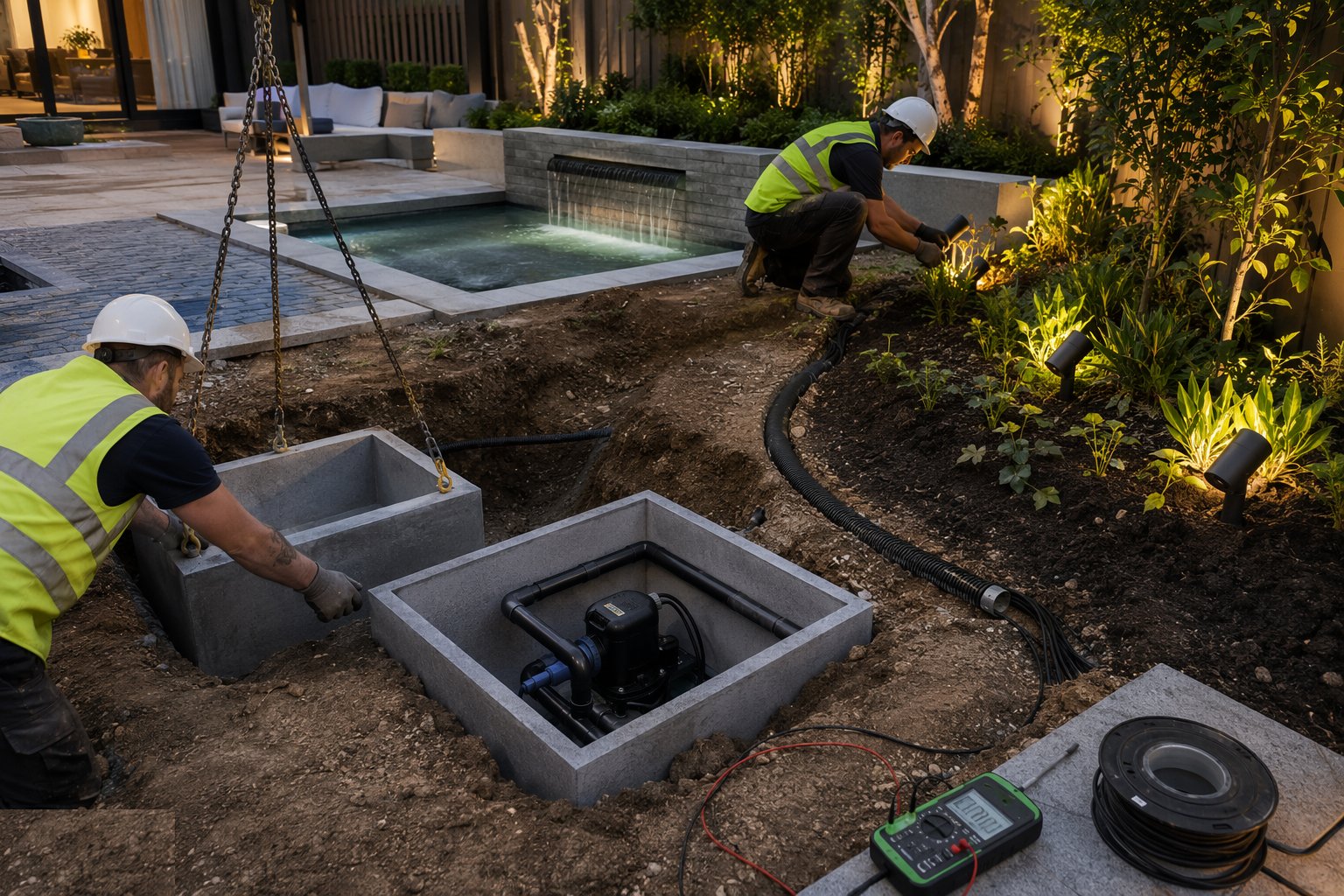
Fountains, rills and garden lighting share the groundworks window: fountain sumps and pump chambers are cast or set with the hard landscaping, cabling runs in duct with draw cord to a proper external-rated supply, and every fitting is IP-rated for its zone. The coordination meeting that matters is the one before the soil goes down — lights under a lawn are cheap on paper and expensive through turf. Circuits are tested, RCD-protected and recorded like any other electrical work.
Step 8: Establishment, snagging and handover
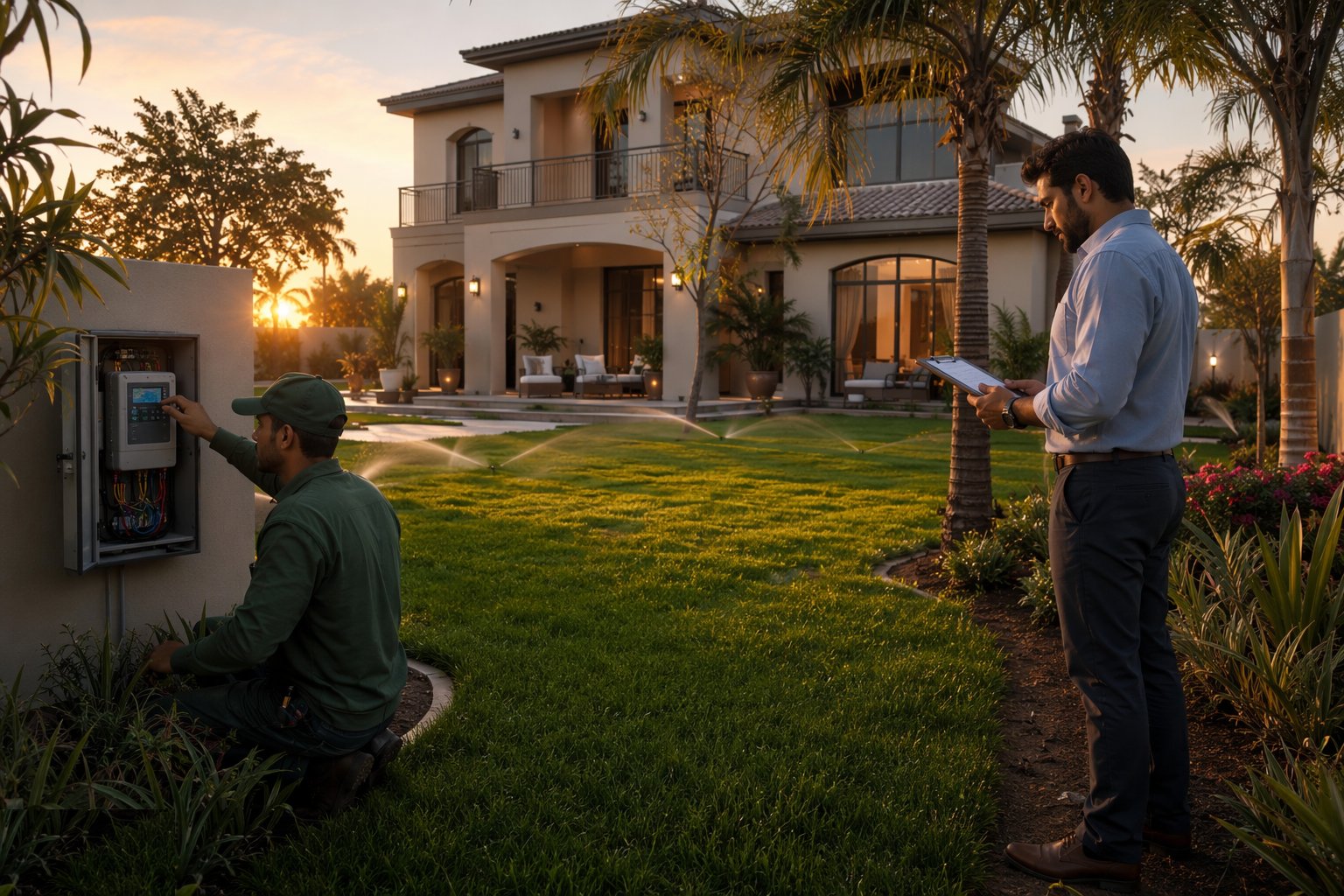
A garden is not finished at practical completion — it is planted. The establishment period (typically 12 months, or the DLP on FIDIC contracts) carries the watering, the replacements of failures, the first hedge trims and the lawn's first season of feeds and cuts. Handover covers the irrigation controller settings and as-laid drawings, the planting schedule and maintenance guide, a snag list of dead or failed stock agreed before sign-off, and in the UK the NHBC check that levels still drain away from the walls.
Plant and equipment
- 360 excavator with grading bucket; dumper and telehandler for soil movements
- Rotavator, stone burier and power rake for cultivation
- Topsoil screen where site-won soil is reused
- Turf cutter, laying boards, lawn roller and water bowser
- Auger and tree-planting attachments; rootball lifting kit for specimens
- Trencher or mole plough for irrigation and lighting ducts
- Irrigation test kit, pressure gauge and controller programming tools
Quality control checks
- Topsoil source certified and sampled — BS 3882 in the UK, approved sweet-soil source in the UAE
- Finished levels and falls checked against DPC and drainage before turf or planting
- Soil depth and cultivation verified per area, not assumed
- Irrigation pressure-tested and zones run and witnessed before planting closes
- Plant stock inspected on arrival — species, size, root condition against the schedule
- Establishment-period failures recorded and replaced per the maintenance obligation
Safety considerations
- Permits to dig and service scans before any excavation near the plot boundaries
- Manual handling: turf rolls and rootballs — mechanical lifting for specimen stock
- Tree-planting with excavators: lift plans, exclusion zones, no one under a swung rootball
- COSHH on fertilisers, pesticides and soil ameliorants
- Dust and silica on dry soil handling; sun, heat and hydration controls on UAE plots
- Electrical work on garden lighting by a qualified electrician, tested before energising
Common defects
- Waterlogged lawns from compacted subsoil and no drainage under the topsoil
- Soil bridging the DPC — damp in the lounge a year after the garden looked perfect
- Turf laid on rubble or unconsolidated fill, dying or rippling in its first season
- Trees planted too deep or staked too high, rocking loose or rotting at the collar
- Irrigation zones that flood one bed and starve the next — never commissioned properly
- Hedge failures through the first summer where establishment watering was an afterthought
Best suited for
- New homes and villas — the plot-level garden that completes the external works
- UAE villa plots where irrigated, salt-tolerant planting is the only survival strategy
- Show homes and sales areas needing instant impact on a compressed programme
- Roof terraces and podiums where lightweight build-ups landscape over structure
- Any plot where the hard landscaping is done and the ground is ready to live
How long does Soft Landscaping & Gardens (Homes & Villas) take?
Typical duration: A UK family garden: 2–4 weeks for soil, turf and planting once the plot is clear. A UAE villa garden with irrigation: 3–6 weeks plus establishment. A show home: days of planting on weeks of preparation..
Related processes
- Flooring & Floor Finishes
- Private Swimming Pool Construction
- CCTV & Security Systems Installation
- TRVs & Heating Controls
- Carpentry — First & Second Fix
- Brick Wall Construction
- Block Wall Construction
- Concrete Structural Walls
- Damp Proofing — DPC, DPM and Cavity Trays
- Firestopping and Passive Fire Protection
- Chasing & First-Fix Cutting for Services
- MEP — Plumbing (First & Second Fix)
- MEP — Electrical (First & Second Fix)
- Ventilation & Air Conditioning
- Below-Ground Drainage Installation
- Sanitary Installation
- Windows & Doors Installation
- Soft Landscaping & Gardens (Homes & Villas) in Residential & Housing
- Soft Landscaping & Gardens (Homes & Villas) in Landscaping & Public Realm
- Soft Landscaping & Gardens (Homes & Villas) in Hospitality & Tourism
- Building Trades & Methods sector guide
- Buildings group