External Works & Landscaping
Drainage, roads, paving and planting — the infrastructure between the buildings that makes a place.
Last updated 2026-07-28 by the BuildPedia Editorial Team.
What is External Works & Landscaping?
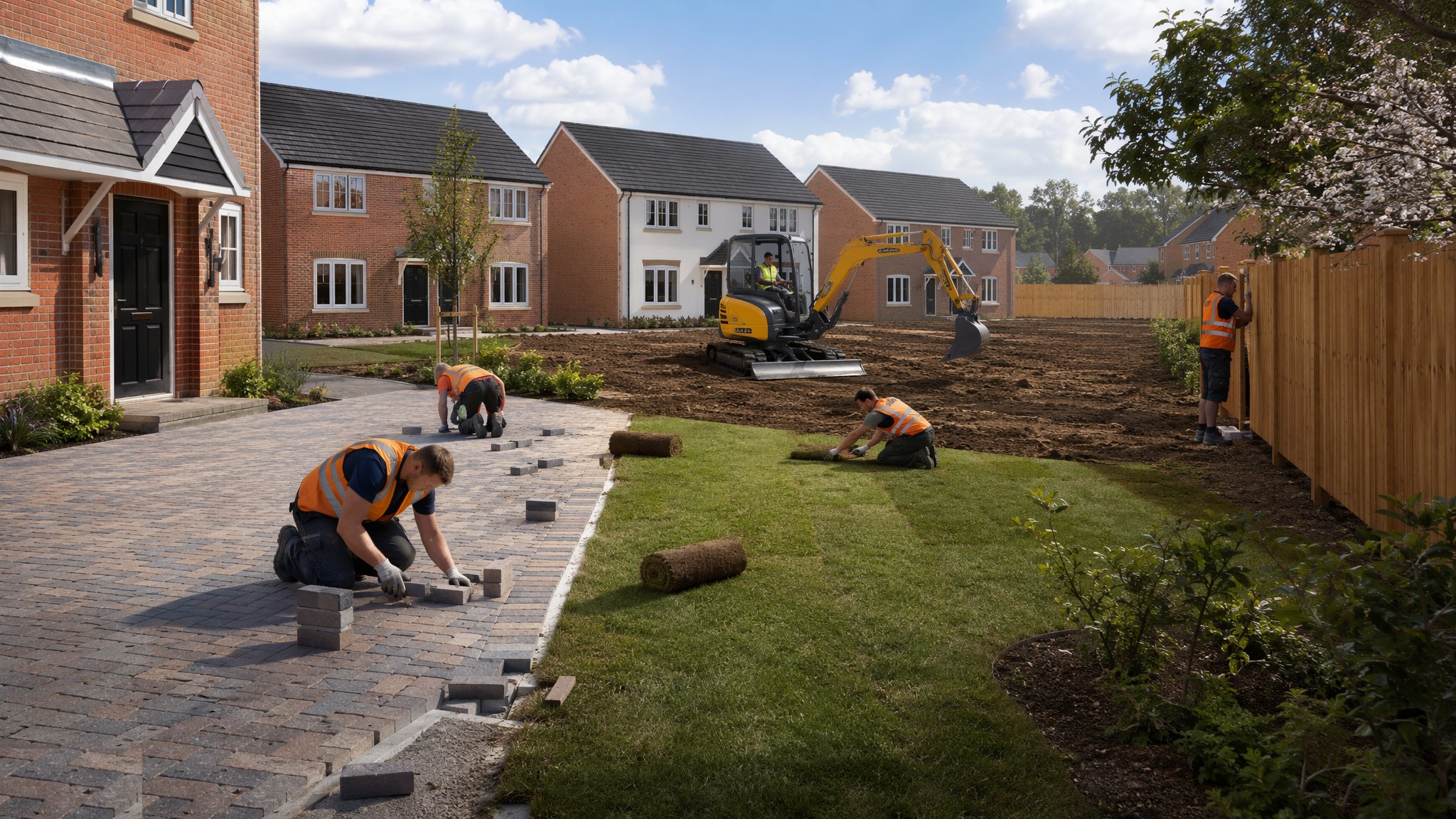
External works turn a building site into a place: the roads and pavements people arrive on, the drainage that quietly handles every storm, the walls and fences that draw the boundaries, and the landscaping that makes it somewhere worth living. On housing developments these works are often adopted by the council or the water company, which means they are built to published standards and inspected to match. In the UAE there is no adoption culture in the UK sense; external works run on authority NOCs instead — Dubai Municipality for drainage connections and for boundary walls, whose heights and materials are controlled by municipal and community guidelines, and the RTA for driveway accesses and dropped kerbs onto public roads.
Drainage has changed more than any other external trade. The modern obligation is sustainable drainage — SuDS: attenuation tanks and ponds that hold stormwater and release it slowly, permeable paving that soaks it away, swales that treat it on the way. The drainage design is now a hydrological argument, proven with calculations and verified with tests, and its failure mode — flooding — arrives years after the site team has left.
When and why is External Works & Landscaping used?
External works run alongside and after the buildings, sequenced so completed areas are not re-excavated — drainage first, then roads to base course, then final surfaces late, when the heavy plant has gone. They matter because externals carry the statutory adoptions, the planning conditions and the residents' first impression; a development with perfect houses and ponding car parks, cracked pavements and dead trees is a failure everyone can see. A single house plot runs the identical sequence at garden scale — drains tested before backfill, the drive built up in compacted layers, boundaries on proper foundations, planting last — except that nothing is adopted: the soakaway, the run to the sewer and the drive are the owner's assets, built and proven to the same standards without an adopting authority's inspector watching.
Types of External Works & Landscaping
Foul and surface water drainage
Below-ground pipework from the buildings to the adoptable sewers: inspection chambers at changes of direction, designed falls, and separate systems for foul and surface water. In the UK the drainage hierarchy puts infiltration first where the ground allows — soakaways sized from percolation tests to BRE Digest 365 — then a watercourse, and only then the sewer; adoptable runs are built to the Sewers for Adoption standard. Air and water tests prove the runs before backfill closes over them. Connections and adoptions are inspected and signed by the adopting authority.
SuDS: attenuation and infiltration
Cellular attenuation tanks wrapped in geomembrane, detention basins and ponds, swales and permeable pavements — holding peak flows to the greenfield run-off rate. These systems need their levels, their membranes and their outfall controls exactly right, and their maintenance access planned, because they work silently until the storm they were designed for.
Roads, pavements and kerbs
Adoptable roads built up in designed layers — sub-base, base and binder courses, then surface course — with kerbs laid to line and level on concrete beds. Footpaths, block paving and asphalt driveways complete the hard landscape. Compaction, levels and falls are tested per layer; the surface only ever copies what lies beneath.
Boundaries and soft landscaping
Boundary walls and fences on their own foundations, gates and railings, then the soft works: topsoil respread, trees and shrubs planted to the landscape plan, turf and seed. Planting has its own engineering — root barriers near services, pits drained and watered, and a maintenance period that decides whether the landscape lives.
External Works & Landscaping: step by step
Step 1: Construct the below-ground drainage
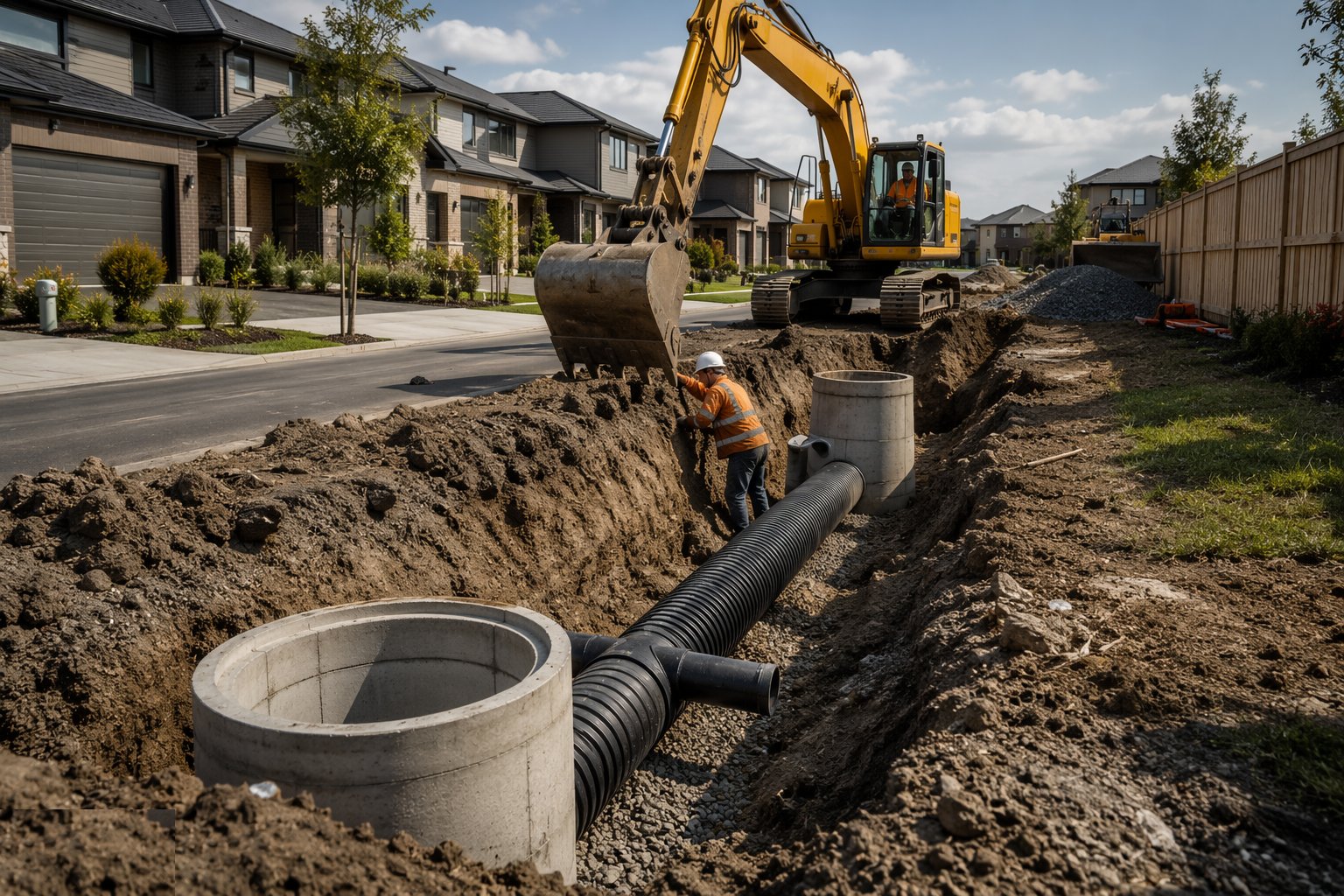
Excavate and lay the foul and surface water runs from the buildings outward, bedding pipes on granular material, setting chambers to line and invert level, and maintaining the designed falls. Test every run — air or water test witnessed and recorded — before backfilling in compacted layers. Connections to the adoptable system are made under the water company's inspection regime.
Step 2: Install attenuation and SuDS features
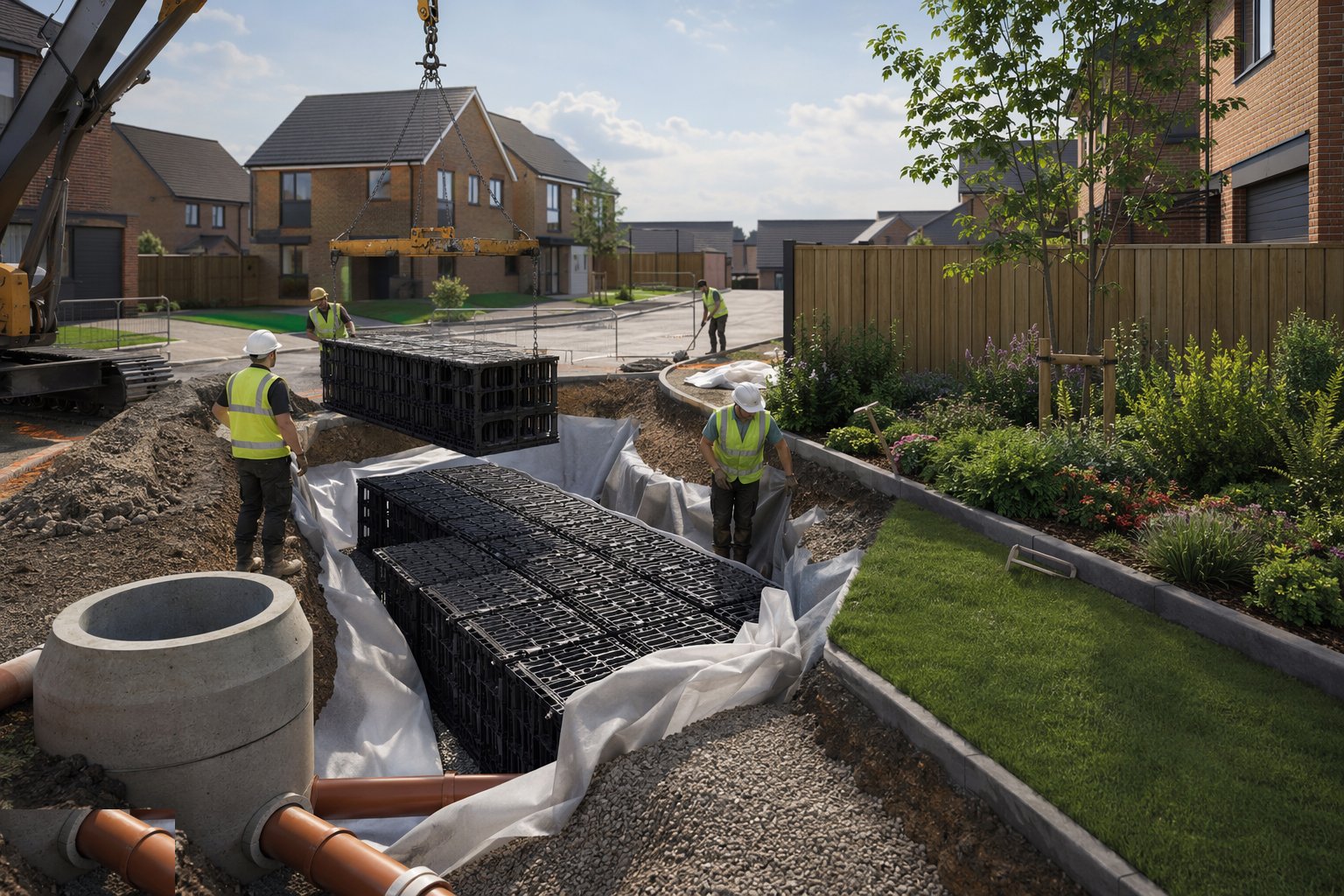
Excavate for tanks and ponds, verify formation levels and bearing, and install cellular tanks wrapped and welded in their membranes with all connections sealed. Flow controls and outfalls are set precisely to level — an orifice 50 mm high is a different hydrology. Ponds and swales are formed, lined where required, and profiled to the landscaping levels.
Step 3: Build the roads and pavements to base course
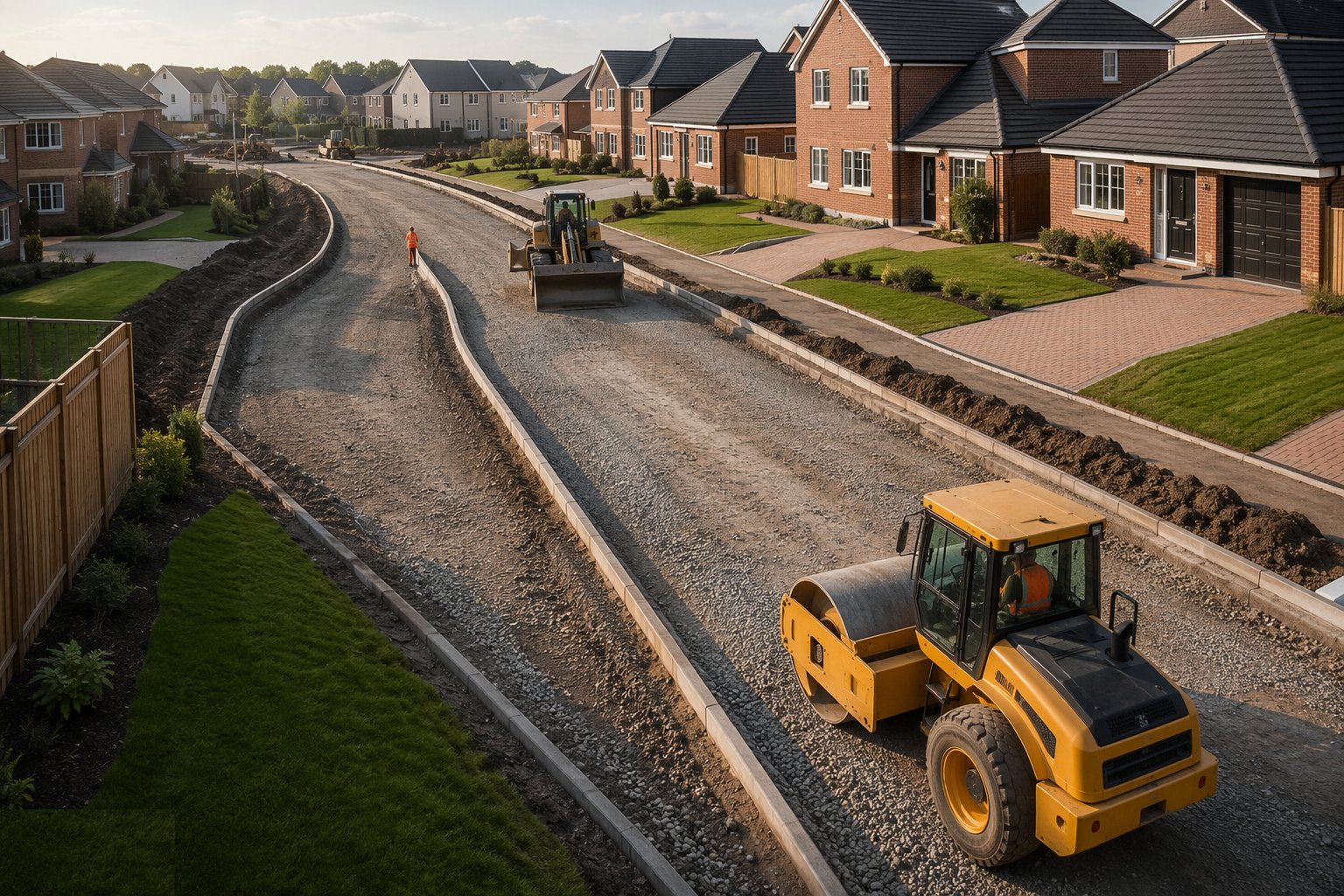
Bring the road formation to level, lay and compact the sub-base in layers, and prove it — plate bearing or density tests per the adopting authority's requirements. Kerbs and edgings are bedded and backed in concrete to string lines and level pins, with drainage crossings and service ducts installed before the carriageway closes over them. Base and binder courses are laid, rolled and checked for level and falls.
Step 4: Construct footpaths, drives and hard landscape

Footpaths are laid in asphalt or flags on their own compacted beds with falls to drain; block paving goes on screeded laying-course sand over a compacted sub-base with edge restraints rigid — a creeping edge restraint is a spreading pavement — and is compacted with kiln-dried sand brushed into the joints, all to BS 7533 practice. Crossovers, tactile paving and dropped kerbs follow the adopting standards. Ironwork — covers and gullies — is set to finished level in mortar beds, adjusted to the surface, never left proud or sunken.
Step 5: Erect boundary walls, fences and street furniture
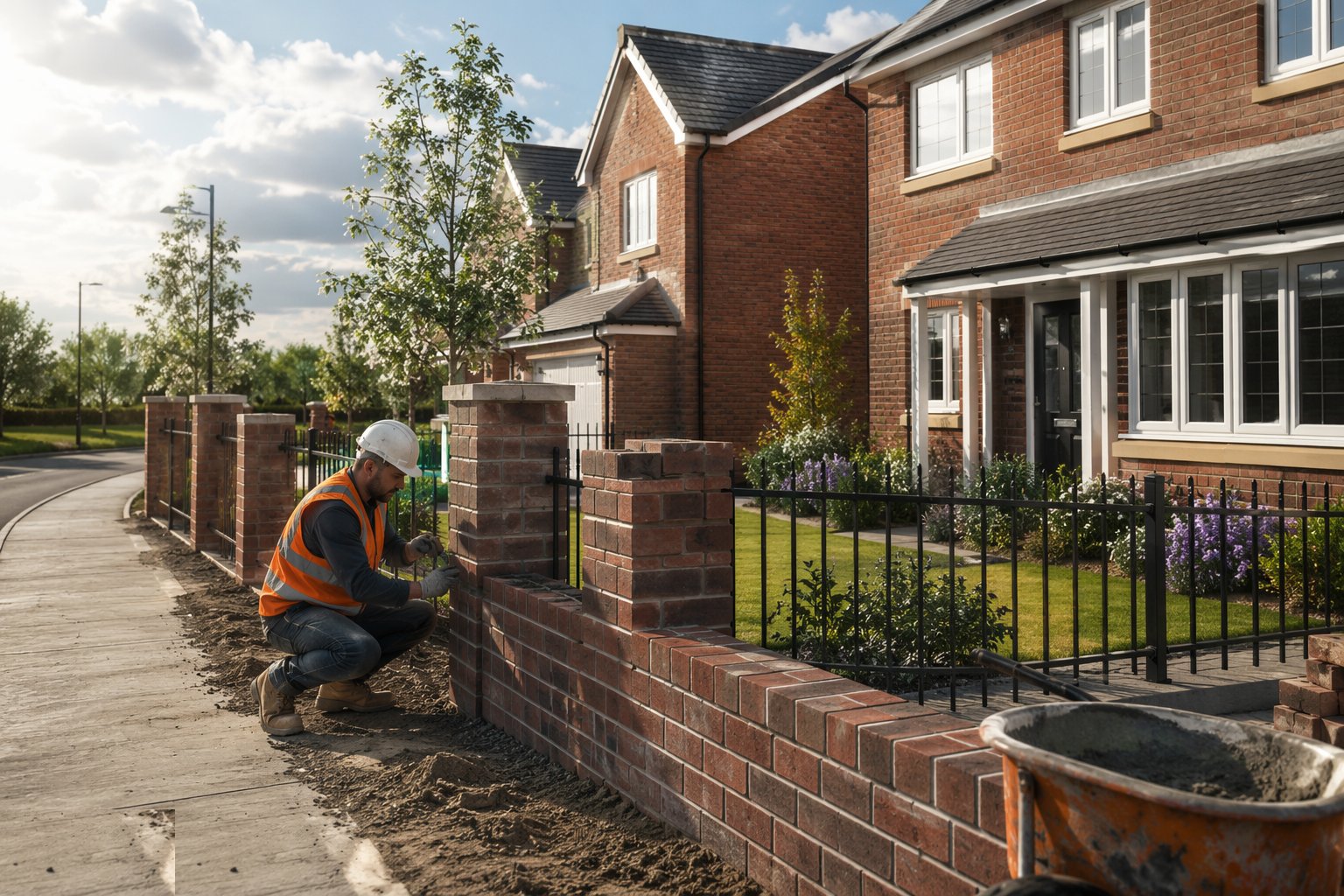
Boundary walls are built on their foundations with piers, copings and movement joints per the design; fences are set to line with posts concreted plumb. Street lighting columns are erected on their bases and connected to the adopted supply. Benches, bins, bollards and cycle stores follow the layout drawing — each fixed, level and out of the pedestrian desire lines.
Step 6: Complete soft landscaping
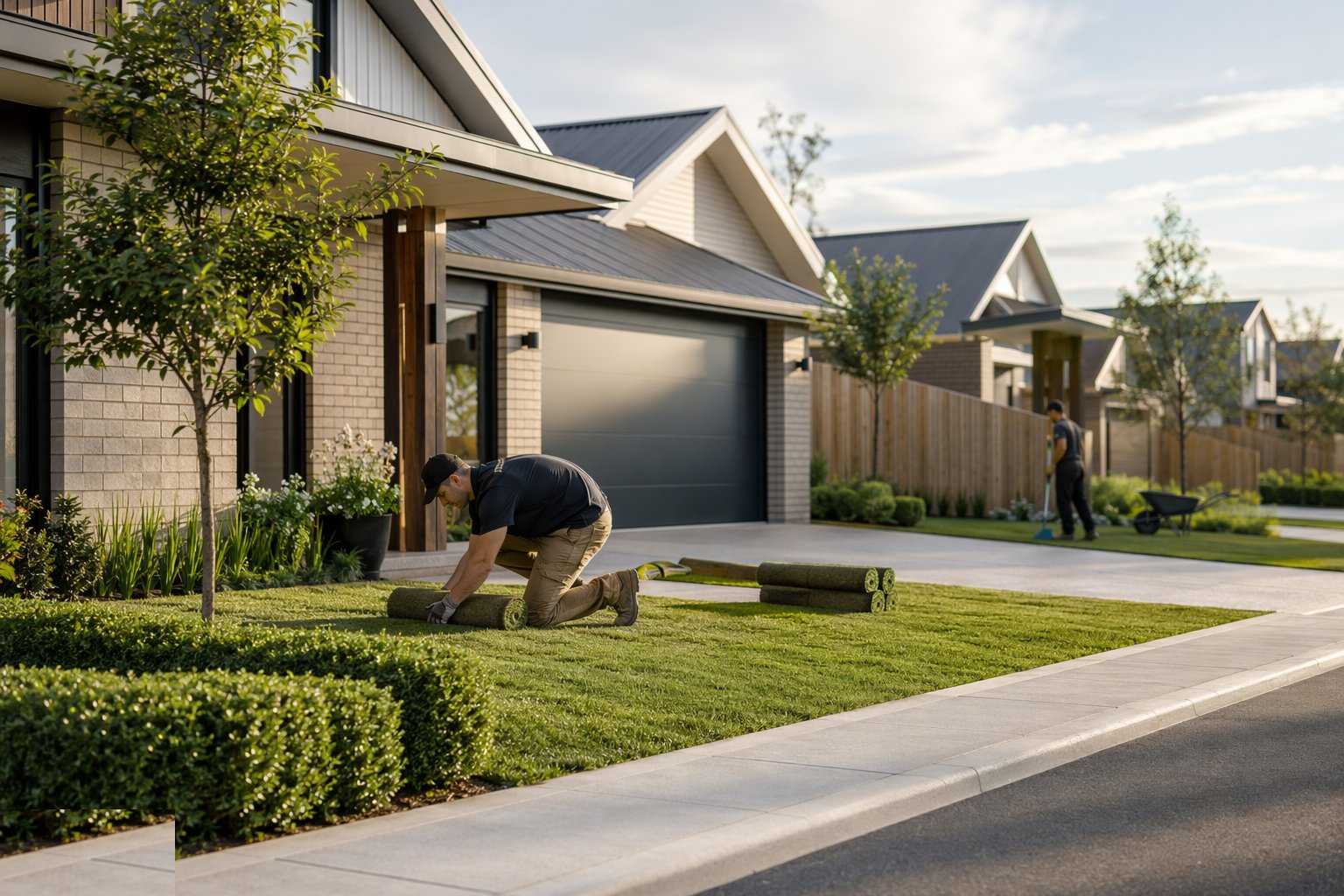
Topsoil is respread and cultivated, levels finished to marry with paths and thresholds — with drainage falls away from every building. Trees are pit-planted with stakes, ties and irrigation, shrubs and hedges to the planting plan, turf laid or seed sown in season. Planting too deep, in rubble, or without water is a slow-motion failure measured in dead whips next spring. In the Gulf, planting survives only with engineered irrigation — usually treated sewage effluent (TSE) where the district supplies it, since potable water for irrigation is restricted — and drought-tolerant xeriscaping is encouraged under Al Sa'fat in Dubai and Estidama in Abu Dhabi.
Step 7: Final surfaces, tests and adoption inspections

Surface course goes down late, when construction traffic is done with the roads. Drainage is CCTV-surveyed where adoption requires it; lighting is tested; road levels and skid resistance are verified per the standard. The adopting authorities walk their systems with their checklists, and the snag list is closed out. As-builts for every buried service go into the handover file.
Plant and equipment
- Excavators, dumpers and pipe-laying kit
- Rollers and compaction plates for roads and paths
- Pavers and asphalt laying equipment (usually specialist subcontract)
- Laser levels, pipe lasers and drainage test kit
- Telehandlers and cranes for tanks, lighting and trees
- CCTV drainage survey equipment
Quality control checks
- Air/water tests on every drainage run before backfill
- Invert levels and falls surveyed per run against design
- Compaction and plate-bearing tests per road layer
- Kerb line and level checks; ironwork set to finished level
- CCTV surveys for adoptable drainage
- Landscape inspections: topsoil depth, planting quality, establishment
Safety considerations
- Trench support and edge protection on drainage excavations
- Plant-pedestrian segregation around paving and surfacing operations
- Hot bitumen and asphalt handling — burns and fume controls
- Manual handling for kerbs, flags and blocks — vacuum lifters
- Public protection where works meet existing roads and footpaths
Common defects
- Back-falling drains — standing water and blockages at occupation
- Ironwork sunken or rocking in the carriageway
- Block paving spreading at unrestrained edges
- Attenuation tank membranes punctured during backfill
- Trees planted too deep or never watered — wholesale establishment failure
- Surface course laid over failed base — reflective cracking within a year
Best suited for
- The infrastructure between buildings — drainage, roads, paving and planting
- Housing developments where adoption standards govern roads and sewers
- UAE villa plots — boundary walls, driveways and irrigated soft landscaping
- Public realm and streetscape schemes where finishes face the public
- The last trades on site — and the first thing the buyer or tenant sees
How long does External Works & Landscaping take?
Typical duration: 4–12 weeks across a housing development, phased with the plots; adoption inspections extend beyond site completion..
Related processes
- Windows, Doors & Glazing
- MEP First Fix
- Internal Finishes
- MEP Second Fix & Commissioning
- Testing, Handover & Snagging
- Site Access & Enabling Works
- Site Clearance & Demolition
- Setting Out & Survey Control
- Earthworks & Excavation
- Dewatering & Groundwater Control
- Shallow Foundations
- Piling & Deep Foundations
- Basement & Substructure
- Waterproofing and Tanking
- Concrete Frame Construction
- Steel Frame Construction
- Masonry & Timber Frame
- Floor Slabs & Screeds
- Roofing
- Façade & Cladding
- Insulation Systems
- External Works & Landscaping in Landscaping & Public Realm
- Foul and surface water drainage — method
- SuDS: attenuation and infiltration — method
- Roads, pavements and kerbs — method