Piling & Deep Foundations
Driven, bored and CFA piles — carrying the building down to ground that can actually take it.
Last updated 2026-07-28 by the BuildPedia Editorial Team.
What is Piling & Deep Foundations?
When the near-surface soils cannot carry the load, you go down until you find ground that can. Piles are slender columns of concrete or steel that transfer the building's weight through weak strata to firm bearing at depth — end-bearing on rock or dense gravel, or friction-shafted in stiff clay, or usually some combination of the two. On residential towers, deep basements and any building over made ground or soft alluvium, piling is not an option, it is the foundation.
Piling is also the most unforgiving process on this list. Everything that matters happens underground, out of sight, in one continuous operation per pile — and a pile that goes wrong is discovered weeks later under a test rig or, worse, under the building. That is why the piling industry runs on records: every pile gets a rig log of depths, torques, concrete volumes and pressures, and those logs are read line by line by people who know what an anomaly looks like.
The choice of system is a ground investigation question first and a logistics question second. Driven precast piles are fast and proven but noisy and vibratory — fine on an open estate, impossible next to a hospital. CFA piles are the urban workhorse: quiet-ish, vibration-free, and fast. Rotary bored piles take the big diameters and the hard strata. Sheet piles do retaining duty. In the Gulf the balance shifts: rotary bored piles under support fluid dominate tower foundations in deep sand and sabkha, driven precast is less common than in the UK, and chloride- and sulphate-bearing ground drives durable mix designs and sometimes coated reinforcement. Each gets its due diligence below.
When and why is Piling & Deep Foundations used?
Piling follows the GI, earthworks to a working platform, and setting out, and it precedes pile caps, ground beams and everything above. It is selected when shallow foundations would settle excessively, when loads are concentrated (towers, cores), when basements need retaining walls, or when uplift and lateral loads rule out gravity solutions. It matters because piles are the structural element with the least visible workmanship and the highest consequence of failure — the entire QA apparatus of integrity testing and load testing exists for that reason.
Types of Piling & Deep Foundations
Driven precast concrete piles
Factory-cast square piles — typically 200–350 mm, manufactured to BS EN 12794 and installed as displacement piles to BS EN 12699 — driven to refusal or a designed set with a drop hammer or hydraulic hammer. Quality is made in the factory, capacity is proven by the driving record, and there is no spoil. The price is noise and vibration, and lengths must suit the rig — joints are possible but add risk.
Driven steel tube and H piles
Steel sections — closed-ended tubes and H-piles — driven as displacement piles to BS EN 12699, to bearing on rock or dense strata; excellent for high loads and difficult driving. Tubes are commonly filled with concrete after driving. Corrosion allowance and driving damage are the design checks; cost per metre is high but capacity per pile is higher.
CFA — continuous flight auger
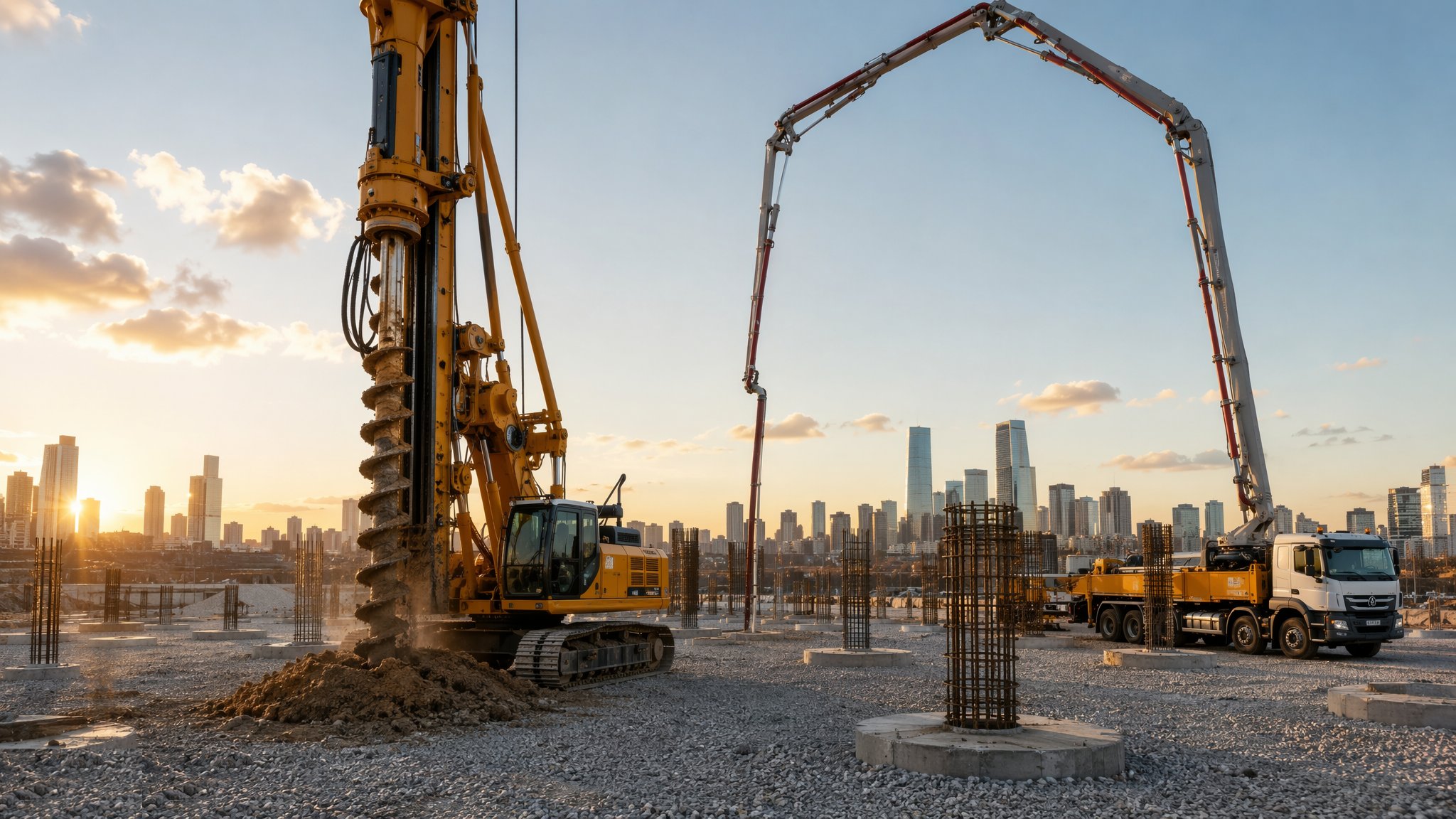
A hollow-stem auger drills to depth in one pass; as the auger is steadily withdrawn, concrete is pumped down the hollow stem under positive pressure, filling the bore continuously so the ground never collapses in. The reinforcement cage is then pushed into the fresh concrete. Executed to BS EN 1536, CFA is fast, low-vibration, and the urban default — but entirely dependent on the operator's discipline and the rig instrumentation, since nobody ever sees the bore. Re-augering a finished bore (over-flighting) loosens the ground and is specifically warned against in FPS guidance.
Rotary bored cast-in-situ piles
An auger or bucket bores the hole — often under temporary casing or bentonite/polymer support fluid — the cage is lowered, and concrete is placed by tremie from the bottom up. Executed to BS EN 1536 like CFA, it handles diameters to two metres and more, sockets into rock, and suits the heaviest loads. Slower and more expensive than CFA, but inspectable and controllable at every stage.
Mini and micro piling
Small-diameter drilled piles — typically 300 mm and below, sometimes grouted with a steel bar or tube — installed to BS EN 14199 by compact rigs that fit through a doorway. The answer for restricted access, low headroom, underpinning and extensions next to existing buildings. Capacity is modest; verification relies on grout records and load tests.
Sheet piling
Interlocking steel sections driven or vibrated in to form a retaining wall — a wall, not a bearing pile — installed to BS EN 12063 for basement edges, cofferdams and excavations near boundaries. They retain soil and reduce water ingress, and can be extracted and reused on temporary works. Clutch leaks, refusal on obstructions and noise at driving are the practical battles.
Piling & Deep Foundations: step by step
Step 1: Design review, GI interpretation and pile layout
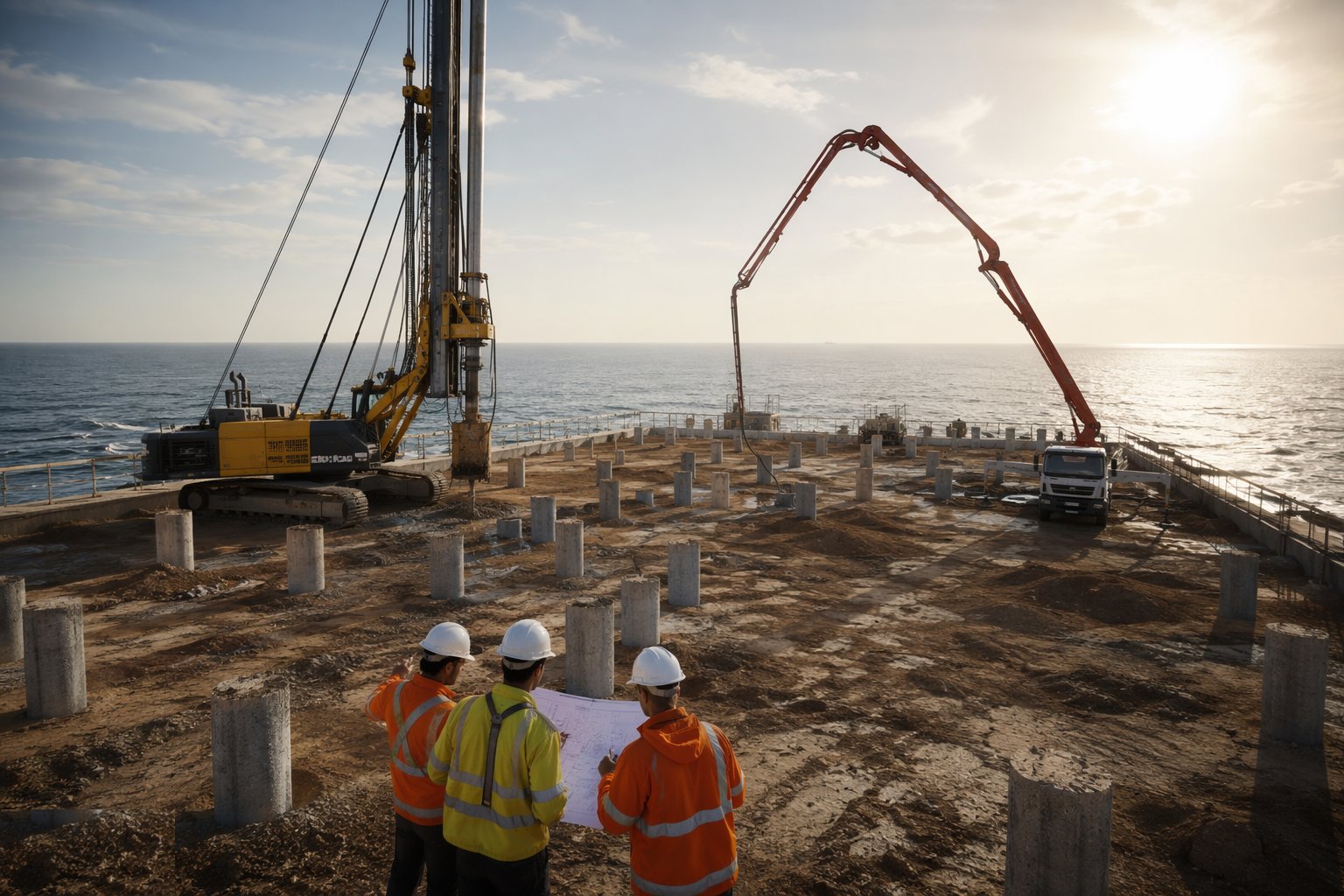
Confirm the pile type, diameter, lengths and working loads from the GI, and set the design approach — typically to Eurocode 7 with the test regime agreed up front. The setting-out coordinates for every pile position are computed and independently checked. Obstructions flagged by the GI or the site history — old foundations, basements, tanks — are probed or pre-augered out before the rig arrives.
Step 2: Build the working platform
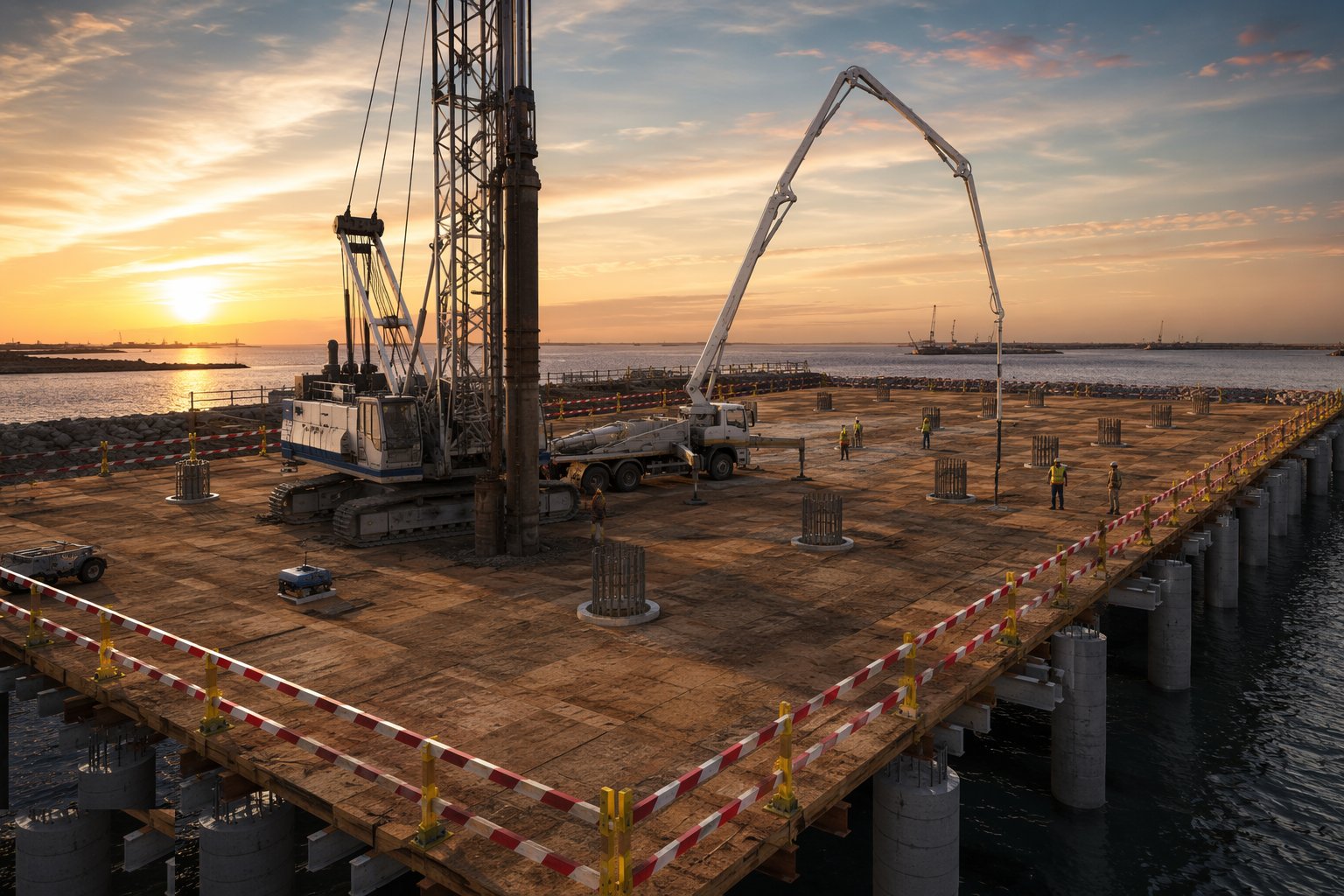
Piling rigs are among the heaviest plant on site and overturning is a real killer, so the working platform — the piling mat — is designed, not guessed: an engineered granular platform over geotextile, designed for the actual rig bearing pressures to the BRE BR470 method, proof-rolled, and kept to a maximum gradient of 1 in 10 for rig stability. The FPS Working Platform Certificate is signed by the Principal Contractor and handed to the piling contractor before work starts, with weekly inspections thereafter. No platform certificate, no rig.
Step 3: Rig set-up and position verification
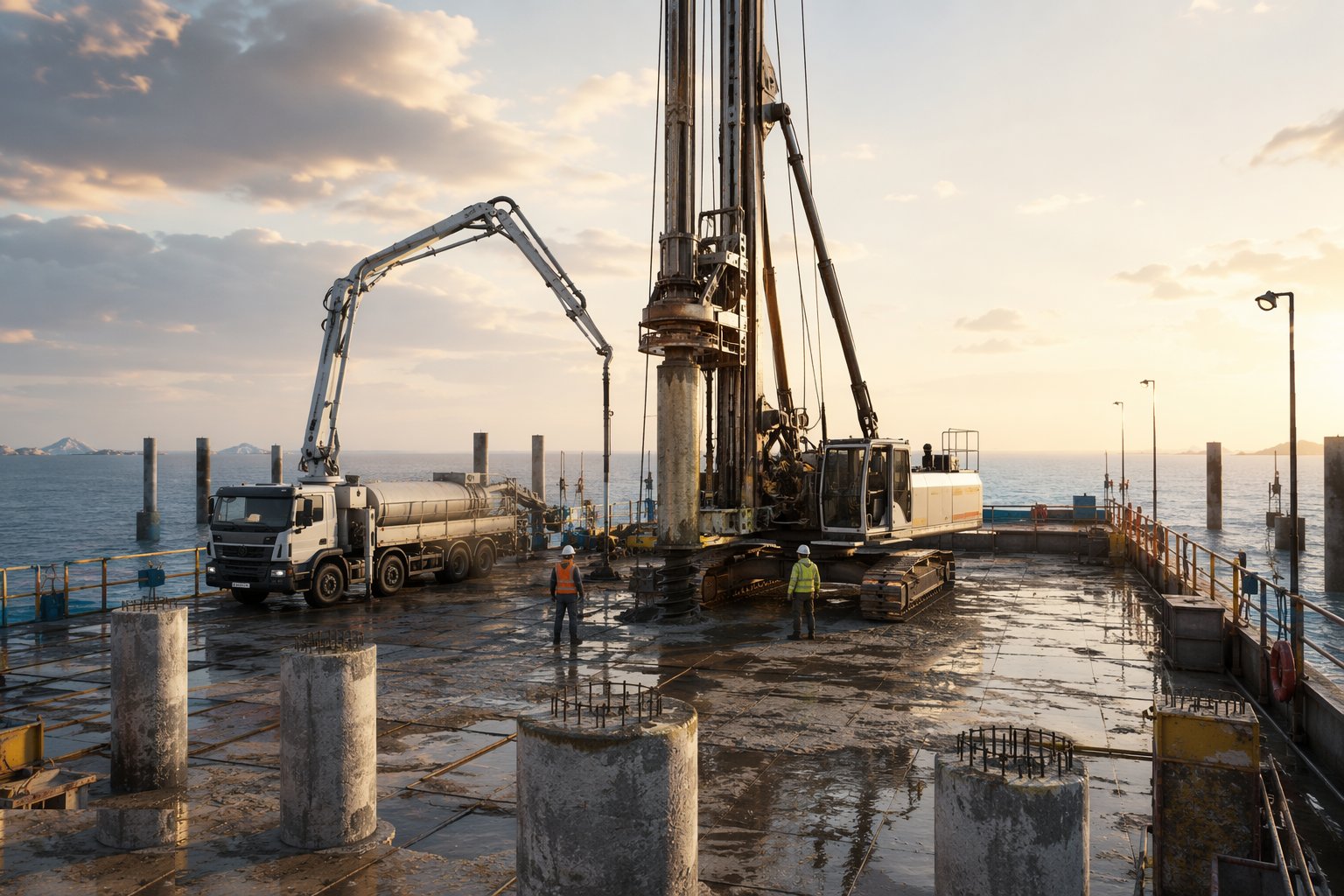
The rig is positioned over the pile point and the position is checked against the setting out before drilling or driving starts — a pile 100 mm off position can still be a pile cap redesign. SPERWall tolerances give bearing piles 75 mm in any direction on plan and a maximum deviation from vertical of 1 in 75, and position and verticality are checked immediately before installation — checks by others do not relieve the piling contractor. The pile reference, design depth and concrete spec are confirmed on the rig log sheet.
Step 4: Bore or drive to the validated toe level
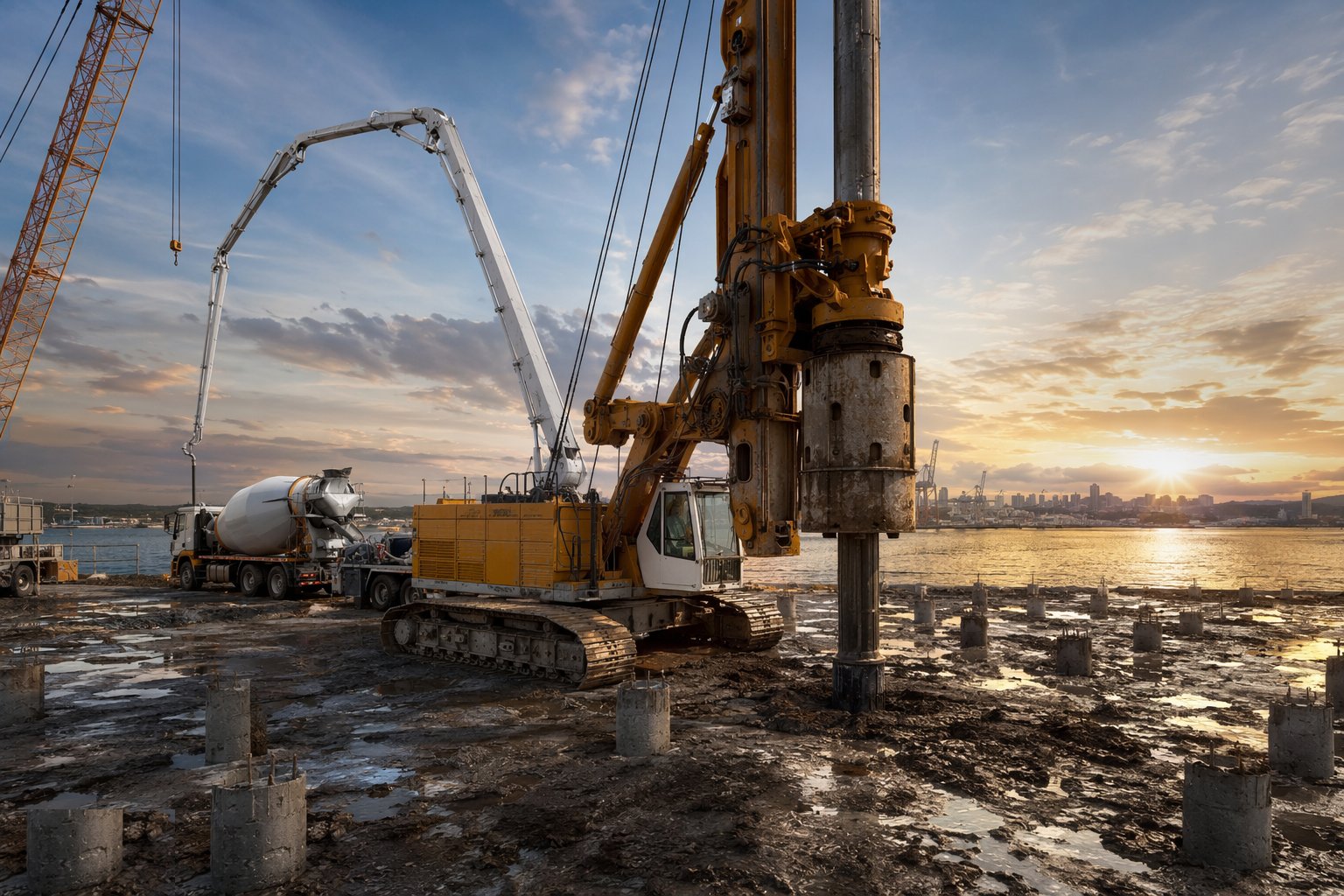
For CFA, the auger advances in one pass to the target depth, with the rig computer logging depth, torque and rate — a soft layer or an obstruction shows immediately in the numbers. For bored piles, each change of stratum is logged and the toe is verified by sampling or by the drilling characteristics against the GI. For driven piles, every blow is recorded and the final set is measured against the design criteria. Toe level is validated pile by pile, not assumed from the average.
Step 5: Concrete placement — pump or tremie
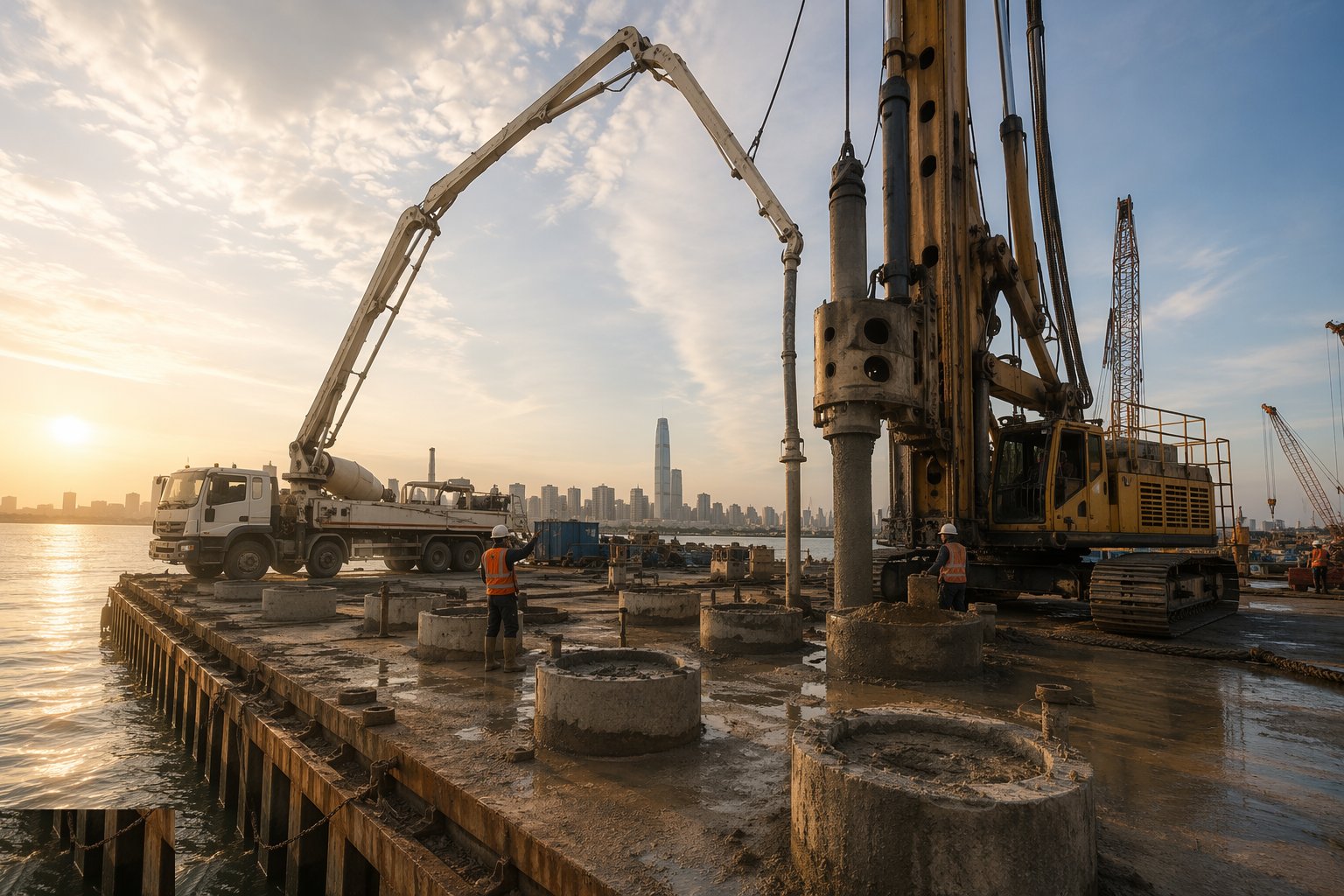
CFA: concrete is pumped down the hollow stem as the auger lifts at a controlled rate, maintaining positive pressure so the column never necks — the instrument trace of pressure and volume against depth is the record that the pile is sound. Bored piles: the cage goes in first, then concrete is placed by tremie pipe from the bottom, keeping the pipe mouth always buried in fresh concrete so support fluid is displaced, never mixed. Volume placed is reconciled against the theoretical volume; shortfalls mean investigation.
Step 6: Reinforcement cage insertion
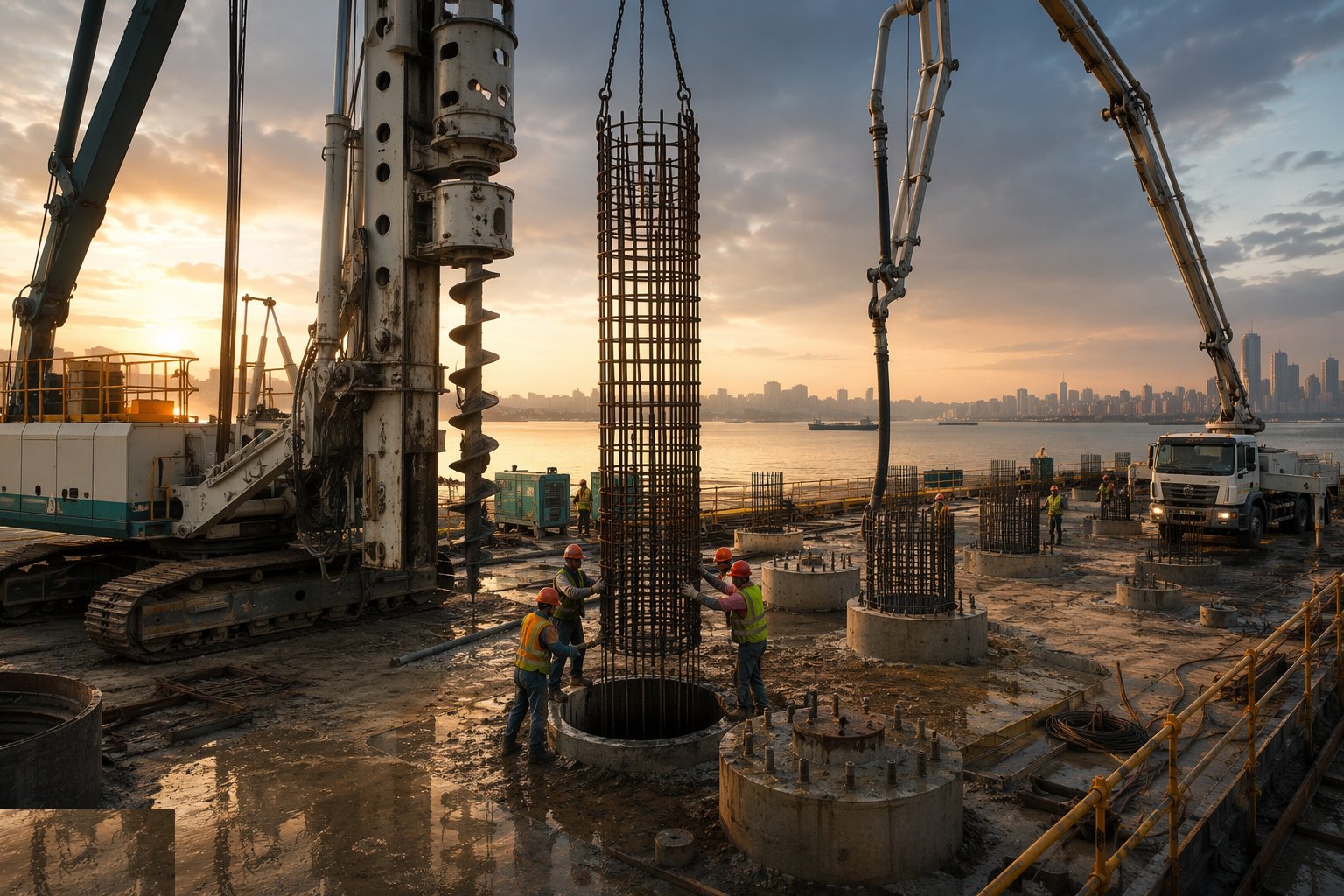
Cages are prefabricated, checked against the bending schedule and lowered — or vibrated into fresh CFA concrete — to the design level with the specified cover by centralisers. Cage depth and orientation are recorded. On CFA piles the cage depth is limited by the fresh-concrete window, which is why cage length and concrete workability are designed together.
Step 7: Pile integrity testing
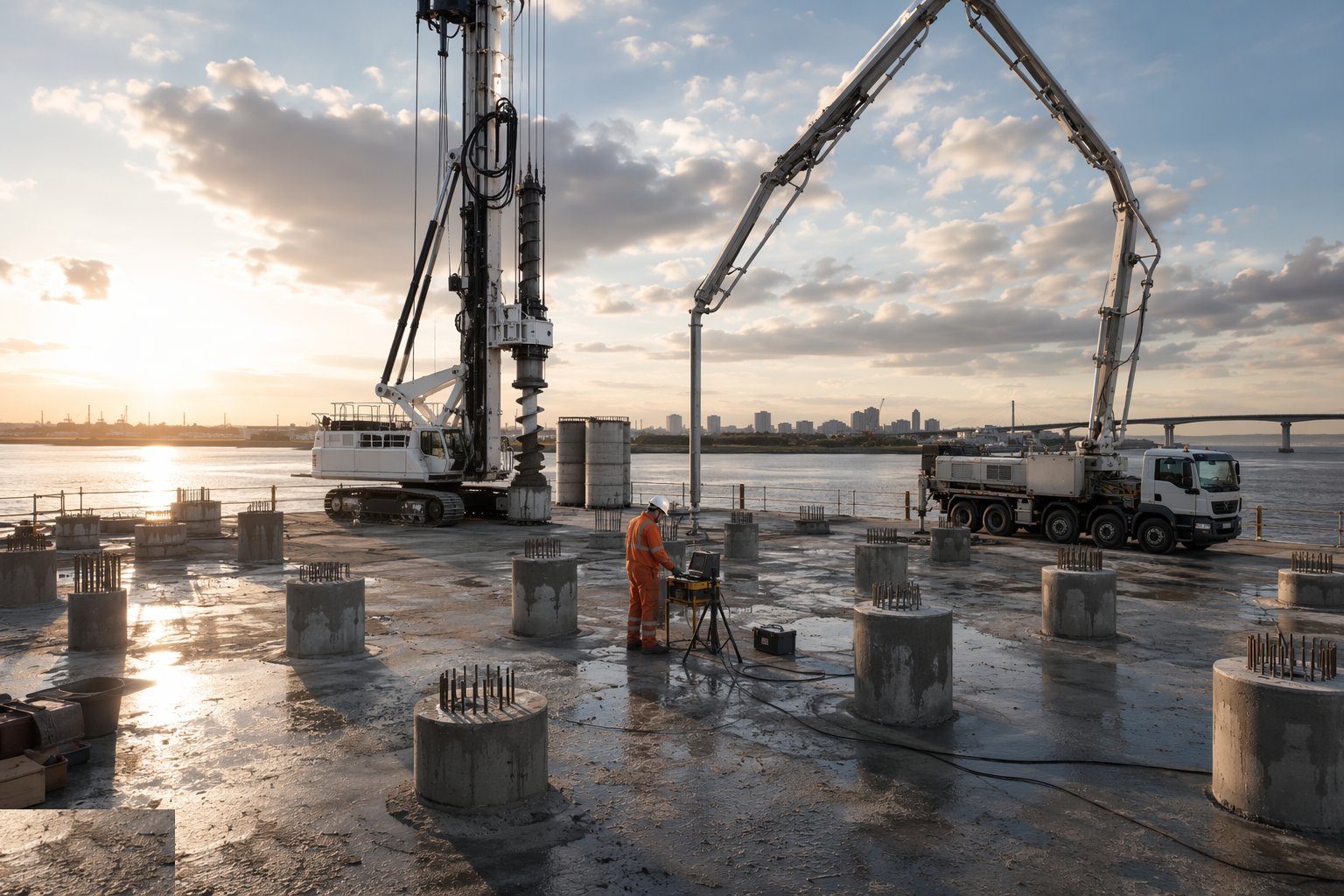
Low-strain sonic integrity testing (the hammer-and-accelerometer test) screens every pile or a large sample for necking, inclusions and length consistency — cheap, fast, and unforgiving. Cross-hole sonic logging (CSL) through pre-installed tubes maps the concrete between tubes on large or critical piles and catches defects the surface test cannot reach. Anomalies trigger coring to recover physical evidence before anyone signs anything.
Step 8: Static and dynamic load testing
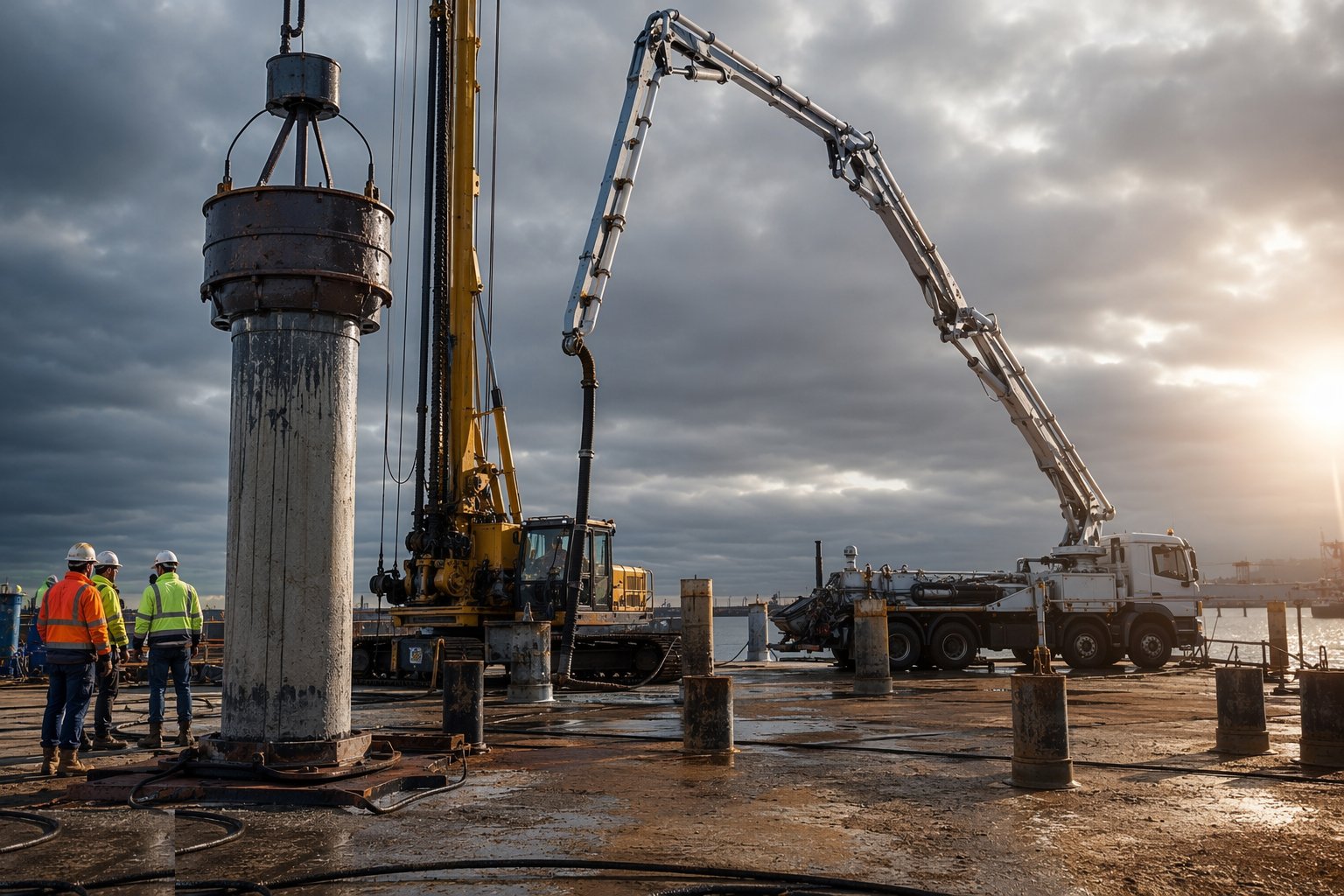
Preliminary working-load piles are tested to destruction or to the design verification load before production piling — the maintained load test, with settlement measured under staged loading held over hours, is the definitive proof of capacity. Dynamic testing with a drop weight and PDA analysis gives rapid capacity estimates on driven piles. Working piles get proof tests on a sample. Test results feed back into the design before the caps are finalised.
Step 9: Crop, trim and construct pile caps and ground beams
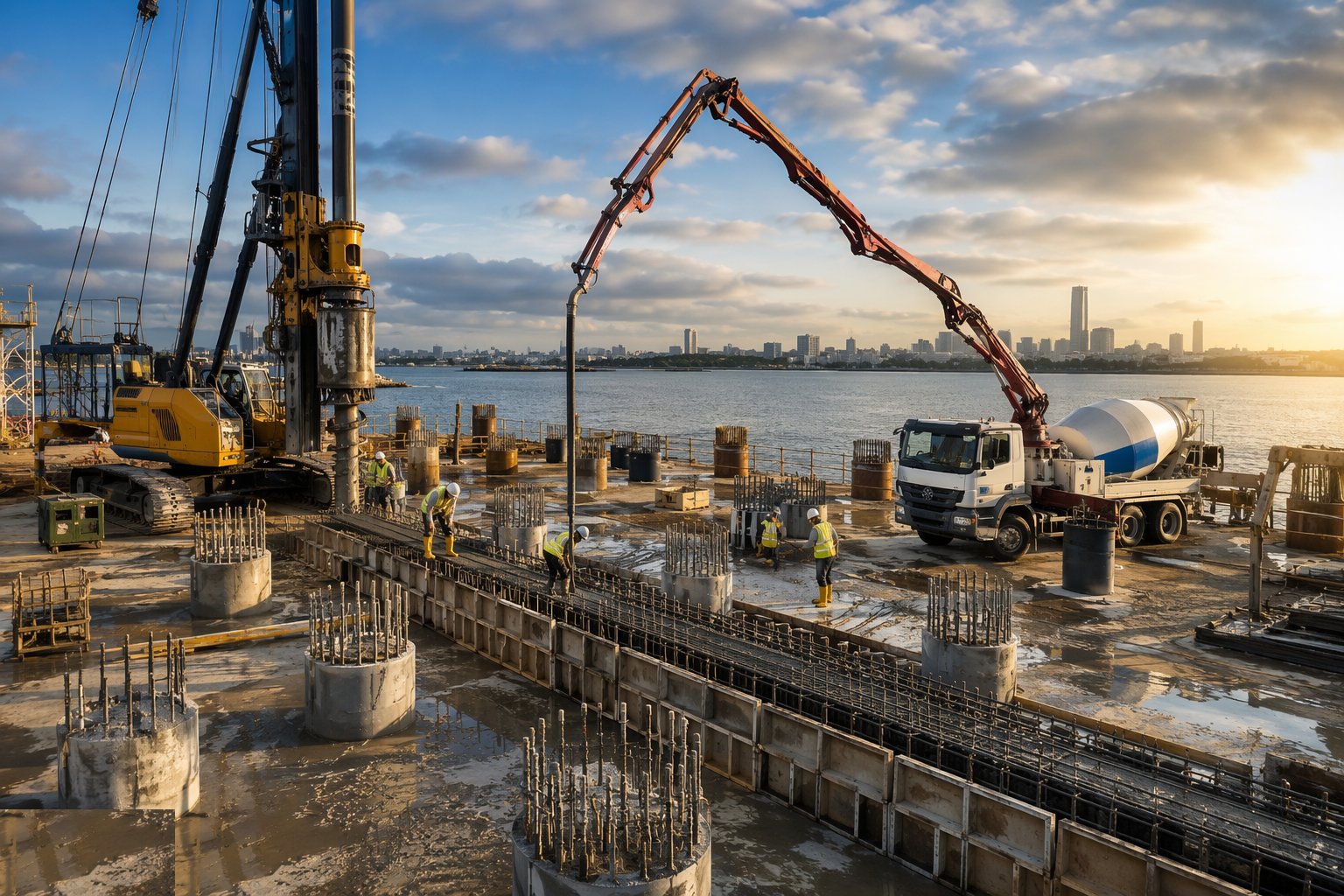
Piles are exposed, and heads are cropped to cut-off level with breakers or hydraulic munchers, leaving sound concrete and projecting reinforcement. Caps and ground beams are then formed, reinforced and poured to tie the group together — with the as-built pile positions surveyed first, because the cap design tolerance decides whether an eccentric pile needs a bigger cap. The survey, the crop records and the pour records close out the piling QA file.
Plant and equipment
- CFA piling rig with instrumentation and concrete pump
- Rotary bored piling rig, casings and tremie equipment
- Piling hammer rigs and vibratory drivers for driven and sheet piles
- Crawler cranes for cage handling on large bored piles
- Ready-mixed concrete supply with dedicated pump and standby pump
- Integrity test equipment: PIT hammer and CSL kit
- Static load test rigs: kentledge blocks, reaction piles, jacks and datum beams
- Pile cropping equipment and excavators for cap excavation
Quality control checks
- FPS Working Platform Certificate signed before piling, and platform inspection records
- Execution to the relevant standard: BS EN 1536 (bored and CFA), BS EN 12699 (displacement), BS EN 12063 (sheet piles), BS EN 14199 (micropiles)
- Pile positions and verticality checked against SPERWall tolerances — forcible correction of concrete piles is prohibited
- Rig logs for every pile: depth, torque, pressure, volume, times
- Concrete volume reconciliation per pile against theoretical
- Slump/flow tests and cube samples from every load
- Low-strain integrity tests on 100% or specified sample of piles
- CSL on critical/large-diameter piles; coring of anomalies
- Static maintained load tests on preliminary piles; proof tests on working piles
- As-built survey of pile positions and cut-off levels
Safety considerations
- Certified working platform — rig overturn is the fatal risk
- Exclusion zone around the rig and under suspended loads
- Open bores guarded, capped and never left unattended
- Bentonite and grout handling: slips, skin contact, spill control
- Noise and vibration management near occupied buildings
- Lifting plans for cages — long, flexible loads that whip
Common defects
- Necked CFA pile from auger lifted faster than concrete supply
- Over-flighted CFA bore — loosened ground and lost shaft friction
- Soft toe in bored piles — debris or slurry left at the base
- Cage not reaching depth in fresh CFA concrete
- Pile out of position or out of plumb beyond tolerance
- Contaminated concrete at the head — overbreak not cropped back
- Set criteria misread on driven piles — refusal on a boulder mistaken for bedrock
- Integrity anomalies ignored until the caps are cast
Best suited for
- Towers, cores and heavy concentrated loads that near-surface ground cannot carry
- Buildings over made ground, soft alluvium or deep shrinkable clay
- Basements needing a piled retaining wall as well as bearing piles
- UAE towers on deep sands and sabkha — rotary bored piles under support fluid
- Restricted-access underpinning and extensions on mini-piles
- Schemes where settlement tolerance, not just bearing capacity, drives the design
How long does Piling & Deep Foundations take?
Typical duration: 2–6 weeks for a housing development; 8–20 weeks for a tower with large-diameter bored piles, including testing..
Related processes
- Setting Out & Survey Control
- Earthworks & Excavation
- Dewatering & Groundwater Control
- Shallow Foundations
- Basement & Substructure
- Waterproofing and Tanking
- Concrete Frame Construction
- Steel Frame Construction
- Masonry & Timber Frame
- Floor Slabs & Screeds
- Roofing
- Façade & Cladding
- Site Access & Enabling Works
- Site Clearance & Demolition
- Insulation Systems
- Windows, Doors & Glazing
- MEP First Fix
- Internal Finishes
- MEP Second Fix & Commissioning
- External Works & Landscaping
- Testing, Handover & Snagging
- Piling & Deep Foundations in Bridges & Elevated Structures
- Piling & Deep Foundations in Power Generation
- CFA — Continuous Flight Auger Piles — method
- Driven precast concrete piles — method