Driven precast concrete piles
Factory-made piles, hammered home — capacity proven blow by blow.
Last updated 2026-07-28 by the BuildPedia Editorial Team.
What is Driven precast concrete piles?
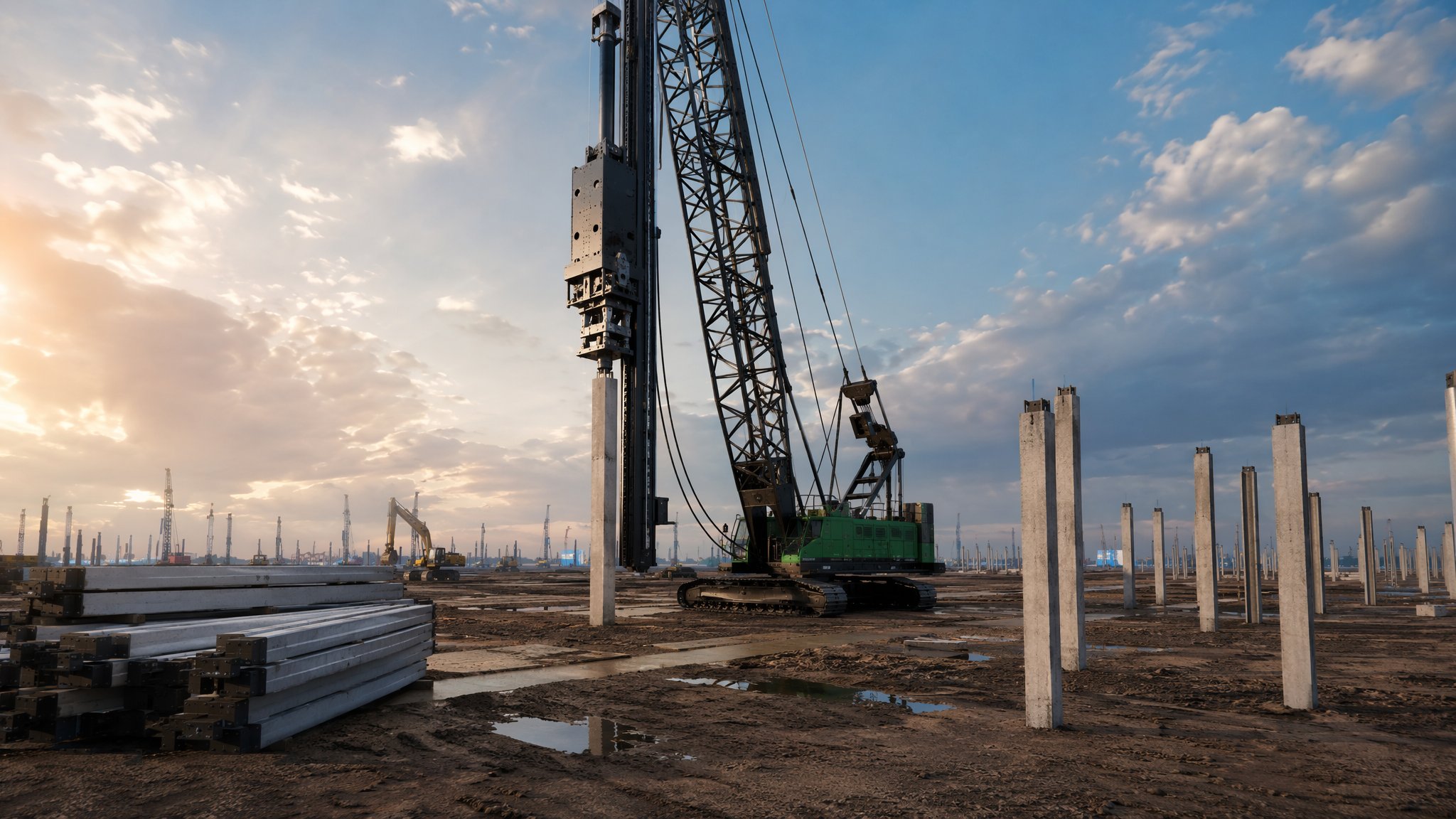
Driven precast piles are the oldest and most honest piling method: a factory-cast, factory-cured reinforced concrete pile — typically 250–450 mm square, in lengths of 6–15 m — is pitched into the leaders of a piling rig and driven into the ground with a hydraulic or drop hammer until it reaches a designed set or refusal. Every blow is a load test: the driving record of blows per penetration is direct, physical evidence of the ground the pile is standing on. What goes into the ground is a known, tested product with verifiable concrete and reinforcement — no dependence on fresh-concrete discipline underground.
The price of that certainty is paid on the surface. Driving is noisy and vibratory — a hydraulic hammer on a concrete pile is audible streets away, and peak particle velocities matter next to old masonry, hospitals, precision plant and live services. The method therefore rules itself out of most tight urban sites before the design conversation starts. Ground conditions matter too: obstructions can deflect or break a pile, soft clays can heave neighbouring piles as later ones displace the ground, and very dense layers can refuse a pile short of design depth.
Where it fits — open suburban estates, industrial sites, infrastructure — precast is fast and economical: a rig can drive 10–20 piles a day, there is no spoil and no concrete supply chain to manage, and the pile can be loaded as soon as the cap is cast. Jointed piles extend depth, but every joint is a structural detail and a driving risk, and pre-boring through obstructions adds cost. Design the pile length against the GI with genuine humility: cut-offs are easy, splicing on extra length mid-shift is not.
How does Driven precast concrete piles work, step by step?
Step 1: Set the rig and pitch the pile
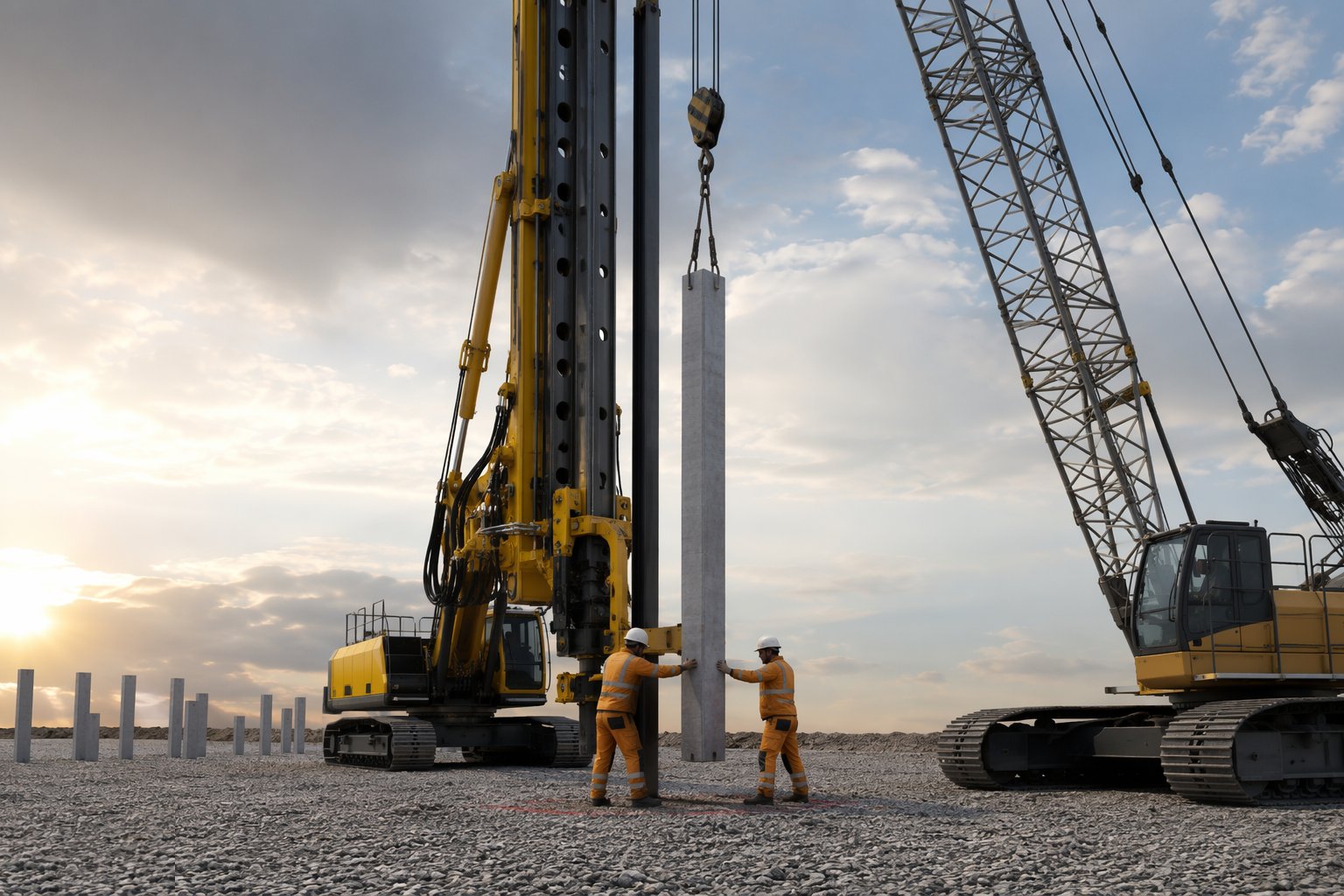
The rig tracks onto the certified working platform and centres over the surveyed pile point. The pile — delivered with a cast-in lifting point and checked for straightness, cracks and spalling on receipt — is pitched into the leaders with the helmet and dolly fitted, and verticality or the designed rake is set from the rig's inclinometers before the hammer lifts.
Step 2: Drive with the hammer, recording every blow
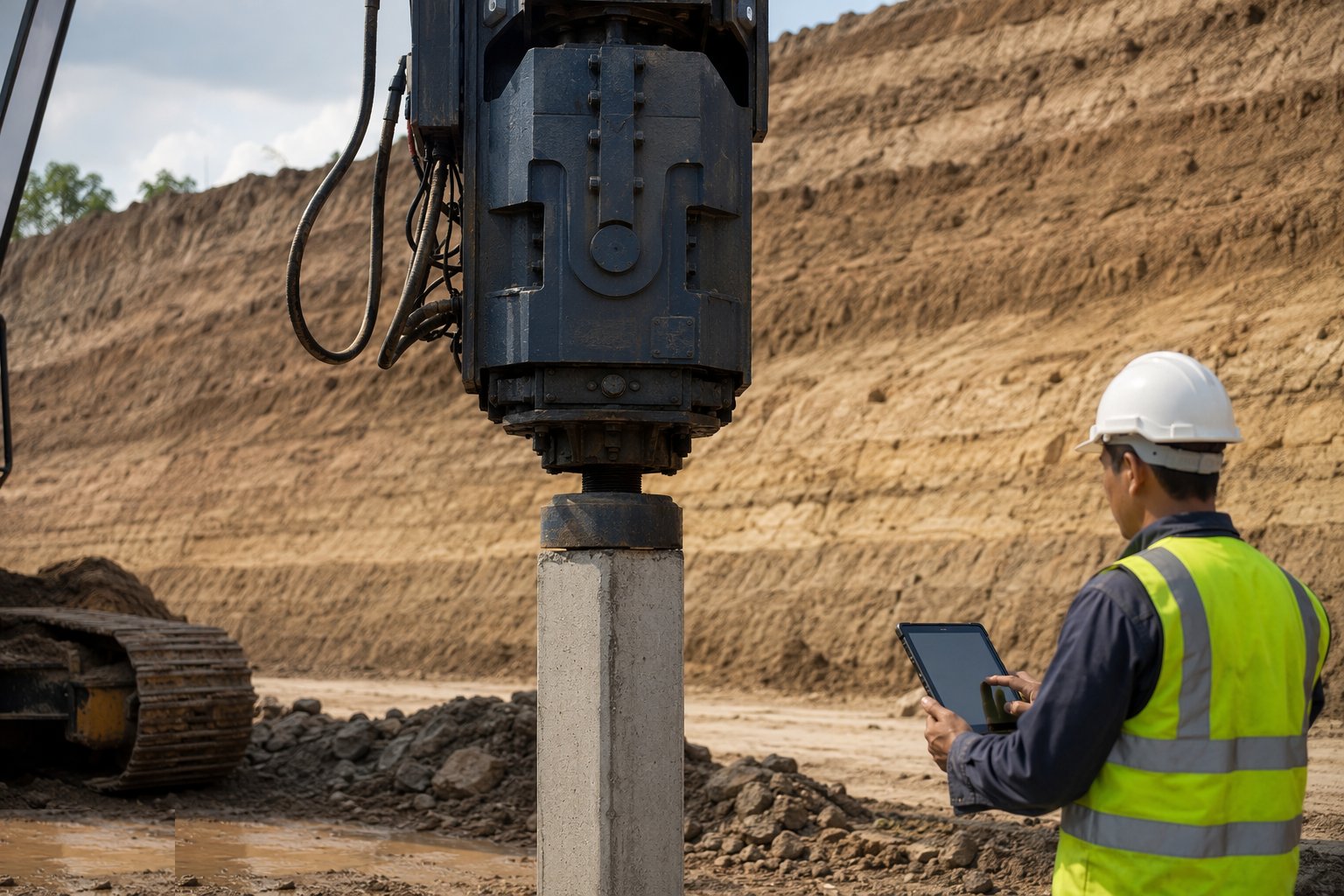
The hammer drives the pile in controlled blows, with the driving record kept blow by blow: penetration per blow, hammer energy, any sudden change of resistance. A pile that races ahead has hit a soft band or void; one that stops dead has met an obstruction or dense layer. Both are compared against the GI at once, not at the end of the shift.
Step 3: Joint on the next length if required
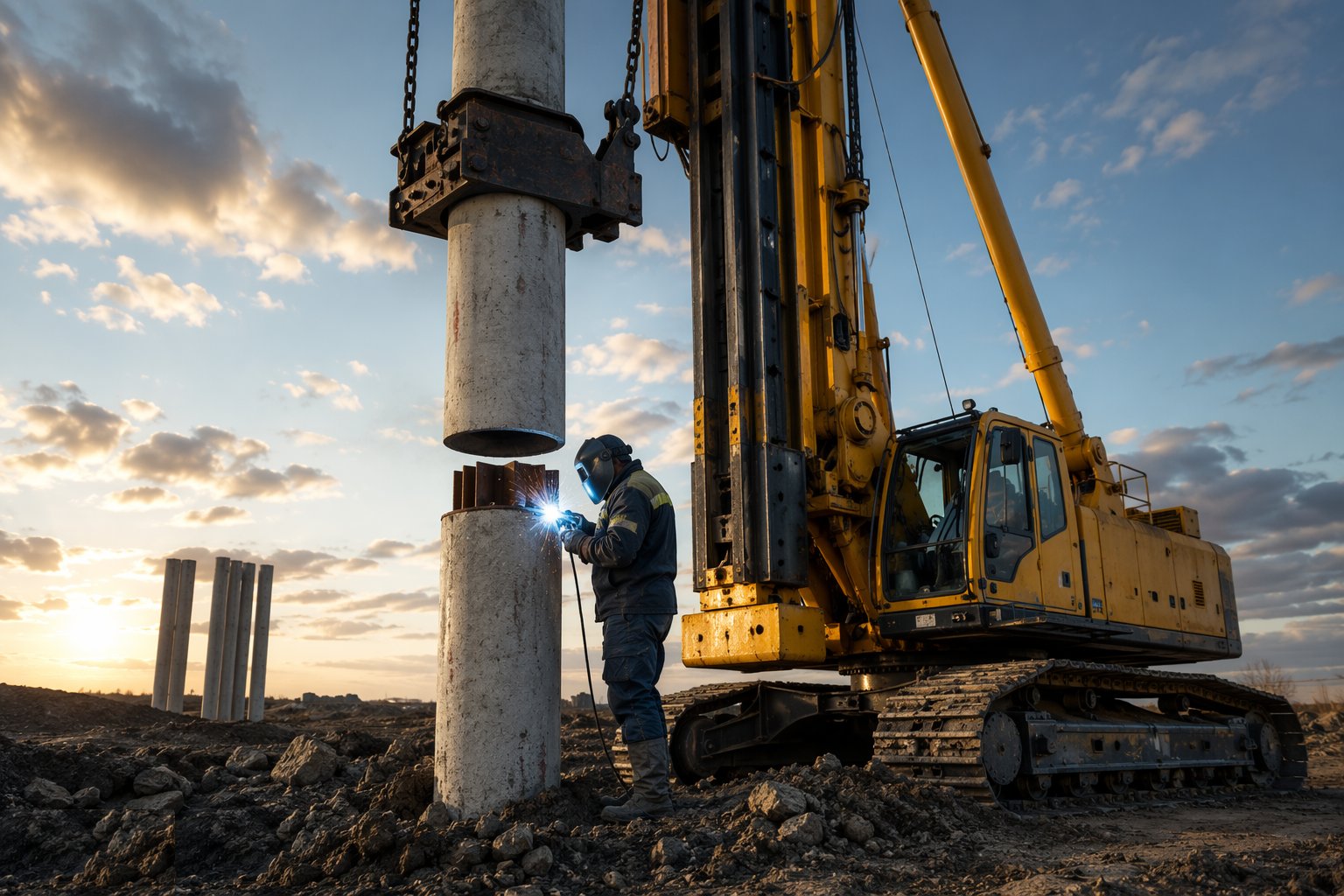
Where depth exceeds a single length, the next section is pitched and jointed — welded or mechanical — with the joint checked for alignment and weld quality before driving resumes. Driving pauses matter: in clays the ground can set up around the shaft during a long stop, and restarting costs capacity evidence and hammer energy.
Step 4: Achieve the designed set
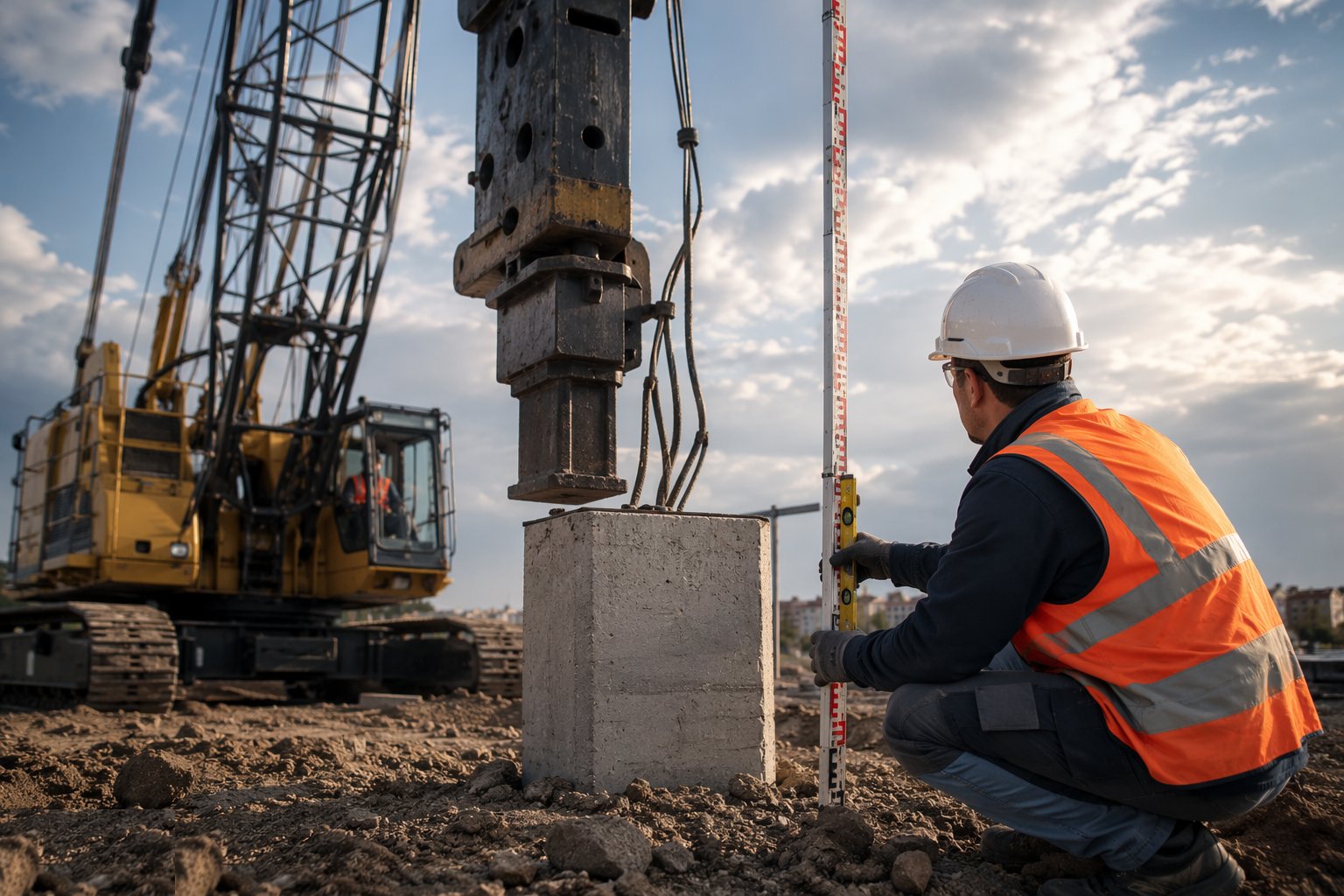
Driving continues to the design criteria: a final set (penetration per number of blows at a given energy) or a founding level confirmed against the GI. The set is measured honestly — marked leader, steady energy, no bouncing on a compressed dolly — because the set is the capacity calculation made physical. Premature refusal on a boulder is the classic false pass, and the record must show whether the ground truly improved or merely blocked.
Step 5: Crop and test
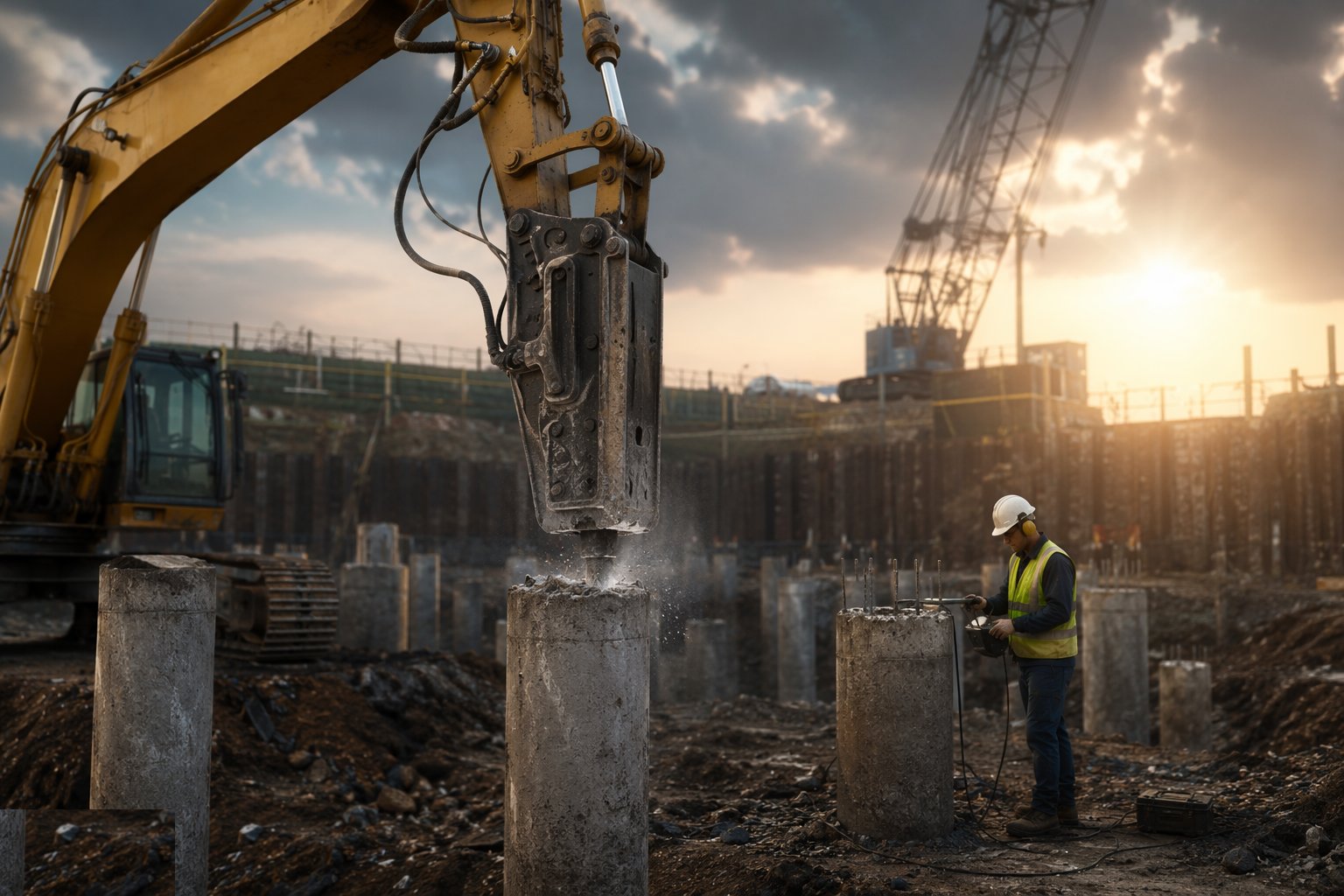
Piles are cropped to cut-off level with breakers or hydraulic munchers, protecting the projecting reinforcement. Dynamic testing with PDA equipment verifies capacity and hammer performance on a sample; static load tests on preliminary piles calibrate the whole design before production driving is signed off.
Step 6: Survey and reconcile the driving records

Every pile's record — blows, sets, depths, hammer energies, any interruptions — is filed against the pile reference and reconciled against the design assumptions. As-built positions and levels are surveyed before caps are poured. Anomalies — a pile driven short, a deflected pile, a broken joint — get engineered resolutions, not paperwork.
What are the benefits of Driven precast concrete piles?
- Capacity is proven as the pile goes in — the driving record is a continuous load test
- Factory-made quality — controlled casting, curing and reinforcement, independent of weather and site concrete supply
- No spoil, no support fluid, no open bores — the cleanest deep foundation on site
- Fast output — 10–20 piles per rig per day on open ground
- Immediately loadable — no curing wait, caps can follow within days
- Displacement densifies loose sands — good in soft ground over firm strata
What are the limitations of Driven precast concrete piles?
- Noise and vibration — effectively excluded from tight urban and sensitive sites
- Obstructions can deflect, refuse or break piles — pre-boring adds cost
- Length limited by handling and leaders — joints add cost and risk
- Ground heave and lateral displacement can lift or shift adjacent piles and neighbouring structures
- Head damage from over-driving is common — hammer energy and dolly condition need watching
- Limited section size — very high single-pile loads need groups or a different system
What is Driven precast concrete piles best suited for?
- Open suburban, industrial and infrastructure sites with no sensitive neighbours
- Housing estates and low-to-medium rise frames on soft ground over firm bearing
- Sites where spoil disposal or concrete supply is difficult
- Fast programmes where piles must be loadable immediately
- Marine and quay work where precast elements suit the plant access
What plant does Driven precast concrete piles need?
- Piling rig with leaders, hydraulic or drop hammer, helmet and dolly
- Crawler crane or rig winch for pile pitching and handling
- Pile delivery wagons and storage racks — piles stored on correct bearers
- Welding sets and alignment frames for jointed piles
- PDA dynamic testing equipment; static load test kentledge for preliminary piles
- Cropper or hydraulic muncher for trimming heads
How is Driven precast concrete piles quality-checked?
- Driving record kept blow by blow for every pile — penetration, energy, set
- Receipt inspection of every pile: straightness, cracks, spalling, casting date and cube results
- Set criteria agreed up front and measured at stated hammer energy
- Dynamic (PDA) tests on a sample; static maintained load tests on preliminary piles
- Joint weld inspection and alignment check before redriving
- As-built survey of position, level and verticality against tolerance
Related processes
- Piling & Deep Foundations — full process guide
- CFA — Continuous Flight Auger Piles — method
- Driven steel tube and H piles — method
- Rotary bored cast-in-situ piles — method
- Mini and micro piling — method
- Sheet piling — method
- Site Access & Enabling Works
- Site Clearance & Demolition
- Setting Out & Survey Control
- Earthworks & Excavation
- Dewatering & Groundwater Control
- Shallow Foundations
- Basement & Substructure
- Waterproofing and Tanking
- Concrete Frame Construction
- Steel Frame Construction
- Masonry & Timber Frame
- Floor Slabs & Screeds
- Roofing
- Façade & Cladding
- Insulation Systems
- Windows, Doors & Glazing
- MEP First Fix
- Internal Finishes
- MEP Second Fix & Commissioning