Power Generation
Solar farms, wind farms, hydro and geothermal — power assets built to industrial standards.
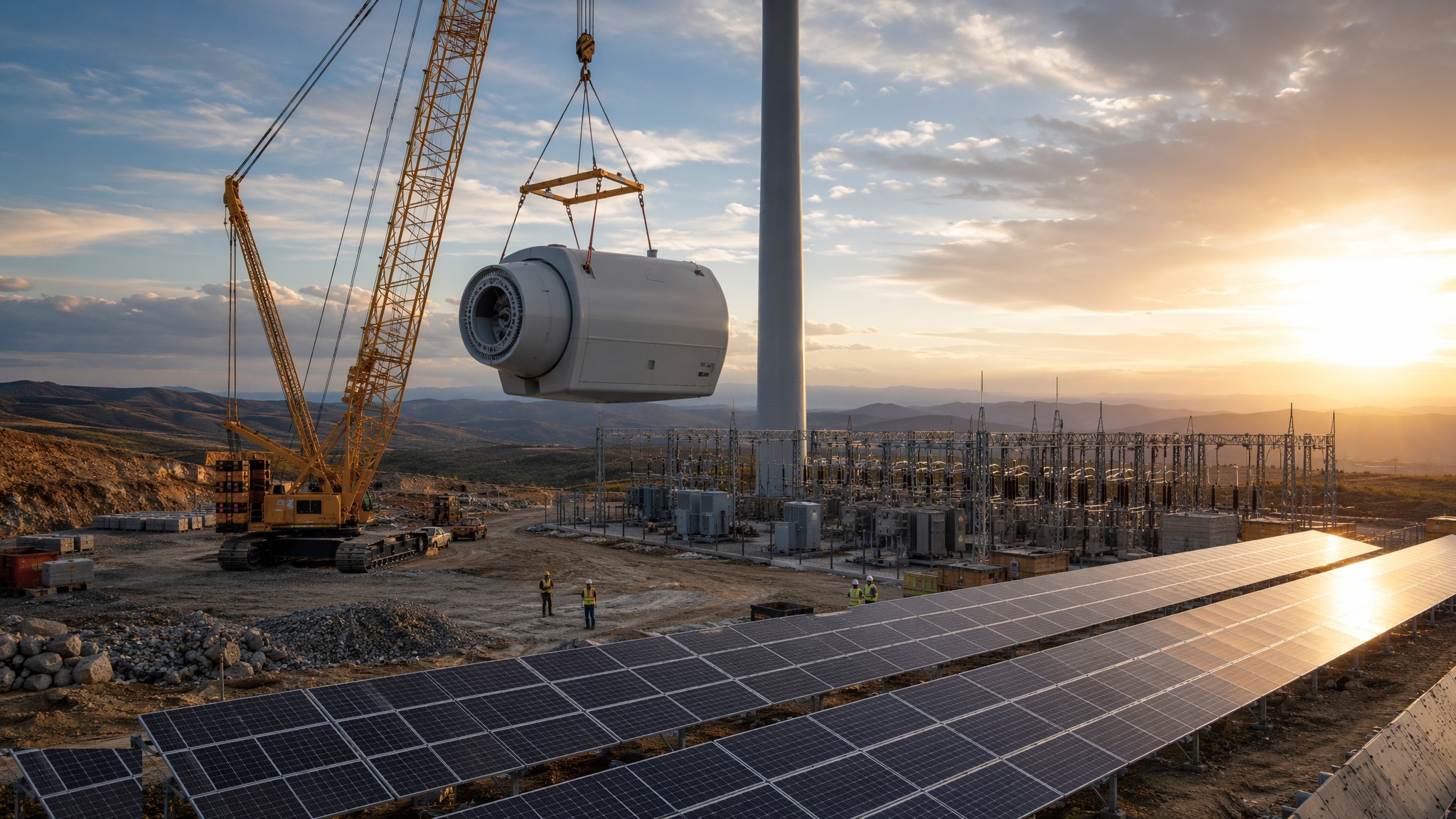
Power generation is where building work meets process engineering. A solar farm is mostly civil and electrical work at scale; a wind turbine is a foundation, a crane lift and a commissioning exercise; hydro is heavy civils in a river valley with the water trying to get back in the whole time; geothermal is drilling and heat-exchange kit with a builder's finish.
The eighteen guides in this sector open with the shared enabling works every scheme needs — site access, survey, ground investigation and the resource and grid studies the asset is financed on — then branch into utility-scale solar, onshore and offshore wind, hydroelectric schemes and geothermal, and close with energisation and handover. Oil & gas facility guides now sit in their own sector under Industrial & Specialist Facilities.
What does Power Generation cover?
Process guides in Power Generation
- Site Access & Enabling Works — Getting plant, people and materials to a remote site and making it safe, legal and workable — the logistics stage every energy project starts with.
- Survey, Ground Investigation & Resource Studies — Fixing where everything goes, proving what the ground will take, and measuring the wind, water and grid the asset is being built for.
- Piling & Mounting Structures — Thousands of driven steel posts and the racking they carry — the repetitive, high-rate foundation system whose pull-out tests and driving logs decide whether the array stands for thirty years.
- PV Module Installation — Hanging the modules, clamping them to torque and wiring the strings — high-rate repetitive work where handling damage, clamp position and connector quality decide the plant's long-term output.
- Electrical Balance of System — Strings to inverters, inverters to the substation, and the SCADA that watches it all — the trenches, cables, MV skids and switchgear that turn thousands of modules into a power station.
- Grid Connection & Energisation — The connection agreement made physical: grid-witnessed tests, a phased energisation sequence and the compliance evidence that lets a finished solar farm finally export a single kilowatt-hour.
- Wind Turbine Foundations — The reinforced concrete bases that hold a 100-metre-plus tower against the overturning pull of the rotor — built to millimetre-level bolt tolerances at the end of a moorland track.
- Craneage & Tower Erection — The heaviest lifts most construction professionals will ever see — a main crane the size of a small building, tower sections, a nacelle and blades as long as a football pitch, all governed by certified crane pads and wind limits.
- Wind Farm Electrical Infrastructure — Kilometres of buried 33 kV array cable stitched from turbine to turbine, a collector substation, and the grid compliance work that turns a field of machines into a power station.
- Commissioning & Energisation — The staged proof that each machine is safe to energise, safe to spin and produces what the warranty promised — from cold checks to first rotation to the power-curve test.
- River Diversion & Cofferdams — Diversion and cofferdam works — moving the river aside by a tunnel, a channel or a phased cofferdam sequence, and keeping it there through every flood the construction period will see.
- Dam & Powerhouse Civils — The concrete and compacted fill at the heart of the scheme — the dam itself, the intake, the spiral-case pits and draft tubes of the powerhouse — placed in blocks and layers over seasons.
- Electromechanical Installation — Turbines, generators, governors and the switchyard — the rotating heart of the scheme, assembled to machining tolerances inside the concrete shell the civils have handed over.
- Impoundment, Commissioning & Handover — Filling the reservoir for the first time under surveillance, proving the machines dry then wet, satisfying the reservoir-safety regime — and handing over an asset built for a century.
- Ground-Source Heat Pumps — Homes & Villas — The small end of the geothermal stream: a buried ground loop and a heat pump serving one house or villa — the trenching, drilling, pressure testing and commissioning that decide whether it heats efficiently for decades.
- Shallow Geothermal — Commercial & District Schemes — Borehole fields under car parks, loops cast into foundation piles and shared ambient-loop networks — shallow geothermal at commercial and district scale, where thermal balance and drilling logistics rule.
- Deep Geothermal Drilling & Wells — Wells one to five kilometres deep drilled to oil-and-gas standards — casing strings, cement, mud logging and well control — the heavy end of the geothermal stream.
- Geothermal Plant, Connection & Commissioning — The surface plant that turns hot water into heat and power — heat exchangers, ORC units and district-scale heat pumps — plus the connection, commissioning and handover disciplines that close the geothermal stream.
Part of the Utilities & Energy group.