Geothermal Plant, Connection & Commissioning
The surface plant that turns hot water into heat and power — heat exchangers, ORC units and district-scale heat pumps — plus the connection, commissioning and handover disciplines that close the geothermal stream.
Last updated 2026-07-28 by the BuildPedia Editorial Team.
What is Geothermal Plant, Connection & Commissioning?
Everything drilled and buried in this stream — from a single villa borehole to a five-kilometre production well — ends here, at the plant that turns the resource into something sellable. The surface plant takes three broad forms. For district heat, an energy centre holds large water-to-water heat pumps raising loop or well temperatures to network temperatures, with plate heat exchangers separating the geothermal fluid from the building-side water. For power, a binary organic Rankine cycle (ORC) plant passes the geothermal brine through a heat exchanger to boil a secondary working fluid that drives a turbine-generator — the geothermal fluid never touches the turbine and is reinjected whole, which is what lets the moderate temperatures typical of UK deep resources, roughly 100–180 °C, generate electricity at all. United Downs uses exactly this arrangement: an air-cooled binary plant of a few megawatts fed by the doublet, with heat offtake planned alongside.
The connections are two contracts as much as two pipes. Power export runs through the grid connection process: in the UK, distribution-scale generation connects through the DNO with protection settings agreed in advance and commissioning witness tests to Engineering Recommendation G99, and the connection queue is as much a programme risk as any construction activity. Heat offtake runs through the heat network framework — CP1 (2020) as the technical code of practice, Ofgem's regulatory regime under the Energy Act 2023, and the HNTAS assurance scheme phasing in mandatory, certificated technical standards. In the UAE there are no deep geothermal plants to connect; the honest parallel is the chilled-water interface, where customers connect to Empower, Emicool or Tabreed networks under the utility's connection conditions, and any ground-coupled scheme would sit inside a building's cooling system with DEWA seeing only the electrical load.
Commissioning a geothermal plant is where mechanical completion meets thermodynamics. Closed loops are filled, dosed with glycol or inhibitor to the verified concentration, purged of air and balanced circuit by circuit; open-loop wells are brought on gradually with the water chemistry watched for scaling and corrosion. Then the performance tests: heat pumps are proved at their duty points and the seasonal performance (SCOP) estimated from measured COP across operating conditions; an ORC unit runs its reliability demonstration at rated output; a heat network proves flow temperatures, pressures and customer-interface performance under CP1-aligned regimes. Handover follows the contract — on FIDIC forms the Taking-Over Certificate starts the Defects Notification Period, during which seasonal performance shortfalls typically surface, and the Performance Certificate closes it; in the UK, practical completion and the defects liability period play the same roles, with the heat network's ongoing regulatory duties passing to its operator.
When and why is Geothermal Plant, Connection & Commissioning used?
Surface plant and commissioning close the sequence because nothing earns revenue until the plant is proven and the connection is live — and because the tests at this stage are the only objective evidence that the wells, loops and plant deliver what the feasibility study promised. It matters disproportionately in geothermal because the resource is invisible: nobody can see the aquifer or the borehole field, so the commissioning data — flows, temperatures, COP, net export — is the asset's birth certificate, and the first winter's measured SCOP is what the owner, the lender and, for a heat network, the regulator will hold the scheme to for the next twenty years.
Types of Geothermal Plant, Connection & Commissioning
District heat energy centre
Large water-to-water heat pumps on a geothermal source — borehole field, energy piles, mine water or a deep well — feeding a heat network through plate heat exchangers, with backup and peak plant alongside. The UK growth form: every serious heat network scheme now reaching for a low-carbon source lands here, under CP1 and the emerging HNTAS regime.
Binary ORC power plant
A packaged organic Rankine cycle unit — brine-side vaporiser and preheater, secondary-fluid turbine-generator, air- or water-cooled condenser — generating from geothermal temperatures too low for steam plant. Factory-built skids keep site work to foundations, piping and electricals; the commissioning burden shifts to chemistry, controls and the grid connection.
Cascade and combined schemes
Power first, then heat: ORC exhaust heat or a separated brine stream cascaded into a district network, greenhouses or industrial users after generation. Every degree of temperature used twice improves the project economics, at the cost of a more complex plant, more interfaces and a commissioning sequence that has to prove both products.
Geothermal Plant, Connection & Commissioning: step by step
Step 1: Install and pressure-test the mechanical plant

Erect the plant on its foundations: heat exchangers, heat pump cascades or ORC skids, pumps, pressurisation and pipework. Verify brine-side materials against the well chemistry before installation — saline geothermal brine demands titanium plates and correctly selected pipework, and the certificate check happens now or expensively later. Hydrotest the piping systems to their test packs, close out punch items, and preserve cleanliness inside brine circuits: debris left in pipework finds the plate exchanger channels first.
Step 2: Complete the electrical and controls works
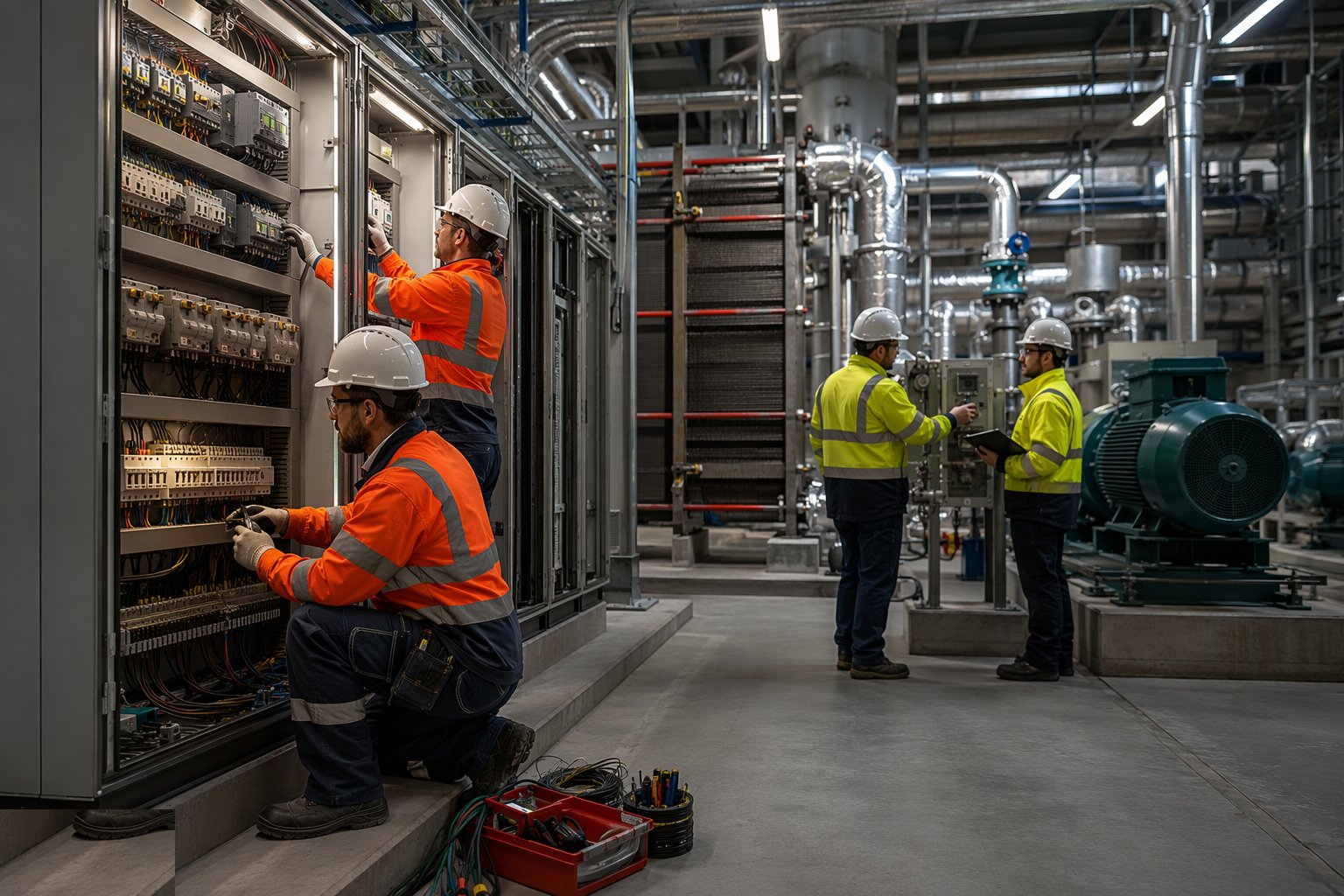
Install the HV switchgear, transformers, protection panels, generator or import metering and the SCADA system. Agree protection settings with the network operator before energisation — settings discovered to be wrong at the witness test stop the connection, not the paperwork. Prove every alarm, trip and control sequence on simulation before heat or pressure is introduced.
Step 3: Make the connection

For power export, complete the grid connection works and the G99 commissioning witness tests with the DNO — protection operation, synchronising, export limitation where the connection agreement requires it. For a heat network, complete the connection and customer-interface tests to CP1-aligned procedures and register the scheme under the notification duties of the new regulatory regime. In the UAE, follow the utility's connection conditions and energisation clearances — DEWA or the emirate authority — with the civil defence clearances that precede energisation on commercial buildings.
Step 4: Fill, dose and balance the loops
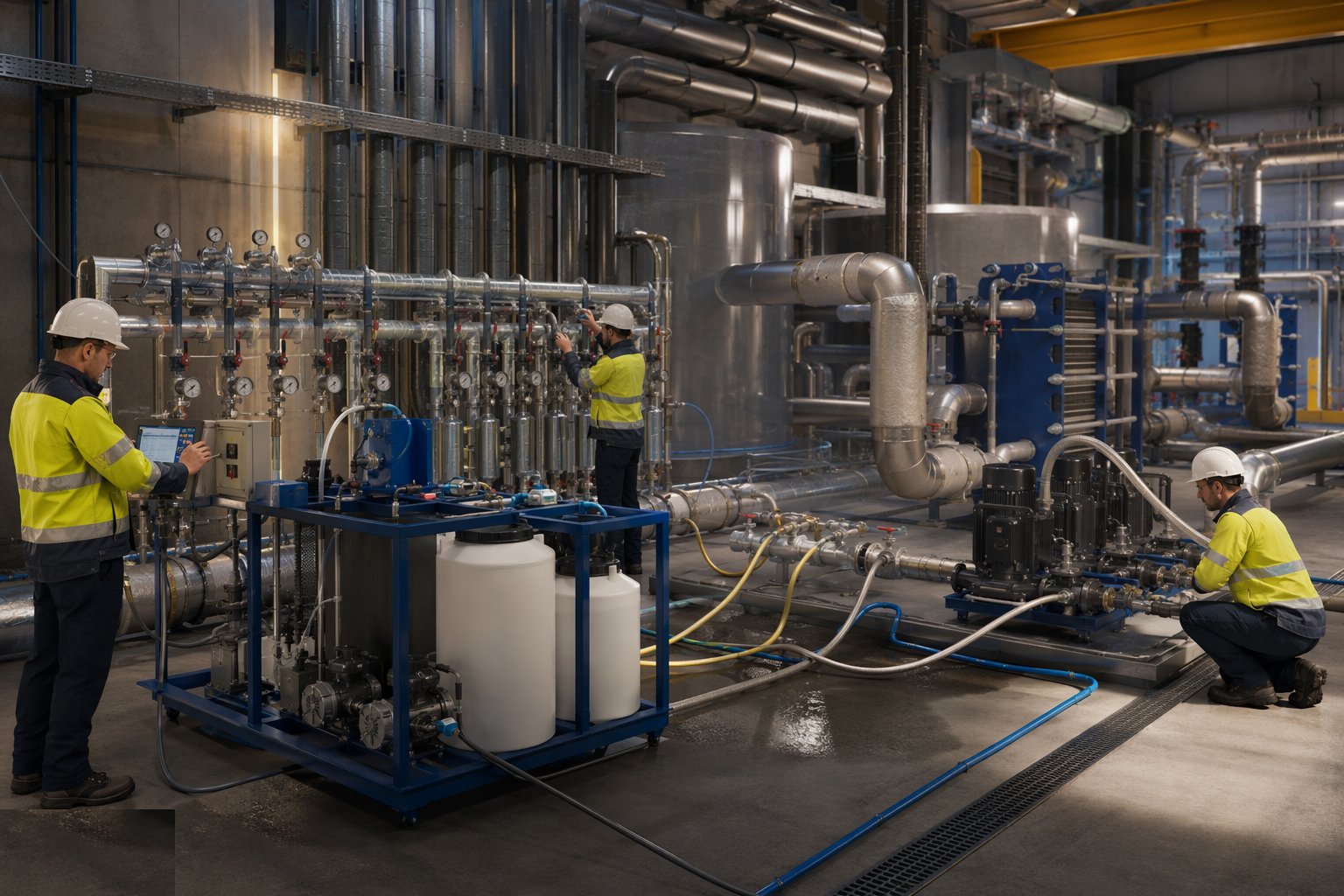
Flush and fill every closed loop, dose glycol or inhibitor to the specified concentration, verify with a refractometer and log it. Purge air methodically — high points, loop fields, network branches — and balance the circuits to their design flows, recording every valve position. Bring open-loop wells on in steps with the discharge chemistry sampled: scaling and corrosion tendencies show themselves in the first weeks, and the treatment regime is tuned on real water, not the feasibility report.
Step 5: Commission cold, then hot

Prove every system at ambient first — rotation, flows, interlocks, controls — then introduce heat: wells flowed, heat pumps staged on one at a time, the ORC taken through its heat-up procedure. Verify temperature differentials across exchangers against design at each stage, and hold at plateaus rather than rushing to full load; most geothermal commissioning faults — fouled strainers, trapped air, control hunting — are cheap at half load and expensive at full.
Step 6: Run the performance and reliability tests

Execute the contractual performance tests: heat pumps at their duty points with COP measured and the SCOP basis derived from measured data across conditions; the ORC at rated output with net export — after parasitic loads — demonstrated over its reliability run; the heat network proving flow temperatures, pressures and interface performance at customer connections. Record everything against the design basis, because these test sheets are the evidence every later performance argument will cite.
Step 7: Hand over and prove the first season

Compile the handover package — O&M manuals, test records, training, spares and the as-built and as-commissioned data — and hand over under the contract: the Taking-Over Certificate and the start of the Defects Notification Period on FIDIC forms, practical completion and the defects liability period under UK forms, with decennial liability running beneath either in the UAE. Agree the first-season monitoring as the practical acceptance evidence: a geothermal plant's true report card is its measured seasonal performance, and the defects period should be long enough to read it.
Plant and equipment
- Plate heat exchangers — titanium plates for brine duty
- Binary ORC skid with turbine-generator, vaporiser and condenser
- Large water-to-water heat pumps with headered cascade arrangements
- Circulation and brine pumps, pressurisation units and dosing equipment
- HV switchgear, transformers and protection panels
- SCADA, controls and heat metering
- Dry coolers or supplementary plant for thermal balance
- Chemical dosing skids, water treatment and sampling stations
Quality control checks
- Piping hydrotest packs closed before insulation and concealment
- Brine-side materials certificates verified against the well or loop chemistry
- Glycol or inhibitor concentration verified at fill and re-checked after commissioning
- Flow balancing records for every circuit, branch and customer interface
- G99 witness test certificates or heat-network connection test records on file
- Performance tests measured against the design duty — COP, SCOP basis, net export
- Commissioning records structured to CP1 where the scheme is a heat network
- O&M documentation, training records and spares complete at Taking-Over
Safety considerations
- Stored thermal energy — hot brine and steam scalding risks during well flow and plant heat-up
- Pressure systems discipline — test packs, isolation certificates and permits to work
- Chemical handling of glycols, inhibitors and brine treatment chemicals
- HV energisation under switching plans with authorised persons only
- Lifting plans and guarding for skid installation and rotating equipment
- Refrigerant management in large heat pump plantrooms — ventilation and detection
- Confined space controls in below-ground chambers and vessels
Common defects
- Loop filled without verified antifreeze concentration — freeze damage or chronic poor performance
- Air trapped in the field or network — flow faults and pump cavitation
- Heat exchangers in the wrong metallurgy — brine corrosion inside the first season
- Protection settings never agreed with the DNO — energisation refused at the witness test
- Performance tests run at unrepresentative conditions — a SCOP claim the first winter disproves
- Scale control neglected on open-loop brine — exchangers foul and output decays
- Defects period closed before a full heating season has run — seasonal shortfalls surface after the certificate
Best suited for
- Heat exchangers, ORC units and district-scale heat pumps
- Connection into heat networks and the grid
- Commissioning against design temperatures, flows and output
- Closing the loop from wellhead to end user
How long does Geothermal Plant, Connection & Commissioning take?
Typical duration: Surface plant installation typically takes three to nine months for a district energy centre or small ORC plant, with commissioning and performance proving adding one to three months — and the first full heating season serving as the practical acceptance test..
Related processes
- Impoundment, Commissioning & Handover
- Ground-Source Heat Pumps — Homes & Villas
- Shallow Geothermal — Commercial & District Schemes
- Deep Geothermal Drilling & Wells
- Site Access & Enabling Works
- Survey, Ground Investigation & Resource Studies
- Piling & Mounting Structures
- PV Module Installation
- Electrical Balance of System
- Grid Connection & Energisation
- Wind Turbine Foundations
- Craneage & Tower Erection
- Wind Farm Electrical Infrastructure
- Commissioning & Energisation
- River Diversion & Cofferdams
- Dam & Powerhouse Civils
- Electromechanical Installation
- Power Generation sector guide
- Utilities & Energy group