Incremental launching
Build the deck in a yard behind the abutment and push it out over the piers - the bridge never has to touch what it crosses.
Last updated 2026-08-25
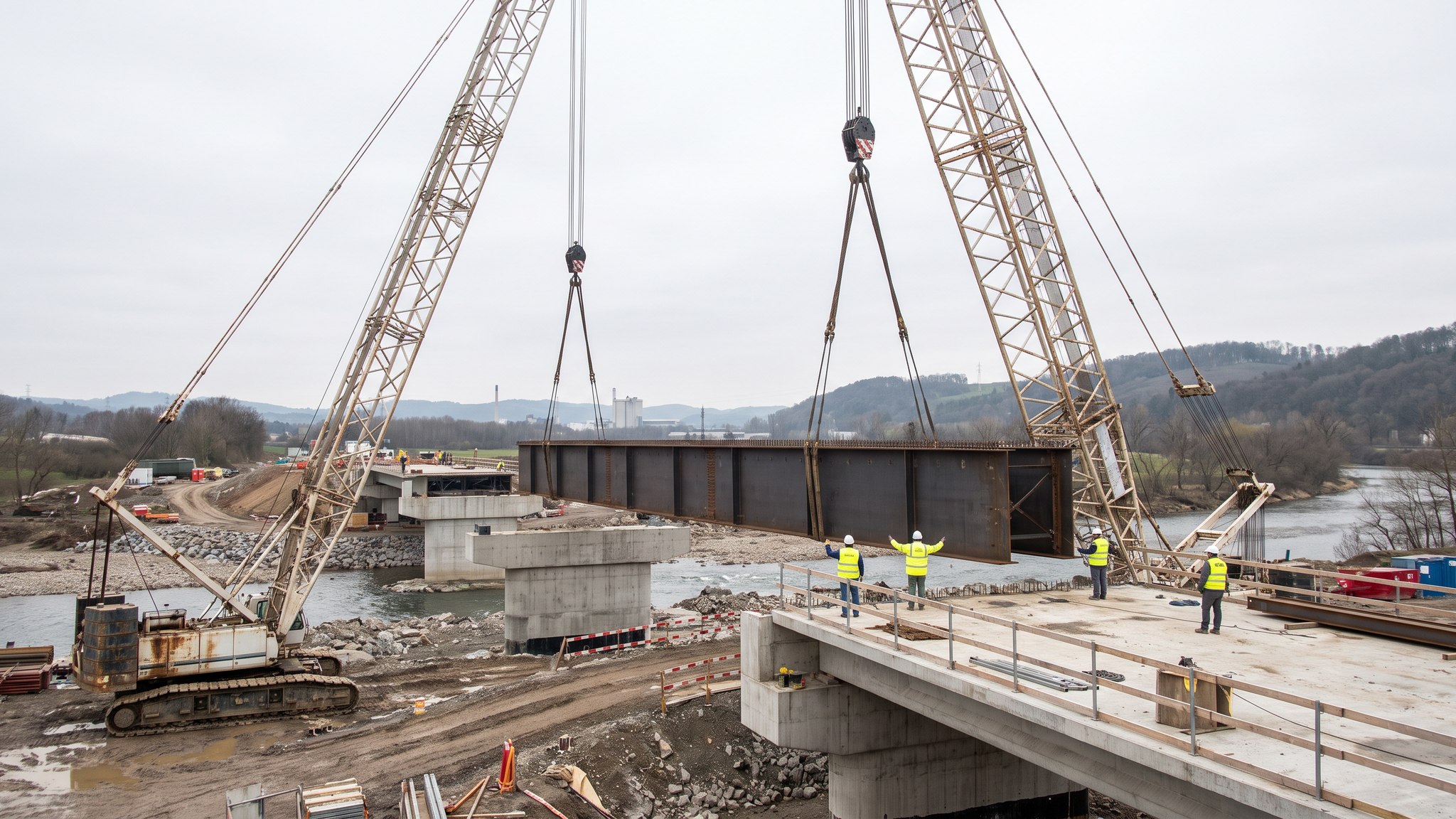
What is Incremental launching?
Incremental launching builds the bridge deck in one fixed place and then moves it. Behind the abutment sits a casting or assembly yard with a cell the length of one segment. A segment is built there - commonly something in the 15-30 m range - stressed to the segment already in front of it, and then the whole deck built so far is jacked forward over temporary sliding bearings on the piers, clearing the cell for the next one. A lightweight steel launching nose is bolted to the leading end to cut the cantilever moment before the deck reaches the next pier; it is typically in the order of 60-70% of the span, with the actual length set by the erection engineer's analysis. A cycle of about a week a segment is a fair working rate. Launched lengths run from around a hundred metres to well over half a kilometre, with spans of roughly 30-60 m typical for a concrete box.
The method exists for sites you cannot get under. Over a live railway or motorway, across a river, above a deep or ecologically sensitive valley, there is nowhere to stand falsework and nothing to crane from. Launching removes the need for both - nothing happens in the gap except the deck sliding through it. Possessions shrink to the hours when the nose is actually crossing, rather than the months a falsework build and strike would occupy. And because every segment is made in the same yard, at ground level, under cover if you want it, the working conditions are close to a factory, which shows in both the concrete quality and the accident figures.
The price of all that is geometry. Every point of the deck has to pass over every pier, so the deck must be a shape that can slide through itself: straight, or on a single constant radius in plan, with a constant grade or one constant vertical curve, and a constant depth end to end. Varying curvature, varying superelevation or a haunched soffit either rule the method out or push the work into expensive temporary measures. There is a structural price too. As it travels, every section takes hogging over a pier and sagging at mid-span in turn, which is why launched decks are normally prismatic boxes with prestress arranged for the journey and further prestress added once the deck is home.
How does Incremental launching work, step by step?
- 1
Step 1: Test whether the alignment can actually be launched
This is the go/no-go, and it belongs at concept stage rather than after the piers have been priced. Check the plan geometry for constant radius, the vertical geometry for a constant grade or single constant curve, and the cross-section for constant depth and constant superelevation. If the highway or rail alignment cannot give that, either the alignment moves or the erection method does. Reviewing it late is how schemes end up paying for a launch that half works.
- 2
Step 2: Build the yard and set up the launch bearings
The casting yard behind the abutment needs a foundation that will not settle under repeated segment loads, because any movement in the cell is built permanently into the deck geometry. The cell holds the soffit, side forms and bulkhead, all set to the launch profile. Temporary sliding bearings and lateral guides go on every pier and on the abutment, and the piers and their foundations are checked by the designer for the horizontal launch and friction forces as well as the vertical load they will finally carry.
- 3
Step 3: Fabricate and fit the launching nose
The nose is a light steel structure bolted to the front of the first segment, and its job is to reach the next pier before the concrete cantilever gets too long. It is fabricated off site, trial-assembled, and connected through a detail the designer has worked out for the launch loads. The nose tip is usually arranged so it can be jacked or ramped as it arrives at a pier, because the deck sags under its own weight and the tip will not simply meet the bearing at the right level on its own.
- 4
Step 4: Cast, stress and cure the segment
Each new segment is cast against the hardened face of the previous one, so the joint is a match and the two fit perfectly when they meet. Reinforcement, ducts, anchorages and any cast-in items are fixed in the cell, the segment is poured and cured, and its strength is confirmed by test before any stressing takes place. The tendons for the launch are stressed to make the deck act as one continuous element. Then the cell is stripped and the segment becomes part of the deck for the next push.
- 5
Step 5: Push the deck forward in controlled increments
The push is done with hydraulic pushing jacks, strand jacks or friction launchers from a single control point, in measured increments, with everybody on the same radio channel. At each increment the crew read jacking force, deck position and alignment, and pier deflection, and compare them with the values the erection engineer has predicted. Anything outside the criteria stops the launch. The nose landing on each pier is a hold point in its own right, and so is any change of shift or any pause overnight.
- 6
Step 6: Land it, jack down and finish the deck
When the deck reaches its final position it is jacked down off the temporary sliding bearings onto its permanent bearings, one location at a time to a sequence the designer sets, and the nose is unbolted and removed. Continuity prestress is then applied to suit the in-service load case, which is a different case entirely from the one the deck was launched under. After that it is ordinary bridge finishing - expansion joints, waterproofing, drainage, parapets and surfacing.
What are the benefits of Incremental launching?
- Nothing has to be built in the gap - no falsework, no crane and no working platform over the railway, road or river
- Possessions and closures are counted in hours around each nose landing rather than months of occupation
- All the deck work happens at ground level in one fixed yard, which is safer, drier and far easier to supervise
- Repeating the same cell dozens of times gives consistent quality and a predictable weekly cycle to programme against
- Minimal disturbance to the ground, the watercourse or the habitat beneath the bridge, which matters on protected sites
- The yard can be sheltered, so work continues in weather that would stop in-situ deck construction
What are the limitations of Incremental launching?
- The alignment must be launchable - straight or one constant curve, constant depth, no varying superelevation
- You need stable land behind an abutment for a yard at least a segment plus the nose long, and it has to stay put
- Every section is loaded in both directions as it travels, so a launched deck carries more prestress than one built in place
- Piers and foundations have to be designed for horizontal launch and friction forces, not just the vertical load they end up with
- It is slow, and the set-up only pays back over enough repeat spans - a weekly cycle across a short two-span crossing rarely justifies the yard
- Span is limited without temporary piers, and temporary piers reintroduce the work in the gap the method was chosen to avoid
What is Incremental launching best suited for?
What plant does Incremental launching need?
- Casting or assembly cell with a fixed soffit set to the launch geometry and adjustable side forms
- Hydraulic pushing jacks, strand jacks or friction launching equipment run from a single control point
- Temporary sliding bearings - low-friction sliding plates over elastomeric pads - with lateral guides at every pier
- Steel launching nose and the connection assembly to the leading segment
- Prestressing jacks, stressing equipment and grouting plant for the ducts
- Survey and monitoring instrumentation for deck position, jacking force and pier movement
How is Incremental launching quality-checked?
- Segment geometry surveyed in the cell before release, and the match joint checked against the segment it was cast against
- Concrete strength confirmed by test before any stressing and before the deck is moved
- Prestressing records - force and extension - reconciled against the design expectation for every tendon
- Jacking force, deck position and pier deflection read at each increment and compared with the erection engineer's predicted values
- Sliding bearing pads inspected and replaced on the cycle the temporary works design requires - they are consumables
- Launch stopped at defined hold points, particularly each nose landing, for a full check before the next push is authorised
Back to process
Bridge Erection Methods