Ballasted track on concrete sleepers
The modern default: heavy sleepers held in a stone bed, adjustable by tamping for as long as the line exists.
Last updated 2026-09-05
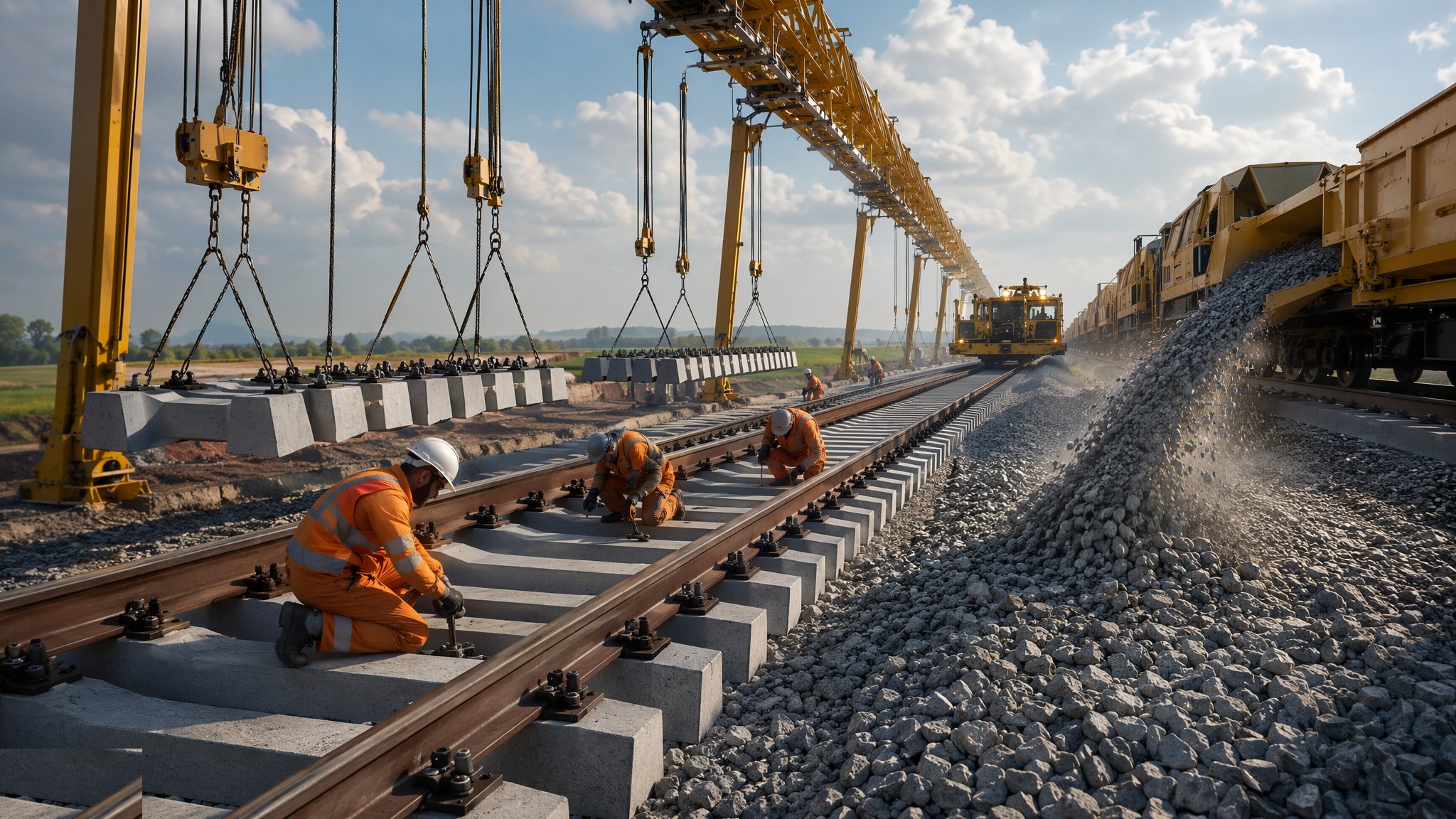
What is Ballasted track on concrete sleepers?
Ballasted track on concrete sleepers is what most of the network is built from and what most new plain line is built as. The rail sits on a resilient pad and is held to the sleeper by a fastening system. The sleepers, made of prestressed concrete, sit in a bed of angular crushed stone that is packed beneath and between them and shouldered at the ends. The ballast does three things: it holds the track in position against vertical, lateral and longitudinal forces, it spreads the wheel load over the formation beneath, and it drains. Everything above the formation is, in principle, adjustable, and that adjustability is the reason the form has survived.
Concrete sleepers became the default because of mass. A heavy sleeper resists movement, and resisting movement is most of what track needs to do. The weight helps hold alignment against the lateral forces from curves and against the longitudinal forces that continuous welded rail generates as it tries to expand and contract. Concrete is also durable, dimensionally stable and made to close tolerances in a factory, which suits a component installed by the hundred thousand. The trade-off is handling. A concrete sleeper is heavy enough that manual placing is not realistic at scale, so the form goes hand in hand with mechanised laying, and it is less forgiving of poor support, since a badly packed concrete sleeper concentrates load rather than flexing around it.
The great advantage of ballasted track is that it can be put right. Geometry that has drifted is restored by tamping, which lifts the track, squeezes ballast in under the sleepers and lets it back down in the corrected position. Ballast that has been crushed and fouled over decades is renewed by cleaning or replacement. Individual sleepers and fastenings are changed out. None of that is available on a slab, which is why ballasted track remains the choice wherever construction depth is not critical and wherever future adjustment is expected. Its costs are the ones that come with an adjustable system: recurring maintenance, ballast that degrades, and a construction depth that is greater than the alternatives. On most projects those are the right costs to accept, and the designer reaches for something else only when a particular constraint says otherwise.
How does Ballasted track on concrete sleepers work, step by step?
- 1
Step 1: Prove the trackbed before any sleeper is laid
Track construction begins on a formation and trackbed that have already been built, tested and signed off. The levels, cross-falls and drainage are confirmed, and the bottom layer of ballast is placed and regulated so the sleepers have something to be laid on. Starting track work on a trackbed that has not been proved is the reliable way of building geometry that will not stay where it is put, and it is far cheaper to correct the layer below than to keep tamping the track above it.
- 2
Step 2: Set out the alignment and establish survey control
The horizontal and vertical alignment is set out from control that runs the length of the works and stays available throughout. Reference marks are established off track so they survive the construction, and every subsequent operation, from sleeper spacing to final lining and levelling, works from the same control. Survey is continuous rather than an activity at the end. The designer's alignment is the reference, and the specification states what is being worked to.
- 3
Step 3: Distribute and lay the sleepers
Sleepers are distributed along the site and laid at the spacing the design calls for, square to the alignment and to the correct level. On most projects this is mechanised, either by a track laying machine working from the railhead or by road rail plant placing sleepers ahead of the rail. Spacing is checked as the work proceeds rather than corrected afterwards. Sleepers are handled with the lifting equipment they were designed for, because a chipped or cracked concrete sleeper is a reject.
- 4
Step 4: Place the rail and fasten it down
Rail is brought in by train or by road rail plant, threaded out along the sleepers, and lowered into position on the rail pads. The fastenings are then installed and tightened, holding the rail to the sleeper while allowing the small movements the system is designed to accommodate. The rail is handled so it is not damaged in placing, since a scored or notched rail is a defect from day one. Where rail is delivered in long welded lengths, its handling and its final condition are governed by the specification and by the infrastructure manager's requirements.
- 5
Step 5: Weld the rail into continuous lengths
Individual rails are joined into continuous welded rail by welding, either by flash butt welding in a plant or from a mobile welder, or by aluminothermic welding in situ. Each weld is made under controlled conditions by a qualified welder, then dressed and tested. Weld quality is checked by inspection and by non-destructive testing at the frequency the specification requires, because a weld is the point at which a continuous rail is least continuous. Records of every weld are kept.
- 6
Step 6: Stress the rail under the specification
Continuous welded rail carries internal forces because it cannot freely expand and contract, and the track is put into a condition where those forces are balanced across the temperature range the route sees. This is a controlled engineering operation, planned and executed to the specification and to the infrastructure manager's requirements, using the equipment and the qualified personnel that the operation calls for. The parameters for any particular site are set by the designer and the infrastructure manager, not chosen on site.
- 7
Step 7: Top up the ballast, tamp and line the track
Ballast is dropped to fill the cribs between the sleepers and to build the shoulders at the ends. A tamping machine then lifts and slews the track to the design alignment and packs ballast beneath each sleeper so it is properly supported. Several passes are usual on new track, since the first pass on loose ballast does not hold. A stabiliser or the first traffic then consolidates the bed. The geometry achieved is measured and compared with the design alignment, and what is acceptable is set by the specification and the infrastructure manager.
- 8
Step 8: Regulate, inspect and hand back
The ballast profile is regulated to the design section, the shoulders are formed, and the site is cleared of surplus material. The track is inspected, the records for welds, fastenings, stressing and geometry are assembled, and the section is handed back fit for traffic within the possession. Early life monitoring follows, because new track settles and the first months of traffic show whether the trackbed beneath is doing its job.
What are the benefits of Ballasted track on concrete sleepers?
- Fully adjustable, since geometry can be restored by tamping for as long as the line exists
- Heavy sleepers resist lateral and longitudinal movement, which suits continuous welded rail and curves
- Ballast drains, spreads load and can be cleaned or renewed when it becomes fouled
- Components are standardised, factory made to close tolerances and available in volume
- Individual sleepers, pads and fastenings can be replaced without rebuilding the track
- Lower construction cost than slab track, with mature mechanised laying and maintenance plant
What are the limitations of Ballasted track on concrete sleepers?
- Requires recurring maintenance, principally tamping and eventual ballast renewal
- Greater construction depth than slab track, which counts against it in tunnels and confined situations
- Ballast degrades under tamping and traffic, and fouled ballast has to be cleaned or replaced
- Concrete sleepers are heavy, so laying and replacement depend on mechanised plant and good access
- Less forgiving of poor packing, since a badly supported concrete sleeper concentrates load
- Transmits more ground-borne noise and vibration than an isolated system where that matters
What is Ballasted track on concrete sleepers best suited for?
What plant does Ballasted track on concrete sleepers need?
- Track laying machine or road rail plant for sleeper distribution and placing
- Rail delivery train or rail handling road rail vehicles for threading and positioning rail
- Flash butt and aluminothermic welding equipment with testing gear for the completed welds
- Rail stressing equipment and the qualified personnel the operation requires
- Ballast hopper wagons or dumpers, a ballast regulator and a tamping machine
- Dynamic track stabiliser and survey and geometry recording equipment
How is Ballasted track on concrete sleepers quality-checked?
- Trackbed levels, cross-falls and drainage proved and signed off before sleepers are laid
- Sleeper spacing, squareness and condition checked as laying proceeds, with damaged units rejected
- Fastening installation and pad presence inspected along the length rather than sampled at the ends
- Every weld recorded, dressed and tested at the frequency the specification requires
- Stressing carried out and documented to the specification and the infrastructure manager's requirements
- Final geometry measured and compared with the design alignment, with acceptance set by the specification
More track construction methods
Next method
Ballasted track on steel or timber sleepers