Pile integrity and load testing
Piles are built where nobody can see them - testing is the only way to know what you actually bought.
Last updated 2026-08-25
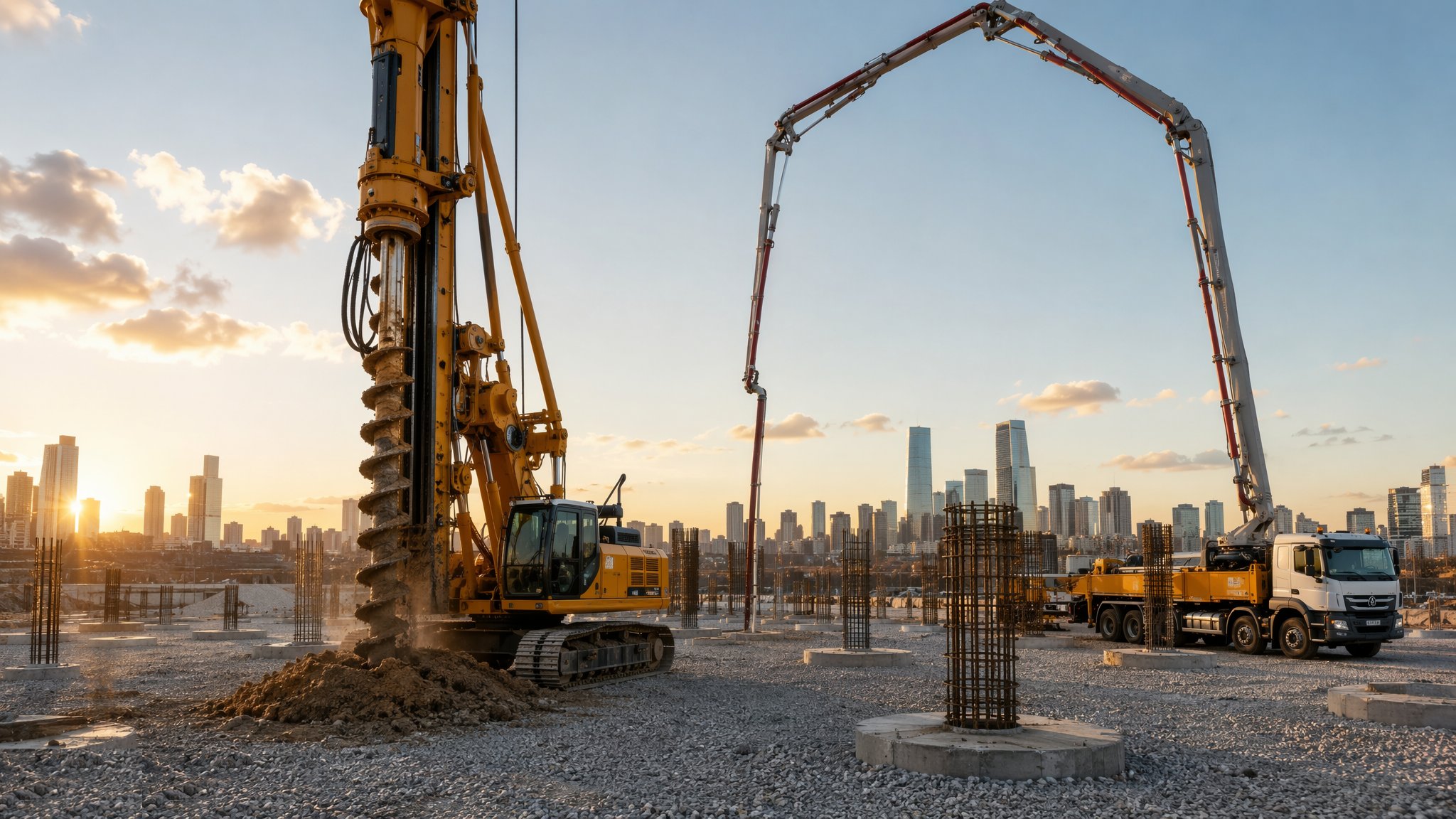
What is Pile integrity and load testing?
Every pile on a site is a structural member cast or driven into ground nobody can inspect, by a rig whose operator is working partly by feel. Testing exists to close that gap, and it splits into two questions that people often confuse. Integrity testing asks whether the pile that is there has the shape, length and continuity that the design assumed - whether there is a neck, an inclusion, a break or a shortfall in length. Load testing asks a different question entirely: whether the pile carries the load it was designed for, at a settlement the structure can live with. A pile can be perfectly sound and still be too short for its load, and it can carry its test load while hiding a defect. You need both, aimed at different things.
Integrity methods run from quick and cheap to slow and definitive. A low-strain test taps the trimmed pile head and reads the reflected stress wave, which is fast enough to cover a whole population - a two-person team commonly gets through 50-150 piles in a day - but it loses resolution with depth, is generally unreliable much beyond 20-30 pile diameters of length, and cannot see past a major defect. Cross-hole logging sends a signal between tubes cast into the pile and gives a much clearer picture through the full length - but the tubes have to be fixed to the cage before the pile is concreted, so the decision to use it is a design-stage decision that cannot be taken later. The usual convention is one tube for each 250-300 mm of pile diameter, which puts three on a small pile and six or more on a large one, and the number is fixed in the specification. Thermal methods read the heat of hydration through cast-in sensors and infer the shape of the shaft. For an existing pile with no head access and no cast-in tubes, indirect methods from an adjacent borehole are the fallback.
Load testing likewise comes in families. A static maintained load test applies load in increments against kentledge or reaction piles and holds each one while settlement is read - the reference method, and the most disruptive, typically running over a day to several days once the reaction is built. A bi-directional test uses a jack assembly cast inside the pile that pushes the shaft up and the base down against each other, which removes the need for kentledge and reaches capacities far beyond what a practical kentledge stack can carry, so it suits high-capacity piles, restricted sites and work over water. A dynamic test drops a weight - a few tonnes to a few tens of tonnes - on an instrumented pile head and derives capacity from the measured response, which is fast enough to cover five to fifteen piles in a day but relies on interpretation and on correlation with a static test. Typical regimes screen a large share of the population for integrity, on many jobs every pile, and load-test a small percentage, often of the order of 1% of the working piles with a stated minimum of one. Which combination is used, on how many piles, and to what load, is decided by the pile designer with the specialist contractor and written into the specification before piling starts.
How does Pile integrity and load testing work, step by step?
- 1
Step 1: Set the testing regime at design stage
The regime is part of the pile design, not an afterthought priced from a rate. The designer decides what has to be proved, how many piles are tested and by which method, and splits the programme into preliminary tests - typically one or two per site, or one for each distinct ground condition or pile type, taken beyond working load by a margin the designer sets, usually on sacrificial piles, to validate the design before production starts - and working tests on production piles to confirm that what is being built matches it. Acceptance is defined in the same document. If cross-hole tubes or a bi-directional assembly are wanted, that decision has to be made now, because both are cast into the pile and cannot be retrofitted.
- 2
Step 2: Install the preliminary test piles and prove the design
Preliminary piles are built by the same rig, the same crew and the same method as production piles, in ground representative of the site, and then loaded well past working load to see how they behave and where they start to give. This is where an optimistic design gets found out cheaply. The result either confirms the design assumptions or sends the designer back to lengthen, widen or re-detail the piles before hundreds of them have been installed. It also settles the practical questions - how long a pile takes, what the ground actually does, whether the rig reaches the depth assumed. A preliminary programme adds something like four to eight weeks ahead of production piling, and it is usually the cheapest month on the job.
- 3
Step 3: Keep the installation records that testing is read against
Modern rigs log what they do, and those records are the first line of quality control. Depth, rotation, torque or blow count, concrete pressure and concrete volume against theoretical volume tell the story of every pile before anyone touches it with a test. Some over-supply against theory is normal - commonly 5-15% in ordinary ground, and more through soft or open strata - so it is the pile that took less than theory, or that behaved unlike its neighbours, that gets looked at first, with what actually counts as acceptable being the specification's to say. Reading the rig records daily is what turns testing from a random sample into a targeted investigation, and it is the step most often skipped.
- 4
Step 4: Prepare the pile heads and run the integrity tests
Integrity testing is only as good as the surface it is done on. Heads are trimmed back to sound concrete, cleaned and made flat and square, and the concrete is given time to gain strength before testing - typically at least a week after casting, with the age set by the specification. A rough, laitance-covered or cracked head produces a poor trace and a false alarm, and a site that panics over test results from badly prepared heads wastes weeks. Cast-in tubes are kept capped, filled and undamaged from the moment the cage goes in. Results are reviewed by the specialist and by the designer together, and anomalies are triaged rather than treated as automatic failures.
- 5
Step 5: Set up and run the load test
A static test needs a reaction system - a kentledge stack, which on a large bored pile can run to several hundred or over a thousand tonnes, or a beam bearing on four to six reaction piles - and that system is significant temporary works in its own right, designed, checked and stood clear of. Building and dismantling it commonly takes a week or more at each end, against a test measured in days. Reaction points have to be far enough from the test pile that they do not interfere with it - typically several pile diameters, with the distance the designer's to set. Settlement is measured against a reference beam founded outside the influence of both the pile and the reaction, and shaded, because a steel beam in direct sun moves enough to spoil a reading. Load is applied in increments and held, with settlement read at set intervals, until the specified maximum is reached and unloading begins.
- 6
Step 6: Interpret, close out and record
Testing produces data, not verdicts. The results are interpreted against the acceptance criteria in the specification by the designer, who decides whether a pile is accepted, retested, investigated further, or replaced or supplemented. Anomalous piles are tracked individually to a written conclusion, and the remedy - additional piles, an enlarged cap, a redesign of the load path - is the designer's. All of it goes into the as-built pile record: installation logs, test reports, interpretations and the closing out of every anomaly, tied to the pile positions on the setting-out drawing.
What are the benefits of Pile integrity and load testing?
- Verifies a structural element that is otherwise completely hidden once it is built
- Preliminary testing lets the designer confirm or refine assumptions before the whole scheme is installed
- Integrity methods are quick enough to screen a large population - 50-150 piles a day for a low-strain crew - and to target the piles worth investigating
- Bi-directional testing removes the need for kentledge, so very high capacities and over-water piles can be tested
- Dynamic testing gives capacity information across five to fifteen piles a day, at a fraction of the time and cost of static tests
- A complete test and installation record is the evidence that settles later disputes about the foundations
What are the limitations of Pile integrity and load testing?
- Cast-in systems have to be specified before the pile is built and cannot be added afterwards
- Low-strain integrity testing loses resolution with depth, is generally unreliable much beyond 20-30 pile diameters, and cannot see past a significant defect
- Static testing is slow and ties up several hundred square metres for two to three weeks, and its reaction arrangement is heavy temporary works
- Dynamic testing relies on interpretation and needs correlation with a static test to be relied upon
- A poorly trimmed or damaged pile head produces misleading traces and manufactures false alarms
- Testing is a sample of the population, so it reduces risk rather than eliminating it
What is Pile integrity and load testing best suited for?
What plant does Pile integrity and load testing need?
- Low-strain integrity equipment - hand hammer, accelerometer and data logger
- Cross-hole logging probes with the access tubes cast into the reinforcement cage
- Kentledge stacks running to several hundred tonnes or more, or four to six reaction piles with a load-spreading beam, or a cast-in bi-directional jack assembly
- Hydraulic jacks, pumps and calibrated load cells for applying and measuring load
- Displacement gauges on an independent, shaded reference beam, with optical levelling as a separate check
- Drop-weight rig and pile head instrumentation for dynamic testing, with signal-matching software
How is Pile integrity and load testing quality-checked?
- Testing regime, methods and acceptance criteria agreed in writing before any piling starts
- Calibration certificates for jacks, load cells and gauges in date - typically an annual interval - and held on file at the time of test
- Concrete maturity confirmed and pile heads trimmed square to sound concrete before testing
- Cast-in tubes or instrumentation checked for damage, capping and fill before the pile is concreted
- Settlement measured independently of the reaction system, on a reference founded outside the influence zone
- Every anomaly logged and closed out by the designer, with the resolution recorded in the as-built pile schedule