Onshore buried pipeline
Conventional cross-country pipeline construction, governed as much by route, consent and land as by engineering.
Last updated 2026-09-06
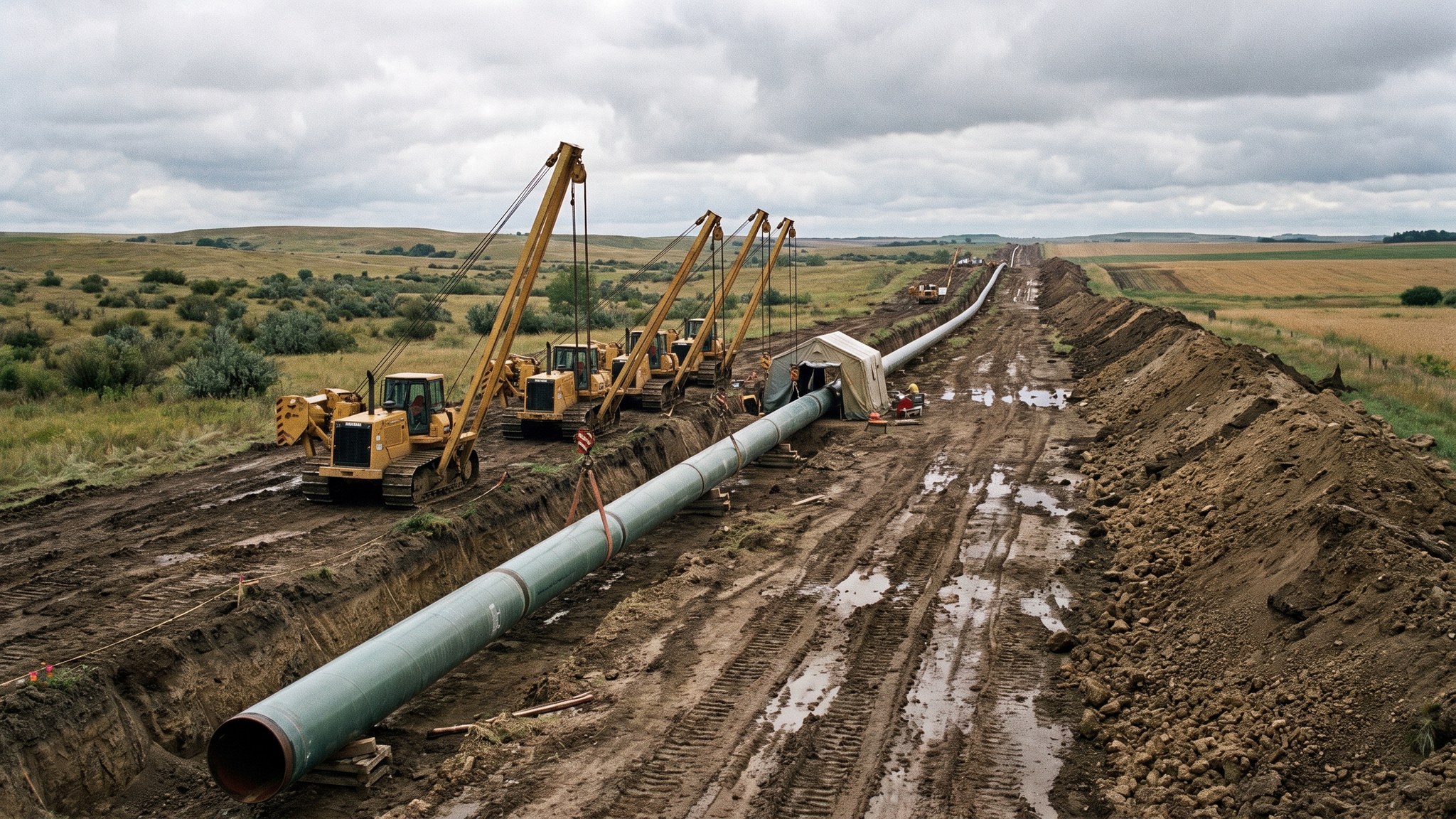
What is Onshore buried pipeline?
An onshore carbon dioxide pipeline is built the way cross-country pipelines have always been built. A working width is fenced off across the countryside, topsoil is stripped and stored separately, the pipe is strung out along the route, welded into long strings, inspected, coated over the joints, lowered into a trench and backfilled, and the land is reinstated behind the spread so that within a few seasons there is little to see. The plant, the crews and the sequence are recognisable to anyone who has built a gas or water main. What is different is not the construction method but the fluid, and the way the fluid changes what has to be assessed and agreed before a single machine moves.
The difference is that a release from a carbon dioxide pipeline does not behave like a release from a natural gas pipeline. Carbon dioxide is heavier than air, it does not burn or rise away, and at concentration it displaces the air people need to breathe. That means it can accumulate in low ground, in cuttings, in ditches, in basements and in confined spaces rather than dispersing upwards. The pipeline designer therefore carries out a route safety assessment for the whole line, and the outcome of that assessment shapes the route itself - where it can pass, how close it can come to occupied buildings and to places where people gather, where the isolation points sit and what monitoring is provided. The distances, the criteria and the modelling behind them are for the designer and the regulator, and they are agreed before the route is fixed. What the construction team needs to understand is that the route is a safety outcome, not just a land and consent outcome, and it cannot be adjusted on site for convenience.
The rest of the project is dominated by land. A cross-country pipeline crosses many ownerships, and each landowner and occupier has to be dealt with individually - access, working width, drainage, crops, livestock, timing around harvest and around calving, and reinstatement obligations that can run for years afterwards. Layered onto that are the statutory consents, the environmental constraints, the archaeology, the watercourse and highway crossings, and the existing services the route has to negotiate. On most projects the consenting and land programme is longer than the construction programme, and the construction spread is a fast-moving factory that arrives only once everything ahead of it has been cleared. Keeping that factory moving is the whole art of pipeline project management.
How does Onshore buried pipeline work, step by step?
- 1
Step 1: Select the route against engineering, land, environment and safety together
Routeing is an iterative exercise. Corridors are compared on length, on ground conditions, on the crossings they require, on environmental and heritage constraints, on land ownership, and on the outcome of the route safety assessment that the pipeline designer carries out because of how the fluid behaves on release. A route that is short and cheap to build can be ruled out by proximity to occupied property or to low-lying confined ground. The designer and the regulator settle the criteria; the project settles the route that meets them.
- 2
Step 2: Secure the consents and the land rights
Statutory consent for the pipeline is obtained through the appropriate route for the scheme, and land rights are secured over the whole working width and the permanent easement. This is a long, individual, negotiated process across every ownership on the line, covering access, working width, temporary and permanent rights, drainage, reinstatement standards and compensation. On most projects it starts years before construction and it determines when each section can be released to the spread.
- 3
Step 3: Survey the ground, the services and the crossings
Ground investigation along the route establishes what the trench will be dug in and what the crossings will need. Existing services are located and agreed with their owners, and each road, rail, watercourse and utility crossing is designed individually - open cut where it is permitted, trenchless where it is not. Environmental and archaeological surveys set the seasonal and method constraints that the programme has to work around. The crossings are usually the pacing items, because each one has its own consent and its own third party.
- 4
Step 4: Open up the working width and string the pipe
The working width is fenced, access is formed, and topsoil is stripped and stored separately from subsoil so it can go back in the right order. Pipe is delivered to a stockyard, hauled to the route and strung out along the working width ready for welding. From this point the spread works as a sequence of gangs following one another along the line, and its productivity depends entirely on having cleared, consented, service-free ground in front of it.
- 5
Step 5: Weld, inspect and coat the line
Pipe joints are welded to a qualified procedure by qualified welders, and every weld is inspected non-destructively. Weld quality is the central quality issue on a pipeline and the inspection records are the permanent evidence of it. The field joints are then coated to match the factory coating on the pipe body, and the coating is checked for holidays before the pipe goes in the ground, because coating is the first line of defence for the outside of the line and it cannot be repaired once buried.
- 6
Step 6: Trench, lower in and backfill
The trench is excavated to the profile the designer has specified, with the ground conditions, the crossings and the land use all influencing what that profile is. The welded string is lowered in on sidebooms, bedded and surrounded as specified, and backfilled with the subsoil and topsoil replaced in the right order. Marker tape and route markers are installed as the design requires. Land drainage disturbed by the works is repaired, which on agricultural land is one of the commonest sources of long-running claims if it is done badly.
- 7
Step 7: Build the above-ground installations and the isolation arrangements
Block valve sites, pig traps, monitoring installations and the terminal facilities at each end are built as small compounds along and at the ends of the route, each with its own civils, security, power and telemetry. Their locations come out of the design and the route safety assessment rather than from convenience. These installations are what allow the line to be isolated and monitored, so they are commissioned as carefully as the line itself.
- 8
Step 8: Reinstate, test, register and hand over
The line is tested and accepted to the procedures the designer and the regulator require before it is put into service. Land is reinstated to the agreed standard, with aftercare obligations that commonly run for several seasons while soil structure and drainage recover. The as-built route, the depth records, the weld and coating records and the easement details are registered and issued, because for the next several decades the operator has to know exactly where the line is, what condition it went in and who must be consulted before anyone digs near it.
What are the benefits of Onshore buried pipeline?
- Well established construction method with an experienced contractor and plant base
- Highest capacity and lowest unit cost for continuous large volumes over land
- Once built and reinstated the line has little visible presence and low operating cost
- Onshore access means the line can be inspected, monitored and, if necessary, repaired
- The spread is fast once ground is cleared, so construction can be short relative to consenting
- Ordinary carbon steel can be used, provided the conditioning upstream reliably keeps the stream dry
What are the limitations of Onshore buried pipeline?
- Route is constrained by the safety assessment as well as by land and environment, and cannot be varied on site
- Consenting and land acquisition typically take far longer than construction
- Crosses many ownerships, each needing individual negotiation and long reinstatement aftercare
- Crossings of roads, railways, watercourses and services are individual designs with individual third parties
- Seasonal and environmental constraints restrict when parts of the route can be worked
- Integrity depends absolutely on the upstream conditioning package keeping water out of the line
What is Onshore buried pipeline best suited for?
What plant does Onshore buried pipeline need?
- Line pipe with factory coating, delivered through a stockyard and hauled to the route
- Tracked excavators, sidebooms, bending machines and welding rigs working as a spread
- Non-destructive testing equipment and field joint coating plant
- Trenchless drilling or auger boring equipment for road, rail and watercourse crossings
- Topsoil stripping and reinstatement plant, and land drainage repair equipment
- Fencing, access matting and temporary bridging for the working width
- Civils plant for the block valve, pig trap and terminal compounds
How is Onshore buried pipeline quality-checked?
- Route safety assessment completed by the designer and reflected in the fixed route and installation locations
- Consents and land rights in place for each section before it is released to the spread
- Welding procedures and welder qualifications approved, with every weld inspected and recorded
- Field joint coating applied and holiday tested before lowering in
- Trench profile, bedding, surround and backfill inspected against the design for each section
- Crossings constructed and signed off individually against their own designs and consents
- Testing and acceptance of the completed line carried out to the designer's and regulator's procedures
- As-built route, depth, weld, coating and easement records registered and issued at handover
More co2 transport pipelines methods
Next method
Offshore subsea pipeline