Repurposed existing pipeline
Re-using an existing hydrocarbon line - attractive on cost and consent, but only after an exhaustive assessment of its condition and its suitability for a different fluid.
Last updated 2026-09-06
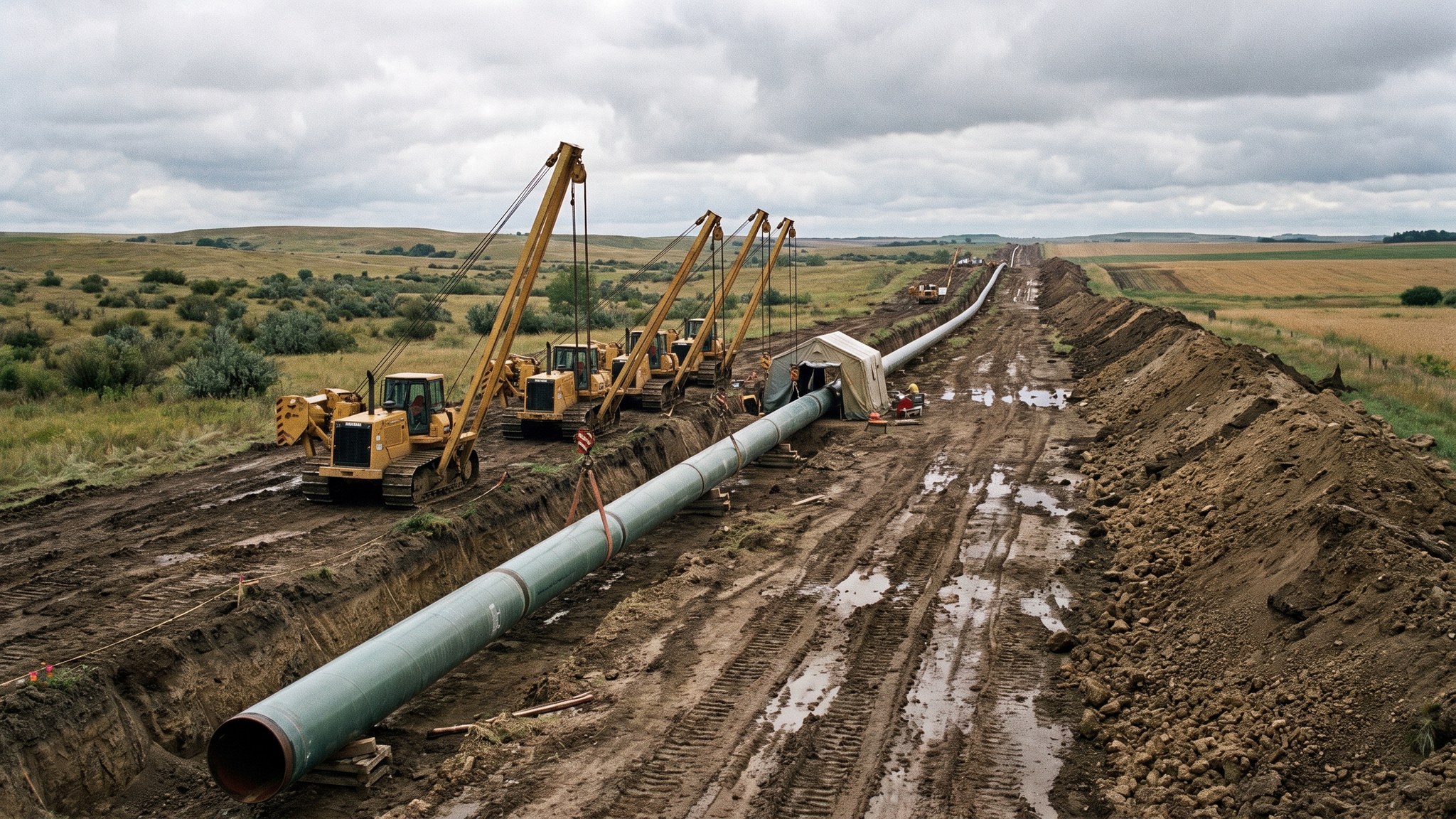
What is Repurposed existing pipeline?
There are existing pipelines running from industrial coasts out to depleted offshore fields and between onshore industrial sites, and many of them are approaching or past the end of the service they were built for. Re-using one to carry carbon dioxide is an obvious idea. The route already exists, the land rights or the seabed position are established, the crossings are already agreed, and the asset is already there. On paper the saving against a new line is enormous, in capital cost and in consenting time, and on offshore routes it can be the difference between a scheme that is viable and one that is not.
The catch is that the line was designed, built and operated for a different fluid, in a different era, to a different specification, and it has spent decades in service accumulating a history. Repurposing therefore begins not with construction but with an evidence exercise. The operator has to establish what the line is made of, how it was built, what it has carried, what condition it is in now, what has happened to it along its length, and whether it is suitable for the new duty. Records from the original construction may be incomplete or inconsistent, particularly on older assets, and where the evidence is missing it has to be recreated by inspection and testing rather than assumed. The regulator will want to see that assessment, and the assessment is what decides whether the idea proceeds.
Where the answer is favourable the works are still substantial. The line usually has to be cleaned internally of the residues of its previous service, inspected internally along its length, re-tested, and modified at its ends and at any point where the new duty demands something different. Sections may be replaced. Valves, instrumentation and control arrangements are commonly renewed entirely. And the same non-negotiable rule applies as to a new line: the stream entering it must be dry, because a repurposed carbon steel line is no more tolerant of water than a new one, and it starts with less margin. Repurposing is therefore best understood as an engineering assessment with a construction project attached, rather than the other way round.
How does Repurposed existing pipeline work, step by step?
- 1
Step 1: Assemble the history of the asset
The starting point is the record. Original design and construction documentation, material records, weld and coating records, the operating history, what the line has carried, what pressures and temperatures it has seen, every repair and modification, every reported incident, and all previous inspection results are gathered and reviewed. On older lines the records are often incomplete, and the gaps in the record become the scope of the physical investigation. This step alone can take many months and it is where most repurposing proposals either gain or lose credibility.
- 2
Step 2: Assess suitability for a different fluid
The pipeline designer assesses whether the line as built is suitable for the new service - the materials, the fittings, the valves, the seals and elastomers, the coatings and the design basis. Elastomers and seals selected for a hydrocarbon service are a well known area of attention, because they behave differently in this service. Where the original design basis does not cover the new duty, the designer establishes what the line can be operated at, and the regulator has to be satisfied with that reasoning. This assessment, not the construction cost, is what determines whether repurposing is viable.
- 3
Step 3: Inspect the line internally and externally
The line is inspected along its length using in-line inspection tools where it can accept them, supplemented by external inspection where it is accessible and by targeted excavation onshore or survey offshore. The purpose is to establish the present condition - wall loss, defects, coating condition, movement, exposure - as measured fact rather than as inference from age. Where the line cannot accept a conventional inspection tool, the modifications needed to make it inspectable become part of the scope, because an uninspectable line is very difficult to justify for a long new service life.
- 4
Step 4: Clean and decommission the previous service
Before the line can be handled for the new duty it has to be cleaned of the residues of the old one, and those residues are a waste stream that has to be captured, characterised and disposed of properly. Cleaning is planned as an operation in its own right, with the receipt, storage and disposal arrangements agreed in advance. Where the line has been laid up for some time, its condition on opening is one of the things the assessment is confirming.
- 5
Step 5: Repair, replace and modify what the assessment requires
The assessment produces a defect list and a modification list. Sections that fall short are replaced, defects are repaired to agreed procedures, and the line is modified where the new duty needs something the old duty did not. Ends, tie-ins, valve stations, pig traps and instrumentation are commonly renewed entirely because they are the parts that are easiest to reach and the parts most specific to the service. On offshore lines these works are campaign items with their own vessel requirements.
- 6
Step 6: Re-establish the safety case for the new service
A route safety assessment is carried out for the new fluid, exactly as it would be for a new line, because how a release behaves has changed even though the route has not. Development that has grown up along the route since the line was built is taken into account. Where the assessment identifies locations that are no longer acceptable, the outcome may be additional isolation, additional monitoring, physical protection or, in the worst case, the conclusion that a section cannot be repurposed. The designer and the regulator settle the criteria.
- 7
Step 7: Test and accept the line for its new duty
The line is tested and accepted for the new service to the procedures the designer and the regulator require, and the results are assessed against the design basis established during the assessment rather than against the original one. Acceptance is a formal step with the regulator, and the whole assessment, inspection and repair record is the evidence for it.
- 8
Step 8: Hand over with a monitoring regime that reflects the asset's age
A repurposed line goes into service with a monitoring and inspection regime that is normally more demanding than a new line would carry, because its history is longer and its margin is smaller. The regime, the re-inspection intervals and the conditions attached to operation are defined at handover and agreed with the regulator. The operator also inherits the obligation to keep proving the case, not just to have proved it once.
What are the benefits of Repurposed existing pipeline?
- Avoids the capital cost of a new line, which offshore can be the difference between viable and not
- Route, land rights or seabed position and crossing agreements already exist
- Consenting is generally faster and narrower than for a wholly new pipeline
- Far less construction disturbance to land, sea users and communities along the route
- Makes use of an asset that would otherwise be decommissioned at cost
- Lower embodied carbon than manufacturing and laying an equivalent new line
What are the limitations of Repurposed existing pipeline?
- Requires an exhaustive and lengthy condition and suitability assessment before anything is certain
- Original records are often incomplete, so evidence has to be recreated by inspection and testing
- Materials, seals and fittings chosen for a different fluid may be unsuitable and need replacement
- Cleaning the previous service produces a waste stream that has to be characterised and disposed of
- The route safety assessment has to be redone for the new fluid, against development that has grown up since
- Remaining life is shorter and margins are smaller, so the ongoing inspection regime is more demanding
What is Repurposed existing pipeline best suited for?
What plant does Repurposed existing pipeline need?
- In-line inspection tools and the equipment to launch and receive them
- Cleaning equipment with receipt, storage and disposal arrangements for the recovered residues
- Excavation plant for onshore inspection and repair locations
- Survey vessels and remotely operated equipment for offshore inspection and intervention
- Welding, cutting and tie-in spreads for section replacement and end modifications
- New valve stations, pig traps, instrumentation and telemetry equipment
- Testing equipment for acceptance of the line in its new duty
How is Repurposed existing pipeline quality-checked?
- Complete record review documented, with the gaps in the record identified and turned into investigation scope
- Material, fitting, seal and coating suitability for the new service assessed and recorded by the designer
- In-line and external inspection completed along the length, with results assessed against the new design basis
- Cleaning completed and the recovered residues characterised, tracked and disposed of with records held
- Defect and modification lists closed out, with repair and replacement procedures approved and recorded
- Route safety assessment redone for the new fluid, with the resulting measures implemented
- Testing and acceptance completed to the designer's and regulator's procedures for the new duty
- Ongoing inspection and monitoring regime, with intervals and operating conditions, agreed and issued at handover