Soft landings aftercare
The design and construction team stay involved after handover until the building actually works.
Last updated 2026-09-05
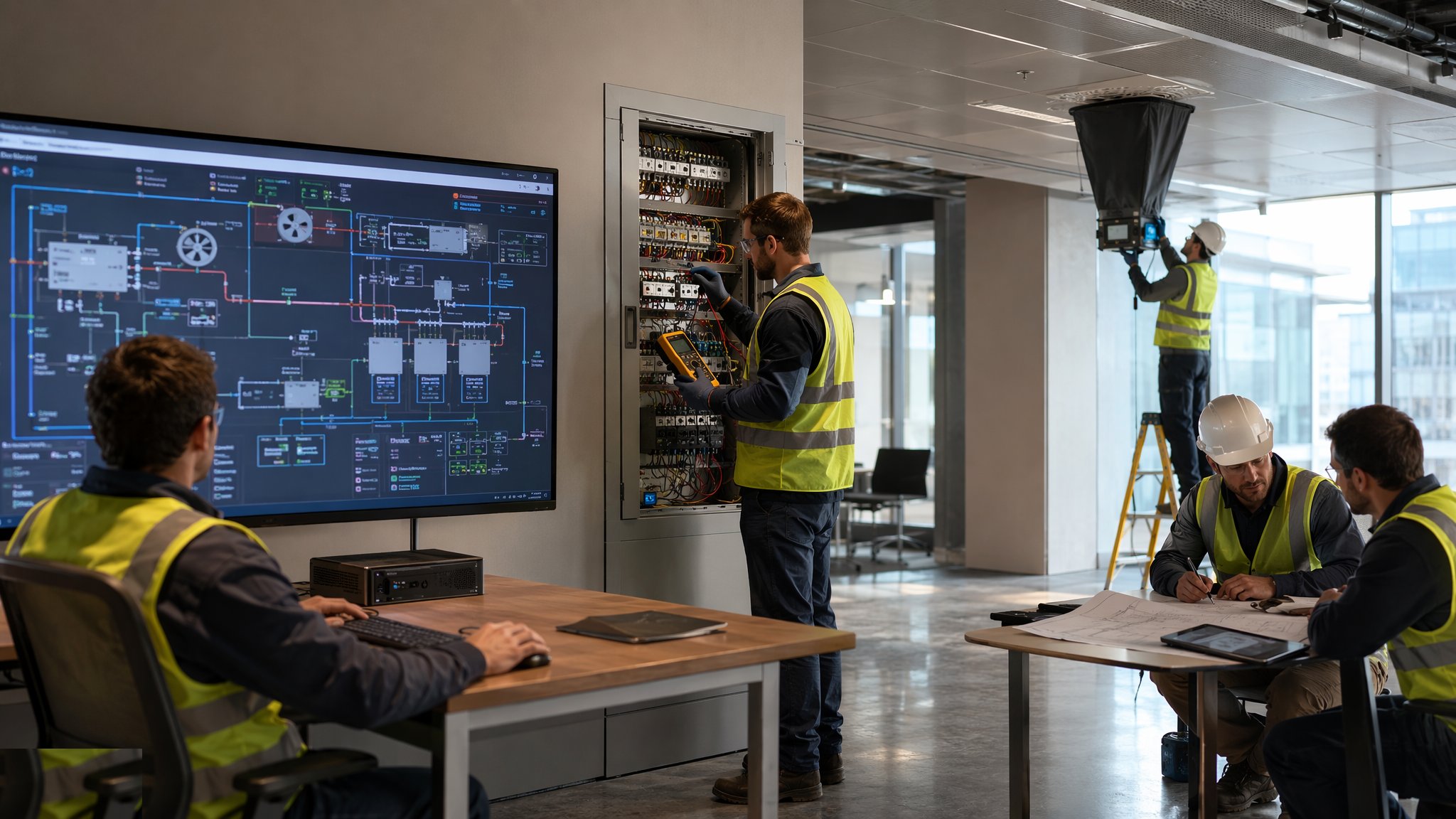
What is Soft landings aftercare?
Soft landings is the general industry term for keeping the people who designed and built the building involved for a defined period after handover, rather than letting them walk away at practical completion. It is a way of running a project rather than a separate trade. The commitment is made at the start, priced into the appointments, and it changes behaviour throughout: the team knows it will have to live with what it hands over. In practice it means shared expectations set during design, involvement of the operator through construction, a resident presence in the building at the start of occupation, and monitored performance with feedback over the first year or two.
The problem it exists to solve is the gap between designed and actual performance. Buildings routinely use far more energy than the design predicted, and the reasons are rarely exotic - controls left on default settings, systems running outside occupied hours, a strategy nobody explained to the people operating it, occupants defeating a system they do not understand, and small defects that were never worth anybody's time to chase. None of those are visible on the day of handover. All of them are obvious to somebody sitting in the building three months later with the trend data open, which is precisely what aftercare arranges.
The cost is a longer commitment from the design and construction team and a client willing to fund it. The return is a building that works, an operator who understands it, and lessons that carry to the next project. It fails where the commitment is signed up to but not resourced, where the people who did the design are replaced by whoever is available, or where the client sees aftercare as free defects cover. It works where the scope is defined, the people are named, the time is priced, and the whole thing is treated as part of the project rather than a favour afterwards. Aftercare and seasonal commissioning overlap heavily, and on most projects the seasonal visits sit inside the aftercare period.
How does Soft landings aftercare work, step by step?
- 1
Step 1: Commit at the start and set the performance expectations
The approach is adopted at inception, before the design team is appointed, and written into the appointments and the building contract. The client, the design team and later the contractor agree what the building is expected to achieve in use and how that will be measured. Roles are named, the aftercare duration is fixed, and the resource is priced. Adopting the language of aftercare without funding anybody to do it is the most common failure, and it is worse than not adopting it at all because it creates an expectation nobody owns.
- 2
Step 2: Involve the operator through design and construction
The people who will run and maintain the building are brought into design reviews and asked what they can realistically operate. They see the plant before the ceilings close, they comment on access and maintainability, and they get to know the controls while there is still time to change them. A maintenance team that first sees a plant room on the day of handover will spend years working round decisions nobody asked them about, and this step costs almost nothing.
- 3
Step 3: Review readiness for handover honestly
Before completion the team reviews whether the building is genuinely ready for the people moving in: are the systems commissioned, are the records complete, has the training happened, is somebody available when the first problem appears. This is a different question from whether the contract allows completion. The output is a clear statement of what is ready, what is not, and what is being carried into occupation with a date against it.
- 4
Step 4: Provide initial aftercare on site
For the first weeks of occupation a member of the team is present in the building, usually daily at first and then tapering. He deals with the flood of small problems that always follow occupation, explains the systems to occupants, and stops minor irritations turning into settings being overridden permanently. This period is where most of the value sits. A room that is too cold on the second morning gets fixed properly if somebody is there, and gets fixed with a fan heater under a desk if nobody is.
- 5
Step 5: Monitor performance and gather occupant feedback
Through the first year the systems are monitored using the trend data and the meters, and energy consumption is compared against the expectation set at the start. Alongside that, the occupants are asked how the building feels - comfort, temperature, air, noise, light and control. Occupant feedback finds things the data does not, because people notice a problem long before it shows up in a monthly consumption figure, and the two together point at the cause much faster than either alone.
- 6
Step 6: Tune the building against what the data shows
Findings are worked through and the building is adjusted: control settings, schedules, sequences, local balancing and, where necessary, physical alterations. The seasonal visits sit inside this period and are run as part of it. Every change is recorded with its reason. The point is iteration - the building is tuned, watched, and tuned again, which is exactly what a single handover event cannot deliver.
- 7
Step 7: Keep training the people who run and use the building
Training is repeated and extended rather than done once. Operators are retrained as the settings change and as they build up questions. Occupants are given plain guidance on what they can control and what they should leave alone, which prevents most of the workarounds that wreck a control strategy. Staff turnover is planned for, with recorded sessions and written guidance so the knowledge does not leave with one person.
- 8
Step 8: Review at the end of the period and record the lessons
At the close of the aftercare period the team reviews the building against the expectations set at the start, records what was achieved, what was not and why, and hands a tuned building with current records to the operator. The lessons are written up for the client and for the design team. For a client with an estate this feedback loop is the most valuable single output of the whole exercise, because it changes the brief for the next building.
What are the benefits of Soft landings aftercare?
- Closes the gap between designed and actual performance instead of leaving it to be discovered
- Somebody is present when the first problems appear, so they get fixed properly rather than worked around
- The team knows during design that it will have to live with the building, which changes decisions
- Operators understand the building because they were involved before they inherited it
- Occupant complaints fall, and the workarounds that defeat control strategies are headed off
- Produces genuine feedback for the client's next project
- Repeated training survives staff turnover far better than a single handover session
What are the limitations of Soft landings aftercare?
- Requires commitment and funding from inception, which is exactly when budgets are tightest
- Extends the involvement of design and construction teams well past their usual exit point
- Easily adopted in name only, with no named people and no priced time behind it
- Can blur into free defects cover if the scope is not written down clearly
- Depends on continuity of individuals, which is hard to guarantee over a year or more
- Benefits are diffuse and hard to price at tender stage, so it is vulnerable to being cut
- Of limited value where the client sells or lets the building immediately on completion
What is Soft landings aftercare best suited for?
What plant does Soft landings aftercare need?
- Building management system access with trend logging configured and proven before handover
- Sub-metering giving consumption by system and by area rather than a single incoming figure
- Portable environmental monitoring for comfort investigations in occupied spaces
- Occupant feedback survey method agreed with the client, and a simple way of logging complaints
- Somewhere in the building for the aftercare representative to sit and work
- Document management for keeping records current as settings change
How is Soft landings aftercare quality-checked?
- Aftercare commitment written into appointments and the building contract at inception
- Named individuals with priced time, not a general obligation on a team
- Operator involvement in design reviews recorded, with comments tracked to closure
- Readiness for occupation reviewed and stated honestly, separately from contractual completion
- On-site aftercare presence recorded with the issues raised and how each was resolved
- Trend logging and metering verified as working before handover, not after
- Consumption compared against the expectation set at the start, at agreed intervals
- Occupant feedback gathered at defined points and reported to the client
- Every adjustment logged with the reason and the previous value
- End of period review issued, with the tuned settings and current records handed to the operator