Site Remediation & Delicensing
The last phase - conventional demolition of the structures that remain, breaking out slabs, foundations, drains and tunnels, remediating and reprofiling the ground, then assembling the evidence that lets the land be released and turned back into ordinary ground.
Last updated 2026-08-25
Typical duration
Typically 3-10 years from the last structure being released to the land being handed over, with the final survey and the evidence package often taking as long as the physical demolition and remediation.
What is Site Remediation & Delicensing?
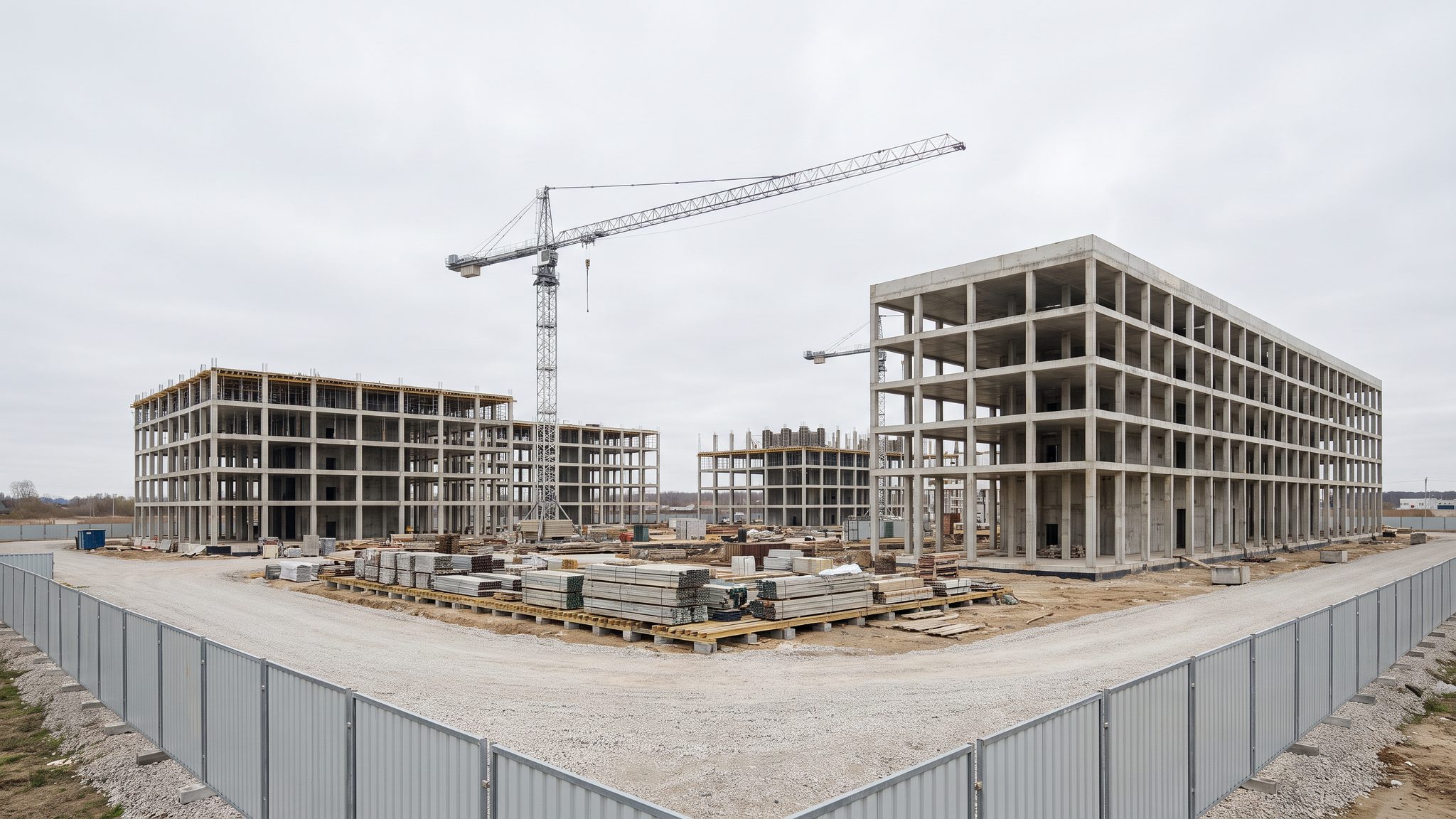
By the time a site reaches this phase the difficult work is behind it and what is left looks, to anyone walking on to it, like an ordinary large demolition and earthworks job. Steel frames and concrete structures come down with high-reach machines. Slabs and foundations are broken out and crushed. Drains, ducts, culverts and tunnels are grubbed up or filled. Ground is excavated, treated or covered, levels are reprofiled, and topsoil goes back on. The plant is the plant any demolition contractor would bring, the methods are the methods any earthworks contractor would use, and the productivity finally starts to look like the rest of the construction industry.
What is still different is the evidence. Nothing is demolished until it has been released, nothing is excavated until the ground beneath it has been characterised, and nothing leaves site until its destination has been agreed. The below-ground work is where the discoveries are - old foundations that are twice the size the drawings show, culverts running under buildings that were demolished in the nineteen seventies, drainage systems that were extended piecemeal for fifty years, and made ground built from whatever was to hand at the time. Every one of those finds stops the excavator, brings the surveyor and the sampling team out, and puts the material into a stream that has to be classified before it can move.
The end point is not a finished building. It is land, and what that land is allowed to be used for is settled by the end state agreed at the very start of the programme. The final survey and the evidence package supporting it are assembled by the site licensee and submitted to the regulator, and the decision to release the land and end the licence rests with them entirely - that process sits outside the scope of this guide. From a construction point of view the deliverable is simpler and harder than it sounds: a stable, drained, restored piece of ground, with a complete and durable record of everything that was left in it and everything that was taken out.
Compare the methods at a glance
When and why is Site Remediation & Delicensing used?
Remediation and land release come last because every structure has to be released before it can be demolished, and because the ground under a building cannot be characterised or excavated while the building is standing on it. The below-ground work in particular is deliberately deferred: opening up ground creates a pathway and an exposure, and it produces arisings that need a destination, so it is done once, at the end, when the surface obstructions are gone and the disposal routes are known. The reason the phase gets so much attention despite being conventional work is that this is where the liability actually ends. A site with structures still standing is a site with a maintenance bill, an inspection regime, an insurance position and a licence, and every year of delay costs money for nothing. Getting to the end state is what stops that. The commercial logic is also what shapes the end state itself. Taking every last foundation out and returning a site to open countryside costs a great deal more than leaving a competent platform, a drainage system and a set of records for an industrial reuse, and it produces a very large quantity of material that has to go somewhere. So the end state is an engineering and economic judgement made decades in advance, and the entire programme has been built around it. The last thing a decommissioning programme delivers is the least dramatic thing on the whole site: ordinary land, with paperwork.
Types of Site Remediation & Delicensing
Explore each method in depth - benefits, limitations, plant and quality control on its own page.
Conventional demolition of the remaining structures
High-reach and mechanical demolition of released structures, using the same plant and methods as any large industrial demolition. Recognisable, productive work, but each structure is only started once it has been formally released and the arisings have a confirmed destination.
Below-ground structure removal
Breaking out slabs, foundations, basements, pits, ducts, culverts and tunnels. It is the least predictable work on the site, because the drawings for below-ground structures are the ones most likely to be wrong, missing or out of date by half a century.
Ground remediation
Excavating and removing affected ground, treating it in place, or containing it beneath an engineered cover system. The choice between them is driven by the agreed end state, the volumes involved and where the excavated material could actually go, rather than by technical preference.
Restoration to the agreed end state
Reprofiling, backfilling, drainage, capping, topsoiling, seeding and landscaping to leave the site in the condition the end state requires - from an engineered industrial platform ready for reuse, through to open land with a long-term monitoring and record regime.
Best suited for
- Sites where every structure has been released and the remaining work can run at conventional demolition and earthworks productivity
- Programmes with a clearly defined end state, which determines how deep the below-ground removal and remediation have to go
- Sites with large volumes of demolition arisings that can be crushed and reused on site as engineered fill
- Land intended for industrial or commercial reuse, where a competent platform and a full record are worth more than open ground
- Programmes that kept their records as they went, and can therefore answer questions with evidence rather than with recollection
Site Remediation & Delicensing: step by step
- 1
Step 1: Demolish the structures that have been released
Once a structure has been cleared, surveyed and formally released, it comes down under conventional demolition arrangements. A pre-demolition audit records what materials it contains and where they will go, the structure is soft-stripped of anything worth recovering, and the demolition method is engineered - high-reach machines for tall structures, sequential deconstruction where the neighbours are close, and explosive techniques only where the site conditions genuinely suit them. Temporary works, exclusion zones, dust and noise suppression, and protection of the services and structures that have to survive are all designed in advance. This is finally work that runs at ordinary demolition productivity, and it looks it.
- 2
Step 2: Break out slabs, foundations and below-ground structures
The slabs and foundations come next, and this is where the programme meets its last set of surprises. Foundations are routinely deeper, wider and more heavily reinforced than the drawings suggest, particularly under heavy plant, and machine bases, pits and sumps appear where nothing was recorded. Concrete is broken out, reinforcement is separated and crushed material is stockpiled for testing and reuse. Every excavation is preceded by characterisation of what is beneath it, and any find that does not match the record stops the work, brings out the survey and sampling team and is dispositioned formally before the machine restarts.
- 3
Step 3: Deal with the drains, ducts, tunnels and buried services
Fifty years of drainage on an industrial site is rarely a system - it is several systems, laid at different times, connected opportunistically and drawn incompletely. Drains, culverts, service ducts, tunnels and abandoned tanks are traced, surveyed by camera, cleaned, and then either removed or cleaned, capped and filled where removal would do more harm than good. Everything that stays is recorded accurately, because it becomes part of the permanent legacy of the site. Buried tanks are emptied, cleaned, cut up and removed, and the ground around and beneath them is characterised, since a tank is the single most likely place for the ground to have been affected.
- 4
Step 4: Characterise and remediate the ground
With the structures gone, the ground can finally be investigated properly. A grid of trial pits, boreholes and samples establishes what is there, and the results are compared against what the end state requires. Remediation follows one of three broad routes: excavate and remove, treat in place, or contain beneath an engineered cover system. The choice is driven as much by volume and destination as by technique, because excavating a large volume of affected ground only works if there is somewhere for it to go. Groundwater is monitored throughout, and the criteria against which the ground is judged are set by the licensee under arrangements agreed with the regulator.
- 5
Step 5: Reprofile, backfill and restore the land
The site is filled, graded and drained to the profile the end state requires. Crushed concrete from the demolition is tested and reused as engineered fill wherever it can be, which is by far the best destination for it - the material is already on site, it saves both import and export haulage, and it avoids adding thousands of lorry movements to a local road network that has already had decades of them. Fill is placed and compacted to specification with the usual testing regime, surface water drainage is installed and proved, and topsoil, seeding and landscaping go on where the end state calls for it. Where a cover system is part of the design, it is built and inspected as an engineered structure with a defined life.
- 6
Step 6: Carry out the final survey and assemble the evidence
The final survey is a systematic campaign across the whole site, planned in advance against agreed criteria, executed to a documented method and recorded to a standard that will stand up to detailed examination years later. It covers the ground, the remaining structures, the drainage and anything left in place. Alongside it goes the evidence package: the characterisation history, the removal records, the disposal records for everything that left, the fill and compaction testing, the as-built information for whatever remains buried, and the disposition of every non-conformance raised in decades of work. Assembling that package frequently takes as long as the physical remediation did.
- 7
Step 7: Support the release of the land
The application to release the land and end the licence is made by the site licensee to the regulator, and the decision is entirely theirs - the process, the criteria and the determination all sit outside the scope of this guide. What the construction and engineering side provides is the evidence: a demonstrably complete and traceable record of what was on the site, what was removed, where it went, what remains and what condition the ground was left in. Queries come back and are answered with records rather than with recollection, which is the reason for every quality control requirement described across this sector. A site that kept its records as it went answers them in weeks. A site that did not can spend years.
- 8
Step 8: Hand over the land and set the long-term record
The land is handed over for its agreed use, with the constraints, monitoring obligations and maintenance requirements that go with it. If a cover system, a drainage system or a monitoring network stays in place, somebody has to own it, inspect it and maintain it, and the arrangements for that are set up and resourced rather than assumed. The final deliverable is the record: a durable, indexed, accessible account of what was built here, what was done to it, what was taken away and what was left, held in a form that will still be usable long after everyone involved has gone. It is an unglamorous end to a programme that ran for decades, and it is the whole point of it.
Plant & equipment
- High-reach demolition machines, standard excavators with shears, pulverisers, crunchers and breakers, and reinforcement separation equipment
- Tracked excavators, dozers, graders, articulated dump trucks and compaction plant for bulk earthworks
- Mobile and static crushing and screening plant for processing demolition arisings into engineered fill
- Drain jetting, camera survey and cutting equipment for tracing, cleaning and removing buried drainage
- Trial pitting, borehole and window sampling rigs, plus groundwater monitoring wells and sampling equipment
- Ground treatment plant where in-situ remediation is used, and geosynthetics and capping materials where it is not
- Dust suppression, water management, silt treatment and discharge monitoring equipment
- Survey instruments, control monuments and monitoring systems for the final survey campaign
Quality control & testing
- No structure demolished until it has been formally released, and no excavation started until the ground beneath is characterised
- A pre-demolition audit for every structure, recording the materials it contains and the destination of each
- Every unrecorded find stopped, surveyed, sampled and dispositioned formally before the machine restarts
- Crushed demolition arisings tested and accepted before being reused as engineered fill
- Fill placed and compacted layer by layer against the earthworks specification, with results traceable to location
- The final survey planned against agreed criteria, executed to a documented method and recorded for later examination
- Disposal records reconciled so that every stream that left the site can be traced to its destination
- As-built records produced for everything left in the ground - drains, foundations, cover systems and monitoring installations
Safety watchpoints
- Structural collapse and premature failure during demolition, controlled by an engineered sequence and exclusion zones
- Deep excavation and unstable faces during foundation and basement removal, under a temporary works design
- Buried and unrecorded services during excavation, including services still live and services on neighbouring land
- Confined space entry into drains, culverts, tunnels, pits and tanks under a formal permit regime
- Contaminated ground, gases and residues encountered during excavation of made ground and around old tanks
- Plant and pedestrian separation across a large, open, continuously changing earthworks site
- Dust, noise, vibration and the interface with the public highway and neighbours during a long demolition campaign
- Radiological criteria, monitoring and the release process itself, all controlled by the licensee and the regulator and outside the scope of this guide
Common defects to hunt
- Foundations far larger and deeper than the drawings showed, discovered when the breaker is already on site
- Buried tanks, culverts and drains found by excavation rather than by survey, stopping the works for weeks
- Ground characterised only where it was convenient, so the final survey finds what the investigation missed
- Crushed arisings stockpiled without testing, so a large volume of usable fill cannot be reused and has to be exported
- Backfill placed without proper compaction control, leaving settlement in land that is supposed to be finished
- Drainage left partly in place and inaccurately recorded, so the legacy record is wrong from the day it is issued
- The evidence package assembled at the end from records that were never kept properly, adding years to the programme
- Monitoring and maintenance obligations left in place with nobody named, funded or resourced to carry them out
How long does Site Remediation & Delicensing take?
Typical duration: Typically 3-10 years from the last structure being released to the land being handed over, with the final survey and the evidence package often taking as long as the physical demolition and remediation..
Related processes
Previous in sequence
04 - Waste Packaging & Transfer