Site Preparation & Enabling Works
Turning a large plot of ground into an industrial platform that can carry a decade of heavy construction - bulk earthworks, deep excavation, transport infrastructure, drainage and the batching, laydown and welfare capacity a workforce of thousands needs before a single permanent structure begins.
Last updated 2026-08-25
Typical duration
Typically 2-4 years from first ground being broken to a platform ready for safety-classified construction, and longer where deep excavation, sea defences or new transport infrastructure sit on the critical path.
What is Site Preparation & Enabling Works?
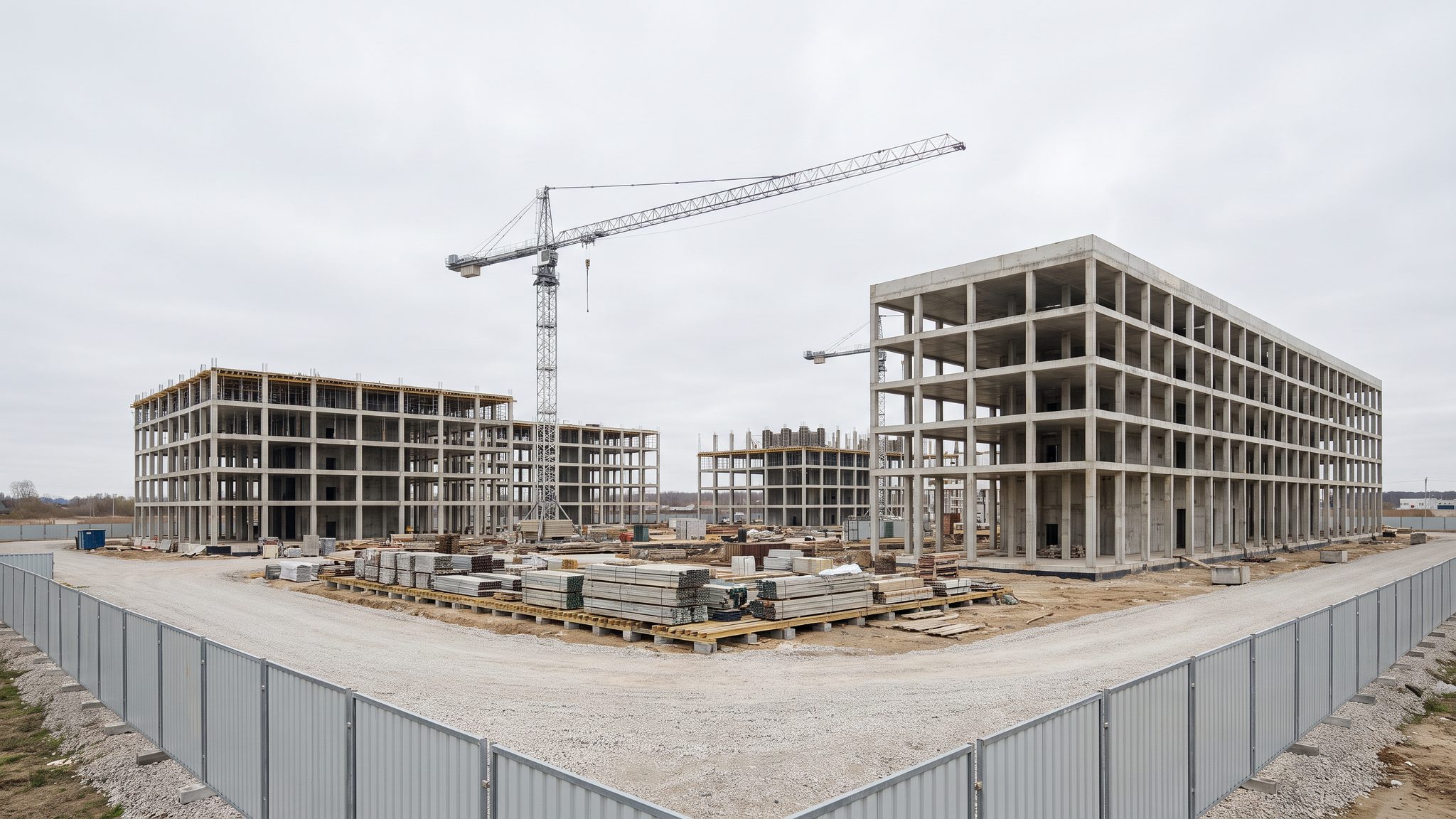
Enabling works on a nuclear project are a major civil engineering scheme in their own right, and on most schemes they are the largest earthworks package anyone on site will ever work on. The plot can run to hundreds of hectares, and before any permanent structure starts the contractor has to build what amounts to a small industrial town: haul roads, a site access road and usually improvements to the public highway, a rail siding or a temporary marine offloading facility, concrete batching plants, reinforcement fabrication and precast yards, workshops, stores, offices, canteens, medical facilities and, on remote sites, accommodation and a park-and-ride for the workforce. Almost none of that appears in the finished plant, and almost all of it has to be complete before the interesting work can start.
The ground investigation is unusually thorough, because the design authority has to demonstrate that the ground beneath the permanent structures will behave the way the design assumes for the whole life of the plant. That means far more boreholes, geophysics, groundwater monitoring and laboratory testing than a comparable industrial project would ever justify, and it means the results are examined by the nuclear regulator as well as by the designer. The main structures normally have to bear on competent strata, so the excavation can be deep and the volumes are enormous. A material management strategy - what is reused as engineered fill, what is stockpiled, what leaves site and by which route - is settled early, because the haulage alone can dominate the local road network. Coastal and estuarine sites add sea defences, cut-off walls and cofferdams to the same package.
What separates this from other large earthworks is the evidence trail. Every element of the works is classified according to whether it carries a safety function, and that classification decides how it is designed, who inspects it, how much of it is documented and who is allowed to sign it off. Work with no safety function is still recorded to a higher standard than ordinary civils, partly because the interfaces feed into the case the licensee has to make to the regulator, and partly because the enabling phase is where the supply chain and the workforce are trained into the quality culture the rest of the project depends on. A contractor who cannot produce clean, complete records for a haul road will not be allowed near the nuclear island.
Compare the methods at a glance
When and why is Site Preparation & Enabling Works used?
Enabling works come first and they run for years, because nothing that follows can start until the platform, the roads and the temporary infrastructure exist. The sequence is not a preference, it is arithmetic: the permanent structures need deep, proven formations, the formations need bulk excavation, the excavation needs somewhere to put the arisings, and the arisings need haul roads that can carry off-highway trucks all winter. On top of that sits the licensing and assurance regime, which is what really sets the pace. The licensee has to satisfy the nuclear regulator on siting, ground behaviour, environmental discharge, water abstraction and the organisational arrangements for controlling the work long before any safety-classified structure is permitted to begin, and each of those consents has its own evidence package and its own timescale. The commercial logic is straightforward. A nuclear project spends an extraordinary amount of money before it earns anything, so the incentive is to compress the physical build - and the only reliable way to compress it is to have the platform, the logistics and the quality organisation genuinely finished, tested and staffed before the critical structures start. Sites that rush the enabling phase spend the next five years working around a compound in the wrong place, an access road that cannot take the loads, and a records system nobody trusts.
Types of Site Preparation & Enabling Works
Explore each method in depth - benefits, limitations, plant and quality control on its own page.
Greenfield coastal platform
The most common arrangement, because large plants need cooling water and heavy components need a sea route. The package adds sea defences, coastal protection, a cut-off wall or cofferdam and often a temporary jetty for offloading, and it brings marine consents, tidal working and coastal ecology conditions with it.
Inland platform
Served by river abstraction or cooling towers rather than the sea. Earthworks are usually simpler and the marine risk disappears, but every heavy component and every cubic metre of spoil has to travel by road or rail, so the transport infrastructure becomes the governing constraint on the whole enabling programme.
Development beside an existing licensed site
Building on land next to a station that is already operating or being decommissioned. The civils are conventional, but the working arrangements, boundaries and access are controlled by the licensee and the regulator rather than by the construction team, and interfaces with the neighbouring site are agreed formally rather than informally.
Logistics-led enabling works
Schemes where the transport infrastructure is the longest item and therefore the first. Junction improvements, bypasses, rail sidings, jetties and accommodation campuses are procured and built as standalone projects ahead of the main works, sometimes years ahead, so that the platform is reachable when it is ready.
Best suited for
- Large greenfield or coastal sites where the whole platform can be engineered from scratch to the design authority requirements
- Projects where the transport infrastructure is on the critical path and has to be delivered years ahead of the main works
- Programmes that need the quality organisation, batching capacity and fabrication shops proven before safety-classified work starts
- Schemes on or beside existing licensed sites, where the enabling works have to fit around arrangements the licensee already has in place
Site Preparation & Enabling Works: step by step
- 1
Step 1: Characterise the ground and fix the platform level
The site investigation on a nuclear project is broader and deeper than anything most engineers will have seen, because the design authority has to prove how the ground will perform under both normal and extreme conditions for the life of the plant. Boreholes, trial pits, geophysical surveys, groundwater monitoring wells and long-running laboratory programmes all feed a single ground model, which is then reviewed, challenged and formally accepted before it is used. Out of that model come the founding levels for the major structures, the platform level for the site as a whole and the decision on whether the ground is taken as found, improved or excavated away entirely. Everything downstream is measured from that platform level, so it is fixed once and changed only through the formal design process.
- 2
Step 2: Set the site boundary and the access arrangements
The site boundary, the entry points and the controls on who comes and goes are set by the licensee under arrangements agreed with the regulator, and the construction team works inside them rather than designing them. From a civils point of view what matters is that the boundary line, the gate positions and the vehicle routes are fixed early, because they determine where the compound can go, where deliveries queue and how the internal haul network connects to the public road. Reworking a boundary once permanent fencing, weighbridges and a search regime are in place is disruptive and slow, so the layout is planned around a boundary that will not move for a decade.
- 3
Step 3: Build the transport infrastructure ahead of the main works
Nothing about a nuclear project fits comfortably on a rural road network. Junction improvements, roundabouts, bypasses, bridge strengthening, rail sidings and marine offloading facilities are treated as separate projects and delivered early, often under their own consents and their own contracts. The internal haul network is built to a full permanent specification rather than as a temporary track, because it will carry off-highway trucks, low-loaders and eventually the transporters carrying the largest components on the project. Weighbridges, wheel washes, fuel points and vehicle marshalling areas go in at the same time. Getting this wrong is expensive in a way that is hard to recover from, because the road becomes the bottleneck for every later phase.
- 4
Step 4: Strip, cut and excavate to formation
Topsoil is stripped and stored where the environmental consents allow, and the platform is cut and filled to the design levels. Where the main structures need competent strata, the excavation for the nuclear and turbine islands can go a long way below the platform, and it is often the single largest hole on any construction site in the country at the time. The excavation is battered, benched or supported to a temporary works design, and it is dewatered and monitored continuously because the sides have to remain stable for a long period while the foundations are built inside them. Fill placement is controlled layer by layer against the earthworks specification, with the material type, compaction method and testing all coming from the designer.
- 5
Step 5: Manage the excavated material
The volumes involved make material management a project rather than a task. Arisings are classified as they come out, and the strategy sets out what is reused as engineered fill, what is crushed and processed into aggregate for the on-site batching plants, what is landscaped into bunds and habitat features and what genuinely has to leave the site. Reuse is pushed hard because every load that leaves adds lorry movements the local consents may not tolerate. Stockpiles are located deliberately, away from ground that will be needed later for laydown, module assembly or crane standing, because a badly placed spoil heap has a way of becoming permanent. All of it is tracked, because the environmental permits require the destination of the material to be demonstrable.
- 6
Step 6: Install groundwater control, drainage and coastal defences
A deep excavation kept open for years needs groundwater control that will not be switched off, so cut-off walls, dewatering wells, relief wells and monitoring instrumentation are installed and then run and recorded continuously. Surface water drainage is designed for a site that becomes largely impermeable, with attenuation, settlement lagoons, silt management and treatment before any discharge, and the discharge itself is made under a permit with its own monitoring obligations. On coastal sites the permanent sea defences and any temporary cofferdam are among the first permanent structures built, because they protect everything that follows and they can only be built in weather and tidal windows that will not wait for the programme.
- 7
Step 7: Build the temporary works town
The construction support facilities are built to industrial standards because they will run for a decade. High-output concrete batching plants with standby capacity, aggregate processing and storage, reinforcement fabrication shops with coupler and bending capability, module and precast assembly buildings, welding shops, calibration and testing laboratories, warehousing with controlled storage conditions, offices, canteens, medical and welfare facilities and, on remote sites, worker accommodation and a park-and-ride. The laydown areas are set out around the crane strategy rather than around what is convenient today, because the heavy lift routes and standing positions for the main cranes have to be kept clear from now until the last module lands.
- 8
Step 8: Establish the quality regime and hand over the platform
The enabling phase is where the project builds the organisation it will need later. Works are classified, procedures are written and approved, inspection and test plans are put in place with defined hold points, the survey control network is established and protected, and the document system that will hold every record for the life of the plant is set up and populated. Handover of the platform is a documented event rather than a conversation: proven formation levels, verified survey control, tested drainage, recorded fill and compaction, as-built information for everything buried, and an accepted list of anything that did not go to plan. It is the first real test of whether the site can produce evidence at the standard the rest of the project demands.
Plant & equipment
- Large tracked excavators and off-highway articulated and rigid dump trucks for bulk excavation and haulage
- Dozers, graders and heavy vibrating rollers for cut, fill and formation
- Drilling rigs for ground investigation, dewatering wells and monitoring instrumentation
- Diaphragm walling, secant piling and cut-off wall rigs for groundwater and excavation support
- On-site aggregate processing and high-output concrete batching plants with standby capacity
- Crawler and tower cranes for the temporary structures, cofferdams and marine works
- Marine plant, jack-up barges and piling spreads where a jetty or sea defence is in scope
- Machine control and survey equipment, GNSS rovers and permanent control monuments
- Water treatment, settlement lagoons, silt management and discharge monitoring plant
Quality control & testing
- Every element classified for safety function before it is designed, so the inspection and record requirements are known in advance
- A permanent survey control network established, independently verified and physically protected for the life of the build
- Formation levels and bearing surfaces inspected and released against defined hold points before anything is built on them
- Fill placement recorded layer by layer with material source, method and test results traceable to location
- Groundwater levels, excavation movement and instrumentation readings monitored continuously and trended, not just spot-checked
- Material traceability maintained even on works with no safety function, because the culture has to be in place before it matters
- Non-conformances raised formally, dispositioned by the design authority and closed with evidence rather than agreed on site
- As-built records for all buried services, drainage and instrumentation issued before the works are covered
Safety watchpoints
- Deep excavation - face stability, groundwater and the long duration the sides have to stand open, all controlled by a temporary works design
- Plant and pedestrian separation on a site with continuous heavy haulage and thousands of people
- Public road interface, where the volume of construction traffic is the single biggest exposure to people outside the project
- Working over and near water on coastal sites, with tidal windows, marine plant and cold water immersion risk
- Occupational health at scale - dust, noise, vibration, manual handling and fatigue across a very large workforce
- Temporary works failure, particularly excavation support, cofferdams and access structures carrying heavy loads
- Weather exposure on an open platform, with wind, cold and water all capable of stopping the operation
- Site-wide emergency arrangements and access for emergency services, which the licensee sets and the contractor works within
Common defects to hunt
- Survey control monuments disturbed or lost, so setting out drifts and the error is only found much later
- Formation left open and degraded by weather, requiring rework at the worst possible point in the programme
- Safety classification decided late, so records that should exist for completed work were never collected
- Spoil stockpiled on ground that turns out to be needed for module assembly or crane standing
- Haul roads and access routes specified for earthworks traffic rather than for the heavy transporters that come later
- Temporary compound and batching plant sited in the footprint of later permanent works
- Drainage and attenuation sized for the platform as excavated rather than for the finished impermeable site
- Incomplete as-built information for buried services, leaving the operator digging speculatively for decades
How long does Site Preparation & Enabling Works take?
Typical duration: Typically 2-4 years from first ground being broken to a platform ready for safety-classified construction, and longer where deep excavation, sea defences or new transport infrastructure sit on the critical path..
Related processes
Next in build sequence
02 - Nuclear Island Foundations