Jackets on pin piles or suction buckets
A welded steel lattice on three or four legs, for water too deep or turbines too heavy for a single tube.
Last updated 2026-09-07
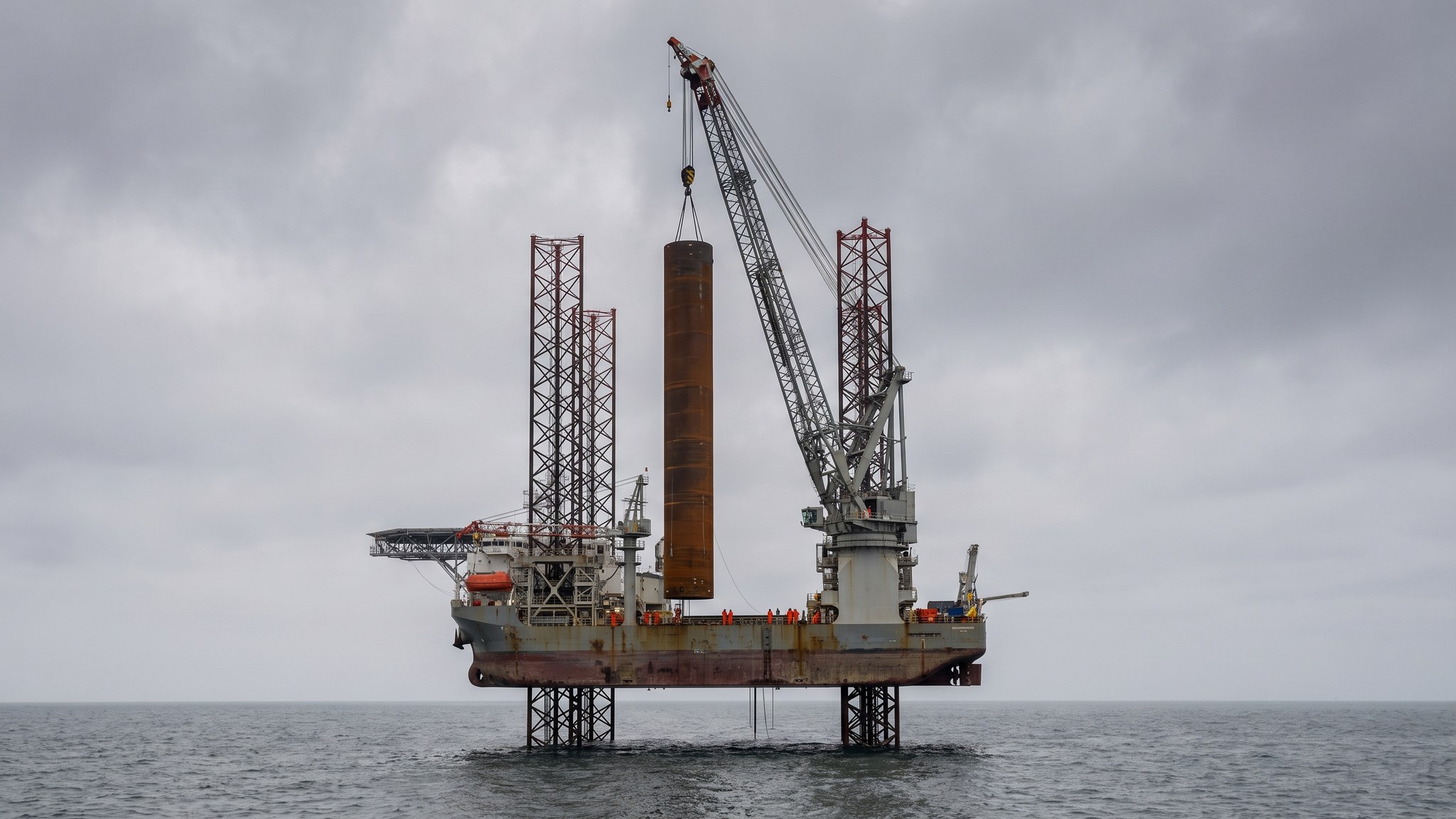
What is Jackets on pin piles or suction buckets?
A jacket is a braced steel lattice, usually on three or four legs, that spreads the turbine load out to a wide footprint on the seabed. Where a monopile resists overturning by bending a single tube, a jacket resists it by pushing down on one leg and pulling up on another, which is a far more efficient use of steel once the water gets deep or the turbine gets heavy. The structure is fabricated from tubular members welded into nodes, and it is those nodes rather than the members that govern the design, because they carry complex stress and the fatigue duty of a machine that runs for decades. A transition piece or a fabricated top section connects the four legs into a single flange for the tower.
There are two common ways of fixing a jacket to the seabed. Pin piles are slender tubes driven through sleeves at each leg, either through the legs themselves or through skirt sleeves at the base, and grouted or swaged to the structure. Suction buckets are large upturned steel cans that are lowered to the seabed, allowed to penetrate under self-weight, and then pushed the rest of the way by pumping the trapped water out of the inside, so the pressure difference across the lid drives them in. That difference matters commercially as well as technically: a suction bucket installation is quiet, which removes the biggest environmental constraint on a driven foundation and often widens the seasonal window a project can work in.
What a jacket buys in structural efficiency it gives back in fabrication. A lattice contains a great deal of welding, much of it in awkward node geometry, and it is far harder to industrialise than a rolled tube. Yards that can produce jackets at rate are fewer, and the fabrication programme is usually the critical path on a jacket project rather than the offshore campaign. Suction buckets add their own condition, which is the ground: they need a seabed that will let the can penetrate and then hold the seal, so the site investigation carries more weight than usual and the designer decides on the evidence whether buckets are viable at each position. Pre-piling with a template on the seabed, then lowering the jacket onto the piles, and post-piling through the installed structure are both used, and the choice follows the ground, the vessel and the contractor's preference.
How does Jackets on pin piles or suction buckets work, step by step?
- 1
Step 1: Build the ground model and choose the fixing
The site investigation has to be good enough to answer two separate questions: whether pin piles can be driven to the penetration the designer wants, and whether suction buckets can be installed and will hold. Layered ground, dense sands, boulder horizons and soft surface material all push the answer one way or the other, and the answer can differ across a single array. The designer then fixes the leg spacing, the batter, the member sizes and the node details from the turbine loads, the water depth and the fatigue life. Because a jacket is a bigger fabrication commitment than a monopile, that decision is made early and changed late at real cost.
- 2
Step 2: Fabricate the lattice and inspect the nodes
Tubulars are cut, profiled and welded into nodes, and the nodes are assembled into legs and bays until the complete jacket stands in the yard. The node welds are the fatigue-critical detail and they receive the heaviest inspection regime on the structure. Anodes, boat landing, ladders, J-tubes and the internal platforms are fitted in the yard, and the top section that carries the tower flange is set and surveyed so that the interface geometry is known before the structure leaves. Corrosion protection is applied across the splash zone and above, where the duty is hardest.
- 3
Step 3: Load out, transport and prepare the position
A jacket is tall and awkward, and load-out is either a heavy lift onto a barge or a skidded operation using the quay. Sea fastening is designed for the transit rather than for the lift. Offshore, the position is surveyed, cleared of ordnance and boulders, and checked for obstructions. Where the design uses a pre-piling template, that frame is set on the seabed first and levelled, because everything about the subsequent fit depends on the piles being in the right place and the right orientation.
- 4
Step 4: Install the pin piles, pre-piled or post-piled
In the pre-piled arrangement, slender piles are driven through the template sleeves before the jacket arrives, and driving proceeds with the same soft-start and noise mitigation discipline as any driven foundation, though the piles are far smaller than a monopile and the noise is correspondingly less. In the post-piled arrangement the jacket is landed first and the piles are driven through its own sleeves. Each has a trade-off: pre-piling separates the noisy work from the lift but demands tight positional tolerance, while post-piling is more forgiving of position but ties the driving spread to the structure.
- 5
Step 5: Or install suction buckets by pumping rather than driving
Where the design uses suction buckets, the structure is lowered until the buckets touch down and penetrate under the weight of the jacket alone. Pumps then remove water from inside each can, and the resulting pressure difference pushes the bucket the rest of the way in. The three or four buckets are controlled together so that the structure stays level as it goes, and the penetration and the pressure are monitored throughout. The operation is quiet, which is its great advantage, and it is reversible, which makes decommissioning far simpler because the same buckets can be pumped the other way to release them.
- 6
Step 6: Land, level and connect the structure
The jacket is landed on the piles or settled on its buckets and brought to level within the tolerance the specification sets, using shims, adjustable sleeves or the bucket control itself depending on the arrangement. Where the design uses grouted pile-to-sleeve connections, the grout is placed and cured as a controlled operation with its own procedure and records. Where it uses mechanical connections, they are made up and verified. Levelness is confirmed by survey rather than by eye, because the tower flange has to present a level interface to the turbine.
- 7
Step 7: Complete outfitting and scour protection
Scour protection is placed around the legs or the buckets in accordance with the design, and its extent is surveyed. Boat landing, ladders, platforms and navigation aids are checked and commissioned, and the J-tubes are made ready for the array cable campaign. The internal access route from the boat landing to the tower base is proved, because a technician has to use it in poor weather for the next twenty-five years. Corrosion protection is inspected for transit damage and made good.
- 8
Step 8: Survey, record and hand over
The as-built survey records position, orientation, level and flange condition, and the driving or suction records, the connection records and the node inspection reports are assembled into the position file. Seabed surveys confirm the scour protection and give a baseline for later monitoring. Because a jacket has many more structural details than a monopile, the completeness of that record matters more, and the through-life inspection programme is planned against it from day one.
What are the benefits of Jackets on pin piles or suction buckets?
- Far more efficient than a monopile in deeper water, where a single tube would need uneconomic steel
- Wide footprint handles the higher overturning loads of larger turbines
- Suction bucket versions install by pumping rather than driving, which cuts underwater noise dramatically
- Suction buckets are reversible, which makes decommissioning simpler and cleaner
- Slender pin piles are far quieter to drive than a very large monopile where driving is used
- The lattice is transparent to waves and current, so hydrodynamic loading on the structure is modest
What are the limitations of Jackets on pin piles or suction buckets?
- Fabrication is welding-intensive and hard to industrialise, and yard capacity is usually the critical path
- More steel and more cost per foundation than a monopile in shallow water
- Node welds are fatigue-critical and demand a heavy inspection regime through fabrication and through life
- Suction buckets need suitable ground to penetrate and seal, so the site investigation carries unusual weight
- Pre-piling demands tight positional tolerance on the seabed template, with little room to recover an error
- Tall, awkward structures complicate load-out, sea fastening and transport, limiting how many go out per trip
What is Jackets on pin piles or suction buckets best suited for?
What plant does Jackets on pin piles or suction buckets need?
- Heavy-lift installation vessel with the crane capacity and hook height for a complete lattice
- Seabed template and its levelling gear where the design is pre-piled
- Hydraulic hammer and follower spread for pin piles, with noise abatement equipment
- Suction pump skids, umbilicals and control spread where the design uses buckets
- Grout plant and mixing spread for grouted pile-to-sleeve connections
- Remotely operated vehicles and survey spread for levelling, penetration monitoring and as-built recording
How is Jackets on pin piles or suction buckets quality-checked?
- Node weld inspection to the specification through fabrication, with full traceability by joint
- Dimensional survey of the jacket in the yard to confirm leg spacing, batter and flange geometry before load-out
- Template position and level survey before pre-piling, checked against the design tolerance
- Pile driving records or bucket penetration and pressure records, reviewed against the ground model
- Grouted connection records covering mix, placement, volume and cure where grout is used
- As-built level and orientation survey of the tower flange, issued as the turbine installation interface