Tramway and depot OLE variants
Lighter overhead in streets and depots, hung from poles, span wires and building fixings.
Last updated 2026-09-05
What is Tramway and depot OLE variants?
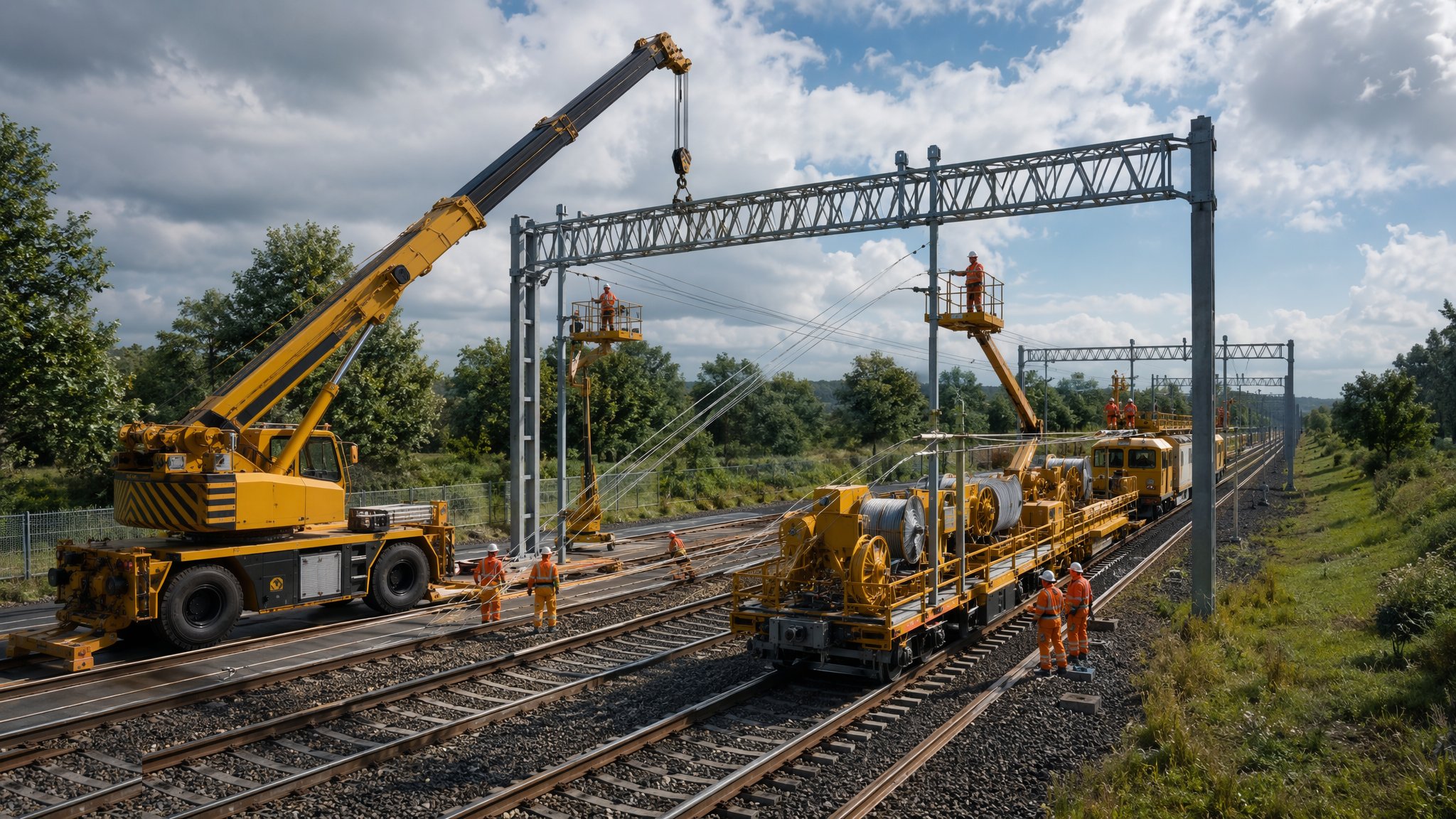
Tramways and depots both use overhead line equipment, but neither looks much like a main line installation. A tramway runs through streets at moderate speed, so the overhead can be lighter and simpler, and in many places it is a single contact wire without the catenary a main line needs. What it gains in simplicity it loses in complexity of support. In a street there is often nowhere to put a mast, so the wire is hung from span wires strung between poles on either side of the carriageway, or from fixings attached directly to the buildings that line the street. Every one of those building fixings is a negotiation with a private owner as well as an engineering detail, and on a city centre tramway that negotiation can take longer than the installation.
The street environment shapes everything else too. The works sit in a live highway, so traffic management, pedestrian routes, statutory undertakers' apparatus and the interests of the highway authority all bear on the programme. Utility diversions in a city centre street are frequently the largest single item in a tramway project, and they happen before any track or overhead work can start. Poles have to be founded in a footway crowded with buried services. Junctions, tight curves and shared running with road traffic all make the overhead layout more intricate than a straight run of open railway. The appearance of the equipment matters as well, because it is at eye level in a public place, and designers routinely spend effort on pole design and wire arrangement that would be irrelevant on a rural main line.
Depot overhead is a different problem again. A depot needs power to move vehicles under their own control, but it also needs staff to work safely on vehicle roofs. That combination drives arrangements that allow parts of the depot overhead to be made dead locally and independently, so that one road can be worked on while the rest of the depot operates. Depot buildings are usually low, so the overhead has to fit within a restricted height, and it is often supported from the building structure rather than from free-standing masts. Some depots use retractable or removable arrangements over specific roads where roof access is routine. Every one of these arrangements exists to separate people from live equipment, and all of them operate under the infrastructure manager's or operator's isolation and permit regime, carried out only by competent, qualified and authorised staff. This page describes none of that regime and gives no procedure of any kind.
How does Tramway and depot OLE variants work, step by step?
- 1
Step 1: Survey the street and locate everything already there
A tramway corridor is a live street, and the survey has to establish what is in it: buried services, highway structures, street furniture, trees, building frontages and access requirements for premises along the route. Statutory undertakers' records are obtained and verified on site, because the position of buried apparatus determines where a pole can be founded. On most city centre projects this survey is the foundation of the whole programme, and the utility diversions it identifies start long before any rail is laid.
- 2
Step 2: Design the support strategy street by street
Where there is room, poles carry the overhead directly. Where there is not, span wires are strung between poles on opposite sides of the street, or fixings are attached to buildings. The designer works through the route deciding which arrangement applies where, balancing engineering need against what the street will physically accept and what building owners will agree to. Appearance is part of the design brief, not an afterthought, because the equipment sits in a public place at eye level.
- 3
Step 3: Secure the building fixings and the wayleaves
Every fixing into a private building needs the owner's agreement, a structural assessment of the building itself and a legal arrangement recording the right to keep the fixing there. On a street with many owners this is a long process that runs in parallel with the engineering, and it is a common cause of delay. Projects that start it early and treat it as a programme activity rather than a legal formality tend to keep their dates.
- 4
Step 4: Divert the utilities and found the poles
Utility diversions are carried out under the highway authority's and the undertakers' arrangements, usually in phases that keep the street working. Pole foundations then go into a footway or carriageway that has just been rearranged, which means trial holes, careful excavation and frequent design adjustment on site. The physical foundation is straightforward. Getting a clear space to put it in is not.
- 5
Step 5: Erect poles, span wires and building fixings
Poles are set, span wires strung across the carriageway and building fixings installed to the agreed details. Work happens in a live street, commonly at night or under traffic management, with pedestrian routes maintained throughout. Each element is small, but there are a great many of them and each has its own local constraint, so progress is measured in short lengths of street rather than in kilometres of route.
- 6
Step 6: Run the contact wire and set out the junctions
The contact wire is run along the route and positioned relative to the track. Junctions, crossovers and tight curves take disproportionate effort because the wire has to follow the vehicle through them. The arrangements, dimensions and settings belong to the designer and the specification and are not given here. What is worth noting is that a short section of complicated street can absorb more time than a long section of plain running.
- 7
Step 7: Build depot overhead with local isolation in mind
Depot overhead is arranged so that individual roads can be made dead independently of the rest of the depot, allowing staff to work on vehicle roofs while the depot continues to operate. Support is commonly taken from the building structure because depot buildings are low, and some roads use retractable or removable arrangements where roof access is routine. The arrangements themselves are designed by the operator and the designer together. Their operation is governed entirely by the operator's isolation and permit regime, and no detail of that regime appears here.
- 8
Step 8: Assure, energise and hand over
The system goes through the assurance and acceptance process before it carries current, and energisation and all subsequent work happen only under the operator's or infrastructure manager's regime by competent, qualified and authorised staff. Handover includes the records of every pole, span wire and building fixing, the legal agreements attached to them and the inspection regime the operator will follow. Building fixings in particular need a recorded owner and a recorded inspection duty, or they become a liability nobody is managing.
What are the benefits of Tramway and depot OLE variants?
- Lighter and simpler than main line overhead, with smaller structures and less material
- Span wires and building fixings allow the wire to be supported where there is no room for a mast
- Suits the moderate speeds and frequent stops of street running
- Depot arrangements allow individual roads to be made dead locally so work can proceed while the depot operates
- Poles and fittings can be designed for appearance, which matters in a public street
- Fits the restricted height of depot buildings without wholesale rebuilding
What are the limitations of Tramway and depot OLE variants?
- Utility diversions in a city centre street are frequently the largest item in the whole project
- Every building fixing needs an owner's agreement, a structural assessment and a legal arrangement
- Work sits in a live highway, constrained by traffic management, pedestrian routes and the highway authority
- Junctions, tight curves and shared running make the overhead layout intricate
- Progress is measured in short lengths of street rather than kilometres of route
- Equipment is at eye level in a public place and is exposed to vehicle strikes and vandalism
What is Tramway and depot OLE variants best suited for?
What plant does Tramway and depot OLE variants need?
- Mobile elevating work platforms and small cranes working under traffic management
- Pole foundation plant suited to footway and carriageway working, with trial hole equipment
- Utility diversion plant, including vacuum excavation for working near buried services
- Wire running equipment sized for tramway overhead
- Access equipment for installing and inspecting building fixings
- Depot access platforms and equipment for overhead installed within buildings
How is Tramway and depot OLE variants quality-checked?
- Street survey and utility records verified on site before pole positions are fixed
- Structural assessment and owner's agreement recorded for every building fixing
- Traffic management and pedestrian routes checked and maintained through the works
- Overhead layout at junctions and curves checked against the design and the vehicle requirement
- Independent checking of the design and of the works to the assurance process
- All work on or near live equipment, including depot roads, carried out only under the operator's isolation and permit regime by competent, qualified and authorised staff
- Complete records of poles, span wires, building fixings and their legal agreements handed over with the asset