Energisation and functional commissioning
The controlled step from a dead installation to a live one, taken with the network operator and in a sequence nobody deviates from.
Last updated 2026-09-06
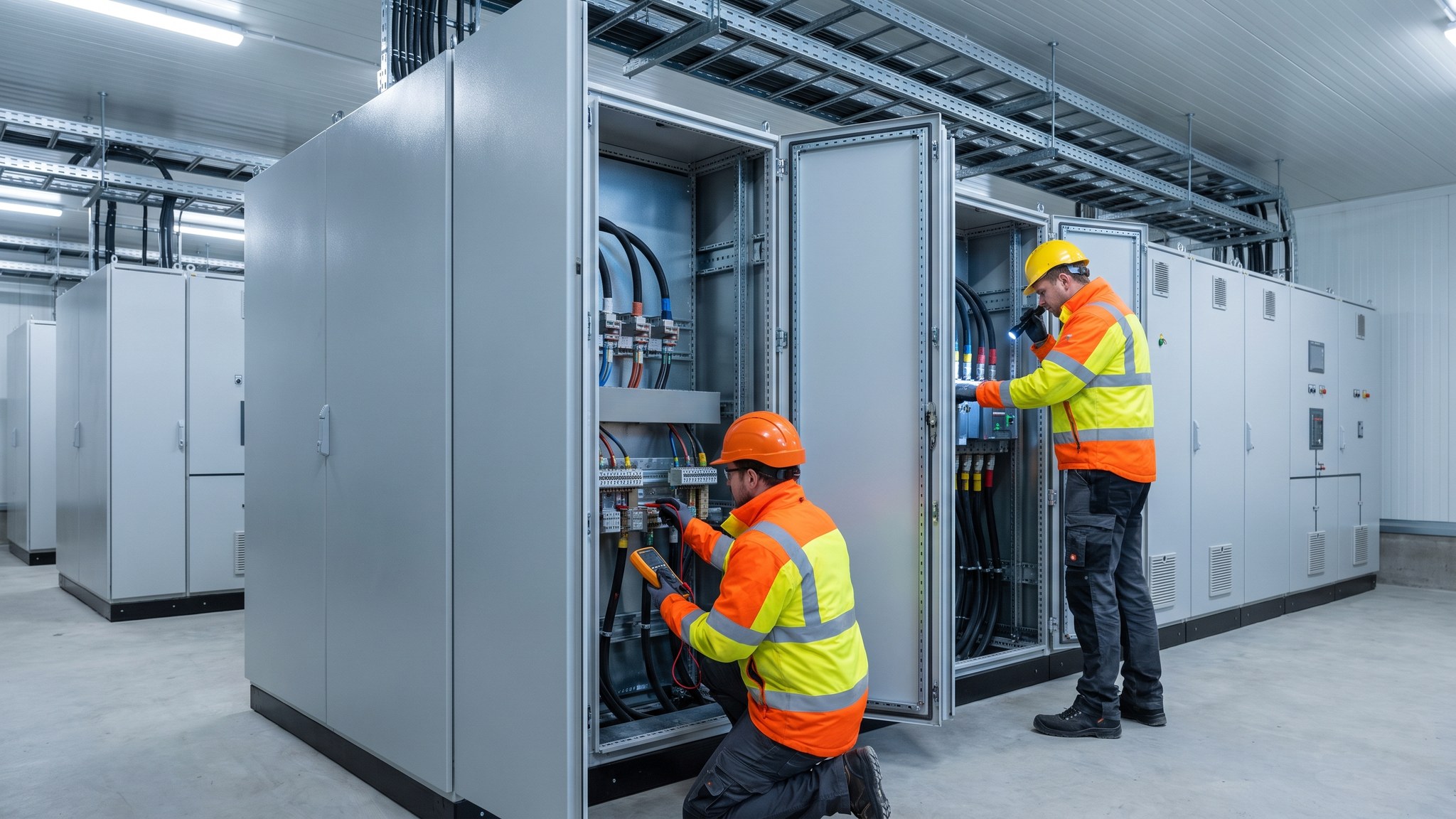
What is Energisation and functional commissioning?
Energisation is the moment the site becomes live. It is a controlled, authorised and rehearsed step, carried out with the network operator, by named competent people, in a defined sequence, and it is the point at which the site stops being a construction site and becomes an operating electrical installation. Everything about it is formal. Who may do what, who may be where, who authorises each step and who may stop it are all established beforehand and written down, and nobody improvises.
What happens on the day, in terms of sequence, procedure, isolation, switching and the checks between steps, is set out in documents prepared by the electrical designer and the commissioning organisation and agreed with the network operator, and it is not the kind of thing that should be described in general terms anywhere. What can be said generally is the shape: authorisation is obtained; the site is prepared and secured; energisation proceeds in stages rather than in one movement; the state is confirmed at each stage before the next is authorised; and at any point the sequence can be stopped and reversed. It is deliberately unhurried, and the pressure to hurry it - because the connection date is here, because plant is on hire, because everyone has been waiting - is exactly the pressure the formality exists to resist.
Once the site is live, functional commissioning begins: proving that the plant does what it was designed to do. Equipment is brought into service in the planned order, protection and control behaviour is confirmed, the battery units and the conversion plant are exercised, and the site controller is proved to see, dispatch and aggregate the whole plant. This is where the interfaces that survived pre-commissioning finally get tested for real, and where the difference between an integrated arrangement and a separated one shows itself most clearly. Functional commissioning is a sequence of steps with authorisations between them, not a continuous period of activity, and the programme reflects that.
How does Energisation and functional commissioning work, step by step?
- 1
Step 1: Obtain the authorisations before anything happens
Energisation proceeds only when the required authorisations are in place: the network operator's, the client's, and those set out in the project's own commissioning documents. The evidence assembled during pre-commissioning is what those authorisations are granted against. No authorisation, no energisation - and that rule holds regardless of what the programme says.
- 2
Step 2: Agree the sequence and the roles in advance
The energisation plan sets out the stages, the order, the checks between stages, and the named people who carry out, witness and authorise each one. Roles are individual rather than organisational. Everyone involved knows in advance what they are doing, who they take instruction from, and who has the authority to stop. That clarity is the whole point of the document.
- 3
Step 3: Prepare and secure the site
Before energisation the site is prepared: construction work stops in the affected areas, access is restricted to those who need to be there, temporary works and materials are cleared, signage and barriers are in place, and the emergency arrangements are confirmed as available. A live site with construction activity continuing around it is a different and much less acceptable proposition.
- 4
Step 4: Brief everyone on the day
A briefing before the sequence starts covers what is going to happen, in what order, what everyone is doing, where the boundaries are and what to do if something is not as expected. It includes the people who are not directly involved but are on the site, because they are the ones most likely to walk into somewhere they should not. The briefing is a control measure, not a formality.
- 5
Step 5: Energise in stages with the network operator
Energisation proceeds stage by stage with the network operator, in accordance with the agreed plan. The state is confirmed after each stage before the next is authorised. The procedures themselves belong to the electrical designer, the commissioning organisation and the network operator, and they are followed exactly. Any departure from the plan stops the sequence rather than modifying it.
- 6
Step 6: Bring plant into service in the planned order
With the site live, equipment is brought into service in the order set out in the commissioning plan, confirming at each step that the plant behaves as designed. Protection and control behaviour is confirmed as the specification requires. Problems found here are dealt with through the same authorised process rather than by anyone reaching into a live installation, which is a discipline that erodes quickly under time pressure if it is not actively held.
- 7
Step 7: Prove the site as one plant
Individual equipment behaving correctly is not the same as the site behaving correctly. The site controller is proved to see every unit, dispatch every unit, aggregate their response and present the plant as a single resource. On separated and modular arrangements this is where the interface work of the whole project is finally examined, and where a well-run pre-commissioning stage repays itself.
- 8
Step 8: Record the state and move to the next authorisation
What has been energised, what has been proved, what remains outstanding and what restrictions apply are all recorded, and the site moves to the next stage of the sequence rather than being handed over. Commissioning a battery site is a chain of authorisations running through to takeover, and each link records the state the site is in before the next is sought.
What are the benefits of Energisation and functional commissioning?
- A controlled, authorised transition rather than an event that simply happens
- Roles, authority and stopping points are unambiguous before anyone starts
- Staged energisation confines any problem to the stage it appeared in
- Carried out jointly with the network operator, which avoids later disputes about state
- Functional commissioning proves the plant behaves as designed, not merely that it is live
- Produces a recorded state of the installation at each step
What are the limitations of Energisation and functional commissioning?
- Depends entirely on the network operator's availability and programme
- Highly exposed to programme pressure, which is precisely what the formality resists
- Requires named competent people who may not be interchangeable
- Problems found at this stage are expensive and slow to correct
- Construction activity has to stop or be relocated around the live areas
- Any departure from the plan stops the sequence rather than being worked around
What is Energisation and functional commissioning best suited for?
What plant does Energisation and functional commissioning need?
- Test and diagnostic equipment used by the commissioning organisation
- Control system monitoring equipment for observing plant behaviour
- Communications equipment for the parties involved in the sequence
- Barriers, signage and access control for securing the live areas
- Emergency arrangements confirmed available throughout the sequence
- Recording arrangements for the state of the installation at each stage
How is Energisation and functional commissioning quality-checked?
- All required authorisations evidenced in writing before the sequence begins
- Energisation plan agreed with the network operator, with named individual roles
- Site preparation and access restriction confirmed before the sequence starts
- Briefing delivered and recorded, including people not directly involved
- State confirmed and recorded after each stage before the next is authorised
- Outstanding items and restrictions recorded before moving to the next authorisation