Pre-commissioning and dead testing
Everything that can be proved with the installation unenergised, proved before anything goes live.
Last updated 2026-09-06
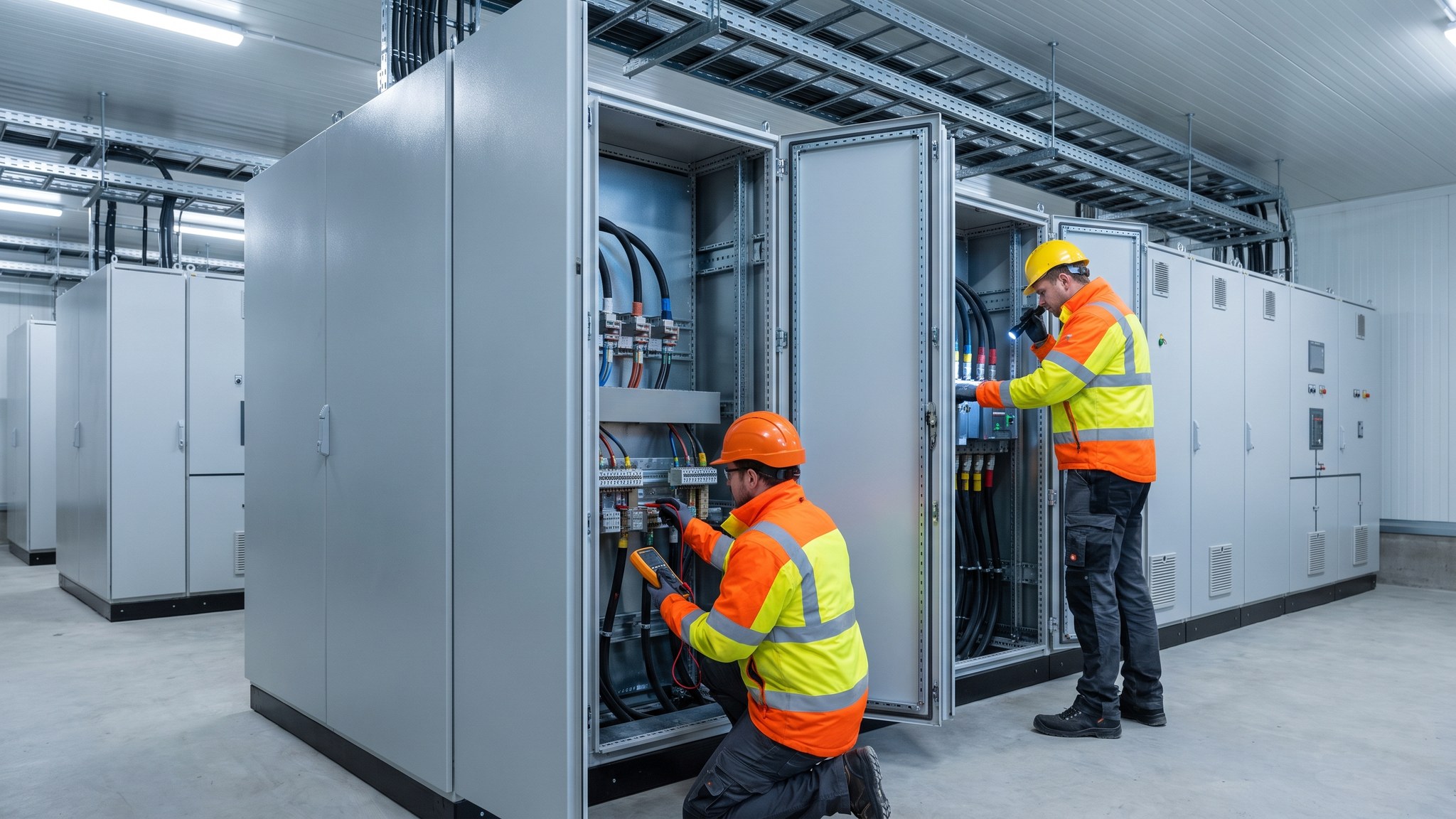
What is Pre-commissioning and dead testing?
Pre-commissioning is the stage at which the installation is checked, verified and proved while it is still unenergised. It covers the mechanical completion of the works, the inspection of what has been installed against what was designed, and the tests that can be carried out without the system being live. It is the least visible stage of the project and the one that determines how the rest of the commissioning sequence goes. Sites that pre-commission thoroughly energise once. Sites that rush it energise, find problems, de-energise, correct them and try again, each cycle consuming time on a network operator's programme that cannot be recovered.
The work is essentially systematic verification. Has everything been installed? Is it the equipment that was specified? Is it where the drawings say? Is it connected as the drawings say? Is it labelled, is it earthed, is it complete, and does the documentation match the physical installation? On a battery site there is a great deal of it, because there are many repeated positions, a large cable population and a control system that touches every item. The volume is exactly why it is done progressively rather than as a single exercise at the end, and why the records are built up as the work proceeds.
Pre-commissioning ends with a formal state: the installation is mechanically complete, inspected, tested so far as it can be while dead, and documented, and it is held in that state pending authorisation to proceed. That authorisation is the first of the sequence of formal steps that runs through to takeover. It is worth being clear that commissioning a battery site is not a handover event but a series of authorisations, each one dependent on the last, several of them involving the network operator. Pre-commissioning is where the evidence for the first of those authorisations is assembled, and any shortcut taken here is paid for at a much higher rate later in the sequence.
How does Pre-commissioning and dead testing work, step by step?
- 1
Step 1: Define what mechanical completion means
Completion is defined in writing before anyone claims it: what must be installed, what must be inspected, what must be documented, and what may be outstanding. Without that definition, completion becomes a matter of opinion and the argument happens at the worst possible moment. The definition is agreed between the contractor, the client's representative and the commissioning team at the start of the works, not at the end.
- 2
Step 2: Verify the installation against the design
Every position is checked: correct equipment, correct location, correct orientation, correct fixings, correct earthing, correct labelling. Discrepancies are logged and either corrected or accepted through a formal process with the designer. On a repetitive site this is done by working through a schedule rather than by walking round looking, because the items that get missed are always the ones nobody was specifically looking for.
- 3
Step 3: Verify the cabling and terminations
Cables are checked for correct identification, correct routing, correct termination and correct labelling at both ends, and the cable schedule is reconciled with what is actually installed. On a large battery site this is a substantial exercise in its own right. It is also the single most productive one, because incorrect terminations are both the most common installation defect and the most disruptive to discover later.
- 4
Step 4: Carry out the dead tests
The tests that can be carried out with the system unenergised are performed by competent parties to the specification, and the results are recorded. What is tested, how, and what constitutes a pass are set by the electrical designer and the specification for the project. Results are reviewed as they are produced rather than filed, because a pattern across several results usually means something different from a single failure.
- 5
Step 5: Prove the control and communications system dead
As much of the control system as can be proved without the power system being live is proved: communications paths, addressing, signal identification, alarm routing and the interfaces between the control system and each item of equipment. Control problems are the most common cause of delay during energisation, and most of them can be found and fixed while the site is still safely dead.
- 6
Step 6: Confirm the safety and fire arrangements are in place
Before the site can move towards energisation, the fire strategy provisions have to be in place and evidenced: layout and separation as designed, barriers built and inspected, detection and ventilation arrangements installed and proved as the fire engineer requires, and water, access and containment complete and tested. The site is about to stop being a construction site, and these provisions are part of what makes that acceptable.
- 7
Step 7: Assemble the documentation pack
The evidence is assembled as a coherent pack rather than a box of paperwork: inspection records, test results, as-built drawings, cable schedules, equipment certification, fire strategy evidence and the outstanding items list. The pack is what the authorisation to proceed is granted against, and the network operator will look at parts of it. Assembling it at the end, from memory, is how projects lose weeks.
- 8
Step 8: Hold the site and obtain authorisation to proceed
With pre-commissioning complete the installation is held in a defined, unenergised, secured state, and authorisation to move to the next stage is sought through the process set out for the project. Access to the installation from this point is controlled by the commissioning organisation rather than by the construction team. That change of control is the real boundary between building the site and commissioning it.
What are the benefits of Pre-commissioning and dead testing?
- Finds installation defects while they are cheap and safe to correct
- Protects the network operator's programme by making energisation a single event
- Builds the documentation the later authorisations depend on
- Establishes a clear, defined boundary between construction and commissioning
- Allows the bulk of control system problems to be resolved with the site dead
- Creates a reconciled record of what is actually installed for the operator
What are the limitations of Pre-commissioning and dead testing?
- Time-consuming and easy to compress under programme pressure
- Large volume of repetitive verification on a site with many identical positions
- Cannot prove anything that only appears when the system is live
- Depends on the completion definition being agreed at the start, not the end
- Requires competent parties and their availability at the right moment
- Documentation assembly is often underestimated in both effort and duration
What is Pre-commissioning and dead testing best suited for?
What plant does Pre-commissioning and dead testing need?
- Test equipment specified for the dead tests, operated by competent parties
- Control system test and configuration equipment
- Access equipment for inspecting equipment and terminations at height
- Survey equipment for confirming as-built positions
- Document management arrangements for progressive record assembly
- Security and access control arrangements for holding the site in a defined state
How is Pre-commissioning and dead testing quality-checked?
- Mechanical completion defined in writing and agreed before the works finish
- Position-by-position verification carried out against a schedule, not by inspection walk
- Cable schedule reconciled against the installation, with discrepancies formally closed
- Dead test results reviewed as produced, looking for patterns as well as failures
- Fire strategy provisions evidenced as complete before the site moves towards energisation
- Documentation pack assembled and reviewed before authorisation to proceed is sought
More commissioning & energisation methods
Next method
Energisation and functional commissioning