Integrated containerised units
Battery, cooling, fire system and often the conversion equipment, all built into one container in a factory.
Last updated 2026-09-06
What is Integrated containerised units?
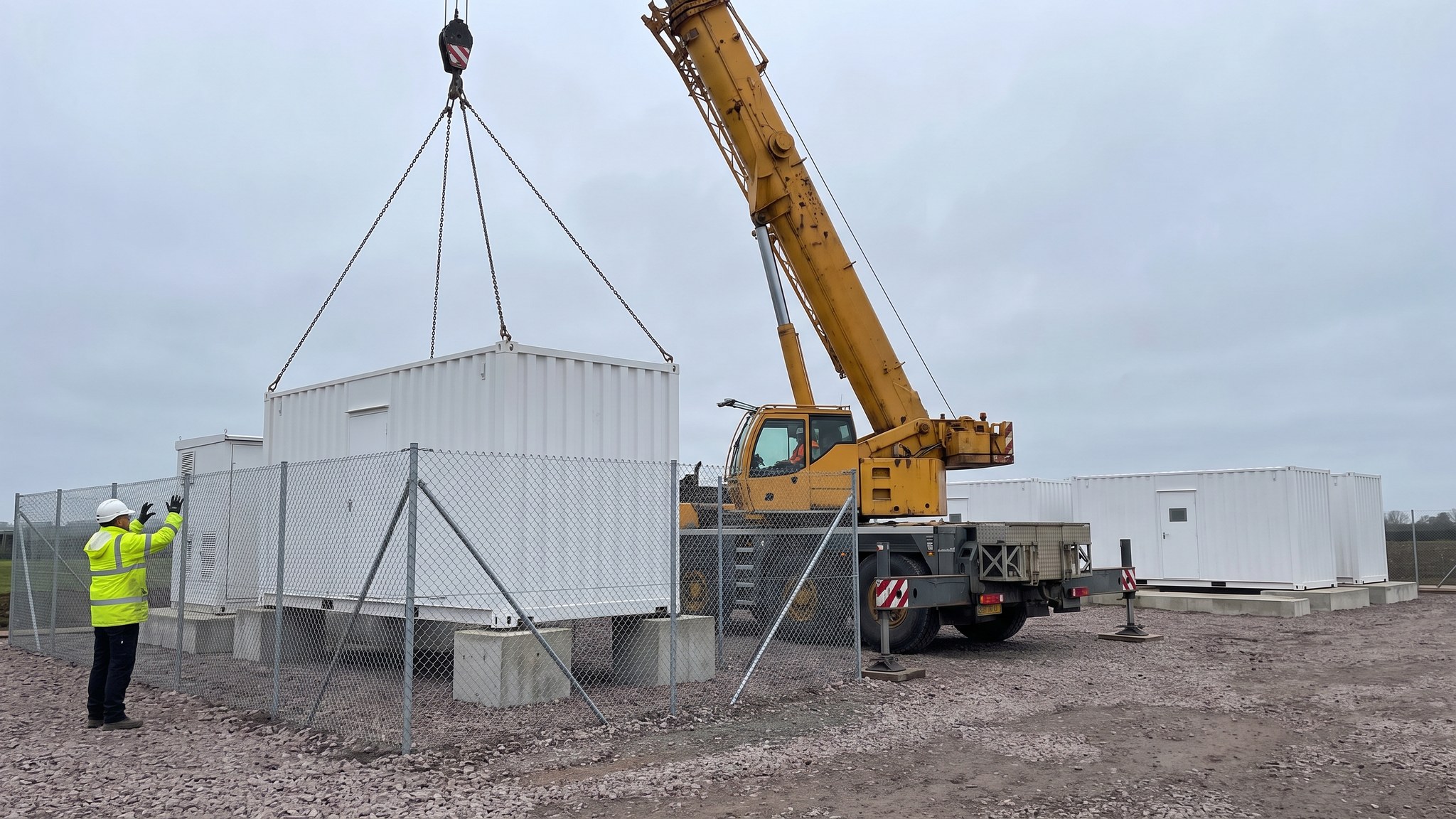
An integrated containerised unit arrives as a finished product. The batteries, the racking, the cooling system, the fire detection and suppression system, the control equipment and on many designs the power conversion equipment are all installed, wired and commissioned inside a steel container at the factory. On site the container is craned onto its base, fixed down, and connected - power in and out, earthing, communications and whatever auxiliary services the design requires. The footprint is commonly a standard shipping container size, typically a 20 ft or a 40 ft unit, because that is what the transport and handling chain is built around, and it is one of the reasons the arrangement is so widely used.
The attraction is that almost all of the complex work happens in a factory rather than in a field. Assembly is done under cover, by the same team, to a repeatable process, with the testing done before the unit ever leaves. Site work reduces to civils, craneage and connection, which shortens the site programme and cuts the amount of skilled work done outdoors in poor weather. For a developer, it also concentrates responsibility - the battery supplier delivers a working, tested unit rather than a collection of parts that somebody on site has to make work together. On a project where the grid connection date is fixed and the site programme is short, that is a substantial advantage.
The consequences are on the site side. A fully fitted container is heavy and it is a single indivisible lift, so the crane, the standing it works from, the access route and the delivery vehicle all have to be sized for it, and the layout has to allow the crane to reach every position in a sequence that does not block itself. It is also a fixed product: what is inside cannot readily be changed, so the design has to be right before the order is placed, and long lead times mean the delivery date is set months ahead. That fixed date is why the civils are on the critical path. At end of life the container is lifted out whole, which is genuinely straightforward, and that reversibility suits the time-limited consents these projects often carry. Lithium battery systems carry a thermal runaway hazard, and that hazard is why the layout, the spacing between units and the overall fire strategy are engineered by the design team - the installation follows the layout they set rather than the convenience of the crane.
How does Integrated containerised units work, step by step?
- 1
Step 1: Fix the specification before the order is placed
An integrated unit is a manufactured product with a long lead time, so the specification - capacity, arrangement, what is and is not inside the container, the interfaces, the fixing arrangement and the weights - is agreed with the battery supplier and frozen before the order goes in. Changes after that point are expensive or impossible. The civils design and the electrical design both work from the same frozen information.
- 2
Step 2: Plan the delivery and the lift together
The delivery route, the vehicle type, the crane size, the crane standing positions and the lift sequence are planned as one exercise, because each constrains the others. Route surveys cover access to the site and around it. The lift plan establishes that every position can be reached without the crane having to move over ground it has already built on or being boxed in by units already placed.
- 3
Step 3: Complete and prove the civils and services
The bases, the crane standings, the access routes and the below-ground ducts and earthing are completed, surveyed and accepted against the battery supplier tolerances before the first delivery is called off. A unit that arrives to a base that is out of tolerance cannot simply be stood to one side, which is why the survey sign-off is a hard gate rather than a formality.
- 4
Step 4: Receive, inspect and check the unit on arrival
Each unit is inspected on delivery for transit damage, and the identification, weights and lifting point arrangement are checked against the supplier documentation before anything is connected to it. Damage found on the vehicle is a supplier matter; damage found after the lift becomes an argument.
- 5
Step 5: Lift the unit into position
The unit is lifted using the supplier lifting points and the lifting arrangement they specify, landed on its base, and checked for position and level. Because the lift is a single indivisible operation on a heavy unit, it is done to a lift plan by a competent team, and it is stopped for weather rather than pushed through it.
- 6
Step 6: Level, align and fix down
The unit is levelled and aligned to the layout, shimmed or packed where the supplier arrangement allows it, and fixed down to the holding-down arrangement the design specifies. Alignment matters beyond appearance, because the connections between units and to the conversion equipment are made to fixed dimensions.
- 7
Step 7: Connect power, earthing, communications and auxiliaries
Power cabling, earthing, communications and any auxiliary services are connected by the appropriate specialists in the sequence the design sets. Cable routes were laid in during the civils, so this step is largely pulling, terminating and testing rather than excavation - which is the whole point of doing the ducting first.
- 8
Step 8: Hand over to testing and commissioning
Once positioned, fixed and connected, the units are handed to the commissioning team. The factory testing done before delivery means site commissioning is largely about the connections, the controls and the interface with the network operator rather than about the equipment inside the container. Records from delivery, lift, fixing and connection are compiled for handover.
What are the benefits of Integrated containerised units?
- Almost all of the complex assembly happens in a factory, under cover and to a repeatable process
- Tested before delivery, so the site programme is shorter and less skilled outdoor work is needed
- Concentrates responsibility with the battery supplier rather than spreading it across site trades
- Standard container footprints suit the existing transport, handling and craneage chain
- Fewer external connections than an equivalent capacity built from many smaller cabinets
- Lifted out whole at end of life, which suits a time-limited consent
What are the limitations of Integrated containerised units?
- Heavy single indivisible lifts drive crane size, standings, access routes and the civils design
- Long lead times, so the specification has to be frozen early and the delivery date is fixed
- Little scope to change what is inside once the order is placed
- A fault in one unit takes a large block of capacity out at once
- Delivery access and craneage constrain the site layout as much as the electrical design does
- Lift operations are weather-sensitive on a programme that has no slack in it
What is Integrated containerised units best suited for?
What plant does Integrated containerised units need?
- Mobile crane sized to the unit weight and the required radius, with outrigger spreading arrangements
- Low loader or suitable delivery vehicles for the container footprint and weight
- Certified lifting accessories matched to the supplier lifting point arrangement
- Telehandler or forklift for ancillary handling around the compound
- Survey equipment for base checks, positioning and final alignment
- Cable pulling, termination and testing equipment for the connection stage
How is Integrated containerised units quality-checked?
- Specification, weights, interfaces and fixing arrangement frozen with the battery supplier before order
- Route survey and lift plan prepared and approved before the first delivery is called off
- Base positions and levels surveyed and accepted against the supplier tolerance as a hard gate before delivery
- Delivery inspection for transit damage recorded before the unit leaves the vehicle
- Position, level and alignment checked and recorded after landing and again after fixing down
- Connection, earthing and testing records compiled and issued with the handover documentation
More battery container installation methods
Next method
Modular outdoor cabinets