Homes & villas - UAE
The same trade in a hot climate - where the enemy is heat, dust and the difference between inside and outside.
Last updated 2026-09-05
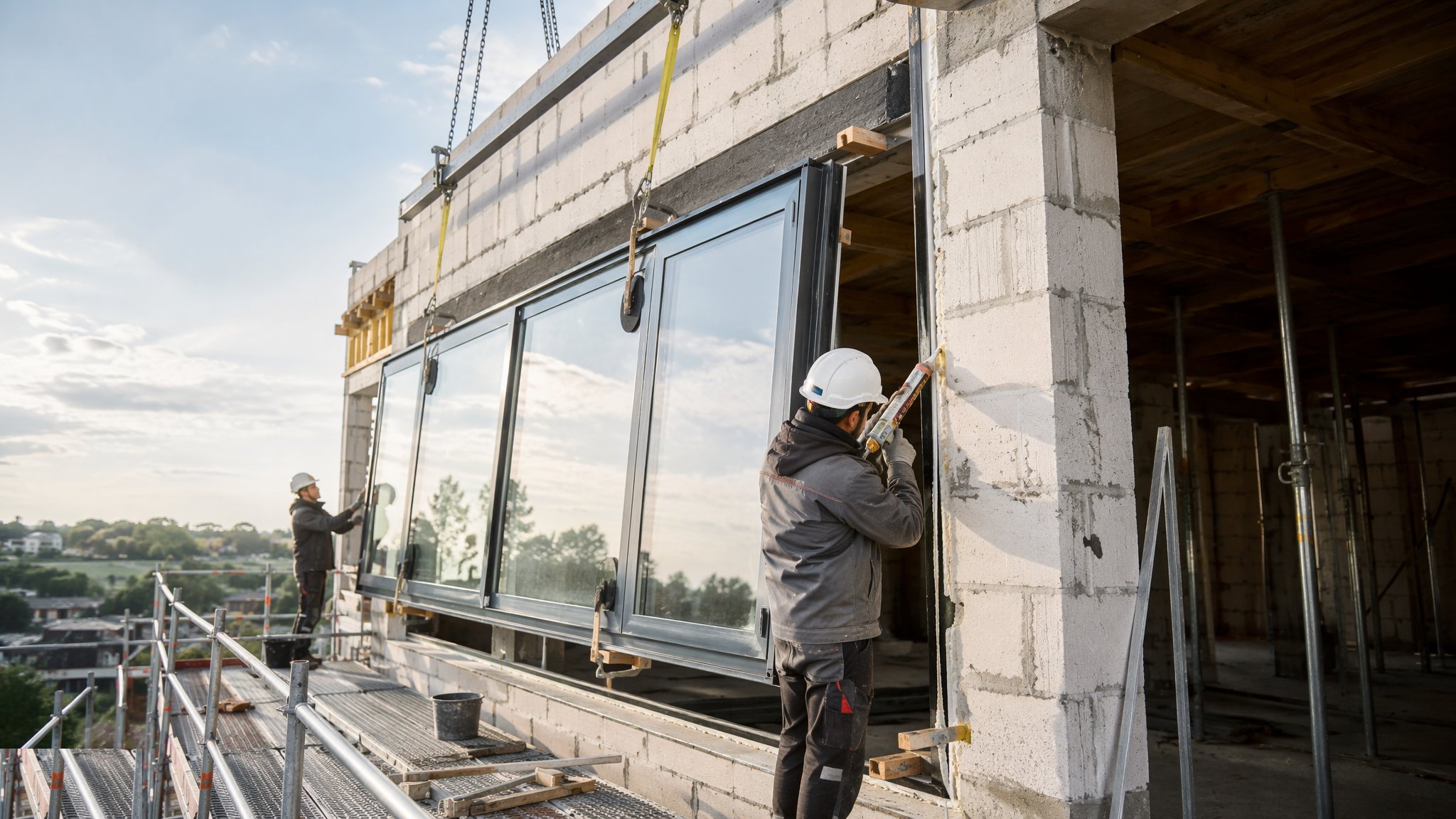
What is Homes & villas - UAE?
A villa in the Gulf is fitted out with the same components as a house in the UK - frames, glass, seals, ironmongery - but almost every design decision behind them is different, because the climate loads the envelope from the other direction. Instead of keeping heat in and rain out, the envelope is keeping heat out and cooled air in, for most of the year and by a large margin. Outside temperatures well above 40 degrees for months at a time, intense direct sun, high humidity on the coast and fine wind blown dust everywhere set the agenda. The installation work looks familiar - survey, set, fix, seal, adjust - but what is being installed, and what the seal has to survive, is not.
Solar gain drives the glazing decision. Glass in this climate is selected primarily to reject solar radiation rather than to retain heat, and the designer sets what each elevation needs based on its orientation and on the shading available to it. Shading itself is part of the architecture - deep reveals, overhangs, screens and shaded terraces do work that glass alone would struggle to do, and on villa projects the shading is usually drawn before the glass specification is finalised. Unit sizes are typically larger than in UK housing: sliding and lift and slide doors onto terraces and courtyards are the norm rather than the exception, and a single leaf can weigh a great deal, which changes the handling, the fixing and the tolerance on the track.
The second theme is condensation and dust, and both live at the same place - the junction between the cool inside and the hot outside. Where an air conditioned interior meets very warm humid outside air, any part of the assembly that carries the outside temperature through to the inside face becomes a place where moisture can form, so the thermal break in the frame and the way the frame meets the wall are treated as a design matter and not left to the installer. Dust is the more relentless problem. Fine sand finds every unsealed gap, blocks drainage slots, abrades seals and gaskets, and works into sliding tracks until units bind. Sealant selection is a specification decision in its own right, because the perimeter joint is exposed to high ultraviolet levels and to a daily temperature swing large enough to move the frame relative to the wall - a sealant that would last for years in a temperate climate can fail in a Gulf summer if it was never selected for that exposure.
How does Homes & villas - UAE work, step by step?
- 1
Step 1: Take the design intent for the elevation, not just the opening
Before survey, the installer needs to understand what each elevation is being asked to do. Orientation, the shading provided by reveals and overhangs, the glass specification the designer has set for that elevation, and whether the opening is a fixed screen, a hinged unit or a large sliding assembly all change the survey, the handling and the fixing. On villa projects it is common for the same building to carry three or four different glass specifications on different faces, and units are not interchangeable between them even where the sizes match.
- 2
Step 2: Survey the structural opening and confirm the substrate
Openings are measured as built, exactly as anywhere else, with squareness, plumb and level recorded. What differs is the substrate: villa construction here is commonly blockwork with a render or stone finish over a concrete frame, so the survey establishes what each fixing point will actually be going into and how thick the finish over it will be. The position of the frame within the depth of the wall is confirmed against the shading and the reveal, because in strong sun a frame set a little further back gains useful shading and a frame set proud loses it.
- 3
Step 3: Plan the handling of large units before delivery
Large sliding units arrive heavy, and a single glazed leaf on a villa terrace door can be well beyond what a crew lifts by hand. Handling is planned before the units leave the factory: the route into the villa, the crane or glazing robot required, the number of people, the temporary support while the leaf is offered onto the track, and where units will be stored on site. Storage matters here more than in a temperate climate - units left in direct sun, stacked and film wrapped, can reach temperatures that damage seals, distort packaging and bake protective film onto the glass so hard it will not come off cleanly.
- 4
Step 4: Set the frame with the thermal break intact
The frame is set level, plumb and square, and packed at the fixing points as in any installation. The additional discipline is that the thermal break in the frame is designed to interrupt the path between the outside and the inside face, and anything that bridges it - a fixing that was not intended to pass through it, a packer bearing across it, a later penetration for a fitting - undermines the reason the frame was specified. Where the frame meets the structure, the detail the designer has drawn manages that junction as well, and the installer builds it as drawn rather than improvising a fixing arrangement that shorts it out.
- 5
Step 5: Fix into the substrate the design allows for
Fixings pass through the frame into the blockwork, the concrete or the embedded provision the design has made for them. The type, size and spacing come from the designer and the manufacturer for that unit in that substrate, and they are set out in the specification - large sliding assemblies in particular carry loads that hand tightened generic fixings will not hold. Any temporary support under a heavy sill or track is left in until the fixings are complete and checked. The frame is re-checked for square after fixing, because a large sliding unit that is out of true will not run, and a track that has picked up a twist will bind long before anybody notices the cause.
- 6
Step 6: Seal for high temperature, movement and ultraviolet
The perimeter is sealed in layers as elsewhere, but the materials are chosen for this exposure. The joint has to accommodate the daily movement between a frame in full sun and the wall around it, so joint width, backing material and sealant type are specified together rather than picked on site, and the sealant is one the specification has selected for the ultraviolet and temperature it will see. Application discipline is stricter, not looser: surfaces are cleaned of dust immediately before application because a joint prepared in the morning is dusty again by afternoon, and work is planned around the hours in which the substrate temperature is within what the product allows.
- 7
Step 7: Seal against dust and set up the drainage
Every gasket, brush seal and interlock is checked seated and continuous, because fine sand entering a track or a drainage channel does not wash out - it accumulates. Drainage slots and weep paths are confirmed clear and are protected from the render and finishing trades that follow, since a slot filled with mortar or paint turns a drained frame into a water trap. Sliding tracks are cleaned before the leaves go in and are kept covered until handover. The installer also confirms that the internal seal is continuous, because in a cooled building the internal air seal is what keeps humid outside air from reaching cool surfaces inside the assembly.
- 8
Step 8: Commission, protect and hand over
Every leaf is operated repeatedly through its full travel, rollers and closers are adjusted, locks and restrictors are set where the schedule requires them, and the effort to move a large sliding leaf is checked as reasonable for the occupier who will use it daily. Units are protected for the rest of the build with materials suited to the heat, and protective film is removed within the period the manufacturer allows rather than left to bake on. Handover includes the cleaning and maintenance regime for tracks, seals and drainage, because in this climate the difference between a unit that lasts and one that binds within two years is almost entirely whether the tracks and drainage were kept clear.
What are the benefits of Homes & villas - UAE?
- Large sliding and folding units open living space onto terraces and courtyards, which is what the architecture is usually asking for
- Solar control glass specified by elevation cuts the cooling load the building has to carry
- Factory made thermally broken frames give a consistent, tested assembly in a climate that punishes site improvisation
- Well sealed and well drained units keep fine dust out of the building, which is a comfort and maintenance issue as much as a technical one
- Shading designed with the opening does work that no glass specification can do on its own
- A villa envelope closed properly at this stage keeps the internal finishing trades working in a cooled, dust free building
What are the limitations of Homes & villas - UAE?
- Sealants and gaskets face high ultraviolet and large daily temperature swings, so material selection is critical and generic products fail early
- Large heavy units need mechanical handling, more crew and more programme than the equivalent UK domestic installation
- Fine wind blown dust contaminates joints during preparation and clogs tracks and drainage after handover
- Condensation risk at any point where the thermal break is bridged, which makes fixing and interface detail unforgiving
- Working hours are constrained in the hottest months, and substrate temperatures can put sealing outside the window the product allows
- Units stored badly in direct sun are damaged before they are ever installed
What is Homes & villas - UAE best suited for?
What plant does Homes & villas - UAE need?
- Crane, telehandler, glazing robot or vacuum lifter sized for the heaviest leaf on the project
- Suction cups, glazing trolleys and temporary supports for offering large leaves onto tracks
- Shaded and ventilated storage for units and sealants, keeping both within the temperature range the products allow
- Levels, squares and straight edges long enough to check large sliding tracks over their full length
- Cleaning and dust control equipment for preparing joints immediately before sealing
- Protection materials rated for heat and ultraviolet, and track covers kept in place until handover
How is Homes & villas - UAE quality-checked?
- Glass specification confirmed against the elevation and orientation for every unit before installation
- Frame position within the wall depth checked against the shading and reveal detail the designer set
- Thermal break confirmed unbridged by fixings, packers or later penetrations
- Perimeter joint width, backing and sealant type confirmed against the specification, with surfaces cleaned immediately before application
- All gaskets, brush seals and interlocks checked continuous, and drainage slots proved clear and protected
- Large sliding leaves operated through full travel and adjusted, with operating effort recorded as acceptable at handover