Above-ground vessel banks in an open compound
Storage vessels in the open air, where natural ventilation is an advantage and the hazard assessment, not the site plan, decides the layout.
Last updated 2026-09-07
What is Above-ground vessel banks in an open compound?
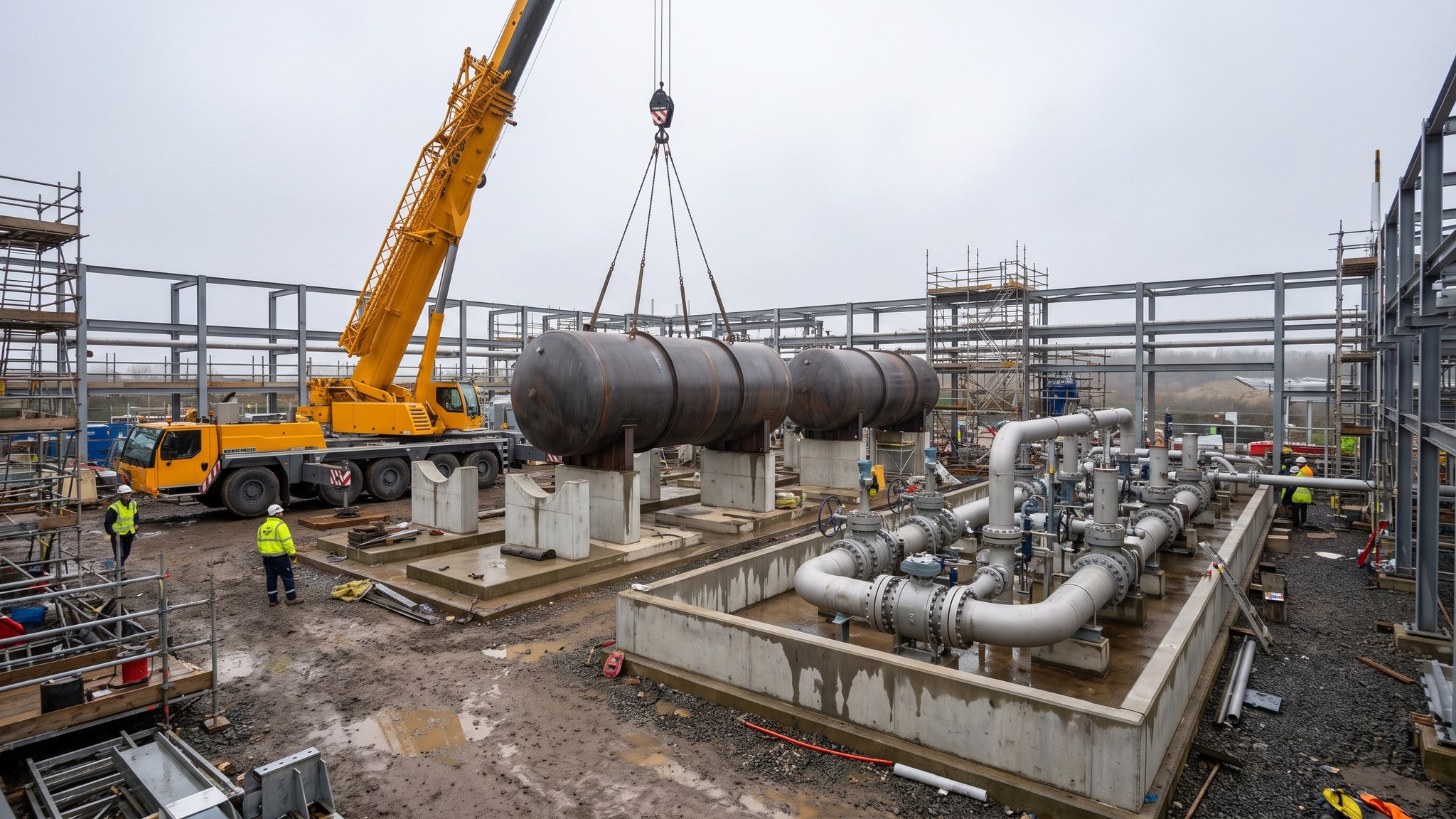
The most common way to store hydrogen on a production site is in banks of vessels standing in the open. It looks like the least sophisticated option and it is in fact the most deliberate one. Hydrogen is far lighter than air and disperses upwards very rapidly, so a leak in the open air is diluted by the atmosphere within moments. Put the same vessels inside a building and that natural advantage is lost, replaced by an enclosed volume where gas can collect and a ventilation and detection system that has to work for the life of the plant. The designer therefore places storage outdoors wherever the site allows, and the open compound becomes one of the defining features of a hydrogen plant's appearance.
The layout of that compound is not a site-planning decision. It comes out of the hazard assessment carried out by the designer with the technology supplier and agreed with the regulator, and the civils and mechanical packages receive it as a fixed constraint. The assessment settles how the vessels are grouped, how the groups relate to each other, to occupied buildings, to the electrical compound, to the boundary and to whatever lies beyond it, and where ignition sources may and may not exist. Anything that could produce a spark is placed by that assessment rather than by convenience, and drainage, roadways and cable routes all follow it. The compound is also fenced and controlled separately, because it is the part of the plant with the largest stored inventory.
The cost of all this is land. Vessel banks are hungry for space, and the separation the assessment demands makes them hungrier still. On a constrained site, storage is often the item that forces the plant to be smaller than the developer wanted, or that pushes storage off the production site altogether. Material compatibility and joint integrity govern the engineering throughout: hydrogen affects some steels in ways that other gases do not, so the choice of material is made by the designer for hydrogen service specifically, and the manifolds and connections joining the vessels into banks are the points the operator will inspect and monitor for the plant's whole life. The vessels themselves are usually the easy part. The pipework between them is where the attention goes.
How does Above-ground vessel banks in an open compound work, step by step?
- 1
Step 1: Take the layout from the hazard assessment
The designer, the technology supplier and the regulator settle the hazard assessment for the storage compound before any layout is drawn. That assessment decides how vessels are grouped, how groups are separated from one another and from everything else on the site, and which areas are treated as hazardous. The compound layout is then produced to suit it. On most projects the mechanical and civils teams treat this as fixed input and raise clashes back through the designer rather than adjusting positions on site.
- 2
Step 2: Fix the storage duty and the vessel configuration
The operator states what the storage has to do - buffer production against variable renewable input, hold inventory for loading, or keep the plant running through interruptions - and the designer converts that into a vessel configuration. The number and arrangement of vessels, how they are banked, and how banks can be isolated from one another all follow. Being able to take one bank out of service while the rest of the plant runs is normally worth designing for from the start.
- 3
Step 3: Select materials for hydrogen service
Hydrogen affects some steels in ways that other gases do not, and the designer specifies vessel and pipework materials for hydrogen service specifically. This is not a decision the contractor makes or substitutes against on grounds of availability. Material traceability is carried through from order to installation, and any proposed substitution is a formal technical query to the designer. On most projects the material submittal and traceability record is one of the first things the operator asks to see.
- 4
Step 4: Build the foundations, plinths and containment
Vessels are supported on foundations designed for their weight and for the loads they impose when full, with saddles, anchors and holding-down arrangements set to the supplier's drawings and surveyed before and after each pour. Falls, drainage and any containment or surfacing specified for the compound are built at the same time. Access roadways and crane positions for installation and for future vessel replacement are designed as permanent structures rather than temporary works.
- 5
Step 5: Set and align the vessels
Vessels are lifted into position on an agreed lift plan and set to the tolerances the manifold design assumes. Alignment matters because the pipework joining vessels into banks is fabricated to a model, and a vessel set out of position turns a factory-made spool into a site alteration. On most projects the whole bank is surveyed as set before manifold fabrication is released, so that the pipework is made to the positions that actually exist.
- 6
Step 6: Install manifolds, isolation and instrumentation
The manifolds joining the vessels, the isolation arrangements that let banks be separated, and the instrumentation that tells the operator what is in the storage are installed to the designer's drawings by qualified specialists. These joints, not the vessels, are where leakage risk concentrates, so the specification sets how they are made and proved and the records are kept connection by connection. Supports, guides and anchors are installed as designed rather than adjusted to suit what was built.
- 7
Step 7: Install detection, protection and the compound enclosure
Gas detection, flame detection, firewater provision and emergency shutdown devices are installed to the safety design, together with earthing and lightning protection for the compound. Fencing, controlled access points, lighting and any security detection are completed as part of the package. Positions come from the safety design; they are not chosen on site. Every device is recorded against the design so the operator inherits a complete asset register.
- 8
Step 8: Prepare, prove and hand the compound over
Bringing hydrogen into a storage compound for the first time is the most hazardous activity on the whole project. Purging, inerting, leak testing and first fill are carried out by specialists under the operator's permit system, to procedures written for that plant and approved for it, and nothing about that work is generic. Handover follows completion of those activities and of the detection and shutdown proving, with the material records, the joint register, the survey record and the as-built drawings issued to the operator.
What are the benefits of Above-ground vessel banks in an open compound?
- Natural ventilation in the open air disperses any release upwards and rapidly
- Avoids the enclosed volume, ventilation plant and detection burden that indoor storage creates
- Banks can be isolated so part of the storage stays available during maintenance
- Vessels and manifolds are visible and accessible for the inspection the operator will do for decades
- Straightforward to extend by adding banks if the compound is laid out for it from the start
- Simple, well-understood civils and lifting operations compared with the alternatives
What are the limitations of Above-ground vessel banks in an open compound?
- Land-hungry, and the separation the hazard assessment demands makes it more so
- The layout is fixed by the hazard assessment and cannot be rearranged for construction convenience
- Equipment and instrumentation live outdoors and are exposed to weather for the life of the plant
- Storage inventory is limited by the site area available, which caps what the plant can offer an offtaker
- The compound often dictates the position of everything else on a constrained site
- The manifold and connection pipework carries a long-term inspection and monitoring obligation
What is Above-ground vessel banks in an open compound best suited for?
What plant does Above-ground vessel banks in an open compound need?
- Mobile cranes with agreed lift plans and designed standing positions
- Piling and concreting plant for vessel foundations, saddles and plinths
- Precise survey instruments for foundation setting out and for as-set vessel survey
- Specialist pipe fabrication and jointing equipment operated by qualified personnel
- Access equipment for manifold, instrumentation and detection installation
- Fencing, lighting and security installation equipment for the compound enclosure
How is Above-ground vessel banks in an open compound quality-checked?
- Material certification and traceability held for every vessel and every length of pipework
- Foundation, saddle and anchor positions surveyed against the supplier's certified drawings
- As-set vessel survey completed and issued before manifold fabrication is released
- Every connection recorded in a joint register identifying the operative and the procedure used
- Detection, shutdown and protection devices proved against the safety design device by device
- As-built drawings, joint register and material records issued to the operator at handover