Packaged compression skids
Compression bought as tested modules rather than built on site - the most maintenance-intensive plant on the project, delivered already proved.
Last updated 2026-09-07
What is Packaged compression skids?
Hydrogen leaves an electrolysis plant in a state that suits the electrolyser rather than the offtake, and almost every project therefore has to compress it before it can be stored, loaded or exported. Compression is the most mechanically demanding duty on the plant. The machines run continuously, they have moving seals working against a gas that finds its way through joints that would hold anything else, and they generate heat, vibration and noise that the surrounding design has to absorb. They are also the item the operator will spend most of the plant's life maintaining. On most projects the designer and the technology supplier decide early that compression will be bought as complete packaged modules rather than assembled from components on site.
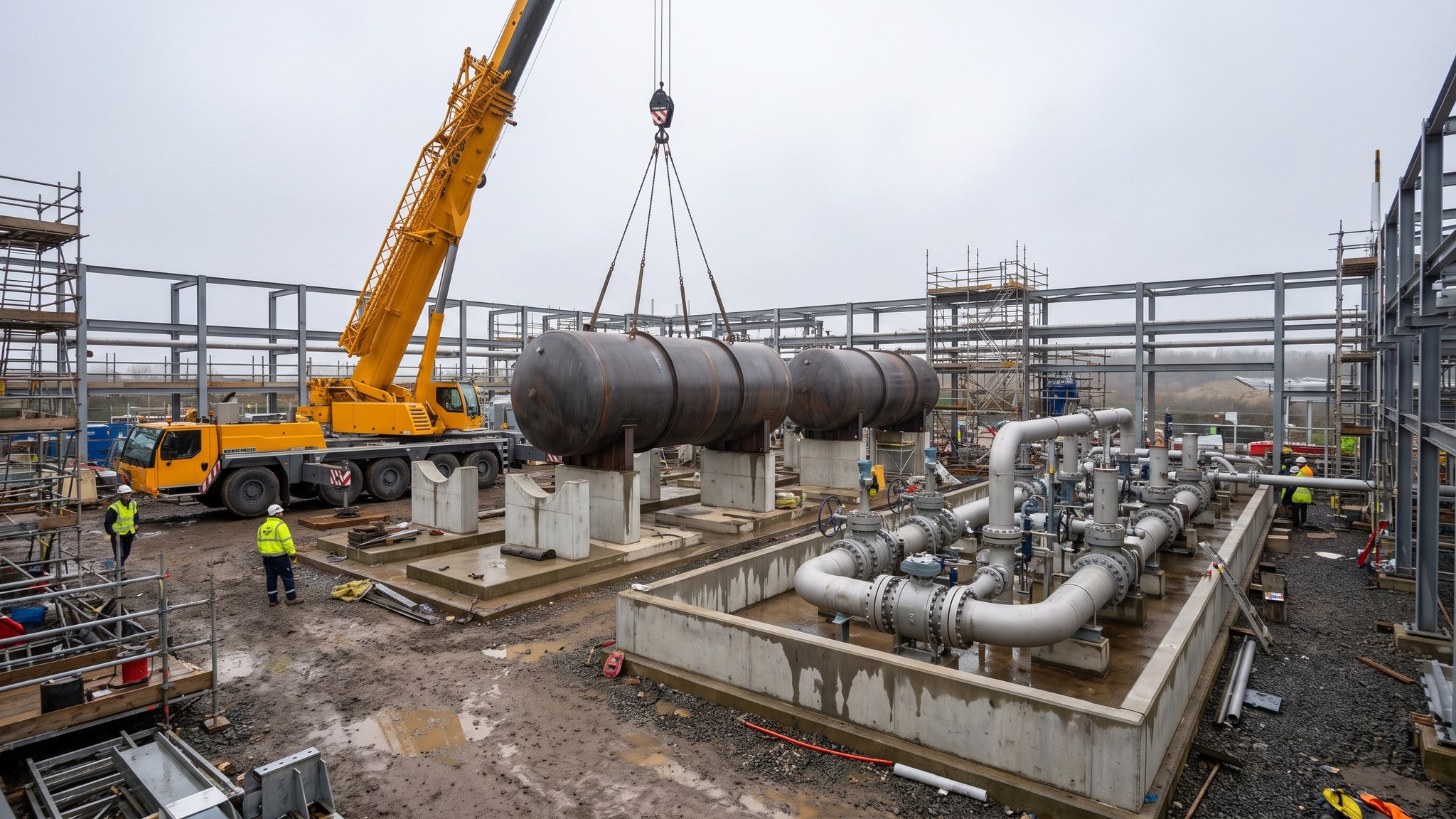
A packaged skid is a compressor, its driver, its cooling, its lubrication, its local pipework, its instrumentation and its local control panel, all built onto a common structural frame in a controlled factory environment and tested there before it is shipped. The value of that is not simply that it saves site labour. It is that the joints, seals and connections that matter most on a hydrogen plant are made and proved by people who make them every day, in conditions where the work can be repeated until it is right, rather than by a site team working at height in weather. The material compatibility and joint integrity that govern the whole engineering discipline on a hydrogen project are therefore settled in the factory, where the supplier can demonstrate them, and the site interface is reduced to a small number of connections at the skid edge.
What the site takes on instead is a heavy-lift and interface problem. The skid arrives as a single indivisible unit that has to be transported to the plant, lifted into position on a foundation built to the supplier's drawing, and connected to process, cooling, power, control and vent systems that were designed to meet it exactly where the supplier said they would. The designer commonly houses or shelters the machines, and the enclosure has to satisfy the ventilation and detection philosophy for the plant as well as the noise and access requirements, so the building around the skid is itself a designed part of the safety case. Maintenance access is planned at layout stage, because a compressor that cannot be opened up without dismantling the pipework around it will cost the operator every year of the plant's life.
How does Packaged compression skids work, step by step?
- 1
Step 1: Settle the compression duty and the number of machines
The designer and the technology supplier fix what the compression has to achieve, how it fits between the electrolysis output and the storage or export interface, and how many machines are needed to deliver it. That last decision is the one that shapes the project. Running duty and standby machines gives the operator a plant that keeps producing during maintenance, at the cost of land, capital and a larger enclosure. On most projects the operator states an availability expectation and the number of machines follows from it rather than the other way round.
- 2
Step 2: Fix the skid envelope and the interface schedule
The supplier issues the skid envelope, the weights, the lifting points and a schedule of every connection at the skid edge, and the plant is then designed around it. Process, cooling, instrument air, power, control, drainage and vent connections are all listed with their positions. On most projects that interface schedule becomes the single most-referenced document in the mechanical package, because every discipline is working to it, and any revision to it is treated as a formal change rather than an update.
- 3
Step 3: Build and prove the foundation and the enclosure
The foundation is designed for the static weight and for the dynamic loads the machine produces, with holding-down arrangements set to the supplier's certified drawing and surveyed before and after the pour. Where the design puts the machines inside a building or shelter, the enclosure is built to the ventilation and detection philosophy agreed for the plant, not simply as a weather cover. Access for maintenance lifting is designed in at this stage, because retrofitting a lifting arrangement over an installed machine is expensive and often impossible.
- 4
Step 4: Witness the factory acceptance testing
The skid is run and proved in the supplier's works before it ships, with the operator and the designer normally present. The point of witnessing is to find problems while the machine is still surrounded by the people who built it and the tools to fix it. Test records, settings, spares lists and the operating and maintenance documentation are agreed at the same time. On most projects a defect found and closed in the works costs a fraction of the same defect found on site.
- 5
Step 5: Transport and lift the module into place
A packaged skid is a heavy abnormal load with a delivery route, a delivery window and a lift plan agreed well in advance. The crane standing position, the ground bearing under it, the overhead clearances and the sequence in which surrounding equipment is installed all have to be settled before the machine is ordered, because a skid that cannot be craned to its foundation has to be dismantled and rebuilt on site, which forfeits the whole reason for buying it packaged.
- 6
Step 6: Make and prove the edge connections
Site work reduces to the connections at the skid edge, and those connections carry a disproportionate share of the risk on a hydrogen plant, because they are the joints made outside the factory. The specification sets how they are made, by whom, and how they are proved, and the work is done by qualified specialists under the designer's regime. Every connection is recorded against the interface schedule so that the operator inherits a complete register of what was joined on site rather than in the works.
- 7
Step 7: Integrate control, protection and utilities
The skid arrives with its own local control system and its own protection settings, and those have to be married to the plant control system so that the machine responds correctly to plant-wide conditions and shutdown signals. Cooling, instrument air, power and drainage are connected and proved. On most projects this integration is where supplier scope and contractor scope meet most awkwardly, so the split of responsibility for signals, settings and alarms is written down before either party starts work.
- 8
Step 8: Prove the machine on the plant and hand it over
Once the connections are complete the machine is prepared and proved as part of the wider commissioning of the plant. The activities that bring hydrogen into the system for the first time - purging, inerting, leak testing and first fill - are the most hazardous on the whole project. They are carried out by specialists under the operator's permit system to procedures written for that plant, and nothing about them is generic or transferable. Handover follows only when the machine has demonstrated what the supplier undertook it would do, with the records, the spares and the maintenance regime issued to the operator.
What are the benefits of Packaged compression skids?
- The joints and seals that matter most are made and proved in a factory rather than on site
- Site work reduces to a small number of edge connections with a clear register of what was joined
- Factory acceptance testing finds defects while the people who built the machine are still around it
- Programme certainty improves because the module arrives already proved rather than being assembled in weather
- A single supplier carries responsibility for the machine, its controls and its performance
- Repeat modules across duty and standby machines give the operator common spares and one maintenance regime
What are the limitations of Packaged compression skids?
- The skid is an indivisible heavy lift, so transport, access and crane provision constrain the whole layout
- The interface schedule is fixed early, and late changes to it are expensive across every discipline
- Long lead times mean the compression order is placed before much of the surrounding design is settled
- The operator is tied to one supplier for spares, settings and specialist maintenance
- Enclosure, ventilation and noise treatment around the machines add cost that the skid price does not show
- Compression remains the most maintenance-intensive plant on the site whatever form it is bought in
What is Packaged compression skids best suited for?
What plant does Packaged compression skids need?
- Heavy mobile or crawler cranes with an agreed lift plan and designed standing positions
- Abnormal-load transport, trailers and route survey equipment
- Precise survey instruments for foundation and bolt-group setting out and for skid alignment
- Specialist jointing and connection equipment operated by qualified personnel
- Temporary power, instrument air and cooling supplies for the proving period
- Access equipment and maintenance lifting arrangements built into the enclosure
How is Packaged compression skids quality-checked?
- Factory acceptance test witnessed and recorded, with defects closed before shipment
- Foundation levels and holding-down arrangements surveyed against the supplier's certified drawing
- Every site-made edge connection recorded against the interface schedule with the operative identified
- Alignment, cooling and lubrication checks completed and signed before the machine is prepared for service
- Control, protection and shutdown signals proved end to end between skid and plant systems
- Operating and maintenance documentation, settings record and spares list issued to the operator at handover
More compression & storage methods
Next method
Above-ground vessel banks in an open compound