Modular tube storage and trailer-based buffer
Buffer capacity that arrives as modules or parked trailers - scalable, relocatable, and the fastest way to storage on a phased site.
Last updated 2026-09-07
What is Modular tube storage and trailer-based buffer?
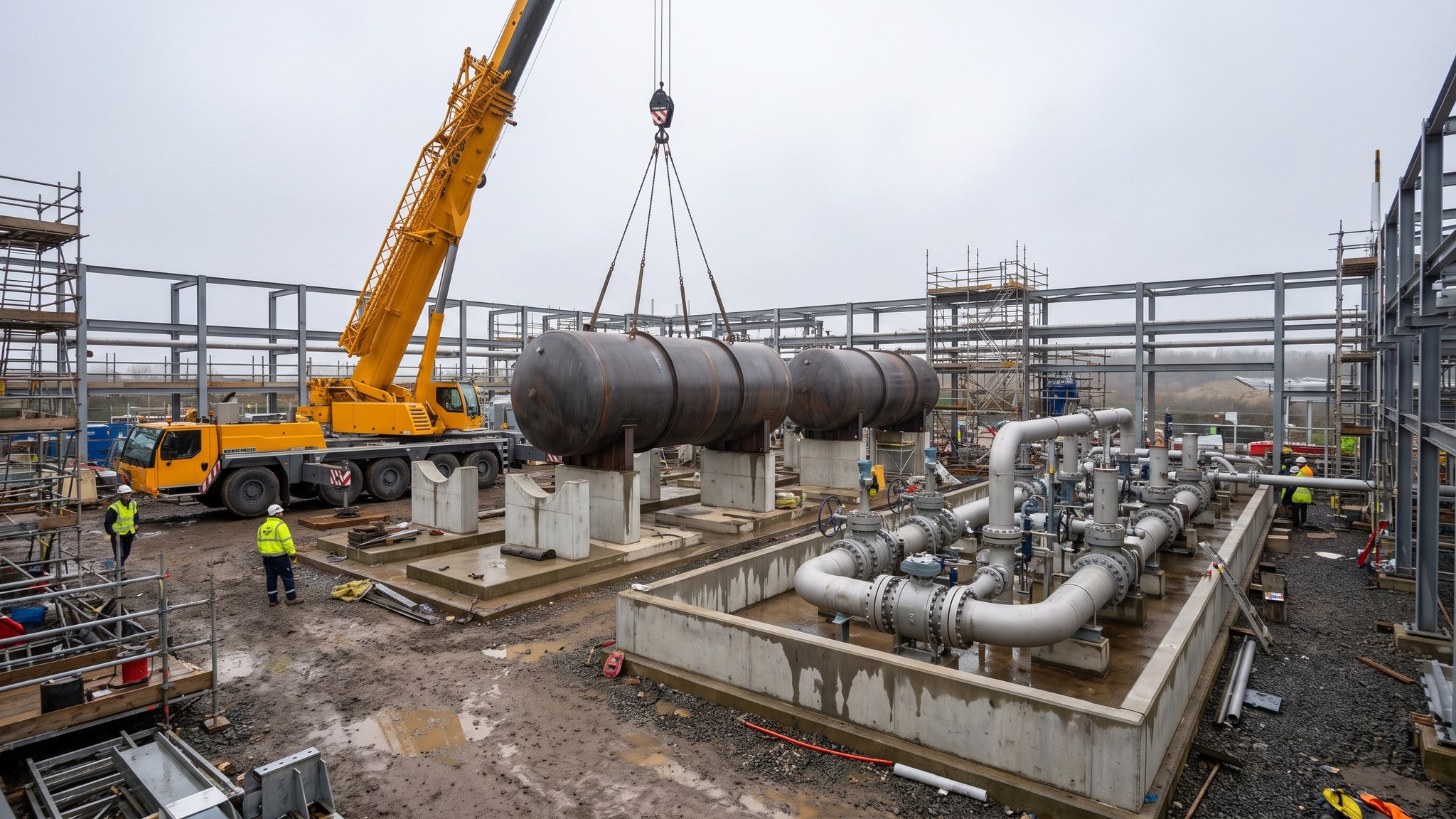
Not every plant needs storage built into the ground. A great deal of hydrogen storage in the industry is held in tube modules: long cylinders assembled into a frame that can be transported as a unit, either mounted permanently on a stand at the plant or left on the trailer that brought it. The tubes and their manifold are built and proved by the supplier, and the plant provides a hardstanding, a connection point and the safety systems around it. That makes tube storage the fastest route to usable buffer capacity, and on many projects it is what the plant runs on for its first years while permanent storage is designed, consented and built.
The commercial logic is what makes the approach attractive. Capacity can be added by bringing another module to site and taken away by removing one, so the operator can match storage to a demand that is genuinely unknown when the plant is designed. A developer commissioning a plant against an offtake contract that may grow, shrink or move can size storage to the contract in hand rather than to the one hoped for. Where the same trailers also serve as the distribution fleet, the parked trailer performs two jobs, acting as buffer while it waits and as transport when it leaves. That blurs the line between storage and loading, and the designer has to be clear about which is which.
The constraints are real. Tube modules hold modest inventory compared with a vessel bank of the same footprint, so at production scale a tube farm becomes land-inefficient and connection-heavy. Every module is a separate set of connections, and connections are where the leakage risk on a hydrogen plant concentrates - the discipline of material compatibility and joint integrity applies to every one of them, every time a module is coupled or uncoupled. A parked-trailer arrangement also means routine coupling operations carried out by people rather than a permanent installation that is made once and monitored thereafter. The designer decides how much of that repeated operation the plant should carry, and the hazard assessment governs where the modules and trailers stand, how they are separated, and how they are approached.
How does Modular tube storage and trailer-based buffer work, step by step?
- 1
Step 1: Decide what the buffer is actually for
The operator and the designer establish whether the storage exists to smooth production, to hold inventory ready for collection, to keep the plant running through a short interruption, or simply to bridge the years before permanent storage is built. Those are different duties and they point at different arrangements. On most projects the honest answer at the outset is that demand is uncertain, and that uncertainty is itself the argument for a modular approach.
- 2
Step 2: Choose between mounted modules and parked trailers
Tube modules can be lifted onto permanent stands and connected as fixed plant, or left on their trailers in designated parking positions and connected through a coupling arrangement. Mounted modules behave like small fixed storage and are made and proved once. Parked trailers give complete flexibility and dual use as transport, at the cost of repeated coupling operations. The designer decides, and the decision drives the hardstanding, the connections and the operating procedures.
- 3
Step 3: Take the standing positions from the hazard assessment
Where modules and trailers stand, how far apart they are, how they relate to occupied buildings and to the boundary, and how vehicles approach and leave are all fixed by the hazard assessment agreed between the designer, the technology supplier and the regulator. Vehicle movement is part of that assessment, because a trailer arrangement means traffic in and around the storage area throughout the operating day. The layout is received as a constraint, not proposed by the contractor.
- 4
Step 4: Build the hardstanding, stands and vehicle arrangement
The civils package provides hardstanding designed for the loaded weight of the modules or trailers, permanent stands where modules are mounted, and the manoeuvring, parking and turning arrangement the vehicles need. Falls, drainage and surfacing follow the design. Because the whole point of the approach is that modules come and go, access is designed for routine repeated movement rather than for a single installation lift.
- 5
Step 5: Install the connection and isolation arrangement
Each standing position is served by a connection point with the isolation, protection and instrumentation the designer specifies. Where modules are permanently mounted, the connections are made once by qualified specialists and recorded. Where trailers are coupled and uncoupled routinely, the coupling arrangement is a designed item with its own operating procedure, and the operator's people are trained and authorised to use it. The distinction between a made joint and an operated coupling is drawn clearly in the design.
- 6
Step 6: Provide detection, shutdown and firefighting cover
Gas and flame detection, emergency shutdown devices, firewater provision, earthing and lightning protection are installed across the storage area to the safety design. Because modules and trailers move, the detection has to cover the standing positions rather than a fixed piece of equipment, and the design accounts for positions being occupied or empty. Every device is proved against the design and recorded.
- 7
Step 7: Write the operating and movement procedures
A modular storage area is operated, not just built. The operator needs procedures covering how a module is brought in, positioned, connected, isolated, disconnected and removed, who is authorised to do each step, and what happens when something is wrong. Those procedures are written for that plant with the technology supplier's input and form part of the operator's permit system. On most projects the procedures are drafted long before the first module arrives.
- 8
Step 8: Prepare, prove and bring the area into service
Bringing hydrogen into the storage area for the first time is the most hazardous activity on the whole project. Purging, inerting, leak testing and first fill are carried out by specialists under the operator's permit system, to procedures written for that plant, and nothing about them is generic. Once the area is proved and the detection and shutdown systems demonstrated, the area is handed over with the joint register, the device records, the as-built drawings and the operating procedures issued to the operator.
What are the benefits of Modular tube storage and trailer-based buffer?
- Capacity can be added or removed as demand becomes clear rather than being fixed at design stage
- The fastest route to usable buffer storage on a plant that needs to start producing
- Modules and their manifolds are built and proved by the supplier before they reach site
- Relocatable, so storage is not stranded if the plant, the offtake or the site changes
- Where trailers double as the distribution fleet, the same asset serves as buffer and as transport
- Modest civils scope compared with fixed vessel banks or anything underground
What are the limitations of Modular tube storage and trailer-based buffer?
- Holds far less inventory for the land it occupies than a vessel bank of similar footprint
- Every module is another set of connections, and connections are where leakage risk concentrates
- A trailer arrangement means repeated coupling operations rather than joints made once and monitored
- Routine vehicle movement in and around the storage area has to be assessed and managed daily
- Becomes land-inefficient and operationally busy at production scale
- Hire, leasing or fleet costs continue for as long as the arrangement is in use
What is Modular tube storage and trailer-based buffer best suited for?
What plant does Modular tube storage and trailer-based buffer need?
- Mobile cranes or handling equipment for lifting modules onto permanent stands
- Tractor units and trailers, with the manoeuvring arrangement designed for them
- Paving and concreting plant for hardstanding, stands and vehicle areas
- Survey instruments for setting out standing positions and connection points
- Specialist jointing equipment for permanently made connections
- Detection, earthing and protection installation and test equipment
How is Modular tube storage and trailer-based buffer quality-checked?
- Supplier certification and test records held for every module brought to site
- Hardstanding and stand design proved against the loaded weight of modules and vehicles
- Permanently made connections recorded in a joint register with the operative identified
- Coupling arrangements demonstrated and the operating procedure approved before first use
- Detection and shutdown coverage proved across occupied and empty standing positions
- Movement, connection and disconnection procedures issued to the operator and confirmed as trained out