Hot commissioning and first power
Turbines producing into the grid for the first time, usually brought forward a string at a time.
Last updated 2026-09-07
What is Hot commissioning and first power?
Hot commissioning is where the wind farm starts working. With the platform live and the strings available, turbines are brought forward one at a time and taken through the sequence that ends with the machine producing into the network. First power on the project is a milestone that matters commercially and reputationally, but technically it is simply the first of many identical events, and what determines the success of the campaign is how efficiently the project can repeat it a few hundred times through a winter.
The work is done string by string rather than turbine by turbine at random. A string shares a cable and a connection, so bringing a whole string forward together makes sense for control, for access and for the way the strings were installed. It also means the wind farm starts generating and earning revenue long before it is finished, which changes the financial shape of the project considerably. Sequencing is therefore planned carefully, and the strings completed first are usually the ones the construction campaign finished first, which is why the cable and turbine campaigns are planned with commissioning in mind rather than as isolated exercises.
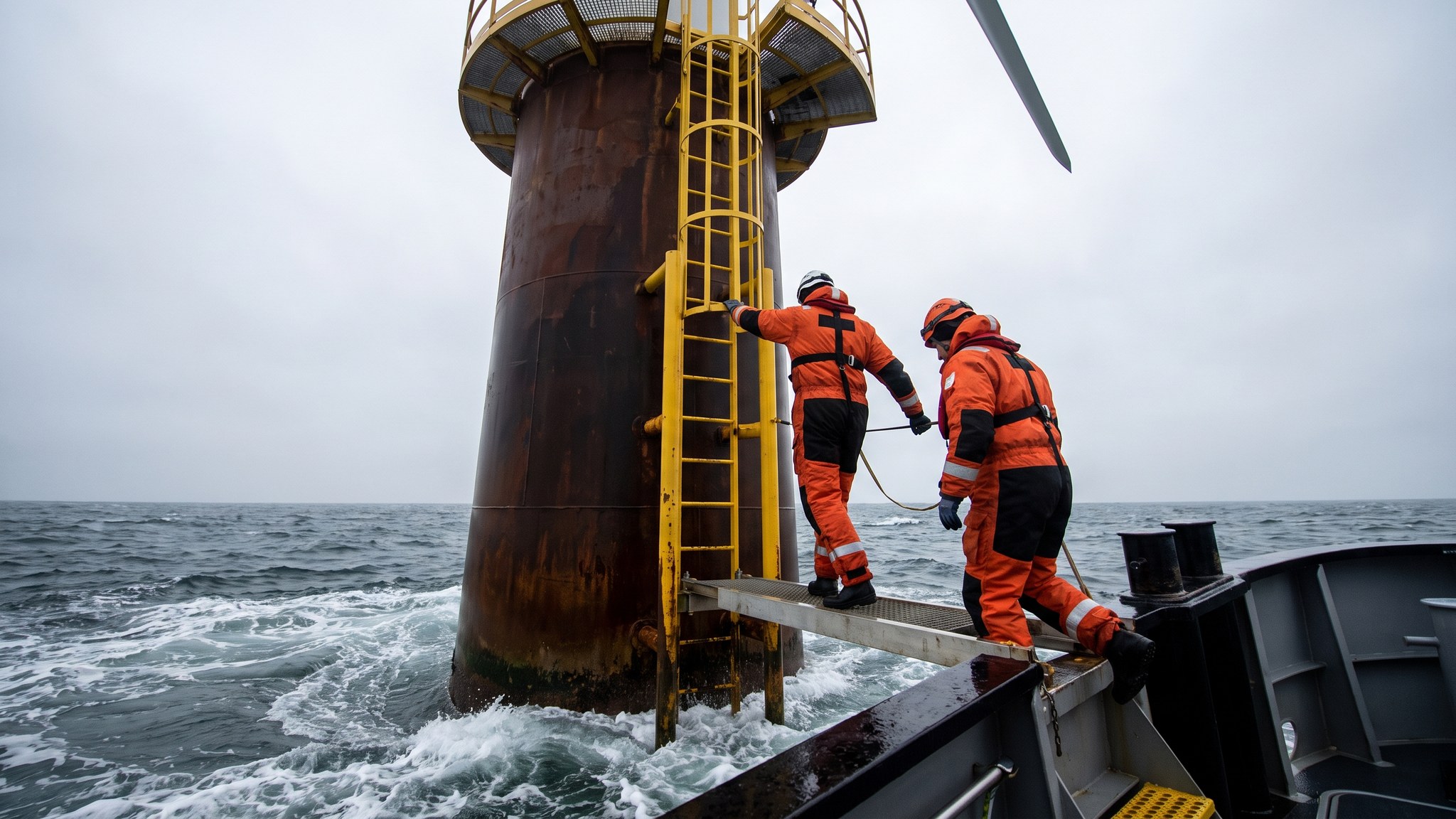
The dominant constraint is access. Every turbine needs technicians inside it for a period, and getting technicians onto a turbine in open water depends on the sea state. A campaign planned against average conditions will fail; a campaign planned against realistic weather, with accommodation close to the work and spare capacity in the technician numbers, will get through. Most projects use an accommodation vessel or a service operation vessel stationed at the site so that crews can transfer directly, work the day and return, rather than losing hours each way to a port. Everything about hot commissioning is a logistics exercise wrapped around a technical one.
How does Hot commissioning and first power work, step by step?
- 1
Step 1: Confirm the turbine is complete and its string is available
A turbine only enters hot commissioning when it has been proved mechanically complete, its cable has been terminated and tested, and the string it sits on is available and under the control of the commissioning team. That status comes from the completion database rather than from anyone's recollection, and it is checked before crews are committed. Committing technicians and vessel time to a turbine that turns out not to be ready is one of the most common wasted-day failures in an offshore commissioning campaign.
- 2
Step 2: Plan the campaign around access rather than around the technical work
The campaign plan is built around how many technician days can realistically be delivered to turbines in each month of the season, given the expected weather and the vessels available. The technical work per turbine is well understood and reasonably predictable; the access is not. Accommodation is arranged close to the work, technician numbers are set with allowance for lost days, and the sequence is arranged so that when one turbine cannot be reached another can. Plans built on average weather rather than realistic weather routinely fail.
- 3
Step 3: Bring the turbine auxiliary systems into service
Before a machine can produce anything, its own supporting systems have to be working: supplies, control, cooling, lubrication, hydraulics, safety systems, lighting and communications. Technicians work through them in the turbine, bringing each into service and proving it, and each step is recorded. This is the bulk of the time spent inside the machine and it is largely independent of the weather once the crew are aboard, which is why getting them aboard is the thing that governs the programme.
- 4
Step 4: Prove the safety and protection systems
The systems that stop the machine are proved before the systems that run it. Emergency stops, braking, the arrangements that hold the rotor, fire detection, lift and access safety, and the protection that will take the turbine off the network if something is wrong are all demonstrated to work. These are demonstrated rather than assumed, and the results are recorded. No machine is allowed to turn under its own power until the means of stopping it have been shown to function.
- 5
Step 5: Release the rotor and run the machine unloaded
With the auxiliary and safety systems proved, the arrangements holding the rotor are released and the machine is allowed to turn without producing into the network. The crew observe how it behaves: how it aligns itself to the wind, how the control system responds, how the drivetrain and the blades behave through the range of conditions available on the day, and whether the monitoring is reporting sensibly. Anything unexpected is investigated at this stage, while the machine is not connected to anything.
- 6
Step 6: Connect and take first power
Bringing the turbine onto the network for the first time is a controlled step carried out under the same formal authorisation regime that governs the rest of the asset, with the network operator informed and involved as the arrangements require. Once connected, the machine begins producing and the crew monitor how it behaves as the wind varies. This moment gets the attention on the first machine of the project and then becomes routine, which is exactly the intention.
- 7
Step 7: Observe the machine across the conditions available
A turbine is not proved by a moment of production. It is observed over a period, across whatever range of wind conditions the weather provides, so that its behaviour can be compared with what the control system and the design predict. Data is reviewed from the shore control room as well as by the crew on site. Machines that behave differently from their neighbours in the same conditions are investigated, because the array provides its own comparison and an outlier is usually telling the project something.
- 8
Step 8: Complete the records and move to the next machine
The commissioning records for the turbine are completed, outstanding punch items are updated, and the machine is formally added to the list of units in service. It then passes into the operating regime and is monitored alongside the rest of the array. The crew move to the next turbine, and the campaign continues. The efficiency of that repetition, measured in turbines per week rather than in hours per turbine, is what determines whether the project meets its full production date.
What are the benefits of Hot commissioning and first power?
- The wind farm begins producing and earning revenue long before construction is complete
- Working string by string matches how the array was built and simplifies control of the work
- Repetition drives efficiency, and the campaign gets markedly faster as crews settle in
- The array provides its own comparison, so an underperforming machine is quickly visible
- Problems found on early machines can be corrected on the rest before they are commissioned
- Turbines enter the operating regime progressively, giving the operations team a gradual build-up
What are the limitations of Hot commissioning and first power?
- Access is the binding constraint and a poor weather season can lose a large part of the campaign
- Needs a substantial pool of qualified technicians, who are in demand across the industry
- Depends on accommodation close to the site, which is another scarce and expensive resource
- Committing crews to a turbine that is not actually ready wastes an entire day
- Faults common to the turbine type can affect the whole array and stall the campaign
- Work inside a turbine is confined, at height and over water, with a demanding safety regime
What is Hot commissioning and first power best suited for?
What plant does Hot commissioning and first power need?
- Service operation vessel or accommodation vessel stationed at the site with a motion-compensated transfer arrangement
- Crew transfer vessels and, where used, helicopter access
- Turbine commissioning tooling, test equipment and calibrated instruments
- Internal lifts, climb assistance, rescue and working at height equipment
- Shore control room with monitoring and data links to every commissioned machine
- Spares holding and logistics to support faults found during the campaign
How is Hot commissioning and first power quality-checked?
- Turbine confirmed mechanically complete and its cable tested before any crew is committed
- Safety and protection systems demonstrated to function before the rotor is released
- Each commissioning step signed off against the approved procedure and recorded per machine
- Behaviour observed across the available conditions and compared against design expectation
- Machine performance compared against neighbouring turbines in the same conditions, with outliers investigated
- Commissioning records completed per turbine and the unit formally added to the in-service list